


12,99 €
Mehr erfahren.
- Herausgeber: John Wiley & Sons
- Kategorie: Ratgeber
- Sprache: Englisch
‘SUMO is a brilliant book, packed with simple, inspirational and innovative ideas that can be applied to any aspect of your life. Paul’s knowledge, enthusiasm and ability to clearly explain these methods is unsurpassed. I heartily recommend this excellent read.’
Professor Damian Hughes, Author and Co-Host of The High Performance Podcast
‘Paul offers a fresh, practical and down to earth approach to change and getting the best from life. An uplifting read for anyone looking to find their spark.’
Owen O'Kane, Psychotherapist & Sunday Times Best Selling Author
Want some straight-talking advice on how to really improve your life?
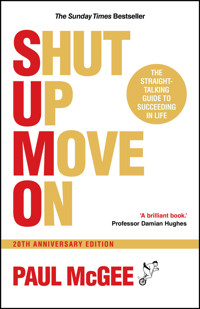
In the 20th Anniversary Edition of SUMO (Shut Up, Move On): The Straight-Talking Guide to Succeeding in Life, bestselling author and personal development heavyweight Paul McGee delivers inspiring insights by revealing how hundreds of thousands of people around the world are fulfilling their potential, seizing opportunities, succeeding at home and at work, and increasing their resilience by adopting the SUMO approach to life.
McGee combines hard-won personal insights, ancient wisdom, modern science, hilarious anecdotes, practical tips, and hands-on frameworks to offer a life-changing read. New to this edition is an exploration of how real people have profoundly improved their lives with the book's timeless principles and strategies, providing a testament to the enduring power of the SUMO principles.
You'll find:
- Exciting and inspirational advice for taking control of your own life
- Ways to change your thinking, mindset, and approach to life's inevitable obstacles
- Ideas to improve your understanding and awareness of the way that other people see the world
Perfect for people wanting a straight-talking approach to success, as well as those who are already fans of the SUMO way of thinking, this new 20th Anniversary Edition is a must-have resource for everyone who's ready to ditch the “whatever will be, will be” fatalism in favor of a practical guide to being the best you can be and achieving what you've always dreamed about.
Sie lesen das E-Book in den Legimi-Apps auf:
Seitenzahl: 233
Veröffentlichungsjahr: 2025
Ähnliche














What people say about Paul McGee’s SUMO presentations and workshops…
‘I’ve absolutely no doubt that your approach can help build resilience and enhance the quality of people’s lives. The clarity and simplicity of your explanations are accessible to everyone, and I know many patients who would benefit from adopting this approach.You use SUMO as a way of having a legitimate and life‐enhancing conversation with ourselves, forcing us to reflect and aim for what really matters.’
Dr Phil Hammond,GP, journalist, and broadcaster
‘The feedback has been unbelievable! Delegates were using some of the seven questions during the conference. Lots of fun, but at the same time, lots of learning.’
Philip Turner,Operations Director, NHS
‘In all our years of running conferences, Paul McGee is the only speaker we have ever invited back. That above all explains the benefit we feel we have gained from hearing Paul’s SUMO philosophy.’
Doug Perkins,Dame Mary Perkins CBE, Founders of SpecSavers
‘I would have no hesitation in recommending Paul McGee and his SUMO philosophy to any organization who wants to engage a large number of staff in a way that provides excellent value for money compared to more conventional ways of training.The overwhelming feedback has been that the sessions were inspiring, thought provoking, humorous, but above all practical in helping my staff make a positive difference.’
Julie Spence,former Chief Constable, Cambridgeshire Police
‘I saw Paul present at an international conference. He uniquely addresses one of the biggest barriers to personal and business development…our own minds. The SUMO philosophy was a unanimous hit. Very, very powerful stuff!’
Simon Newton‐Smith,General Manager, Virgin Atlantic, Southern Africa
What people say about Paul McGee’s SUMO book…
SUMO is a brilliant book, packed with simple, inspirational and innovative ideas that can be applied to any aspect of your life. Paul’s knowledge, enthusiasm and ability to clearly explain these methods is unsurpassed. I heartily recommend this excellent read.
Professor Damian Hughes, Author and Co‐Host of The High Performance Podcast
‘The SUMO approach is powerful, simple and effective. Anyone who reads it is sure to look at themselves and the world differently as a result.’
Octavius Black and Sebastian Bailey, Co‐founders of The Mind Gym
‘We live in a complex world. Paul McGee’s messages stand out because they’re clear, simple, and above all they work. We have a short time on this planet and we need to make the most of it. SUMO shows you how. By applying these ideas I believe you can make a BIG difference in every area of your life, personally and professionally.’
Marie Mosely, Business Psychologist
‘I can honestly say no other book has had such a profound effect on my life. I have had all my family and friends read it, and it has become my mission in life to spread the principles to everyone I meet. If only everyone read SUMO the world would be a better place.’
Kevin Wickson, Service Director, PESL
‘The one thing that stands out in the book is how Paul addresses the steps to success with clarity and ease, in the most simple language. I will recommend the book to people I know, because like me they will appreciate the practical wisdom.’
Sudakshin Susarla, Chennai, India
‘I started the book on a flight to France and have just finished it on a train from London.
I did more than enjoy it…I loved it.
I have read many of these books, and spent many a motorway mile listening to Steven Covey and others, but was all too often left a little cynical.
I think including the personal stuff was brave but brilliant. It would be all too easy to preach the gospel and not document the journey.
Finally here was a book written for someone like me by someone like me.’
Stuart Brown, Managing Director, Ten Alps Publishing
‘SUMO remains one of the most relevant and influential books I’ve read over the last 15 years. The learning, practical tools, and adaptability it provides is something quite rare and special, testament to the book’s longevity and ongoing relevance to both business and personal life. If you read nothing else this year, invest time in this book. You won’t only feel a better person for it, you will be. It won’t disappoint. Nor for that matter will any of Paul’s books, seminars, and training sessions.’
Wayne Gales, CEO, Weaver Vale Housing Trust
‘Paul offers a fresh, practical and down to earth approach to change and getting the best from life. An uplifting read for anyone looking to find their spark.’
Owen O’Kane, Psychotherapist & Sunday Times Best Selling Author
The Sunday Times Bestseller
SHUT UP MOVE ON
THE STRAIGHT-TALKING GUIDE TO SUCCEEDING IN LIFE
20TH ANNIVERSARY EDITION
PAUL McGEE
‘A brilliant book.’Professor Damian Hughes
This edition first published 2026
© 2026 Paul McGee.Illustrations © Fiona Osborne
First edition published 2005Mass market edition published 2006Updated second edition published 2011Third edition published 2015
All rights reserved. No part of this publication may be reproduced, stored in a retrieval system, or transmitted, in any form or by any means, electronic, mechanical, photocopying, recording or otherwise, except as permitted by law. Advice on how to obtain permission to reuse material from this title is available at http://www.wiley.com/go/permissions.
The right of Paul McGee to be identified as the author of this work has been asserted in accordance with law.
Registered OfficesJohn Wiley & Sons, Inc., 111 River Street, Hoboken, NJ 07030, USAJohn Wiley & Sons Ltd, New Era House, 8 Oldlands Way, Bognor Regis, West Sussex, PO22 9NQ, UK
For details of our global editorial offices, customer services, and more information about Wiley products visit us at www.wiley.com.
The manufacturer’s authorized representative according to the EU General Product Safety Regulation is Wiley‐VCH GmbH, Boschstr. 12, 69469 Weinheim, Germany, e‐mail: [email protected].
Wiley also publishes its books in a variety of electronic formats and by print‐on‐demand. Some content that appears in standard print versions of this book may not be available in other formats.
Trademarks: Wiley and the Wiley logo are trademarks or registered trademarks of John Wiley & Sons, Inc. and/or its affiliates in the United States and other countries and may not be used without written permission. All other trademarks are the property of their respective owners. John Wiley & Sons, Inc. is not associated with any product or vendor mentioned in this book.
Limit of Liability/Disclaimer of WarrantyWhile the publisher and authors have used their best efforts in preparing this work, they make no representations or warranties with respect to the accuracy or completeness of the contents of this work and specifically disclaim all warranties, including without limitation any implied warranties of merchantability or fitness for a particular purpose. Certain AI systems have been used in the creation of this work. No warranty may be created or extended by sales representatives, written sales materials or promotional statements for this work. This work is sold with the understanding that the publisher is not engaged in rendering professional services. The advice and strategies contained herein may not be suitable for your situation. You should consult with a specialist where appropriate. The fact that an organization, website, or product is referred to in this work as a citation and/or potential source of further information does not mean that the publisher and authors endorse the information or services the organization, website, or product may provide or recommendations it may make. Further, readers should be aware that websites listed in this work may have changed or disappeared between when this work was written and when it is read. Neither the publisher nor authors shall be liable for any loss of profit or any other commercial damages, including but not limited to special, incidental, consequential, or other damages.
Library of Congress Cataloging‐in‐Publication Data is Available:
ISBN 9781907326196 (Paperback)ISBN 9781907326219 (ePDF)ISBN 9781907326202 (ePub)
Cover Design: WileyCover Image: © Fiona Osborne
Dedication
This book is dedicated to you and your future success. May it encourage you to seize life's opportunities, support you through your struggles, and inspire you to make a difference.
About the Author
Photo by Courtney Hobbs
Paul McGee is an international motivational speaker, Sunday Times bestselling author, and performance coach.
He's Managing Director of his own training and education company, and also the proud creator of SUMO (Shut Up, Move On®).
Paul's main aim is to help people achieve better results in life and have more fun in the process. He's shared his SUMO message in over 40 countries, and works with both large and small organizations in the private and public sectors. He's also worked with five Premier League football teams and once was M.C. of an event where he introduced two future British Prime Ministers. On the downside, he's hopeless at DIY, has an appalling sense of direction, and is allergic to bullsh*t.
Originally from Manchester, he combines his love of comedy and football by supporting both Wigan Athletic and Bradford City (it's a long story).
He loves being around people who make him think, and consumes countless hours of podcast episodes every week whilst on his long morning walks.
In 2019, he was awarded the title of Visiting Professor by the University of Chester, in recognition of the extensive work he's done to make academic knowledge relevant, accessible and practical in helping people from all backgrounds and ages – including school children.
Apart from speaking and writing, he spreads his ideas and insights via Instagram, TikTok and X (@thesumoguy) and also via LinkedIn and Facebook. Do connect – he would love it if you did.
Paul is an avid lover of sunshine, so why the heck he still lives in the north‐west of England is a mystery to many.
Paul has been married to Helen for nearly 40 years, and his two children Matt and Ruth remain both his biggest source of joy and his most important teachers (although he chooses to ignore their feedback about his jokes).
Preface to the 20th Anniversary Edition
It was the spring of 2005. I sat at my kitchen table overlooking my garden, making some final changes to the draft of my SUMO book. It was the first time I'd worked with my publisher, Capstone, and it was exciting to do so. But no one was fooling themselves. My editor knew he was taking a chance working on such a book. Thirteen publishers had already turned down the opportunity to publish SUMO. As one editor put it so directly…‘no one is going to walk into a bookshop and buy a book that's telling them to Shut Up, Move On. A book title has to work from the outset, and Paul, yours just doesn't.’
Despite my passion for what I was writing I had some genuine concerns. Was anyone really going to take seriously a book that encouraged ‘Fruity Thinking’, said Hippo Time was OK and that we might want to Ditch Doris Day? I had my doubts, but I chose to allow them to occupy the seats at the back of my mind. The seats at the front were where hope and expectation sat. However, doubt was sometimes encouraged to take centre stage by some well‐meaning friends who sensitively asked ‘What will you do if it's a flop? How will you cope with the disappointment?’ Who needs enemies, eh?
My mentor and best mate Paul Sandham was far more encouraging: ‘You've got a unique, quirky style bud. It won't be to everyone's taste, but it will connect with more people than you realize. Just make sure you share your struggles, not just your successes. That's what will make this book different.’ So I did.
As you'll discover, I've sought to add some colour and context to what you're about to read. My goal is not just simply to share some ideas, but to highlight how these ideas have helped me overcome some of my own challenges. Twenty years on from its first publication, it seems my mate Paul had a point – people connect with stories. People not only read mine, but contacted me to share theirs. You see, I realize that although we may never have met, we do have things in common. Most of us are not celebrities. We're not chased by the paparazzi. Our photos don't appear in glossy magazines. Our weight gain or weight loss is not a source of news for the gossip columns. But we all have our own story – something that is significant to us personally. We're all still of equal importance even if that doesn't equate to equal profile. Ultimately, we're all on a similar journey. It's called life.
We have our dreams. We have our disappointments. We're full of hope. We also get hurt. We fall. We get back up. We press on. We give up. We wake up happy. We wake up sad. We delight in the company of friends and family. We despair when we feel rejected and alone. Life, at times, seems utterly amazing and at other times appears to make no sense. Our relationships are our biggest source of pleasure and also our biggest source of pain. We sometimes savour the special moments but sleepwalk through the majority of them. We feel we're capable of anything but our doubts are our constant companions. We surprise ourselves. We despair of ourselves.
So, we may be from different places, different backgrounds and be different ages, but we still have so much in common. It's what we have in common that seems to connect with the readers of this book. Deep down I sensed it would. How could I be so sure?
Well, I don't just write about the SUMO message. I speak about it too. As I write the preface to this 20th anniversary edition, the number of countries I've shared these ideas in has reached over 40. Several million people have now heard this message via my talks and videos on Instagram, TikTok and X (@thesumoguy). A few have ridiculed both me and my ideas. But most have related to them. My message, I feel humbled to say, has resonated with people across all ages, from all backgrounds and amongst all cultures. Not everyone gets my humour. You'll see why later. But many do connect with some, if not all, of what I'm saying.
Yet, if you're reading this book for the first time, you're reading it in a world that is vastly different from the world of those who first opened these pages back in 2005. What we now take for granted as very much part of our everyday lives was either in its infancy or did not even exist when this book was first published. On Facebook? Me too. But its creator Mark Zuckerberg developed it only in 2004. In 2005, it was only available to college students in the United States. When SUMO was first published, it's likely only a few people outside of the US had heard of Facebook. Yet, today it has so many users that if Facebook was a country it would be the third largest on the planet behind China and India. In 2005, you called people ‘friends’ because you actually knew them.
What about Twitter? (Now known as X.) I love to tweet. Back in 2005, no one had heard of it, let alone used it. Why? Twitter wasn't launched until July 2006.
What about YouTube? In 2005, the domain name was secured, but no videos were uploaded until later in the year. It wasn't launched in the UK until my wife's birthday, 19 June 2007. To be fair, I don't think my wife's birthday had much to do with the launch, but I so wished I'd filmed her at our romantic meal out near the monkey enclosure at Chester Zoo that day. If I had, you would have been able to witness for yourself the look of joy on her face as we chilled out with the baboons and gorillas while we ate our cheese and pickle sandwiches and consumed several pork pies. (Yes, you've guessed it, I'm from the north of England.)
The ‘financial crisis’ was something people remembered happening back in the 1980s and early 1990s. Few, if any, economists back in 2005 were predicting the financial global meltdown that was to take place three years later.
In 2005, you probably also used your watch to tell the time, regretted not having your camera to capture a special moment and simply zoned out when conversations became boring. You see, SUMO was first published in a world devoid of iPhones. There were no apps. It was difficult to see photos of what meals your friends had been eating earlier that day. How did we survive? I'm not sure.
Now, a world of immense possibility to enhance both connection and conflict exists because of such technological development and ideas. It has also multiplied, perhaps a hundredfold, the amount of distractions we now accept as being a normal part of our day‐to‐day lives. Why reflect when I can scroll through Instagram, watch a reel or WhatsApp my friends? Why converse with the people I'm with when I can connect with ‘friends’ I've never met? Why engage with my children when I can place headphones on them and sit them in front of an iPad?
If there's one word to sum up the last two decades it would not be change. That's too obvious. No, the word would be ‘relentless’. A relentless amount of change, happening at a relentless speed where standing still means you're going backwards and staying in the game means not staying in the same place. No human being that's ever walked upon this planet in previous generations has had to deal with the relentless pace of life and change we now take for granted. Who knows how AI will impact our lives? Life, for many people, is like being on a rollercoaster which never stops and the brakes are no longer working.
This is our current reality, and as such I think the SUMO message is perhaps even more relevant and applicable to life now than it was when it was first published 20 years ago. Here's why I think that's the case. If you and I are to maximize our potential and the opportunities that life has for us, there are several factors which I believe will contribute to this. Each one is, to some extent, explored within the SUMO approach. Let me give you a brief overview of what these factors are.
Reflection. At the heart of SUMO is the call to get off auto‐pilot; to stop and press pause. Our relentlessly fast‐paced, busy and distraction‐filled world does not encourage this. People now pay thousands of pounds to escape the noise of the world – to find silence. SUMO, however, will help you to reflect in a very honest and practical way about a number of aspects of your life. Some of these reflections will bring you reassurance, but others may cause you to reconsider your priorities and current behaviour. The SUMO challenge is to live with increased awareness, attention and appreciation.
As the Latin writer Publilius Syrus said, ‘Awareness, not age, leads to wisdom.’ Reflection gives you the opportunity to become more self‐aware.
Recovery. The pace of change and the tidal wave of distractions can be exhausting. Not just physically, but, perhaps even more importantly, mentally. Modern technology means we are more accessible than ever before. But this, in turn, means we're finding it increasingly difficult to switch off. I don't know what it's like for women, but I'm increasingly seeing guys on their mobile phones whilst relieving themselves at the urinal. I've eavesdropped on some very interesting conversations whilst taking a comfort break at various service stations throughout the UK.
The reality is our minds are being constantly stimulated. We're not allowing ourselves to press pause and take time out. And despite the mental fatigue that this brings, more and more people are reporting difficulty in sleeping.
I've worked with five Premier League football teams. These elite sportspeople need to be in peak physical and mental condition. And what might surprise some people is the important role recovery time plays in this. It's built into their training programme. It's not a nice option – it's a necessity.
You might not be an elite sportsperson, but you're about to discover that the SUMO approach encourages us to build recovery time into our own lives.
Perhaps we need to take a lesson from the airlines. In their safety announcements they always state the following: If there's a drop in cabin pressure, put your oxygen mask on first before helping others.
Responsibility. More than any other animal humans are hugely dependent on others for our survival when we're born. But some people believe they can live their whole lives relying on others to meet their needs. People can develop a sense of entitlement that the world owes them a living, that teachers, employers and governments should take responsibility for our welfare and well‐being.
Well, here's the deal. This way of thinking will seriously undermine a person's ability to make the most of their time on this planet. As you'll discover, taking personal responsibility (whilst still being open to support from others) will be the cornerstone to you achieving the life you want.
Resilience. We mentioned earlier that life at times can be described as a rollercoaster. It has both ups and downs. However, it's how you deal with the down times, the setbacks, the challenges and disappointments that influences whether such events derail you or drive you on to succeed. Throughout this book, and particularly in one chapter, you'll discover how to develop resilience when the going gets tough.
Relationships. The quality of your life is determined by the quality of your relationships. That's true in both your personal and professional life. The people in your world play a significant role in influencing how you see yourself and the opportunities life can offer. As I mentioned earlier, these relationships will be your biggest source of joy. They'll also be your biggest source of pain. Either way, relationships are the bedrock of our lives and there are ways to enhance them.
Let me be very clear on this. Good relationships are not simply a matter of luck. As you'll discover, the SUMO approach will explore a simple visual metaphor that thousands of people claim has helped them reduce conflict, communicate more clearly and build better relationships with others. Of course, simply reading about it won't magically and mysteriously cause relationships to succeed. But taking action and applying the insights will increase your chances.
Resourcefulness. Lots of things are nice to have. I would like to go into McDonalds and order a lobster thermidor. But it's not on the menu.
Sadly, some people spend time and energy focusing on what is not on their menu – in other words, they focus on what isn't in their lives rather than what is. Now, not only is this deeply dissatisfying




