


11,99 €
Mehr erfahren.
- Herausgeber: John Wiley & Sons
- Kategorie: Fachliteratur
- Sprache: Englisch
"Fraser gives hope to anyone who ever dreamed of selling to a wider market"
—Lorraine Kelly
"You have a great story to tell"
—Gordon Brown
"Fraser is an exciting young entrepreneur with an amazing story. His jams taste really fantastic too!"
—Duncan Bannatyne
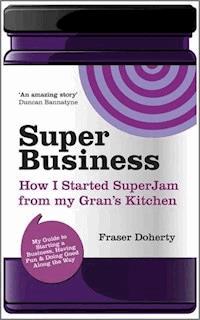
At just 14 years old, Fraser Doherty was selling jars of homemade jam to his neighbours. A few years later, SuperJam was flying off the shelves of the world's largest supermarket chains.
SuperBusiness tells how he transformed a hobby into a much-loved brand, selling millions of jars along the way. Fraser explains how he did it – from his own kitchen table, without huge investment – and how you too, can come up with a killer idea, build a brand, make money, and do good in your community.
Those crazy business ideas really can grow into something amazing and life changing. If this story doesn't inspire you to start your adventure, nothing will.
Sie lesen das E-Book in den Legimi-Apps auf:
Seitenzahl: 234
Veröffentlichungsjahr: 2011
Ähnliche


















Table of Contents
Cover
Title page
Copyright page
About the ‘Jam Boy’
Acknowledgments
My Adventures in Jam
1 Why Start a Business?
Family Influences
Being Your Own Boss
Being an Entrepreneur
What Do You Want from Life?
2 Eureka! Super Idea
Finding Inspiration
Be Interested in Everything
Gaps in the Market
Being Inspired by Other Companies
Finding Ideas from Other Countries
Road Test It
Keep It Super Simple
What Is a Good Idea?
My ‘Eureka’ Moment
3 Finding Support
Slowly Building Up
Taking the Leap
Finding a Mentor
Creating a Board
Raising Finance
4 Researching and Pitching Your Idea
Getting to Know the Competition
Understanding Your Customers
Getting the Pricing Right
Finding Outlets for Your Product
Researching My Super Idea
Getting Your Brand Out There
Writing a Business Plan
Pitching Your Product
Pitching to Waitrose
Creating the Brand
Super Heroes
Finding a Factory
Pitching Again
Picking Myself Up to Try Again
Solving the Branding Problem
Finding a New Factory
The Final Pitch
5 Launch!
Start Small
Building a Website
The SuperJam Website
Beta Launch
Trade Fairs
Launch Party!
Announcing the Launch
6 Telling a Story
Knowing What Your Message Is
Talking to the Press
Writing Articles
Giving Good Interviews
Global Student Entrepreneur of the Year
Speaking at Events
7 Sell, Sell, Sell
Afraid of Selling
Finding Customers
Knowing Who You Are Selling To
Building a Relationship
Print Advertising
Giving It All Away
Direct Mail
Online Advertising
Television Advertising
SuperJam in the Spotlight
Events and Trade Fairs
Partnerships with Other Brands
8 Love Your Customers
Encouraging Loyalty
Talk to Your Customers
The Lovers and the Haters
Acting on Feedback
Replying to Every Letter
Creating a Sense of Community
9 Do Good
Your Chance to Change the World
The Business of Doing Good
Business as Protest
Ben & Jerry’s
Selling out
Three Bottom Lines
A Cup of Tea and a Laugh
Remember Why You’re Doing This
10 Building a Team
Attracting the Right People
SuperJam’s Recruits
Flexible Working
Outsourcing
SuperJam’s Manufacturing Partners
Chinese Production
Crowdsourcing
11 Diversify and Grow
Finding New Markets
Diversifying the SuperJam Range
Don’t Stretch Your Brand too Far
Going International
The Future and Beyond
A Handful of Places to Go for Inspiration
Support Organizations
Websites
Books
Index
This edition first published 2011
© 2011 Fraser Doherty
Registered office
Capstone Publishing Ltd. (A Wiley Company), The Atrium, Southern Gate, Chichester, West Sussex, PO19 8SQ, United Kingdom
For details of our global editorial offices, for customer services and for information about how to apply for permission to reuse the copyright material in this book please see our website at www.wiley.com.
The right of the author to be identified as the author of this work has been asserted in accordance with the Copyright, Designs and Patents Act 1988.
All rights reserved. No part of this publication may be reproduced, stored in a retrieval system, or transmitted, in any form or by any means, electronic, mechanical, photocopying, recording or otherwise, except as permitted by the UK Copyright, Designs and Patents Act 1988, without the prior permission of the publisher.
Wiley also publishes its books in a variety of electronic formats. Some content that appears in print may not be available in electronic books.
Designations used by companies to distinguish their products are often claimed as trademarks. All brand names and product names used in this book are trade names, service marks, trademarks or registered trademarks of their respective owners. The publisher is not associated with any product or vendor mentioned in this book. This publication is designed to provide accurate and authoritative information in regard to the subject matter covered. It is sold on the understanding that the publisher is not engaged in rendering professional services. If professional advice or other expert assistance is required, the services of a competent professional should be sought.
Library of Congress Cataloguing-in-Publication Data
9780857081421 (paperback), 9780857081667 (epub),
9780857081674 (emobi), 9780857082152 (epdf)
A catalogue record for this book is available from the British Library.
About the ‘Jam Boy’
At 22, Fraser Doherty is one of the UK’s most successful young entrepreneurs. He started his company, SuperJam, at the age of just 14 using his Gran’s jam recipes. By 17, he had become the youngest ever supplier to a major UK supermarket, when Waitrose launched his range of 100% fruit jams in all of its stores. SuperJam is a fun and exciting brand that has reinvigorated the world of jam.
Fraser was named the Global Student Entrepreneur of the Year in 2007, the first ever winner from outside North America. His story is an inspiration to anyone thinking of starting a business. His company, started as a hobby in his parents’ tiny kitchen in Scotland, has grown to become a well-loved and iconic brand, stocked by Tesco and Asda Wal-Mart, some of the largest supermarkets in the world.
Named one of the ‘30 under 30’ entrepreneurs in the world by Inc. magazine, Fraser’s approach to business is one of adventure, of challenging the status quo in a 200-year-old industry, of having fun and investing profits in charitable causes, like hosting massive parties for elderly people.
Acknowledgments
Before I tell you my story, there are a number of people I ought to thank for making it all possible. Not least, of course, my Gran, for teaching me how to make jam in the first place and inspiring the work that I do with the elderly. It has to be said that I’m thankful she’s unaware of her intellectual property rights …
My parents and brother Connor, for letting me cook jam for years on end in their tiny kitchen and supporting me over all these years. But I’d have to say that the best help and support I’ve had in getting my business off the ground has been from all of the people who believed in my idea and were willing to give me help along the way.
Kevin, my mentor, for sharing the lessons he had learned in setting up his company. Mike, the buyer at Waitrose, for being willing to listen to my ideas and giving me feedback on how to improve them. Simon, the designer, for creating the brand. And the Prince’s Trust (the PSYBT), for giving me a small loan in the beginning to get everything started.
Without all of you, none of this would have happened. Thank you for believing in my dream.
My Adventures in Jam
If I were to meet the 14-year-old me and tell him what was in store, he would never believe it. That his tiny enterprise, started with just £5 worth of fruit, would one day be supplying Wal-Mart. He would be terrified and amazed by the thought that one day he would be invited to the most prestigious universities in the world—Columbia, Oxford and dozens of others—to share his story with other young people who dream of starting their own companies.
My story so far is an eight-year adventure that started with a eureka moment in my Gran’s tiny kitchen in Glasgow, which ended up giving birth to an internationally loved brand of jam on sale on the shelves of the worlds’ largest supermarket chains.
There have been incredible highlights. I have been invited to Downing Street to have dinner with the Prime Minister, after he heard about my story, and I have even seen SuperJam entered into the National Museum of Scotland as an example of an iconic Scottish Brand, alongside Irn-Bru, Baxters and Tunnock’s Tea Cakes.
We’ve celebrated selling our millionth jar, and celebrated many more since. We’ve launched a cookbook and an iPhone app, sharing my Gran’s and my jam-making secrets with the world. The story of SuperJam itself has travelled far and wide, been the feature of television documentaries, school textbooks in Russia and news broadcasts in China. I have found myself sharing my story in places I would never have even of dreamed of finding myself.
SuperJam challenges established brands in an industry that has been around for hundreds of years. It reinvents what jam is: rather than being sickly sweet and made without much fruit, I have created a product that is healthier, more natural and a great deal more ethical than anything that came before it in the world of preserves. It is made 100% from fruit and all natural, and I have had hundreds of letters from people thanking me for coming up with a healthier kind of jam.
Building SuperJam into a commercially successful business has given me the priceless opportunity to help others in my community. For the past couple of years we have been running our own registered charity, The SuperJam Tea Parties, organizing hundreds of free tea dances in community centres and schools for elderly people who live alone or in care. Thousands of people have come along and had a great time and, for me, doing things like that is immensely more satisfying that just running a business to get rich.
My proudest moment of all, though, has to be the day I was lucky enough to share the front page of the Susan Boyle Special Edition of The Sun, when we gave away a jar of SuperJam to all of the paper’s 5.5 million readers!
There have also been huge challenges along the way. Convincing massive companies to take me seriously, to risk hundreds of thousands of pounds on my idea, was not easy—not only because I was so young, but because I had no experience and, coming from a hard-working but not very well-off family, absolutely no money behind me.
The process of getting my idea off the ground involved creating a brand that looked as good as it tasted, and then finding a factory that believed in my product enough to put it into production and lend me hundreds of thousands of pounds. Oh, and once that was done, I had to figure out how to convince supermarket buyers to stock my product, alongside the tried-and-tested brands that have been on sale for 100 years or more.
I wanted to write this book to share with you the adventure that I have been on over the past few years, the ups and downs, things I found fun and lessons I have learned. I felt that the time has come to share the SuperJam story with you, now that the company is no longer a tiny start-up but an established brand that has had massive success in the major supermarkets. Most new products that launch in the supermarkets don’t last as long as SuperJam has and very few become as well loved.
I definitely didn’t get everything right first time, and there were even points where I thought about giving up. I have certainly been on a very steep learning curve over the past few years. In this little book I’m not trying to preach to you or to pretend that I am some kind of business guru who knows the answers to everything. I am definitely not that.
Having said that, I have picked up a lot of useful advice along the way and learned all about the ups and downs of starting a company. There are a lot of things that I learned by making my mistakes. Hopefully by my sharing my story with you, these are the mistakes that you won’t have to make too. If someone had given me this advice a few years ago, my business would have got to where it is today a lot more quickly and with many fewer sleepless nights.
I don’t want to pretend that SuperJam’s success has been entirely down to me; in fact, it has been almost entirely down to finding other people who believe in the idea as much as I do. In the early days, I was lucky enough to be supported by organisations like The Prince’s Trust. As the business grew, I have learned from other entrepreneurs and even found a few to be my ‘mentors’. They have built multimillion-pound companies and been willing to share the lessons they learned from it with me. I have scattered some of their inspirational stories, ideas and ways of doing things throughout this book, as well as some studies throughout on particular companies that have inspired me along the way.
By telling you about how SuperJam became a success, I want to give you an insight into how to come up with your own idea and get support from people who can help you make it happen. I want to help you prepare for the launch of your idea and understand how to listen to and love your customers. Hopefully I can also give you some advice about selling, generating publicity for your business, building a team and fostering a company culture, and about the importance of giving back to your community.
As well as sharing with you some of the things that I have picked up along the way, I’m also hoping to give you a sense of the excitement and thrill that I get from the whole enterprise. Nothing in my life has compared to the sense of achievement that I felt when I first saw my products on the supermarket shelf, for example.
It obviously takes a huge amount of hard work to get a business, new product or charity off the ground. You have to believe in your idea when everything seems to be going wrong and put everything you have into making it work. But, when it does work out in the end, it feels pretty amazing.
The SuperJam StorySo Far
Age 14
September 2003 – Spent an afternoon learning my Gran’s secret jam recipes!
Age 15
February 2004 – Made the first batch of ‘Doherty’s Preserves’, with labels I had designed on the computer, and sold the jars door to door for £1.50 each.
Age 16
February 2005 – Invested £50 in hiring my first stall at a farmers’ market, selling over 200 jars of jam, the most I had ever made!
August 2005 – Made the first delivery of my homemade jam to a shop, called The Store, in Stockbridge in Edinburgh.
Age 17
June 2006 – Channel 4 followed me around every day and supplied me with a mentor, John Boyle, as part of a documentary called Tricky Business.
March 2006 – Took my first few jars of SuperJam to a Waitrose ‘Meet The Buyer’ day, telling them all about my idea for making jam 100% from fruit.
Age 18
April 2007 – Made the first batch of SuperJam in the factory. It was something like 50,000 jars, more than I had made in the previous four years!
March 2007 – SuperJam launches in Waitrose, making me the youngest person ever to supply a major supermarket. We sold over 1,500 jars in one store on the first day!
November 2007 – Became the first ever person from outside North America to win the prestigious ‘Global Student Entrepreneur of the Year Award’.
November 2007 – SuperJam launched nationally in Tesco, which became national news on the BBC, GMTV and This Morning, and I was even interviewed by the biggest news show in China!
Age 19
March 2008 – The brand is launched on the shelves of the biggest retailer in the world, Wal-Mart, in its Asda stores in the UK, along with those of Morrisons. We celebrate reaching our thousandth outlet!
July 2008 – SuperJam is entered into an exhibition in the National Museum of Scotland as an example of an ‘Iconic Scottish Brand’, alongside Irn-Bru, Baxter’s and Tunnock’s Tea Cakes!
Age 20
March 2009 – Shared the front page of The Sun with worldwide singing sensation Susan Boyle, offering a free jar of SuperJam to all of The Sun’s 5.5 million readers. My proudest moment of all!
Age 21
August 2010 – The SuperJam Cookbook is launched, filled with recipes for how to make jam at home 100% from fruit and puddings that people can make with their homemade jam.
November 2010 – Became the first jam company in the world to launch an iPhone app, with recipes, videos and other fun bits and pieces.
December 2010 – Invited to start selling SuperJam, The SuperJam Cookbook and a range of SuperJam aprons and homewares on the home shopping channel QVC.
1
Why Start a Business?
How often do you get up on a Monday morning and feel excited about the week ahead, like you’re doing what you love every day, what you were born to do?
There are a small number of people out there who spend every day doing what they’ve always dreamed of, doing what they feel in their gut is the right path for them. Maybe you’re one of them, and I congratulate you if that’s the case.
For one reason or another, a lot of people take the safe options in life or make the choices that they were told were right, and find themselves in jobs that unfortunately they don’t love.
You’ve heard it a million times before and you’ll hear it a million more, but happiness, enjoying every day and feeling fulfilled in yourself, is the most important thing in life. I find it really sad when I think of the millions of people who spend every day working in jobs that don’t inspire them simply to pay the bills.
What makes me even sadder is that I know that everyone has what it takes to start a business or come up with a killer product or even set up a charity that could help thousands of people. The only thing stopping you is your mind, a fear of what might go wrong.
Maybe you fear the humiliation of failure, or quite reasonably are worried what might happen if you wind up not being able to keep up with your mortgage repayments. Perhaps you feel trapped in the daily cycle of work to pay the bills and look after your kids. It is fears and worries like these that stop you from giving your own venture a shot.
You may well feel that because of this, your family and friends might not be supportive of you taking the leap and leaving the security of what you’re doing. You might be worried by the thought of having to quit your job and borrow a stack of money even to try your idea out. And then what happens if it doesn’t work out and your business goes down the pan?
In my mind, these are fears that you don’t have to feel. The risks you have to take to start your own business are a lot lower than you probably imagine. It is even possible to get an idea off the ground without the need to quit your job and without having to borrow a great deal of money.
It is super easy to try out your ideas in the evenings and weekends after work on a small scale without having to put huge amounts of money on the line. You don’t have to jump in at the deep end and try to get your product into a thousand stores on day one. Think small. Make a few, see if people like them and take it from there. Once you have proven for sure that there is a market for your idea, that’s when you can take the leap and leave your job or borrow money to take it to the next level.
It is commonly said that nine out of ten businesses fail. That simply isn’t true; of course a lot of businesses are not as successful as their founder had hoped, but very few actually go bust.
I always suggest that, at whatever stage in life you’re thinking of starting a business, you should make sure you have a safety net. Don’t pack up your studies or your job right away, don’t remortgage your house and don’t spend your pension on your idea. If you don’t take crazy risks, you’ll be free to walk away at any point, if you feel it isn’t working out like you had hoped.
I know it isn’t easy to jump ship and change career. It’s especially not easy when you have kids and mortgage payments to look after. That’s why I’m fired up about encouraging young people not to start walking down a path in life that doesn’t feel like them. It’s a lot easier to follow your passion when you’re young.
I’m really grateful that I was able to find my passion so early in life and could give it a shot without much risk. If my jam-making business hadn’t taken off, it wouldn’t have been such a big deal because I didn’t have a family depending on me to make it work.
Although it is in some ways easier to follow your passion from day one, there is nothing stopping you making a change later in life, though. You might be having second thoughts in the middle of your career or even be retired. I’ve met loads of people who have left well-paid jobs in the City to start businesses, choosing to ditch the mad hours of the rat race for the flexibility that comes from setting up on your own.
Starting a small business can be whatever you want it to be; it can mean three days a week or seven, it can mean being out on the road selling or working from home. You can create a business to suit your lifestyle and grow it to whatever size you are comfortable with.
Family Influences
Where we find ourselves now in life has a huge amount to do with our families, where we grew up and the advice we received when we were younger.
Aside from perhaps my gran, there is nobody I need to thank more than my mum and dad for inspiring me to do what I love. When I was growing up they always let me make my own choices in life and never told me that I had to take a particular path.
When my dad was younger, his dream was to become a doctor. When he didn’t get accepted to study medicine at Glasgow University, rather than staying at school to get the grades he needed, he decided to become an engineer. At the time, electrical engineering was being heavily promoted as the future for Scotland.
I was still growing up when my dad was made redundant and I saw the problems he and his friends had with the fear of job loss due to the nature of the technical industries in Scotland. By the time I was in my teens, he had taken a break from being an engineer to become a lecturer. Although he was a great teacher, he found working in colleges frustrating and ended up not particularly enjoying his work.
Of course, had he ignored what everyone said and become a doctor, he would have been a lot more successful and found himself enjoying his work a lot more.
Having seen my dad do what ‘they’ told him taught me to listen only to my heart and to put all of my energy into doing what I love. That means I didn’t listen too carefully to the advice of careers advisers or anyone who laughed at my jam idea. After my dad was made redundant, I didn’t have a lot of faith in the security of salaried jobs.
When I was a kid, I was always coming up with harebrained ideas to try to make some extra pocket money. A lot of parents wouldn’t let their kids try things out like mine did, but I think they wanted me to make mistakes and learn from them. Thankfully, they never tried to force me to become a doctor or a lawyer or anything else that I didn’t want to be. They knew the importance of doing what makes you happy.
Being Your Own Boss
My first few attempts at setting up my own little business weren’t really much of a success, as you’ll find out later. It was fun each time, though, and I soon began to decide that one day I would start a real business and it would be my career. I concluded that I never wanted to work for anyone other than myself and at 14 started to really think about how I was going to set up my first proper business.
When you make that decision to start up your own business, you are setting yourself a challenge and putting faith in your own ability to make it happen. You have an idea that you believe in so much that you nurture it over years and years until you get to where you’re trying to go.
Having the idea is the first step. Then you have to figure out how to make it happen and convince yourself to work hard enough to get things moving. There isn’t anyone there telling you to do the work in the morning—you have to tell yourself.
When you’re employed, you rely on your boss to value you, respect you and take care of you. In many companies, as an employee, you’re little more than a number. The bosses’ motivation in the morning is not to make your life better; it is to enrich themselves and their shareholders. If they can do that by laying you off, they will.
So setting up on your own is about taking the responsibility for creating your employment fully into your own hands, not relying on a big company or the government to keep you in a job. It’s down to you, which can sometimes mean a lot of pressure and sleepless nights. But it also means a great deal of satisfaction from knowing that all of the fruits of your labour are yours to keep. After tax, at least!
And even though you may have to work on your idea in the evenings and weekends after work, when you’re already exhausted, it shouldn’t really feel like work. When you’re doing what feels right in your gut, the excitement and adrenaline of seeing your ideas becoming reality motivates you to work harder than you’ve ever worked before. If what you’re doing is authentic to who you are, it comes easily.
What is important is having that desire to give things a go and wanting to do them purely for the thrill and fun of it. There are continual setbacks in setting up a business and a lot of ideas fail completely. But if things don’t work out in the way you had hoped, you can always learn something from the experience. The most important skill is having a willingness to try again, try something new or change your idea a little, based on what you learned from its not working out. As an entrepreneur, you get satisfaction from trying again and again until one of your ideas is eventually successful. And, when it is, you’ll have the pleasure of getting up in the morning and being in charge of your day, and of being your own boss.
Being an Entrepreneur
Being an entrepreneur is a whole way of life. It isn’t necessarily about being a ‘businessman’, wearing a suit or sitting in an office working on a computer; it can be whatever you want it to be. It’s up to you what you wear, what hours you work and which ideas you try out. You can choose to spend every waking hour on your business or take time out for the things you value in life: your family, friends, interests and community. It’s about looking at life as a big adventure and feeling like you can give anything a shot. You have that big idea and you don’t stop thinking about it from the moment you wake up until the moment you go to sleep.
Entrepreneurs are a bunch of people who look at the world differently to everyone else, see things we don’t like and try to change them. We have a certain spark that drives us to look for opportunities and to try to solve problems in the world around us.
Entrepreneurs are everywhere. Think of all the people who create new products, set up small companies, social enterprises and charities. Maybe you’re a Dyson who wants to build a better vacuum cleaner or an Anita Roddick who’s horrified by the idea of testing cosmetics on animals.




