


72,99 €
Mehr erfahren.
- Herausgeber: John Wiley & Sons
- Kategorie: Geisteswissenschaft
- Serie: Wiley Series in Sustainable Design
- Sprache: Englisch
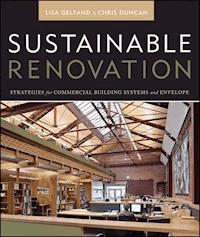
The complete resource on performing sustainable renovations for both Historic and modern existing buildings This forward-looking and insightful guide explores how the sustainable renovation of existing buildings presents great opportunities for initiating extensive changes in the performance of the built environment. Great examples of existing building upgrades are examined, illustrating how to do sustainable renovations, along with current design approaches for radically improving the functionality of existing prewar, postwar, and late modern buildings. Sustainable Renovation saves its key focus for institutional and commercial buildings, but discusses the challenges they pose within a global scope that encompasses all building practices. Some of the discussions in this book include: * The significance of energy and resource demands by the building sector and the urgency of reducing loads in existing buildings * Management, design, and construction approaches to achieve major modernization in occupied buildings * International case studies that focus on methods and benefits of successful sustainable transformations of existing building performance Repurposing buildings to preserve style and add performance remains a work in progress as designers and builders discover new methods for improving sustainable practices and standards. With incremental modernization and operations strategies available for immediate implementation, this book demonstrates the different ways of thinking necessary when considering and attempting the integration of sustainable concepts into existing buildings--and enables readers to rethink the world that's built around them.
Sie lesen das E-Book in den Legimi-Apps auf:
Seitenzahl: 468
Veröffentlichungsjahr: 2011
Ähnliche




















CONTENTS
Acknowledgments
Preface
Chapter 1: Introduction
Sustainability Defined
The Urgency of Sustainability in Buildings
The Importance of Existing Buildings
The Benefits of Sustainable Renovation
Chapter 2: Whole Building Design
Introduction
Existing Building Context
Understanding Existing Building Strategies
Modern Building Code Implications
Chapter 3: Facility Management Upgrades
Introduction
Immediate Improvement
Beyond Energy—Green Operations and Maintenance
Chapter 4: Building Envelope Redesign
Introduction
Air Infiltration Losses
Insulation Strategies
Pre-War Buildings
Mid-Century Modern Buildings
Late Modern Buildings
Chapter 5: Building Systems Replacement
Building System Needs
Pre-War Buildings
Mid-Century Modern Buildings
Late Modern Buildings
Systems Replacement Summary
Chapter 6: Building Materials
Environmentally Beneficial Products
Low-Emitting Materials
Pre-War Buildings
Mid-Century Modern Buildings
Late Modern Buildings
Chapter 7: Construction Operations
Introduction
Initial Construction Activities
Construction Debris
Occupied Rehabs
Commissioning
Chapter 8: High Performance Renovation
Transformation
Retrofitting Active Energy Systems
Waste Water Strategies
Passive House (Passivhaus) Design and Existing Buildings
Chapter 9: The Future of Renovation
Introduction
Energy Conservation and Building Lifecycle Strategy
Deconstruction
Conclusion
Index
Inserts
Copyright © 2012 by John Wiley & Sons, Inc. All rights reserved.
Published by John Wiley & Sons, Inc., Hoboken, New Jersey.
Published simultaneously in Canada.
No part of this publication may be reproduced, stored in a retrieval system, or transmitted in any form or by any means, electronic, mechanical, photocopying, recording, scanning, or otherwise, except as permitted under Section 107 or 108 of the 1976 United States Copyright Act, without either the prior written permission of the Publisher, or authorization through payment of the appropriate per-copy fee to the Copyright Clearance Center, Inc., 222 Rosewood Drive, Danvers, MA 01923, 978-750-8400, fax 978-646-8600, or on the web at www.copyright.com. Requests to the Publisher for permission should be addressed to the Permissions Department, John Wiley & Sons, Inc., 111 River Street, Hoboken, NJ 07030, 201-748-6011, fax 201-748-6008, or online at www.wiley.com/go/permissions.
Limit of Liability/Disclaimer of Warranty: While the publisher and author have used their best efforts in preparing this book, they make no representations or warranties with respect to the accuracy or completeness of the contents of this book and specifically disclaim any implied warranties of merchantability or fitness for a particular purpose. No warranty may be created or extended by sales representatives or written sales materials. The advice and strategies contained herein may not be suitable for your situation. You should consult with a professional where appropriate. Neither the publisher nor author shall be liable for any loss of profit or any other commercial damages, including but not limited to special, incidental, consequential, or other damages.
For general information on our other products and services, or technical support, please contact our Customer Care Department within the United States at 800-762-2974, outside the United States at 317-572-3993 or fax 317-572-4002.
Wiley publishes in a variety of print and electronic formats and by print-on-demand. Some material included with standard print versions of this book may not be included in e-books or in print-on-demand. If this book refers to media such as a CD or DVD that is not included in the version you purchased, you may download this material at http://booksupport.wiley.com. For more information about Wiley products, visit www.wiley.com.
Library of Congress Cataloging-in-Publication Data:
Gelfand, Lisa.
Sustainable renovation : strategies for commercial building systems and envelope / Lisa Gelfand and Chris Duncan.
p. cm. —(Wiley series in sustainable design)
Includes index.
ISBN 978-0-470-87261-1 (cloth : alk. paper); 978-1-118-10011-0 (ebk); 978-1-118-10013-4 (ebk); 978-1-118-10217-6 (ebk); 978-1-118-10218-3 (ebk); 978-1-118-10219-0 (ebk)
1. Buildings—Repair and reconstruction. 2. Commercial buildings—Remodeling. 3. Sustainable buildings—Design and construction. I. Duncan, Chris, 1962- II. Title. III. Title: Strategies for commercial building systems and envelope.
TH3401.G45 2012
690'.24—dc22
2011010962
ACKNOWLEDGMENTS
I WOULD LIKE TO THANK my coauthor, Chris Duncan, for his research, expertise, humor, and hard work on this book. It would also never have come about had Chris not known from the beginning of our practice that what is now known as sustainable renovation was the most effective thing we could do.
My thanks to all our clients, contractors, and fellow professionals who have envisioned what could be done with existing buildings, crawled through their interstices, and worked with us to transform them. We bring the experience of architectural practice to this book, but very little of what we’ve learned here was learned in the office. I want to thank all the dedicated nonprofit developers who have made sustainability a priority among all their competing needs, and the project teams who have made it happen.
My particular thanks to Ken Rackow and Sandy Kovtun, for roping in the pictures and the paperwork; Rosanna Lerma for her invaluable insights, and for years of fruitful collaboration; and Deven Diliberto for a summer of productive research. I also want to thank the rest of our partners for their patience in putting up with another research project as we busily try to keep our practice rolling.
Thanks to the team at Wiley for their support. And finally, I would like to thank Andrew and Zach, my sons, for giving me an urgent stake in the future.
Lisa Gelfand
I thank my wife Donna Graves for wrangling a fellowship that allowed me the time to investigate the broad spectrum of sustainable strategies that can be applied to existing buildings. The Loeb Fellowship at the Harvard Graduate School of Design provided me “affiliate” status—giving me free reign to attend classes and access to the libraries of Harvard University—making invaluable resources available while providing an energizing break from a hectic work life. In particular I appreciate the inspiration of Kenneth Kao and Bill Dunster, whose ZED class set the bar high, and Christoph Reinhart who provided a refresher course in building physics and led me to a number of valuable insights.
Of course my time in Cambridge could not have occurred without the extra efforts put in by the principals and staff at Gelfand Partners Architects who allowed me to mostly disappear for ten months while supporting all my ongoing projects. Thank you. I thank as well the architecture and engineering firms around the world who are developing and applying the sustainable renovation techniques we illustrate in this book. While they continue to provide inspiration to the communities in which they work, they provided us with practical advice and useful examples included in our book. On a more local level, I am grateful to live in the Bay Area where so many architects and engineers are working to make our buildings more sustainable. I especially thank Russell Bayba, who let me babble on about the book and helped steer me back on course.
I thank Doug Montalbano for careful reading and advice on a late draft of this work. Lastly, my children Alice and Malcolm put up with a distracted father through many days of writing, perhaps hearing a bit more about buildings and energy than they would prefer. I hope that this book can help transform our relationship with existing buildings and allow my children to grow up in a world where environmental degradation becomes a distant memory.
Chris Duncan
PREFACE
THE GREEN BUILDING COMMUNITY has generated excitement through the promotion of highly sustainable new buildings, but the truth is that for industrialized nations the vast majority of the buildings of the future already exist. Furthermore, existing buildings are a large contributor to the disproportionate use of energy by the developed world. If we are to mitigate the effects of buildings on the environment, we must improve the performance of existing buildings.
About half of the U.S. energy demand in the building sector comes from single-family homes. Other resources such as water, the materials that go into construction, and products and services used by residents also have significant impact on the environment. Since energy use translates directly into family utility bills, and indoor air quality, waste, and water use have direct effects on family finances and well-being, the benefits of green renovation are equally direct. As a result, a great deal of information is available to homeowners who wish to improve the energy performance, the health, and the comfort of their homes. In this book we will study the other half of the market, the commercial sector, where we work, learn, shop, and recreate.
But these buildings come in many shapes and sizes. Sometimes they are built of materials that no one uses anymore, or there may be no record of how they were built. They occur in all geographies and climate zones. They serve many different purposes. Contractors, architects, and engineers may have lost the skills and knowledge needed to work with their materials and components. Their financial value may be associated with their location and cash flow more than with their design or performance for their users.
These obstacles are all surmountable. In this book we provide a tool case:
An analysis of the environmental impact of existing buildingsIllustrations of the benefits of sustainable renovationMethods for measuring, modeling, and monitoring building performanceDescriptions of low and no cost measures that gain rapid resultsCommon systems and materials found in prewar, postwar, and more recent buildingsStrategies and examples achieving high performance in various buildingsA road map for reducing the impact of the building sector by 80 percent in the next thirty yearsWhile every existing building is a little different from the one next door, we wish to demystify some of the uncertainty that surrounds renovation. Just like new construction, there are a finite number of ways to make buildings functional, light, thermally comfortable, safe, and sanitary. Understanding what exists in any given building, owners and designers can plan for low cost and high yield immediate improvements, major renovations, transformative change, or a phased approach that creates incremental improvements as critical elements of the building systems age and fail.
The first three chapters in the book introduce the concept of sustainability, provide an understanding of whole buildings, and illustrate potential immediate upgrades. Chapters four through six examine strategies for upgrading building envelopes, systems, and materials relative to different climates and different eras of original construction. This is the how to heart of the book. We hope the reader will synthesize this specific information on building technics as related to individual buildings to better understand how to implement a sustainable renovation for the reader’s own combination of climate, building type, and use.
Our emphasis is on improvements in building energy performance, indoor environmental quality, and impacts on the outside environment. These are the areas where the biggest changes are needed. Promising new building integrated power generation options exist. We include such options. However, at the highest rate of production currently forecast for our electrical system, they provide only 10 percent of the improvement needed to reach our target for building sector energy reduction. It is hoped that new breakthroughs will improve power generation efficiency, storage of energy, and links with the grid, but in the mean time, energy conservation delivers a much bigger bang.
Lastly, we look at construction operations, examples of exemplary performance, and how the numbers add up in the aggregate for all existing buildings in the United States. Sustainable renovation can be done; we show in the case studies how it has been done, and we argue that it must be done more widely in the future. The goal of 80 percent reduction in building energy use may sound audacious, but it is nothing more than the sum of all the things we already know how to do, implemented over the next generation.
Chapter 1
INTRODUCTION
Mt. Jhomolhari in the Himalayas in 2009. During the last five years retreating glaciers and melting snow have exposed cliffs on this recently white peak. Gelfand Partners Architects.
We shape our buildings, and afterwards our buildings shape us.
— Winston Churchill1
SUSTAINABILITY DEFINED
In 2010, a chunk of ice three times the size of Manhattan broke off the Greenland ice cap and floated out to sea. Scientists were excited—the event occurred as predicted, and would soon be followed by another Manhattan-sized ice floe. Every three hours updates appeared on the Internet. Reporters asked anxiously if the ice would crash into some unlucky coastline. They seemed relieved to hear that nine-tenths of the iceberg was underwater, and that it would melt or drift aground far away from any coast. Asked if the event was an indication of global warming, the scientist paused for a moment and answered, “Yes, obviously,” but the significance was really the accelerated ice melt caused by the warming of the ocean, that great heat sink, which, though itself more gradual, was a far more rapid agent of change than the atmosphere.2
While it is exciting to see a theory validated, the implications for rising waters, changing climates, and disruption of habitat are frightening indeed. In the years since the world population began meeting to define sustainability, environmental change has accelerated, as has the need to limit human impacts. In 1987, the United Nation’s Brundtland commission defined sustainability as: “meeting the needs of the present without compromising the ability of future generations to meet their own needs.”3 This careful humanist definition encompassed the needs of people in developing countries to continue to improve their welfare and happiness and for people in wealthy and industrialized nations to maintain their comfort and well-being. However, overwhelming scientific evidence shows that our influence on the future extends beyond our ability to make ourselves more or less comfortable. Today we influence the ability of the biosphere of which we are a part to continue to flourish or even perhaps to survive.
Science depends upon the cautious accretion of observations and knowledge and cannot answer the question of whether or which species can adapt fast enough to thrive in a drastically altered environment. Gambling on the acceleration of 50,000 years of evolution into 100 years seems risky. We are in this together with the plankton and the polar bears. It seems only prudent to maintain or restore atmospheric and oceanic dynamics close to those to which we are all adapted. The Hippocratic oath to do no harm was first sworn in an era when physicians could do very little good. Our new environmental compact, consistent with our new powers, must go beyond the ancient Hippocratic standard, and find ways to heal.
Climate change appears to be tracking along the predictions of the worst-case scenarios. And so sustainability discussions today focus more sharply on carbon and energy than the resource depletion or air and water quality issues of earlier environmentalists. Deforestation, over-hunting and over-fishing, contamination of air and water with waste, and introduction of toxins arouse sorrow, outrage, and no small amount of action. But despite lack of progress in some areas, we can in fact substantiate considerable progress in slowing the destruction of the Amazon, cleaning up toxic emissions, and restraining chemical pesticide and fertilizer pollution.
Lesen Sie weiter in der vollständigen Ausgabe!
Lesen Sie weiter in der vollständigen Ausgabe!
Lesen Sie weiter in der vollständigen Ausgabe!
Lesen Sie weiter in der vollständigen Ausgabe!
Lesen Sie weiter in der vollständigen Ausgabe!
Lesen Sie weiter in der vollständigen Ausgabe!
Lesen Sie weiter in der vollständigen Ausgabe!
Lesen Sie weiter in der vollständigen Ausgabe!
Lesen Sie weiter in der vollständigen Ausgabe!
Lesen Sie weiter in der vollständigen Ausgabe!
Lesen Sie weiter in der vollständigen Ausgabe!




