


90,99 €
Mehr erfahren.
- Herausgeber: John Wiley & Sons
- Kategorie: Geisteswissenschaft
- Serie: Wiley Series in Sustainable Design
- Sprache: Englisch
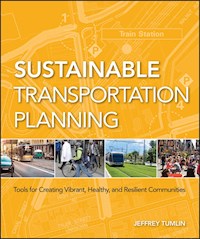
"The Great American Dream of cruising down the parkway, zipping from here to there at any time has given way to a true nightmare that is destroying the environment, costing billions and deeply impacting our personal well-being. Getting from A to B has never been more difficult, expensive or miserable. It doesn't have to be this way. Jeffrey Tumlin's book Sustainable Transportation Planning offers easy-to-understand, clearly explained tips and techniques that will allow us to quite literally take back our roads. Essential reading for anyone who wants to drive our transportation system out of the gridlock." -Marianne Cusato, home designer and author of Get Your House Right: Architectural Elements to Use and Avoid ?The book is full of useful ideas on nearly every page.? ? Bill DiBennedetto of Triple Pundit As transportations-related disciplines of urban planning, architecture, landscape architecture, urban economics, and social policy have undergone major internal reform efforts in recent decades Written in clear, easy-to-follow language, this book provides planning practitioners with the tools they need to achieve their cities? economic development, social equity and ecological sustainability goals. Starting with detailed advice for improving each mode of transportation, the book offers guidance on balancing the needs of each mode against each other, whether on a downtown street, or a small town neighborhood, or a regional network.
Sie lesen das E-Book in den Legimi-Apps auf:
Seitenzahl: 503
Veröffentlichungsjahr: 2011
Ähnliche




















Contents
Acknowledgments
Foreword
Chapter 1: Introduction
Why Transportation?
The Big Picture: Mobility vs. Accessibility
Structure of This Book
Chapter 2: Sustainable Transportation
What Is Sustainability?
Chapter 3: Transportation and Public Health
The Human Body
Does This McMansion Make Me Look Fat?
Danger, Will Robinson!
Anger, Will Robinson!
Health and Equity
Driving and Social Health
Transportation and Trust
Conclusions
Chapter 4: The City of the Future
Yesterday’s Tomorrowland
Imagining the Sustainable City of the Future
Chapter 5: Streets
Conceptualizing Streets
Principles of Street Design
Chapter 6: Pedestrians
Introduction
Pedestrian Planning Principles
Pedestrian Planning Tools
Pedestrian Design Tools
Measuring Pedestrian Success
Case Study: Marin County Safe Routes to Schools
Chapter 7: Bicycles
Introduction
Why Invest in Cycling?
Increasing Cycling
Key Cycling Principles
Design So That Everyone Will Enjoy Biking
Measuring Bicycle Success
Further Information
Chapter 8: Transit
Introduction
Transit Modes
Case Study: Los Angeles Metro Rapid
Case Study: Portland Streetcar
Case Study: San Diego Trolley
Design for Transit
Measuring Success
Case Study: Boulder, Colorado, Community Transit Network
Transit Planning Resources
Chapter 9: Motor Vehicles
Introduction
Designing for Cars
Design Manuals That Build upon Context
Design Guidance
Modeling Traffic
Freeways
Chapter 10: Parking
Introduction
Parking Is Destiny
Parking Economics 101
Parking Tools
Parking Management Principles
Top Ten Parking Management Strategies
Chapter 11: Carsharing
Introduction
Types of Carsharing
Impacts
Where Carsharing Is Most Successful
Public Policies That Support Carsharing
Municipal Fleets
Jump-Starting a Program
Chapter 12: Stations and Station Areas
Introduction
Multimodal Access
Case Study: WMATA’s Orange Line
Station Components
Case Study: BART Station Replacement Parking
Chapter 13: Transportation Demand Management
What Is Traffic Congestion and Why Does It Happen?
Planning for Reduced Traffic
Traffic Reduction: A How-To Guide
Chapter 14: Measuring Success
Definitions
How Performance Measures Are Used
How Performance Measures Are Misused
Measuring Success for Multiple Modes
Using Performance Measures to Balance Modes
Citywide Transportation System Measurements
Evaluating Project Alternatives
Additional Resources
Chapter 15: For More Information
Useful Online Resources
Required Reading
Useful Tools
Index
Advertisement
Copyright © 2012 by John Wiley & Sons, Inc. All rights reserved.
Published by John Wiley & Sons, Inc., Hoboken, New Jersey.
Published simultaneously in Canada.
No part of this publication may be reproduced, stored in a retrieval system, or transmitted in any form or by any means, electronic, mechanical, photocopying, recording, scanning, or otherwise, except as permitted under Section 107 or 108 of the 1976 United States Copyright Act, without either the prior written permission of the Publisher, or authorization through payment of the appropriate per-copy fee to the Copyright Clearance Center, Inc., 222 Rosewood Drive, Danvers, MA 01923, 978-750-8400, fax 978-646-8600, or on the web at www.copyright.com. Requests to the Publisher for permission should be addressed to the Permissions Department, John Wiley & Sons, Inc., 111 River Street, Hoboken, NJ 07030, 201-748-6011, fax 201-748-6008, or online at http://www.wiley.com/go/permissions.
Limit of Liability/Disclaimer of Warranty: While the publisher and author have used their best efforts in preparing this book, they make no representations or warranties with respect to the accuracy or completeness of the contents of this book and specifically disclaim any implied warranties of merchantability or fitness for a particular purpose. No warranty may be created or extended by sales representatives or written sales materials. The advice and strategies contained herein may not be suitable for your situation. You should consult with a professional where appropriate. Neither the publisher nor author shall be liable for any loss of profit or any other commercial damages, including but not limited to special, incidental, consequential, or other damages.
For general information on our other products and services, or technical support, please contact our Customer Care Department within the United States at 800-762-2974, outside the United States at 317-572-3993 or fax 317-572-4002.
Wiley publishes in a variety of print and electronic formats and by print-on-demand. Some material included with standard print versions of this book may not be included in e-books or in print-on-demand. If this book refers to media such as a CD or DVD that is not included in the version you purchased, you may download this material at http://booksupport.wiley.com. For more information about Wiley products, visit www.wiley.com.
Library of Congress Cataloging-in-Publication Data:
Tumlin, Jeffrey.
Sustainable transportation planning : tools for creating vibrant, healthy, and resilient communities/ Jeffrey Tumlin.
p. cm. — (Wiley series in sustainable design; 16)
Includes index.
ISBN 978-0-470-54093-0 (hardback); ISBN 978-1-118-11923-5 (ebk); ISBN 978-1-118-11924-2 (ebk); ISBN 978-1-118-12760-5 (ebk); ISBN 978-1-118-12761-2 (ebk); ISBN 978-1-118-12762-9 (ebk)
1. Transportation—Planning. 2. Sustainable urban development. I. Title.
HE151.T86 2011
388.4—dc23
2011016262
Acknowledgments
This book would not have been possible without the support and wisdom of many people, most prominently the following:
Julia Fremon, who kept me in the transportation field despite my better judgment, and who taught me everything I know about managing smart, creative, irrepressible people.
Bonnie Nelson, who believed in 1987 that it was possible to create a transportation consulting firm with a fun, egalitarian work environment and a sustainability focus, even before sustainability was a common word.
Patrick Siegman and Don Shoup, who taught me everything I know about parking.
Allan Jacobs, Jan Gehl, and Jane Jacobs, who helped me see cities through new eyes.
All of my colleagues at Nelson\Nygaard, whose ideas have shaped every page of this book, and particularly Tom Brennan, Brian Canepa, Mark Chase, David Fields, Michael King, Tara Krueger, Amy Pfeiffer, Patrick Siegman, Paul Supawanich, and Jessica ter Schure, who wrote substantial portions of the book, and Colin Burgett, Rick Chellman, Ed Hernandez, Lisa Jacobson, Ben Lowe, Carrie Nielson, and Michael Moule, who provided critical research and edits. I remain especially grateful to Steve Boland, who not only edited this entire book, but also helped restructure and rewrite entire chapters.
Many of our clients, who generously gave permission to have text and artwork from our previous work incorporated into this book, including the cities of Seattle, Santa Monica, San Francisco, Glendale, and Berkeley, and the Urban Planning Council of the Emirate of Abu Dhabi.
The folks at Wiley, including editor John Czarnecki, senior production editor Donna Conte, marketing manager Penny Ann Makras, and publisher Amanda Miller, who believed that it was time for a book like this one.
And finally, to Huib Petersen, who put up with me through the dark days of writing.
Foreword
One always hopes that competing forces can be brought together in creative ways that leave all or at least most of the competitors at rest, maybe even pleased, if not completely satisfied. Most important, with regard to the main subjects of this book, transportation and sustainable urbanism, is the underlying question: Does this bringing-together serve the basic interests of the people touched by the competing forces, and of the environment?
City planners and urban designers are very often in conflict with transportation professionals. Of course, that could be said in reverse: transportation professionals are often in conflict with city planners. But, for a long time (though less at present), transportation professionals may have barely noticed the planners. The position of transportation professionals, particularly the traffic engineers, has been long established: Early on, they collected lots of data about traffic volumes and presumed capacity of street types and lane widths; they were in the engineering departments of cities and states; they put together manuals on street design and adopted standards; they built predictive traffic models; they had numbers, and made more. They did a lot of good and, of course, they made some mistakes. Who didn’t?
As a young city planner, working in Pittsburgh, I came to understand that those urban phenomena to which numbers could be attached were more likely to receive higher priority when it came to doing things as part of an urban plan than those that did not have quantitative data to justify their implementation. Streets and public rights-of-way got higher priority and were allocated more land more readily than other uses the values of which were less countable—like open space, for example, or housing, or—God forbid—urbanity. But I nevertheless tended to believe the data and projections (forgetting that trend need not forecast destiny), and tried to live by the standards.
Later, after years of experience, I began to question the data and projections, and certainly the standards set by the transportation profession, and often enshrined in city codes and ordinances. One only has to see many Vancouver streets, where three meters is the policy for lane widths, to begin to seriously and strongly question the twelve- and thirteen-foot lane standards that are so often the norm elsewhere. Narrower lanes on a commercial shopping street mean lower speeds than wider lanes, and thus fewer deadly accidents with pedestrians. On the best tree-lined streets, the trees come all the way to the corners; they don’t stop some long distance from the corners to accommodate some sight-distance standard found in a manual.
A person can spend a lot of time gaining experience and learning lessons about how to design and arrange streets and roadways, from a citywide scale down to the smallest detail, in ways that will best meet the needs of the many planned-for users and of the environment itself. Would that it were easier! Would that there was an accessible, easy-to-understand source of both knowledge and methods that traffic professionals, planning practitioners, and the involved public alike could turn to in relation to transportation issues.
Jeff Tumlin does this; Sustainable Transportation Planning is a “how-to” guide for planning practitioners, transportation professionals, citizen activists, and people from a host of other professions and walks of life who want to understand transportation and land-use issues related to sustainable urbanism. His aims are to demystify common approaches to transportation matters, to help people challenge (and understand) traffic engineers when that is appropriate, and to help transportation professionals who want to do the “right thing,” but lack training and appropriate texts. The book is concerned with resolving competing needs on a street, ways to reduce carbon dioxide emissions, the relationships between roadways and transit and economic development, social equity, quality of life, and much more.
Most importantly, this book is written in accessible language. It is a work that grows out of considerable experience. It does not contain a lot of theory. It is a book for general audiences and professionals alike.
In many ways Tumlin challenges the field from which he comes. One suspects that many of his brethren will take out after him, but hopefully not until they have read the book.
Jeff and I have consulted each other informally and worked together on projects in San Francisco and abroad. He is quick and sharp-witted at the same time that he is creative. He is interested in solving urban problems, not in making them. And, as any reader will soon find out, he knows his field (and others), is engaging, and writes very well.
Allan Jacobs
Chapter 1
Introduction
We transportation planning and engineering professionals are currently the most significant obstacle to sustainable urbanism in North America, Australia, and other growing regions around the world who seek to emulate us. Although transportation planning’s related disciplines of land-use planning, architecture, landscape architecture, urban economics, and social policy have undergone major internal reform efforts over the past few decades, transportation remains largely stuck in a 1950s mentality, believing that there is an engineering solution to all problems—that we can literally pave our way out of our cities’ congestion, mobility, and economic development problems. Our colleagues in other fields have recognized that sustainable urbanism is the most important environmental issue of the coming century, and that the challenges of sustainability can be met only by joining forces—witness interdisciplinary efforts such as LEED-ND. Meanwhile, transportation remains largely isolated, focusing on the details of systems efficiency while missing the big picture.
This book aims to reunite transportation with its sister fields to fill the largest remaining gap in urban sustainability strategies. Specifically, it seeks the following.
First and foremost, this book is written to help non-transportation professionals understand transportation practice, so that they can more effectively guide it. Although grasping the details of highway engineering and bridge design requires years of technical study and professional licensing, the basic concepts of transportation are straightforward, if much misunderstood. Many elected officials and citizens are confused by the engineering jargon and black-box tools we use. Others are intimidated by our complex manuals, unaware that these tomes are often guidelines rather than standards, and that even our standards documents offer abundant flexibility.For planning practitioners, policymakers, and citizen activists, this book provides step-by-step instructions for implementing smart transportation concepts in their communities. For example, how does one actually implement Don Shoup-style parking reforms and address specific pitfalls? How can a downtown implement a productive circulator shuttle? On a main street, how should a local engineer allocate limited right-of-way among the competing needs of cyclists, through traffic, parked cars, sidewalk café tables, trees, and other demands? What are the most cost-effective tools for reducing the 30 percent of U.S. carbon dioxide emissions that come from transportation?For planning, design, transportation, and engineering students, this book offers an overview of where transportation fits in the overall study of urbanism.For transportation professionals, this book seeks to provide a better understanding of where our discipline fits in the larger context of sustainable urbanism. Transportation is not, after all, an end in itself, but rather a means by which communities achieve their larger goals. If we recognize that building roads and transit lines will never “solve the congestion problem,” what is our role?While this book has a clear perspective, and a goal of changing the industry itself and how it relates to other fields, it is not intended to be a polemical manifesto; others have already written those. It is not a work of academic research, though many academic texts are referenced throughout. It is also not an engineering or design manual; instead, it strives to help the reader understand how best to use existing manuals, and how to update local guidelines with a larger perspective (do not, under any circumstances, use this text alone to design your streets or transportation systems!). The aim of this book is to synthesize all of these objectives in language that general audiences will find accessible, and to offer implementation-focused guidance: Here is how to define your community’s values as they relate to transportation; here is a summary of the current academic thinking in everyday language; and here is how best to use the various sets of guidelines and standards that exist, and to address the many contradictions and tensions among them. Simply put, this book is intended to demystify transportation for nonprofessionals and to act as a guidebook for avoiding the typical pitfalls of transportation for design and planning professionals.
In many ways, this book is a transitional document, aimed at helping auto-dependent cities and auto-oriented professionals find their way toward a post-carbon, health-oriented future (Figures 1-1 and 1-2). It is written with a North American perspective, so it will be of little use for cities such as Copenhagen, Freiburg, and the Dutch provincial capitals, all of which are already decades ahead of most places in the world. For the auto-dependent world, however, this book shows that it is not only possible to reduce automobile dependency, but also that doing so will help cities better achieve most of their goals—including the goal of making it easier to drive for those who need to do so.
Figures 1-1 and 1-2 Portland, Oregon, exhibits two key attributes of great places: pleasant places to walk and multimodal transportation options.
Source: Nelson\Nygaard.
Why Transportation?
Transportation is not an end in itself. Rather, it is an investment tool that cities use to help achieve their larger goals. Though most transportation planners and engineers focus their efforts on the efficient movement of people and goods, transportation touches all aspects of life in a city:
Economic development. Although some politicians promote major transportation capital projects to “reduce congestion,” in fact the prime motivation for most major transportation investments is economic development, because access drives real estate values. Places with excellent access by various modes of transportation tend to attract jobs and residences.Quality of life. In a poor economy, the leading citizen complaint is typically “jobs.” But in a strong economy, “congestion” typically rises to the top of the list. Indeed, since Julius Caesar first tried to ban daytime use of wheeled carts to reduce traffic congestion in ancient Rome, congestion has been one of the greatest irritants in most great cities. Ancient Rome also suffered from another transport-related annoyance we hate today: noise, whether from freight deliveries, airplane takeoffs, honking horns, or the hum of highways.1 Done well, transport can be central to the quality of life of cities, and the source of both public enjoyment and tourism dollars. San Francisco’s top tourist attractions include its cable cars, historic streetcars, and a spectacular Art Deco bridge.Social equity. Transportation policy is inevitably social policy, with specific winners and losers in any transportation investment decision. Projects to benefit higher-income motorists may harm lower-income pedestrians, whereas other investments may significantly expand mobility and job opportunities for those too young, old, or disabled to drive. Advocates for the winners in conventional transportation funding allocations sometimes argue that any adjustment in the current formula is “social engineering”—a criticism with some merit—but then, any public investment in transport, even and perhaps even especially those reinforcing the status quo, results in social impacts.Public health. Particularly for children and the elderly, there is no better indicator of overall public health (particularly measured by obesity, heart disease, and Type 2 diabetes) than rates of walking. Health science tells us that our bodies are uniquely designed for walking, and the proper functioning of many of our bodily systems requires a minimum of 20 minutes of sustained walking per day. Transport systems that do not make daily walking a pleasure for all citizens will tend to result in significant public health costs.Ecological sustainability. With 27 percent of United States greenhouse gas emissions2 and 72 percent of U.S. petroleum use coming from transport,3 transportation is inseparable from ecological policy—and, one might argue, from international relations.The Big Picture: Mobility vs. Accessibility
To achieve cities’ goals, transportation takes two key approaches: mobility and accessibility.
Mobility. Mobility investments help us travel freely wherever we might want to go. Mobility investments are mainly capital facilities like an added highway lane, a rail extension, or a bicycle path. Mobility investments may also include measures that make the transportation system more efficient and productive, such as synchronizing traffic lights or improving transit speed, reliability, or frequency.Accessibility. Accessibility investments help us get the things we want and need. Rather than focusing on movement, accessibility may bring the product closer to the consumer. Locating a school and a retail main street in the middle of a neighborhood improves accessibility, reducing the need for people to move long distances and improving their choices. Accessibility investments include mixed-use zoning, delivery services, and high-speed Internet services that reduce the need for movement.All transportation systems should invest in both mobility and accessibility, balancing the two. Systems that overemphasize mobility (Dubai, the exurbs of Los Angeles County) tend to require excessive capital investment and result in dispersed land-use patterns. Mobility-oriented systems that emphasize only the automobile create all of the problems of automobile dependency addressed elsewhere in this book. Systems that overemphasize accessibility (monasteries, some resorts, some utopian communities) may result in close-knit communities isolated from the rest of the world, or levels of density too oppressive for most people. For more sustainable cities, the challenge for designers is to provide most of the needs of daily life within walking distance while maintaining the social and economic benefits of being tied to the larger region.
Structure of This Book
This book is in three sections:
In the first section (Chapters 2–4), the framework for the rest of the book is set. Chapter 2 introduces concepts of sustainability, including ecological, social, and economic elements of sustainability. Chapter 3 discusses issues of public health, which should be well understood by those who are interested in transportation planning. Chapter 4, “The City of the Future,” sets out some broad principles by way of describing a vision for the future of our cities that is truly sustainable and healthy.
The second section (Chapters 5–10) provides practical advice for designing sustainable transport systems. Chapter 5, on streets, is an overview of the basic building blocks of all transportation systems; Chapters 6 through 10 address individual modes, including walking, biking, transit, and automobiles (which are addressed in separate chapters on cars and parking).
Finally, the third section (Chapters 10–15) covers other important topics in transportation planning: carsharing, transit station and station area design, transportation demand management, and performance measurement. These topics aim to help make the most efficient use of any transportation system. The final chapter of the book provides sources for more information.
Notes
1. Romolo August Staccioli, The Roads of the Romans (Rome: L’Erma di Bretschneider, 2003), summarized in Tom Vanderbilt, Traffic: Why We Drive the Way We Do (and What It Says About Us) (Knopf, 2008), 8).
2. U.S. Environmental Protection Agency. Inventory of U.S. Greenhouse Gas Emissions and Sinks: 1990–2009 (April 15, 2011). Available at http://epa.gov/climatechange/emissions/downloads11/US-GHG-Inventory-2011-Complete_Report.pdf.
3. U.S. Energy Information Administration. Energy Annual Review 2009 (August 2010), Figure 2.0. Available at www.eia.gov/emeu/aer.
Chapter 2
Sustainable Transportation
What Is Sustainability?
There is no common definition of sustainability, and certainly no standard definition for how it applies to transportation. Like so many once-powerful terms (“awesome,” “unique”), sustainability is at risk of being rendered meaningless by the marketing industry, which uses the word to trumpet spectacularly unsustainable development projects from Las Vegas to Dubai, or defend the rapacious practices of the extraction industries in their shareholder reports. A good working definition of sustainability as it applies to cities was written by the Brundtland Commission of the United Nations in 1987: “sustainable development is development that meets the needs of the present without compromising the ability of future generations to meet their own needs.”1 Twenty-five hundred years earlier, the Buddha offered a more poetic definition, urging humans to build their household economy within nature’s limits, as the bee treats the flower, gathering “nectar to turn into sweet honey without harming either the fragrance or the beauty of the flower.”2
More complex definitions recognize that true sustainability must balance competing objectives, including the triple bottom line of “people, planet, and profit,” or “equity, ecology, and economy.” These definitions recognize that we cannot achieve an ecological objective, such as carbon neutrality, without simultaneously maintaining a stable society and productive economy (Figure 2-1). For example, though the use of petroleum—a polluting, finite resource—is unsustainable ecologically, an immediate ban on its use is unsustainable socially and economically. Today’s economy is so dependent upon petroleum that a sudden ban would result in tremendous social upheaval and poverty, both of which would have dire ecological consequences. Sustainability, therefore, is never an end state, but a process of moving toward a better world.
Figure 2-1 To determine whether your project is sustainable, you must analyze not only the triple-bottom-line issues of ecological, economic, and social sustainability, but also the intersections of these issues: Is your project viable, equitable, and bearable? Will it be loved?
Environmental Sustainability
Much of the current thinking about sustainability has its roots in the science of ecology. The word is derived from the Greek, meaning “the study of the household”; in this case, the house being the entire planet, all things living upon and in it, and their myriad relationships. The word also comes from the Greek and means the “one who manages the household.” Obviously, both the manager and the house are interdependent.
Lesen Sie weiter in der vollständigen Ausgabe!
Lesen Sie weiter in der vollständigen Ausgabe!
Lesen Sie weiter in der vollständigen Ausgabe!
Lesen Sie weiter in der vollständigen Ausgabe!
Lesen Sie weiter in der vollständigen Ausgabe!
Lesen Sie weiter in der vollständigen Ausgabe!
Lesen Sie weiter in der vollständigen Ausgabe!
Lesen Sie weiter in der vollständigen Ausgabe!
Lesen Sie weiter in der vollständigen Ausgabe!
Lesen Sie weiter in der vollständigen Ausgabe!
Lesen Sie weiter in der vollständigen Ausgabe!
Lesen Sie weiter in der vollständigen Ausgabe!
Lesen Sie weiter in der vollständigen Ausgabe!
Lesen Sie weiter in der vollständigen Ausgabe!
Lesen Sie weiter in der vollständigen Ausgabe!




