


78,99 €
Mehr erfahren.
- Herausgeber: John Wiley & Sons
- Kategorie: Geisteswissenschaft
- Sprache: Englisch
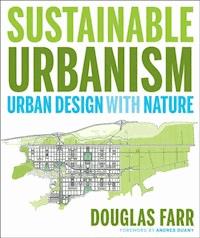
Written by the chair of the LEED-Neighborhood Development (LEED-ND) initiative, Sustainable Urbanism: Urban Design with Nature is both an urgent call to action and a comprehensive introduction to "sustainable urbanism"--the emerging and growing design reform movement that combines the creation and enhancement of walkable and diverse places with the need to build high-performance infrastructure and buildings. Providing a historic perspective on the standards and regulations that got us to where we are today in terms of urban lifestyle and attempts at reform, Douglas Farr makes a powerful case for sustainable urbanism, showing where we went wrong, and where we need to go. He then explains how to implement sustainable urbanism through leadership and communication in cities, communities, and neighborhoods. Essays written by Farr and others delve into such issues as: * Increasing sustainability through density. * Integrating transportation and land use. * Creating sustainable neighborhoods, including housing, car-free areas, locally-owned stores, walkable neighborhoods, and universal accessibility. * The health and environmental benefits of linking humans to nature, including walk-to open spaces, neighborhood stormwater systems and waste treatment, and food production. * High performance buildings and district energy systems. Enriching the argument are in-depth case studies in sustainable urbanism, from BedZED in London, England and Newington in Sydney, Australia, to New Railroad Square in Santa Rosa, California and Dongtan, Shanghai, China. An epilogue looks to the future of sustainable urbanism over the next 200 years. At once solidly researched and passionately argued, Sustainable Urbanism is the ideal guidebook for urban designers, planners, and architects who are eager to make a positive impact on our--and our descendants'--buildings, cities, and lives.
Sie lesen das E-Book in den Legimi-Apps auf:
Seitenzahl: 416
Veröffentlichungsjahr: 2012
Ähnliche



















Contents
Foreword by Andrés Duany
Preface
How to use this book
Acknowledgments
Part One The Case for Sustainable Urbanism
Chapter 1: The Built Environment: Where We Are Today
The American Lifestyle on the Wrong Course
Pioneering Reforms: Setting the Stage for Sustainable Urbanism
Chapter 2: Sustainable Urbanism: Where We Need to Go
Sustainable Urbanism: The Grand Unification
The Three Steps of Sustainable Urbanism
Part Two Implementing Sustainable Urbanism
Chapter 3: Leadership and Communications
Leadership Talking Points for Sustainable Urbanism—Jim Hackler and Irina Woelfle
The Power of Paired Choices
Implementation Agendas for Leaders
Chapter 4: The Process and Tools for Implementing Sustainable Urbanism
RFQ for Sustainable Urbanist Professionals
Benchmarking Municipal Sustainability: The Santa Monica Sustainable City Plan—City of Santa Monica
Documenting Community Preference in Form and Sustainability: Image Preference Survey (IPS)—Christina Anderson
Conducting a Charrette—Bill Lennertz
Shaping Sustainable Neighborhoods with the Toledo Smart Neighborhood Analysis Protocol (SNAP)—Carolee Kokola
A Sustainable Urbanist Neighborhood Plan: Toledo SNAP—Carolee Kokola
Regulating Plan and Form-Based Code—Christina Anderson
Incorporating Sustainability through Codes, Covenants, and Restrictions (CC&Rs)—Dan Slone
RFP for a Sustainable Urbanist Developer—City of Victoria, British Columbia
Part Three Emerging Thresholds of Sustainable Urbanism
Chapter 5: Increasing Sustainability Through Density
Explaining Density
Illustrating Density
The Transect of the Everyday
Water and the Density Debate—Lynn Richards
Transit Supportive Densities
Chapter 6: Sustainable Corridors
The Sustainable Corridor—Doug Farr, Leslie Oberholtzer, and Christian Schaller
The Integration of Transportation, Land Use, and Technology—Shelley Poticha
Biodiversity Corridors—Rebecca L. Kihslinger, Jessica Wilkinson, and James McElfish
Chapter 7: Sustainable Neighborhoods
Neighborhood Diagrams
Neighborhood Definition—Victor Dover and Jason King
Neighborhood Completeness—Eliot Allen and Doug Farr
Neighborhood Housing—Laurie Volk and Todd Zimmerman
Car-Free Housing
Neighborhood Retail—Robert J. Gibbs
Economic Benefits of Locally Owned Stores—Matt Cunningham
Third Places
Healthy Neighborhoods—Melanie Simmons, Kathy Baughman McLeod, and Jason Hight
Walkable Streets and Networks—Dan Burden
Complete Streets—Fred Dock
Universal Basic Home Access—Eleanor Smith
Managing Travel Demand—Jeffery Tumlin
Car Sharing—Jeffery Tumlin
Chapter 8: Biophilia
Open Space—Carolee Kokola
Public Darkness—Nancy Clanton and Todd Givler
Stormwater Systems—Jim Patchett and Tom Price
Food Production—Lynn Peemoeller and Jim Slama, with Cathy Morgan
Outdoor Wastewater Treatment—Thomas E. Ennis
Indoor Wastewater Treatment—John Todd Ecological Design
Chapter 9: High-Performance Buildings and Infrastructure
The Impact of Planning on Building Energy Usage—Alan Chalifoux
2030 °Challenge—Ed Mazria
High-Performance Infrastructure—Hillary Brown
Large District Energy Systems—Doug Newman and Robert Thornton, John Kelly, and Adam Lund
The 2030 Community Challenge: Economic Growth with Sustainable Urbanism
Part Four Case Studies in Sustainable Urbanism
Chapter 10: Lessons Learned from Sustainable Urbanism
Built Infill
BedZED: London’ England
Glenwood Park: Atlanta, Georgia, United States
Holiday Neighborhood: Boulder, Colorado, United States
Christie Walk: Adelaide, Australia
Newington: Sydney, Australia
High Point: Seattle, Washington, United States
Built Greenfield
Upton: Northampton, England
Kronsberg: Hannover, Germany
Loreto Bay: Baja California Sur, Mexico
Civano: Tucson, Arizona, United States
Poundbury: Dorchester, England
Chapter 11: State of the Art in Unbuilt Sustainable Urbanism
Unbuilt Infill
Dockside Green: Victoria, Canada
Lloyd Crossing: Portland, Oregon, United States
Z-Squared: London, England
New Railroad Square: Santa Rosa, California, United States
Uptown Normal: Normal, Illinois, United States
Unbuilt Greenfield
Dongtan: Shanghai, China
Galisteo Basin Preserve: Santa Fe, New Mexico, United States
Pulelehua: Maui, Hawaii, United States
Coyote Valley: San Jose, California, United States
Scales of Intervention
Epilogue
Glossary
Index
SUSTAINABLE URBANISM
Copyright © 2008 by Farr Associates.All rights reserved
Published by John Wiley & Sons, Inc.,Hoboken, New Jersey
Published simultaneously in Canada
No part of this publication may be reproduced, stored in a retrieval system, or transmitted in any form or by any means, electronic, mechanical, photocopying, recording, scanning, or otherwise, except as permitted under Section 107 or 108 of the 1976 United States Copyright Act, without either the prior written permission of the Publisher, or authorization through payment of the appropriate per-copy fee to the Copyright Clearance Center, 222 Rosewood Drive, Danvers, MA 01923, (978) 750-8400, fax (978) 646-8600, or on the web at www.copyright.com. Requests to the Publisher for permission should be addressed to the Permissions Department, John Wiley & Sons, Inc., 111 River Street, Hoboken, NJ 07030, (201) 748-6011, fax (201) 748-6008.
Limit of Liability/Disclaimer of Warranty: While the publisher and the author have used their best efforts in preparing this book, they make no representations or warranties with respect to the accuracy or completeness of the contents of this book and specifically disclaim any implied warranties of merchantability or fitness for a particular purpose. No warranty may be created or extended by sales representatives or written sales materials. The advice and strategies contained herein may not be suitable for your situation. You should consult with a professional where appropriate. Neither the publisher nor the author shall be liable for any loss of profit or any other commercial damages, including but not limited to special, incidental, consequential, or other damages.
For general information about our other products and services, please contact our Customer Care Department within the United States at (800) 762-2974, outside the United States at (317) 572-3993 or fax (317) 572-4002.
Wiley also publishes its books in a variety of electronic formats. Some content that appears in print may not be available in electronic books. For more information about Wiley products, visit our web site at www.wiley.com.
Graphic Design (interior); Sam Silvio,Silvio Design Inc.,Chicago
Wiley Bicentennial Logo:Richard J. Pacifico
Library of CongressCataloging-in-Publication Data: Farr, Douglas Sustainable urbanism: urban design with nature/Douglas Farr. p. cm. Includes bibliographical references and index. ISBN 978-0-471-77751-9 (cloth) 1. Urban ecology. 2. Urban ecology – United States. 3. City planning – Environmental aspects. 4. Sustainable development. 5. Neighborhoods. I. Title. HT241.S8736 2008 307.76–dc22 2007029064
To Gail, Will, my inspiringcolleagues at Farr Associates, andthe good Kingdom of Upnot
Foreword
The time has come, the Walrus said,To talk of many things:Of shoes–and ships–and sealing-wax–Of cabbages–and kings–And why the sea is boiling hot–And whether pigs have wings.
Lewis Carroll (1872)
Through the Looking-Glass
And so indeed, the time has come. This was the year when the Intergovernmental Panel on Climate Change’s report converged with “An Inconvenient Truth.” The boundaries of our playing field are now visible. The vast and amusing game called the American Lifestyle has limits after all!
What shall we do now?
Well, with about forty years’ worth of dedicated publications, there is certainly a lot of know-how available. For example, on my office’s “green” bookshelf, the 1963 edition of Olgyay’s Design with Climate sits 3 feet away from last year’s edition of Schaeffer’s Solar Living Sourcebook. My collection may be impressive—but I am not its equal. When I count which ones of these many books I have managed to really study, the honest answer is…just one: Christopher Alexander’s A Pattern Language.
Surely, this cannot be entirely my fault, for I am known to be a disciplined and interested reader.
The problem may lie with the books themselves. It seems that when I try to read the hortatory ones, I get their point well before the last page; and the technical ones are just too tedious to get through. Besides, both of these kinds of books are usually too specialized, with each author implying that their particular silver bullet is the important one to deal with the world’s environmental problem.
And so it has been for decades: waves of books asserting the importance of safeguarding habitat; or the danger of atmospheric pollution; or the demise of water quality; or the dreaded holes in the ozone layer; or the need for conservation, recycling or alternate energy; or the urgency of reinstating the production of local, organic agriculture; or green building. Taken together these books offers a complete body of knowledge, but no single volume has been holistic (or legible) enough to induce my expertise…with the unique exception of A Pattern Language.
Why then, having Alexander’s book already in hand, should we welcome Doug Farr’s? It may be, ironically enough, because A Pattern Language is too beautiful; too much a work of art. It is an epic, worthy of being the foundation myth of a great, ethical, intelligent, pleasurable civilization—one I would delight to inhabit. Alas, however, most Americans have come to mistrust intuition as a basis for action. Our leaders trust technique, not mystique. They require “studies” to provide them with “metrics” that support “accountability.” Happily, Doug Farr’s manual responds well to this situation. While it is similar to Alexander’s in that it propounds the full range of elements necessary for a sustainable future, it is potentially more convincing because it does so technically.
Also, like A Pattern Language, this manual designates the human settlement pattern—and not just the dwelling—as the crucial variable in the environmental equation. This makes a great deal of difference, as the absence of the community scale in the environmental literature has been masked by the recent obsession with “green” building—the latest of the silver bullets. But this is a long story, beginning with Ian Mc Harg’s early Design with Nature, which did not make a proposition regarding what was to be built once the where had been determined.
The primacy of the settlement pattern is demonstrated by what can happen when it is overlooked: Take the ecologically-sited headquarters to which every employee must daily drive a long distance; or the green Wal-Mart that depends on a trade area of 35 miles; or the chic “model” house in the desert with “solar” glass walls of impossible expense. With this manual, such absurdities are shown for what they are.
Without dismissing the techniques involved, Farr corrects the equation. The book’s presentation has a refreshing bias towards the practical and the pleasurable, and it also avoids case studies that are dependent on the sort of socialized subsidies that disqualify many marvelous European models from widespread influence in this country. No less important, he is practiced enough to avoid the imposition of austerities and inconveniences as a condition of securing a sustainable dwelling. Americans will not voluntarily tolerate suffering.
But there is nothing in this manual that recommends a neo-medieval nightmare. It may advocate a simplification, but that could lead to a more pleasant, elegant and meaningful life, and one relieved of the spiritual pall that comes from harming the planet which nurtures us.
Andrés Duany
Preface
This book celebrates the magical power of design and of an emerging pattern of human settlement—Sustainable Urbanism—that holds the promise of strengthening the interdependence of all life on earth. We humans are now a “superspecies,” making personal and national choices that together will determine the world our children will inherit and the fate of the world’s other species. Many progressive leaders now envision and champion a win-win balance between humanity’s needs, both social and economic, and those of nature. An increasing number of those leaders recognize the power of thoughtful urbanism to induce people to voluntarily live a more human-powered and less resource-intensive lifestyle. A small but fast-growing number of leaders are now beginning to recognize opportunities to enhance the inherent sustainability of a walkable, diverse urbanism integrated with high-performance buildings and infrastructure.
This book is a pioneering first effort to understand and document this emerging design movement called sustainable urbanism. This book grew out of the questions we at Farr Associates have encountered trying to fulfill our firm’s mission to design sustainable human environments. It started as a modest project to develop a manual of practice that would bridge the differing scales of sustainability efforts practiced by our firm’s amazingly hardworking and talented planners and architects. It has grown to involve some of the best designers, consultants, researchers, and developers in the United States and beyond. Despite the knowledge and high quality of work represented here, it is hard not to think of this book as a first draft, destined to be written over and over as our collective knowledge, achievements, and sense of urgency increase.
This book is a strategic call for leadership in the design and development of the places where Americans live, work, and play. All sustainability is local. The leaders who shape the built environment in the United States are decentralized and number in the millions of people. They include, among others, governors, mayors, city councils, municipal staff, government regulators, businesses, financiers, architects, planners, engineers, developers, builders, green builders, urbanists, environmentalists, farmers, utilities, voters, neighbors, and NIMBY groups. This book is designed to be a comprehensive how-to manual and implementation playbook to overcome the organizational challenges created by this broad decentralized leadership.
This book seeks to create a brand, agenda, and standards for an emerging and growing design reform movement: sustainable urbanism. Sustainable urbanism is an integration of walkable and transit-served urbanism with high-performance buildings and high performance infrastructure. It is related to the LEED for Neighborhood Development (LEED-ND) initiative, which the principal author of this book has chaired for several years. The book complements LEED-ND by trying to accelerate the parallel reforms needed to create a tipping point in support of widespread adoption of this approach.
This book provides a historical perspective on the standards and regulations that are often barriers to reform. Hundreds of separate national standards, and likely millions of local regulations, interact to increase resistance to change and make it difficult or even illegal to create sustainable urbanism. A working knowledge of when and why a given regulation was first adopted is essential to making a persuasive argument to change it.
This book is an urgent call to action concerning the design of the places where Americans live, work, and play. We are just coming to understand some terrible truths about the lifestyle choices made by the average American. After centuries of increasing longevity, U.S. life expectancy may be dropping due in large part to a sedentary and indoor lifestyle. Our affluence allows us to accumulate massive amounts of stuff, and we build increasingly larger dwellings to store it. Given the well-known environmental harms that result from our lifestyle, our failure to change amounts to a de facto plan to burden our children and grandchildren with the enormous costs of adapting to a changed global climate. Timelines communicate, at a glance, the key events leading up to the development of emerging thresholds of sustainable urbanism.
This book embraces the precautionary principle, a cornerstone of intergenerational courtesy. The precautionary principle states that any action or policy that might cause severe or irreversible public harm needs to be subjected to the highest scrutiny. The advocates of such untested actions or policies are burdened with proving that harm will not result. The design of land use and infrastructure—the crucial support structures for how we live, work, and play—should be subject to this kind of scrutiny because thoughtless design is already linked to adverse impacts on human health as well as climate change. While land use and infrastructure are arguably the most long-lasting and deterministic attributes of human settlements, the current debate on climate change tends to skip over them in favor of quicker fixes. Time is of the essence in adopting the reforms of sustainable urbanism. The precautionary principle demands the reform of land use and infrastructure as part of a comprehensive reform agenda targeting critical health and climate issues.
How to Use This Book
The purpose of this book is to help catalyze the adoption of Sustainable Urbanism to become the dominant pattern of human settlement by the year 2030. The book is organized to fulfill this ambitious goal in a comprehensive step-by-step manner.
Part One: The Case for Sustainable Urbanism
The task of implementing sustainable urbanism will require the participation of the next several generations of development professionals. The first part of this book functions essentially as an outline for courses in planning, architecture, engineering, environmental studies, and interdisciplinary sustainable development that could be used to train development professionals, public officials, and municipal staff on the emerging practice of sustainable urbanism. It posits that the American lifestyle puts society and the planet on the wrong course, and it proposes sustainable urbanism, a comprehensive reform of the built environment, as an achievable remedy. This first part of the book narrates and quantifies the magnitude of the problem, provides a history of pioneering reforms, makes the compelling case for sustainable urbanism, and outlines an agenda of strategic reforms leading to the dominance of sustainable urbanism.
Part Two: Implementing Sustainable Urbanism: Turning a Swarm into a Movement
Sustainable urbanism represents a generational shift in how human settlements are designed and developed. Its adoption as a societal norm requires all of the many participants in the process of planning and developing the built environment to work as a single organism toward a shared purpose. Part II of this book is designed to serve as an operating system to coordinate the work of discrete individuals to achieve magnified benefits. The leadership section details specific steps for mayors, municipal planners, banks, realtors, state governments, transit agencies, utilities, think tanks, Congress, municipal bond rating agencies, architects, developers, and others to implement sustainable urbanism one action at a time. The process section describes the detailed steps needed to implement sustainable urbanism through individual planning and development projects. It also provides templates for selecting qualified design professionals, project types, and development teams. Finally, it provides a communications and marketing framework for communicating the concept, benefits, and synergies of sustainable urbanism. This section also introduces the transect—a powerful communication tool for illustrating the spectrum of human place types and their capacity for sustainability.
Part Three: Emerging Thresholds of Sustainable Urbanism: Design Benchmarks and Rules of Thumb
In order to facilitate the widespread adoption of sustainable urbanism, benchmarks for design and development are essential. Part III features nearly thirty emerging thresholds of sustainable urbanism. Each is a distillation of the professional judgment of national experts regarding the performance that is likely or possible across a broad spectrum of human and natural systems. The thresholds can be used as benchmarks for designers to use as performance targets on projects, particularly useful in conjunction with the LEED for Neighborhood Development standard, or to provide the foundation for developing even more robust standards. The standards span five comprehensive areas of concern: density, corridors, neighborhoods, biophilla, and high-performance buildings and infrastructure. Together these constitute some of the most challenging opportunities for design integration in sustainable urbanism.
Part Four: Case Studies: Lessons Learned and State-of-the-Art Sustainable Urbanism
This case study portfolio captures a moment in time at the genesis of a revolutionary and powerful design movement. Part IV of this book documents a diverse and mature worldwide movement of visionary neighborhood-scale projects, both those already built and those yet to be built, that take a sustainable urbanist approach. Intriguing case studies from the United States, Canada, Mexico, Europe, Australia, and China integrate walkable urbanism, natural habitats, and high-performance infrastructure and building. The redevelopment and greenfield projects integrate infrastructure, building, and natural systems to varying degrees and levels of visibility. The sustainable leadership behind each project is described in narrative form to serve as a model for future projects. The project metrics, including key benchmarks, and a summary of sustainability systems also provide design guidance and goals.
Acknowledgments
Like so many projects that snowball, this book started as a modest pamphlet. The initial goal was to establish standards to coordinate the work of the planners and architects at Farr Associates. That initial idea grew in scope, complexity, and personnel and came to involve more than fifteen people in our office and more than fifty experts and case study practitioners worldwide. A project of this magnitude takes a village. I regret that I cannot hope to extend thanks to every one of the many, many people whose contributions and hard work were essential for this project to succeed.
This book would not have happened without Kevin Pierce, former Principal at Farr Associates; I thank him profusely for making the connections and seeing the opportunity herein. And I thank John Czarnecki, our editor at Wiley, for his patience during our many distractions through the long course of this project.
This book would not have been possible without the help of many talented and hardworking current and former staff members at Farr Associates. Joyce Coffee, Elizabeth Lindau, Elena Disabato and Renee McGurk oversaw the project through its long gestation. Leslie Oberholtzer, Christina Anderson, James Gwinner, April Hughes, Carolee Kokola, Adam Lund, Jamie Simone, and Christian Schaller all brought their talents to shaping the content. Book interns Meghan Bogaerts, Genevieve Borich, Erica Burt, and Ben Smith carried this project to the finish line, and I further credit Genevieve with the clarity of the book’s thesis. Annalise Raziq, Jonathan Boyer, and Leslie Oberholtzer each deserve extra-special thanks both for their critical inputs to the book and for helping to sail the ship during this odyssey.
While the concept for sustainable urbanism was born in our office, a significant share of the content of this book is the work of others outside our firm. I am humbled by the stature of both the threshold contributors, all leaders in the respective fields, and the case study teams who participated in this project. I am indebted to these people and thankful for their generosity in sharing their work and wisdom for this book.
The roots of my interest in sustainable urbanism and in the benefits of working in interdisciplinary teams sprang from Project Clear, a land use and water quality study conducted at the University of Michigan Biological Station. I owe lifelong thanks to my incredibly smart team members and friends: project director Dr. Art Gold, administrator Mark Paddock, biologists Linda Greer and Marion Secrest, geologist Michael Tilchin, attorney Stanley Pollack, and Dr. Seth Ammerman.
Scott Bernstein, Director of the Center for Neighborhood Technology (CNT), has been a mentor, collaborator, and friend for more than twenty-five years. While no formal contribution of his appears here, his ideas and those of his many colleagues at CNT, including friends Michael Freedberg and Jackie Grimshaw, permeate this book.
Thanks to the early Chicago members of the American Institute of Architects’ Committee on the Environment, including Steve Blonz, Pat Dolan, Mike Iverson, Helen Kessler, and Carol McLaughlin, who together learned and debated the principles of green building and urban sustainability years before LEED. Thanks to Scot Horst and the members of the LEED Steering Committee, whose sustained debate of these issues sharpened many arguments herein.
Through the course of more than fifteen congresses, the board, staff, and membership of the Congress for New Urbanism (CNU) contributed content to this book. David Hudson, Heather Smith, Steve Filmanowicz, Payton Chung, Nora June Beck, and Lee Crandell all helped out generously. Four board members merit special thanks: Dan Solomon, my architecture professor at Columbia University, for his mentorship, for his design excellence, and for introducing me to CNU; John Norquist, for his insights on the inherent value of urbanism; Susan Mudd, for her committed environmental leadership within CNU; and Andrés Duany, for his intelligence, generosity, and tireless advocacy of urbanism, and especially for conceiving the urban-rural transect.
This book would not exist had I not served as Chair of the LEED for Neighborhood Development project. While success has many parents, I credit the troika of Kaid Benfield, Christine Irvin, and Shelley Poticha with getting this important initiative off the ground and Nigel Howard, Peter Templeton and Bill Browning for early support at the U.S. Green Building Council (USGBC). Over the last four years, I have earned the equivalent of a Ph.D. by serving as chair to the immensely talented members of the Core Committee who developed the draft LEED for Neighborhood Development standard: Dana Beech, Kaid Benfield, Victor Dover, Sharon Feigon, Rebecca Flora, Daniel Hernandez, Bert Gregory, Jessica Cogan Millman, Michael Pawlukiewicz, Tom Richman, Susan Mudd, John Norquist, Elizabeth Schilling, Laura Watchman, and Sandy Wiggins. I thank each and every one of them for sharing their wisdom in what I hope is not a once-in-a-lifetime process of interdisciplinary collaboration, the fruits of which appear both in LEED-ND and in this book.
Kaid Benfield, my co-chair, deserves credit for patiently schooling me in the history, values, and accomplishments of the smart growth movement, and helping me to tell the story of this pioneering reform. Rob Watson—Kaid’s colleague at the Natural Resources Defense Council and “father of LEED”—filled in the history of USGBC and LEED.
Thanks to Tim Beatley for his pioneering book on European green urbanism and to the German Marshall Fund for allowing me to see “green” Europe first hand. Thanks to Joe Van Belleghem, developer of Dockside Green, for making sustainable urbanist development look easy, and to John Knott for his faith and courage in taking on the full agenda at Noisette. I also credit the work of Eliot Allen, a brilliant planner and analyst, for first showing me how to elegantly map and quantify the seemingly unknowable attributes and benefits of sustainable urbanism, and Hillary Brown for pioneering the field of high-performance infrastructure.
Numerous friends deserve thanks for their generosity as sounding boards and critical listeners: Ellen Dunham-Jones, Ellen Greenberg, Jen Henry, Rick Mosher, Knute Nadelhoffer, David Pott, Annalise Raziq, Jill Riddell, Janette Sadik-Kahn, Jeff Speck, Susie Spivey, and Alison True. Thanks, too, to Dr. Howard Frumpkin and Dr. Andrew Dannenberg of the Centers for Disease Control.
Finally, this book could not have happened without support from Chicago and Illinois. Thanks to my dear wife, Gail Niemann, for her tireless support, tough editing, and sincere interest in the topic of this book. Thanks to my son, Will, whose “How far did you get on the book today, Dad?” kept me going. Thanks to my sister, Anne Farr, for her generous help, and to Jonathan Black, whose eleventh-hour editorial input greatly strengthened the power of the essay. Thanks to the Chicago Green Brain Trust: Jim Patchett, David Yocca, Howard Learner, Jim Slama, and Craig Sieben. Thanks to Chris Koos, mayor of Normal, Illinois, and the citizens of McLean County, Illinois, for allowing us to first test many of the sustainable urbanist ideas in this book. Thanks to David Reynolds and Commissioners Bill Aboldt and Sadhu Johnston of the Chicago Department of the Environment for their patronage and support in implementing sustainable urbanism on the ground in Chicago. Finally, thanks to Chicago’s mayor, Richard M. Daley, who, by adopting sustainable urbanism as the hallmark of his tenure, has tasked his administration with implementing the book’s thesis.
PART ONE:THE CASE FOR SUSTAINABLE URBANISM
Chapter 1The Built Environment:Where We Are Today
The American Lifestyle on the Wrong Course
“We have seen the enemy and he is us.”Pogo, by Walt Kelly
It’s the American way to celebrate our robust range of life choices. We pride ourselves on being able to pick where we work, whom we live with, where we shop, and how we play. We decide on our government. We treasure the right to vote. For centuries we’ve believed that the sum total of these highly personal decisions will lead to an optimal society, that community can best evolve through every individual pursuing his or her own “rational,” enlightened
self-interest. That presumption is now being put to a severe test—and many of us would argue it has failed us badly. Our lifestyle, to put it simply, is on the wrong course.
The evidence is all around us. The lifestyle we, the American middle class, have selected has led to a serious deterioration in public health. We have become a sedentary population, deprived of exercise, and the result is a rising incidence of obesity. In 1991 the four states with the highest levels of adult obesity had rates between 15 percent and 19 percent. A mere fifteen years later, the proportion of all adults nationally over age twenty who are obese has reached a shocking 30 percent, dramatized in . To provide another perspective, weight-related health problems account for 9.1 percent of all health care expenditures in the United States. But according to a study by the National Institutes of Health, over the next few decades the greatest price that obesity may exact from society, if we fail to change course, is a life expectancy that is up to five years lower.
Lesen Sie weiter in der vollständigen Ausgabe!
Lesen Sie weiter in der vollständigen Ausgabe!
Lesen Sie weiter in der vollständigen Ausgabe!
Lesen Sie weiter in der vollständigen Ausgabe!
Lesen Sie weiter in der vollständigen Ausgabe!
Lesen Sie weiter in der vollständigen Ausgabe!
Lesen Sie weiter in der vollständigen Ausgabe!
Lesen Sie weiter in der vollständigen Ausgabe!
Lesen Sie weiter in der vollständigen Ausgabe!
Lesen Sie weiter in der vollständigen Ausgabe!
Lesen Sie weiter in der vollständigen Ausgabe!
Lesen Sie weiter in der vollständigen Ausgabe!
Lesen Sie weiter in der vollständigen Ausgabe!
Lesen Sie weiter in der vollständigen Ausgabe!
Lesen Sie weiter in der vollständigen Ausgabe!
Lesen Sie weiter in der vollständigen Ausgabe!
Lesen Sie weiter in der vollständigen Ausgabe!




