


9,99 €
Mehr erfahren.
- Herausgeber: Profondo Rosso
- Kategorie: Geisteswissenschaft
- Sprache: Englisch
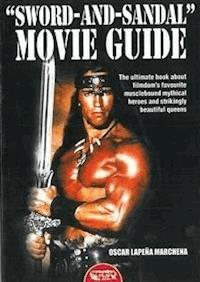
Over 250 of the wildest sword-and-sandal movies ever made are reviewed here: blockbusters…bombs…cult faves…rare gems…classics…groundbreakers…and everything in between! This book covers all of filmdom’s favourite muscle heroes, including Hercules, Goliath, Samson, Conan, Spartacus, Thaurus, Vulcan and many others. An A-Z guide to the world of Fantasy-Adventure flicks, providing obscure background notes, details of all the major cast and crew names, alternative titles, remake and sequel listings. Plus hundreds of rare illustrations.
Das E-Book können Sie in Legimi-Apps oder einer beliebigen App lesen, die das folgende Format unterstützen:
Veröffentlichungsjahr: 2013
Ähnliche




















OSCAR LAPEÑA MARCHENA
SWORD-AND-SANDAL MOVIE GUIDE
Hercules, Ursus, Samson and Goliath Conquer Atlantis
with contributions by Luigi Cozzi
Translated by Roberto Curti
published by
PROFONDO ROSSO
THE LITTLE SHOP OF HORRORS
founded in 1989 by Dario Argento
Via dei Gracchi 260, Roma 00192
Tel. 06-3211395
www.profondorossostore.com
© 2012 by PROFONDO ROSSO S.A.S.
chapter 01 WHAT IS “SWORD-AND-SANDAL” OR “PEPLUM”?
The word “peplum” refers to the garment – a short skirt – worn by many men and women alike during the Roman Empire. The term is also used to label those historical films which were produced in Italy, or with an Italian participation, between 1957 and 1965, even though some of those were also produced afterwards. The “peplum” genre (nicknamed “sword and sandal” in the Us) usually defines a work belonging to the fantastic genre, set in an universe that makes reference to Greek and Latin mythology, which usually forms the basis of plots. Stories often refer to a historical or religious episode as well, and sometimes even point to a different movie genre.
The term “peplum” was initially used by French movie magazines, namely Cahiers du Cinema, when critics started to get interested in those lesser known titles and directors. Paradoxally, the “peplum” genre was very popular at the box office, especially in its first years, even though movie magazines largely ignored those films, while the sparse reviews were uniformly negative.
The film which started the genre was Hercules (Le fatiche di Ercole, P. Francisci, Italy 1958), then almost a hundred titles followed, all of them set in an indefinite world suspended betweeen myth, history and fantasy. As it happened with silent historical flicks made in Italy in the second decade of the Twentieth century, “peplum” allowed Italian movie industry to get out of an economical crisis.
Even though the term “peplum”, in its strict sense, should apply only to films made in the above mentioned period of years, we’d rather think of it as the genre which deals with Ancient Times, no matter when these films were produced. In fact we believe that such genre has its own spirit, its own aesthetic characteristics which allow it to blend mythological references with historical ones, as well as an almost total freedom when introducing fantastic elements. Anyway, we’ll mostly analize those “peplum” films made in Italy in the ‘50s and 60s.
The so-called “peplum” has a number of features – regarding its production, structure and narrative resources – which make it a genre on its own. At no time it could be mistaken for a European, popular and fantastic version of Hollywood Epics. Us epic films reexamined Christian history and religion, leaving very little room for fantasy. They were produced under very different economical conditions and were aimed at different types of audiences. Hollywood Epics featured a smaller number of films and always aimed at magnitude; characters were often historical ones, with a preference for the Christ figure. Fantastic and mythological elements were scarcely present, whereas in Italian “peplum” fantasy is the main element.
To find the elements which influenced “peplum”, one has to go back to the Age of Enlightenment. Historical novels were reinvented in the XVIII century, and fully developed during Romanticism. XIX century’s historical novels were born as a propaganda movement in response to the opinions of some intellectuals - particularly Edward Gibbon – who believed that the influence of Christianity had caused the decadence of the Roman Empire. These novels made ancient times familiar to the huge public, since the early age of cinema; at that moment the typical clichés and scenes that would soon overrun all screens were born. Among the most successful novels of the period, which were all adapted for the screen, are The Last Days of Pompeii (E. Bulwer – Lytton, 1854), Fabiola, or The Church of the Catacombs (Cardinal Wiseman, 1854), Salambò (G. Flaubert, 1862), Ben-Hur (General L. Wallace, 1880), Cleopatra (H. Ridder Haggard, 1889) and Quo Vadis? (H. Sienkiewicz, 1896).
At the birth of cinema, classical past had already acquired a shape and was very well known through paintings (which often ascribed the fall of the Roman Empire to corruption of morals). There were also recreations of ancient times in “live portrayals” by circuses and the like. In 1889, in London, the Barnum circus carried a show by the name of “Nero, or the Destruction of Rome”. The show consisted of five episodes, with such names as: “The triumph of Nero, the persecution and condemnation of Christians”, “Gladiator fights and chariot races”, “The Conspiracy against Nero”, “Orgy at the Palace, the burning of Rome, the martyrdom of Christians and the death of Emperor Nero”.
There were also the so-called pirodramas, which consisted in the creation of baroque set pieces that illustrated historical episodes, such as the destruction of Pompeii, and which were then burned. Audiences were led to believe that the Ancient Age ended because of traumatic and spectaculat disasters. And we mustn’t forget the theatrical genre known as toga plays, born in England in 1885 and ended at the beginning of WW1, when it was abandoned in favour of films. Toga plays were set in Classical Antiquity: examples are Claudian (W. G. Wills, H. Herman, 1883), The Sign of the Cross (W. Barret, 1896), Androcles and the Lion (G. B. Shaw, 1913).
Last but not least, many of the first films set in Classical Antiquity followed the model of successful operas. Cinema was soon the ideal medium to recreate the excesses and sensationalism of Italian operas, overcoming stage limits and allowing depth of field. Movies featured elements which couldn’t be used on stage, such as giant tridimensional set pieces and a large number of extras. All this helped building the bases on which XX century “peplum” would develop.
Lesen Sie weiter in der vollständigen Ausgabe!
Lesen Sie weiter in der vollständigen Ausgabe!
Lesen Sie weiter in der vollständigen Ausgabe!
Lesen Sie weiter in der vollständigen Ausgabe!
Lesen Sie weiter in der vollständigen Ausgabe!
Lesen Sie weiter in der vollständigen Ausgabe!
Lesen Sie weiter in der vollständigen Ausgabe!
Lesen Sie weiter in der vollständigen Ausgabe!
Lesen Sie weiter in der vollständigen Ausgabe!
Lesen Sie weiter in der vollständigen Ausgabe!
Lesen Sie weiter in der vollständigen Ausgabe!
Lesen Sie weiter in der vollständigen Ausgabe!
Lesen Sie weiter in der vollständigen Ausgabe!
Lesen Sie weiter in der vollständigen Ausgabe!
Lesen Sie weiter in der vollständigen Ausgabe!
Lesen Sie weiter in der vollständigen Ausgabe!
Lesen Sie weiter in der vollständigen Ausgabe!
Lesen Sie weiter in der vollständigen Ausgabe!
Lesen Sie weiter in der vollständigen Ausgabe!




