


Erhalten Sie Zugang zu diesem und mehr als 300000 Büchern ab EUR 5,99 monatlich.
- Herausgeber: Books on Demand
- Kategorie: Geisteswissenschaft
- Sprache: Englisch
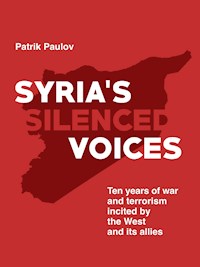
"A merciless revelation of the lies from media and politicians and the concealed facts... anyone who think they've heard the truth from the media and the politicians should read it!" Arbejderen, Danish daily "A comprehensive, independent analysis done because the book has so much focus on Syria's own people - ordinary people that always disappear in the media watching for the benefit of the leaders - and at the same time, Paulov dismantles the official media picture, revealing the game of the world powers... He contributes to public education, diversity, and debate." Jan Oberg, Swedish Peace researcher and director of Transnational Foundation Syria's Silenced Voices by Patrik Paulov depicts a decade of war in Syria through the eyes of Syrians who do not agree with the media image in the West. It is, simultaneously, a critical review of the Western countries and their allies' involvement and interests in the war. Syria's Silenced Voices also examines the unknown role played by Sweden, a country which has declared itself a "humanitarian superpower". Sweden has in fact been backing a Syrian opposition movement allied with terrorist organizations. Patrik Paulov concludes that what has happened in Syria and why is important to discuss since it is not just about Syria and the Syrian people. It is about examining the role of the Western governments in causing death and destruction in the other parts of the world, under the disguise of promoting democracy and human rights. Syria's Silenced Voices (Syriens tystade röster in Swedish) was first published by Karneval publishing house in Stockholm in 2019. The English edition is updated and with a newly written chapter added in May 2021.
Sie lesen das E-Book in den Legimi-Apps auf:
Seitenzahl: 476
Veröffentlichungsjahr: 2021
Das E-Book (TTS) können Sie hören im Abo „Legimi Premium” in Legimi-Apps auf:
Ähnliche



















Syria's silenced voices
About the authorReviews of Syria's Silenced VoicesPrefaceIntroduction: ”At last someone wants to talk to us"1. The arab spring comes to Syria2. “The protests quickly became violent”3. Truth is the first casualty of war4. When the EU sparked dissatisfaction5. With al-Qaeda against “shia extremism”6. The Syrian war in miniature7. ”We are the real opposition”8. Peace plan pushed into sinking9. Weapons flow into Syria10. Women's freedom becomes restricted11. Chemical attack in whose interest?12. When The United States released the leaders of ISIS13. Natural resources, power struggle and Israel14. Russia steps in – the war is turning15. A Swedish aid scandal16. A Swede keeps silent17. The Swedish jihadists18. A Nobel Peace Price Laureate travels to Syria19. Occupied Aleppo20. Swedish foreign minister receives a letter from Syria21. Who supplies the news?22. Torture report against peace?23. A radical law proposal24. The incalculable Trump25. No friends but the mountains and the US26. Who is supplying the evidence?27. Calls for peaceful change28. Liberation sweeps across Syria29. European aid scandals30. Swedish Foreign Ministry avoids answering31. Thieves, torturers, and oppressors32. Syrian voices 201933. Syria and the world 2021ReferencesCopyrightAbout the author
Patrik Paulov is a freelance writer based in Göteborg, Sweden, specializing in international affairs, mainly the Middle East.
He has published several articles about the war in Syria in Sweden’s largest newspapers, as well as in alternative and independent media. In 2015, he made a well-publicized revelation about Swedish foreign aid to opposition groups in Syria, that were cooperating with a-Qaeda terrorists. Stop Sweden's aid to the allies of al-Qaeda in Syria
Until 2018, Patrik Paulov worked as international editor of the weekly newspaper Proletären.
Reviews of Syria's Silenced Voices
“A merciless revelation of the lies from media and politicians and the concealed facts… anyone who think they've heard the truth from the media and the politicians should read it!"
Arbejderen, Danish daily paper
“A comprehensive, independent analysis, because the book has so much focus on Syria's own people and at the same time, Paulov dismantles the official media image, revealing the game of the world powers… Actually, Paulov does what a journalist should do: he asks questions, digs where he stands, and seeks documentation instead of cutting and editing mainly US news agencies. He contributes to public education, diversity, and debate. One can only be surprised that so many have not done what he does here… Buy the book! Read it! And tell others! Then you might also help others in the media industry to do like Paulov.”
Jan Øberg, Swedish Peace researcher and director of The Transnational Foundation (TFF).
“Syria’s silenced voices… is easy to read and follow the war until early 2019. The most important thing is that he [Paulov] puts Swedish media reporting about the war against voices from Syrians inside of Syria. He has met and interviewed them and maintained contact with them.”
Folket i bild/Kulturfront, Swedish monthly Magazine
“A sharp reckoning of the actions of the Western world in Syria, as well as with the media coverage."
Jämtlands Tidning, Swedish weekly paper
“Patrik Paulov's important book deserves a large readership. What is deeply tragic is that those who have most to learn from reading it are Swedish journalists and politicians.”
lindelof.nu, Swedish blog
Preface
Syria’s Silenced Voices depicts a decade of war in Syria through the eyes of Syrians who do not agree with the media image of Syria generally presented in the West. The book is, simultaneously, a critical review of the involvement of Western countries and their allies’ in the war and their interests in it.
Syria's Silenced Voices (Syriens tystade röster in Swedish) was first published by Karneval förlag in Stockholm in 2019. Unfortunately, the situation in Syria has not changed significantly since then. The fears expressed by people interviewed in 2019 have instead become a reality.
With few exceptions, the military war on the ground has been increasingly replaced by an economic war, in which the United States and the European Union are brutally stifling Syria’s bruised economy. Even though the war has changed, it is still the civilian population that is being sacrificed.
Something that has not changed is the silence in the mainstream media concerning the role of the Western world and its allies in adding fuel to the ten-year-long war. Sweden’s involvement in the regime change war, for instance, still seems to be a no-go zone for the media.
However, there is at least one exception. In the Netherlands, some in the mainstream media have extensively examined the Dutch government’s involvement in the Syrian war and highlighted the fact that aid from the Netherlands and other countries to alleged “moderate opposition” actually benefited armed extremists and terrorists.
This is a huge scandal, one that should be acknowledged and widely discussed in all Western countries involved in the destabilization of Syria.
The reason why Syria's Silenced Voices is being published in an English edition – updated and with a newly written chapter added in May 2021 – is due to the fact that the content of the book, as well as the discussion of what really happened in Syria and why, remains relevant to the current circumstances.
Also, it remains important since this is not just about Syria and the Syrian people. It is about examining the role of our governments, in causing death and destruction in the other parts of the world under the disguise of promoting democracy and human rights.
It is about learning from what has happened so that we do not have to face similar catastrophes in the future.
Patrik Paulov, May 8, 2021 Göteborg, Sweden
Introduction: ”At last someone wants to talk to us"
May 2016. I’m calling the number. 0096321… Waiting for a while. It is quiet, yet noisy on the phone. Nothing is happening. I try again. After all, we have an appointment for an interview. This time things are working better. The silence turns into a familiar but faint noise on the phone.
There is a crackle and someone answers.
“Hello…”
I introduce myself and ask to speak to Doctor Tony Sayegh. He comes to the phone and we exchange some courtesy phrases. I express my appreciation that he is taking the time to talk to a journalist from a small country in northern Europe. Then he interrupts me.
“I am the one to say thank you to you. Finally someone wants to talk to us. We know that Western media always report about the other side. But we who live in the government-controlled part of Aleppo can never tell our view of what is happening. We have lived under the terrorists' fire for almost four years… ”
Tony Sayegh is a surgeon and works in Aleppo, Syria's largest city. When I call him, it has been less than a week since I established contact with the Syrian Medical Association's local department with a request to interview one of their English-speaking doctors.
Events in Aleppo have, throughout the year, been among the headlines in the Swedish and Western media reporting of foreign affairs, over and over again.
• “Syria exterminates its population” (February 8)
• “Hospital bombed in Syria – several dead” (February 15)
• “A quarter of a million children under siege in Syria” (March 15)
• “Many killed in hospital attack” (April 28)
The list could be made much longer.
The strange thing is that I am the first journalist from the West to contact the Medical Association in Aleppo for an interview. No one has ever asked to speak to Tony Sayegh or any other doctor living and working in the part of the city where the overwhelming majority of residents live. No one has bothered to listen to their testimonies concerning how they get through the ravages of war.
In 2016, the media in Sweden and the rest of the Western world pay attention mainly to the eastern part of Aleppo. That is the part of the city which, according to Western politicians and the media in 2016, is “liberated territory” in the hands of “the opposition.”
I talk to Tony Sayegh for over an hour. The call is sometimes disconnected and I have to call again. Still, it feels strangely simple and trouble-free to contact and talk to someone in a country that has been ravaged by war and destruction for more than half a decade.
He is quiet and calm, formulating his words well. Throughout the conversation, however, there is a tone of despair in his voice. Feeling despair about the fact that parts of his hometown have been ruined. That the residents on the eastern side are forced to live under imposed Sharia law and are ruled by groups that, according to him, are criminals and terrorists rather than “moderate rebels".
Despair about being isolated and silenced. About belonging to the people of western Aleppo – an enclave controlled by the Syrian government and surrounded. Despair about belonging to a group of people that the Western world treats almost as “non-humans”.
I understand his despair. I remember my own visit to the bustling million city of Aleppo. The narrow alleys in the old city's large market area. The modern, vibrant metropolis. The hospitality. The narrow, crooked streets of the Palestinian refugee camp. At that time, neither I nor my friends in the city had any idea that war would soon strike Syria and cause death and destruction on an almost unimaginable scale.
I also understand Tony Sayegh’s despair about not being able to make his voice heard. Because there are always others who speak in the name of Aleppo, or in the name of the Syrian people. Despair about the fact that the vast majority of people in Sweden and the rest of the Western world will never hear his version of what is happening and who is responsible for the disaster that has hit Syria.
Tony Sayegh is not a unique voice. During the years of war, I have regularly interviewed and listened to what residents in Syria and Syrians in exile say. There have been many meetings, conversations, and written interviews.
They have been with people from different cities and with different backgrounds. Several are from the opposition and opponents of the “regime”. Others are dedicated supporters of president Bashar al-Assad, who, at the same time, advocate democratic reforms, or who are critical of the security services’ excesses and other well-documented abuses.
What unites these voices is that they feel silenced, just as Tony Sayegh does. They do not agree with the picture of Syria or of the war as it is depicted in the media in Sweden and the rest of the Western world. Yes, they have sometimes reacted with dismay when I informed them about how events in their everyday life and reality were presented in Sweden.
For instance how the term “civil war” was used over and over again over the years. They firmly claim that it has never been a civil war. Already when the first clashes took place in March 2011, foreign powers from the Middle East and outside the Middle East were involved in what was happening on the ground.
To see the conflict through the eyes of Syrians whose picture of reality has rarely or never appeared in the major Swedish or Western media is one of the purposes of this book.
It does not mean that their experiences and opinions are the whole truth. As we all know, there are many Syrians in the country and abroad who have a diametrically opposite view of many if not most things. We have heard testimonies from those Syrians and have heard their descriptions of reality over and over again since the war began.
But even the most convinced opponents of Syria's current rulers, those who testified about torture and abuse and who demanded that Bashar al-Assad be brought to justice, should also – in the name of democracy, freedom of speech, and the future peace – be in favour of breaking unilateralism and giving the diversity of voices and perceptions that actually exist in Syria a chance to be heard.
This is because Tony, Aliaa, Rima, Bashar, May, Elissar, and others that you will meet in the following pages are people living in Syria who dream of being able to live in peace soon and of seeing everything that has been razed rebuilt.
To depict the foreign intervention in the war is another central part of the content in the following pages. The dirty game behind the conflict is so massive and has had such horrific effects that it most certainly should be studied and discussed for a long time.
The situation is a daunting example of how things can end up when wealthy, powerful countries in the West, along with what many describe as medieval-like kingdoms in the Middle East, decide to overthrow another country's government – by providing weapons and making sure that money flows to forces following in the footsteps of the al-Qaeda founder, Osama bin Laden.
In Sweden, the most silenced part of this intervention have been some of the actions of Sweden itself. Besides the assistance Sweden provides for vital UN humanitarian operations and the support it extends to a large number of refugees from Syria, there are other less known and less flattering efforts made from the Swedish side. As have representatives from Saudi Arabia and other Gulf state kingdoms, Swedish government representatives have attended conferences that planned to “create democracy” in Syria, and Swedish aid has been given to forces that carried out ethnic cleansing alongside Jabhat al-Nusra, an organisation designated as terrorist by the UN.
The foreign intervention is a topic that comes up in my conversation with the Aleppo doctor Tony Sayegh in May 2016.
I ask him: What should the outside world do to help Syria and the Syrian people to overcome the ravages of war?
“I'll give you a short answer. Leave us alone. Don’t worry about us, forget that we exist… ”
It becomes quiet, and I almost think the phone call is disconnected again. I ask if he is there. I get a gentle reply and ask him to explain what he means that we should forget about the Syrians.
“Well, what we need is that the US, Europe, Turkey, and the Gulf states leave us in peace and stop supporting the terrorists. It should be decided in the UN Security Council that other states stay away from Syria and that all those who supported the terrorists should be punished. When you leave us in peace, when you forget about us, then I am convinced – like most Syrians are – that the Syrian army can achieve peace.”
I cannot forget Syria. I cannot forget the testimony of Tony Sayegh and other Syrians about the tragedy that has been going on for over ten years.
But I am not Syrian, hence it is not my job to point out which way forward is right or wrong for Syria; it is not up to me to point out who is most suitable to lead the country on the road to peace and reconciliation, towards reconstruction and better living conditions, and to democracy and increased respect for human rights.
The right to decide the future of Syria belongs only to the Syrian people. Several UN Security Council resolutions have repeatedly stated this.
The disaster in Syria is largely due to the fact that this right has not been respected, that the leaders of other states acted over the heads of the Syrian people and that they acted against the interests of Syrians.
Providing thousands of tons of weapons to extremist groups that bombed schools and bus terminals, destroyed infrastructure and industries, and silenced opponents – this has not contributed to democracy, nor has it strengthened respect for human rights or created better living conditions.
The war and its horrors cannot be undone; however, there are opportunities to reduce the suffering in Syria. There are opportunities even for an individual small country like Sweden to make a positive effort quickly and by simple means.
When this was written, emergency calls were being heard from Syria about the acute shortage of fuel, medicines, and other vital necessities. This is in addition to the destruction and emergency situation caused by eight years of war.
The Swedish foreign minister could listen to the demands of the Syrian people to lift the EU's economic sanctions. The foreign minister could veto an extension of the sanctions.
Such action would rapidly contribute to improving the humanitarian situation in Syria and facilitate reconstruction. It would enhance the possibilities for Syrians to get underway with the reform process, hence, for creating a better future.
1. The arab spring comes to Syria
All of us have seen photos and film clips from Syria’s demolished cities. Homs, Aleppo, Damascus, Palmyra, Kobane, and Raqqa are some of the names that are engraved in our minds. During the years of war, parts of Syria have been transformed into places that resemble ruined Iraqi cities after the US-led invasion in 2003 or Gaza after one of Israel’s recurring bombing campaigns.
Before the war began, a large part of the Syrian population was living a life that resembled ours. An example of Syria´s former level of development and well-functioning healthcare was given by Marit Halmin, from Doctors Without Borders, in an article from Swedish news agency Tidningarnas Telegrambyrå (TT) on January 7, 2018.
“A country that almost was equal to Sweden in development and prosperity has been bombarded 100 years back in time. We received patients who, before the war, had been as accurately and regularly monitored as in Sweden, and who now died of myocardial infarction due to lack of treatment. ”
How could things have ended up this way? And what was it that actually happened during the dramatic spring of 2011 when it all began?
The first months of that year were both bewildering and hopeful. The eyes of the world were directed at Arab countries and the mass protests that had flared up so suddenly. Streets and town squares were filled with people.
That there was a pent-up frustration with corruption, misuse of power, oppression and poverty is a fact. The spark that ignited the wildfire was Mohammed Bouazizi’s dramatic protest in Tunis in December 2010. He was a 26-year-old vegetable seller that became tired of harassment by the police and their recurrent demand for bribes. On December 17, he stood outside the town hall in his home city of Sidi Bouzid, poured petrol on himself and then set himself on fire.
After the young Tunisian’s death, it was as if the dams burst: people all over Tunisia hit the streets to demand changes and the departure of president Zayn al-Abidin Ben Ali. Pressure became so great that parts of the internal power apparatus turned against the president. On January 14, 2011, Ben Ali fled the from Tunisia to Saudi Arabia; his twenty years plus in power was over.
Even before Ben Ali fled his post, the people in Egypt were inspired by their Tunisian sisters and brothers. Town squares were occupied. Factories stood still as the workers went on strike. The result was the very same. After days of contradictory information came the dramatic announcement on February 11: after nearly 30 years in the post as president Hosni Mubarak had been forced to depart.
What had happened in Tunisia and Egypt was a sensation. Two leaders that had been practically cemented to power for decades were removed in a short time.
There was more to the upheavals in Tunisia and Egypt than the above-mentioned facts. The picture of what happened in the Arab world during the first months of 2011 is often simplified and romanticized. The people’s dissatisfaction and the mass movement in which it was expressed are one side of the story. Another side of the story is that there were powerful actors involved, whose agendas did not at all originate in the demands of the people for democracy and social justice. This became evident when the “Spring” spread across the Arab world.
In Libya, the movement was not at all as massive as in the neighbouring countries, and the leading oppositional forces soon turned out to be various rebel groups that, with arms in hand, had decided to take power. Nevertheless, it was the military actions of other countries that forced Muammar Gaddafi, Libya’s leader since 1969, away from the capital city Tripoli and hence caused the loosely organized government to collapse.
On March 20, 2011, the operation led by the NATO military alliance commenced. Officially, it was described as the setting up of a no-fly zone with the purpose of preventing the Libyan military forces from massacring the citizens that were fighting for democracy. Later it became obvious that it was a massive bombing campaign that resulted in widespread casualties as well as great destruction to Libya's infrastructure. It was a bombing campaign in which NATO member states and non-aligned Sweden participated side-by-side with dictatorial kingdoms such as Qatar and the UAE. We were soon, also, to see a similar cooperation take place in regard to Syria.
That several member states in the Gulf Cooperation Council played a prominent role during the Arab Spring was something that citizens of another Gulf country were soon to become aware of. In the small island nation of Bahrain, hundreds of thousands of people had hit the streets during February and March 2011, protesting against King Hammad al-Khalifa’s rule. This meant that the demonstrations in Bahrain, a country with 1.4 million citizens, gathered a considerably larger proportion of the people than the demonstrations did in Tunisia and Egypt.
When the king’s security forces shot and imprisoned demonstrators who demanded democratic reforms and a better life, parts of the outside world did not react at all the way they had done previously that spring.
On March 11, US Secretary of Defense Robert Gates arrived in Bahrain to meet with King al-Khalifa. It was an official visit that was reported in the media. According to the opposition in Bahrain, Gates gave the all-clear to what was soon to happen. Two days later thousands of soldiers from Saudi Arabia and the UAE disembarked in the territory of the small island state. “A blatant occupation,” declared the Bahraini opposition in a statement cited by the British Independent on March 15.
With tanks and heavy arms, the two Gulf countries managed to assist King al-Khalifa in quelling the Bahraini people’s mass protests and keeping him on his throne. In this case, it was evident that a regime change similar to that in Egypt and Tunisia, and the one that was soon to happen in Libya, was not at all appreciated by the West and Bahrain’s neighbours.
In March 2011, “the Arab Spring” came to Syria. A recurring description of how the Syrian protests for democracy developed into war sounds today like this:
“In March 2011, demonstrations for democracy began in Daraa. The government’s utilization of deadly violence as response triggered nationwide demonstrations that demanded president Bashar al-Assad´s departure. As disorder was spreading, crackdown on dissidents intensified. Supporters of the opposition took to arms, initially to defend themselves, and later on to expel government forces from local areas. Violence escalated and turned into a civil war when rebel groups were formed to fight against the government forces for control of the country.”
The quote is from the Swedish daily Aftonbladet (December 28, 2018), and refers to the British Guardian and The National Encyclopedia as sources.
A similar picture had been conveyed by the Swedish media during the spring and summer of 2011. “Military shot demonstrators in Syria – several dead,” was the headline of an article on April 29 by news agency Tidningarnas Telegrambyrå (TT). It described how security forces had killed 48 people during Friday’s protests alone, according to “a Syrian human rights organisation.” This human rights organisation, the Syrian Observatory for Human Rights (SOHR), was soon to become one of the most cited sources in the media coverage of Syria. At that time, nobody was informed that the SOHR consisted of one person in London with connections to a banned oppositional group in Syria: the Muslim Brotherhood.
In the TT-article, a witness in besieged Daraa, a city in southern Syria, is cited. ”There are corpses on the streets of the city that are lying there and rotting since no one dares to go out to take care of them, says a citizen to TV-channel Al Jazeera.” During the Arab Spring, Al Jazeera had increasingly supported the political interests of its financier and owner, namely the Gulf country Qatar’s royal family.
A few single reports that broke this pattern had surfaced during this period and gave a counter image. The Israeli National News reported on March 21 that four demonstrators and seven policemen were killed in Daraa during the weekend. Also, demonstrators had burned down the courthouse in the city as well as the ruling Ba’ath Party’s headquarters. This suggests that the Syrian authorities were confronting not just peaceful demonstrators in Daraa.
Two months later, the British Times reporter Martin Fletcher travelled around Syria. He sharply criticized the Syrian government and its actions against popular protests. However, in an article published on May 12, he wrote that he was surprised by the large support Bashar al-Assad had and by the size of the demonstrations critical of the government in Syria; they could not be compared to the uprising that overthrew Egypt’s Mubarak.
Such news was not covered by the media in Sweden.
Soon reports followed that Syrian officers and soldiers had deserted in protest against the massacres. In July 2011, it was reported that these had formed “the Free Syrian Army”, a name that, henceforth, was commonly appearing in the media coverage. Syria’s government was presented as a regime dependent on an isolated and increasingly desperate small sect. The only factor that allegedly enabled Bashar al-Assad to remain in his position of power was the sheer violence used against “his own people”.
On July 12, US Secretary of State Hillary Clinton declared that Assad had lost his legitimacy as Syria’s President, and she promised to support a transition to democracy. The following day, the very same standpoint was expressed by President Barack Obama: it was a clear signal to the outside world. Soon many leading politicians would be doing the same, and the call “Assad must go” echoed around the world.
During the autumn, after Libya’s Muammar Gaddafi ultimately was captured and killed, demands increased that the outside world should take military action against Syria, as they had against Libya. On December 13, 2011, Aftonbladet’s editorial stated that it was time to remove Syria’s dictator. It concluded that the bombing of Libya was an example to follow.
“According to the UN, over 4000 people have now been killed since the opposition began its work for democracy in Syria. More than 14,000 have been arrested. The regime has struck ruthlessly, but the uprising has continued.
“Before the military intervention in Libya, the Security Council referred to its responsibility to protect the civilian population. Reasonably, the same thing should be applied today to Syria.
“The outside world cannot silently watch a dictator committing mass murder on his own people any longer. According to the UN, this is a ’crime against humanity’.”
The editorial pointed out that firstly diplomatic and civil means should be used. The editor then continued:
“But a military intervention from the UN Security Council should not be ruled out any longer. France has raised the question of internationally monitored buffer zones along Syria’s borders, where civilians would be offered protection. It is an interesting idea.
“Until now Russia and China have been highly critical of an intervention in Syria. But as criticism in the region is increasing, it should also be possible to put pressure on them to change their policy, just as they did in Libya.”
This is how it would sound during the first years of the Syrian war. This is also roughly the version that was generally accepted in the Western media and publicly accepted by Swedish politicians.
However, there are those who firmly dismiss this description of reality, namely Syrians that were themselves present during the dramatic year of 2011.
2. “The protests quickly became violent”
Syria’s contemporary history is closely connected to the development in the rest of the Arabian Peninsula. During the First World War the Ottoman Empire moved towards its collapse. In the midst of a full-scale war, France and the UK were holding secret negotiations concerning sharing the areas of the collapsing empire between themselves. According to the Sykes-Picot agreement of 1916, areas that were later to become Syria and Lebanon came under French mandate. The Brits claimed Jordan, Iraq, and Kuwait.
The borders which the European colonial powers drew in the Middle East during the 1920 San Remo conference were as arbitrary and artificial as the borders that had been drawn on the map of Africa a couple of decades earlier.
According to the Statute of the League of Nations, administering the mandates in the Arabian Peninsula would take the affected areas to independence. This did not at all align with the plans that France had.
The Swedish diplomat Ingmar Karlsson writes in The Root of Evil (Historisk media, 2016):
“For Paris, the purpose of this task was to serve the strategic, economic, and ideological interests of France… These aims would be accomplished by addressing Arab nationalism in the mandate of Syria with a classic divide and rule strategy. Dividing and separating became, therefore, the linchpin of French politics.”
The ruling power sought to create and add fuel to antagonisms between the many ethnic and religious groups there were in the area – a method that was to be re-used in Syria less than a century later.
Syria’s period as a French mandate was full of uprisings, strikes, and protests against the colonial rule. France’s reaction was often violent. During the uprising of 1925-27, Damascus was exposed to “what was until then history’s largest daily bombardment, from the air, against a civilian population,” according to Ingmar Karlsson. The same method was used in May 1945 as a desperate – and unsuccessful – final attempt by France to break the nationalist movement.
Syria became formally independent in 1946. During the following chaotic years the Arab Socialist Ba’ath Party emerged as the strongest and most organized power. Through a military coup, the Baath Party took power in 1963. It took another seven years of internal fighting and cleansing until the situation was stabilized with Hafez al-Assad – father of the current President Bashar al-Assad, at the helm.
Taking firm measures against both Islamist and Marxist oppositions, Hafez al-Assad brought order to the broken country and established a functioning state. “For better or worse he is the father of modern Syria,” writes Aron Lund in The Dream of Damascus (Silc, 2010).
During that period there were two distinct political systems and power blocs in the world: capitalism in the West and socialism in the East. This gave countries in the Third World a certain amount of leeway. Syria allied itself with the Eastern superpower, the Soviet Union, even while it was fiercely attacking the pro-Soviet communists at home.
The largest internal menace to Hafez al-Assad did not come from the left but from the Muslim Brotherhood. In 1979, this Sunni Muslim organisation initiated an armed uprising against the Baath Party and the secular state. The uprising continued for three years until the Syrian army’s massive offensive in the city of Hama, which the Brotherhood had proclaimed a “liberated area”.
The British Middle East reporter Robert Fisk was present in Syria during those years, and he travelled to Hama during the final battle in early 1982. In The Great War for Civilisation (Norstedts, 2007) Fisk writes about how the Brotherhood had “cut the throats of families of government workers, murdered police officers, and beheaded teachers that were demanding secularized teaching.” All attempts to negotiate failed, and the Brotherhood dismissed offers that would give them ministerial posts in the government.
The violent uprising received a violent response as Hafez al-Assad ordered the army and the security forces to enter Hama. Thousands of civilians were killed during the battles before the Syrian authorities retook control of the city.
The defeat in Hama was a major setback for the Muslim Brotherhood. Its leadership was forced into exile in Iraq, Saudi Arabia, and Jordan. The weakened organisation lived on, however, and when it was time for the next uprising less than three decades later the Brotherhood was one of the forces in the frontline.
The dissolution of the Soviet Union at the beginning of the 1990s changed world politics, hence weakening Syria’s position. The country came even under greater pressure after September 11, 2001 and the start of an ongoing war against terrorism which the US President, George W. Bush, had launched.
In his adress to the nation, in January 2002, Bush coined the phrase “axis of evil”, in which he included Iraq, Iran, and North Korea. When John Bolton, then Under Secretary of State for Arms Control and International Security, testified before the Senate in September the following year, he not only mentioned those three countries, but he also described Libya and Syria as “rogue states” that were a menace to US national security.
Regarding Syria, Bolton’s claim was Syria, according to the Washington Times of September 29, 2003, that that the country had weapons of mass destruction in its possession and that it supported terrorism. What was behind the accusation that Syria supported terrorism had to do with the fact that Syria wouldn't give in to US pressure to close the official offices that Palestinian liberation movements had in Damascus. On top of that, Syria had a close relationship with Iran and the Lebanese movement Hizbollah, both of which had been on the White House’s list of enemies for a long time..
The invasion of Iraq by the “coalition forces” – led by the US, the UK, Australia, Spain and Poland – in March 2003 had major consequences for Syria. In the years that followed, more than a million Iraqi refugees crossed the border into Syria.
The unrest in the region had a negative impact on the domestic political situation in Syria. In 2000, after the death of Hafez al-Assad, his 34-year-old son Bashar al-Assad was appointed president and leader of the Baath Party. The dissolution of the Soviet Union combined with the change of president saw Syria orientate more and more to the West. During what was called the Damascus Spring, the liberalization of the economy went hand in hand with increased freedom of speech and political freedom in general.
But the political freedoms that Bashar al-Assad had initiated soon after taking over came to a standstill. One important reason was the war in Iraq: hence, the increasing threat from outside. Not only Syria but all those countries that were threatened by the Bush Administration at that time were concerned about the aggression against Iraq. Another reason for concern in Syria was that parts of the old guard within the Baath Party were opposed to the political freedoms being initiated.
Concerning the political system in Syria, that there was dissatisfaction and a spread desire for change was something that all Syrians I have spoken with affirmed. A wish for change is, however, not the same as supporting what happened when the “Arab Spring” came to Syria in 2011. This became evident as I interviewed residents of Syria and asked about the initial protests and bloodshed.
Aliaa Mahfouz Ali is from the city of Jableh near the Syrian Mediterranean coast. In 2011, she was 25 years old and worked as a teacher at the University in Aleppo. By the time I interviewed her, two years later, it was no longer possible for her to continue with her job.
“I cannot go there because the roads to Aleppo are so dangerous. They are full of armed gangs that would love to behead me for my ethnic and religious background”, she explained.
I had contacted Aliaa Mahfouz Ali in June 2013 after she was quoted in a New York Times article on Syria. I was able to carry out a written interview with her in the same month. Sometimes I had to wait before I received her replies due to the power failures that Syrians have learnt to live with.
Allow us to look back to the spring of 2011. What happened as the protests in Syria began?
“During the first demonstrations, I thought like many other people did – that this movement might lead to something positive for the country; however, I did not participate in any of the demonstrations. The slogans that were initially heard are usually described as a cry for democracy and freedom, against corruption, and demands for better living conditions. But these slogans were nothing but a façade to camouflage the real purposes.”
Wasn’t it so that most of those that demonstrated were ordinary people that had become tired of the shortcomings in the Syrian society and were hoping for a better future?
“Some people that sought reforms found the slogans to be appealing, and some of my friends participated in the demonstrations. The situation was rather complicated at the start, and it was difficult to discern what was actually going on. But soon, the religious extremists took over and took off the mask of demands for democracy and reforms. Some emphasize that a couple of highly educated people participated, or that communists joined the demonstrations; however, the truth is that these people were nothing but a tool for the extremists and the extremist attempt to take over power.”
For a long time, Syria experts in the West claimed that it was only the government side that was using violence and that the opposition was peaceful and only took up arms at the end of 2011. What is your opinion regarding this?
“From the starting phase, we saw many violent attacks from the protests that resulted in casualties. For instance, a peasant in Banias [a city 25 kilometers south of Jableh] was killed on April 10, 2011. Nine military men were killed near the coastal freeway outside Banias.
“I was a part of the traffic on the freeway as I heard heavy explosions and shooting that went on for several minutes. I also heard urgings from the mosques nearby: people were urged to join the jihad in Syria. As I arrived home to Jableh I got to know that nine soldiers had been ambushed and killed. Many outbursts of violence similar to this took place during the first period, which exposed the true face of the protests. They were never peaceful.”
In the New York Times article, Aliaa Mahfouz Ali was presented as ”the daughter of a retired Alawite military man and a French teacher.” I asked how she saw the conflict in Syria being described as sectarian, between the oppressed Sunni Muslim majority of people and a government that had certain support from the Alawites, the Christians and the rest of the minorities in the country.
“Before the uprising, it was shameful to discuss or even mention ethnic origins in public: Syria was a society where people with different ethnicities and religious backgrounds lived side by side. The Western media have a tendency to want to classify the conflict in my country as sectarian; they insist on classifying people based on religious adherence instead of basing it on their political or ideological opinions. The same thing was done in Iraq, Afghanistan, and other countries that have been struck by the Western democracy.”
Rima Sawah is a teacher and a resident of the city of Homs. During the time of my interview, October 2015, she was a member of the oppositional Souria Al-Watan Party, a secular left party that was established in 2012 and is active inside Syria. The party disassociated itself from both the foreign supported opposition and the armed groups.
Tell me about spring 2011.
“A lot of people went out to the streets to protest against poverty and corruption, but many also had religious and sectarian reasons. ‘We will send the Alawites to the grave and the Christians to Beirut’, was a slogan that was heard in the demonstrations. It was a threat directed at Alawites and Christians that they would be killed or kicked out of Syria.”
Many Syrians have described how snipers killed opposition demonstrators and simultaneously shot at the pro-government demonstrations that also took place. Was this something that you experienced?
“As a resident in Homs, one of the first cities with demonstrations, I can confirm that a number of unidentified men shot at the demonstrations of both sides and killed many people. Both sides accused each other of being responsible for the killing. Those who shot at the demonstrators can only be regarded as traitors to the country. I think they were paid by other countries to drive Syria to this dirty war.”
In the 1980s, the Muslim Brotherhood staged a violent uprising. What was the role of this Sunni Muslim organisation in the protests in 2011?
“The Muslim Brotherhood attempted to take advantage of the situation to come to power. It was evident that they had prepared themselves long before the protests began. The demonstrations started out from mosques and most of the weapons were hidden there long ago. The Brotherhood was the first to support the armed actions and described them as an answer to the brutality of the regime forces. The Brotherhood has supported all Islamist groups in Syria and considers Jabhat al-Nusra, an organisation designated as terrorist as a part of the so-called revolution.”
Mother Agnes Mariam, or Fadia Lahham as her real name is, has become a well-known peace activist in Syria and abroad. In September 2012, when I spoke to her for the first time, she was committed to a project in Homs province that aimed to bring an end to the battles and pave the way for peace and reconciliation at a local level. This province, which shares a border with Lebanon, was an area where violent clashes had escalated more quickly than most other regions.
When I called Mother Agnes to ask for an interview, she was in Brussels as part of a speaking tour in Europe to inform politicians and religious leaders of the ongoing peace initiative called Mussalaha. Her efforts to bring peace to Syria have made her popular in some circles and very unpopular in others. Critics have called her “Assad’s propaganda nun”. That she would have anything to do with the Syrian Government or president is something she firmly dismisses.
“No, I do not defend any side: I take an ethical standpoint for peace and to defend the civilian population,” she said when I brought up that question.
Nadia Lahham, aka Mother Agnes, was born into a Catholic family in Lebanon. Her father was Palestinian and her mother Lebanese. Toward the end of the 1960s, when she was 16 years old, she rebelled and left Lebanon. Among the things she did was to live as a “hippie” in Amsterdam for a couple of years,. Back in Lebanon in 1971, she became a nun. Since 1993, she has lived and worked in Syria and Lebanon.
Just like Aliaa Mahfouz Ali, Mother Agnes initially experienced the spring of 2011 as something positive.
“The Syrians had for a long time lived in some sort of totalitarian rule with the power being in the hands of only a few people. The need for change was great. But Syria was, at the same time, also a country where citizens lived in safety and had food every day as well as education.”
When the demonstrations began in March 2011, opposition figures received permission to hold meetings in the monastery in Qara, where Mother Agnes was the mother superior. Qara is situated between Damascus and Homs, about ten kilometers from the border with Lebanon. When police and security forces initially arrested demonstrators, the monastery’s representatives negotiated with the authorities for the demonstrators to be released. But it was not long before the protests rapidly changed character.
“We received reports early on that the uprising had become violent and began to contain sectarian slogans. The violence was increasing more and more, and then turned to sheer terror against the civilian population. What is the result of 18 months of ‘revolution?’ It is death, destruction, and everything negative that one can imagine. People are afraid. They are, however, not too afraid of the army for they are used to them; they are afraid of the rebels. They are bandits that try to justify their crimes by talking about the Syrian revolution, about democracy and liberty. People have lost their homes, their jobs, as well as having lost faith in the future.”
Mother Agnes spoke about several crimes committed by the rebels. She told how Alawites in Homs had been beheaded because of their ethnic and religious background. One account concerned a man from her village that was accused of supporting the government and, as punishment, his body was mutilated and left in the street. Mother Agnes spoke further about the sabotage of the infrastructure, the destruction of the country’s cultural heritage, and the vandalizing and plundering of churches.
The US, Europe, and the Gulf states say that the problem in Syria is Bashar al-Assad and that the only solution is to remove him from power. What is your opinion?
“I don’t know the man and I will not evaluate him politically. But look at Iraq, where they removed Saddam Hussein. It has brought chaos and separation to the country. And look at Libya. It has hardly become better today. What I don’t understand is how Assad suddenly became Dracula. Why did the West accept him in 2010 when he was received in Paris by the French president Nicolas Sarkozy?
“The Western countries say that they want peace in Syria, that they want democracy. They treat the Syrian people, however, as children. They want to choose the Syrian leader for them, and when the reality in Syria does not suit them then they create a different reality. They refuse to realize that the majority of the Syrian people has opted not to support the uprising that is becoming increasingly violent.”
These people do not in any way express unique standpoints. There are many Syrians and independent Syria experts that have conveyed similar descriptions of the protests in 2011 and the violence that followed.
In January 2021, a Dutch priest, Frans van der Lugt, a resident in Syria for five decades, wrote about the uprising in a letter translated from Dutch into English and cited by several alternative media outlets:
“Most Syrians do not support the opposition… Therefore, you cannot say that this is a popular uprising. The majority of the people are not part of the rebellion and certainly not part of the armed rebellion. What is occurring is, above all, a struggle between the army and armed Sunni groups that aim to overturn the Alawite regime and take power.
“From the start, the protest movements were not purely peaceful. From the start I saw armed demonstrators marching along in the protests, who began to shoot at the police first. Very often the violence of the security forces has been a reaction to the brutal violence of the armed rebels.”
Frans van der Lugt was killed on April 7, 2014. He was shot in the head in his home in the old city of Homs, a district that was at that time controlled by armed groups and besieged by the Syrian army.
On May 7, 2014, Russia Today published an article by Sharmine Narwani titled “Syria: the hidden massacre.” Sharmine Narwani is a commentator and analyst of the Middle East geopolitics and has had articles published in The Guardian and The New York Times, among others.
“The hidden massacre” is about the killing of Syrian civilians as well as police officers, soldiers, and members of the security forces during March and April 2011, at the start of the “Arab Spring” in Syria. Sharmine Narwani mentions 88 killed, including the nine soldiers in Banias that Aliaa Mahfouz Ali spoke about. Some of the events were reported in the news. Most of them were never given any attention in the West.
But the Syrian government itself played a part in censoring reports of these deadly attacks against the police and army. Sharmine Narwani interviewed the then Deputy Foreign Minister, Faisal Mekdad, about a specific event in Daraa at the beginning of April in which at least 18 soldiers were killed in a single attack. She asked why the government prevented this news from being reported. Faisal Mekdad said that it was done in “an attempt not to antagonize or not to raise emotions and to calm things down – not to encourage any attempt to inflame emotions which may lead to escalation of the situation.”
3. Truth is the first casualty of war
“My name is Nayirah and I just came out of Kuwait… What I saw happening to the children of Kuwait and to my country has changed my life forever.”
This was how a 15-year-old girl Nayirah began her four-minute long testimony on October 10, 1990, before the senators in the United States Congressional Human Rights Caucus. The opening part of the testimony is straightforward:
“I volunteered at the Al Adan hospital [in Kuwait City] with twelve other women who wanted to help as well. I was the youngest volunteer. Other women were from twenty to thirty years old. While I was there I saw the Iraqi soldiers come into the hospital with guns. They took the babies out of the incubators, took the incubators and left these children to die on the cold floor. It was horrifying.”
The testimony is available on several YouTube channels. It is emotional: several times Nayirah bursts into tears. The result of her appearance had dramatic consequences for millions of people.
Parts of the young volunteer’s testimony were shown the same evening by the TV-channels ABC and NBC. The teenager’s compelling story reached between 35 and 53 million viewers in the US during the first evening and night broadcasts. President George H.W. Bush, as well as other politicians who advocated war, used Nayirah’s story several times after that when arguing for the US to use military force to expel Iraq from Kuwait.
All of this influenced public opinion, and several politicians in the US Congress that were previously negative to the thought of war changed their positions; hence, George Bush had a majority in the Senate. With that, all attempts to find a solution involving negotiations to get Iraq to discontinue its illegal occupation of Kuwait, and thereby peacefully solve the conflict between the countries, were abandoned. On January 17, 1991, three months after Nayirah’s appearance, Operation Desert Storm commenced. A coalition led by the US went on the attack and so began the ariel bombing of Iraq. The consequences for the Iraqi people were devastating.
After Baghdad and other cities had been bombed and there had been much death and destruction, Nayirah’s testimony was exposed as fake. It was staged for the purpose of persuading the public and elected politicians to support the war.
On January 6, 1992, a New York Times reporter, John MacArthur, revealed that Nayirah was the daughter of Kuwait’s ambassador to the US and not an eyewitness to Iraqi atrocities. It also turned out that her appearance had been a part of the advertising agency Hill & Knowlton’s strategy to propel the US to go to war against Iraq. The money that Hill & Knowlton received for this job came from Kuwait.
The revelation of this false testimony resulted in powerful reactions not only in the US but worldwide. Amnesty International concluded on January 7, 1992, that there was no credible evidence that Iraqi soldiers had removed babies from their incubators, thereby causing them to die. Middle East Watch, a department of Human Rights Watch, came to the same conclusion when they conducted their own investigation where it had happened. On January 12, The Independent published an article that concluded that the Iraqi soldiers causing the deaths of premature children was a myth.
A decade later it was time for another, even bigger, lie. It was spread by many politicians in the West and by the media, and it had devastating consequences for Iraq and Syria. In the autumn of 2002, US President George W. Bush and UK Prime Minister Tony Blair strongly claimed that the Iraqi president, Saddam Hussein, had weapons of mass destruction at his disposal. This claim was made despite the fact that the UN weapon inspectors, over a course of several years, had disarmed Iraq and stated that they had found no evidence that the country still possessed any nuclear, biological or chemical weapons.
When the tensions rose and the opposition to the coming war increased, Bush and Blair claimed that these weapons of mass destruction were not only a menace to Iraq's neighbours, but also to the populations of the US and the UK.
After initiating the war in March 2003, the lies were revealed: the invading forces did not find the slightest trace of weapons of mass destruction in Iraq. Just as in the case of Nayirah, it was propaganda to enable a war, in turn, proved to be about totally different concerns than human rights.
This phenomenon was nothing new, so not specifically created for Iraq. In the 5th century BC, the Greek dramatist Aiskylos had concluded that “truth is the first casualty of war.”
But when the war in Syria broke out in 2011 the words of Aiskylos and the lessons learned from the two wars in Iraq were forgotten. During the first week of the crisis in Syria, the media had already taken as a starting point a much simplified and distorted picture of reality concerning the conflict’s antagonists and protagonists: Assad belonged to the first category, while the opposition and the rebels belonged to the second. The government and its supporters were, henceforth, considered as biased sources, while the voices of the opposition were usually presented as witnesses of the truth.
Let us begin with a typical example of partial media coverage. On January 17, 2013, and in the days that followed, several Swedish newspapers and news sites published a text from Swedish news agency TT stating that “Syrian military has killed more than a hundred civilians, including children, on the outskirts of the city of Homs.” The source cited was “the anti-government Syrian Observatory for Human Rights.” Some media – but not all of them – acknowledged that this information was unconfirmed. The side that was accused of having committed mass slaughter did not get to comment on the claims.
On January 18, 2013, America’s CNN broadcast a short video report titled ”What happened in Homs?” Their film team was present in the village where the bloodbath had taken place a few days earlier. Locals told the CNN reporter about the massacre and showed him pools of blood in a house. He heard the story of a mother and her five children who had been killed for refusing to allow gunmen to use the roof of the family’s house. When the villagers were asked if it was the army that had done this, they were upset and answered:
“No, it was armed men, rebels, dressed in black.”
According to the witnesses, the perpetrators belonged to a fundamentalist group with connections to al-Qaeda. [The film clip can be seen on CNN.com.]
This counter-image was never reported in the Swedish media. The hundreds of thousands of Swedes that read or heard about the massacre were left with the impression that the Syrian soldiers, and so Assad, had murdered “their own people”, that was the only side given attention in widely disseminated reports.
The lack of criticial sources was already evident back in the spring of 2011. On social media, dramatic images and film clips allegedly showing how government forces attacked peaceful demonstrations were being spread. The reactions afterwards to these were very strong as they affected many people’s view of the conflict. But critical voices were found on Twitter and Facebook, voices that questioned if all the images and clips actually showed what they claimed to show. At some point, Denmark Radio (DR) and Reuters and other mainstream outlets were faced with similar questioning about some of their reports.
On May 16, 2011, Denmark Radio published what it termed revealing images from Syria on the program TV Avisen. Their correspondent Steen Nørskov had been handed the films on the border between Lebanon and Syria. DR stressed that the images that had been smuggled out were real and came from a trustworthy source. They were said to show how Syrian opposition demonstrators were exposed to brutal torture by the government’s militias. This report reached a wide audience.
As soon as the program had been broadcast, its genuineness was questioned. The next day, DR’s TV Avisen was forced to backtrack and confess that the images had nothing to do with Syria. In fact, the images came from Iraq and were several years old.
The week before, on May 8, Reuters had published a similar film that had been uploaded on social media. It claimed to show Syrian security forces assaulting demonstrators and threatening them with guns held to their heads. Reuters pointed out, though, that the genuineness of this material could not be guaranteed. Yet still Reuters opted to disseminate the film.
It was shown the same day by, among others, Australia’s ABC News 24. Two days after the publication, the ABC program Media Watch received a tip-off concerning this: the video did not come from Syria. The uniforms were not Syrian, the men’s dialect placed them in northern Lebanon, not Syria; and the registration plates that were shown were Lebanese. On May 12, ABC News 24 apologized. The film came from Lebanon and had been available to watch on YouTube since 2008. The fact that Reuters had made the same discovery already on May 8 and had retracted the video did not hinder its spread through other news sources.
Patrick Cockburn, a longstanding Middle East reporter for The Independent, was one of those who at an early stage in his reporting on Syria had warned that these non-verified YouTube clips could be sheer propaganda films. On January 15, 2012, he wrote:
“The BBC and other television stations happily run nightly pictures of mayhem from Syria, grandly disclaiming responsibility for their authenticity. These disclaimers are intoned so often that they now have as much impact on viewers as warnings that a news report may contain flash photography. People understandably believe that if the BBC and other channels were not convinced of the truth of YouTube pictures they would not be using them as their main source of information on Syria.”
Cockburn pointed out that YouTube and technical development has made it difficult for governments to conceal oppression. The problem is, however, that the large international media outlets are quiet about how easy it is to manipulate these clips.
“… these developments have also made the work of the propagandist easier. Of course, people who run newspapers and radio and television stations are not fools. They know the dubious nature of much of the information they are conveying. The political elite in Washington and Europe was divided for and against the US invasion of Iraq, making it easier for individual journalists to dissent. But today there is an overwhelming consensus in the foreign media that the rebels are right and existing governments wrong. For institutions such as the BBC, highly unbalanced coverage becomes acceptable.”
Spreading false films due to insufficient critical sources is by all means a serious matter. What is even worse is that news that had been widely spread had turned out to be fabricated. An example of this was when the Syria State Television, in the beginning of 2012, got hold of raw footage from a film team from Al Jazeera that had been present in a rebel-controlled area in Homs. The Qatar-based channel was one of the Arab world’s largest and was considered as one of the most trustworthy.
By that time, the most intensive battles were in and around Homs, close to the border to northern Lebanon. In Al Jazeera's Arabic broadcasts, a badly injured child was interviewed in a field hospital in the city. Covered in bandages, she said that God would punish Bashar al-Assad and his children. This was what the viewers got to see. The raw footage that depicts the time before the broadcast shows something else.
On March 2, 2012, the LebaneseAmerican professor Asaad AbuKhalil commented on his blog, Angry Arab News:
“This is really scandalous…[the film] shows the footage prior to Aljazeera reports: they show fake bandages applied on a child and then a person is ordered to carry a camera in his hand to make it look like a mobile footage. It shows a child being fed what to say on Al Jazeera.”
It has to be said that Asaad AbuKhalil, at that time, was not just angry at Al Jazeera for lying; he was angry because their lies thwarted the Syrian “revolution” and were helping the Syrian “regime” – of which he was an outspoken critic. Also, he was not surprised by Al Jazeera having fabricated their news.




