


9,99 €
Mehr erfahren.
- Herausgeber: legenda Q |Kraterleuchten
- Kategorie: Geisteswissenschaft
- Sprache: Englisch
English translation of the successful German title »Mach's menschlich« – now available for the international market!
What does a working world look like when people and their needs come first?
Attracting new employees and retaining existing staff is perhaps the biggest challenge currently facing medium-sized companies. This can only truly succeed if people experience their work as meaningful and enjoyable and it helps them to unlock their potential. How can that be achieved?
Drawing on his experience as the owner of a medium-sized business, Samir Ayoub has packaged his insights into 40 practical theses that act as a guide. They outline the contours of a working world based on meaning, trust, responsibility and freedom and shed light on all the key fields of action when it comes to transformation. In addition to questions involving leadership, organisation and technology, Samir pays particular attention to his area of expertise, focusing on spatial design and the question of how contemporary and innovative office concepts can contribute to a working environment centred around people.
An overview of the big picture is provided by Samir's friends Christoph Quarch and Jan Teunen in a philosophical essay exploring the intellectual foundations of the modern working world.
This book is written for business owners, HR managers and people & culture leaders who are interested in authentic and effective approaches to transformation.
Das E-Book können Sie in Legimi-Apps oder einer beliebigen App lesen, die das folgende Format unterstützen:
Seitenzahl: 79
Veröffentlichungsjahr: 2025
Ähnliche



















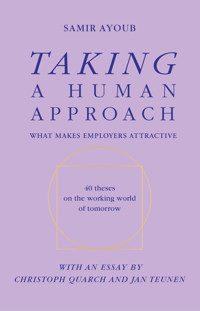
TAKING A HUMAN APPROACH
What makes employers attractive – 40 theses on the working world of tomorrow
SAMIR AYOUB
withCHRISTOPH QUARCH
withJAN TEUNEN
Publishing information
TAKING A HUMAN APPROACH
Editor and author
Samir Ayoub
Curator
Prof. Jan Teunen –
www.teunen-konzepte.de
Essay
Dr Christoph Quarch
Prof. Jan Teunen
Project management/organisation
Anja Plattner
Johannes Lossack
Monika Held
German Book design of the print edition
Fuenfwerken Design AG –
www.fuenfwerken.com
Typesetting english version
Kerstin Fiebig
Proofreading German version
Lydia M. Behnke
Translation
YT Language Solutions
Publisher
legenda Q
CEO Sven Nieder
An imprint of
Kraterleuchten GmbH
Gartenstraße 3, 54550 Daun, Germany
All rights have been clarified to the best of our knowledge. Should legal claims nevertheless arise, we ask the rights holders to contact legenda Q Verlag.
Translated from
MACH’S MENSCHLICH! (ISBN 978-3-948206-10-9)
2024
1. Edition, 2025
ISBN e-book: 978-3-948206-18-5
ISBN paperback: 978-3-948206-17-8
Contents
INTRODUCTION
I. NEW WORK.
A WORKING ENVIRONMENT CENTRED AROUND PEOPLE
II. THE THREE FIELDS OF ACTION FOR TRANSFORMATION
III. UNLOCKING HUMAN POTENTIAL
IV. NEW LEADERSHIP.
LEADERSHIP IN A WORKING ENVIRONMENT CENTRED AROUND PEOPLE
V. NEW OFFICE.
SPACES IN A WORKING ENVIRONMENT CENTRED AROUND PEOPLE
VI. TRANSFORMING A SOCIETY OF WORK INTO A SOCIETY OF MEANING.
PATHS INTO THE FUTURE
THE REDISCOVERY OF THE HUMAN BEING
Christoph Quarch and Jan Teunen
OUTLOOK
ACKNOWLEDGEMENTS
I dedicate this book to
my father KHALED AYOUB,
who taught me that no journey is too far in living a personal vision,
and to my mother SYLVIA AYOUB,
whose favourite colour adorns the cover.
INTRODUCTION
What needs to happen for people to enjoy working? What are the conditions that need to be met for them to feel that their work is meaningful, for them to enjoy their work, and for them to fulfil their potential and get the best out of themselves? I have been pondering these questions for almost 30 years. Providing good and practicable responses to them is my personal mission. It now seems to me that it is time to pass on the insights and knowledge that have been given to me. This is because I realise that more and more people are concerned about one issue in particular: how can we create working environments that are centred around people?
I have found answers to this question by developing and implementing contemporary concepts for room and office designs with my eighteen designfunktion teams and external project partners. Our core concern here is to create effective spaces that allow people to develop their potential: spaces that inspire, attract and support people. With proven and at the same time innovative New Office concepts, I try to support people and organisations in achieving their strategic and operational goals.
Yet I have learned over the years that New Office concepts are not enough by themselves. As an entrepreneur and experienced manager, I have realised that modern spatial concepts can only be effective if they are embedded within a modern working environment, i.e. something known as New Work. This is also why I feel that it is important to convey a clear understanding of what New Work is all about so that entrepreneurs and decision-makers can integrate the approach into their companies in a meaningful and culturally sustainable way. Above all, I am keen to support my colleagues in the SME sector in overcoming the various challenges that they face with a clear and practicable New Work/New Office strategy.
One of the biggest challenges at present is attracting new employees and retaining existing employees. The issue of organising knowledge work in the hybrid working environment and making corporate culture a tangible spatial experience is more crucial than ever when it comes to sustainable corporate success.
This is therefore the important thing for me: with my 40 theses, I would like to explain some terms and concepts that are currently relevant and highlight what really matters when we talk about New Work, the transformation of knowledge work, the development of potential, New Leadership, New Office and future prospects. I hope to provide inspiration and guidance to anyone who makes decisions about the design of working environments for their employees, with the result that they are able to fulfil their great responsibility.
As it is important for me not to lose sight of the bigger picture when making specific proposals, I have invited cultural capital producer Jan Teunen and philosopher Christoph Quarch to embed my theses in a larger context with an essay on the intellectual foundations of working environments centred around people.
This is also why I feel that it is important to convey a clear understanding of what New Work is all about so that entrepreneurs and decision-makers can integrate the approach into their companies in a meaningful and culturally sustainable way. Above all, I am keen to support my colleagues in the SME sector in overcoming the various challenges that they face with a clear and practicable New Work/New Office strategy.
SAMIR AYOUB
March 2023
NEW WORK.
A WORKING ENVIRONMENT CENTRED AROUND PEOPLE
Thesis 1
We are transforming from a society of work into a society of meaning. New Work is the answer to this.
The world is changing. Climate change, geopolitical shifts, digital transformation, economic and political conflicts, as well as changes in people’s expectations, all add up to a world of VUCA: volatility, uncertainty, complexity and ambiguity are proving to be fundamental signs of our time that inevitably affect how we organise our work. One of the key challenges for companies today involves finding ways and means of generating and maintaining both resilient and innovative work cultures in the face of rapid change processes.
One promising answer to this is New Work: a coherent trio of organisation (New Leadership), space (New Office) and technology that supports people in achieving self-efficacy, raising their potential with their work, realising their potential and experiencing their actions as meaningful. Providing support for this is the order of the day.
Work these days is no longer primarily just about earning a living. Working people are much more concerned with creating a sense of meaning and experiencing purpose. Creating a sense of meaning arises from a company’s focus on value and purpose. Experiencing purpose results from people doing something that seems meaningful to them – in which they can realise their potential, which corresponds with their values and moral standards. They want to contribute towards the sustainable improvement of our world. They want to make a difference that allows them to make their contributions with commitment and enthusiasm. And they will therefore only commit to companies that credibly communicate their own values and put these into practice – values that appear meaningful, with which they can identify and whose visions and goals are experienced as a source of motivation for their own work.
When people resonate with the values and visions of a company, their willingness to give their best and work with passion and energy grows. This increases the individual’s self-efficacy and retention time along with the company’s innovative capacity and resilience. Creating authentic and credible meaning will become the core task of corporate management in any future society of meaning.
Work these days is no longer primarily just about earning a living. Working people are much more concerned with creating a sense of meaning and experiencing purpose. Creating a sense of meaning arises from a company’s focus on value and purpose. Experiencing purpose results from people doing something that seems meaningful to them – in which they can realise their potential, which corresponds with their values and moral standards.
Thesis 2
New Work means creating working environments that put people at the centre.
New Work is not a method, but a cultural change. It is about organising work in such a way that it makes people stronger rather than wearing them down. This will always be the case when people can do what they “really, really want to do” at work, as New Work pioneer Frithjof Bergmann said. This is why purely cosmetic adjustments or superficial changes are not enough when switching to New Work. On the contrary, a fundamentally different mindset is required that no longer sees work as a mere means to the end of economic value creation, but organises it in such a way that it has its own meaning.
This does not mean that economic returns in new working environments become secondary in importance. That cannot be the case because only sound economic viability will create the conditions required for meaningful work. However, it does mean that New Work requires the implementation and cultivation of a set of values centred around people which, in addition to material and monetary gain, also emphasises self-fulfilment with meaning and the development of people’s potential as a company’s goals.
Thesis 3
Trust, freedom, responsibility and meaning are values that are lived out in practice in any working environment centred around people.




