


57,99 €
Mehr erfahren.
- Herausgeber: John Wiley & Sons
- Kategorie: Fachliteratur
- Serie: Wiley Trading Series
- Sprache: Englisch
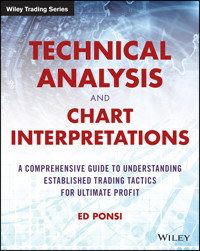
Ed Ponsi's straightforward guide to understanding technical analysis Technical Analysis and Chart Interpretations delivers simple explanations and easy-to-understand techniques that demystify the technical analysis process. In his usual straightforward style, bestselling author Ed Ponsi guides you through the twists and turns to show you what really matters when it comes to making money. Whether you trade stocks, currencies, or commodities, you'll develop invaluable skills as you master difficult concepts and the tools of the trade. Technical analysis translates to any form of trading, and this book delivers clear, jargon-free guidance toward interpreting the various charts you'll see in the field. Technical analysis can be confusing. Volatility, cycles, Elliot waves, Fibonacci, trends--it's easy to get lost, and most of the available literature is incomprehensible to all but the experts. This book is different--it's technical analysis for the rest of us. You'll see through the language to understand the underlying concepts, and how to apply them correctly. * Learn what true technical analysis entails * Discover the tools that simplify accurate analysis * Master the tactics and strategies used by the pros * Develop a valuable trading skill that transcends markets Simply recognizing the vocabulary isn't nearly enough, and a passing acquaintance with the topic is guaranteed to do more harm than good. When technical analysis methods are used incorrectly, they are ineffective at best, and actively destructive to your bottom line at worst. Technical Analysis and Chart Interpretations cuts through the confusion to give you a firm understanding and the skills to apply it correctly.
Sie lesen das E-Book in den Legimi-Apps auf:
Seitenzahl: 502
Veröffentlichungsjahr: 2016
Ähnliche

















Table of Contents
Title Page
Copyright
Dedication
Introduction: The Journey
About the Author
Part I: The Foundation of Technical Analysis
Chapter 1: Why Technical Analysis?
Technical and Fundamental Divergence
The Collapse of Lehman Brothers
Price Is Truth
Which Technical Analysis Method Will Work Best for You?
Chapter 2: The Language of Trading
Final Thoughts on the Language of Trading
Chapter 3: The Cornerstone
Dow Jones & Company
The Dow Jones Industrial Average
The Dow Jones Transportation Average
Final Thoughts on the Cornerstone
Chapter 4: The Dow Theory
Trends Are Persistent
Confirmation
Volume Confirmation
Other Types of Confirmation
Random Walk Theory
The Middle Ground
Final Thoughts on Dow Theory
Part II: Key Concepts of Technical Analysis
Chapter 5: Common Types of Charts
Price Data
Time Frames
Line Charts
Bar Charts
Candlestick Charts
Point and Figure Charts
The Use of Scale in Charts
Final Thoughts on Common Types of Charts
Chapter 6: Support and Resistance
Support Becomes Resistance, and Vice Versa
The Concept of Anchoring
All Levels Are Not Created Equal
Pullbacks and Throwbacks
Using Breaks in Support
Using Breaks in Resistance
Trading Between Support and Resistance
Final Thoughts on Support and Resistance
Chapter 7: Trends and Trend Lines
Uptrends
Downtrends
Breaking the Trend Line
Consolidation
Degree or Angle of the Trend
Sustainable Trends
Multiple Trend Lines
Channel Lines
Using Channel Lines
Support Becomes Resistance
Final Thoughts on Trends and Trend Lines
Chapter 8: Volume
Institutional vs. Individual Volume
Buyers vs. Sellers
Volume Represents Commitment
High-Volume Breakouts
Volume and Trend
Bearish Trend Volume
Support, Resistance, and Volume
Climactic Volume and Capitulation
Short-Covering Rallies
Final Thoughts on Volume
Chapter 9: Gaps
Full Gaps and Partial Gaps
Gaps in Illiquid Investments
Intraday Gaps
Opening Gaps
Breakaway Gaps
Runaway Gaps
Exhaustion Gaps
Island Reversals
Gap Fills
Currency Market Gaps
Final Thoughts on Gaps
Part III: Price Patterns
Chapter 10: Reversal Chart Patterns
Patterns Are Imperfect
Reversal vs. Continuation Patterns
The Head and Shoulders Reversal Pattern
Inverse Head and Shoulders Pattern
Head and Shoulders Continuation Pattern
Double Top Pattern
Double Bottom Pattern
Triple Top Pattern
Triple Bottom Pattern
Diamond Reversal Patterns
Final Thoughts on Reversal Chart Patterns
Chapter 11: Continuation Patterns
Triangles
Bearish Descending Triangle Pattern
Flags and Pennants
Wedges
Final Thoughts on Continuation Patterns
Chapter 12: Additional Chart Patterns
The Cup with Handle Formation
Fractal Cup with Handle
Respect Both Technical and Fundamental Analysis
The Broadening Formation
Final Thoughts on Additional Chart Patterns
Part IV: Candlestick Patterns
Chapter 13: Candlestick Charting Patterns
Candlestick Reversal Patterns
Complex Candlestick Reversal Patterns
Final Thoughts on Reversal Candles
Chapter 14: Continuation and Indecision Candlestick Patterns
Continuation Candlestick Patterns
Indecision Candlestick Patterns
Final Thoughts on Candlesticks
Part V: Fibonacci
Chapter 15: Fibonacci Trading Techniques
Leonardo Bonacci and
Liber Abaci
The Golden Ratio and Fibonacci Rabbits
Significance in Trading
Fibonacci Retracement Levels
Fibonacci Extensions
Fibonacci Retracements of Greater Than 100%
Fibonacci Time Applications
Fibonacci Cycles
Fibonacci Time Extension Lines
Final Thoughts on Fibonacci
Part VI: Technical Indicators
Chapter 16: Moving Averages
Order of Moving Averages
Moving Average Support and Resistance
Moving Average Trading Signals—Single Crossover System
Average Returns of the Golden Cross and Death Cross
Moving Average Trading Signals—Multiple Crossover Systems
Other Types of Moving Averages
Final Thoughts on Moving Averages
Chapter 17: Moving Average Envelopes and Bollinger Bands
Reversion to the Mean
Moving Average Envelopes
Bollinger Bands
Standard Deviation
Bollinger Band Breakouts
Cycle of Volatility
Bollinger Bandwidth
Final Thoughts on Moving Average Envelopes and Bollinger Bands
Chapter 18: Oscillators
Types of Oscillators
Centered Oscillators
Banded Oscillators
The Stochastic Indicator
Final Thoughts on Oscillators
Chapter 19: Average True Range (ATR)
The Market and the Sea
Creation and Development of ATR
Final Thoughts on ATR
Chapter 20: Complex Indicators
Average Directional Index
Parabolic Stop and Reverse
Always Tighten, Never Loosen
Final Thoughts on Complex Indicators
Part VII: Oscillators
Chapter 21: Point and Figure Charting
Point and Figure Basics
Increment or Box Size
Point and Figure Index Charts
Point and Figure Patterns
Point and Figure Catapult
Point and Figure Triangles
Point and Figure Price Targets
One-Box Reversal Targets
Final Thoughts on Point and Figure Charting
Part VIII: ATR, ADX, and PSAR
Chapter 22: Cycles and Tendencies
The Presidential Election Cycle
The Decennial Cycle
The “Sell in May” Cycle
The Santa Claus Rally
The January Barometer
Seasonal Cycles
Currencies—A Special Situation
Longer-Term Cycles
The Kondratieff Wave
Sector Rotation
Early Stage of Economic Growth
Middle Stage of Economic Growth
Late Stage of Economic Growth
Final Thoughts on Cycles
Part IX: Cycles
Chapter 23: Sentiment Indicators
A Bullish Bias
The AAII Sentiment Survey
The VIX
Commitments of Traders Report
Large Speculators versus Small Speculators
Final Thoughts on Sentiment Indicators
Part X: Point and Figure Charting
Chapter 24: Psychological Aspects of Technical Analysis
Behavioral Traps
Ten Trading Biases
Fallacies, Herding, and More
Final Thoughts on Traps, Biases, and Fallacies
Chapter 25: Understanding Bubbles
The Five Stages of a Credit Cycle
China Stock Bubble 2007
NASDAQ Stock Bubble 1999
China Stock Bubble 2015
Final Thoughts on Bubbles
Chapter 26: Trading versus Reality
Lesen Sie weiter in der vollständigen Ausgabe!
Lesen Sie weiter in der vollständigen Ausgabe!
Lesen Sie weiter in der vollständigen Ausgabe!
Lesen Sie weiter in der vollständigen Ausgabe!
Lesen Sie weiter in der vollständigen Ausgabe!
Lesen Sie weiter in der vollständigen Ausgabe!
Lesen Sie weiter in der vollständigen Ausgabe!
Lesen Sie weiter in der vollständigen Ausgabe!
Lesen Sie weiter in der vollständigen Ausgabe!
Lesen Sie weiter in der vollständigen Ausgabe!
Lesen Sie weiter in der vollständigen Ausgabe!
Lesen Sie weiter in der vollständigen Ausgabe!
Lesen Sie weiter in der vollständigen Ausgabe!
Lesen Sie weiter in der vollständigen Ausgabe!
Lesen Sie weiter in der vollständigen Ausgabe!
Lesen Sie weiter in der vollständigen Ausgabe!
Lesen Sie weiter in der vollständigen Ausgabe!
Lesen Sie weiter in der vollständigen Ausgabe!
Lesen Sie weiter in der vollständigen Ausgabe!
Lesen Sie weiter in der vollständigen Ausgabe!
Lesen Sie weiter in der vollständigen Ausgabe!
Lesen Sie weiter in der vollständigen Ausgabe!
Lesen Sie weiter in der vollständigen Ausgabe!
Lesen Sie weiter in der vollständigen Ausgabe!
Lesen Sie weiter in der vollständigen Ausgabe!
Lesen Sie weiter in der vollständigen Ausgabe!
Lesen Sie weiter in der vollständigen Ausgabe!
Lesen Sie weiter in der vollständigen Ausgabe!
Lesen Sie weiter in der vollständigen Ausgabe!
Lesen Sie weiter in der vollständigen Ausgabe!
Lesen Sie weiter in der vollständigen Ausgabe!
Lesen Sie weiter in der vollständigen Ausgabe!
Lesen Sie weiter in der vollständigen Ausgabe!
Lesen Sie weiter in der vollständigen Ausgabe!
Lesen Sie weiter in der vollständigen Ausgabe!
Lesen Sie weiter in der vollständigen Ausgabe!
Lesen Sie weiter in der vollständigen Ausgabe!
Lesen Sie weiter in der vollständigen Ausgabe!
Lesen Sie weiter in der vollständigen Ausgabe!
Lesen Sie weiter in der vollständigen Ausgabe!
Lesen Sie weiter in der vollständigen Ausgabe!
Lesen Sie weiter in der vollständigen Ausgabe!
Lesen Sie weiter in der vollständigen Ausgabe!
Lesen Sie weiter in der vollständigen Ausgabe!
Lesen Sie weiter in der vollständigen Ausgabe!
Lesen Sie weiter in der vollständigen Ausgabe!
Lesen Sie weiter in der vollständigen Ausgabe!
Lesen Sie weiter in der vollständigen Ausgabe!
Lesen Sie weiter in der vollständigen Ausgabe!
Lesen Sie weiter in der vollständigen Ausgabe!




