


Erhalten Sie Zugang zu diesem und mehr als 300000 Büchern ab EUR 5,99 monatlich.
- Herausgeber: The Crowood Press
- Kategorie: Lebensstil
- Sprache: Englisch
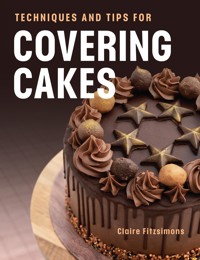
Using detailed, fully illustrated step-by-step instructions, Techniques and Tips for Covering Cakes provides practical guidance on how to cover a variety of cakes using six different types of cake coverings. Some of the cake coverings are quick to achieve and require minimal preparation whilst other projects will provide the keen cake decorator with more of a challenge. Popular coverings such as buttercream and chocolate are included as well as sugarpaste, royal icing, marzipan, fruit and nuts.
Sie lesen das E-Book in den Legimi-Apps auf:
Seitenzahl: 240
Veröffentlichungsjahr: 2024
Das E-Book (TTS) können Sie hören im Abo „Legimi Premium” in Legimi-Apps auf:
Ähnliche

















CONTENTS
Preface
Chapter 1Basic Cake-Decorating Materials and Tools
Chapter 2Cakes – All Shapes and Sizes!
Chapter 3Buttercream
Project 1: Rose Cupcakes
Project 2: A ‘Semi-Naked’ Celebration Cake
Project 3: St Clement’s Ombre Birthday Cake
Chapter 4Marzipan
Project 4: Two Ways to Cover a Fruit Cake before Icing
Project 5: Battenberg Cake
Project 6: Prinsesstårta Cake
Chapter 5Chocolate
Project 7: Chocolate Yule Log
Project 8: Triple-Chocolate Drip Cake
Project 9: Mirror-Glazed Chocolate Mousse Cakes with Salted Caramel
Chapter 6Fruits and Nuts
Project 10: Summer Berries Celebration Cake
Project 11: Sicilian Cassata Cake
Project 12: Fruit Cake with a Glazed Nut Topping
Chapter 7Royal Icing
Project 13: Swirly Textured Christmas Cake
Project 14: Pearl Wedding Anniversary Cake
Project 15: Small Square Celebration Cake with a Collar
Chapter 8Sugarpaste
Project 16: Daisy Ring Celebration Cake
Project 17: Fondant Fancies
Project 18: A Three-Tier Wedding Cake
Chapter 9Finishing Touches
Appendices
Suppliers
Further Reading
Conversion Tables
Index
PREFACE
Ihave been teaching, in some form or another, for nearly forty years. I began my teaching career in London as a primary school teacher, and taught for nearly twenty-five years before embarking on a change of direction.
Cooking and baking have always been centre stage in my life. My parents and grandparents were all good cooks, and I was always keen to be in the kitchen, amongst all the action! My Nana, who lived with us, started collecting a monthly magazine called the Cordon Bleu Cookery Course. When the magazines were reprinted into a collection of twelve books, she bought me the set for my sixteenth birthday. My love for cooking and baking was then firmly established. When I left home to go to college, my books came with me. Whilst I was teaching cooking, baking and sugarcraft became my hobby and creative outlet, and I attended a variety of weekend courses, mostly sugarcraft and cake decorating.
When my husband and I decided to move away from London, I knew I would need to occupy myself with something if I was not going to be in the classroom every day. Sitting at the kitchen table one night, my husband looked up at my cookery books and pointed to my Cordon Bleu books. ‘How about going on a course there?’ Before I had an opportunity to change my mind, I had enrolled on a three-month course! The three months became nine months and I qualified as a Chef de Cuisine in the summer of 2007. I then completed a part-time Sugarcraft course at Brooklands College in Weybridge.
After working as a private chef and wedding-cake maker for a while, I began to miss teaching. I applied to work as a sugarcraft tutor in a renowned cookery school in Farnham, Surrey. I taught general sugarcraft skills, making wired sugar flowers and baking. I also became a cookery tutor for Surrey adult learning, teaching French cuisine. When the Covid pandemic struck, both schools were forced to close. As life started to slowly return to normal, I made the decision to continue to teach, but only at home. I now run small sugarcraft workshops from my home in Surrey.
There has been a resurgence of interest in cake making and decorating in recent years, mainly due to popular television programmes such as The Great British Bake Off. The internet and a variety of publications all provide recipes, along with a photograph of the finished cake. In this book I provide practical step-by-step guidance, using simple instructions and photographs that describe how to cover a variety of cakes using six different types of cake covering, as well as a photograph of the finished cake.
Chapters 3 to 6 each include three projects of differing complexity. I have included some simple recipes for the cakes, but as the focus of this book is on how to cover the cakes, most of the detailed instructions are about the covering. Popular cake coverings such as buttercream and chocolate are included, as well as sugarpaste and royal icing. Some of the cake coverings are quick to do, but I have also included projects that require some time and preparation.
My final chapter gives an assortment of ideas for final decorations. I have called it ‘Finishing Touches’. Many of these decorations can be bought ready-made, and when time is an issue this may be your preference. However, most of the decorations can be made well in advance and stored until needed. They could be ‘mini projects’ when time allows.
When the pandemic struck, I contemplated teaching online classes but decided it was not for me. About ten years ago one of my students, Kate, commented ‘you have so many handy hints and tips – you should write a book!’ So when I was approached by The Crowood Press, and remembering Kate’s comment, I thought – why not? This would be a wonderful opportunity to teach and share my ideas in a different format.
Nothing has given me greater pleasure than teaching learners of all ages, sharing with them the skills needed and giving them the confidence to succeed.
I hope this book will give you all the guidance required to produce a beautifully covered cake!
CHAPTER 1
BASIC CAKE-DECORATINGMATERIALS AND TOOLS
Before embarking on any kind of cake decorating, it is important to ensure you have the correct tools to hand. There are some essential pieces of equipment that all cake decorators will need, as well as specialised tools that are specific to the type of cake covering.
There is a dizzying array of equipment to buy on the market now, some of which are very useful, but many of which are not! Buying good, well-made materials and tools from reputable companies will be more cost effective in the long run as they will last for years. Tools that are cheap to buy and promise a ‘quick fix’ decoration rarely deliver.
Some essential tools for cake decorating.
This chapter will act as a guide through some of the items used for cake covering, beginning with the essential pieces of equipment. The chapter later looks at some items that may be useful to have, but are not necessarily vital!
ESSENTIAL EQUIPMENT
Cake Tins
Cake tins come in all shapes and sizes, from round, square and rectangular, to loaf and hemisphere. Unless the plan is to have a career in cake making, consider the practicalities of storing a huge collection, as well as the issue of the cost. Rather than purchasing an array of tins, buy just one or two good quality tins of a standard size instead.
Cake tins come in all shapes and sizes.
Most family cake recipes call for a 20cm (8in) round deep tin. This size will give approximately fourteen cake servings. This is useful if you are considering baking a tall sponge cake with several layers of buttercream or ganache.
A smaller, 15cm (6in) tin will be large enough for a sponge celebration cake serving six to eight people.
Popular tins include:
•Shallow sandwich tins: These are useful for making a layered cake. The advantage here is that cakes are quicker to bake, the disadvantage being that more than one tin will be needed. Tins that have a removable bottom are useful as cakes are easier to remove from the tin.
•Spring-form tins: These have a spring-loaded clip at the side of the tin. This makes the removal of delicate cream sponges or cheesecakes much easier.
•Loaf tins: These tins usually come in two sizes, 450g (1lb) and 900g (2lb), although the shapes of the tins can vary from quite narrow with sharp corners to square with rounded corners. These are used for loaves, sweet and savoury.
•Square and rectangular tins: These tins are popular for celebration cakes. They have the advantage of making a cake that is much easier to portion up. This might be a consideration if tasked with cutting up a large cake at a party.
Another cake for large events and parties is the popular traybake. There are traybake tins available to buy, but a sharp-cornered roasting tin could be used instead.
•Bundt tins: These tins have become increasingly popular. They produce very ornate, patterned cakes that require minimal or even no cake covering. This can be a huge advantage if time is short. They are available to buy in both metal and flexible silicone, and come in a variety of shapes and sizes. The most expensive to buy are made from cast aluminium. They are quite heavy, but have the advantages of producing a cake with well-defined patterns, and being able to withstand many years of use. The advantage of silicone moulds is that they are much cheaper to buy, however, the detail on the finished bake often lacks definition.
•Novelty cake tins: These tins have become increasingly popular, particularly for children’s cakes. The results can sometimes be disappointing as the impressed pattern on the inside of the tin is rarely defined and is often lost on the baked cake. Consider buying a shaped tin instead. A dome or hemisphere tin, for example, would give far more decorating opportunities, from making a ladybird cake or ‘the skirt’ on a doll cake, to a spaceman’s helmet or even a football!
Whichever cake tin is used, always remember to prepare the tin correctly, either by greasing and/or lining it with good quality baking paper. This will not only help to release the cake, but it will also extend the life of the tin.
Hiring Tins
If a very large tin or a novelty shaped pan is needed for a one-off event, consider hiring one from a local cake-decorating shop. Second-hand tins are also available to buy in charity shops and from online sites such as eBay.
Stand Mixer
A stand mixer should not be considered an essential piece of equipment. Most good stand mixers are extremely expensive, and it is perfectly possible to make all the coverings in this book without using one. But if you enjoy baking it is a worthwhile investment. A good quality machine can last many years. Most brands come with useful attachments, including a paddle for mixing batters as well as a whisk for whipping cream and egg-based toppings. Kenwood and KitchenAid are two of the most popular brands. Both have different sized models with differing capacities, and both have various add-on attachments available. These machines are often available to buy second hand or as ‘reconditioned’.
A stand mixer and hand whisk are both useful for a keen cake maker.
Hand Mixer
A hand mixer is another kitchen appliance to consider. As it is more compact and affordable than a stand mixer, it is a very useful alternative. Many cake makers believe a lighter sponge can be achieved by using a hand mixer rather than the more powerful stand machine, which may overbeat more delicate cake mixtures. Most have a set of attachments, including a whisk. These vary enormously in price, and it is worth doing a little research to find one that best suits your needs as well as your budget. Some hand mixers are available with a stand. Also new to the market are cordless machines, which would be very useful when whisking in a confined space or when needing to whisk a mixture over a bain marie or near to the cooker.
Weighing Scales
Weighing ingredients accurately is essential when following a recipe, so a reliable set of scales is a worthwhile investment. Digital scales tend to be the most accurate, and most allow measurements to be changed between imperial and metric. Salter are a trusted brand, but there are many on the market to suit every budget.
Cake Turntable
A revolving turntable is an essential piece of decorating equipment. It will allow the cake to be turned round with one hand whilst applying the covering of buttercream, ganache or whatever with the other. It will raise the cake to a workable height, which will help to avoid neck and back strain. It will also make it easier to check that the cake is level.
Examples of static and tilting turntables.
Avoid using a static cake stand with a lipped edge for decorating. These are for displaying and presenting a finished cake. A decorating turntable has a flat edge, making it easier to slide the cake off the surface. Some have a non-slip surface and have a ‘tilt’ facility. This is very useful when piping small and delicate details round the sides of a cake.
Serrated Knife or Cake-Cutting Wire
A long serrated knife, such as a bread or ham knife, is useful to cut cakes across for even layers. A serrated knife will cut through a sponge without tearing it. Another option is to use a cake-cutting wire. These are easy to use and inexpensive. The next chapter will explain how to use both a serrated knife and a cutting wire to level a cake, as well as slice it into even layers for filling.
A long serrated knife or cake wire cutter is useful for cutting cakes into even layers.
Non-Stick Rolling Pin
When covering a cake with marzipan or sugarpaste, a rolling pin will be needed. For cake decorating, these are usually made from silicone or plastic rather than wood, as they need to be non-stick. They come in a variety of sizes. Choose one that is an appropriate length for the width of the cake.
Non-Stick Board or Rolling Mat
A non-stick board or silicone rolling mat will make the task of rolling out marzipan or sugarpaste so much easier. It will reduce the amount of icing sugar or cornflour used when trying to prevent the paste from sticking to the work surface. If space is an issue, consider having a silicone roll-up mat. They are non-slip and come in a variety of sizes. Buy a large one that will give a spacious working area. Some have measurements and size guides printed on them, which will help when rolling out the paste.
Cake Boards and Cake Drums
Cake boards are available in a variety of shapes and sizes and are inexpensive to buy. They are needed not only to display decorated cakes, but also to give a support under each cake when making a tiered or stacked cake. Cake drums are non-compressed cake boards. They usually have a depth of approximately 1cm (0.4in). When covering a drum with sugarpaste, the combined depth of the paste and the drum equals 15mm (0.6in), so the edge of the board can be covered with 15mm-width ribbon.
Large disposable food-safe boards are useful when decorating. They make the task of moving a fragile cake from work surface to turntable or display board so much easier. If a cake board is not used underneath the cake when moving it, there is a high chance that it will crack when being lifted into position.
Cake boards and cake drums are available in a variety of shapes and sizes.
Baking or Parchment Paper
Baking paper has several uses for cake decorating as well as the more obvious use as a wrapping. Once baked cakes have cooled, they need to be covered. A good quality baking paper or non-stick parchment paper will prevent the cakes from drying out. It is available to buy on a roll, as sheets, or as ready-cut circles. The ready-cut circles are particularly useful when needing to line several tins for baking. Baking parchment can be used for making piping bags for royal icing. Small squares of baking paper or waxed paper are required when using a flower nail for piping flowers with buttercream, royal icing or ganache. Simple stencils for decorating the sides and top of a frosted cake can also be made with baking paper.
Aluminium Foil
Foil is another essential item and one that most people have in their kitchen cupboard. Foil has several uses. As well as being used in baking, it is perfect for wrapping cakes such as fruit cakes for long-term storage. It can also be scrunched up or moulded into cups to use as a mould for drying sugar and chocolate decorations.
Acetate Sheets and Rolls
Food-safe acetate sheets are readily available to buy online or in specialist cake and sugarcraft stores. They are invaluable for piping small decorations with royal icing and chocolate. Acetate is also available to buy on a roll in various widths. Narrow-width rolls are often referred to as cake collars. Here the acetate can be used either to line a cake tin to give extra height, or to support creamy fillings before setting when making a cold dessert or a cake such as a Frasier.
When working with melted chocolate, a strip of acetate can also be used to apply a side design to a cake. Once set, the acetate can be peeled away easily without having to touch the surface decoration. The chocolate will have a smooth sheen devoid of finger marks!
Spatulas
A set of rubber or silicone spatulas are handy to have for mixing small quantities of icing, buttercream or jam. Silicone ones can withstand high temperatures. They are easy to clean, which is a huge advantage when mixing syrups and sticky glazes.
Palette Knives
A large, long palette knife is very useful for applying various coatings to the top and sides of cakes with a large surface. A small-angled palette knife allows coating or icing to be applied to hard-to-reach areas whilst keeping hands and fingers away from the icing.
Palette knives – long, short and angled.
Silicone spatulas and pastry brushes are both easy to clean and can withstand high heat.
Silicone Pastry Brush
Traditional pastry brushes are made with natural bristles and usually a wooden handle. They are used for applying glazes or an egg wash. They are difficult to clean thoroughly as they require handwashing only. In time they will also begin to shed their bristles. Silicone pastry brushes on the other hand are heatproof, dishwasher safe and do not shed their bristles. They are more hygienic as they can be cleaned at a higher temperature, avoiding a build-up of old food particles.
Tape Measure or Ruler
Measuring the depth and diameter of the cake is necessary before rolling out marzipan or sugarpaste. Guesswork is not an option here, and having something to measure with will save time and avoid a potentially costly mistake!
Tape measure, ruler and rolling-pin with guide rings.
Rolling-Pin Guide Rings and Spacers
A quick and easy way to achieve an even thickness when rolling out marzipan and sugarpaste is to use either rolling-pin guide rings or spacers. The silicone guide rings have two rings in each set and are used by attaching one ring to each end of the rolling pin and then rolling out the paste until the guide rings touch the work surface. The advantage of the set of ring guides is that they come in different thicknesses so can be used for pastry as well as marzipan and sugarpaste.
The set of two spacers is used by placing one on each side of your paste and rolling out until the rolling pin no longer spreads the paste and the correct depth of paste is achieved.
Cake Smoothers
If covering a cake with marzipan or sugarpaste, a cake smoother is an essential tool – and ideally use two, one for each hand. Choose smoothers that have at least one straight edge with sharp corners. They are used to smooth the paste on the top and sides of the cake. They can also give a polished finish to sugarpaste. Flexible smoothers are used when decorating cakes with sharp edges. They are made of silicone and come in various shapes and sizes.
Cake smoothers, side scrapers and contour combs.
Side Scrapers and Contour Combs
These tools are used to scrape away excess buttercream, royal icing, chocolate or ganache, as well as giving a final smooth coating to a cake. They are available in plastic and metal, and both work equally well. However, metal scrapers can be used warm, which can sometimes be helpful when wanting to achieve a smooth buttercream, ganache or chocolate coating.
Side scrapers come in different sizes, so think about the height of the finished cake. Tall side scrapers are available to buy for modern, multiple-layered cakes. Double-edged scrapers, also known as contour combs, have either one straight side and one patterned side, or two patterned sides. These can be used with buttercream, chocolate ganache or royal icing to create contours and patterns on the sides of cakes.
Piping Bags
For piping buttercream and ganache, some large piping bags will be needed. This size of piping bag is available either as a reusable bag that is usually made of nylon or silicone, or as a disposable bag, made of plastic. These are usually sold on a roll and are less cost effective but are sometimes preferred as they are more convenient. Good quality plastic bags are easier to grip when piping, they can be washed thoroughly, and reused several times before disposal. Biodegradable plastic bags are also now readily available.
Buttercream-and ganache-filled bags can also be stored in the fridge or freezer.
Paper piping bags are used for piping small quantities of royal icing or chocolate. These can be bought ready-made in various sizes, as well as in sheets, ready cut to assemble into bags. The most cost-effective option is to make a piping bag, using good quality baking parchment. Easy step-by-step instructions on how to make one can be found on p.102.
Different sized piping bags and a variety of piping nozzles.
Piping Nozzles
Choosing the correct piping nozzle is dependent on the type of decoration required. Larger nozzles are made of either metal or plastic and are generally used for piping buttercream and other thick frostings. Small metal piping nozzles are used for royal icing or melted chocolate. Most nozzles are identified by a number or letter, although some brands prefer to use their own numbering system, which can be rather confusing! There are some specific nozzles required in the projects for buttercream and royal icing, and examples of piping effects given in Chapter 9.
USEFUL EQUIPMENT
Pizza Wheel
A pizza wheel is not an essential cake-decorating piece of equipment, but a kitchen tool that many households may already own. It is very useful for easily trimming away marzipan and sugarpaste around the base of the cake once it is covered.
Small Spirit Level
Although not an essential piece of equipment, a small spirit level can be extremely useful. A level cake will be much easier to cover, and is vital when stacking cakes one on top of another. Keep a small spirit level just for cake decorating.
Cake Cooling Rack
As well as using a cooling rack for cooling down baked cakes, a rack will be needed when applying drips and liquid glazes to a cake. Choose a cooling rack that has a non-stick coating. It will be easier to remove the cake from the rack as well as being easier to clean.
Kitchen Thermometer
An easy-to-read digital hand-held thermometer with a long probe will take the guesswork out of checking the temperature of cooked frostings, such as ganache, Swiss meringue buttercream and mirror glazes. They are easily obtainable from most good cook shops.
Tweezers
This is another non-essential item, but one that can be extremely useful when applying tiny embellishments, such as tiny sugar pearls, on to a finished cake. Cake-decorating tweezers are usually curved to help place small decorations accurately anywhere on the cake without damaging the cake surface.
Fine Skewer, Scribing Tool and Acupuncture Needles
All these tools can be used for similar tasks when using sugarpaste as a cake covering.
Sometimes air bubbles form in the paste when rolling it out, and these can be easily removed using one of these tools. They are useful for accurately marking a guide line when piping on the side of a cake. They are also useful for marking on the top of the cake as a guide for inserting dowels when making a stacked cake.
A very fine skewer is easily available in most good cook-shops. A scribing tool is a cake-decorating tool that has a handle with a fine, needle-like tip. These are available from most good cake-decorating shops. Individually wrapped acupuncture needles are also a good choice as they are sterile and therefore more hygienic to use. They are easily available to buy online.
Acupuncture needles, scribing tool and a fine skewer.
Shaped Cutters and Plunger Cutters
These cutters are certainly not essential, but when time is short and a quick decoration is needed on top of a cake, a little set of cutters is useful to have at hand. Plunger cutters such as these can provide an almost instant sugarpaste decoration with minimal effort. An example of their use can be found in Project 16 in Chapter 8.
A selection of shaped cutters and plunger cutters.
Silicone Moulds
Small silicone moulds such as these can also give an instant impact to a finished cake. They are more expensive to buy than cutters, but sugarpaste, chocolate and marzipan can all be used in a silicone mould. Examples of their use can be found in Chapter 9, ‘Finishing Touches’.
A variety of silicone moulds.
CHAPTER 2
CAKES – ALL SHAPES AND SIZES!
There is a style and type of cake to suit every occasion! So, think about the event and how many servings will be needed. Also consider whether there might be any dietary requirements to take into account. Most recipes can now be easily adapted to make a gluten-free or vegan cake, thanks to readily available ingredients in the supermarket. If making a cake for a family celebration, consider the dietary restrictions for children, pregnant or nursing mums and elderly relatives. Using cake toppings that contain raw egg white or alcohol may not be appropriate.
A variety of cakes, all shapes and sizes.
As this book is about providing the tips and techniques needed for covering cakes, some cake recipes are not given, although the recipes for fillings and toppings have all been provided in the projects throughout the book. Here are some suggestions for popular cakes to suit a variety of occasions, as well as step-by-step instructions on how to prepare two types of sponge cake for filling and covering. One is a round sponge, baked in two separate sandwich tins, and the other is a rolled fatless sponge.
Consider Where the Event Will Take Place
If the party is outside and the cake is going to be sitting in the sunshine for longer than fifteen minutes, then a fresh cream filling or a cream cheese topping may not be a suitable choice!
VICTORIA SANDWICH
A Victoria sandwich is a perennial favourite when filled with jam and/or buttercream or freshly whipped cream. A simple finish can be made by dusting with either icing sugar or caster sugar. To make a very simple decorative topping use either a stencil or paper doily. Place this on the top of the cake before dusting over lightly with icing or caster sugar as shown in the step-by-step guide below.
A basic recipe for a Victoria sandwich, sometimes known as a Victoria sponge, can also be adapted to make other flavoured cakes, using any of the citrus fruits. Fresh lemon, lime, orange and grapefruit all work well by adding the zest of the fruits into the cake mixture and the juice to a buttercream filling. Avoid adding juice to fresh cream fillings as they will curdle. Both chocolate and coffee cakes can also be made using a Victoria sandwich recipe. For a chocolate cake, substitute some of the flour in the cake recipe with cocoa powder, or make a paste by mixing cocoa powder with water or milk and add melted chocolate to the buttercream filling. Coffee essence or reconstituted coffee granules can be added to both the cake batter as well as the buttercream filling. Adding walnuts to coffee cakes is also a popular choice, but best avoided if young children will be eating the cake.
A Victoria sandwich cake.
When making a selection of cakes for large gatherings, it is also a good idea to label specific cakes if they contain ingredients known to cause allergic reactions, such as nuts and sesame seeds. As well as baking larger cakes, consider making individual cakes using cupcake paper cases or individual card cases, either round or loaf shaped.
MADEIRA CAKE




