


Erhalten Sie Zugang zu diesem und mehr als 300000 Büchern ab EUR 5,99 monatlich.
- Herausgeber: EECLECTIC
- Kategorie: Geisteswissenschaft
- Serie: Scriptings: Political Scenarios
- Sprache: Englisch
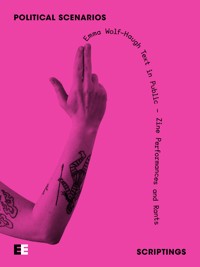
Emma Wolf-Haughs Publikation Text in Public – Zine Performances and Rants verbindet Texte aus performativen Arbeiten, Performance-Skripte sowie collagierte und kollektiv entstandene Textformen miteinander. In Wolf-Haughs interdisziplinärer Praxis der letzten zehn Jahre überlagern sich Installation, Performance und experimentelle Workshop-Formate. Oft dient dabei DIY-Publishing im Kollektiv oder Selbstverlag dazu, Emmas vielschichtige Aktivitäten mit Text zu bündeln und neu zu kombinieren. Die Publikation durchquert kulturelle und historische Schauplätze, gelebte Gegenwart und imaginierte Zukünfte und nutzt Autofiktion und Anekdote als Teil einer Tradition queer-transfeministischer Arbeiter*innensprache und -ethik, die freizügig ist und gleichzeitig geschickt innerhalb von Limitationen operiert.
Sie lesen das E-Book in den Legimi-Apps auf:
Seitenzahl: 146
Veröffentlichungsjahr: 2022
Das E-Book (TTS) können Sie hören im Abo „Legimi Premium” in Legimi-Apps auf:
Ähnliche




















Emma Wolf-Haugh
Text in Public
Zine Performances and Rants
Edited by Achim Lengerer
Published by
SCRIPTINGS
and
EECLECTIC
Many of the texts in this publication were written for performance, some for live performance, some as scripts for video and others as performative writing that lives across the page towards imagination.
Index
Sex in Public
What the Fuck Are You Looking At? Translating Your Gaze
Poverty of Vision
Libidinous Memorial Flag for Peter Clemens
Inflamed Recreation Room
The Re-appropriation of Sensuality
Dyke Action – Sex in Public with Line Skywalker Karlström
Domestic Optimism Act One:
Modernism – A Lesbian Love Story
Domestic Optimism Act Two:
Radclyffe Hall – The Lazerbeam Theirstory Projects
Friction, Magic, and Queens
Reading Troupe #01:
Physical Education, Exercises in Embodying Discourse
Obsidian Butt Plug
Symbolic Monarch Tells Women of Ireland to Calm Down...Wait...Really?
Relational Otherness: A Manifesto
Sex in Public
A model citizen is supposed to represent – face forward, smiling.
Full optimisation and the national future.
Citizenship, reproductive family feeling, inheritance and blood.
The centrality of blood is the mechanism by which corrosive sexuality is immaculatised in a space of sentimental nationalism.
This privatised sexual culture is what was called the love plot of intimacy, a rite of blood as a psychic base for identification.
Enforcing boundaries between open spaces, commerce replacing state, making sex private by making bodies narrative, productive things – cushioned from chaos by the reinforcement of public and private divisions.
Fantasy becomes banalised by ordinariness; the most intimate crevice now vibrates in the law.
The explicit aim is to structure everyday life, currently phrased as the promotion of a white-dominated social mirage, carefully organised by hazy mass memories and faceless hierarchies.
Above the door is written: The Amnesia Archive.
Let’s say these whirl exploitations are central to the bureaucratic transactions of citizenship and let’s speak their names.
One, Two, Three
If viewed from miles above, this place would appear as a small boxlike structure, like thousands of others set down along the lines of rivers in the world. Though in this one the face of the girl starts moving up the wall, past a window framing the perfect hazy coastline with teeth of red factories and an incidental gas tank explosion which sends flowers of black smoke reeling up into the dusk. I can feel her lips against mine from across the room, tasting weed or cheap white wine on them as she disappears through a square hole in the ceiling. Watching as her legs and feet leave the rungs of the metal ladder, following her hips through that dark space, the soles of her sneakers floating effortlessly in the opening for a second, then shifting out of view. I follow her motions, pulling myself up two rungs at a time and, as my head clears the ceiling, I see her recede further back in the space, the horizontal red lines of her arms still luminous. Like her I have to crouch in order to move through the narrow space and finally reach her. Her hands slide from her pockets and over the front of my trousers, moving back and forth until we we’re both wet.
I lean in close and unsnap her jeans, button by button, using only my teeth.
One, Two, Three
To cultivate a collective ethos of futurity through the fractures of the contemporary, they gave up their monogamy.
Distinctions between self and other collapsed, while the relationship between visibility and this hegemonic cluster slid along its developmental slope, downwards, inwards, towards a middle point.
Practical homonormativity and well-cared-for economic brick walls rewrite the meanings of vulnerability and receptivity and the whole field of sexual and social relations becomes a privatised ethics of fiscal ties.
This sense of rightness could come and dance directly on top of you in a dense, relentless way.
If every sexual encounter involves bringing someone back to your house, the general sexual activity in a city becomes anxiety-filled, class-bound and choosy. Public rest rooms, peep shows, sex movies, bars with grope rooms and parks with enough greenery are necessary for a relaxed and friendly sexual atmosphere within a democratic metropolis.
Non-residential scenes of intimacy – warm, unstable, shifting, intimate lives involving rages, instabilities, ambivalences and failures. A range of ways of being sociable and sensual beyond civic coherence. It is through sex, touch, sound, sight, smell – as well as reverse biopolitical processes – that bodies bring worlds of non-economic erotic exchange into being.
A complex cluster of sexual practices, intimacy and care makes us think about the many ways in which vulnerability can be performed.
One, Two, Three
I unbuckled her belt and she pulled down her pants. I turned her gently around, slowly eased my fingers into her ass, and she pushed into me, taking my fingers all the way down. Her ass was lubricated with Vaseline, I wondered if it was from this morning or last night. That thought made me even hotter. Someone started licking my back and stroking my pussy from behind. This was also a great pleasure for me. I fucked her gently at first, then gradually as hard as I could. Sweat poured off us in sheets. From the depth of inebriating darkness of that underground cave, I fucked and got fucked, moments of surrender for all of us. Onlookers touched themselves in the shadows.
Rethinking the presumptions about penetration and vulnerability, the sexual and emotional intimacies of touching and being touched go on endlessly.
The liberation of doing it, in not admitting to ourselves and others that we were confronted with our own failed attempts to transcend fantasies, in asking what the limits of queer might be. Thinking that queer might not be the word to define all of our unrealised public cultures around different aspects of emotional life.
Forms and arrangements – as fictional, uneven, off-centre – destabilise the importance of a historical relation to a statistically imagined norm. At this point, the critical culture of the public sphere is produced in almost every aspect of the convex, bent, radiating shadows.
One, Two, Three
It was dark because somebody had taken the bulb away. I had a piss and, as my eyes became accustomed to the gloom, I saw a woman, a labouring type, big with cropped hair and, as far as I could see, wearing jeans and a dark short coat. Another woman entered and the woman next to the labourer moved away, not out of the place altogether, but back against the wall. The new woman had a piss and left the place and, before the woman against the wall could return to her place, I nipped in there sharpish and stood next to the labourer. I put my hand down and felt her pussy and she immediately started to touch mine. The youngish woman with fair hair, standing back against the wall, went into the vacant place. I unbuttoned the top of my jeans and loosened my belt to allow her free reign. The woman next to me began to feel my arse. At this point a fifth woman entered. Nobody moved. It was dark. Just a little light spilled into the place from the street, not enough to see immediately. The woman next to me moved back to allow the fifth woman to piss. But the fifth woman quickly unbuttoned her shirt and flashed her tits and the women next to me returned to my side, lifting up my coat and shoving her hand down the back of my trousers. The fifth woman kept puffing on a cigarette and, by the glowing end, watching.
One, Two, Three
People come here to find each other.
Activist claims to visibility quickly follow those material transformations where ‘the woman’ imagines sex in public; this involves smooth bondage tape that guarantees safer sex in a homophobic environment, seamless black silk tightly stretched emphasise the look and practice of decorating the soft, badly lit areas.
In feelings of embarrassment, frustration, and anger with imposed structures and affects of narrativity, you passed through the unique combination of decor, space, lighting and dance with a spiritual education.
The absence of clocks contributed to the dynamic. In the everyday world the clock signifies the unstoppable forward movement of logical time. When the clocks are nowhere to be seen, time starts to dissolve, providing an opportunity to forget our socialised selves – the person who has to get up at a certain time, go to work at a certain time, take lunch at a certain time, leave work at a certain time, and so on – and we can experiment with a different cycle.
Time, though, doesn’t simply stand still, but goes into symbolic reverse.
One, Two, Three
I followed the trail through the woods towards another sandbank. Upon arriving I noticed an inconspicuous path around the periphery, lined with queer-looking women standing about. Were all the stories true? My heart started pounding. Could this be the holy grail? I chased that feeling into the woods, and deep inside I found several women with their pants down, kissing one another while a dyke on her knees alternated licking them. There were about five other women around them watching, silently, as though observing a fine piece of art they wouldn’t dare touch. It was like I’d gone back in time.
Curious to see the other happenings around the woods, I backtracked to the main trail and followed it south.
I passed a grassy patch full of dykes lounging in the sun. There was no way that they couldn’t see the orgy from where they were sitting. Then it occurred to me that they were also probably cruising. Across from them was another path into the woods with even more femmes, butches and transmen coming and going.
Unbelievable, I thought with a smile. I entered and followed the narrow pathway along the sandbank. There were about fifteen other queers in there with wandering eyes, but no sex to speak of. Though they were hungry for it – waiting for it, you could tell.
I decided to stand on the path and cruise too. From where I was, I could see families through the woods passing by. All they had to do was look over and they could see exactly what was going on, especially where the orgy was happening. It made me feel strongly content to know this.
___________________________________________________________________________________________________________
Sex in Public was developed through a series of performance experiments at Ecologies of Practice, Tanzfabrik, Studio 13, Berlin, 2017 & The Other Thing, MDT Theatre, Stockholm, 1–2 April 2017, both curated by Siegmar Zacharias, as well as at Miraculous Thirst, how to get off in days of deprivation, Galway Arts Centre, curated 2018 by Iarlaith Ni Fheorais with Basic Space.
The finished work was shown as part of the group exhibition TOUCH, nGbK neue Gesellschaft für bildende Kunst, Berlin, curated 2018 by the working group: Bakri Bakhit, Nadja Quante, Thomas Rustemeyer, Anna Voswinckel & Maja Zimmermann.
Sex in Public incorporates collaged texts from:
Lauren Berlant & Michael Warner, ‘Sex in Public’, 1998
Samuel R. Delany, Times Square, Red Times Square Blue, 1999
Joe Orton, The Orton Diaries, 1986
David Wojnarowicz, Close to the Knives: A Memoir of Disintegration, 1991
Video: Sex in Public, video performance, excerpt, 1.28 min, sound developed in collaboration with Teresa Stroetges, voice: Emma Wolf-Haugh, 2017
What the Fuck Are You Looking At?
Translating Your Gaze
Recently I was on the S-Bahn, listening to music, lost in thought, engaging more with an internal world than the external world of public space. I caught the eye of an older man standing across the aisle. It was clear that he had already been looking at me before I noticed him. I was immediately pulled into an awareness of myself as I might be seen from outside, in this instance an uncomfortable sensation. Usually, when you catch someone looking at you in public space, there is an unspoken agreement that they will look away – once the acknowledgement is made. But this man didn’t flinch, he continued staring without any change in expression; in fact, his face was oddly expressionless. Although I held his gaze for quite a long moment, he continued his staring. I couldn’t read him. His gaze wasn’t clearly hostile, although it could have been. It could also have been objectively bored, beyond giving any kind of shit – but then why single me out from all the bodies on the train?
I wondered if perhaps I’d held his gaze for too long and the look had been misunderstood. Maybe he thought I was responding to a cruising gesture, possibly he read me as a gay man and was trying his chances at the end of the working day. It wouldn’t be the first time I’ve been cruised by men in public.
The strange and stark encounter continued until my stop. I was unsettled, angry and confused. I didn’t know how to respond, whether to bridge the silence with some kind of verbal retort or attempt deflection by adopting some version of a noble statue.
I remember a good friend telling me that when men stared at her on public transport she would start to drool and dribble and they would look away in revulsion.
I considered what I might say to him as I exited the train. I thought there must be something I could do that would counteract his unwanted gaze, some kind of small retaliation that would give back whatever was being projected. All I could think of was you’re being very rude – which seemed far too polite. As I neared my stop, I began to feel concern that he would follow me, having misinterpreted the prolonged eye contact as a sexual invitation. I noticed that he was wearing really terrible shoes. I made a plan to leave my seat at the last moment and exit by the door behind where I was sitting, just to be sure. I left the train and, after walking a few steps, looked over my shoulder to check that he wasn’t behind me.
This encounter left me lurching through a range of possible responses; the impossibility of translating bad-shoe S-Bahn man’s gaze left me questioning how we translate each other’s gazes at all, and thinking about how exhausting it can be to deal with other people’s eyeballing, facial expressions and body language. How we constantly read each other and how this reading is ramped up in urban space. If we could chart all the significant gazes throughout a day’s movement around the city, what might it tell us about our positioning in the social sphere?
Based on other people’s gazes I’ve come to understand that for many I’m difficult to read – the confusion is translatable. I catch someone staring as they attempt to figure out my gender; it’s become familiar, it’s a gaze that searches for particular signs and signifiers, a gaze that looks and looks again. Sometimes it seems like genuine curiosity and fascination, and, depending on one’s mood and the thickness of one’s skin on a given day at a given time, it can be something that doesn’t soak through. But then there are often openly hostile gazes, punitive gazes, the kinds of looks and stares that carry the weight of entitlement, the prerogative to size up, judge and objectify that which doesn’t fall on a particular side of the viewer’s expectations.
In these kinds of gazes there is such an intense degree of objectification that it flickers in and out of desire, a particular kind of desire very close to violence. The open and abject curiosity towards difference that quickly becomes rejection. It goes like this: if I can’t then you can’t either to how dare you to why wave it in my face? Difference is posited as excess, an unholy abundance that is disruptive of the presumed and ingested social order. If one follows the rules correctly then such a subjectivity should not be possible, therefore that one is clearly breaking the rules and surely is looking for punishment… an attitude which can easily slide into violent thought and action.
Excess is a queer mode, a means to being beyond the limitations that are prescribed onto our bodies, our love, our style, our swagger and our lives.
While not necessarily conscious, excess is one way that queer subjectivities breach the limitations that are imposed – on everyone. But once a boundary has been breached, it becomes an unconscious manoeuvre, one aspect of one’s world of possibility. Viewed from outside, however, it can always be translated as excessive and dissonant, inherently threatening to the stifling comfort of containment.
This is how I’ve come to interpret the hostile stares on public transport, in airports, on the street, in the women’s toilet. It still unsettles me, happy as I am to forget having moved beyond the comfort of passive containment within a limited set of signs and signifiers that make one easy to read, to fix and absently file in place.
The counterposition to the uneasy experience of being read punitively is to be read as queer by other queers. While not impervious to hostility or indifference, this experience is also open to pleasurable exchanges of acknowledgement, flirtation, appreciation and supportive desire – hence the importance of embodied queer social space.
How is my art-making inflected by this subject-object relation of my own body in the public realm? And how, more broadly, does it influence the decisions queer artists might take in making objects to be looked at, writing words to be read – or in acts of translating desire materially?




