


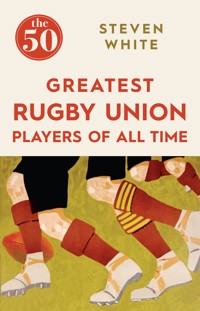
The 50 Greatest Rugby Union Players of All Time The 50 Greatest Rugby Union Players of All Time E-Book
Steven White
Erhalten Sie Zugang zu diesem und mehr als 300000 Büchern ab EUR 5,99 monatlich.
- Herausgeber: Icon Books
- Kategorie: Lebensstil
- Sprache: Englisch
Throughout the history of rugby union, a select few players have stood out above the rest. Bringing together 50 of the finest, this book reveals the fearless scrum-halves, tricky wingers, explosive centres and powerful props that have lit up the game, celebrating their achievements and controversially ranking them in order of greatness. Is the might of Jonah Lomu preferred to the vision of David Campese? Who was more influential, Jonny or Johnno? Which hemisphere has produced the most superstars? And most importantly, who will be named the greatest player of all time? Passionately argued, provocative, and sure to trigger lively debate, this book is a must-read for rugby fans everywhere. Published in time for the Six Nations 2016 and fully updated following the 2015 Rugby World Cup, hosted in England.
Sie lesen das E-Book in den Legimi-Apps auf:
Seitenzahl: 267
Veröffentlichungsjahr: 2015
Das E-Book (TTS) können Sie hören im Abo „Legimi Premium” in Legimi-Apps auf:
Ähnliche
















GREATEST
RUGBY UNION
PLAYERS OF ALL TIME
Also available
The 50 Most Influential Britons of the Last 100 Years
The 50 Greatest Walks of the World
The 50 Greatest Train Journeys of the World
GREATEST
RUGBY UNION
PLAYERS OF ALL TIME
STEVEN WHITE
Published in the UK in 2015 by Icon Books Ltd, Omnibus Business Centre, 39–41 North Road, London N7 9DP email: [email protected]
Sold in the UK, Europe and Asia by Faber & Faber Ltd, Bloomsbury House, 74–77 Great Russell Street, London WC1B 3DA or their agents
Distributed in the UK, Europe and Asia by TBS Ltd, TBS Distribution Centre, Colchester Road, Frating Green, Colchester CO7 7DW
Distributed in Australia and New Zealand by Allen & Unwin Pty Ltd, PO Box 8500, 83 Alexander Street, Crows Nest, NSW 2065
Distributed in South Africa by Jonathan Ball, Office B4, The District, 41 Sir Lowry Road, Woodstock 7925
Distributed in India by Penguin Books India, 7th Floor, Infinity Tower – C, DLF Cyber City, Gurgaon 122002, Haryana
Distributed in Canada by Publishers Group Canada, 76 Stafford Street, Unit 300 Toronto, Ontario M6J 2S1
ISBN 978-178578-026-4
Text copyright © 2016 Steven White The author has asserted his moral rights.
No part of this book may be reproduced in any form, or by any means, without prior permission in writing from the publisher.
Images courtesy of the Press Association
Typeset and designed by Simmons Pugh
Printed and bound in the UK by Clays Ltd, St Ives plc
CONTENTS
INTRODUCTION
THE 50 GREATEST RUGBY UNION PLAYERS
50. Grant Fox
49. Os du Randt
48. Frank Bunce
47. Bryan Habana
46. Syd Millar
45. Ken Catchpole
44. Victor Matfield
43. John Smit
42. Lawrence Dallaglio
41. Gavin Hastings
40. Paul O’Connell
39. Jeremy Guscott
38. Keith Wood
37. Tim Horan
36. Mervyn Davies
35. Bill Beaumont
34. Jason Robinson
33. Sergio Parisse
32. Serge Blanco
31. Mark Ella
30. Mike Gibson
29. Jason Leonard
28. George Nepia
27. Frik du Preez
26. Serge Betsen
25. Shane Williams
24. Richard Hill
23. Jean-Pierre Rives
22. Hugo Porta
21. Willie John McBride
20. Colin Meads
19. George Gregan
18. Barry John
17. Danie Gerber
16. J.P.R. Williams
15. Philippe Sella
14. Sean Fitzpatrick
13. George Smith
12. Joost van der Westhuizen
11. John Eales
10. Zinzan Brooke
9. Jonny Wilkinson
8. Jonah Lomu
7. Dan Carter
6. Michael Jones
5. Martin Johnson
4. Brian O’Driscoll
3. David Campese
2. Richie McCaw
1. Gareth Edwards
INTRODUCTION
Selecting the 50 greatest rugby union players of all time has been an incredible task. There has been a lot of time spent watching old footage, which has been immensely enjoyable, and a lot of time too spent arranging and rearranging the order until I was happy that I had a 50 that represented the very pinnacle of the sport. It has been an honour, although inevitably it has also involved some painful decisions. The game has seen far more than 50 greats and there have been some astonishing players whose stories I have not had room to tell.
By far the most difficult consideration when compiling this list was attempting to analyse individuals in this most team-based of sports. A player is only ever as good in defence as the man outside him. And what’s the use of a scrum-half with incredible distribution if the fly-half’s positioning is below par? Almost all of the players included here had the fortune to play alongside some wonderful players.
Since the first international game in 1871, the sport of rugby union has gone through so many changes that it is virtually unrecognisable from the game that is played today. There were some phenomenally important players from those early days; the tales of the New Zealand Originals and the Invincibles tour are legendary and their influence is still felt today. However, the changes in the laws and playing styles over time make it even more of a curious challenge to compare and contrast abilities.
For instance, I have not included a single full-back who played before the rule change in 1963 to prevent teams kicking straight to touch from anywhere on the pitch. Before then, the job of the full-back was almost entirely defensive and based on kicking. Since that law change we’ve seen full-back become one of the most important (and exciting) positions on the pitch.
Another problem I faced is that you are not always comparing like with like. When you place two players side by side and one is a prop and the other a winger, how do you decide who is better? You have to look beyond the statistics, beyond the points scored and competitions won (although it goes without saying that the greatest players are more likely to be on the winning side). I chose to pore over old footage, re-watching classic games and focusing on individuals to try to see who had consistently had a great impact on the game.
This approach has its limitations, given the game’s long history and the many legendary players for whom extensive footage does not exist. Expert testimonies, such as Gareth Edwards’ 100 Great Rugby Players (in which he did not feel the need to rank them in anything other than alphabetical order), have proved invaluable for filling in the gaps.
Still, one has to be mindful of the nostalgia that surrounds some of those players of yesteryear. This is not a history of the sport, and there would be a different bias if we were to include players for their historical significance or for the romance attached to their stories. I have tried to set aside nostalgia and judge each player on their contributions on the pitch, and as such it would have been difficult to leave out someone like Shane Williams for Gwyn Nicholls, or to remove Sean Fitzpatrick in order to make room for Dave Gallaher.
I have tried to eliminate bias (and not simply select the entirety of the 2003 England World Cup-winning team) and I have found that re-watching footage with a different eye has resulted in certain trends. The first is a heavy Kiwi representation, and I doubt that people will find that too contentious. As the All Blacks will be the first to point out, all things considered, the New Zealand rugby union team are the greatest sporting team in history. And while overall the most successful nations have a nice representation, this list can’t escape the dominance of the All Blacks.
The other trend that has emerged in this selection is perhaps more controversial. As alluded to above, some undoubtedly legendary figures have been omitted where I felt that their legend owed more to their story than to their playing ability. I have attempted to remove the rose-tinted glasses of nostalgia and the end result is a selection of players which may lead to mass outrage and tables overturned by old boys in clubhouses across the world at the sheer quantity of professional-era players. I stand by each and every selection. I think that although some may argue that the romance of the sport dwindled as money rolled in and the importance of winning became tied up with marketing opportunities and all-important sponsors, ultimately, the competition grew fiercer and it gave an opportunity for the real talent to go out on to the pitch and express itself to a greater audience.
But for all my attempts at reason and objectivity, ultimately, the romance of the sport has played its part in every one of these selections. The little guy, the smart guy, the guy built like an outhouse with the surprising kicking ability. The fire, the passion, the leadership. Statistics may play a part, but every single one of these 50 players has or had something unquantifiable, something that meant every time they laced up their boots and pulled on their jersey they had the power to raise the hairs on the back of your neck and make this most special of sports even more magical.
THE 50 GREATESTRUGBY UNION PLAYERS
50. GRANT FOX
Fly-half, New Zealand 1984–93
This World Cup-winning fly-half may not have been the greatest natural ball-carrier New Zealand have ever had in this position, but he was a pivotal player in one of many periods of dominance the All Blacks have held over world rugby.
A master in the art of goal-kicking, indeed, Fox was a real innovator. He was one of the first players to popularise the leaning forward of the ball on the tee and the first to have a real recognisable routine, so common in the kickers of today. His calm backward and side-steps, accompanied by heavy exhaling as he calmed himself before striking, became a familiar sight throughout the late 1980s and early ’90s.
He was perhaps not one for the romantics; Fox was not a flair player, he did not display huge amounts of imagination and was rarely found dashing through the lines – but he did score an astronomical amount of points. Indeed, he would kick so many penalties and conversions that New Zealand would find themselves dominating the scoreboard, even without having to perform particularly well. Often all it would take was for the All Blacks to keep their discipline and wait for the penalties – and therefore the points – to pile up.
Despite him immediately scoring huge points totals following his test debut in 1985, Fox did not have a secure place in the side, facing competition from the likes of Wayne Smith and Frano Botica. In 1986, he was part of the widely condemned New Zealand Cavaliers tour of South Africa. Fox was banned for three tests, allowing the young Botica into the side. It caused a selection headache, Botica initiated lovely free-flowing attacks, he was a powerful runner and overall a more creative outside half. All instincts led to Botica’s selection, but the fact remained that the All Blacks were simply more likely to win with Grant Fox in the side.
By the time the inaugural World Cup rolled around in 1987, Fox was the undisputed fly-half of choice. New Zealand won the tournament quite comfortably, with a team that included other great players such as Sean Fitzpatrick and Michael Jones. Fox played a huge part in that victory, finishing the tournament as top scorer with an immense 126 points, which remains a record for the most points any single player has ever scored at a World Cup. With their remorseless style, New Zealand were able to take every single game away from their opposition quite quickly and won every game by a comfortable margin of at least twenty points.
This was perfectionism, even before the days of professionalism. Fox was passionate about his analysis and training. His dedication to winning was single-minded and set the standard for the days of crafted, well-drilled players. There was a languid, self-assured style to Fox’s play that controlled the All Blacks back line from ’87 through to ’93. Fox’s mood often typified the performance the entire side displayed and so much rested on him. When the fly-half was calm and collected, New Zealand would stroll to victory, but on the rare occasion that the Kiwis suffered a defeat, Fox’s perfectionism bubbled over into visible annoyance and there was no recovery.
Fox remained a fixture in the All Blacks back line-up until the winning series against the British & Irish Lions in 1993 when he dramatically scored a match-winning kick in the first test in the dying moments, ending his career at the end of that international season.
After Fox’s retirement, the All Blacks really struggled to find a replacement. Many were tried and rejected, but 1995 saw the emergence of another outstanding goal-kicker in Andrew Mehrtens, who was Fox’s true successor.
Though Mehrtens eventually exceeded many of Fox’s scoring records, it was done through echoing and mimicking the style of play that Fox introduced. In 78 matches for the All Blacks Fox scored 1,067 points and only 1 try (his lack of try scoring was the source of many jokes from both the media and teammates). But for good or ill, Fox changed the way the game was played forever.
49. OS DU RANDT
Prop, South Africa 1994–2000, 2004–07
Known for his powerful scrummaging and indomitable work rate, Jacobus du Randt is one of the most revered prop forwards the game has ever seen and a true South African hero. Nicknamed ‘Ox’ (‘Os’ in Afrikaans), the iconic prop is the only South African to have won two World Cups, with three years out of the game in between.
Du Randt suffered a devastating injury when in peak form in 2000 and believed his career to be over after being sidelined for three years. He battled back in one of the most astonishing comebacks in rugby history to reclaim a place in the World Cup squad in 2007, twelve years after South Africa’s inaugural success in the competition.
Making his debut against Argentina in 1994, Randt quickly cemented his position as the first-choice loosehead prop. Du Randt entered the 1995 World Cup in the front row of a solid Bok scrum. He was yet to lose an international test and his naivety perhaps proved useful as he entered every scrum like he believed he was invincible. Nowhere was this more evident than in the semi-final against a tough France side on a sodden pitch. The Springboks had to hold on in the final moments of the game under intense pressure as they faced a series of five-metre scrums, with du Randt holding his own to become the real unsung hero of the tournament.
The scrum was also to play a pivotal role in the final against New Zealand. The tactics employed by the Springboks involved a tight physical game, as they were desperate to shut out Jonah Lomu. The most crucial plays of the day came out of the scrum and du Randt held his nerve for the scrimmage in the dying seconds of the game, allowing his team the platform to score the decisive drop-goal.
In the intermediary years between World Cup successes, du Randt made his name as the best and most dependable prop forward in the world, entering the 1999 World Cup at the top of his game. While the Springboks were ultimately defeated in the semi-final by eventual winners Australia, Os du Randt was one of the best players of the tournament again. His status as the best remained until a chronic knee injury in 2000 kept him on the sideline for three years with his future in the game coming under threat.
After a slow recovery, he was coaxed out of retirement and convinced to play for former club Free State Cheetahs. Things went well for his provincial side, and although he had never intended to play for South Africa again, he was swayed to make himself available for international selection in 2004.
Things did not go entirely to plan and initially it did not look like a fairy-tale comeback for du Randt as high-profile defeats to both Australia and New Zealand in the Tri-Nations (although the Springboks still managed to scrape the championship title) were followed by touring side losses to Ireland and England in the autumn internationals that same year. The England game in particular exposed some weakness in the Springbok pack, with the scrummaging coming under scrutiny as they were turned over repeatedly in this area. Nevertheless du Randt worked hard to retain his place for an unforeseen three years up to and including the 2007 World Cup. Here is where the second part of the du Randt story really stands out.
Aged 36, du Randt was named man of the match in the semi-final victory over Argentina. Los Pumas had surprised many by reaching the semis, and had done so through expert scrummaging and a tight pack. Du Randt used all of his experience to pick their game plan apart in a tough contest. Os was in inspired form for the Bokke and played the full 80 minutes of their final victory over England, not looking like a player ready to retire. Not content with holding down the scrum and securing the breakdown, du Randt made one incisive run in particular where he looked in his prime. South Africa won the 2007 World Cup by virtue of their superior and mighty pack, the experience of du Randt proving invaluable to his side as well as a romantic story to endear himself to the fans, carving out a special place in Springbok legend.
48. FRANK BUNCE
Centre, Western Samoa 1991, New Zealand 1992–97
Frank Bunce managed a surprising 55 caps for the All Blacks despite being something of a late bloomer, not making his debut until he was 30. He may have been a late arrival to the international rugby scene, but his brutal and unforgiving presence in New Zealand’s midfield provided some much-needed stability through the 1990s.
What made this granite-like centre even more unusual is that, like Michael Jones, he was poached after making his initial appearances for Western Samoa. The Samoans were the surprise package of the 1991 Rugby World Cup, with Bunce at the heart of the side, before he switched his allegiance to play for the country of his birth.
Bunce’s hard-working, honest approach made him an effective centre and counterbalance to his much more unpredictable Wallabies opposite number Tim Horan. They often brought out the best in each other, making their individual contests one of the highlights of the Bledisloe Cup during the mid-’90s. Bunce provided the power to complement his technically impressive side. In defence, there were few as solid and technically adept, hitting with a real crunch, often relieving his side and even turning over the ball with his work at the breakdown; it was such that a back-rower would have been proud.
That said, Bunce was not simply a lump, throwing himself at the opposition. His power and pace made him a dangerous runner and prolific try scorer. It seems a straightforward approach, but Bunce was at his most dangerous towards the end of a match, when any lapse in concentration or tiring legs were exposed by the superior stamina of the machinelike midfielder as he pounced and broke the defensive line time and time again.
Perhaps not blessed with the natural gifts of Horan or Philippe Sella, Bunce made up for it with graft and hard work. Frank Bunce spent the majority of his career at Auckland, although for many years was not a first-choice player. It was only when he moved to North Harbour in 1991 that he gained enough first-team experience to warrant inclusion in the budding Western Samoa side that sparked a late renaissance of his stalled career. Western Samoa surprised everyone by defeating Wales and Argentina to make the knockout stages of the World Cup, with Bunce’s blistering physicality the cornerstone of their success. An offer to play for the All Blacks was too good to refuse and Bunce linked up with North Harbour teammate Walter Little in the midfield to form a terrifying partnership.
Once given the opportunity, Bunce grabbed it with both hands and only missed one test in the next five years, even appearing at the first Sevens World Cup in 1993. Bunce used his strength selflessly in the field, using his upper body strength to offload and bring his outside centre or winger into play to great effect. Such was his relentless approach that he even managed twenty test tries himself. His impact was never more keenly felt than in the 1995 Rugby World Cup, where his diversionary tactics were used to unleash Jonah Lomu on the unsuspecting home nations.
From the moment he made his belated international debut, Frank Bunce persistently defied expectations to continue at the top level, playing his last game for New Zealand in 1997, just before his 36th birthday, a draw at Twickenham ending an eleven-game winning streak.
47. BRYAN HABANA
Wing, South Africa 2004–
South Africa’s World Cup victory in 1995 had a huge impact not only on the sport, but on the political landscape of a nation. It also left a huge impression on a future star. Aged twelve, Bryan Habana was in the stands as he watched his emerging rainbow nation become champions in a sport that was relatively new to him (having attended a school that prioritised soccer). Habana left the stadium that day with a t-shirt printed with a photo of his own smiling face in the centre with the inscription ‘I’m the Bokke’s greatest supporter’. Habana waited after the game to get the autographs of both the All Blacks and Springbok teams, and his face ended up surrounded by the signatures of his new heroes.
Twelve years later and Bryan Habana was lifting the Webb Ellis trophy after finishing the tournament as the top try scorer, and later that year was honoured as the greatest player in the world with the award of the 2007 IRB Player of the Year trophy.
Habana is someone who seemed destined to become a world great right from the start. A natural rugby player, he made his Springboks debut as a replacement against England on 20 November 2004, scoring a try with his first touch of the ball.
Habana quickly established himself as indispensible for the Springboks, starting every single test in 2005, scoring twelve tries in twelve tests to earn him a first nomination for that IRB World Player of the Year award. The emergence of their new superstar came at just the right time for South Africa who had struggled to emulate their success in the years following the 1995 World Cup and had lacked a truly world-class winger, with their biggest try-scoring threat in recent years having come from the by-now-retired captain and scrum-half Joost van der Westhuizen. Habana provided something that South Africa had been lacking: width. His two long-range tries against Australia in the summer of 2005 helped the Springboks win their first Tri-Nations match overseas for seven years.
Habana, who has been clocked at 10.2 seconds running the 100 metres, made headlines around the world in 2007 by racing a cheetah to raise awareness to the plight of the near-extinct animal. Now, it’s not a huge surprise to learn that Habana did not win that race, even with a 35-yard head start. But it was close, and as a publicity stunt for a charity, as much as showcasing the incredible speed of one of the fastest men in the world, it highlighted Habana’s popularity and charisma outside of the world of rugby.
Bryan Habana entered the 2007 Rugby World Cup as an already established superstar but left as one of the true greats, having proven himself on the world stage and, with a total of eight tries, having managed to equal Jonah Lomu’s record for tries in one tournament. Following the World Cup victory, South Africa’s domination quickly foundered; a change in playing style did not suit Habana, who failed to make any impact at all during 2008. An expansive style did not suit any of the back line but as the finisher, the superstar and the furthest exposed on the wing, Habana took more than his fair share of the blame. He rose to the challenge of his critics, revaluated his playing style and in the 2009 season was a pure defensive rock. He gained some weight and really worked on the perceived weaker aspects of his game, and he managed to do this without sacrificing his killer try-scoring instincts. That year Habana was selected in the South Africa side to play the British & Irish Lions and was dependable in defence, as well as scoring a memorable try in the second test, as the Springboks won the series.
But Habana is more than just speed and a strong tackle. With ball in hand, his superior upper body strength in the tackle often gains crucial yards as he drives the defender back and uses his power to give his pack enough time to secure the breakdown, even as he often finds himself isolated by sheer speed. This strength, accompanied by his sharp awareness, means that when a teammate can keep up, Habana can be very dangerous in the offload.
Using his pace, Habana can also do the undervalued donkey work, the chasing of kicks that can really put a team under pressure, something not enough of the speedy wingers do consistently at the top level. He will control his run with unbelievable accuracy, leaving him to arrive at precisely the time to hammer his opponent down to the ground. He played as both scrum-half and centre throughout junior rugby before settling to the wing. This time spent at half-back and in the midfield gave Habana extra dimensions to his game; his handling and positional awareness are superior to those of most wingers and are used ruthlessly to exploit the opposition in their own 22.
The 2015 Rugby World Cup saw a slightly different side to Habana, as his South Africa side struggled slightly and lost many of its most experienced players to injury. As well as the physical knocks, they suffered humiliation at the hands of the excellent Japanese in their opening game and Habana played like a man with something to prove for the rest of the tournament. With much of the media focusing on another Jonah Lomu record – his overall tally of fifteen World Cup tries – and Habana’s expected retirement, the pressure was on, and sometimes it showed. On the occasions where he was allowed to enjoy his rugby, he propelled South Africa into the semi-finals. But a tough clash with the incomparable All Blacks was too much for the Springboks, resulting in a narrow defeat, with Habana showing his frustration and marching to the sin bin following a cynical challenge at the breakdown. Consignment to the periphery in the third-place play-off was an unfortunate way for Habana to exit what was surely his final World Cup. With the world waiting for the final, Habana spent the match trying to put on a show for the spectators and attempting to score the one try that would have broken Lomu’s record. Ultimately, he failed.
Even taking all this into account, Habana is simply one of the greatest finishers the game has ever seen. Whether rubbing salt in the wounds of the opposing fans or delighting his own supporters, Habana always plays, and scores, with a smile on his face.
46. SYD MILLAR
Prop, Ireland 1958–70
Syd Millar may well be more remembered for his coaching and his time as chairman of the IRB than for his playing days. But before all of that, the former prop was a formidable player for both Ireland and the British & Irish Lions throughout the 1960s.
If one man encapsulates the spirit, tradition and sense of special occasion that defines the British & Irish Lions, then it’s Syd Millar. He completed three tours as a player before coaching the famous 1974 tour of South Africa and even returned to manage the side against the Springboks in 1980.
This desire to compete and to win that he instilled into the later tours heralded back to his playing career; he would do everything it took to win. Reportedly, Millar began his career playing at fly-half in his schoolboy days, and as a sixteen-stone prop forward, those handling skills made him a rare and great asset for Ballymena and Ireland.
An incredibly versatile player, he played both loosehead and tighthead for the Lions over the years, and was the most-used prop in the 1962 tour, playing in 16 of the 24 matches, offering more to the game than sheer size and scrummaging. Although the Lions ultimately lost that tour 3-0, Syd Millar fared well against his opposition.
Despite this, however, Millar was not selected for the 1966 Lions tour to Australia and New Zealand. It is a testament to his character that in the following years he fought his way back into contention for one final tour in 1968, once again to South Africa. Millar was tough and being dropped did not dent his confidence, only inspired him to improve himself.
Even today, being a tight forward requires a lot of resilience in the face of off-the-ball incidents; the front row of the scrum is a hotbed for cheap shots that players love to use to wind up and grind down their opponents. It was even worse in the ’60s. With no television crews, no citations and only one referee to spot the incidents, so many went under the radar, even by the crowd. But Millar was a proud player who rarely bit back – even when literally bitten. With cheap shots flying and teeth sinking, it was lucky that the Ireland captain of the time, Bill Mulcahy, was a trainee doctor. With no replacements available, it was not uncommon for Mulcahy himself to treat Millar on the side of the pitch before returning to the field.
This experience inevitably helped Millar become an expert on a most physical national side: South Africa. He was involved in four successive tours there (two as a player, one as a coach and then finally as a manager in 1980) with varying degrees of success. He used his expertise to help the Lions prepare for the physicality of the immortal 1974 tour.
As a player, his finest moment for the Lions didn’t come against the Springboks but right at the start of his career, against Australia. Although that same tour saw two test match losses against New Zealand, Millar was a key player in the two victories over Australia and he rates that ’59 side as the best he ever played in.
Even after he was no longer Lions coach, his insatiable appetite for rugby saw him become chairman of the IRU in 1995, then chairman of the IRB from 2003 to 2007. His contribution to the game of rugby both on and off the pitch is incomparable.
45. KEN CATCHPOLE
Scrum-half, Australia 1961–68
Although hailing from an Aussie Rules-playing family, Ken Catchpole was one of the most recognisable and fondly remembered rugby union players ever to captain the Wallabies.
There are relatively few now who will remember seeing Ken Catchpole in his glory days, but his image is instantly recognisable. A distinguishing stance with his eyes firmly on the receiver, his posture an indication of the power behind the pass, whether that was with a planted back foot or from a diving pass.
Much like the future captain George Gregan, Catchpole was small, but mighty. He was fast and tough, a truly sturdy player. His endurance often saw him the liveliest player on the pitch in the final minutes of the game, making last-ditch tackles and stealing ball from the opposition breakdown right to the final whistle. Catchpole was a great all-round scrum-half; it’s not often a half-back can combine consistent distribution with defensive dependency as well as a flair to find the galvanising run in broken field, but Catchpole in his prime displayed all of these qualities.
Despite making his debut against Fiji in 1961, aged 21 – bizarrely starting as captain – it took Catchpole two years to establish himself as Australia’s starting number nine. Crucially, Phil Hawthorne made his debut aged eighteen in 1962 and Catchpole’s combination with this incredibly talented fly-half was the basis for many historic Wallabies victories during the 1960s.
In stark contrast to many hard-hitting and aggressive back lines of the time, Catchpole and Hawthorne set about carving up defences with an elegance that took most sides by surprise. The basis for this successful strategy lay with Ken’s impeccable passing and tactical leadership.
The records came tumbling and history books were rewritten almost immediately as Ken Catchpole was named captain for the South African tour of 1963. It was during this tour that the Wallabies became the first team ever to visit and defeat the Springboks in successive tests.
It was on the 1966/67 tour to Great Britain that Catchpole announced himself to an unsuspecting set of home nations and cemented his legendary status. Australia not only achieved a first ever victory over Wales but also registered a record victory against England at Twickenham. The 23 points scored (Catchpole contributing a try) was the most that England had ever conceded in ‘the fortress’ since the first test there in 1910. Although not always known for their generosity, the English press and key commentators recognised Catchpole as the greatest half-back the world had ever known.




