


Erhalten Sie Zugang zu diesem und mehr als 300000 Büchern ab EUR 5,99 monatlich.
- Herausgeber: Jonathan Ball
- Kategorie: Geisteswissenschaft
- Sprache: Englisch
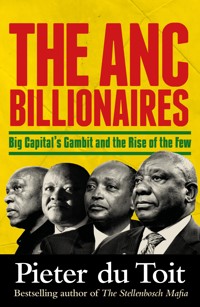
'We were talking about the rise of Japan, about Ronald Reagan's Star Wars … globalisation, technology. And they were still banging on about the Freedom Charter.' – Anglo American's Michael Spicer on the ANC in the mid-1980s. In 1985, a group of white South African business leaders, led by Gavin Relly, the executive chairperson of Anglo American, travelled to a game lodge in Zambia to meet with the exiled ANC leadership under Oliver Tambo and Thabo Mbeki. This visit set in motion a coordinated and well-resourced plan by big business to influence and direct political change in South Africa. In The ANC Billionaires, top-selling author Pieter du Toit draws on first-hand accounts by major roleplayers about the contentious relationship between capital and the ANC before, during and after the country's transition to democracy, and shows how the liberation organisation was completely unprepared to navigate the intersection between business and politics. He also ties the rise of the new elite – including Cyril Ramaphosa, Patrice Motsepe and Saki Macozoma – to the ANC, a party of government and patronage.
Sie lesen das E-Book in den Legimi-Apps auf:
Seitenzahl: 420
Veröffentlichungsjahr: 2022
Das E-Book (TTS) können Sie hören im Abo „Legimi Premium” in Legimi-Apps auf:
Ähnliche

















THE ANC
BILLIONAIRES
Big Capital’s Gambit and the Rise of the Few
PIETER DU TOIT
Jonathan Ball Publishers
johannesburg • cape town • london
To my family
Praise for the Author
Praise for The Stellenbosch Mafia
‘The book offers something quite different: a thoughtful account of how a few big-hitting Afrikaner businessmen came to make Stellenbosch their base, and an analysis of whether there is any merit to the suggestion that they have acted in concert to pull the levers of politics and governance behind the scenes … The Stellenbosch that comes through most vividly from Du Toit’s book is not so much the town awash with money and influence – though yes, that too – but the town seething with gossip, rivalry, and social snobbishness …’ – Daily Maverick
‘Du Toit walks readers through the book with a keen understanding of how socio-economic divisions further exacerbate hostility towards the elite.’ – Fin24
‘Woven together with the goings-on and opinions held in boardrooms and at dinner tables around town, the story quite lives up to its tantalising title.’ – Country Life
CONTENTS
Cast of characters
ANGLO AMERICAN
BIG CAPITAL
THE LIBERATION MOVEMENT
NEW MONEY
THE POLITICIANS
THE FIXERS
Timeline of events
1983•United Democratic Front (UDF) established, consisting of a range of local, community-based organisations.
1984•Tricameral parliamentary system introduced, excluding black representation.
•Widespread township violence commences and spreads across South Africa.
1985•Oliver Tambo declares the ANC’s intention to make South Africa ungovernable.
•International banks call in South African loans after apartheid president PW Botha’s ‘Rubicon’ speech.
•Botha declares state of emergency, which will last until the release of Nelson Mandela.
•Business delegation under Anglo’s Gavin Relly meets Tambo and the ANC in Lusaka.
•Congress of South African Trade Unions (Cosatu) established in Durban.
1986•Anglo’s internal ‘high road, low road’ scenarios for South Africa gain national prominence.
•Big capital meets PW Botha at the Carlton Hotel.
•Secret meetings between apartheid justice minister Kobie Coetsee and Mandela start.
1987•Afrikaner dissidents meet the ANC in Dakar, Senegal.
•First meeting of the Mells Park group between Afrikaner intellectuals and ANC leaders.
•Standard Chartered, Barclays Bank and Citibank quit South Africa.
1988•Apartheid spy boss Niël Barnard starts dialogue with Mandela in prison.
•Consultative Business Movement (CBM) is established to facilitate contact between business and Mass Democratic Movement (MDM) leaders.
1989•South African Communist Party (SACP) conference held in Cuba, chaired by Thabo Mbeki.
•Paris conference about future of South Africa arranged by French first lady Danielle Mitterand.
•FW de Klerk replaces Botha as apartheid head of state.
•The Berlin Wall comes down and socialism collapses in Eastern Europe.
1990•Namibia formally gains independence from South Africa.
•De Klerk announces the release of Mandela, unbans ANC and other liberation movements.
•First official contact between the apartheid government and the ANC as exiles return.
•First meetings of the Brenthurst Group between big capital and the ANC are held.
1991•ANC holds its first elective (national) conference in South Africa for more than 30 years.
•National Peace Accord is signed, paving the way for constitutional negotiations.
•Codesa I is held at the World Trade Centre in Kempton Park in December.
1992•Mandela visits Davos, and an ANC delegation visits the World Bank and the International Monetary Fund (IMF) in the US.
•Codesa II is held in May, but suspended after the Boipatong massacre.
•ANC adopts ‘Ready to Govern’ policy document, starts formulating the Reconstruction and Development Programme (RDP).
•Thebe Investment Corporation, a black-owned firm, is established with the ANC’s support.
1993•Multiparty Negotiating Forum (MPNF) meets to negotiate an interim constitution.
•Chris Hani is murdered; Mandela goes on national television to ask for calm.
•Macro-Economic Research Group (MERG) economic policy proposal is rejected by ANC.
•First big empowerment deal, between Sanlam and New Africa Investments Limited (NAIL), is concluded.
1994•ANC wins the first democratic elections.
•RDP becomes the democratic government’s broad policy and economic framework.
•Patrice Motsepe, a young lawyer, starts his own mining business, Future Mining.
1995•A small technical team starts designing a new macroeconomic policy for South Africa.
•Mandela tells Trevor Manuel to closely shadow then finance minister, Chris Liebenberg.
•Second significant empowerment deal, the unbundling of JCI by Anglo, is announced.
1996•The rand comes under attack after rumours circulate that Mandela is dying.
•RDP office in the presidency is closed by Mandela.
•Manuel is appointed minister of finance, and Cyril Ramaphosa leaves politics.
•The government adopts Growth, Employment and Redistribution strategy (GEAR) as its macroeconomic policy.
1997•Motsepe establishes African Rainbow Minerals (ARM) and takes ownership of seven AngloGold shafts.
•Saki Macozoma, Transnet CEO since 1996, is appointed to the board of Standard Bank.
•Truth and Reconciliation Commission holds hearings on the role of business during apartheid.
1998•Ramaphosa is appointed chairperson of a commission to consider black economic empowerment (BEE) legislation.
•Tokyo Sexwale establishes Mvelaphanda Holdings.
2000•New legislation vests mineral rights in the state, causing a collapse of mining shares.
2001•Ramaphosa establishes Millennium Consolidated Investments.
•Macozoma becomes chairman of the board at NAIL, the iconic black investment firm.
2002•Motsepe’s ARM lists on the Johannesburg Stock Exchange (JSE).
2004•Motsepe leads a consortium to become Sanlam’s black empowerment partner.
•Sexwale leads a consortium to become Absa’s empowerment partner.
•Macozoma and Ramaphosa become Standard Bank’s empowerment partners.
2006•Ramaphosa leaves Johnnic after a bitter boardroom fight with former struggle comrades.
2007•South Africa runs a budget surplus for the first time in democratic history.
•Thabo Mbeki is removed as ANC leader and replaced by Jacob Zuma.
•Manuel resigns as finance minister, rattling the markets, but is later reappointed.
2008•The global financial crisis hits, but South Africa navigates it thanks to strong reserves.
2009•Sexwale resigns as chairman of Mvelaphanda Holdings to go into Zuma’s cabinet.
2010•Motsepe donates R10 million to the Jacob Zuma Foundation.
2011•The China Investment Corporation acquires a stake in Ramaphosa’s Shanduka.
2012•Ramaphosa is elected ANC deputy president; Motsepe becomes a significant ANC donor.
•Thebe Investment Corporation takes a stake in Shell South Africa and Capitec Bank.
2013•Sexwale is axed by Zuma in a cabinet reshuffle.
2014•Ramaphosa becomes deputy president of the country and Manuel leaves politics.
•Macozoma leaves the board of Standard Bank and Liberty after 17 years.
2015•After becoming deputy president of the country, Ramaphosa exits all his business interests.
•Motsepe signs deal with Sanlam to remain a ‘core shareholder’ until 2025.
•Zuma fires his minister of finance, costing the country billions of rands in four days.
2016•Motsepe establishes finance and investment house African Rainbow Capital.
2017•Ramaphosa is elected ANC president.
2018•Zuma is ousted as head of state and replaced by Ramaphosa.
2020•Macozoma is appointed chairman of the board at Vodacom.
•Motsepe, Nicky Oppenheimer and Johann Rupert each pledge R1 billion for pandemic relief.
•Burglars allegedly steal $600 000 from Ramaphosa’s game farm Phala Phala.
2021•Motsepe is appointed president of the Confederation of African Football (CAF).
ACRONYMS AND ABBREVIATIONS
ANC African National Congress
BEE Black economic empowerment
CAF Confederation of African Football
CBM Consultative Business Movement
Codesa Convention for a Democratic South Africa
Cosatu Congress of South African Trade Unions
Fabcos Foundation of African Business and Consumer Services
GDP gross domestic product
GEAR Growth, Employment and Redistribution strategy
Idasa Institute for Democratic Alternatives for South Africa
IFP Inkatha Freedom Party
IMF International Monetary Fund
JCI Johannesburg Consolidated Investments
JSE Johannesburg Securities/Stock Exchange
MDM Mass Democratic Movement
MERG Macro-Economic Research Group
MK uMkhonto weSizwe
MPNF Multiparty Negotiating Forum
Nafcoc National African Federated Chamber of Commerce and Industry
NAIL New Africa Investments Limited
NBI National Business Initiative
NEC national executive committee
NIS National Intelligence Service
NUM National Union of Mineworkers
Numsa National Union of Metalworkers of South Africa
PAC Pan Africanist Congress
RDP Reconstruction and Development Programme
SACP South African Communist Party
SARB South African Reserve Bank
Swapo South West Africa People’s Liberation Organisation
UDF United Democratic Front
USSR Union of Soviet Socialist Republics
VAT value-added tax
Introduction
The winter of 2022 was a difficult one. Eskom, the parastatal that has the monopoly on the provision of electricity, was in an advanced state of failure as loadshedding crippled the economy and further depressed South Africans’ standard of living. Unemployment was at crisis levels, with the expanded definition closing in on 50 per cent, and continued tepid economic growth, high inflation and the rising cost of living meant that the country wasn’t about to exit the stagnation and regression of the previous decade and more. And South Africans were increasingly starting to question the country’s underlying social compact, querying what undergirds our society and challenging the agreements and covenants we entered into during the political transition from apartheid to democracy.
There are very few achievements in this country’s tumultuous history that rank alongside the political transition between 1990, when the African National Congress (ANC) was unbanned, and 1996, when the final Constitution was adopted. In the space of six short years, South Africa went from exclusionary white minority rule to a democracy under a black majority government. This wasn’t achieved easily, nor without bloodshed, but the country avoided a civil war and protracted strife because the main actors on all sides of the divide were able to look beyond the horizon. And it was these main actors – principally the National Party (NP) government and the ANC – who were able to agree on the main tenets of what was achievable and what wasn’t.
Of course, there were many factors that contributed to decisions about the interim constitution, the final election date and the government of national unity. But it was the elite pacts – the agreements between those groups in society that possess political and economic power – that ensured stability and breakthroughs.
While the political compromises have been investigated, documented and analysed, the economic compromises and agreements that took place among the elite have had similar, if not more consequential, repercussions for South Africa. Almost 30 years after political freedom was achieved, the country is still searching for agreement on how to change the structure of the economy, how to ensure that more people are included, and what needs to be done to achieve faster, efficient growth. And while the ANC government, in power for 28 years in June 2022, remains engaged in its internecine wars of power and succession, and while big capital retreats from investment just enough to remain profitable while hedging its bets on South Africa’s future, ordinary South Africans stagger on, trying to remain afloat in an increasingly hostile economic environment in which living costs are shooting up and wages remain behind.
The rise of a few well-connected and very wealthy billionaires and millionaires after 1994, all of them connected to the ANC, is testament to the opportunism of some individuals who very early on identified the rich seam of economic opportunity that freedom brought, and who believed that their alignment with the post-apartheid political elite could be a very profitable bargaining chip. It is also testament to big capital’s solutions to the existential crisis it went through in the 1980s and 1990s. By the early 1990s these conglomerates – Anglo, Rembrandt, Sanlam, Old Mutual, Liberty Life, AngloVaal – controlled 86 per cent of the Johannesburg Stock Exchange (JSE) and had been producing rich profits for decades.1 They had to find a way to survive.
But the ANC did not really believe in the free market, and it most certainly did not believe in apartheid capitalism. So the conundrums during the transition years were, for big capital, how to protect its interests while embracing the new regime, which historically had been antagonistic towards it; and, for the ANC and liberation movement, how to implement its stated policies in a rapidly changing global environment antagonistic towards its ideological foundation.
The repercussions of the decisions made by big capital and the ANC to account for those challenges are still being felt today. Big capital is operating in a market-friendly global environment, with capital flowing freely from hospitable to inhospitable climes to ensure the best returns for investors, while the ANC remains in government and in charge of policy and other governance levers able to influence the shape of wealth accumulation and redistribution.
Michael Spicer, an executive at Anglo American during the transition years and someone who played a central role in big capital’s attempts to move closer to the ANC – and in attempts to help move the ANC closer towards business – remained adamant that early empowerment was ‘absolutely necessary’. After establishing contact with the ANC during a period in which the apartheid government seemed to be resolutely unwilling to do so, big business moved to create structures and relationships to help it understand the ANC – but also to ensure that the ANC understood that they were now in a different environment than 1980s exile. ‘It was very, very difficult to navigate that space during that time,’ Spicer, who died suddenly in March 2022, said in an interview for this book. ‘The movement spanned Stalinism to free marketeers, and it tried to provide some coherence, but in general it wasn’t market friendly. And then throw into the pot race, apartheid and the history of the country …’2
But big business had no option other than to navigate that space if it wanted to continue operating in South Africa, and what followed were thousands of hours and hundreds of days of influencing, cajoling, meeting and convincing the liberation movement of the value of South African big capital – with some of its leaders even providing logistical and organisational support for the political negotiations process. Spicer said that after individuals like Gavin Relly, Anglo American’s boss who succeeded Harry Oppenheimer, and Mike Rosholt, at the top of the Barlow Rand empire, agreed what had to be done, there was a largely coherent view that big business, too, ‘needed to make changes’.3 He recalled ‘a flurry of activity’ in big business, trying to massage and persuade the presumptive new political leaders of their bona fides and what was needed to ensure future success. ‘Business was taking a hands-on, coordinated and coherent approach.’4
One of the ‘many streams’ that came together to ensure a peaceful transition was the country’s strong civil society. ‘Churches, universities, the judiciary, a strong business community and a vibrant NGO sector – all of these managed to pull together,’ Spicer said. ‘And business played quite an important role in that it had relationships – personal relationships – with all the leadership. The relationships built up in the discussions, both in exile and when [the ANC] came back, were one of the reasons we had a successful transition.’
Business was quite clear about its intent; the ANC less so. The movement arrived back in South Africa uncertain of its exact economic policy positions, save to proclaim allegiance to its 1955 Freedom Charter, a document which by then had become moribund as a guideline for modern economic theory, opaquely advocating for the nationalisation of banks, mines and monopoly industry. Saki Macozoma, one of post-1994 South Africa’s most successful black businessmen, says he was involved in long discussions at the highest levels in the ANC about keeping the party in line with the main policy positions of the Freedom Charter, but that implementing them as was envisaged in 1955 wasn’t possible. ‘When those of us in the ANC’s economic transformation committee were putting together the Ready to Govern document in 1992, we tried to keep it aligned with the Freedom Charter. But applying it to the economy largely did not make sense; it was not going to work, irrespective of the conditions we found,’ he said.5
Trevor Manuel, who was finance minister between 1996, when he was appointed by Nelson Mandela, and 2009, when he was shifted to another portfolio by Jacob Zuma, says there was a singular determination to run the country efficiently and to gain the trust of the global community. ‘We wanted to demonstrate that we weren’t two-bit players just out of nappies; we were serious about running the country,’ Manuel said.6
And what did this in effect mean? South Africa had to become a credible investment destination, and it had to play by the rules. So it meant the adoption of pro-market, conservative economic policies that had as their goal the consolidation of state expenditure, the reduction of debt and, crucially, the redistribution of wealth and social development through economic growth.
It also meant bringing formerly excluded black businessmen into the rosewood-panelled salons of big capitalism. And some of them became fabulously wealthy.
Almost thirty years later, amid high levels of poverty and deprivation, and the deterioration of social services, the question is being asked ever more urgently: did the ANC sell out the ideals of the liberation struggle? Could the political transition have been concluded in such a way as to ensure a just and sustainable economic transition?
Bobby Godsell, who once headed Anglo American’s gold division and who distinguished himself as Cyril Ramaphosa’s sparring partner in the 1980s at the Chamber of Mines’ negotiating table, is strident in his beliefs that there hasn’t yet been an economic transition. ‘The problem is that the focus in the 1980s was on political transition and avoiding a race-based civil war, and, let’s be clear, that was a good thing to focus on. But we’ve had black inclusion in the economy now for almost thirty years, and if you want to look at the economic transition, what new business can you think of? What new technology? What significant expansion of a business, other than cellular phones?’ he asked.7
The ANC, on its return, exuded a sense of entitlement, Godsell said. ‘I think right from the beginning, there was the sense that political office, political power, entitles you to economic benefit; it entitles you personally to benefit.’ And he noted that they didn’t like ‘the white guys’ and were ‘looking for new partners’ – ‘Remember who introduced the Guptas to South Africa – not Jacob Zuma but Thabo Mbeki.’ He continued, ‘For the last twenty years, the ANC has been more open to influence from foreigners than from white South Africans. So race has corrupted our concept of power and accountability, in politics and in economics, and particularly in the link between the two. And we haven’t done a good job of separating those.’8
Jay Naidoo, Cosatu’s first general-secretary, a minister in Mandela’s cabinet and still a significant voice on the left, concurred that the economic transition – and ensuring a more equal, caring society – has not worked. ‘We failed completely. The statistics show us that. You don’t have to be a rocket scientist to see it.’ He cited high levels of poverty and unemployability among black youth as the most significant failure of democracy. ‘The question then becomes, why did we fail? And how do we ensure we don’t repeat the same mistake, because we have an opportunity to put things right, but now we’re headed down the same road.’9
He had a view of how it should have been done. ‘If we wanted to build a black business sector, we should have taken our traditional allies, who were Nafcoc [the National African Federated Chamber of Commerce and Industry], Fabcos [the Foundation of African Business and Consumer Services], the taxi associations, and sat down in a room with them and said, “How do we help you guys, who were already building businesses under apartheid, grow into medium and large enterprises?”’10
As for black economic empowerment and ‘the way it morphed into a transfer of assets to a politically elected elite: there was never a discussion of that,’ he said.
But did the ANC sell out to big capital? Did it betray what it set out to do, which was not only deliver political freedom for the oppressed, but also restore them as significant players in the country’s economy? Said Naidoo, ‘Were there agendas and sub-agendas? Absolutely, probably hundreds. Maybe there were elements that did sell out, but you can’t take Mandela and that generation across the arc of their life and say, “This is the generation that sold us out,” because their generation was here to deliver us political freedom. One person, one vote was the ANC legacy, and they created a constitutional democracy that gave us the levers of power to address the legacy, be that economic, the land issue or issues of exclusion. If we failed to do that, we can’t blame the Mandela generation. That’s where we take responsibility and I’m very happy to take responsibility for my role in fucking up.’ But, he reiterated, ‘It wasn’t like the entire MDM colluded with big capital in order to sell out the people. It didn’t happen like that.’11
Spicer was clear about what big capital’s agenda was: ensuring that the ANC adhered to market liberalism. And how big capital went about ensuring this by drawing in the new political elite in the ANC makes up a large portion of this book. Business wanted to survive, and in order to do so, it had to make the black elite owners of capital, even though they couldn’t afford it. The black elite had to own a chunk of the country’s wealth so that the system could survive; and the transfer of assets to a politically connected elite was enormously profitable for big capital.
When the mines and the banks and the conglomerates went about shopping for empowerment partners, for the first decade at least, it found the same partners every time. Cyril Ramaphosa became extraordinarily wealthy not because he was a shrewd businessman with a knack for turning around flailing companies, or because he was an industrialist who created a new service, market or product. He, like many others, was favoured because of his links to the governing ANC.
Of course, this wasn’t new in the world of capitalism, where the moneyed class move, if not in lockstep with, very close to the holders of political power. Under apartheid, Afrikaner capital exploited its proximity to the NP government, with the establishment of business empires such as Anton Rupert’s Rembrandt considered a project of Afrikaner nationalism. But it now seems as if the project is starting to consume itself. The ANC government remains unable to create an environment for capital to thrive, and capital seems to be at the end of its tether with the political class. Neither has much more to offer the other. And poverty and unemployment are worse than in 1994.
‘The trouble is that the ANC has turned out to be no different from many other liberation movements,’ said Spicer. ‘It has never progressed, and it’s essentially stuffed with people who have a nationalist view, and behind that there’s a sort of neo-patrimonial, pre-capital type of behaviour.’
Not only is there a deep distrust of how business works, said Spicer, but there’s also a lack of understanding. ‘Zuma epitomised that [type of behaviour]: it’s jobs for cadres and family and chiefs, not constrained by the law, and someone like Zuma was puzzled [by adverse reactions to it] because he thinks it’s natural. Many think it just happens, and the notion of profit remains an illegitimate concept.’12
This book attempts to explain the rise of ANC-connected billionaires and millionaires by tracking attempts by big capital to influence and direct the political transition, and the ANC’s progression from an organisation with socialist leanings and communist sympathies to a government that reluctantly embraced the free market. It is by no means an exhaustive history of the period, nor is it a definitive account of someone like Patrice Motsepe’s remarkable ascension to the top table of South African business and wealth. It does, however, attempt to weave together the machinations of the political economy of the pre- and post-transition period, with the establishment of the first class of super-rich black and empowered businessmen.
From my analysis of events, both in my nearly 20 years of reporting on this country’s politics and history, and researching this and a previous book (The Stellenbosch Mafia: Inside the billionaires’ club), it is clear that big capital has always held enormous sway in the halls of political power. Business does not make money without the acquiescence of politics, and politics doesn’t deliver if business doesn’t thrive. It has always been, and will continue to be, a fraught relationship beset at every turn with the danger of corruption and patronage. If the years of state capture have taught us anything, it should be that.
South Africa is at a dangerous inflection point. Naidoo listed the country’s woes: ‘One in three people are dependent on a grant, the same and worse go hungry, half the population is mired in poverty and 45 per cent of people are unemployed. How did we get here?’ It could have been different, he believes, if big capital, the then-government and the ANC had risen above their constituencies. ‘Politically, we got the National Party to rise above its constituency and find common ground with us. Couldn’t we have done that on the economy? It would have made absolute sense, rather than us sitting now with these high walls, electric fences, armed responses and too terrified to even leave our homes.’13
Spicer expressed his frustration with billionaire Ramaphosa’s reluctance to make difficult decisions as head of state, saying that his style of social compacting, where politics trumps everything, inevitably ends up with decisions made based on the lowest common denominator. ‘We’re unstrategic and unfocused, and this at a time when the global environment is very challenging. Even in Africa, South Africa is falling behind, where countries like Rwanda and Kenya are making difficult choices.’ Describing Ramaphosa as ‘not a conviction politician,’ Spicer added, ‘The trouble with him is that he believes in leading from behind, and our problems don’t allow for a gradualist approach. But that’s the guy’s nature; he’s not a get-out-ahead, decisive sort of guy.’14
South Africa’s political transition was a remarkable feat of tolerance and pragmatism. Big capital’s desire for survival meant it had to cross boundaries and co-opt its erstwhile enemies. And the new ruling political class saw, and exploited, the opportunities this rapprochement presented. But years of destructive politics now means that the brittle pact reached between economic and political elites almost 30 years ago is under extreme pressure. We may have seen some new billionaires join the establishment class of the Oppenheimers and the Ruperts, but this country will have to make tough decisions, and make them soon, to ensure that it isn’t only the few that are lifted out of deprivation.
This book attempts to shed light on how we came to this point, and how difficult decisions were made in the 1990s. ‘These weren’t easy; they weren’t namby-pamby discussions. They were often loud and angry, but we worked through them, and we had to ensure that the objectives that we had set were attained,’ said Manuel.15
And we’re going to have to do it again.
PART I
TURBULENCE
1985–1990
1
The long road to Lusaka
‘South Africa in the 1980s was a dramatically different
place [to the 1950s]. We were talking about the rise of
Japan, about Ronald Reagan’s Star Wars project and
how it was going to break the Soviet Union … And they
were still banging on about the Freedom Charter.’
– Michael Spicer, special assistant to
Anglo American’s chief executive in 1985.1
Gavin Relly had been at the helm of Anglo American for more than two years when he led a small group of South African businessmen and journalists to a lodge in Zambia for a meeting with the banned ANC on 13 September 1985.
Anglo was a giant organisation, and increasingly felt change was coming – and that nothing should be left to chance, said Michael Spicer, Relly’s special assistant. ‘So the idea behind the mission to Zambia was not only to go and make contact with fellow South Africans, but to talk to them about how the world was changing and how the ANC needed to get their thinking up to speed.’
With Relly were Tony Bloom, chief executive of Premier Milling, Zach de Beer from Anglo, Peter Sorour, director of the South Africa Foundation, Tertius Myburgh, editor of the Sunday Times, Harald Pakendorf, editor of Die Vaderland, and Hugh Murray, editor of Leadership magazine. Among the ANC luminaries were Oliver Tambo, Thabo Mbeki, Chris Hani, Pallo Jordan and Mac Maharaj. The meeting was brokered by Zambia’s president Kenneth Kaunda.
The businessmen were clearly pleasantly surprised by the ANC delegation and noted that while they themselves wore informal safari suits, Tambo’s team was dressed in suits and ties – evidence, Bloom said, of how seriously the ANC was taking the meeting. ‘It was difficult to view the group as hardline Marxists, bloodthirsty terrorists who were interested in reducing South Africa to anarchy and seizing power with a hatred of whites …’2
The two parties had animated but friendly discussions at the Mfuwe Game Lodge in the east of the country, under the shade of a tree on the banks of the Luangwa River.3 Zambia had become the ANC’s main refuge, with ‘KK’, as Kaunda was affectionately known in liberation circles, providing resources and protection to the organisation, which ran their global anti-apartheid campaign from both Zambia and London. And Lusaka, the country’s capital, became synonymous with the ANC.
Kaunda held a unique position among the leaders of frontline states4 in that he maintained a relationship with apartheid South Africa’s white leaders and historically had a measure of influence with them; he and PW Botha’s predecessor, BJ Vorster, had met on more than one occasion, and cooperated to help bring the Rhodesian war to a close.5
And Kaunda had a relationship with the Oppenheimers, whose family empire included both Anglo and diamond miner De Beers, and with Relly. ‘Anglo had developed the copper mines in Zambia that were later nationalised by the government, and Gavin had a spell up there and many of his close associates also spent time up there,’ said Spicer.6
Even though Kaunda opened the meeting with the statement that there was more that united the two groups than divided them, both parties – the ANC and the South African businessmen – held strong convictions. For the Anglo people, politically, it was about ending the armed struggle and the accompanying violence, while economically they were at pains to stress the importance of a growing economy to any future reforms. For the exiled ANC group, it was about explaining that it wasn’t the liberation movement who were the aggressors, and that bringing an end to the armed struggle and violence was up to the Pretoria regime. And as far the economy was concerned, the ANC wasn’t about to be dissuaded from following every prescript contained in the Freedom Charter of 1955.7
So there was a gulf between the two sides, with the Relly group, despite its constructive intentions, believing themselves to live in a normal society, albeit one with deep structural issues. The businessmen gave an analysis of how they viewed present-day South Africa and explained why they believed president PW Botha was serious about reforms. They also believed that Botha’s tentative steps could be accelerated if the ANC renounced violence and suspended the armed struggle.
Relly added that steps needed to be taken to put the question of universal franchise – essentially ‘one man, one vote’, that well-worn phrase used to scare white South Africa – on the agenda, because he didn’t believe it was attainable at that time. (Interestingly, three-quarters of a century before, Relly’s grandfather, Sir Walter Stanford, had argued unsuccessfully for black franchise at the 1909 national convention that led to the South Africa Act being adopted later that year.8)
Both Mac Maharaj and Pallo Jordan strongly rejected the businessmen’s points of view, giving a completely alternative analysis of the South African situation. Maharaj said the Botha government hadn’t only lost legitimacy, but that it was ‘fumbling and rudderless’ and clearly at a loss for ideas. He agreed that change was in the air, but said that it was because of ordinary South Africans starting to resist the regime. Then Jordan ‘in a passionate fashion’ and Mbeki ‘forcibly’ explained that the problem in the conflict lay on the side of the apartheid government: ‘There is a right side and a wrong side. The problem is being created by one side and that side is not the ANC,’ Jordan said.9
The business delegation argued that belligerent statements from the ANC had forced white people into hardened positions, while the ANC delegation emphasised that violence was the last option.10
After a lunch break, during which the businessmen and ANC delegates ‘mixed very easily’, and seating was informal and conversation relaxed, the discussion turned to the economy. Tambo said the struggle was not about capitalism versus communism, but about freedom. Mbeki then denounced the concentration of wealth ‘in the hands of only three companies’ [presumably referring to Anglo, Rembrandt, Sanlam or Old Mutual]and said that an ANC government would have to start spreading wealth immediately should it come to power.
Relly countered Mbeki by saying that things were ‘infinitely more complex’, and detailed the need for investment by capital to alleviate poverty and hunger, and to account for the needs of a growing population. Bloom backed Relly up, saying that an ANC government ‘should be very careful about formulating any policies which in any way would have the effect of killing initiative’. This was essential for the maintenance of growth and was missing elsewhere in Africa.11 And Bloom rejected the notion of nationalisation, saying that while he agreed that government should be in charge of certain services, it should not run industry ‘because, quite frankly, they simply made a terrible job of it’. South African state-run industry was mostly badly managed, he said.12
It seemed that the businessmen were struggling to convince the ANC group of the virtues and the necessity of a free market and private enterprise system, even though there was no doubt that Mbeki, who had a master’s degree in economics from Sussex University, understood exactly what they meant and what they were saying.
Nonetheless, the meeting closed in a cordial manner, with the group taking photographs for posterity and the ANC delegates joking that their pictures were already on file with the security police. ‘The departure was a strangely poignant moment – we were returning to South Africa and they were staying behind, and there was almost an air of sadness,’ Bloom said.13 Indeed, Tambo had told the Anglo delegation how pleased he was to be with ‘fellow countrymen’, and that he and his comrades ‘lived and existed for their dream of returning to South Africa’.14
Michael Spicer said later, ‘One of the overriding impressions that [Relly] came back with was how magical it was to sit and talk to a bunch of South Africans who were desperately longing to come back. And we discovered how much we had in common, despite the dramatic differences there were due to our past.’15
The importance of Relly’s safari should not be underestimated, says Trevor Manuel, the later minister of finance who was then playing a leading role in the United Democratic Front (UDF), effectively the ANC’s internal wing. ‘The overarching situation was that the apartheid government, or the apartheid regime, as we preferred to call it, had lost its ability to govern, and included in that was that the issue of the rooi gevaar had kind of disappeared. And you had, from the mid-1980s, a grouping of well-heeled South Africans making their way initially to Lusaka. The business group that was led by Relly and Bloom was actually quite important in this regard, because part of what it did was to kind of start communicating to the rest that you could talk to the ANC.’16
The meeting almost hadn’t taken place. PW Botha, the tentative reformer cum hardline nationalist, initially hadn’t interfered, but then, once the impending visit became publicly known, had intervened directly to try and prevent the group from leaving South Africa.
The purpose of the meeting, which made ‘a dramatic impact’, said Spicer, ‘was absolutely not to anoint the ANC as heir apparent’. Rather, by mid-1985, Relly had let it be known that Anglo would have to take a leading role in shaping South Africa’s uncertain political future, because the country, in the grip of widespread violence, governed by a series of states of emergency, and throttled by wave after wave of sanctions, was reaching breaking point.
As far as Anglo was concerned, Spicer said, it was largely due to Relly’s insistence that it should do everything it could to engage the ANC. Relly, Spicer contends, ‘was a statesman’ who challenged his leadership ‘to bend their minds’, even though many were wary of the ANC, still considered to be a communist organisation. The Anglo chief ‘wanted to influence unfolding events,’ Spicer said.17
But Botha persuaded ‘quite a few of the Afrikaans businesspeople, and the non-Anglo crowd, not to go’.18 Botha – ‘tough, brutal, overpowering and, at times, thuggish, vindictive and petty’19 – hated being upstaged by anyone, least of all South Africa’s capitalist barons, and specifically by representatives of English-speaking capital.
Harry Oppenheimer, informally regarded as the leader of the English-speaking business community in the country, did not want Relly, his successor as Anglo chair, trekking north. (Rembrandt’s Anton Rupert was considered to be Harry’s counterpart among Afrikaner-owned business; he’d declined an invitation by Relly to accompany him to Lusaka.20) This was despite the fact that as far back as the 1970s, Oppenheimer had told his management team to start building relationships with prominent black employees, even while the government of John Vorster was taking the hardest line of any previous apartheid government against the black majority. It is unclear why Oppenheimer was opposed to the trip, but Spicer said despite the Anglo supremo detesting the Nationalists, he also didn’t want to antagonise the government unnecessarily.21
But Relly was Anglo blue blood, having climbed the corporate rungs to run its coal business, and its Canadian and Zambian mining operations, and eventually being appointed to the executive committee and the corporation’s board in 1965. Relly was the Anglo prototype: well educated, well read and well travelled, he was always immaculate in a dress shirt and double-breasted blazer with a pocket square. Schooled at the elite Diocesan College, or Bishops, in Newlands, Cape Town, he went to Trinity College at Oxford University for his tertiary education, where he obtained a master’s degree in politics, philosophy and economics, then fought with the South African forces in Italy during the Second World War.
In his 20s, Relly served as personal assistant to opposition leader Sir De Villiers Graaff, whose United Party had been ousted from government by the National Party in 1948. Relly became private secretary to Sir Ernest Oppenheimer, Anglo’s founder, in 1949, and then to his son, Harry, when he took over the chair of Anglo from his father when Ernest died in 1957. ‘He had a grounding in business and politics equalled by few,’ wrote business journalist Hugh Murray.22
Despite Botha’s open antagonism and Oppenheimer’s private doubts, he was determined to fly to Lusaka and sit down with the ANC. He was already fielding strong and diverse opinions about the political situation in the country on his management committee – Relly was a reformist, but many in his leadership team weren’t23 – and believed a face-to-face meeting with the ANC was necessary.
‘He was my mentor and I admired him tremendously because he was, in a slightly different way, a statesman of equal stature to Oppenheimer: very warm-hearted, gregarious and a people person. He thought holistically about South Africa’s situation,’ said Spicer.24
Clem Sunter, another senior Anglo manager at the time, said Relly was ‘a pro-reform and get-involved type of guy, as was Harry, who brought with him his whole relationship with the Progressive Party.’25 Harry, considered a visionary leader by those who worked for him (and who thought himself to be a businessman-politician, and sometimes vice versa), had been elected as the United Party’s member of parliament for Kimberley in 1948, when theologian DF Malan became the first apartheid premier. (The Progressive Party had been formed in 1959 by liberal former United Party members who sought a stronger opposition to apartheid, and Oppenheimer maintained close links to it and its successor parties, including the later Democratic Party.)
Relly was under no illusions that grand attempts at national reform would be difficult. ‘You can remove every tenet of apartheid, every law which applies to it, and you would still not have dealt with the prejudices and attitudes which 300 years of South African history and 38 years of apartheid have built up in white people, and by association obviously among black people. Apartheid has demoralised the white and degraded the black,’ he said at the time.26
But Anglo, the backbone of South African industry since the First World War, and a major beneficiary of apartheid’s labour policies, was ready to talk to the leaders of the oppressed.
Still, Martin Kingston, who knew the ANC intimately during exile – he was married to OR Tambo’s daughter, Thembi, while working in the banking industry in London – cautioned against seeing Anglo as driven by morality and the desire to see social justice done. ‘It was hardly an altruistic position they took,’27 he said.
And Doug Band, who was head of CNA and Gallo Records, both part of Anglo, said that Relly too exhibited some of the contradictions of the time. ‘He had, in my view, quite liberal tendencies in one direction, but in other directions he could sometimes shock me by saying things that took me by surprise.’28
‘There is no modern economic thinking in the ANC,’ Gavin Relly said on Anglo’s corporate Gulfstream jet on the flight back to South Africa.29 It was as if the organisation, marinated in Marxism-Leninism after having been in exile for almost 30 years and supported by the Soviet Union, was still stuck in the 1950s.
The Anglo boss was concerned about the state of the ANC, and its lack of insight into and knowledge of a rapidly globalising and modernising world, and its ‘fossilised’ economic ideas. ‘What really bugged Gavin and the people working for him, and the people who were in touch with the ANC, was that they had no modern economic thinking. South Africa in the 1980s was a dramatically different place (to the 1950s). We were talking about the rise of Japan, about Ronald Reagan’s Star Wars project and how it was going to break the Soviet Union … It was the period where globalisation was advancing rapidly, it was about the advance of technology, the demographic changes … All of that was going to change the world. And they were still banging on about the Freedom Charter,’ said Spicer.30
To Relly, the world as it was seemed beyond the grasp and capabilities of ANC. ‘The onset of globalisation had forced governments to be aware of imminent change and align themselves to that. Business did, too. And this was completely beyond the ANC, because their lodestar remained the Freedom Charter of 1955,’ Spicer said. ‘The Freedom Charter was just not an adequate guide to economics in the 1980s, let alone in the 1990s, as we saw the major trends emerging. Countries had to behave very, very differently, and the sort of old-style statism from circa 1950, 1960 would be appallingly inappropriate.’31
The Freedom Charter is the statement of core principles of the South African Congress Alliance, which included the ANC and the South African Indian Congress. It opens, ‘We, the People of South Africa, declare for all our country and the world to know: that South Africa belongs to all who live in it, black and white, and that no government can justly claim authority unless it is based on the will of all the people; that our people have been robbed of their birthright to land, liberty and peace by a form of government founded on injustice and inequality; that our country will never be prosperous or free until all our people live in brotherhood, enjoying equal rights and opportunities; that only a democratic state, based on the will of all the people, can secure to all their birthright without distinction of colour, race, sex or belief.’
Specific reference is made to ‘the country’s wealth’ being ‘restored to the people’: ‘The mineral wealth beneath the soil, the banks and monopoly industry shall be transferred to the ownership of the people as a whole’ and ‘all other industry and trade shall be controlled to assist the wellbeing of the people.’32
The contrast between that thinking and the way Anglo American operated couldn’t have been starker. Established as a mining company by Sir Ernest Oppenheimer in 1917, Anglo modernised South Africa’s gold- and diamond-mining industry and played a significant role in establishing the migrant labour system that was responsible for so much social strife and misery under apartheid. Spicer explained that it was thanks to the ingenuity of Anglo – and other mining companies – that deep-drilling techniques now in common use across the globe were perfected.33 But mines were also in need of cheap labour, and the Truth and Reconciliation Commission – a statutory body that convened hearings around the country in the late 1990s in order to grant or refuse amnesty from criminal prosecution for anyone who was involved in apartheid-era crimes and atrocities – later found that mining bosses helped the apartheid government devise and design legislation to ensure a consistent supply of mineworkers.34
But Oppenheimer and Relly’s enterprise wasn’t just playing a walk-on part in the war; it was a dominant player in the tightly controlled apartheid economy. It was part of a group of massively diversified conglomerates that controlled the vast majority of the country’s economy. Anglo moved beyond its interests in gold and diamond mining even before the National Party came to power in 1948, acquiring chemicals manufacturer AECI in 1929 and Union Steel in 1945. In the 1960s it started competing with parastatal Iscor by establishing Highveld Steel, bought Scaw Metals and established Mondi Paper. In the 1970s it moved into vehicle retail and production, and property, and obtained a large chunk of Barclays Bank. It also possessed a significant share in another giant conglomerate, Barlow Rand. Later, during the 1980s, it took over Ford and the whole of Barclays after their parent companies divested from the country. It also had interests in South African Breweries and sugar giant Tongaat-Hulett, and co-owned Premier Milling with insurance giant Liberty Life.35
By 1992 Anglo controlled 34 per cent of the JSE’s entire market capitalisation, followed by insurance behemoth Sanlam with 16 per cent, Anton Rupert’s Rembrandt with 15 per cent, Old Mutual with 14 per cent (which included Barlow Rand), Liberty Life with 5 per cent and mining company AngloVaal on 3 per cent.36 Together they controlled 86 per cent of the JSE.
So for the largest part of its existence, Anglo had dominated the country’s economic landscape, with most of the stock traded on the JSE in the mid to late 1980s being controlled directly or indirectly by the company.37 It was a capitalist behemoth, at one stage producing a third of the world’s gold output and 80 per cent of all diamonds38 – a boon for the developing South African state in the twentieth century.
Relly told Spicer what the Zambia delegation had wanted to impress on their exiled compatriots at that September 1985 meeting: ‘Guys, wake up! The Freedom Charter is a 1950s document; it’s a guide to the world of the 1950s. That world has gone. It’s gone definitively. There is a new world.’39
2
South Africa burning
‘Between 1985 and the release of Mandela was a period of real strife in which the apartheid state smashed anything standing.’
– Jay Naidoo, general-secretary of Cosatu 1985–1993.1
On the night of 3 and 4 September 1984, South Africa’s new tricameral constitution took effect. It was the result of a national referendum by which coloured and Indian South Africans were granted limited representation in parliament, but with in-built domination by the white chamber. This meant that whatever happened in the houses of representatives (coloured) and delegates (Indians), the white house of assembly would always hold sway.




