


Erhalten Sie Zugang zu diesem und mehr als 300000 Büchern ab EUR 5,99 monatlich.
- Herausgeber: Jonathan Ball
- Kategorie: Geisteswissenschaft
- Sprache: Englisch
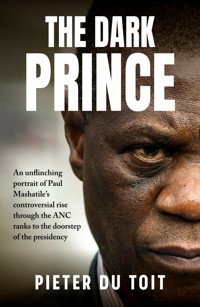
Should Paul Mashatile be South Africa's next president? Having survived scandal, controversy and the Zuma years, Paul Mashatile has risen through the ranks to the doorstep of the presidency. Over a political career spanning 30 years, he has successfully navigated the corruption and factionalism that the ANC has become known for. Now he wants to take charge of the party – and the Union Buildings. The question is: Should he? Is Paul Mashatile suitable for the highest office? He has been associated with the 'Alex Mafia' for more than 30 years. What influence do they have over Mashatile? He leads a lavish lifestyle, living in luxury homes in Johannesburg and Cape Town. How were they acquired? He has been outspoken about the economy, black economic empowerment, and South Africa's foreign relations. But does he have firm principles? And how has his string of lovers affected his professional life? This meticulously researched account by bestselling author Pieter du Toit answers these vital questions and reveals the dark truth about the ANC's crown prince.
Sie lesen das E-Book in den Legimi-Apps auf:
Seitenzahl: 415
Veröffentlichungsjahr: 2025
Das E-Book (TTS) können Sie hören im Abo „Legimi Premium” in Legimi-Apps auf:
Ähnliche

















Pieter Du Toit
Jonathan Ball PublishersJohannesburg & Cape Town
Also by Pieter du Toit
The Super Cadres: ANC Misrule in the Age of Deployment (2024)
The ANC Billionaires: Big Capital’s Gambit and the Rise of the Few (2022)
The Stellenbosch Mafia: Inside the Billionaires’ Club (2019)
Enemy of the People: How Jacob Zuma Stole South Africa and How the
People Fought Back,with Adriaan Basson (2017)
For my sons,
whom I want to flourish in South Africa
The old world is dying and the new world struggles to be born.
Now is the time of monsters.
Loose translation of Antonio Gramsci by Slavoj Žižek
Contents
Paul Mashatile: Life and Career
1961Born in Gerhardsville, near Pretoria
1982Matriculates at the Alexandra High School
1983Founding leader of the Alexandra Youth Congress
1984Helps organise the Alexandra bus boycott
1985Arrested and detained without trial at Diepkloof Prison
1989Released from detention following a hunger strike
1990Coopted into the ANC’s structures in the PWV region
1991Appointed political education officer for the ANC PWV
1992Elected to the regional executive committee of the ANC PWV
1993Serves as regional ANC secretary under Tokyo Sexwale
1994Elected to the Gauteng provincial legislature
1994Elected Gauteng ANC secretary
1996Appointed Gauteng MEC for Roads, Transport and Public Works
1997Thabo Mbeki elected ANC leader, becomes president two years later
1996Re-elected Gauteng ANC secretary
1998Appointed Gauteng MEC for Safety and Security
1998Elected Gauteng ANC deputy chairperson
1999Appointed Gauteng MEC for Housing
2001Defeated in Gauteng ANC election for deputy chairperson
2004Appointed Gauteng MEC for Economic Development
2004Defeated in Gauteng ANC election for deputy chairperson
2007Elected chairperson of the Gauteng ANC
2007Jacob Zuma elected ANC leader, becomes president two years later
2008Elected premier of Gauteng after resignation of Mbhazima Shilowa
2009Appointed Deputy Minister, and later in the same year, Minister of Arts and Culture
2010Re-elected chairperson of the Gauteng ANC
2012Zuma re-elected as ANC leader
2014Left out of cabinet after the election, becomes MP and committee chairperson
2014Re-elected chairperson of the Gauteng ANC
2016Appointed Gauteng MEC for Human Settlements
2017Elected ANC treasurer-general, Cyril Ramaphosa elected ANC leader
2018Zuma resigns as president, Ramaphosa elected as head of state
2022Elected ANC deputy president, Ramaphosa re-elected ANC leader
2023Appointed deputy president of South Africa
Prologue
Shortly after becoming deputy president in March 2023, Paul Mashatile received a dubious character called Louis Liebenberg at his palatial home in Waterfall, Midrand.1 Liebenberg, a grifter and a bombast, gave Humile Mashatile a diamond. The size of the stone is in dispute (Liebenberg claims it was a one-carat gem worth R109 000, while a former bodyguard says it was three carats), but the fact that the Mashatiles accepted the gift is not.2
In August 2025, Mashatile was fined R10 000 by Parliament’s ethics committee for his failure to declare Liebenberg’s largesse. At the same time, he suddenly declared to Parliament that a mansion in the exclusive Cape Town suburb of Constantia, valued at R28.9 million, was one of his residences.3 The house isn’t registered in his name – it was bought by his son-in-law, Nceba Nonkwelo – and for two years the deputy president denied using it as a primary residence. That arrangement suddenly changed. Mashatile, a career politician who in 2024–2025 earned a salary of R3.16 million, enjoys the run not only of the Constantia mansion but of the Waterfall house, valued at R37 million.4
Mashatile denied any impropriety. ‘Look, people must read. That’s just one of the first things you must learn in life. There’s nothing in Parliament that I said a house [in Constantia]. I said I live there. That house is owned by my son-in-law. It’s a very simple thing to read, so what’s the problem? I don’t use government money, there’s no government money in those houses, so what are you looking for, there’s no government money in that house, so I don’t know what’s your problem. It’s a private home; it’s owned by the family … so how does government come in?’ he said when asked about the luxury Cape Town house.5 His relationship with Liebenberg remains unclear.
Liebenberg was arrested in October 2024 and charged with fraud, corruption, money laundering and theft. Standing atop an alleged Ponzi scheme, he is said to have swindled more than R400 million out of unwitting investors in his diamond trading company.6
With God on his side, as he claimed, he duped thousands of people into buying ‘packets’ of diamonds, while delivering unhinged sermons and rants on his Facebook page that dominated the front pages of Sunday newspapers and celebrity magazines for weeks. But it was clear from the start that Liebenberg was a trickster. He was an avowed supporter of Jacob Zuma, donating millions of rands for the legal fees of the former head of state and leader of the African National Congress (ANC) who was such a vital cog in the scheme of grand capture that ravaged South Africa between 2009 and 2018. He even visited the corrupted former president at his homestead in KwaZulu-Natal, bringing cows as a gift and declaring his loyalty.7
Shortly after Liebenberg’s arrest, the South African Human Rights Commission (SAHRC) filed a case against him at the Equality Court, accusing him of racism. ‘We have been in the country longer than the k****rs, and suddenly BEE comes and now he gets everything free because he is a k****r. He’s a k****r because he was born that way … because he’s f**ked so much and now has 15 children,’ he said, among other things.8
Despite accusations of fraud, theft and racism, Liebenberg seemed to be a favourite of the political elite. The uMkhonto we Sizwe Party (MKP), formed by Zuma after his exit from the ANC, called him ‘proof of what loyalty is’.9 His wedding to his third wife in October 2022 was attended by Zulu King Misuzulu kaZwelithini and senior ANC minister Lindiwe Zulu.10
After a court appearance in August 2025, Liebenberg said he supported Mashatile’s campaign for the ANC leadership. ‘The deputy president is an absolute gentleman. He has a jewel for a wife. A beautiful woman. She is clearly well-spoken and intelligent. I feel terrible that the deputy president has become the subject of the media,’ he said.11
But questions about Mashatile’s lifestyle, his friends and their networks will not go away. The ANC integrity commission, a toothless body created in 2012 to pacify those critical of corruption and wrongdoing in the party, investigated Mashatile and made recommendations to the party’s top seven leadership. Reports that he had been cleared were vehemently denied by the commission chairperson, the Rev Frank Chikane, without stating what its findings or recommendations were.12
Mashatile wants to be president. He has made that abundantly clear. It is even becoming apparent that Cyril Ramaphosa, whose term of office as head of state is due to end in 2029, is enabling his deputy to succeed him. But doubts remain about Mashatile’s probity, judgement and suitability for a role that demands integrity.
It was unseasonably frigid on the morning of 7 April 2025 when Mashatile sat down next to the head of the Ahmed Kathrada Foundation, Neeshan Balton, in a restaurant in Illovo, Johannesburg, for a breakfast dialogue with invited guests.
The deputy president’s public exposure in the previous couple of months had been significantly ramped up, and it was apparent that he was being positioned to play a more active role in public discourse. But it was peculiar that the Kathrada Foundation was giving him a platform like this, I thought as I waded through the tightly packed tables to find a seat as close to the front as possible.
Balton, a passionate ANC activist from the old Congress movement and an even fierier anti-corruption crusader, has been outspoken about the majority party’s rapid decline in recent years. According to him, the ANC has become an organisation of locusts and charlatans, with political leaders at every level succumbing to the worst impulses of human greed, material excess and crass exhibitionism.
Mashatile had been part of that culture for decades. As an elected official in the Gauteng government in the 2000s, he became known for his disregard for public funds, racking up towering bills at some of Johannesburg’s finest restaurants. He was sometimes known as ‘the Don’, holding court while plotting an assault on the party leadership. Mashatile is at the heart of various concentric networks connected to politics, business and private interests. These networks have allowed those closest to him to become wealthy, they have channelled money to the ANC, and they have provided luxury homes and supported his sometimes fraught personal life.
The networks are hidden from the public eye and populated by figures who are not compelled to exhibit fidelity to the Constitution or have any regard for limited public resources. Two years before the Illovo breakfast, as Mashatile’s life of excess started to overshadow his undistinguished record as an elected official, some of his closest comrades from the ‘Alex Mafia’ approached the High Court in an attempt to gag investigative journalists unpicking these networks.
I thought the Kathrada Foundation’s invitation was rather surprising after its aggressive defence of Pravin Gordhan, the ANC’s foremost internal opponent of state capture, and its public stance on corruption and maladministration. Mashatile wasn’t a natural fit for the organisation. Nevertheless, the restaurant – on the second floor of what was once a pulsing nightclub – was packed with struggle veterans from the Indian Congress movement. Old fogeys and greybeards, men who had fought apartheid, helped keep internal resistance alive in the face of the security and riot police, built underground networks and established the United Democratic Front (UDF). Some carried the scars of old battles, one walked with a limp, others were weatherbeaten with age. But they listened attentively to Mashatile, often nodding in agreement and sometimes applauding.
Balton questioned the deputy president on a range of matters, principally the future of the Government of National Unity (GNU) – then amid the strife of the 2025 budget deadlock – the economy and infrastructure. I sat to Mashatile’s right among a group of former activists who showed great warmth for someone they believed shared their struggle values. And I wondered whether they approved of the way Mashatile had arranged his public and private affairs, and how he operated in Gauteng, and what they thought of his R37 million house in Waterfall. Did they believe he was the best a generation could offer, that he was someone to help South Africa move forward?
Balton asked Mashatile about the ANC’s disastrous election results in 2024. Why had voters rejected the party of liberation, he wanted to know. The struggle veterans shifted in their chairs and strained to hear a leader of the ANC speak. Mashatile launched into a compendium of reasons, straight from the party manual on standard responses and diversion. ‘Load-shedding made people lose confidence and we brought in the Minister of Electricity too late. People didn’t vote for the ANC because we didn’t invest enough in electricity generation. Now we must plan well ahead of time. We must fix water, energy and logistics. We must fix the ports, Transnet and Prasa. We must create jobs and help families feed themselves,’ were his answers, according to my notes.
And he was correct. All these factors did contribute to the ANC’s loss of support. But Mashatile’s response – as always – was formulaic, prepackaged and drafted in committee. Balton wanted more. He asked about state capture. Why did Mashatile not mention that as one of the reasons for the ANC’s decline and would he care ‘to reflect’ on it? Again, Mashatile was noncommittal and evasive. There were ‘challenges’, and ‘some of us criticised what was happening’, but it was ‘a challenge to criticise the president [Jacob Zuma]’. He told his audience that it was ‘important to address’ state capture, that Cyril Ramaphosa had been ‘brought in to fix things’, but that they had ‘underestimated the damage’. ANC leaders cannot dissect what happened during the state capture era because it would mean admitting complicity or silently endorsing the large-scale pillaging of state resources. And doing that would mean exposing networks of extraction and risking damage to the ecosystem that maintains the whole movement.
Balton allocated me the only media question after his conversation with Mashatile. After the severe market reaction over fears that the GNU was starting to unravel, how urgent was it that the DA should remain part of the government, I inquired. Mashatile, always half-reclining when he is seated, turned and looked at me. ‘The ball is in their court. We want the GNU to remain intact … here we want certainty,’ he responded. And he explained about better education, an improved health sector and higher VAT. ‘We have told that to the DA. If they are not listening, there is nothing I can do … nothing I can do.’
Up close, Mashatile seems disengaged and unserious, either incapable of grappling with complex issues or unwilling to do so. And although old struggle ties were warm on that cool April day, I’m pretty sure most in the audience saw it too.
Introduction
‘We are a democracy, and there is only one way to get a democracy on its feet in the matter of its individual, its social, its municipal, its State, its National conduct, and that is by keeping the public informed about what is going on. There is not a crime, there is not a dodge, there is not a trick, there is not a swindle, there is not a vice which does not live by secrecy. Get these things out in the open, describe them, attack them, ridicule them in the press, and sooner or later public opinion will sweep them away.’
– Joseph Pulitzer, c. 1910, quoted in Alleyne Ireland, An Adventure with a Genius: Recollections ofJoseph Pulitzer
Shipokosa Paulus Mashatile is the deputy president of South Africa, having been appointed to that position by President Cyril Ramaphosa in March 2023. He is also the deputy president of the ANC, the majority party in Parliament and the dominant political formation in the country since 1994, when it won the first democratic elections.
Although much diminished after a calamitous general election in 2024, the ANC remains by far the largest political party, leading the national executive, Parliament and most provinces, cities and towns. Thanks to its policy of cadre deployment, ANC functionaries and loyalists occupy not only executive and elected positions at all levels of government but almost all senior, middle and lower positions in every bureaucracy and the civil service. The culture and ethos of the state, most provincial governments and most municipalities are extensions of the ANC’s culture and ethos, creating the hegemony between party and state crucial for the success of a nationalist project.
Inside the government, despite the ANC’s loss of its majority and the formation of a coalition, the party’s policy agenda remains in the ascendant. The cabinet accommodates ministers from rival parties, such as the Democratic Alliance (DA), but they have no bearing on policy direction or economic reforms. The apex of government, the all-powerful Presidency, has become a super-cabinet, an executive within an executive and a state within a state, increasingly usurping line functions from existing departments. Apart from Ramaphosa and Mashatile, it includes at least three other members of the national executive, a director general and the secretary of cabinet. It is also where Operation Vulindlela, the project jointly run by the Presidency and the National Treasury as a quasi-government, is situated. The Presidency, too, is a redoubt of ANC policy, tradition and culture.
The ANC’s dominance of the South African polity despite its electoral decline means it still commands control of most public resources, including major capital investment and procurement projects at national level, supply chain management systems at provincial level, and the contracting of service providers at local government level. It is in this environment that politically connected patronage networks, extraction networks, rent seekers and javelin throwers have flourished in what has become a festival of corruption over almost two decades. Between 2007, when the party then led by Jacob Zuma started its descent into corruption and impunity, and the present, when maladministration and graft have become institutionalised, the ANC has cultivated an opaque ecosystem that supports the party’s survival by exploiting political power and access to resources. And it has thrived.
It is within this context that the era of Jacob Zuma became the defining period in post-apartheid South Africa. The ANC’s underwriting of the Zuma doctrine of patronage and extraction created a culture where political leaders became beholden to private interests, where the activities of state and government were redirected and tailored to the commercial interests of connected businessmen, and where leaders were rewarded for their cooperation. The state capture years under Zuma and the Guptas were years of depravity. State-owned companies such as Transnet, Prasa, Denel and Eskom were routed, with billions of rands stolen and lost. Institutions such as the National Prosecuting Authority (NPA) and the South African Revenue Service (SARS) were mercilessly targeted and disembowelled. And Parliament, one of the guarantors of democracy, was coopted and neutralised, collapsing under political pressure and failing in its task of ensuring oversight and exacting accountability. State capture, party-sponsored graft and ANC leaders’ recklessness represented a full-bore assault on good governance and the democratic architecture. They affected society at every conceivable level. And they critically damaged the executive, the legislature and the state.
The country’s subsequent crisis is directly related to mismanagement by the ANC and its leaders. This is not a controversial statement, nor does it reveal any political or ideological opposition to the party. Measured against the main tenets of the Constitution, and principally the Bill of Rights at the core of South Africa’s supreme law, the ANC has not only failed in many of its obligations as the party of government for 30 years, it has also intentionally acted against most of the country’s foundational prescripts. It therefore follows that anyone with designs on the party’s top position, and by extension the presidency of South Africa, will have to display an extraordinary commitment to the rule of law and good governance and accountability, as well as clarity of thought about policy and the economy. South Africa is no longer – and hasn’t been for years – the darling of the international community. Our democratic miracle has shown itself to be severely fraying at the edges (actually, much deeper than just the edges) and our national crisis related to the economy, rule of law, unemployment and general decay is glaring.
These, then, are extraordinary times, and they demand an extraordinary response from South Africans and their political leaders. And the warning from our immediate past about politicians with unexplained wealth, comforted by large networks of private interests and protected by similarly compromised party comrades, simply must be heeded.
Joseph Pulitzer, the American newspaper magnate after whom the famous journalism prize is named, said democracy will stay on its feet if the public remains informed, and when that which is done in the dark is brought to light. Tricks, swindles and vices live in secrecy, and they must be brought out into the open, he said.
Mashatile wants to lead the ANC, and he wants to be president, yet there is much about him that remains inexplicable, and much that is still hidden. Like Zuma, he is a politician often described by those who know him as charming, even disarming. Certain captains of industry believe he would be a more decisive president than Ramaphosa, who has in the judgement of many failed to provide principled and firm leadership. And there are others who argue he might achieve much success in managing difficult relations between South Africa and countries such as the US, Russia and China, an area in which the Ramaphosa government has conspicuously failed.
But these views are all speculative. They are informed guesses based on Mashatile’s public record since 2023, when he became deputy president of South Africa and rose to prominence as a politician of national consequence. Before that, he was known as the treasurer of the ANC and party strongman in Gauteng, but he has never occupied a position in the national consciousness like other senior ANC leaders over the past three decades. Many of them have shown, through the rough and tumble of public life, what they stand for. Anyone who wants insight into Gwede Mantashe’s beliefs doesn’t have to rely on public addresses or search for press statements in his name. He has been visible and active in government and the party for decades. The same goes for Lindiwe Sisulu, Blade Nzimande and Malusi Gigaba. Or even Zweli Mkhize, Fikile Mbalula and Panyaza Lesufi, the Gauteng apparatchik. Mashatile, however, is a completely different story. It is difficult to pin down what he stands for, and most people – even those with a keen interest in South Africa’s politics – would be unable to provide a cursory explanation of where he comes from or what his political trajectory has been.
What has become known in recent times, however, is that Mashatile leads a life of glorious excess. He has access to at least two extraordinary mansions bought by his son-in-law and his son. His family has benefited from doing business with the government, not only being awarded contracts but also being granted multimillion-rand loans that remained unpaid for years. He is the central figure in a vaunted grouping called the Alex Mafia, a collection of former struggle activists from Alexandra township near Johannesburg. They have become wealthy after achieving success in politics and business, and they have done so in proximity to Mashatile. His broader network, which includes private businessmen and businessmen who trade with the state, provides him with the means to support his lifestyle – and that of his intimates.
Politically, Mashatile is the quintessential party man, never straying from ANC dogma and ideology, faithfully repeating established maxims and beliefs despite repeated policy failures. He declares support for the role of the private sector and the rule of law but would jump at the opportunity to embrace the Economic Freedom Fighters (EFF) – a party that poses a visceral threat to democracy – as a governing partner. And what of his record in government as an elected official? He has held executive positions for most of our democratic history, after being elected in 1994 as a member of the Gauteng provincial legislature and handed his first senior position two years later, when he became the MEC (member of the executive council, or provincial cabinet minister) for Roads, Transport and Public Works.
Apart from attempting to establish the outlines of Mashatile’s network, as well as to analyse his beliefs about the economy, democracy, the rule of law and any vision for the future, this book also traces his performance as an elected public official. It was thanks to his years in provincial government that he was able to build his base in Gauteng, but what did he achieve? And what can we learn from his period as chair of a parliamentary committee dealing with the budget? Does he understand the economy, does he believe in fiscal probity, and what are his views on the role of the state? They aren’t obvious, and if we are to understand where a possible future president might lead the country, Mashatile’s beliefs must be interrogated.
The election of Ramaphosa as president in 2018 did not signal the end of state capture, nor did it introduce an era of accountability. After a brief period of optimism and hope, it became clear that the debasing and undermining of institutions such as the police, NPA and Parliament have allowed organised crime and patronage networks to survive the initial – largely performative – threat of reform by Ramaphosa. These institutions have not been able to recover sufficiently from the scourge of capture to execute their mandates in accordance with the Constitution and the demands of the public.
In 2025, South Africa saw several simultaneous breakdowns in systems and public institutions, further infrastructure collapse and a rapid escalation in the violent and rabid activities of organised crime. The coalition government remained under built-in pressure due to the cleavages in policy, culture and vision between its two major constituent partners, and the rapidly changing geopolitical environment created turbulence and uncertainty not experienced for decades.
The challenges for South Africa’s political leaders are enormously complex. The largest political party has shown itself unable to govern in anyone’s interests but its own, repeatedly choosing the survival of its system of patronage over the national interest. Mashatile is a product of this ethos. His bid for the party leadership and the presidency of the country will determine whether South Africa wants to reject the ANC’s culture of crass extraction, or whether it wants to hold on to its commitment to revolutionary destruction.
1
Born in Verwoerd’s South Africa
On 21 October 1961, Shipokosa Paulus Mashatile was born on a farm in Gerhardsville, a small community north of Fourways and west of Centurion, about halfway between Johannesburg and Hartbeespoort Dam.
His official biography states that his parents, Bishop Diamond Nyangeni and Mirriam Nomvula Mashatile, lived on the farm where his father was a preacher.1 Although they were allowed to live in the area, apartheid laws determined that they were never full citizens of the country of their birth and that their roots lay in distant homelands – or reserves – created by the government’s central planners and native commissioners. By 1960, the year before Mashatile’s birth, all black people had been removed from white areas and the government had cleared out slums within urban boundaries. It established black townships for migrant workers, separated from white areas by buffer zones such as rivers or other natural barriers. City and town planning was such that black workers did not travel through white areas to reach their places of employment. In terms of culture, ethnicity, race and class, South Africa was the most rigidly divided society on earth.2
Mashatile’s mother did domestic work and sold vegetables to help her husband support their eight children. The young Mashatile and his brothers and sisters ‘honed their entrepreneurial skills and acquired a solid work ethic assisting their mother in her small enterprise’.3 As they did so, ‘grand apartheid’ reached its apogee. By the late 1960s, most of its key laws had been promulgated, resistance had been all but crushed and the security state had begun to emerge.
Three days before Mashatile drew his first breath, Hendrik Frensch Verwoerd, a doctor of sociology, led the National Party to its largest victory in a general election since it supplanted the United Party of Jan Christian Smuts in 1948. It was a triumph for Verwoerd but a dark and disastrous period for liberation movements. They were hobbled and outlawed, their leaders were imprisoned or banned, and popular dissent was stamped out.
Verwoerd’s Nationalists had led South Africa out of the Commonwealth and proclaimed a republic on 31 May of that year. Full independence from Britain was the culmination of a dream cherished by Afrikaner nationalists since the Boer republics were vanquished in the South African War of 1899–1902, and the electorate rewarded Verwoerd for his determination and strong leadership. The National Party increased its popular support by ten percentage points, and in the constituency system of the time it won a thumping majority in the 156-seat House of Assembly – 105 seats compared with 45 for the United Party, its closest competitor. Two other parties had one seat each, including the new Progressive Party, with Helen Suzman as its lone representative.4 For the first time, there was no black representation in Parliament. Until 1958, four white MPs were elected to represent the interests of black South Africans, alongside a Natives Representative Council, which was extra-parliamentary and had no executive or political power. Verwoerd excised the ‘black’ parliamentary representation and disbanded the Natives Council.5
The Verwoerd government had been severely tested in the years before Mashatile’s birth. On 3 February 1960, British prime minister Harold Macmillan stood up in the parliamentary dining room in Cape Town and delivered his famous ‘wind of change’ speech to a joint meeting of the House of Assembly and the Senate. On a month-long tour of Africa, visiting current and former colonial territories, Macmillan gained a deep impression of a growing black African nationalism, a rising self-confidence among African leaders and an increased clamour for full independence. Among others, the Gold Coast (Ghana) won independence in 1957, Nigeria in 1960, Uganda in 1962 and Kenya in 1963.6
Britain had been a reluctant ally of South Africa after World War II, but Macmillan warned his audience that the political realities of a changing Africa could no longer be ignored, including by Verwoerd and his people: ‘The wind of change is blowing through this continent, and, whether we like it or not, this growth of national consciousness is a political fact. We must all accept it as a fact, and our national policies must take account of it.’7 Macmillan went on to explain that British policy dictated that people in its colonies must have an increased share of ‘political power and responsibility’, and merit alone should be the basis of political or economic advancement. He told his audience of white MPs that Britain, in staying true to its own convictions, ‘shall sometimes make difficulties for you’ but that it was a fact that ‘this difference in outlook lies between us’.8
The language today seems archaic and stodgy, but Macmillan’s admonishment of South African race laws was as strong as could be expected. Verwoerd’s successor, John Vorster, would later say that the South African prime minister looked ‘strained’ as he listened to his British counterpart.9 South Africa had become used to dealing with its enemies – as turbulence in the late 1940s in its diplomatic conflict with India showed – and increased pressure from the United Nations (UN) and its member states. But to be so rejected by Britain presented a whole new challenge and precipitated a period of growing isolation on the global stage.
Verwoerd’s response, though as gracious as was possible (Macmillan did not share the contents of his address with Verwoerd beforehand, as was customary), was a rejection of Macmillan’s thesis. He told his guest that South Africa was a white country and part of the Western world. Yes, there should be justice for the black man in Africa, but there should also be justice for the ‘white man of Africa’, he said. The whites in South Africa occupied a deserted country, with black occupation of land only in certain parts of the subcontinent. He agreed with Macmillan, he said, that people should have the opportunity to enjoy the full rights of citizenry. But that should happen first in areas that black ancestors found and occupied.10
If Macmillan’s address represented a new phase in the international rejection of South African apartheid policies, events on 21 March 1960 – mere weeks after the departure of the British premier – changed the country forever. In early March, Robert Sobukwe, a black activist from the eastern Cape Province, broke away from the ANC to form the more radical Pan Africanist Congress (PAC), and he started to organise a national demonstration against passes, the infamous ‘dompas’. Blacks were required to carry these identification documents to enable them to ‘pass’ into urban areas that the apartheid government reserved for whites, despite black people having lived there for decades or centuries. The pass became emblematic of the rigidity and the brutality of the apartheid regime, because failure to carry one could lead to imprisonment and eventual expulsion to the reserves from the industrialised areas of the Witwatersrand and elsewhere, and condemnation to a life of poverty and deprivation.
On the morning of 21 March, Sobukwe led a crowd of supporters to the police station in Orlando, Soweto, and gave himself up for arrest. No one was carrying a pass. At the same time, in Sharpeville, south of Johannesburg, a crowd of 5 000 people surrounded the police station, also demanding arrest. A small contingent of inexperienced policemen were on duty, and, according to police reports later, stones were thrown, tempers flared and shots were fired into the crowd. In the chaos that followed, 69 people (men, women and children) were killed, many shot in the back as they ran away, and 180 were wounded.11
After the Sharpeville massacre, Chief Albert Luthuli, the ANC leader, led a new wave of protests, burning his pass and asking all black South Africans to stay away from work. It was a resounding success, with businesses dependent on black labour forced to a halt. Capital fled the country and international condemnation was harsh.12 But Verwoerd, so certain of his own convictions and determined to ensure the future of South Africa as a white man’s country, was unmoved and his response merciless. On 24 March the government banned all public meetings; four days later it introduced legislation to ban the ANC and ancillary organisations; and on 30 March a state of emergency was declared, with hundreds of people arrested.13 On 8 April, the ANC, PAC and other organisations were banned. It would be 30 years before the ban was lifted, and by then Mashatile had joined the struggle against apartheid, been imprisoned and become an elected representative of the ANC.
Bishop Nyangeni and Mirriam Mashatile raised their children in a country where politics was dominated by the colossal figure of Verwoerd and where the resistance against institutionalised racial oppression had been brutally crushed. Luthuli described Verwoerd as ‘the author of our calamity’ and added that his laws directed every aspect of a black South African’s life, from cradle to grave.14 Verwoerd became prime minister of the apartheid state in 1958 and not only implemented the government’s nascent and often hesitant apartheid policies but completely redesigned them and provided his followers with a theoretical framework from which to justify them. Such was his dominance that the party, Afrikaner intelligentsia and academia deferred to him on almost all theoretical development of the philosophy of apartheid, its future and possible alternative constitutional arrangements. Historian Hermann Giliomee says that in the years after Verwoerd’s death, Afrikaners remained so ‘enchanted’ with him that there was almost no effort to find new ways to politically accommodate black people. And his successor, Vorster, sought to implement Verwoerd’s ideas as if they were the sole blueprint for the country’s future, instead of the evolution of apartheid political theory.15
Little is known of Mashatile’s early years in Gerhardsville. His official biography says the family moved (or, perhaps more accurately, was evicted) to the township of Atteridgeville, west of Pretoria. He left his parents’ home when he enrolled at Paradise Bend Primary School in the slums of Diepsloot, north of Johannesburg, staying with his aunt and uncle. In 1972, 11-year-old Mashatile returned to Atteridgeville to continue his education at Bathabile Primary School.
During his years at Paradise Bend the apartheid state was at the height of its powers. Vorster, appointed Minister of Justice in mid-1961, was the epitome of the apartheid hard man. Upon his appointment, he told Verwoerd that he should be left to ‘deal with the threat of subversion and revolution in my own way … if you fight communism with the Queensberry Rules, then you will lose’. ‘Tough, unyielding’ and a German sympathiser during World War II, Vorster brooked no resistance and armed the police, the special branch and the security police with enough emergency regulations to enable them to play outside ‘the rules’.16 He introduced draconian laws such as the so-called Sabotage Bill of 1962, giving the Minister of Justice, the prime minister and law enforcement agencies unprecedented powers to arrest and detain people without due process. The following year, he introduced the ‘90-Day’ Bill, which enabled him to detain anyone suspected of any offence under a range of laws, including the Suppression of Communism Act and the Unlawful Organisations Act.
Under Vorster, who took over as prime minister when Verwoerd was assassinated in 1966, apartheid was enforced and implemented with a religious zeal. By the late 1960s the violence and acts of sabotage that had occurred earlier in the decade had been largely dealt with, and the ANC’s armed resistance was limited to irregular bombings. Henry Kenney, who wrote perhaps the most incisive biography of Verwoerd, says his final years ‘coincided with the greatest economic boom in South African history’. Despite the uncertainty of 1960 and 1961, the government’s hardline approach enabled capital to return to receptive climes and the economy to grow at an annual rate of about 6 per cent between 1960 and 1970. Manufacturing output increased by 70 per cent during the first half of the decade, and gross national product by 48 per cent.17Time magazine, though critical of apartheid, said in 1966 that South Africa was enjoying a period of exceptional growth thanks to cheap labour, a gold-backed currency and high returns for international investors. In the same year, the Rand Daily Mail declared that South Africa was suffering under ‘a surfeit of prosperity’, and in 1967 the Financial Mail called the period between 1961 and 1966 ‘the fabulous years’.18
For a black boy travelling back and forth between Atteridgeville and Diepsloot, however, the future looked interminably bleak. Mashatile lived in a world in which his parents had no political rights and where their freedom of movement, employment and rights of association were directed and restricted by a system of laws which left them at the bottom of the heap. As he grew up he faced a simple choice: comply or fight back.
2
Alex and Political Awakening
Alexandra is a Johannesburg township east of Sandton and across the Jukskei River, one of the natural barriers that apartheid spatial planners used to separate black and white communities. In the early 20th century, it was one of the only areas around Johannesburg where black people could own land. The first properties were put on the market in 1913, ironically the same year in which the infamous Natives Land Act was promulgated.1 This was the original legislative tool used to deprive blacks of property in the country of their birth.
‘Alexandra is noteworthy because it served as the crucible of numerous political traditions, which crystallised into the mass African nationalism of the 1950s, as well as a new popular civic culture in the 1980s. It has thus been the source of path-breaking black political cultures for decades,’ write academics Philip Bonner and Noor Nieftagodien in Alexandra: A History. And it was the site of the ‘six-day war’, a turning point in the struggle against apartheid in Johannesburg, in which residents and security forces engaged in intense violent conflict after police teargassed mourners at a funeral in 1986.
‘Alex’, as the township is popularly known, played the formative role in Paul Mashatile’s political and social awakening. It was where his political and activist career started, and where he formed lifelong bonds with the comrades who would become known as the Alex Mafia. He completed his primary education in Atteridgeville around 1974 and moved to Alexandra for the next phase of his education, enrolling at Alexandra High – commonly referred to as ‘Roma’ because it used to be run by the Roman Catholic Church.2
Alex, named for either a British royal or the daughter of the original owner of the farm on which it was built, was popular among black people arriving in Johannesburg to look for work because, in the early days, it did not fall under the control of the municipality. Plots were bigger than in Sophiatown, Martindale and Newclare, some of the early ‘locations’ the city established to house African workers and their families.3 The rapid industrialisation of the Witwatersrand after the South African War created a constant demand for cheap labour, which was mostly supplied by black workers from the area and migrant workers moving to the expanding city.
Initially black, white and coloured workers mixed freely and lived cheek by jowl in areas such as Doornfontein and the city’s outskirts. But the Natives (Urban Areas) Act of 1923 set out the government’s policy on African presence in cities and introduced new living arrangements for different races. The Act recognised the need for African accommodation in cities, but in the eyes of the government black people were there for only one reason: to work. Colonel Charles Stallard, who led a commission of inquiry into the matter, put it bluntly: Africans were not welcome in cities, except as labourers. And it was in the interests of commerce and industry to have a settled and steady supply of labour housed in locations and townships.4 The Act was amended in 1930 and 1937 to tighten control over the movement of black people, their passes and their contracts of employment.5
Johannesburg built various ‘hostels’ to accommodate workers on the outskirts of the city, developed ‘locations’, such as mining compounds, to enable better control over workers, and tried to isolate ‘freehold’ areas where black homeowners lived, including Sophiatown. The city did not dispose of refuse or provide transport, health, education and recreational facilities. The conditions fuelled the spread of disease, severely curtailed life expectancy and increased child mortality rates. Many areas became overcrowded and unhygienic slums.6
One of these was Alex, a rapidly expanding township on the outskirts of the city with no rubbish removal and a river used for cooking, cleaning and sewage disposal. African workers from across the country settled there, but there was no transport to the city and many people grew small crops or brewed traditional beer for a living.7 Some lived in a smattering of the old brick houses, built during the township’s early years when people owned plots, but most people were crammed into shacks, ‘barracks’ and ‘zincs’ or any other shelter they could construct.8
In 1953 the Minister of Native Affairs, Hendrik Verwoerd, tabled the Bantu Education Bill, which sought to take control of ‘mission schools’ such as Roma.9 Alexandra High was attached to St Hubert’s Catholic Church, established in 1919 at the behest of Bishop Charles Cox, the apostolic administrator of the Transvaal.10 Cox played a leading role in the expansion of Catholic missions throughout the region, and Catholic (and mission) schools became focal points of consciousness and resistance against segregation and discrimination. But by 1975, when Mashatile probably started his secondary school journey in Alex, the system of Bantu education implemented by Verwoerd in the 1950s was well established.
Although the state built two new high schools in Alex during the early 1980s, overcrowding, a lack of equipment, a shortage of qualified teachers and other issues continued to hamper children’s education. In 1982 Izwi lase Township, one of Alex’s newspapers, published letters from schoolchildren decrying the system. ‘I left Alexandra High School because my teachers were lazy, they did not come to classes. Some of them were not qualified, they taught me subjects they did not know,’ wrote one student. Another said of his geography teacher: ‘All he does is read from the textbook, and sometimes tries to explain difficult words. We might as well read the book on our own.’11
Historian David Welsh argues that African education was ‘a major target’ of Verwoerd. ‘There was a long tradition among Nationalists of antipathy towards African education; educated Africans tended to be more resentful of white domination and, moreover, the expansion of educational opportunities would diminish the supply of farm labour. Even the introduction of school feeding schemes was opposed.’12
Roma in Alex was one of the schools removed from the control of missionaries. Nationalists felt they were producing too many ‘black Englishmen’, educated Africans at the forefront of demands for equal rights. In addition, the dominance of English meant that the cultural forces were tilted against Afrikaans, and that had to be remedied. Black schools were brought under central government control and a Department of Bantu Education was established.13 The ideology informing the apartheid state’s approach to education was crystallised in one of Verwoerd’s most infamous speeches. Delivered in the Senate in 1954, it gives one of the clearest insights into the apartheid leader’s beliefs and frame of reference: ‘It is my department’s policy that education should be rooted with both feet in the native areas and in the native spirit and in the native community. It is there where Bantu education can come to its right and where he should serve his community. The Bantu must be led to serve his community in all aspects of life. There is no place for him above the levels of certain forms of labour in the white community. Within his own community, however, all doors are open.’14
Mashatile matriculated in 1982, at the age of 21, three years after he was supposed to have finished his schooling. There seems to be a modern revisiting of the true nature and effect of Bantu education on black South Africans, with some arguing that it was not the abomination it has been made out to be. But there is agreement about the stark disparity in spending on white and black education during apartheid. Between 1953 and 1971–1972, the per capita amount spent on a black child’s education increased by 47 per cent, from R17 to R25. For their white counterparts it increased by 260 per cent, from R128 to R461.15 Henry Kenney says this provides ample evidence for the belief that African education ‘simply amounted to an education for inferiority, that it was designed to provide Africans only with that minimum level of competence which would enable them to provide efficient manual work for white employers’. Hermann Giliomee cites researchers and educationalists, including Ken Hartshorne, saying that ‘syllabi were much the same to those used by white provincial schools, and an improvement on what was used before’. But there is no doubt among scholars that poorly resourced schools, a lack of teachers and poor infrastructure meant that Bantu education – Mashatile’s education – had a destructive effect on generations of black South Africans.
Mashatile’s high school years in Alex – when it was used as a base by activists and underground ANC operatives, becoming a hotbed of resistance against apartheid – were regularly interrupted by political events. In 1976, his second year at Roma, the student uprising in Soweto took place. The use of Afrikaans as a language of instruction was a cornerstone of the education system because of Verwoerd and his successors’ belief that Africans needed to be proficient in the language if they were to enter the labour market. But by the 1970s a new type of resistance had emerged among township youths. Inspired and led by Steve Biko, the Black Consciousness movement quickly spread and young people were swept up by the idea of black pride and the rejection of inferiority. In 1971, Biko founded the black-only South African Students’ Organisation; within four years schoolchildren across the country were protesting about inferior education, and historian Gail Nattrass says Biko’s influence manifested itself in a growing resistance.16
On 16 June 1976, almost 20 000 schoolchildren marched from Morris Isaacson High School towards Orlando West Junior Secondary School in response to a new decree about Afrikaans as the medium of instruction in black schools. During the march the police opened fire and killed scores of children, shooting some through the head and others in the back. The uprising, and the ensuing violence that spread to other parts of the country, was broadcast on the television news and grimly illustrated the brutality of the apartheid regime. In Alex, where Mashatile was in his second year at Roma, residents organised a stayaway in solidarity with the Soweto revolt, but violence and clashes with police led to the deaths of four people. Mashatile would later say that those who died on 16 June should be ‘a great source of inspiration’, and that the uprising was ‘a powerful statement of the youth’s desire for change and a better future. It was a brave act of defiance against a system that sought to suppress their potential and destroy their dreams.’17
Alex, the resistance against apartheid, and increased frustration among young black men motivated Mashatile to get involved in the struggle, and he joined the Congress of South African Students (Cosas), the student movement with ties to the banned ANC. The 1980s, however, were to hold much trauma for the young activist.
3
Into the Crucible of Resistance




