


Erhalten Sie Zugang zu diesem und mehr als 300000 Büchern ab EUR 5,99 monatlich.
- Herausgeber: Jonathan Ball
- Kategorie: Sachliteratur, Reportagen, Biografien
- Sprache: Englisch
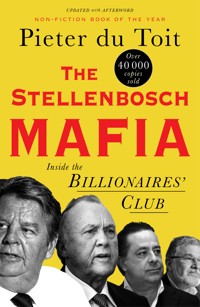
About 50km outside of Cape Town lies the beautiful town of Stellenbosch, nestled against vineyards and blue mountains that stretch to the sky. Here reside some of South Africa's wealthiest individuals: all male, all Afrikaans – and all stinking rich. Johann Rupert, Jannie Mouton, Markus Jooste and Christo Weise, to name a few. Julius Malema refers to them scathingly as 'The Stellenbosch Mafia', the very worst example of white monopoly capital. But who really are these mega-wealthy individuals, and what influence do they exert not only on Stellenbosch but more broadly on South African society? Author Pieter du Toit begins by exploring the roots of Stellenbosch, one of the wealthiest towns in South Africa and arguably the cradle of Afrikanerdom. This is the birthplace of apartheid leaders, intellectuals, newspaper empires and more. He then closely examines this 'club' of billionaires. Who are they and, crucially, how are they connected? What network of boardroom membership, alliances and family connections exist? Who are the 'old guard' and who are the 'inkommers', and what about the youngsters desperate to make their mark? He looks at the collapse of Steinhoff: what went wrong, and whether there are other companies at risk of a similar fate. He examines the control these men have over cultural life, including pulling the strings in South Africa rugby.
Sie lesen das E-Book in den Legimi-Apps auf:
Seitenzahl: 379
Veröffentlichungsjahr: 2019
Das E-Book (TTS) können Sie hören im Abo „Legimi Premium” in Legimi-Apps auf:
Ähnliche















Pieter du Toit
JONATHAN BALL PUBLISHERS
JOHANNESBURG • CAPE TOWN • LONDON
TABLE OF CONTENTS
This book is dedicated to my family, who have supported me
throughout the long days and longer nights of writing.
Thank you Janetha, Schalk and Lukas.
CAST OF CHARACTERS
ACRONYMS AND ABBREVIATIONS
BAT British American Tobacco
BLF Black First Land First
CCRD Centre for Competition, Regulation and Development
CEO chief executive officer
Cosatu Congress of South African Trade Unions
EFF Economic Freedom Fighters
FNB First National Bank
Iscor Iron and Steel Corporation
JSE Johannesburg Stock Exchange
NPA National Prosecuting Authority
PwC PricewaterhouseCoopers
RMB Rand Merchant Bank
SACP South African Communist Party
SARS South African Revenue Service
SARU South African Rugby Union
STAR Steinhoff Africa Retail
TIB Tegniese en Industriële Beleggings
TRC Truth and Reconciliation Commission
UAE United Arab Emirates
WMC white monopoly capital
PREFACE
DE VOLKSKOMBUIS restaurant is opposite the Markötter Rugby Fields, which belong to Paul Roos Gymnasium, Stellenbosch’s prestigious boys’ school. Stellenbosch used to be a quaint village, known mainly for its university, rugby club and surrounding wine farms. Today, however, it’s an exclusive, wealthy business centre, whose surrounding mountains create a kind of buffer zone seemingly keeping out the rest of South Africa. It’s also the home of the so-called Stellenbosch Mafia.
De Volkskombuis, which had fallen on hard times, was refurbished by, depending on whom you listen to, either Johann Rupert himself or Remgro, the holding company founded by his father as a cigarette manufacturer called Rembrandt.
‘Go there for lunch – it’s a fantastic place,’ Rupert said after an interview he gave me for this book. The restaurant is a Stellenbosch institution. It has been there for years and continues to serve local Boland fare, such as waterblommetjiebredie and a hearty oxtail. Since its revamp, the slightly run-down, rural look is gone, replaced by a modern kitchen and understated but expensive finishings, and it boasts a wine list populated by produce from the best estates in the area.
In April 2018, I attended a lunch event there organised by Jannie Durand, the CEO of Remgro. A colleague and I were to give a talk that evening about the political climate in the country, and the event was intended as an opportunity to talk with local businesspeople about South Africa and its problems. Besides the affable host, Durand, the lunch was attended by Jannie Mouton, the retired founder of the PSG Group, GT Ferreira, one of the driving forces behind Rand Merchant Bank, Edwin Hertzog, who built the Mediclinic private hospital group from scratch, Wim de Villiers, the vice chancellor of the university, Jean Engelbrecht, proprietor of Rust en Vrede, a pre-eminent Stellenbosch wine estate, lawyer Arend de Waal, Ronnie van der Merwe, Mediclinic’s CEO, and Nils Flaatten, a former CEO of Wesgro, the Western Cape government’s economic development agency. The guests represented some of the country’s biggest corporates and between them controlled billions of rands in investments, employed thousands of people and made enormous contributions to the fiscus. They considered themselves rainmakers, but, in some quarters, they stood accused of being the high priests of so-called white monopoly capital, a shapeless and faceless entity allegedly controlling the economy, exploiting workers and living off the fat of the land. If ever there were a Stellenbosch Mafia, this might well be it, I thought, as we took our seats and started exchanging pleasantries.
The Stellenbosch Mafia has been described as a grouping of influential white Afrikaner businessmen who use their clout informally to steer the economy and pull the strings of government from their Boland lair. The term, which got a lot of media air during the height of the Bell Pottinger-inspired defence of the state-capture network in 2017, has been around for many years but its definition has changed in recent times. Whereas a decade or more ago it was confined to business circles and used only in grudging respect when referring to a select few businessmen in Stellenbosch, it has now become a swear word and conjures up images of conspiracy and control, of back-room dealings and illegal influence. The Stellenbosch Mafia was an oddity, the term a quirk of business journalism and, for some, a badge of honour and amusement. But, in present-day South Africa, it has taken on a much more sinister image, with the Mafia being accused of manipulating the economy and even being in charge of the country and controlling society. And, in Johann Rupert, the Mafia had its don, a larger-than-life figure who controlled Stellenbosch and the country.
Of course, this Mafia is a fascinating subject to investigate, even more so after the scandalous demise of Steinhoff and its flamboyant chief executive, Markus Jooste, the quintessential inkommer. Stellenbosch is a town of intrigue and gossip, power and influence, and constructed along class, if not racial, lines. The town’s old money has always exerted influence beyond its borders, and in alliance with academia has helped forge a micro-society in which many believe themselves to be removed from the realities of present-day South Africa. This belief of living in a bubble has in some ways made research for this book easier, and in other ways much harder, compounded by the fact that the author spent his formative years at school and university in the town. Stellenbosch has always been awash with delicious tales of deceit and disaster, even before the Jooste debacle anecdotes of fast cars, fast women and fast money did the rounds. But, beyond Steinhoff, it was clear that the phenomenon that is Stellenbosch, a place of influence and fortune, had more to it than what had been reported up until now.
For someone who came of age in Stellenbosch, I found research for the book more difficult than I had anticipated – after-dinner talk about who lunches with whom and who lost how much on the JSE is hardly enough for a book, after all. There is some good and proper skinder in Stellenbosch, but not all of it could be verified. Townsfolk were by and large very guarded, even those I had known for decades. Some refused to talk, while others had to be persuaded over many months to firm up anecdotes, fables and legend.
At the Volkskombuis lunch, conversation ranged from state capture to the disastrous tenure of Jacob Zuma as head of state. Questions were posed about the state’s capacity to effect change and the degree to which certain institutions, like the South African Revenue Service and the National Treasury, had been hollowed out under the previous government. And whether or not Cyril Ramaphosa, who was then still very much in his honeymoon period as head of state, had the political capital and will to make the necessary fundamental changes to party and state in order to repair the damage wrought by wilful neglect and graft.
Durand, a gracious host, kept our glasses filled with Stellenbosch’s finest. Next to me, Mouton was restless, and I thought we might be boring the famous raconteur and billionaire to death. But, as the afternoon wore on and the main courses were served and cleared, he started listening more intently and engaging more often. Just before dessert was served he couldn’t keep it in any more: ‘Ja, ja, you guys have been telling me what’s wrong with the country – but now tell me what’s right with the country! Give me some hope!’ he said. Mouton pointed out that he is a South African, and that there is nowhere else for him to go. There are enough good people in the country to help build a future, and that’s what he wanted to do in his retirement. ‘I’m off to speak to accounting graduates later; what should I tell them about our future?’ Mouton animatedly demanded. Hertzog and Ferreira spoke about the responsibility of big business to ‘stick its head above the parapet’ and to play a meaningful role in society. Ferreira referred to a corporate clash with government in 2007 when his friend, colleague and fellow Stellenbosch old boy Paul Harris, was castigated by Essop Pahad, then President Thabo Mbeki’s hatchet man, after FNB ran an advertising campaign highlighting the effects of crime. Business hasn’t always covered itself in glory, I contended, preferring to protect its own interests and steering clear of active corporate citizenship.
Business, of course, has a different societal function from politics and activism, but surely it cannot isolate itself from society when political convulsions grip the country? Big business has tended to be pretty weak and lethargic when society has been grappling and fighting with change. In fact, it was only during the final years of apartheid that business decided to take the initiative, and then only because of the inevitability of political change. And in the immediate aftermath, during the rainbow years of democracy, it fell over its collective feet to ingratiate itself with the new order. State capture has again shown up the failings of the captains of capital. There seemed to be a wholesale reluctance to engage with the ANC and government while Zuma’s project was in full swing, even though it became clear that the environment was not conducive to profitmaking.
Hertzog agreed. ‘We don’t like involving ourselves in politics. It’s not what we do,’ he said, adding that the era when business could retreat into boardrooms, leaving the country to sort itself out, was over.
Being at that event with Durand, Hertzog, Mouton et al. was fascinating. Whenever the Mafia had been attacked over the last few years, the comments had invariably been directed at these men I was having lunch with. This book is an attempt to draw the outlines of the so-called Stellenbosch Mafia: does it exist, who are they and what do they do? It will by no means be the definitive account of the Boland town, with its unusually high concentration of billionaires, and it cannot possibly do justice to the colourful array of characters who constitute the elaborate networks of contacts and schemers.
Stellenbosch is a unique town, steeped in Afrikaner political and cultural history. Its oak-lined streets and Cape Dutch architecture, girded by cobalt-blue mountains, certainly make it one of the prettiest towns in the country and an eminently desirable address. But it has in recent times become a smug little place, taken with its own sense of grandeur and importance, thanks in large part to the wealthy industrialists who have taken up residence there. Success in Stellenbosch often revolves around whom you know, which networks you are plugged into and where you come from. It is difficult to secure access to those networks if you are not part of its feeder system – the schools, the university and its halls of residence. Many of the most successful Stellenbosch enterprises have at their core relationships between people that stretch beyond company balance sheets – bonds between individuals who grew up together, went to school together and studied at university together. Of course, this interconnectedness does not always translate into acceptance within the broader network, nor does it guarantee success, as the case of Markus Jooste and Steinhoff illustrates.
The term ‘mafia’ connotes a criminal syndicate involved in various illegal activities. It recalls images of Italian crime families and New York mobsters who intimidate and racketeer their way to illicit riches. In the South African context, driven by political expediency, ‘Stellenbosch Mafia’ refers to a wealthy group of businessmen who have supposedly cynically exploited workers in order to make obscene profits while the divide between rich and poor grows wider every day. Not only are they seen by some to be the very embodiment of the worst excesses of capitalism, but they also reportedly wield influence over government and society, pulling the strings of the minister of finance or deciding who plays fly half for the Springboks. This group of businessmen, so the narrative goes, care about nothing but themselves and growing rich off the fat of the land. It is not an easy portrait to sketch.
I have been a beneficiary of those networks and school ties that are so reviled by many. The hallowed halls of school and university where many of these corporate captains were educated are the same institutions to which I owe allegiance. And many Stellenbosch friends and acquaintances have leveraged these networks to elevate themselves to the top tier of connected capitalists. But these networks have also afforded me access to some members of the so-called Mafia. Thanks to interviews I conducted in Stellenbosch, at their offices, homes and in social settings, and by retracing the steps of my youth, I have been able to piece together a narrative that, hopefully, gives the reader some insight into this fascinating town and its influential inhabitants.
A study like this one, incomplete as it undoubtedly is, cannot rely solely on anecdotes about liquid lunches at the Decameron restaurant or a billionaire importing luxury vehicles and giving them to friends. Nor can it only be about the vanity of Jooste and the inevitability of Steinhoff’s demise. This book attempts to determine whether or not the Stellenbosch Mafia is real, who the members are and how they created their wealth.
Pieter du Toit
Johannesburg
June 2019
1. A POWERFUL ELITE, OUT OF TOUCH AND OUT OF REACH
‘It is time … that you guys have enough self-confidence … that [you realise when] we interact that there’s no … not always … ulterior motives.’
– Johann Rupert, during an interview with Given Mkhari on PowerFM, 4 December 2018
JOHANN RUPERT was nervous before his interview on PowerFM, the Johannesburg talk-radio station established to give a voice to the growing black middle class and cohort of black professionals in Joburg. He had been stung by a PR campaign during the height of that project of grand corruption, state capture, that sought to position him as the high priest of so-called white monopoly capital, and now he wanted to put the record straight.
At the age of 68, South Africa’s second-richest man was growing concerned about his legacy as the inheritor of the huge business empire that his father, Anton, had built. And he resented the repeated accusations that he was the Godfather-like leader of the ‘Stellenbosch Mafia’, a term coined by his detractors to collectively denote an amorphous set of rich, white tycoons from the designer Boland town, who, it was said, gerrymandered and manipulated the economy to their own selfish ends.
It had all grated on Rupert so much that, at the insistence of his family and friends, he had met a biographer to discuss the possibility of a tome about his life to sit alongside the one about his father. (The intended author allegedly didn’t impress Rupert or his wife, Gaynor, and the project was shelved.)
The PowerFM interview had been brokered so that Rupert could speak directly to a demographic that he believed was hostile to him, his family, his business – and Afrikaners in general. He wanted to explain that he was not a modern-day incarnation of Hoggenheimer, that caricature of a stereotypical Jewish capitalist effectively used by Afrikaners in the 1930s and 1940s to whip up nationalist sentiment.
But the interview went awry almost immediately. Maybe it was his frayed nerves or perhaps it really was the hubris that often comes with great wealth, but, either way, Rupert proceeded to rile listeners with his combination of outdated racial epithets and anecdotes, his brusque manner and the way he engaged with Mkhari (who, admittedly, was all at sea, just like his interlocutor).
He repeatedly spoke about Shangaans – an ethnic group who, in many quarters, bear the disparaging connotation of tsotsi-like characters – and Vendas, and other African tribes. He referred to ‘blacks’ in a style that smacked of pre-constitutional South Africa. ‘It’s “black people”, Mr Rupert,’ Mkhari corrected him.
‘Aah, you’re part of the snowflake generation!’ Rupert stumblingly replied, using the term now in vogue when referring to millennials who seem easily affronted by political incorrectness.
Iman Rappetti, a PowerFM presenter and senior journalist, was in the audience. She did not care about Rupert’s legacy, his bumbling manner or his apparent detachment from race, society and blackness. As he spoke – and while the mostly black audience were lapping up his observations, lessons and tales – Rappetti bristled, increasingly irritated and disgusted by what she saw as a slight delivered to a sceptical but receptive black audience by a beneficiary of apartheid networks and injustices. ‘He is so very arrogant,’ she said under her breath as the conversation on stage continued. ‘How dare he?’ she asked.
Rupert went on to speak about his parents – how hard they had worked, studied and saved to get ahead in life. They wouldn’t have hung around at Taboo (a Johannesburg nightclub famous for glamour and excess, and frequented by new black money), he said. He knew Steve Biko, and you would never have seen him there, he said. ‘I look at your generation and I don’t see leadership,’ Rupert told Mkhari.
For many listening – and certainly for Rappetti – those comments encapsulated Rupert and his contemporaries’ ignorance about history and society. Was he oblivious to the fact his parents had the distinct advantage of being white, with access to education and other gateways to opportunity? Did he not understand the grave offence caused by his gross generalisations about young black people hanging around clubs?
‘Mr Rupert, you suffer from cognitive dissonance,’ Rappetti said, before telling him that many would interpret his comments as racist. The chairperson of luxury-goods company Richemont, who had just concluded a lucrative agreement with Chinese online retail giant Alibaba, was taken aback. His friends, black and white, knew he wasn’t racist, he protested. It was no good – the accusations came thick and fast: you fail to recognise your own privilege; you talk down to black people; what you say is racist…
‘This was a mistake,’ Rupert muttered after the interview, detaching the microphone from his lapel.
While black Twitter blew into a storm of criticism and PowerFM’s telephone lines were jammed with indignant callers, the audience mobbed him, tugging at his sleeves to take a selfie, shaking his hand and hoping to exchange details. His team of supporters, including professional golfer and close friend Ernie Els, quickly exited the venue as the attendant staff of Johannesburg Stock Exchange (JSE) Top 40 company Remgro – the investment company Rupert chairs – tried to make sense of events. They couldn’t understand the furore but acknowledged that Rupert could have been better prepared. They jetted back to Cape Town that night.
Mkhari, who had been outwardly deferential to Rupert during the interview, acknowledged afterwards that the reaction to the conversation showed that deep cleavages in South African society persist. ‘A cursory glance at social media reveals that, to many, Rupert is a symbolic representation of white, and in particular Afrikaners’ racial privilege, through which collective black disadvantage makes meaning,’ he wrote in the Sunday Times.1
Journalist and editor Ferial Haffajee said the interview was ‘cringeworthy’ and that there are many other billionaires who ‘practise’ a much more ambitious and inclusive form of capitalism than Rupert does, citing reclusive insurance mogul Dick Enthoven, who owns, among other businesses, Spier wine estate, near Stellenbosch.2 And Talk Radio 702’s Eusebius McKaiser said that even though Rupert did provide some salient lessons for black people, the messenger ‘does matter’, and Rupert was not the right one to deliver it.3 The Economic Freedom Fighters (EFF), the party that is one of Rupert and the Stellenbosch Mafia’s most ardent critics, labelled him the ‘president of whites’ and said his comments exposed him as the ‘face of white privilege’. Rupert, the EFF said, is ‘an arrogant white Afrikaner who sees nothing beyond his selfish racist white capitalist interests’.4
The Rupert family is not alone when it comes to this kind of criticism. That disastrous radio interview came shortly after a high-profile and much-publicised court case involving former Minister of Public Enterprises Malusi Gigaba and the Oppenheimers’ private aviation company, Fireblade.
The dispute centred on promises made by Gigaba while he was Minister of Home Affairs to the effect that Fireblade would be granted assistance and resources to establish a private international terminal at OR Tambo International Airport. The courts found in the Oppenheimers’ favour and declared Gigaba to have lied under oath when he denied giving the country’s richest family a number of undertakings. But this case was about more than just perjury. South Africans were repulsed by the audacity of the super-rich seeking the luxury of their own international terminal, bypassing a regular port of entry that we common citizens must use. And why should government help the Oppenheimers with resources from Home Affairs in the form of border-control and customs staff?
Wealth has always been contested: who has it, how did they acquire it and what do they do with it? But the Oppenheimer saga and the Rupert interview seem to have underscored what many already believed – that the very rich benefit from a different set of rules from those that the rest of society must conform to. Because they are rich, the Oppenheimers can have their own terminal, staffed by public servants; because he is rich, Rupert can get away with tribalistic slurs.
There is no clarity on exactly where the phrase ‘Stellenbosch Mafia’ originated, but the first recorded references were apparently in an interview Alec Hogg did with market analyst David Shapiro in January 2003, referring to the birthday of a Remgro heavy, Pietie Beyers.5 Nevertheless, it’s clear that it now denotes the existence – in the minds of many – of a grouping of influential and wealthy millionaire and billionaire businessmen, who use the Western Cape town as a base from where they control hundreds of enterprises. These businesses generate enormous amounts of revenue for their shareholders and founders, which, they argue, gives them leverage over society: a food retailer, Shoprite, controls the prices of basic goods; a trading company, PEP, influences what clothes you wear; and Mediclinic, a private hospital group, decides who receives medical treatment. The super-rich owners of these companies, through their economic clout, influence behaviour not only in society, but also in politics, as they are able to call upon the powerful and connected, and make demands ordinary South Africans cannot. Or so the theory goes.
The Stellenbosch mafia control everything, Julius Malema told an election rally in March 2014. ‘They control the judiciary, they control the economy, they control the land, they control the chain stores, they control the mines, they control the banks.’ And, then, just to emphasise the outsized influence of the Mafia, he added: ‘If the Stellenbosch boys don’t want you to be anything, you will never become something in life.’6
Malema, the populist leader of the EFF, has been one of the most vocal proponents of the notion of a Stellenbosch Mafia, as well as its most strident critic. Ever since the party’s formation in 2013, Malema and the EFF have campaigned on economic issues, attacking ‘white capital’ and regularly invoking the ‘Rupert’ name as a catch-all for everything capitalist, anything that might indicate that workers are being exploited or as a collective name for big business and big money. He told students in 2016 that white monopoly capital was the biggest impediment to justice in South Africa, and fingered the Ruperts and the Oppenheimers as the faces of ‘WMC’ and ‘the enemy’. He said black South Africans must take back their land and stop being slaves in the country of their birth.7But, as we shall see later, one of Malema’s closest confidantes, Floyd Shivambu, had no qualms about reaching out to Rupert and ‘the Mafia’ when he wanted help.
Andile Mngxitama, leader of anarchist black-consciousness movement Black First Land First (BLF) has also targeted the Mafia. The organisation has attempted to occupy property and farms belonging to Rupert – which earned it court interdicts. When a fire broke out on farms belonging to Rupert in February 2018, BLF said: ‘We are excited by the news that fire has broken out in some of the farms currently illegally owned by the Rupert family. Black First Land First believes that the fire is the retribution by our black God. The fire is just and welcomed.’8 After Rupert’s PowerFM interview, Mngxitama threatened violence, telling an election rally in Potchefstroom that five white people would be killed for every black person murdered.9 He also said that Rupert admitted that he had his own private army in the form of taxi associations, and that BLF would retaliate in response.
But, for some, it may go even further than capital and ownership. Mngxitama and his fellow travellers, like former Sunday Times columnist Pinky Khoabane, believe that the Mafia – with Rupert as its nominal head – are in charge of the ANC government and that they have the power to order, for example, the head of state to replace the minister of finance with one who is more to Stellenbosch’s liking.
The BLF and EFF’s criticism of the Mafia, and almost exclusively of Rupert, is largely unsophisticated, however. Both groups venture deeply into territory reserved for conspiracy theorists and race-baiters, and often make sweeping statements and grand accusations without offering much evidence of their claims. Towards the end of 2018, for example, Malema hosted a press conference in his party’s spartan Braamfontein headquarters and said he was told that the Stellenbosch Mafia would sort out his tax affairs, presumably because they are all-powerful and control the South African Revenue Service (SARS). ‘Never,’ he said. He would never bow down to Rupert and his friends. Yet he offered no evidence that the Mafia were in control of tax administration.
The South African Communist Party (SACP), however, takes a more measured line and locates the Mafia, with Rupert and Naspers chairperson Koos Bekker named as prominent members, within the context of rabid global capitalism. It believes the Mafia is an example of ‘corporate capture’ – not unlike state capture – and that, as representatives of capital, such individuals seek to undermine the post-apartheid order. But, the party believes (in contrast to the EFF and Mngxitama), ‘simply treating corporate capture as a monolithic plot hatched by global (white) capital … leaves us strategically and tactically disarmed’.10
The SACP believes that not only did Rupert inherit his business empire, but its creation in the first place during apartheid was thanks to Anton Rupert’s position and skin colour:11
It is an empire that does not depend on South African government tenders. Johann Rupert can leave the schmoozing of ministers to others. He can leave the bullying of the South African government, the heavy lifting to ‘market sentiment’, to the ratings agencies, while he enjoys a weekly family meal at the Ruperts-only reserved table in his favourite Stellenbosch restaurant when he is not on holiday in one of the family’s properties in the Seychelles or in Onrus.
Although people like Rupert and Bekker show some form of loyalty to South Africa, the SACP believes them to be not far removed from the Guptas (the Guptas are a family that were deeply involved in the corruption of the state during the presidency of Jacob Zuma), and that there are no ‘good capitalists’ and ‘bad capitalists’: they are all part of the same system of global exploitation.12
Rupert, and many other former bankers, chief executive officers, venture capitalists and entrepreneurs who call Stellenbosch home (Rupert does not), detest being labelled as part of the so-called Mafia. Rupert is not averse to the odd ribbing or sniping comment, but Malema’s constant badgering of him as the embodiment of the exploitation of workers and ultimate representative of white capital started to chafe in the latter part of 2016. The EFF leader had blamed Rupert for his woes with SARS, publicly stating that the businessman had ordered an investigation into his affairs.13 Rupert decided he’d had enough and sent Malema a message through a mutual acquaintance, telling the EFF’s ‘commander-in-chief’ that if he did not stop lying about him, he would tell the world that the EFF was funded by Rupert’s money.
But this hasn’t stopped Malema from hounding Rupert and the Mafia. In 2017 the EFF leader referred to Rupert in a speech in which he spoke about the problem of ‘whiteness’, saying Rupert had never challenged him in court for his statements.14 In 2018 he went further, calling President Cyril Ramaphosa ‘a product of the Ruperts’, saying that Ramaphosa was a ‘cleaner’ in Stellenbosch and that the newly appointed chairperson of the Eskom board, Jabu Mabuza, belonged to the same WhatsApp group as Rupert and Ramaphosa.15 And, shortly before Ramaphosa was elected head of state in 2018, he lashed out again, implying that the ANC leader was being ‘handled’ by Rupert.16
But, beyond the populist and often rabid form of politics espoused by Malema, the idea of the Mafia persists in other quarters. Shortly after the spectacular crash of the opaque behemoth Steinhoff in December 2017, the Mafia was described in City Press as ‘the Afrikaner-industrial complex’, which included Rupert, Jannie Durand (CEO of Remgro), Dr Edwin Hertzog (Mediclinic International), Jannie Mouton (PSG), Christo Wiese and Whitey Basson (Shoprite and Pepkor), and disgraced Steinhoff CEO Markus Jooste.17 A former employee of a Steinhoff subsidiary described the Mafia in as far as it refers to Steinhoff, as a group of Stellenbosch University graduates and friends who instilled a ‘domineering, patriarchal, misogynist and racist culture in which no human emotion was spared when it came to those all-powerful aphrodisiacs: profit and money’.18 And financial news service Bloomberg, attempting to make sense of the Steinhoff debacle, explained that Jooste and Wiese are part of the Mafia, ‘the close-knit group of wealthy businessmen who have owned vineyards in the exclusive hills around Cape Town’.19
The term ‘Stellenbosch Mafia’ has been part of the South African political and economic lexicon for more than a decade, and, although nobody seriously believes that the grouping exists formally, it cannot be denied that there are networks and back channels among the Boland-based businessmen. Back in 2003, Shapiro referred to VenFin, which merged into Remgro, as ‘very, very secretive’,20 while financial journalist Jana Marais in 2014 attempted to figure out who the Mafia was, arguing that many of its alleged members actually trace their roots back to Johannesburg, where people like Mouton, Jooste and GT Ferreira (from the Rand Merchant Bank orbit) spent a chunk of their professional careers.21
There is no doubt that the phrase gained currency in the wake of the Steinhoff crash, with politicians – as is their wont – slating big business as corrupt, and blaming the Steinhoff scandal on the greed and criminality of the Mafia. Jan Mahlangu, trade-union federation Cosatu’s coordinator for pension funds and a trustee of the Government Employees Pension Fund, said in the aftermath of the Steinhoff crash that it represented ‘corruption at its worst’,22 and that the federation declared that it wanted ‘the criminals responsible to be prosecuted and their assets seized. These so-called irregularities are nothing but naked corruption and they are proof that the South African private sector is rotten to the core.’23
Bloomberg reported that Steinhoff’s fall ‘cracked open the Stellenbosch Mafia’; meanwhile, the Financial Mail published a cover with a mock-up of The Godfather movie with the headline ‘The fall of a Stellenbosch don’.24
Such reports and commentary have done enormous damage to the town and its reputation, and have served to solidify the perception that the Stellenbosch boys aren’t a force for good, but rather capitalist evil incarnate. In an era of fake news and Twitter bots, the Mafia narrative has seen social media run rampant, with allegations of incestuous business relationships, members of the Mafia ‘buying’ journalists, and politicians being at the beck and call of the Stellenbosch elite.
Christo Wiese, one half of the suave partnership behind the Pepkor and Shoprite empires (the other half being Whitey Basson), acknowledges the negative impact of the Steinhoff implosion on Stellenbosch and big business, but argues that just because there are ‘a few bad apples’ doesn’t mean everyone is bent. ‘This [Steinhoff scandal] wasn’t only bad for corporate South Africa, but especially [bad] for segments that were impacted, like Stellenbosch, the so-called “Stellenbosch Mafia” and Afrikaners,’ he told Finweek’s Marcia Klein in July 2018.
Rupert acknowledges the existence of a lunch club that meets at the Decameron – an eatery apparently favoured by Stellenbosch top executives – and Wiese says Steinhoff did damage to the Mafia. But a functioning, formal network? That doesn’t exist, say many who are considered to be part of it.
‘Do businesses that operate from Stellenbosch really control the country? No way. It really is a narrative that must be laid to rest. Sure, we exert influence in our sectors of the economy, but, then again, every business does that to certain degrees. But, we cannot even control the sector we operate in: the person in charge of regulating private hospitals from the Department of Health even believes the word “profit” is a swear word!’ laments Hertzog, former CEO of one of Stellenbosch’s big success stories, Mediclinic International, during an interview in his private office just off Dorp Street, across the road from Distell Corporation (another Stellenbosch corporate institution and part of the Rupert orbit).25
Hertzog, whose father helped Rupert’s father found the Rembrandt Group – forerunner of Remgro – says it is a fallacy and a myth that there is a grouping, formal or informal, that could be termed a ‘mafia’. ‘Besides, a mafia refers to a gang that is involved in criminal activities. And also, who belongs to this Mafia? I certainly know many of the wealthy and successful businesspeople in Stellenbosch, but that does not mean I do business or deals with them, or that I know them particularly well,’ he says.26
Yet there’s no denying that the town has become something of a South African cross between Silicon Valley and the Hamptons in the United States, a hotbed of innovation and entrepreneurship as well as home to some of the richest corporate titans of our time, with wine estates, Cape Dutch mansions and modern, cubist architectural wonders serving as family homes dotted around the town.
Besides Rupert’s Remgro, with its associated companies and multimillionaire executives, Stellenbosch is also where a host of current and former Rand Merchant Bank (RMB) chiefs have their homes, including Ferreira, who is still chairperson of Rand Merchant Investments, Michael Jordaan, the former rock-star CEO of First National Bank, and Paul Harris, the former chief executive of FirstRand. (Harris’s base is in Johannesburg, but he owns properties in town and his son Kevin manages his business interests from Stellenbosch.) Rupert was the founder of RMB. Beyond the RMB stable, Capitec, the country’s coolest and most effective young bank, catering for the unbanked with its no-frills approach, also had its origins in Stellenbosch. It was conceptualised and conceived by the trio of Michiel le Roux, Riaan Stassen and Jannie Mouton. Founder of the PSG Group and an investment dynamo, Mouton has his personal and corporate base in Stellenbosch. (PSG is now run by his son, Piet.)
The town is also home to the head office of the country’s leading private hospital group, Mediclinic, founded by Hertzog, with seed capital provided by Rembrandt. Basson, the country’s most successful grocer, has been producing wine on his private estate just outside of town for years while taking the short commute to Shoprite’s headquarters, twenty minutes away in Brackenfell. And while Wiese, the Pepkor patriarch, has never lived in Stellenbosch, he completed his law degree at the university and maintains a strong connection with the town through the various boards on which he used to hold directorships. Koos Bekker, chairman of Naspers (which was founded in Stellenbosch), and owner of Babylonstoren wine estate, is also regularly lumped together with this group. Not to mention Jooste and his Steinhoff friends, many of whom not only studied at Stellenbosch and settled there, but stayed in the same university residence, Wilgenhof, where South African rugby’s patriarch, Dr Danie Craven, ruled the roost for many years. And almost all of their children either went to the same high schools in town or attended university there.
The size and reach of the companies either founded or controlled by these businessmen from Stellenbosch are enormous. Between them, they have major or direct stakes in no fewer than 16 of the JSE’s top 100 companies. This includes three among the top 10, seven among the top 30 and nine in the prestigious Top 40 Index. All have their roots in, or demonstrably strong ties with, Stellenbosch.
Naspers, where Bekker now serves as non-executive chairman after many years as chief executive, is the biggest of the bunch, with a market capitalisation in excess of R1.5 trillion. Rupert’s Richemont comes in at number six, with R607 billion, and FirstRand, born after Rupert sold his bank to Harris, Ferreira and Laurie Dippenaar, is at number eight (R385 billion). Shoprite is at number 18 (R130 billion) and Rupert’s Remgro at number 22 (R108 billion), followed by Rand Merchant Bank Holdings at number 23 (R106 billion). Capitec sits at number 24 (R100 billion), Hertzog’s Mediclinic at number 32 (R70 billion – almost as big as its major competitors, Netcare and Life Health, combined) and Steinhoff Africa Retail (or STAR, Steinhoff’s South African operations, previously Pepkor) at number 39 (R57 billion). Other notable Stellenbosch-linked companies listed on the JSE’s Top 100 include Rand Merchant Holdings (#40), Mouton’s PSG Group (#43) and PSG Konsult (#99), Rupert’s Reinet Investments (#47), the Distell Group (a merger between Rembrandt’s Distillers Corporation and the Stellenbosch Farmers’ Winery at #66) and Wiese’s Brait (#79).27
These companies’ interests encompass almost the entire spectrum of the South African economy and, given the fact that the Top 40 Index represents almost 80% of listed shares on the JSE, they carry some clout. From media and technology to banking interests, healthcare, finance, consumables and retail, the members of the so-called Mafia continue to manage a diverse portfolio of money-spinning interests. Not only do many of these companies hold interests in one another (the PSG–Steinhoff relationship is the best known), but many members also sit on one another’s boards, such as Ferreira and Harris, who sit on Rupert’s Remgro board (and both also sit on the First Rand/Rand Merchant Bank boards); Capitec’s Stassen sits on the PSG board (and PSG holds a major stake in Capitec); Remgro’s Durand sits on the Mediclinic board, while Mediclinic’s non-executive chairman, Hertzog, serves as Rupert’s deputy on the Remgro board.
It is these close relationships that provide conspiracy theorists with fodder. Despite the Stellenbosch elite’s denials of the existence of a beast such as the Mafia as a grouping, whether formal or informal, of influential capitalists and financiers who have the capability to direct both governments and market forces, like the Randlords of old, suspicions abound and animosity remains.
This seems to be largely due to the stupendous wealth that many of the town’s most prominent residents enjoy. Beyond the obvious cast of characters – the old money in the Remgro stable and the new money in the PSG–Steinhoff orbit – there is a tier of equally wealthy investors, fund managers and entrepreneurs flying under the radar. They gather at restaurants in town to exchange ideas and capital, strike property deals worth millions over chilled glasses of wine and jump on private jets for weekend golfing getaways at private and exclusive estates. And the networks overlap with old school ties, or bonds formed in university halls of residence and often through shared experiences in the cauldron of Johannesburg’s corporate cut and thrust. The concentric circles of these networks increasingly include the next generation, too, with the progeny of many millionaires (and billionaires) leveraging their industrialist fathers’ contacts as they build their own empires.
Some of the offspring’s projects succeed; others don’t. But there always seems to be enough capital, and chutzpah, to tackle the next. Take National Braai Day, for example. It’s run by a guy called Jan Braai – real name Jan Scannell – whose efforts are funded by the Millennium Trust. The trust, by all accounts a billion rand or more strong, is a foundation run by Michiel le Roux, one of the founders of Capitec, and managed from Stellenbosch. Scannell, whose father was CEO of Distell, is married to the daughter of Claas Daun, one of the drivers behind Steinhoff. And Jan Braai is paid to organise braais and social-media campaigns to usurp Heritage Day in favour of Braai Day. Not a bad living, especially if it’s funded as lavishly as this one.
Wealth is clearly on display among the Stellenbosch elite. One ‘inkommer’ in Jonkershoek Road, one of the most expensive and exclusive streets in town, built a grey aluminium-and-granite blockhouse, with a see-through garage door of Perspex so that passers-by can view the owner’s luxury cars.
But a particularly conspicuous display, legend has it, occurred in 2015 when one of the town’s richest men, owner of a splendid wine estate on the Helshoogte Pass, was enticed by one of his children to purchase a Mercedes-Benz G63 AMG 6x6. The G63, with six wheels, is a monster of a truck and costs in excess of R13 million. When the model was spotted on South African roads in 2015, the retired banker allegedly contacted the manufacturer but was told there weren’t any right-hand-drive vehicles available for the South African market. Not to be put off, he contacted no less than the Mercedes-Benz CEO in Germany, Dieter Zetsche, and enquired about a G63 for his son. A deal was struck in which Mercedes agreed to deliver right-hand-drive vehicles at around $1 million each – but the minimum order had to be ten trucks. The banker managed to fill up the rest of the order among his fellow moguls in town, keeping two for himself. The G63s have been spotted in Stellenbosch, driven by some of the most glamorous of the town’s young folk.
The most delicious part of this tale, and it has been told many a time in town, is that the banker gave one of the trucks to a fellow billionaire as a gift (the two are close, and had worked together in the past), but asked the recipient to pay the import duties. Lore has it that the vehicle was returned to sender with a note saying that gifts don’t normally come with a price tag, thank you very much. (The actors in this vignette are known to the author and the story has been confirmed by more than one source. The protagonists, however, did not want to comment on the matter.)
But the story about the Friday lunch club is perhaps the quintessential anecdote about how the Mafia operates. The venue can be any one of the many exclusive eateries around town, but legend has it that Decameron, a 1970s-style Italian institution in Plein Street, is the club’s favourite haunt. Diners have seemingly included Mouton and Ferreira, and allegedly Wiese, as well as less-known hangers-on. Rupert has denied being part of the lunch club, while some of the younger generation claim to have been summoned to languid and liquid lunches, often leaving with instructions or ideas – or capital investment. The Mafia’s critics have latched onto this, claiming these exclusive Italian lunches are where plans are hatched and schemes cooked up, with accumulation and exploitation the main objectives.
The fact that the alleged Mafiosi are all of the same hue, white – and mainly Afrikaans – adds to the conspiracy theorists’ narrative, as does the fact that apartheid brought them economic advantage. These are held up as explanations for how this group have been able to not only hang on to their seemingly ill-gotten gains, but increase their wealth many times over.
But the reason why the theory and idea of a secret and all-powerful Mafia controlling the country has gained broad traction lies in poverty and politics. South Africa is considered an upper-middle-income country, but the high levels of poverty and unemployment make it one of the most unequal societies on earth. South Africans have become used to these economic statistics being bandied about, but it remains instructive to note that the country in which these powerful companies and individuals mentioned earlier operate is still caught in the clutches of transferred, chronic and extreme poverty.
A report by the World Bank28 released in March 2018 makes alarming reading, especially for those who refuse to acknowledge South Africa’s deep crisis of economic and social development. High unemployment – in the 30%-40% range, according to the broader definition – a widening wealth gap and extraordinarily high rates of poverty mean South Africa is the most unequal society in the world. The Mafia’s clutch on big business and their wine-quaffing and Mercedes-flaunting lifestyle are keeping the poor in their place, their enemies proclaim.
Many members of the Mafia dispute this, though, and argue that enterprising capitalism creates jobs and generates wealth. The country’s ruling elite, however, do not see the success of capital, never mind Afrikaner capital, in the same light. Many in the ANC have taken an adversarial position to enterprises that seek to create profit and wealth. The party itself has adopted an official position that identifies ‘monopoly capital, made up of local and foreign corporations controlling large chunks of the economy, as the primary enemy of the national democratic revolution’.29




