


Erhalten Sie Zugang zu diesem und mehr als 300000 Büchern ab EUR 5,99 monatlich.
- Herausgeber: Saqi Books
- Kategorie: Geisteswissenschaft
- Sprache: Englisch
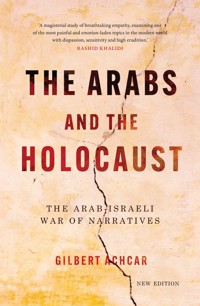
The Arab–Israeli conflict goes far beyond the wars waged on Middle Eastern battlefields. There is also a war of narratives revolving around the two defining traumas of the conflict: the Holocaust and the Nakba. One side is charged with Holocaust denial, the other with exploiting a tragedy while denying the tragedies of others. In this path-breaking book, eminent political scientist Gilbert Achcar explores these conflicting narratives and considers their role in today's Middle East dispute. He analyses the various Arab responses to the Holocaust, from the earliest intimations of the genocide, through the creation of Israel and the occupation of Palestine, and up to our own time, critically assessing the political and historical context for these responses. Achcar offers a unique ideological mapping of the Arab world, in the process defusing and international propaganda war that has become a major stumbling block in the path of Arab–Western understanding.
Sie lesen das E-Book in den Legimi-Apps auf:
Seitenzahl: 751
Veröffentlichungsjahr: 2011
Das E-Book (TTS) können Sie hören im Abo „Legimi Premium” in Legimi-Apps auf:
Ähnliche













GILBERT ACHCAR, who grew up in Beirut, is Professor at the School of Oriental and African Studies, University of London. His many books include The Clash of Barbarisms: The Making of the New World Disorder (Saqi Books, 2006), published in thirteen languages, The 33-Day War: Israel’s War on Hezbollah in Lebanon and Its Aftermath (with Michel Warschawski, Saqi Books, 2007), and Perilous Power: The Middle East and U.S. Foreign Policy, a book of dialogues with Noam Chomsky.
‘A work of breath-taking empathy, examining one of the most painful and emotion-laden topics in the modern world with dispassion, sensitivity and high erudition … [A] magisterial study’ Rashid Khalidi, Edward Said Professor of Modern Arab Studies, Columbia University
‘Essential reading for anyone who seeks a balanced understanding of the place of Jews and the Holocaust in Arab thinking today. Whether or not one agrees with Gilbert Achcar on every issue, he provides a welcome and well-informed counterpoint to caricaturists and hate-mongers and fear-promoters of every persuasion.’ Michael R. Marrus, Chancellor Rose and Ray Wolfe Professor Emeritus of Holocaust Studies, University of Toronto
‘An erudite, perceptive, and highly original study that shines much-needed light on a field which has tended to be dominated by partisanship and propaganda’ Avi Shlaim, Professor of International Relations, St Antony’s College, University of Oxford
‘A sensitive and insightful exploration of an important dimension of the Middle East conflict … Achcar’s book, which combines meticulous scholarship and an engaging style, is a significant contribution to the mutual understanding that is in such short supply.’ Peter Novick, Professor Emeritus of Modern History, University of Chicago
‘A penetrating analysis of the multiplicity of attitudes and responses in the Arabic-speaking world toward Nazism, anti-Semitism, and the Holocaust’ Francis R. Nicosia, Raul Hilberg Distinguished Professor of Holocaust Studies, University of Vermont
‘A courageous undertaking … [Achcar] succeeds in treating the subject of the relationship of Palestine and the Nazi Holocaust with original thinking, profound scholarship, and meticulous analysis.’ Naseer Aruri, member of the Palestine National Council; Chancellor Professor (Emeritus) of Political Science, University of Massachusetts, Dartmouth
‘In a field fraught with bad faith and sheer propaganda, Gilbert Achcar’s book stands out as scholarly and even-handed.’ Idith Zertal, Senior Research Fellow, Institute of Jewish Studies, University of Basel
‘A systematic and scholarly refutation of the simplistic myths that have arisen following the formation of Israel … the best book on the subject so far’ Tariq Ali, Guardian
‘A refreshing and original study, showing clearly that Muslim anti-Semitism is neither universal, nor inevitable, nor subject to pat explanations.’ The Economist
‘Gilbert Achcar’s The Arabs and the Holocaust is for the most part a fascinating, subtle and original analysis of Israeli and Arab historical narratives.’ Simon Sebag Montefiore, BBC History Magazine
‘Achcar is in full mastery of both the Arabic and the Western sources on his subject. His exhaustive survey of Arabic sources is particularly important in correcting the many distortions circulated by polemicists seeking to paint Arabs and Muslims as anti-Semites … Policy makers would do well to heed Gilbert Achcar’s call for a more balanced approach to the tragedies that make the Palestinian-Israeli conflict so intractable.’ Eugene Rogan, Times Literary Supplement
‘Lucid and penetrating’ Stephen Howe, Independent
‘[Achcar] carefully examines the long history of Arab-Jewish conflict back through the 19th century, illuminating the range of opinions’ The Washington Post
‘Calm and judicious in tenor yet unyielding in its intellectual rigor, this selection may show the path out of a seemingly intractable dispute.’ Booklist
Gilbert Achcar
The Arabs and the Holocaust
The Arab–Israeli War of Narratives
Translated from the Frenchby G. M. Goshgarian
SAQI
First English edition published in 2010 by Saqi Books
This ebook edition published in 2011
EBOOK ISBN: 978-0-86356-835-0
Copyright © Gilbert Achcar, 2010 and 2011
Translation copyright © G. M. Goshgarian, 2010 and 2011
Originally published in France by Actes Sud as Les Arabes et la Shoah
Indexer: [email protected]
All rights reserved. No part of this book may be reproduced or transmitted in any form or by any means, electronic or mechanical, including photocopying, recording or by any information storage and retrieval system, without permission in writing from the publisher.
And why beholdest thou the mote that is in thy brother’s eye, but considerest not the beam that is in thine own eye?
MATTHEW 7:3
Contents
Preface
Introduction: Words Laden With Pain
Shoah, Holocaust, Jewish Genocide
Zionism, Colonialism, Uprootedness
Nakba
PART 1: THE TIME OF THE SHOAHArab Reactions to Nazism and Anti-Semitism 1933–1947
Prelude
1. The Liberal Westernizers
2. The Marxists
3. The Nationalists
The Baath Party
The Syrian Social Nationalist Party
The Lebanese Phalange
Young Egypt and Egyptian Nationalism
The High-School Student Movement Futuwwa in Iraq
Iraqi Arab Nationalists and Nazism
Syrian Arab Nationalists and Nazism
Arab Nationalism and Anti-Semitism
The June 1941 Pogrom in Baghdad: The Farhūd
4. Reactionary and/or Fundamentalist Pan-Islamists
Pan-Islamism and Fundamentalist Counter-Reformation
The Religion of Islam and the Jews
Rashid Rida
Shakib Arslan
‘My Enemy’s Enemy’: Alliances of Convenience, Affinity and Complicity
Amin al-Husseini: The Grand Mufti
‘Izz-ul-Din al-Qassam
Amin al-Husseini and the 1936–1939 Arab Revolt in Palestine
Amin al-Husseini’s Exile and Collaboration with Rome and Berlin
Amin al-Husseini and the Jewish Genocide
Amin al-Husseini, Architect of the Nakba
Amin al-Husseini’s Divergent Legacies
PART 2: THE TIME OF THE NAKBAArab Attitudes to the Jews and the Holocaustfrom 1948 to the Present
Prelude
The Nakba as seen by Benny Morris: A Symptomatic Trajectory
5. The Nasser Years (1948–1967)
‘Throwing the Jews into the Sea’?
Nasserism and Anti-Semitism
The Eichmann Trial, Reparations, Comparisons and Holocaust Denial
6. The PLO Years (1967–1988)
The Programmatic Redefinition of the Palestinian Position toward the Jews
Transposing the Image of the Holocaust: the Battle of Comparisons with the Nazi past
7. The Years of the Islamic Resistances (1988 to the Present)
Hezbollah, Hamas and Islamized Anti-Semitism
From Garaudy To Ahmadinejad: Reactive Exploitation of the Memory of the Holocaust
Conclusion: Stigmas and Stigmatization
Of Anti-Semitism, Anti-Zionism, Philosemitism, Islamophobia and Exploitation of the Holocaust
Of Zionism, the State of Israel, Racism, the End of Denial and Peace
Acknowledgements
Notes
Bibliography
Index
Preface
This book had its inception early in 2006, when my friend Enzo Traverso asked me to contribute a chapter on the reception of the Holocaust in the Middle East to the monumental work on the history of the Shoah that he and three other scholars were co-editing for the Italian publishing house UTET in Turin.1 The editors were looking for someone who could write about the reception of the Holocaust in the Middle East. I accepted the invitation, but only after much hesitation: the short six months I was given to complete my essay – an author who had been approached before me had bowed out late in the day – made the task, given its scope and complexity, a perilous one.
I took it on nonetheless, motivated by what might be called a sense of duty. The work being put together would, I knew, be a good one, and I did not want to see the issue I had been asked to discuss – a delicate question if ever there was one – treated incompetently or left aside. Out of a concern for intellectual rigour, I limited the field of my research to countries that lay directly in my area of competence, countries whose language I knew – those of the Arab world from which I come. After my editors had approved this restriction, I began intensively researching and writing, and I eventually turned out the long chapter that closes the second and final volume of that work.2 Enzo was the first to suggest, insistently, that I work this chapter up into a book. At the time, I was not particularly inclined to plunge back into intensive research on the same topic.
But I continued to give it thought, since the questions raised were being posed ever more sharply in the Middle East. For example, late in 2006 a Tehran conference called ‘Review of the Holocaust: Global Vision’ promoted Holocaust denial, with the Iranian president, Mahmoud Ahmadinejad, contributing his own deliberately provocative statements. Urged on both by readers of the original chapter – including the publishers of the French, British and American editions of the present book – and by my own desire to discuss the problem in a form more widely accessible than the voluminous compendium published solely in Italian, I undertook the project of transforming the chapter into a book.
It was obvious that it was going to take enormous effort to depict the reception of the Holocaust in the Arab world, where the diversity of countries and conditions is multiplied many times over by the diversity of political tendencies and sensibilities, even as the inhabitants’ views of the Jewish tragedy are rendered infinitely more complex by their relationship to the Palestinian drama, the Nakba. The Introduction to the book is accordingly devoted to this very complex relationship between the Holocaust and the Nakba.
To make my task somewhat more manageable, I have focused on the countries most directly affected by the creation of the state of Israel, those of the Arab East. Maghreb countries – those of the Arab West, in North Africa – are treated only incidentally. This restriction notwithstanding, the slim volume initially envisioned has mushroomed into a thick book. The discussion of the Holocaust period – the 1930s and 1940s – takes up more than half of it. I have construed the Shoah (the ‘catastrophe’) broadly in the following pages, not restricting it to the post-January 1942 phase of systematic liquidation that the Nazis called the ‘Final Solution’ but including the entire period of Jewish persecution – both in Germany and, later, in the lands conquered by the Nazis – that began with Hitler’s assumption of power in 1933.
I have privileged these years over the following decades for several reasons. First, they are the main object of the historical controversy fought out in the battle of the narratives. (Wherever good secondary sources were not available, I have explored primary sources.) Second, it was between the end of the First World War and that of the Second that the main ideological currents of the Arab countries took shape; their diverse relations to the Holocaust provide an excellent index of their own nature. As a result, this book provides an ideological mapping of the Arab world – and, as I see it, as much of its interest lies therein as in the title subject. Finally, a detailed discussion of the attitudes toward the Holocaust that have taken shape in the six decades since the state of Israel came into being is impossible here, for the simple reason that it would fill several volumes.
I certainly have not titled my book The Arabs and the Holocaust because I share the grotesque view that the Nazis had no closer collaborators in their persecution of the Jews than the Arabs. I do not even suggest that ‘the Arabs’ participated in the crime, actively or passively, as many population groups across Europe did.3 Yet as a result of the Zionist enterprise and Jewish immigration to Palestine, the Arabs were deeply affected by the Holocaust, and my main ambition has been to render the complexity of their relation to it. To be sure, one finds many odious attitudes toward the Holocaust in the Arab world; but one also finds absurdly distorted interpretations of the Arab reception of the Holocaust in Israel and the West. My aim is to open up avenues of reflection that make it possible to go beyond the legion of caricatures, founded on mutual incomprehension and sustained by blind hatred, that plague discussion of the subject.
Finally, though it would be impossible to provide an exhaustive account of Arab reactions to the Holocaust, I do believe that a more narrowly focused investigation of Palestinian perceptions of the Shoah is both possible and necessary. I would hope that a Palestinian scholar will soon produce, on this subject, the equivalent of what Tom Segev and Peter Novick have produced, respectively, on the Israelis’ and the Americans’ relationship to the Holocaust,4 with the same admirable concern for objectivity and the same critical distance from nationality and ethnicity that they demonstrate. And, in the interests of mutual comprehension, I would also hope that an Israeli scholar will soon produce an in-depth study of the history of the Israeli receptions of the Nakba, the drama of the Palestinian people.
LONDON, AUGUST 2009
A note on the transliteration of Arabic
I have transliterated Arabic names and terms using a simplified version of the rules for romanization applied in the specialized literature, with the aim of making them more accessible to lay readers yet still recognizable to those who know the language. To the same end, names of well-known individuals are transliterated in accordance with common practice. Finally, in the case of Arab authors who have published in a European language, their own transliterations of their names have generally been respected. However, the romanization of Arabic names by the various authors is respected in the citations, as is the rule.
INTRODUCTION
Words Laden With Pain
Anyone who sets out to write about the genocide of the Jews by the National Socialist state confronts a delicate terminological problem. What name should be given a calamity that, from the standpoint of a humanist ethics, will remain forever ‘unnameable’?
Shoah, Holocaust, Jewish Genocide
All the words used to name the genocide of the Jews are heavily connoted; none is neutral. Even formulas apparently inspired by Émile Durkheim’s scientific imperative to avoid ‘prenotions’ in approaching ‘social facts’, such as Raul Hilberg’s title The Destruction of the European Jews,1 are plainly the result of a difficult choice: subjecting the object under study to a distanced, clinical gaze. Hilberg clearly declares, in the preface to the first edition of his book, ‘We shall not dwell on Jewish suffering … ’2 This is an entirely respectable and even ineluctable choice when, as in the case of his monumental work, keeping a scientific distance does not indicate a lack of empathy but, rather, reflects a desire to control it so as to remain as objective as possible. The aim in such cases is to ensure the credibility of the facts on which subsequent empathy may be solidly based without incurring the suspicion that empathy has tailored the facts to its needs. This attitude, of course, is utterly different from the pseudo-scientific detachment of the deniers’ approach, which is hard put to hide the antipathy that is its basic motivation.
The most satisfactory objective designation seems to me ‘Jewish genocide’, an expression that makes use of the generic term ‘genocide’ while particularizing it by invoking the identity of the victims, as do the terms ‘Armenian genocide’, ‘Roma genocide’ and ‘Rwandan genocide’. These terms by no means contradict either the contention that every genocide is a singular occurrence or the undeniable fact that the Jewish genocide surpasses all other twentieth-century genocides in scope – an objective observation that can and should be acknowledged without entering into the ‘competition of the victims’ that Jean-Michel Chaumont has admirably studied in his book of that name.3
Naturally, the designations sanctioned by public discourse and the media are not motivated by this same quest for rigour. Two terms have become established as designations of the Jewish genocide in its singularity: ‘Shoah’ and ‘Holocaust’. The first is a Hebrew word generally translated as ‘catastrophe’: employed with the definite article in the singular (Ha-Shoah), it is the natural expression in the language of the Jewish religion for the terrible tragedy that befell the European Jews (along with other, non-European Jews, who are all too often forgotten). It is not, to be sure, a ‘scientific’ term, but a way to accentuate the singularity of the Jewish genocide.
Esther Benbassa, however, criticizes the use of the term Shoah, arguing that, with its biblical origins, it designates a punishment inflicted by God. She also emphasizes that the expression used in Yiddish, the language of the majority of victims and survivors of the Jewish genocide, was different.4 Despite its secularization, she asserts, the term Shoah contains all the ingredients of a ‘secular theology’ of the Jewish tragedy. Her objection is well-founded, but she herself, paradoxically, uses the term Holocaust, to which the same criticisms apply a fortiori.
‘Holocaust,’ indeed, has the same function in present-day usage. It is derived from a Greek word, holokaustos, that means ‘entirely consumed by fire’. More precisely, it comes from the Greek translation of the Hebrew Bible (Leviticus 1:3) and has entered the Western languages by way of Church Latin. The word refers to the ancient Israelites’ practice of burning sacrificed animals as an expiatory offering. The Hebrew text has no equivalent for the Greek word, utilizing only the term olah, which means ‘ascension’ or ‘elevation’ (the word aliyah has the same root) to designate ‘immolation’ – probably because what is burned rises towards heaven in the form of smoke. The burnt offering, or olah, is a variant of qorban, which means ‘sacrificial offering’. In the Bible, the word olah is used only to describe animals that were to be entirely consumed by fire, which is why it was translated as ‘holocaust’. Other offerings, such as ‘meal-offerings’ of flour or cakes, were only partially burned; the rest had to be given to ‘Aaron and his sons’, that is, the priests.
In view of its original meaning, the use of the word ‘holocaust’ to designate the Jewish genocide is eminently contestable and a subject of fierce controversy. The criticism focuses above all on the fact that its etymological meaning makes its utilization as a name for the Jewish genocide – and in particular for the funereal sequence of gas chamber/crematorium – macabre if not indeed reprehensible. Moreover, the very idea that the victims of the Jewish genocide might be considered ‘expiatory offerings’ is quite simply appalling.
The website of the United States Holocaust Memorial Museum in Washington, DC, offers an account of the historical development that has led to this incongruous use of the term:
In secular writings, holocaust most commonly came to mean ‘a complete or wholesale destruction,’ a connotation particularly dominant from the late nineteenth century through the nuclear arms race of the mid-twentieth century. During this time, the word was applied to a variety of disastrous events ranging from pogroms against Jews in Russia, to the persecution and murder of Armenians by Turks during World War I, to the attack by Japan on Chinese cities, to large-scale fires where hundreds were killed.
Early references to the Nazi murder of the Jews of Europe continued this usage. As early as 1941, writers occasionally employed the term holocaust with regard to the Nazi crimes against the Jews, but in these early cases, they did not ascribe exclusivity to the term. Instead of ‘the holocaust,’ writers referred to ‘a holocaust,’ one of many through the centuries …
By the late 1940s, however, a shift was underway. Holocaust (with either a lowercase or capital H) became a more specific term due to its use in Israeli translations of the word sho’ah. This Hebrew word had been used throughout Jewish history to refer to assaults upon Jews, but by the 1940s it was frequently being applied to the Nazis’ murder of the Jews of Europe. (Yiddish-speaking Jews used the term churbn, a Yiddish translation of sho’ah.) The equation of holocaust with sho’ah was seen most prominently in the official English translation of the Israeli Declaration of Independence in 1948, in the translated publications of Yad Vashem throughout the 1950s, and in the journalistic coverage of the Adolf Eichmann trial in Israel in 1961.5
It was, however, Elie Wiesel who definitively established the use of the term by insistently designating ‘The Holocaust’ a unique event. And he did so in full awareness of the implications, as Zev Garber and Bruce Zuckerman have shown in a remarkable critical discussion of the use of this term as a proper name for the Jewish genocide:
While it is certainly true that the vast majority of people (Jew and Gentile) continue to use ‘The Holocaust’ without understanding its religious/sacrificial connotations, it strains credulity to argue that those Jewish thinkers and writers who first adopted this term and even more importantly, allowed it to flourish, totally ignored information that could easily be found simply by opening a dictionary. … there is little doubt that the one man who has done the most to establish ‘The Holocaust’ in the modern consciousness was well aware of what he was doing and well aware of what the term ‘holocaust’ meant in all its nuances. … And the motivation for Wiesel’s use of ‘The Holocaust’ has unmistakable religious/sacrificial overtones, as his own writings reveal.6
We believe that he well understood all of the factors that could come into play … he chose this term nonetheless to preserve the specialness of the tragedy as a Jewish tragedy.7
Arno Mayer, for his part, contests the term ‘holocaust’ on the grounds that this ‘religiously freighted’ word takes its place in an ‘overly sectarian’ cult of the memory that has spawned, in his estimation, ‘a collective prescriptive ‘memory’ unconducive to critical and contextual thinking about the Jewish calamity’.8 For the Durkheimian reason evoked earlier, Mayer’s argument is legitimate insofar as it aims to challenge the use of the term in scholarly studies of the Jewish genocide. However, usage has ultimately conferred on ‘Holocaust’, as on other terms, a meaning that transcends its origins: it now names the Jewish genocide in particular, as Michael Marrus has stressed.9 Furthermore, Mayer himself has forged a term, ‘Judeocide’, which, unlike Hilberg’s, puts the Jewish genocide as a whole in a category of its own, much more, indeed, than the word ‘holocaust’, which continues to be used as a generic term to designate a considerable number of other tragedies – a circumstance that Elie Wiesel deeply deplores.
Thus, if the aim is to name the Jewish genocide in its singularity while also communicating the emotional force with which its memory is fraught, the term ‘Shoah’ is certainly far more appropriate. Indeed, the website of Yad Vashem, the Jerusalem-based Israeli institution created to memorialize the Holocaust (its official English name is The Holocaust Martyrs’ and Heroes’ Remembrance Authority), today advocates the use of Shoah.10 Yet ‘Holocaust’ has come into general use in most Western languages, including English and German, whereas Shoah has gained wide currency in French and, albeit to a lesser extent, Italian. The latter term is, however, gaining ground in Europe as well as in the United States. This book thus uses both terms, depending on the context as well as the languages in which it is published.i
Zionism, Colonialism, Uprootedness
Zionism, considered as the political movement to create a Judenstaat (‘state of the Jews’) in the title of the famous book by its principal founder, Theodor Herzl, was first and foremost a reaction to anti-Semitism that envisioned an ethnic-nationalistic segregation and regrouping of Jews on a territory of their own. It often found itself in virulent opposition to competing options that promoted the individual and collective rights of Jews, where they already resided, whether via autonomy or social integration.
The beginnings of the Zionist colonization of Palestine considerably antedate Hitler’s assumption of power, as do the first hostile Arab reactions. The Arab inhabitants of Palestine perceived the Zionist undertaking there as one more avatar of European colonialism, particularly since it mostly unfolded under the post-First World War British colonial mandate. In his famous 1917 letter addressed to the Zionist movement, British Foreign Secretary Lord Arthur Balfour declared His Majesty’s government favourable to ‘the establishment in Palestine of a national home for the Jewish people’.
From the inception of European-Jewish colonization in Palestine in the latter half of the nineteenth century – a movement accelerated above all by pogroms in Russia – to the outbreak of the First World War, Arab peasants squared off with Jewish settlers in repeated and sometimes bloody confrontations. These were not xenophobic or even anti-Jewish reactions on the part of the Palestinian villagers, at least initially, but rather altogether predictable reactions by farmers who had been expelled from their lands. The clearest proof is that when the settlers allowed the peasants to remain on the land and gave them the opportunity to continue working it, they acquiesced in the new arrangements. When, in contrast, the new owners sought to expel them or to induce the Ottoman authorities to do so, as they increasingly did after the turn of the century, the farmers rebelled.11
The hostility of the native population, both Muslim and Christian, would increase over the years in direct proportion to the expansion of this colonization and to the growing awareness that the Zionist movement was seeking to create a state in Palestine. Thus, well before the First World War, opposition to Zionism was a key component in the formation of a Palestinian identity and of an Arab nationalistic consciousness. Witness the articles published from the late nineteenth century on – with greater frequency after mid-1908, thanks to the political liberalization in the Ottoman Empire at that time – in newspapers in not only Palestine but Cairo, Beirut and Damascus as well.12
The number of Jews living in Palestine doubled between the dawn of the twentieth century and the First World War. It increased by a factor of ten under the British mandate, rising from 61,000 in 1920 (out of a total population of 603,000) to more than 610,000 (of a total population of nearly 1,900,000) on the eve of the proclamation of the state of Israel.13 In the early 1920s, Jews were migrating to Palestine at an average annual rate of 8,000; this migration then intensified, cresting at 34,000 in 1925.14 Inevitably, the first major anti-Jewish Arab riots broke out shortly after the de facto establishment of the British mandate. Beginning in Jerusalem in 1920 and Jaffa in 1921, the initial violence culminated in the riots of 1929.15
The fact remains, however, that the Nazis’ seizure of power in 1933 and its aftermath were much more than a mere stimulant to Jewish immigration to Palestine. They were the decisive factor lending credence to the views of the Zionists and leading ultimately to the realization of their project – as the immigration statistics make clear. After the 1925 peak (a result, in particular, of both the Depression and of anti-Jewish measures in Poland coinciding with new restrictions on immigration to the United States) the number of immigrants sank to fewer than 20,000 for the entire five-year period 1927–31 – that is, an annual average of fewer than 4,000. In 1931, Jews made up one-sixth of the population of Palestine: according to the British census, the country counted 175,000 Jews and 880,000 Arabs that year.16 Immigration levels rose to higher than 12,500 in 1932, then shot up to more than 37,000 in 1933, 45,000 in 1934, and 66,000 in 1935. The influx was then slowed by the 1936–9 Palestinian uprising, after which the British colonial administration imposed restrictions on Jewish immigration.17
Over the forty-year period 1882–1931, a total of nearly 187,000 immigrants arrived in Palestine. Between 1932 and 1938, a period of only seven years, more than 197,000 people poured into the country, followed by 138,300 more in the ten years between 1939 and 1948. In sum, a total of nearly 313,000 immigrants settled in the area between Hitler’s assumption of power in 1933 and the end of the British mandate in 1948, according to official Israeli statistics.18 One hundred and fifteen thousand of them came illegally.19 In the three years between the end of the war in Europe in May 1945 and the proclamation of the state of Israel in May 1948, 80,000 Holocaust survivors came to Palestine illegally, according, once again, to official Israeli figures.20
In 1932, the Jewish population of Palestine – almost 181,000 – constituted 18.3 per cent of the total population. By 1946, it represented more than 35 per cent,21 reaching 37 per cent at the moment the state of Israel was proclaimed two years later. Of the 716,700 Jews living in the new state six months after it declared its independence, 463,000, that is, nearly two-thirds, had been born abroad, according to the 11 November 1948 census.22
Thus the ‘state of the Jews’ plainly owes its creation to the Holocaust, for more than one reason. The Nazis’ anti-Semitic policies were initiated with the expulsion, under increasing duress, of German Jews.23 Until 1939, the Nazis preferred that these Jewish émigrés leave Germany for Palestine:
Jewish emigration to Palestine … is a lesser evil for Germany. ‘I know from my own experience,’ wrote an official of the Auswärtiges Amt [the German Foreign Office], ‘how unusually unpleasant the influx of Jewish intellectuals is for us.’ He pointed out that the emigration of Jews to the United States, Turkey and Iran influenced intellectual life in the direction of strengthening anti-German feeling, and that Jewish immigrants in Latin America caused the Germans much economic, propagandistic and political harm … But in Palestine, argued that official, the Jews are among themselves and cannot harm the Third Reich.24
Within Germany, Hitler actively intervened in the debate over Palestine in 1937 and early in 1938. He insisted on the stepped-up promotion of Jewish emigration and deportation by all possible means, regardless of destination. According to Hitler, Palestine was to continue as a prime destination for German Jewish refugees, and became an even more significant factor in Nazi emigration policies in 1938 and 1939 as the Gestapo and the Sicherheitsdienst collaborated with underground Zionist organizations in the ‘illegal’ immigration of Jewish refugees past the British blockade into Palestine.25
Nearly 53,000 Jews from Germany alone left for Palestine between 1933 and 1939, taking only legal emigration into account. German Jews represented one-quarter of all legal Jewish immigrants in 1933; by 1939, the proportion had risen to 52 per cent.26 Their emigration was facilitated by a 25 August 1933 agreement between German Zionists and representatives of the Jewish Agency, on the one hand, and the Nazi government on the other. Known as the Haavara (‘transfer’ in Hebrew), it authorized German Jews emigrating to Palestine, and these Jews alone, to transfer part of their assets there in the form of goods exported from Germany.27 The agreement was the more controversial in that it subverted the economic boycott of Nazi Germany which many believed capable of precipitating the downfall of the Hitler regime, which at that time was still being put in place. On the other hand, the Haavara agreement shored up the then almost bankrupt Jewish Agency for Palestine,28 the institution responsible for organizing Jewish immigration and overseeing the Yishuv.ii
In spite of all the Zionist movement’s efforts, a majority of the German and Austrian Jews who left continental Europe by September 1939 went to the Americas – 95,000 of them to the United States and 75,000 to Latin America, over against the 60,000 who emigrated to Palestine.29 Yet the fact remains that, in 1948, 170,000 Jews from Poland constituted the largest segment of the Yishuv.30 When all is said and done, it is obvious that National Socialism, by substantially boosting Jewish emigration to Palestine, allowed the movement to attain the critical mass that enabled it to triumph politically and militarily in 1948. ‘The rise of the Nazis thus proved advantageous for the Zionist movement,’ Tom Segev has accurately pointed out.31
History was thus confirming Herzl’s vision – in a way that he could not have imagined in his worst nightmares. ‘The present scheme’, Herzl had declared in the preface to his 1896 manifesto in book form, ‘includes the employment of an existent propelling force … And what is our propelling force? The misery of the Jews.’32 This vision underlies the same ‘philosophy of the beneficial disaster’ that Shabtai Teveth, the biographer of the president of the Jewish Agency’s executive committee and the most important of the founding fathers of the state of Israel, David Ben-Gurion, attributes to the man whom he knows better than anyone else does. Teveth cites Ben-Gurion: ‘The harsher the affliction, the greater the strength of Zionism.’33,iii
This philosophy explains, in Teveth’s view, Ben-Gurion’s relative indifference to the Holocaust, for which he has been much criticized: ‘Two facts can be definitely stated: Ben Gurion did not put the rescue effort above Zionist politics, and he did not regard it as a principal task demanding his personal leadership … ’35
The head of the Jewish Agency gave stark expression to the implacable logic of Zionist priorities when he declared, in December 1938, not long after the Nazi pogrom known as Kristallnacht: ‘If I knew that it was possible to save all the children in Germany by transporting them to England, but only half of them by transporting them to Palestine, I would choose the second – because we face not only the reckoning of these children, but the historical reckoning of the Jewish people.’36 He added: ‘Like every Jew, I am interested in saving every Jew wherever possible, but nothing takes precedence over saving the Hebrew nation in its land.’37,iv
In the opposing camp, the most eminent members of the Brit Shalom and, later, Ihud circles, both of which rejected Zionist statism in favour of a binational state in Palestine – Hugo Bergmann, Martin Buber, Judah Magnes, and Henrietta Szold – waged, unsurprisingly, a desperate struggle to persuade the Yishuv to put rescuing Europe’s Jews ahead of all else. Late in 1942, when news of the ‘Final Solution’ began to reach the Yishuv, members of these circles played a pivotal role in founding an association called Al-domi (biblical Hebrew meaning ‘do not remain silent’) that worked actively, albeit in vain, to attain this end. The very existence of this association appears to have been blotted from memory.39
The American Council for Judaism (ACJ) followed an equally consistent line. An anti-Zionist organization founded by Reform rabbis and lay-people in the 1940s,40 the ACJ favoured a single democratic, secular Palestinian state in which Jews and Arabs would enjoy equal rights. The UN Special Commission on Palestine took note in 1947 of the ACJ’s position that ‘proposals to establish a Jewish State … are a threat to the peace and security of Palestine and its surrounding area, are harmful to the Jews in Palestine and throughout the world, and are also undemocratic’.41
The ACJ, which boasted more than 14,000 members at its apogee, fought energetically to open America’s doors to the displaced. This was the logical corollary of its opposition to the Zionist project in Palestine in a context of solidarity with European Jews. Its attitude was not unlike that of the British writer Israel Zangwill who broke with the Zionist movement when it opted for Palestine as the only territorial objective of the future ‘state of the Jews’ – this despite the fact that Zangwill is said to have been the author of the notorious phrase that has it that Palestine was ‘a land without a people for a people without a land’ (an attribution that is imprecise and has been contested).42 Zangwill – who knew well that, unless the Arabs were driven from Palestine, creating a Jewish state in this country implied domination of an Arab majority by a Jewish minority43 – militated in favour of ‘territorialism’, the project of regrouping Jews on a territory better suited to the purpose than Palestine, wherever it might be – preferably in the United States. ‘America,’ he wrote,
has ample room for all the six millions of the Pale [i.e. the Pale of Settlement, home to most of Russia’s Jews]; any one of her fifty states could absorb them. And next to being in a country of their own, there could be no better fate for them than to be together in a land of civil and religious liberty, of whose Constitution Christianity forms no part and where their collective votes would practically guarantee them against future persecution.44,v
Conversely, the Palestinian project determined the American Zionists’ position on the question of immigration to the United States by Holocaust survivors. The extraordinary Congress that brought American Zionists together with leaders of the world movement in New York’s Biltmore hotel in May 1942 demanded only that the doors of Palestine be opened to Jewish refugees – not those of every country at war with the Axis, beginning with the United States.46 As Aaron Berman has shown, this stance was not modified – quite the contrary, in fact – when it was learned that the Nazis were carrying out a systematic genocide:
American Zionist leaders decided that their primary task had to be the building of support for the immediate establishment of a Jewish state in Palestine. Their decision did not reflect a callousness about or disinterest in the terrible fate of the European Jews. Rather, American Zionists believed that there was nothing unique about Hitler’s plan for genocide … Believing that Jewish homelessness was the basic cause of all anti-Semitism, American Zionists resolved to put a final end to Jewish statelessness …
Sadly, the American Zionists’ calculation was faulty. … once the Nazis embarked on their program of genocide, the American Zionist decision to make the establishment of a Jewish state their primary goal handicapped any attempt to build a powerful lobby to force the American government to undertake the rescue of European Jewry.47
David Wyman, who can hardly be accused of hostility to American Zionists, has drawn up a balance sheet of their actions in this field: ‘An unavoidable conclusion’, he writes, ‘is that during the Holocaust the leadership of American Zionism concentrated its major force on the drive for a future Jewish state in Palestine. It consigned rescue to a distinctly secondary position.’48 However, he adds, ‘substantially more was possible than they recognized’.49
Of all the arguments invoked to justify the Zionists’ undeniable lack of enthusiasm for the demand that the United States, Great Britain and the other allied countries open their gates before continental Europe’s Jewish refugees, even the most reasonable constitute mitigating circumstances at best. The political motivation for this lack of enthusiasm is equally undeniable, as is indicated by a comment of Ben-Gurion’s that Segev cites: ‘In the wake of the Kristallnacht pogroms,’ Segev reports, ‘Ben-Gurion commented that “the human conscience” might bring various countries to open their doors to Jewish refugees from Germany. He saw this as a threat and warned: “Zionism is in danger!”’50
Francis Nicosia sums up the consequences of the Zionists’ attitude towards Nazism:
If, as the Zionists had always claimed, the assimilationists had been living an illusion, the Zionists had undoubtedly lived one of their own. It was rooted in the fallacy that if anti-Semitism was natural and understandable, as Herzl and others had insisted, there was room for its accommodation to the principles and goals of Zionism. Herzl and others believed that anti-Semites would accept Zionism, even if they disliked or hated Jews, and that they might indeed do everything necessary to support Zionist efforts until Jews and non-Jews reached their common goal of removing Jews from Germany. What they had not understood, and what post-World War I German Zionists apparently would not understand until after 1933, was that whatever appeal Zionism had for most anti-Semites, even for the Nazis after World War I, it was of a purely pragmatic nature, and therefore problematic. Indeed, an understanding of National Socialism and precisely how Zionists should respond to it seemed to elude the entire Zionist movement, including the Yishuv, until well into the Second World War.51
The fact remains that responsibility for the failure to grant haven to European Jewish refugees ultimately lies with the governments of the allied countries that were in a position to do so. Although Berman’s judgement can seem excessively severe, he is not wrong that ‘while Germany was primarily responsible for the Holocaust, the democratic governments of the United States and the United Kingdom must be considered at least accomplices in genocide’.52 Nothing is more revealing in this regard than the international conference held in Evian, France, from 6 to 15 July 1938. Initiated by Franklin D. Roosevelt, its mission was to reflect on the fate of the Jewish refugees from Germany and Austria, whose numbers had increased considerably as a result of the Anschluss and the intensification of the Nazis’ anti-Semitic program. Thirty-two countries sent delegations.
As the conference proceeded, delegate after delegate excused his country from accepting additional refugees. The United States delegate, Myron C. Taylor, stated that his country’s contribution was to make the German and Austrian immigration quota, which up to the time had remained unfilled, fully available. The British delegate declared that their overseas territories were largely unsuitable for European settlement, except for parts of East Africa, which might offer possibilities for limited numbers. Britain itself, being fully populated and suffering unemployment, also was unavailable for immigration; and he excluded Palestine from the Evian discussion entirely. The French delegate stated that France had reached ‘the extreme point of saturation as regards admission of refugees.’ The other European countries echoed this sentiment, with minor variations. Australia could not encourage refugee immigration because, ‘as we have no real racial problem, we are not desirous of importing one.’ The delegates from New Zealand, Canada, and the Latin American nations cited the Depression as the reason they could not accept refugees. Only the tiny Dominican Republic volunteered to contribute large, but unspecified areas for agricultural colonization.53
It was due to this set of historical circumstance that the Jewish tragedy, which peaked in the Shoah, also culminated in the Palestinian tragedy, the Nakba. In a pivotal essay, Edward Said underscored the ‘link to be made between what happened to Jews in World War II and the catastrophe of the Palestinian people’,54 going so far as to add that ‘the Jewish tragedy led directly to the Palestinian catastrophe by, let us call it, “necessity” (rather than pure will).’55 Of course, the Holocaust was incomparably crueller and bloodier than the Nakba. This consideration, however, in no way diminishes the tragedy of the Palestinians, particularly since they did not, as a people, bear any blame for the destruction of European Jewry.
In an attempt to show conversely that ‘the Jewish tragedy did not create the Palestinian catastrophe’, Joseph Massad criticizes Said’s contention. The Zionist project, he argues, antedated National Socialism and the Holocaust; furthermore, ‘only one-third of holocaust survivors ended up in Palestine, mainly because they could not go to the United States.’56 His argument, however, is aimed at the wrong target. When Said speaks of ‘the Jewish tragedy’ he obviously means the Holocaust in the broad sense of the tragedy spawned by the Nazis’ accession to power and its aftermath, not in the narrow sense of the 1942–5 ‘Final Solution’.
Moreover, the direct relationship between the Palestinian drama and the Jewish tragedy was inscribed in the fact that Zionism was first and foremost a reaction to anti-Semitism. Certainly, if one takes the Holocaust in the narrow sense of the ‘Final Solution’ initiated in 1942, it becomes harder to maintain that the state of Israel owes its existence to the Holocaust. And it is indeed primarily pro-Zionist authors who have combated such a thesis.57 Yehuda Bauer, who, like Massad, reformulates the idea in narrow terms (‘Israel was created by the Holocaust’), advances the opposite thesis:
On the contrary, if the German Reich had held out one more year, it is doubtful whether there would have been any survivors at all … The Holocaust prevented a Jewish State from coming into existence with, as new-minted citizens, the millions of Jews who were murdered. Indeed, because of the Holocaust, the attempt to establish a state almost failed. There were almost not enough Jews left to fight for a state. The ones who survived the Holocaust were central to that effort, and had there been more, the effort would have been easier and the outcome more certain. My answer, therefore, is unequivocal: The view that Israel was created by the Holocaust is erroneous. The opposite is true.58
Bauer’s contention is the more surprising in that a few lines earlier he declares: ‘If the United States had opened its gates to Jewish immigration … it is highly probable, in my view, that a much larger proportion of Jewish D.P.s would have gone to the United States than did.’59 The notion that the ‘millions of Jews who were murdered’ might have constituted ‘new-minted citizens’ of the state of Israel, many of whom would have fought for its creation, is of a piece with the one that led Mordecai Shenhabi – the man credited with the idea of founding Yad Vashem – to propose in 1950 that Israeli citizenship be posthumously conferred upon all Holocaust victims.
Discussing the debates that this proposal touched off, Segev describes it as ‘utterly spurious’: ‘There is no way of knowing which, or how many, of the Holocaust’s victims considered themselves “potential citizens” of Israel. Many of them died precisely because they had preferred not to move to Palestine when that option was opened to them. And most of the world’s Jews, Holocaust survivors among them, chose not to come to Israel even after the state was founded.’60
It remains true, however, that Holocaust survivors in the strict sense made up about one-third of the Zionist forces who fought in the 1948 war.61 Nevertheless, the motive common to the authors just cited, over and above the fundamental differences dividing them, is their legitimate rejection of the idea that the creation of Israel was an answer to the Jewish genocide. Bauer passionately disputes it: ‘I do not think I have to deal with this because the very line of thought is so repugnant. I think most Jews would have preferred saving the lives of the Jews who died in the Holocaust to establishing the state.’62
Said’s thesis is no different. His recognition of the ‘necessity’ informing the historical process that culminated in the creation of the state of Israel by no means implies approval or legitimization of its creation or of the ways in which it was achieved: ‘I do not accept the notion that by taking our land Zionism redeemed the history of the Jews, and I cannot ever be made to acquiesce in the need to dispossess the whole Palestinian people.’63 Historical ‘necessity’ implies no political or moral justification for such acquiescence. Nor does it imply any imperative reason to endorse Zionism. As Isaac Deutscher explained in 1954:
From a burning or sinking ship people jump no matter where – on to a lifeboat, a raft, or a float. The jumping is for them an ‘historic necessity’; and the raft is in a sense the basis of their whole existence. But does it follow that the jumping should be made into a programme, or that one should take a raft-State as the basis of a political orientation?64
The rising tide of refugees to Palestine was not Nazism’s only contribution to the creation of the state of Israel. In 1947 there also existed a mass of concentration-camp and other Jewish survivors of Hitler’s genocidal enterprise who had been reduced to a state of extreme poverty and profound distress. Supporting the creation of the state of Israel was the way that North America, Europe and the Soviet Union solved, on the cheap, the embarrassing problem represented by this multitude of unfortunates whom neither the Americans nor the Europeans nor the USSR wished to take in.
While the Soviet authorities encouraged illegal Jewish immigration to Palestine from the Central and Eastern European countries under their control,65 Washington asked London to allow Jews to immigrate legally into the country, which was still under British mandate. ‘On June 6, 1946, President Truman urged the British government to relieve the suffering of the Jews confined to displaced persons camps in Europe by immediately accepting 100,000 Jewish immigrants [in Palestine]. Britain’s Foreign Minister, Ernest Bevin, replied sarcastically that the United States wanted displaced Jews to immigrate to Palestine “because they did not want too many of them in New York.”’66 Long before Bevin, Mussolini had responded in much the same vein to Truman’s predecessor, who asked him, in 1939, to grant the Jews refuge in Italian colonies: ‘President Roosevelt asked Benito Mussolini to allow Jews to move to Ethiopia, which was under Italian rule; Il Duce wondered why the refugees could not be settled in the United States.’67
Once the war had ended and the horror of the camps had been fully revealed, the desire to get rid of the devastated Jews by sending them elsewhere persisted. The foundation of the state of Israel directly served that end: 200,000 Holocaust survivors settled there in the year following its creation.68 According to the official statistics, more than 76,500 immigrants arrived there from Europe between 15 May 1948 and the end of the year, followed by another 122,000 in 1949.69 In addition to the sordid fact that certain states sought to resolve the problem of the Holocaust survivors at the Palestinians’ cost – as some states nowadays seek to rid themselves of their radioactive waste by exporting it to poor countries – the Zionist movement naturally tried to exploit the shock waves that followed the liberation of the camps in 1945. A former foreign minister of Israel, Shlomo Ben-Ami, has explained this stratagem:
The target of Zionist diplomacy was no longer Britain but the United States and international opinion. There was little hope of averting an open clash with the mandatory power now entangled in the conflicting pledges and promises to Arabs and Jews. And as has happened frequently in the history of Zionism, the cause was enhanced by the Jewish catastrophe. It was the full truth and the awesome impact of the Holocaust of European Jewry, as it was exposed worldwide after the war, that served now as the platform upon which Zionist diplomacy could mobilise governments and international opinion in order to attain its major political objective, a Jewish state in Palestine. Once again, Jewish catastrophe was the propellant of the Zionist idea and a boost to its prospects.70
Finally, the National Socialist enterprise steeled the Yishuv for war in both the physical sense, since Palestinian Jews took part in the British war effort, and also the psychological sense, since it imbued Zionist militants with great determination, born of the feeling (the illusion, in the view of critics and sceptics) that they were fighting to establish the definitive response to the Holocaust. From the moment it was proclaimed, the state of Israel laid full claim to its legitimization based on the Holocaust and the anti-Nazi struggle. The terms of the ‘declaration of independence’ read out by David Ben-Gurion on 14 May 1948 are well known:
The catastrophe which recently befell the Jewish people – the massacre of millions of Jews in Europe – was another clear demonstration of the urgency of solving the problem of its homelessness by re-establishing in Eretz-Israel the Jewish State, which would open the gates of the homeland wide to every Jew and confer upon the Jewish people the status of a fully privileged member of the community of nations.
Survivors of the Nazi holocaust in Europe, as well as Jews from other parts of the world, continued to migrate to Eretz-Israel, undaunted by difficulties, restrictions and dangers, and never ceased to assert their right to a life of dignity, freedom and honest toil in their national homeland.
In the Second World War, the Jewish community of this country contributed its full share to the struggle of the freedom- and peace-loving nations against the forces of Nazi wickedness and, by the blood of its soldiers and its war effort, gained the right to be reckoned among the peoples who founded the United Nations.71
The subsequent war between the new state and the Palestinians and surrounding Arab countries ended with the defeat of the Arab camp and the emergence of the Palestinian refugee problem.72 The two narratives of these events, Israeli and Palestinian-Arab, inevitably turned, from the outset, on two very different sequences. The Israeli narrative featured extermination – the Shoah – and rehabilitation by the state. The Palestinian and Arab narrative revolved around the usurpation carried out by the state and the attendant expulsion – the Nakba.73
Nakba
Few people know, and even fewer point out, that the Arabic word nakba, which has been circulating in the Western languages for a few years now, is one possible equivalent of Shoah in Arabic. The other is karitha, a word that is today employed as the Arabic translation of Shoah as distinct from Holocaust, translated mahraqa. Nakba means ‘grievous catastrophe’. The term has been in use in the Arab countries since 1948 to describe the foundation of the state of Israel and its consequences: the first Arab–Israeli war, the defeat of the Arab armies, the massive exodus of the Palestinians from the territories that came under the control of the new state, and that state’s refusal to allow Palestinians back to their homes and lands after the cessation of hostilities.74
Among the most powerful illustrations of the tragic nature of the conflict in the Middle East is that a state created as a refuge for persecuted Jews who had been reduced to the condition of refugees or ‘displaced persons’ in turn created the problem of the Palestinian refugees. The Law of Return, by which anyone recognized as a Jew has the right to settle in Israel and acquire Israeli citizenship, became a cornerstone of the legitimization of the new state, which simultaneously denied Palestinian refugees the right to return that they have not ceased to demand ever since.
The symmetries between the various terms – Shoah/Nakba, displaced person/refugee, law of return/right of return, UNRRA/UNRWAvi (the list could be extended) – should give us pause, even if the two situations are not perfectly symmetrical. They offer a particularly striking illustration of the complexity of the issue and a partial explanation of why it arouses so much passion that some have even accused the Palestinians of imitating Israel. The accusation calls to mind the Palestinian poet Mahmoud Darwish’s remark to the Israeli poet Helit Yeshurun, during a 1996 interview, that Israelis ‘are jealous of anyone whom the world recognizes as a victim. That’s an Israeli monopoly.’75
Thus two Israeli academics, Ruth Linn and Ilan Gur-Ze’ev of the University of Haifa, have accused the Arabs of plagiarizing as it were the term shoah, without having bothered to find out which Arabic word is used to designate the Palestinian tragedy. They seem not even to have heard of the term nakba. ‘Following the Israeli use of the Hebrew word shoah “Holocaust” to refer to the annihilation of the Jews by the Nazis, the Arabs employ the Arabic word karita [sic] “Holocaust” [sic] to convey the magnitude of their disaster following the establishment of the Jewish state,’76 they claim, going so far as to suggest that the Arabs borrowed the idea of the ‘right to return’ from Holocaust narratives.77
Similarly, Meir Litvak and Esther Webman, Israeli academics affiliated with Tel Aviv University’s Moshe Dayan Center, contended not long ago that the Israeli ‘terminology and discourse of the Holocaust had a profound effect on the Palestinian discourse on the Nakba from its early emergence’.78 In support, they cite a source that hardly qualifies as authorized: the Arabic translator of a book by a French Holocaust denier. ‘Other aspects of Holocaust terminology’, they continue, ‘have been cast into the Palestinian discourse on the Nakba. “Destruction and redemption” (shoah u-geula), “Holocaust and rebirth” (shoah u-tehiya) turn into “Nakba and resistance” (Nakba wa-muqawama), “perseverance and resistance” (israr wa-nidal).’79 In fact, these formulas do not correspond in the slightest; moreover, the pairs of Arabic words cited are not even formulas in general use in ‘the Palestinian discourse’.
In a recent book, Litvak and Webman extend this argument, although they now acknowledge that the use of the term nakba – a very common Arabic word – predated the Nakba itself in warnings against the impending catastrophe in Palestine. They accordingly date the plagiarism of which the Palestinians are accused to an earlier period: ‘Indeed, the terminology and discourse of the Holocaust highly affected the Arab discourse on the Nakba from the mid-1940s, when immigration to Palestine emerged as the solution for the displaced Jews in Europe.’80
In point of fact, the Arab ‘terminology and discourse’ of the Nakba developed from 1948 on in complete independence from ‘the terminology and discourse of the Holocaust’, which had not yet come into general circulation, as the studies on the reception of the Holocaust in both the West and Israel attest. The word nakba began to establish itself in the Arab world from 1948 on as a means of underscoring the gravity of a defeat (hazīma) that some sought to minimize as a mere naksa (a setback) – a move the Nasserites would repeat in 1967 with no better success.
The Syrian academic Constantine Zurayk (Qustantīn Zurayq), a liberal Arab nationalist, is generally credited with having put the term nakba into broad circulation as a designation for ‘The Catastrophe’ (al-nakba) in a pamphlet that had a profound effect on public opinion: The Meaning of the Catastrophe (or disaster), published in 1948 and reissued in a second edition the year after. In the introduction, the author declares: ‘The Arab defeat [hazīma] in Palestine is not a mere setback [naksa] or a simple, transitory misfortune, but a catastrophe [nakba] in every sense of the word, a calamitous ordeal among the most difficult that the Arabs have undergone in the course of a long history full of ordeals and calamities.’81
The extraordinary complexity of the problem before us, like the passion it introduction arouses, is more than just the result of two experiences of persecution. History, after all, abounds in instances of the emigration or forced exile of persecuted people who become persecutors in their turn. Oppressed religious sects and people deported for ethnic or political reasons are among the examples that spring to mind. What makes the Israeli–Palestinian problem exceptional is, above all, that no other population actively involved in a colonial–settler project was fleeing a form of persecution as long-standing and brutal as European anti-Semitism, or was made up of survivors of such a stupefying crime against humanity.
It was with this circumstance in mind that Mahmoud Darwish exclaimed, in his exchange above with Helit Yeshurun, ‘Do you know why we Palestinians are famous? It’s because you are our enemy. Interest in the Palestinian question flows from interest in the Jewish question. Yes. People are interested in you, not me … ! The international interest in the Palestinian question merely reflects the interest people take in the Jewish question.’82 This was, of course, an exaggeration blurted out in the heat of the moment: the Palestinian tragedy would certainly have resounded if the Westerners who settled in Palestine had been, say, members of a Protestant sect rather than Jews. How, then, are we to explain the importance accorded to the Palestinian tragedy apart from the Jewishness of Israel?
It cannot fairly be said that the ‘uprooting’ of the Palestinians – to borrow the expression used by Pierre Bourdieu and Abdelmalek Sayad to describe the rural populations ‘regrouped’ by the French army in camps in colonial Algeria83 – has been exceptionally extensive or cruel. Compare it with the Algerian case, in which some two million ‘regrouped persons’ came under the direct control of the French colonial army: measured against its standards of brutality, the Israeli army pales. None of the massacres of Palestinians carried out by Israeli forces compares in scope to the one perpetrated by the French army in May 1945 in the Algerian cities of Setif and Guelma, to cite only that case: several thousand Algerians – tens




