


Erhalten Sie Zugang zu diesem und mehr als 300000 Büchern ab EUR 5,99 monatlich.
- Herausgeber: Saqi Books
- Kategorie: Geisteswissenschaft
- Sprache: Englisch
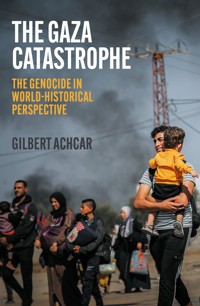
From a foremost expert on the Middle East, a searing indictment of the forces that led to the genocidal war on Gaza and its reverberations across the globe. The destruction rained on Gaza has been seen by many as a vengeful overreaction to the reckless Hamas-led attack on 7 October 2023. However, the new catastrophe befalling the Palestinian people is the continuation of a decades-long course in which Israeli politics, policies and military strategies have inexorably shifted to the right. Gaza was the final nail in the coffin of the Atlanticist "international liberal order" before Donald Trump's return to the White House. The Gaza Catastrophe reckons with the lethal consequences and the significance of a war waged by an advanced military-industrial state – with full US participation and support from the West. Renowned political scientist Gilbert Achcar explores the dynamics of a complex historical process that culminated in the war on Gaza and wider conflict in the Middle East. He offers critical insights on the genocide's regional and international ramifications, as well as radical critiques of Zionism, Hamas and other state and non-state actors. This vital volume is essential to understanding the root causes of the violence destabilising the entire region and the wider world, as well as the conditions required to bring it to an end.
Sie lesen das E-Book in den Legimi-Apps auf:
Seitenzahl: 423
Veröffentlichungsjahr: 2025
Das E-Book (TTS) können Sie hören im Abo „Legimi Premium” in Legimi-Apps auf:
Ähnliche















THE GAZA CATASTROPHE
GILBERT ACHCAR is Emeritus Professor of Development Studies and International Relations at SOAS, University of London. His many books, published in more than twenty languages, include The Clash of Barbarisms: The Making of the New World Disorder; Perilous Power: The Middle East and US Foreign Policy, with Noam Chomsky; The Arabs and the Holocaust: The Arab-Israeli War of Narratives; The People Want: A Radical Exploration of the Arab Uprising and The New Cold War: The United States, Russia and China, from Kosovo to Ukraine.
GILBERT ACHCAR
THE GAZACATASTROPHE
The Genocide inWorld-Historical Perspective
SAQI
SAQI BOOKS
Gable House, 18–24 Turnham Green Terrace
London W4 1QP
www.saqibooks.com
First published in Great Britain 2025 by Saqi Books
Copyright © Gilbert Achcar 2025
All rights reserved. No part of this book may be reproduced or transmitted in any form or by any means, electronic or mechanical, including photocopying, recording or by any information storage and retrieval system, without permission in writing from the publisher.
ISBN 978-1-84925-091-7
eISBN 978-1-84925-092-4
A full CIP record for this book is available from the British Library.
The EU GPSR authorised representative is Logos Europe,
9 rue Nicolas Poussin, 17000 La Rochelle, France.
E-mail: [email protected]
Printed and bound in Great Britain by Clays Ltd, Elcograf S.p.A
Contents
PREFACE
PART IReflections on the Gaza Genocide and its World-Historical Significance
PART IIBackground to the Catastrophe
1. The Whitening of European Jews and the Misuse of Holocaust Memory
2. The Duality of the Zionist Project
3. Zionism and Peace
4. On the Electoral Victory of Hamas
5. The Crisis in Gaza
PART IIIGaza, Nakba, Genocide
6. Initial Comments on Hamas’s 7 October Counter-Offensive
7. The Impending Catastrophe and the Urgency of Stopping It
8. 7 October in Historical Perspective
9. Two Gaza Scenarios: Greater Israel vs. Oslo
10. Israeli Far Right’s Plans for Expulsion and Expansion
11. The First Joint US–Israeli War
12. Gaza: Is There Any Plan for “the Day After”?
13. Netanyahu’s Bloody Onward March
EPILOGUEEnter Trump
APPENDIXStatement on Antisemitism and the Question of Palestine
INDEX
Preface
ON 24 FEBRUARY 2025, the United States and Israel stunned the world by voting alongside Russia, North Korea, Belarus, Nicaragua, and twelve other states – mostly Russia-linked African states – against the United Nations General Assembly’s Resolution ES-11/7, titled “Advancing a comprehensive, just and lasting peace in Ukraine”. That resolution merely emphasized the relevance of basic principles of the UN Charter to “the full-scale invasion of Ukraine by the Russian Federation” and called for “a peaceful resolution of the war” in line with international law. It was supported by most countries that are traditionally part of the geopolitical West, or Western-friendly, while sixty-five countries of what may be described as the non-aligned bloc of the Global South, including China, India, Brazil and South Africa, abstained.
Four days later, the world was further shocked, and to a much greater degree, by the way in which Ukrainian president Volodymyr Zelensky was treated by US president Donald Trump and his very arrogant vice-president, JD Vance, at a media gathering in the Oval Office. These two events – along with a few others, such as Vance’s outrageous performance at the Munich Security Conference in mid-February – unmistakably signaled the collapse of what I called in the summer of 2024, a few months before it became common wisdom, “the fall of Atlanticist liberalism” (a.k.a. “the liberal international order”).1 This observation was made at a time when it was not at all certain that Donald Trump would win a second presidential term, thus inaugurating what I have called “the age of neofascism”, leading to a convergence between neofascists on the backs of oppressed peoples.2
It is since its inception at the end of World War II that Atlanticist liberalism has been gradually undermined by the countless inconsistencies manifested by its key upholders, chief among them being the United States. This historical process culminated with the administration of Joe Biden, due chiefly to its full complicity in the perpetration of the Gaza genocide. The way was thus paved for a further surge in neofascism – a surge that is the direct consequence of the abysmal wreckage of the traditional upholders of liberalism and their own relentless shift to the right ever since neoliberalism prevailed globally. Gaza was a key landmark in that regard.
The Gaza catastrophe that has unfolded since 7 October 2023 is indisputably the worst episode in the Palestinian people’s long ordeal – worse even than the 1948 Nakba, an Arabic term that means “catastrophe”. Whereas the key feature of the Nakba was what has come since then to be called “ethnic cleansing”, “genocide” is the keyword of the present catastrophe, which deserves the stronger Arabic name for catastrophe: Karitha.
This book sets itself three objectives: a) a long-term analysis of the tragic history that predates the Gaza genocide, from Zionism’s origins to Hamas’s takeover of Gaza and the beginning of Israel’s repeated onslaughts on the Strip; b) a close observation of the events that began on 7 October 2023, placing them in historical context and perspective; and c) a reflection, from a more detached and all-encompassing viewpoint, on various aspects of the tragedy, including a critique of Hamas and considerations on the far-right drift of Israel’s society and polity, as well as on the global context of a surging far right and the decadence of Western liberalism, against which the Gaza genocide constitutes a watershed in world history.
The book has four components. Part I – “Reflections on the Gaza Genocide and Its World-Historical Significance” – was written as the introductory chapter to this book, and completed in December 2024. Part II – “Background to the Catastrophe” – is a selection of articles providing a contextualization that is necessary in order to understand the tragedy that has unfolded since 7 October 2023. It includes articles written over three decades, from 1994 to 2024. Part III – “Gaza, Nakba, Genocide” – gathers articles written since 7 October 2023, during the first year of the ensuing war. It starts with immediate reactions to the Hamas-led attack from Gaza and the beginning of the Israeli onslaught on the Strip, and continues with analyses of the 7 October operation, Israel’s genocidal war, its aims, and its outcomes. The book’s epilogue was completed in February 2025.
The events that have been unfolding since 7 October 2023 have understandably led to a plethora of books reflecting upon them. Many came out just as the first year of war was ending, some of them by authors who had never previously written on Palestine and Israel but felt prompted to comment on the immensity of the tragedy that unfolded before the world’s eyes. I have deliberately not engaged with this prolific literature, although it includes some excellent contributions. The reason for this is that I did not want to engage in a metadiscourse – a discourse on other discourses – not only because this would have delayed the completion of this book, but also because I believed that readers would be primarily interested in my own first-hand analysis as an Arab internationalist writer with a long familiarity with the topic.
I very much hope that this book will be perceived as a useful contribution to the understanding of the Gaza genocide and the world-historical period into which it has emerged.
London, 1 March 2025
NOTES
1 Gilbert Achcar, “Anti-Fascism and the Fall of Atlanticist Liberalism”, translated from my weekly column in Arabic in the London-based daily Al-Quds al-Arabi, 13 August 2024, on my blog at gilbert-achcar.net/anti-fascism-and-atlanticist-liberalism.
2 Likewise in my weekly Arabic column, translated on my blog: “The Age of Neofascism and Its Distinctive Features”, 4 February 2025, at gilbert-achcar. net/age-of-neofascism, and “Peace Between Neofascists and War on Oppressed Peoples”, 18 February 2025, at gilbert-achcar.net/peace-between-neofascists.
Part I
Reflections on the Gaza Genocide and its World-Historical Significance
TWO PRELIMINARY QUESTIONS
In what sense is Israel’s genocidal onslaught on the Gaza Strip a consequence of the Hamas-led attack on 7 October 2023? The best way to answer this question is to resort to an allegory. Imagine a Native American who, having intended to set a few houses on fire in a nearby white settler colony, inadvertently sets off the gigantic blast of a huge buildup of explosive material, purposely amassed with the intention of inflicting death and mayhem on the native reservation to which the arsonist belongs. The same type of causality pertains in both the deadly attack of 7 October and the Gaza genocide.
How is the Hamas-led attack related to the antisemitic pogroms of the Pale of Settlement in the Russian Empire of the nineteenth and early twentieth centuries, and/or to the Nazi genocide of the Jews in 1941–45? The only indisputable relation between the 7 October attack and the dreadful history of European antisemitism lies in the fact that the atrocious fate of the European Jews was the main factor that led to the creation in Palestine, on the flank of the Arab Middle East, of the settler-colonial state of the Jews that Theodor Herzl, the founder of political Zionism, had called for.
That state has very sadly confirmed Herzl’s cynical assertion-cum-prophecy that antisemitism is “a movement useful to the Jewish character. It represents the education of a group by the masses, and will perhaps lead to its being absorbed. Education is accomplished only through hard knocks. A Darwinian mimicry will set in. The Jews will adapt themselves.”1
The Darwinian mimicry has indeed set in, to the point that Israel has become a state ruled by a coalition of neofascists (Benjamin Netanyahu’s Likud) and neo-Nazis (the likes of ultraright ministers Itamar Ben-Gvir and Bezalel Smotrich) that has perpetrated the first genocide – including the intentionality entailed in the concept – executed by a technologically advanced state since the final defeat in 1945 of the far-right Axis powers’ coalition of World War II. What is more, it is history’s first genocide to be broadcast live on television.
GENOCIDE AND DENIAL
There is no need here to provide yet another account of the astounding extent of Israel’s almost total physical destruction of the Gaza Strip, and its extermination of a huge number of Palestinians, a majority of whom have been children and women (who are certainly non-combatants). A few such provisional accounts can be found in Part III below; and, most importantly, three thorough examinations of the record were released in December 2024: Amnesty International’s “You Feel Like You Are Subhuman”: Israel’s Genocide Against Palestinians in Gaza, Médecins Sans Frontières’ Gaza: Life in a Death Trap, and Lee Mordechai’s Bearing Witness to the Israel–Gaza War – this last one a database compiled by a former officer in the Israeli armed forces, presently teaching history at the Hebrew University of Jerusalem.2 It is sufficient to recall here that the number of deaths identified by the Gazan health services well exceeds 45,000 at the time of writing. To these must be added the 10,000 unidentified dead believed to lie under the rubble – an estimate that is very probably conservative, if only because this figure has not been revised for several months.
Consider now the letter by three public health experts who, in July 2024, sounded the alarm in the venerable medical journal The Lancet, reminding the world that
Armed conflicts have indirect health implications beyond the direct harm from violence. Even if the conflict ends immediately, there will continue to be many indirect deaths in the coming months and years from causes such as reproductive, communicable, and non-communicable diseases. The total death toll is expected to be large given the intensity of this conflict; destroyed health-care infrastructure; severe shortages of food, water, and shelter; the population’s inability to flee to safe places; and the loss of funding to UNRWA, one of the very few humanitarian organisations still active in the Gaza Strip. In recent conflicts, such indirect deaths range from three to 15 times the number of direct deaths.3
If we follow the three experts in applying to the war on Gaza a conservative estimate of four indirect deaths per one direct death, we could now say, after them, that it is not implausible to estimate that up to 220,000 or even more deaths have occurred or are about to occur as a consequence of the ongoing onslaught on the Strip. We are thus getting close to one-tenth of the total population of Gaza, which was estimated at close to 2.4 million before the war. This is regardless of the variety of neologisms made with the suffix “cide” (killing) that went along with the Gaza genocide: ecocide, domicide, culturicide, educide or scholasticide, etc.
Even if we set aside the undeniable intentionality of the destruction of 66 per cent of the total structures in the Gaza Strip until early September 2024, including an estimated total of 227,591 damaged housing units,4 the intentionality of the human carnage that went along with this destruction can be denied only by those who wish to keep their eyes wide shut. For, if anything, the intentionality is made even more obvious by the multiplicity of means of mass murder, a combination of extremely intensive bombing and other uses of lethal firepower against densely populated urban zones, with the starvation of a whole population by deprivation of food and the finishing off of its sick and wounded by deprivation of healthcare necessities – all three means plainly documented by international organizations. The same combination of killing, starvation and deprivation of healthcare was at work in the Nazi extermination camps, albeit to an even more atrocious and murderous degree.
Let us now compare the foregoing with the well-known definition of genocide in Article II of the “Convention on the Prevention and Punishment of the Crime of Genocide”, adopted by the United Nations General Assembly (UNGA) on 9 December 1948, which stipulates that
genocide means any of the following acts committed with intent to destroy, in whole or in part, a national, ethnical, racial or religious group, as such:
a) Killing members of the group;
a) Causing serious bodily or mental harm to members of the group;
a) Deliberately inflicting on the group conditions of life calculated to bring about its physical destruction in whole or in part …5
No intellectually honest and righteous person can fail to see the reality of genocide in the case of Gaza. Omer Bartov is professor of holocaust and genocide studies at Brown University. Born Israeli, he served in Israel’s armed forces, and was severely wounded in 1976. His testimony is important:
On 10 November 2023, I wrote in the New York Times: “As a historian of genocide, I believe that there is no proof that genocide is now taking place in Gaza, although it is very likely that war crimes, and even crimes against humanity, are happening … We know from history that it is crucial to warn of the potential for genocide before it occurs, rather than belatedly condemn it after it has taken place. I think we still have that time.”
I no longer believe that. By the time I travelled to Israel, I had become convinced that at least since the attack by the IDF on Rafah on 6 May 2024, it was no longer possible to deny that Israel was engaged in systematic war crimes, crimes against humanity and genocidal actions. It was not just that this attack against the last concentration of Gazans – most of them displaced already several times by the IDF, which now once again pushed them to a so-called safe zone – demonstrated a total disregard of any humanitarian standards. It also clearly indicated that the ultimate goal of this entire undertaking from the very beginning had been to make the entire Gaza Strip uninhabitable, and to debilitate its population to such a degree that it would either die out or seek all possible options to flee the territory.6
The recognition that Israel has perpetrated a genocide in Gaza is hence not a token of some “new antisemitism” – a phrase used by the neoconservative historian and Armenian genocide denier Bernard Lewis to designate anti-Israel stances among Arabs and Muslims.7 Rather, it is the refusal to recognize this plain fact that constitutes a new variant of genocide denial. And like all genocide denial, this one is upheld by the perpetrators and their supporters, whose number in the West is all the more significant, since the perpetrators of the Gaza genocide have the particularity of claiming the moral inheritance of the main victims of the Nazi genocide, carried out in Europe with the active or passive complicity (the latter, that of bystanders) of all countries of the present geopolitical transatlantic West.
GAZA BEFORE 7 OCTOBER 2023
This tragedy did not begin on 7 October 2023 – far from it.8 The Hamas-led attack crossed the Iron Wall, which is the name commonly given to the fence that Israel built around Gaza, turning the Strip into a huge open-air internment camp. That confinement was achieved with the complicity of Egypt’s dictatorial government, which allowed only intermittent and restricted passage through the single crossing from the Strip into its territory. Israel started constructing the barrier around Gaza in 1971, completing it twenty-five years later. After Israel’s unilateral withdrawal from the Strip in 2005, it was enhanced with a sophisticated surveillance and deterrence system, including remote-controlled machine guns.
The Gazan population has been suffering an unendurable ordeal at the hands of Israel ever since it occupied the Strip in 1967 – and more than ever after Hamas’s takeover in 2007. Since 7 October, several authors have drawn attention to Benjamin Netanyahu’s peculiar relationship with Hamas. Adam Raz, a historian working at the Akevot Institute for Israeli-Palestinian Conflict Research in Haifa and the author of How Israel Stole Palestinian Property,9 wrote a long piece on this relationship for Haaretz two weeks into the conflagration.10 Although he indulged in a lax use of concepts like “terrorism” and “pogrom”, Raz convincingly explained:
For over a decade, Netanyahu has lent a hand, in various ways, to the growing military and political power of Hamas … Releasing Palestinian prisoners, allowing cash transfers, as the Qatari envoy comes and goes to Gaza as he pleases, agreeing to the import of a broad array of goods, construction materials in particular, with the knowledge that much of the material will be designated for terrorism and not for building civilian infrastructure …
Take note: It would be a mistake to assume that Netanyahu thought about the well-being of the poor and oppressed Gazans – who are also victims of Hamas – when allowing the transfer of funds … His goal was to hurt Abbas and prevent division of the Land of Israel into two states …
The prime minister himself spoke briefly at times about his position regarding Hamas. In March 2019, he said during a meeting of Likud MKs, at which the subject of transfer of funds to Hamas was under discussion, that, “Whoever opposes a Palestinian state must support delivery of funds to Gaza because maintaining separation between the PA [Palestinian Authority] in the West Bank and Hamas in Gaza will prevent the establishment of a Palestinian state.”11
Netanyahu’s cynical attitude was indeed not motivated by “the well-being of the poor and oppressed Gazans”. In a 2019 report on socioeconomic conditions in the Strip, Ghazi Sourani, a Gaza-based intellectual well known in the Arab world and a founding member of the Popular Front for the Liberation of Palestine (PFLP), emphasized that half of the labor force in the Strip had become unemployed, while the poverty rate had increased to 53 per cent measured by consumption patterns, and 67.6 per cent by income, with close to 38 and 53.9 per cent of the Gazans, respectively, living in abject poverty.12 Begging was on the rise among women and children. Electricity and drinking water were provided only a few hours per day, while pollution of both sea and aquifers was worsening due to the dumping of untreated waste.
This dire background sharply contrasted with “the ostentatious privileges of layers of the upper bourgeoisie (historically linked to the Muslim Brotherhood and presently Hamas) consisting of rich wholesale traders, real estate and money exchange speculators, and a few industrial and touristic businesses, whose commerce has increased since Hamas achieved a monopoly on the rule of Gaza”.13 It contrasted as well with the “millionaires” who took advantage of the tunnels into Egypt to organize large-scale smuggling with Hamas’s complicity.14 Sourani also denounced Hamas’s “imposition of an occult fundamentalist logic on education curricula in the Gaza Strip”,15 its promulgation of “legislations limiting freedoms in general and freedom of opinion and belief in particular, its prohibition of all political or cultural meetings without prior authorization by the security services”, and its “imposition of the hijab on female students in all universities and secondary schools” and “of the ‘Islamic shorts’ (covering the knees) on all males on the seaside”.16
Hamas’s increasingly repressive government of Gaza naturally led to anger and protests, culminating in a mass uprising against its rule of the Strip in the summer of 2023. Since this story is hardly known, it is useful to quote at length from a report published by Al-Monitor in early August:
Thousands of Palestinians took to the streets last Sunday [30 July 2023] and again this Friday [5 August] in various areas of the Gaza Strip in rare public protests against Hamas, which has ruled the enclave since 2006. Masses gathered in Gaza City, Nuseirat, Khan Yunis, the Jabaliya refugee camp, Rafah, Bani Suheila and Shujaiya. The protesters chanted, “Hamas leave us be”, “We want to live”, and “The people want the end of the division [between Gaza and the West Bank]” …
The protests came in response to calls by activists on social media, which grew stronger as the electricity crisis worsened in the past month, with Gazans barely getting five hours of power daily amid a scorching heat wave. Hamas’ security forces cracked down on the peaceful protesters and assaulted several people with batons. Dozens of protesters were injured and many had to be hospitalized …
Among the protesters’ demands is also for Hamas to allow municipal elections in the Gaza Strip. Since Hamas’ rise to power in 2007, the Islamist movement has banned all forms of elections, including general, municipal, chambers of commerce, and even university students’ council elections. Hamas fills those positions from its own ranks and allies without any electoral process.
Hamas has launched an arrest campaign against citizens who took part in the protest. Last Sunday, Hamas’ security forces stormed Abu Youssef Al-Najjar Hospital in Rafah governorate, and took three patients who were being treated for injuries sustained during the protests. They were eventually released …
Although rare, these are not the first anti-Hamas protests in Gaza. In March of 2019, similar demonstrations under the same slogan, “We Want to Live”, lasted for four days … One of the groups advocating for the “We Want to Live” movement released a statement following the protests on Sunday, that read, “The time of silence over injustice and the exploitation of religion for oppression is over.” Despite the crackdown, activists on social media continue to call for new protests.17
It was against this background of rising anger at Hamas’s rule of Gaza that the 7 October attack took place. This is not to insinuate that it was launched in order to distract from the popular wrath and nip the uprising in the bud before it gathered further momentum. Indeed, it is clear that Hamas had been preparing its operation since much earlier than the summer of 2023. But what is equally obvious is that radicalism in the (very legitimate) detestation of Israeli oppression of the Palestinian people had all along been Hamas’s official raison d’être, and was therefore a convenient cover for the socially, politically, and culturally reactionary character of its religious fundamentalist perspective. In that sense, there has been a functional complementarity between Hamas and the Israeli far right, which has translated into interplay between them.
Ariel Sharon – who, during his rule (2001–06) was then the most right-wing prime minister Israel had seen – mastered this game, every now and then assassinating a senior member of Hamas in order to provoke new indiscriminate suicide attacks by the movement in retaliation, and hence rekindle his own popularity. Benjamin Netanyahu sought instead a modus vivendi with the Islamic Resistance Movement (whose Arabic acronym is Hamas), taking advantage of it for the reasons explained above by Adam Raz. However, Netanyahu too surfed on Israeli society’s animosity toward Hamas, exploiting in particular the episodic launching of rockets from Gaza into Israeli territory. He regained the prime ministership after winning the Israeli legislative election of 10 February 2009, in the wake of the first major Israeli onslaught on Hamas-ruled Gaza, which had ended on 18 January of the same year. His Likud party increased its number of seats in the Knesset, the Israeli parliament, at the March 2015 election, after the second major Israeli onslaught on Gaza, led by Netanyahu himself in the summer of 2014.
ON HAMAS’S STRATEGY
This permanent tension with the Israeli warden of Gaza’s open-air prison was used by Hamas to justify its repressive behavior inside the Strip. At the same time, it genuinely adhered to a messianic vision of its struggle against Israel – a vision shaped by Islamic fundamentalism, along with a mixture of European-imported antisemitism and anti-Jewish pronouncements found in Islamic scriptures.18
The secular Palestine Liberation Organization (PLO), which presided over the Palestinian struggle after Israel’s defeat of Arab armies in the 1967 Six-Day War, soon reached the conclusion that it was vain to try to achieve the liberation of Palestine from the Jordan River to the Mediterranean Sea by violent means, which Israel possesses in much greater abundance. It thus pursued the more limited goal of a Palestinian state in the 1967-occupied Palestinian territories (OPT) of Gaza and the West Bank by means of diplomatic pressure, exerted by the rich Arab oil producers whose revenues had increased suddenly and sharply after the 1973 oil shock. These efforts, too, ultimately proved fruitless. But the PLO managed to ride the wave of the First Intifada (Arabic for “uprising”) that started in December 1987 and peaked the following year, constituting the most important and impactful episode in the long history of the Palestinian struggle. The PLO leadership used the Intifada’s impact to obtain recognition from the United States – though not without its chief, Yasser Arafat, publicly and shamefully declaring, “We totally and absolutely renounce all forms of terrorism” in order to meet Washington’s condition for that purpose.19
Five years later, in September 1993, Arafat was on the White House lawn, signing the famous Oslo Accords between the PLO and the Israeli government of Yitzhak Rabin and Shimon Peres. Prompted by a flare-up in Hamas’s activities to recognize the PLO in their turn, the Laborite Zionist pair concluded a deal with Arafat inspired by an updated version of the 1967 Allon Plan – a plan that sought to annex to Israel key strategic parts of the 1967-OPT, and hand direct control over their densely populated parts initially to the Jordanian monarchy.20
Hamas would thereafter expand in direct proportion to the increasing failure of this grand scheme, predicated on a fool’s bargain that allowed Israel not only to pursue its colonization of the West Bank, but to accelerate it tremendously. The Islamic movement would resort extensively to suicide attacks during the initial post-Oslo years. The entire “peace process” irreversibly collapsed after, in September 2000 – seven years after the signing of the Oslo deal in Washington – Sharon deliberately provoked a second uprising, known as Second Intifada, or Al-Aqsa Intifada, in the 1967-OPT. Unfortunately, the Arafat leadership fell into the trap of using the light weapons that Israel had authorized the PA (set up under the Oslo Accords) to hold for the purpose of policing the enclaves that it was tasked to tame. Israel would seize the opportunity of what then took the shape of an armed confrontation in order to escalate its violence in the 1967-OPT to an unprecedented level, making use of the full spectrum of its military force.
Arafat’s death in 2004, and his succession by Mahmoud Abbas, created the conditions for the 2006 electoral victory of Hamas. Sensing the opportunity, the Islamic movement had decided to suspend its commitment to armed struggle and enter the electoral arena.21 This was nevertheless intolerable for Washington, though it had insistently demanded that these elections be held in the hope that they would bestow legitimacy on Abbas. The coup jointly orchestrated by Abbas’s PA and Washington failed to subdue Hamas, but resulted in the political partition of the 1967-OPT into two rival “authorities” ruling Gaza and the West Bank, respectively.22
Although Hamas took charge of the government of the Gaza Strip from then on, it nevertheless continued to cultivate a mystical belief in the liberation of Palestine by armed means. This perspective had become its ideological trademark in the face of the approach of the West Bank’s PA, which it denounced as a traitor to the Palestinian cause and a subcontractor of Israel’s subjugation of the Palestinian people. One patently counterproductive manifestation of Hamas’s “armed struggle” strategy is its intermittent resort to launching rockets across the fence surrounding the Strip, despite the obvious fact that Israel’s retaliation would be incomparably more brutal and murderous on each occasion.
This strategy is irrational: it makes little sense to assault one’s enemies on the very terrain upon which they hold insurmountable superiority. Zionist settler-colonial domination of historical Palestine is not comparable to the settler-colonial domination of Algeria and South Africa. In both these countries, the settler-colonial population was a minority exerting domination over the indigenous majority. In Palestine, as is well known, Zionist settler-colonialism uprooted the indigenous population, thus cancelling the natives’ overwhelming majority. Even with the present demographic quasi-parity between Palestinians and Israeli Jews in the entire area between the river and the sea, the balance of armed forces is overwhelmingly to Israel’s advantage, thus perpetuating the subjugation of one population by the other.
Under such circumstances, to take the initiative of violence in confronting the Israeli state (in contrast to the reasonable resort to armed defense in the face of attacks by Zionist settlers adopted in the West Bank) is plainly irrational. “Who really wants to confront a nuclear superpower with four slingshots?” Unless you already knew it, you would never guess who made that statement. It was Yahya Sinwar himself, Hamas’s leader in Gaza, and the man who took the fateful decision to prepare and launch the 7 October attack. That was in a 2018 interview with an Italian journalist published in Israel’s Yedioth Ahronoth and Italy’s La Repubblica.23 Indeed, against an enemy with such overwhelming military superiority, the only rational strategy is to wage the struggle on the terrain upon which it holds no superiority, but is rather in a position of moral inferiority. This is principally mass nonviolent struggle against the occupier, best epitomized by the First Intifada that peaked in 1988, provoking a deep ethical and political crisis among the Israeli population – including its armed forces, and up to the highest echelons.
Whatever cost such nonviolent struggle entails for the Palestinians (1,600 were killed by the Israelis during the First Intifada between the end of 1987 and 1993; and 223 Palestinians were later killed by Israel during the eighteen months of the 2018–19 Great March of Return in Gaza), it remains significantly less than that of armed engagements between Palestinians and Israelis (over 3,000 Palestinians were killed by Israeli forces during the Second Intifada, from September 2000 until the end of 2004; and over 2,300 were killed in Gaza in less than two months in July–August 2014). On the other hand, the political impact of nonviolent struggle by Palestinians is incomparably more positive for their cause.24
Only through this kind of struggle – along with its natural complement abroad, which is the solidarity movement spearheaded by the Boycott, Divestment, and Sanctions (BDS) campaign – can the Palestinian movement hope to achieve its goal of obtaining equal rights, self-determination on its historical land, and recognition of the right of Palestinian refugees to return to it. For only thus can it hope to achieve the indispensable condition for the attainment of this goal, which is to split Israeli Jewish society, thus offsetting its military superiority. Launching rockets instead – or, worse, irresponsibly launching such a dreadful attack as that of 7 October – will lead only to the further unification of Israeli society around hatred of the Palestinians, reinforcing its rightward drift and tolerance for killing sprees.
EXCURSUS 1: FIFTEEN YEARS AGO
The above considerations have long been obvious. In the spring of 2009, Ghazi Sourani, quoted above, acting for the Central Cultural Department of the PFLP’s Gaza branch,25 invited me, along with a few other authors, to contribute to a special issue of their publication Al-Hayat Al-Jadida (“The New Life”) commemorating the sixty-first anniversary of the 1948 Nakba. Below are excerpts from my contribution, entitled “The Imminent Nakba and How to Confront It”:
Just as the failure of Oslo led to the downfall of its Israeli protagonists, the leaders of the Zionist Labor Party, whom Sharon replaced in heading the government, the failure of his own project led to the downfall of the party that he founded, Kadima [Sharon split from Likud in 2005], which was replaced by the right-wing Likud in coalition with open advocates of ethnic cleansing. No doubt that their shared conviction is that coexistence is not possible with the Palestinians, and that Israel’s security will not be established without “cleansing” most Palestinians of all areas close to where Israelis live, including Israeli settlers on the West Bank. This would be achieved by deporting the majority of Palestinians across the Jordan River and into the Sinai Desert after exterminating part of them to terrorize the rest in order to achieve that purpose. In other words, what is looming on the horizon and threatening the Palestinians remaining on the land of Palestine is a new Nakba that, if it happens, will inevitably be much worse in terms of killing and destruction than the first, the 1948 Nakba.
In the face of this impending catastrophe, a radical review of the Palestinian liberation strategy is necessary by returning to the axioms that were self-evident in the past, in the era of political hegemony of the Arab nationalist movement in general and Nasserism in particular throughout the Arab nation. The self-evident truth forgotten since then is that the Palestinian struggle cannot achieve victory in isolation from the Arab hinterland and that it has no prospects unless it acts as the spearhead of the entire Arab liberation struggle …
The most accurate expression of this awareness was perhaps the idea expressed by Dr George Habash during the struggle in Jordan, that the Palestinian revolution must have a Hanoi, like what was available to the Vietnamese revolution in its heroic struggle to liberate the occupied southern part of the Vietnamese homeland … Dr Habash saw that it was necessary to start by transforming Amman into an Arab Hanoi so that the struggle to liberate western Palestine could find its necessary rear base …
Of the Arab-Israeli pincer imposed on the Palestinian people, the Jordanian regime constitutes the weakest jaw due to the demographic composition of the Hashemite Kingdom, where there is a majority of Palestinians, not to mention that the majority of “East Jordanians” hold anti-Zionist and anti-imperialist nationalist sentiments that prevail over the narrow provincialist sentiments promoted by the monarchy. Transforming Amman into an Arab Hanoi is an indispensable condition for the effectiveness of the struggle to turn the largest possible part of the 1967-occupied Palestinian territories into liberated zones. For as long as those territories remain caught between the jaws of a pincer as they are now, any thought of turning them into liberated zones is nothing more than a naïve dream, as naïve as Arafat’s dream.
The second long-term part of the liberation strategy, the part related to the first Nakba of 1948 and its dire consequences, is dependent on what Abdel Nasser himself realized after the June 1967 defeat, the last war before it was confirmed that the Zionist state had become a nuclear power. Betting on eliminating the Zionist state by military force applied from outside is a naïve dream too, or rather suicidal madness, as there is no doubt that it will not hesitate to resort to its nuclear weapons if it faces a threat of military defeat …
This means that no rational strategy in confronting the Zionist state is possible without relying on the combination of the Palestinian and Arab struggle with the effort to split Israeli Jewish society from within. This last goal requires Palestinian and Arab liberation forces to be able to address the Israeli Jews and detach a significant portion of them from the Zionist mindset. Here the degree to which the very nature of the religious fundamentalist movement conflicts with the requirements of liberation becomes evident. The rise of that movement in the Palestinian and Arab spheres has led to the rallying of Israeli Jews behind their most reactionary leaders in a way that exceeded any previous stage in our region’s history.26
7 OCTOBER 2023: A CATASTROPHIC MISCALCULATION
Before 7 October, the clearest illustration of the counterproductive character of Hamas’s violent strategy is what happened in May 2021, when the movement’s action aborted the Unity Intifada that had started in Jerusalem on the sixth day of that month, and over the following days rapidly spread to the West Bank, and even to Palestinian citizens of Israel. This was commonly perceived as the beginning of a new Intifada, reconnecting with the first, which peaked in 1988. On 10 May, Hamas jumped into the fray by delivering a swaggering “ultimatum” to Israel to withdraw, by early evening on the same day, all its security forces from the Temple Mount and Sheikh Jarrah in Jerusalem – the sites where the new uprising had been ignited – as if anyone could conceive in their wildest imagination that Israel would yield to such a threat. On that same evening, Hamas, along with Islamic Jihad, started launching rockets into Israeli territory, dubbing their bombing campaign the Sword of Jerusalem Battle. Israel’s response was predictably swift and brutal, leading to the usual disproportionate number of Palestinian casualties (256 killed in Gaza alone over ten days). More pertinently, though, this action aborted the budding Intifada, demobilizing the Palestinian youngsters who had set it in motion.
How Sinwar, who had stated with much perspicacity in 2018 that it made no sense to “confront a nuclear superpower with four slingshots”, could succumb to a state of such delusion as to believe, in 2021, that Hamas was able to intimidate the Israeli state into backtracking – or, later, that the attack his movement launched on 7 October 2023 would be the opening salvo in the liberation of Palestine – is unfathomable from the standpoint of practical rationality, or what Max Weber would call the “ethic of responsibility”. It only makes sense from the standpoint of mystical belief – Weber’s “ethic of conviction” in which practical rationality is usurped by faith. In the decision to launch the Al-Aqsa Flood operation on the morning of 7 October 2023, a religious mystical dimension was unmistakably involved. Any dismissal of this blatant reality against the evidence of Hamas’s own pronouncements, under the pretext that it would constitute an Orientalist interpretation in the sense of the term popularized by Edward Said, is simply an instance of Orientalism in reverse: a view predicated on the belief that “Islamism” is merely a “language” of Muslims devoid of specific consequences.27 Religious beliefs, however, are not just the specific form of expression of a rational-practical kernel – and this is no less true in the case of Hamas than that of any other Islamic fundamentalist organization, from the moderate Muslim Brotherhood to the extremist Islamic State, to consider Islam alone. They are sincere beliefs, and it is insulting and condescending to those who profess them to claim the contrary.
This fervent belief in a forthcoming liberation of Palestine thanks to divine intervention was most patently translated prior to the Al-Aqsa Flood in the convening in Gaza on 30 September 2021, under the auspices of Hamas, of a so-called Foresight Conference, entitled “Promise of the Hereafter – Palestine after Liberation”, officially held “Under the Patronage of the Leader Yahya Sinwar, ‘Abou Ibrahim’”. The conference discussed and adopted a detailed blueprint for the administration of a hypothetically liberated Palestine, down to settling issues such as the future state’s provisional legal system, its land and sea border arrangements with neighboring states, the issuing of a new Palestinian currency, and the fate of the Israeli Jews. Among the last, those who surrendered would be allowed to remain or given time to leave, whereas the conference decided “to keep for a while the Jews that are scholars and experts in medicine, engineering, technology and both civil and military industry”.28 The conference’s resolution concluded by stating that “we have a date with victory, which God promised to His worshipers”. In his message to the conference, Sinwar assured the participants that the battle for liberation had become closer than ever, explaining that “the Sword of Jerusalem Battle was a model of preparation and development” for this goal. Thus, “liberation has become close in time and our patronage of this conference conforms to our vision of victory’s imminence”.29
This same mystical vision – which a rational mind can only perceive as a rather pitiful instance of taking one’s dreams for realities – presided over Hamas’s launch of the 7 October attack. As it started to unfold, the operation was announced by an audio message recorded by Muhammad al-Deif, the commander-in-chief of the Al-Qassam Brigades, Hamas’s armed wing. Here are some excerpts of what he said, after summarizing the crimes committed by the Zionist oppressors:
We decided to put an end to all of this, with God’s help, so that the enemy understands that the time for them to revel without being held accountable has ended … Our righteous Mujahideen, this is your day for you to let this criminal enemy understand that their time has ended … Fight, and the angels will fight with you as your vanguard, God will reinforce you with the horse-riding angels and will fulfil His promise to you … Our young people in the West Bank, all our people regardless of your organizations, today is your day to sweep this occupier and its settlements from all our land in the West Bank and to make them pay for the crimes they perpetrated throughout those long, difficult years … Our people in Jerusalem, rise up to support your Al-Aqsa Mosque, expel the occupation forces and the settlers from your Jerusalem, and demolish the dividing walls. Our people in the occupied interior, in the Negev, Galilee, and the Triangle, in Jaffa, Haifa, Acre, Lydda, and Ramla, ignite the soil with fire under the feet of the usurping occupiers, by killing, burning, destroying, and closing roads …
Our brothers in the Islamic resistance, in Lebanon, Iran, Yemen, Iraq, and Syria, this is the day on which your resistance merges with your people in Palestine so that this terrible occupier understands that the time of rampaging and assassinating religious scholars and leaders has ended, the time of plundering your wealth has ended, the almost daily bombing in Syria and Iraq has ended, the time of dividing the nation and scattering its forces in internal conflicts has ended. Now is the time for all Arab and Islamic forces to unite to sweep this occupation away from our sanctities and our land.
Today, today, everyone who has a gun should take it out, for the time has come, and whoever does not have a gun should use their knife, hatchet, axe, Molotov cocktail, truck, bulldozer, or car … This is the day of the great revolt to end the last occupation and the last apartheid regime in the world. O righteous men and women, the finest memorizers of the Book of God, O worshipers who fast and stand, kneel and prostrate themselves – gather in your mosques and places of worship and return to God and urge Him to send down their death upon us, to provide us with His trusted angels, and to fulfil through us your hopes of praying at Al-Aqsa, liberated …30
Countless attempts have been made to justify the 7 October operation and demonstrate its rationality. One argument was that it was judiciously launched at a time when Israeli society was deeply divided, with weekly demonstrations against Benjamin Netanyahu. The problem is that it only succeeded in superseding this division and unifying the Israelis behind full support for the genocidal war launched by their government – whatever resentment a portion of them would maintain toward Netanyahu. Another argument was that 7 October served to draw the world’s attention back to the Palestinian cause at a time when it had been descending into oblivion. Since the price of temporarily drawing attention in this way was tens of thousands, if not hundreds of thousands, of people massacred, a whole territory erased, and Israel’s permanent reoccupation of this territory, this would be the worst bargain ever made. Such a defense of the attack betrays a deplorable lack of human empathy with the terrible fate that befell the Gazan population, let alone what happened during the attack itself.
There is no possible vindication for what has been the most catastrophic miscalculation ever in the history of anticolonial struggle. To be sure, the resentment of the Gazans against Israel was fully understandable and legitimate. This is why I commented on 16 October 2023 that “The most crucial issue with Hamas’s conception of the fight against Israeli occupation and oppression is not moral, but political and practical.”31 One of the worst flaws in Hamas’s miscalculation is that it disregarded the fact that Israel was led by the most far-right government in its history, including people who openly advocate the expulsion of the Palestinians from their historical land – a gang of anti-Palestinian racists who would not hesitate to seize any suitable opportunity to launch a genocidal war on the Strip and reoccupy it permanently. All of them are known to have bitterly opposed the unilateral Israeli withdrawal from Gaza implemented by Ariel Sharon in 2005.
ISRAEL’S ROAD TO THE GAZA GENOCIDE:1. THE DRIFT TO THE FAR RIGHT
“The most right-wing government in Israel’s history.” This same appraisal of a newly formed Israeli government has been made countless times since 1977, the year when the Likud, that heir to Mussolini-admirer Ze’ev Jabotinsky’s far-right Zionist Revisionism, won the legislative election for the first time. Ever since, the Israeli polity has been subject to a rightward trend, interrupted only by the divisive impact of Israel’s invasion of Lebanon in 1982 – the Zionist state’s first obvious “war of choice” – and later by that of the First Intifada at its peak in 1988, as well as by the widening opposition at the end of the last century to the continuation of Israel’s costly occupation of South Lebanon. These events contributed to the restoration of the Laborite wing of Zionism into power, first in 1984–86, then in 1992–96 (leading to the Oslo Accords), and finally in 1999–2001 (the withdrawal from Lebanon in 2000).
Overall, however, of the forty-seven years from the moment Likud first came to power up to 2024, the party has governed Israel for thirty-four years, half of them under Netanyahu’s leadership. The continuous drift of Israel’s society and polity to the far right has culminated in the present cabinet, formed by Netanyahu at the very end of 2022 – a coalition of the neofascist Likud with a collection of far-right groups of such a nature that it led Holocaust historian Daniel Blatman, of the Hebrew University of Jerusalem, to make a very alarming statement to Haaretz, used as title of the interview that the newspaper published with him: “Israel’s Government Has neo-Nazi Ministers. It Really Does Recall Germany in 1933.”32
How to explain this drift, whose sinister character is significantly amplified by the fact that it has occurred in a state founded by people most of whom had escaped from Nazism or survived the genocide that it perpetrated, a state that justifies its existence by the need to anticipate the possible recurrence of something like Nazism? The truth is that the Darwinian mimicry evoked by Theodor Herzl cannot work as an explanatory factor in isolation from the context in which the founder of statist Zionism sought to insert his project – namely, the colonial undertaking and its inherently genocidal tendency – common to all colonial endeavors – to dehumanize the “barbarians” whose land it seizes.
The paradox, however, is that the colonial means by which Herzl dreamt of realizing his project came to fruition at the very onset of decolonization. In that sense, as Maxime Rodinson – a French Marxist scholar of the Middle East, of Jewish descent – put it in the aftermath of the 1967 Six-Day war, “the Zionists were unlucky”:
The conscience of the world had developed, and no longer accepted right of conquest, or accepted it more reluctantly … Zionism began as a living force in the era of nationalism, of which it was itself a manifestation, and it pursued its career during the era of decolonization …
Arab opposition [to Jewish settlement] manifested itself the moment that the Zionist intention to establish a Jewish state by detaching Palestine’s territory from the Arab world became clear. This opposition mounted as the true nature of the Zionist project became obvious, and grew more irreconcilable as the Zionists came nearer to success. Therefore the Arabs were not rejecting the foreigners as such; they were rejecting foreign occupation of their territory – whether we choose to classify this phenomenon as colonialism or not. The conflict therefore appears essentially as the struggle of an indigenous population against the occupation of part of its national territory by foreigners.33
By a historical paradox, this new settler-colonial state was created in the very same year that the largest of all colonial empires was losing its “jewel in the crown”. It was in 1947, the year of India’s independence, that the UNGA adopted the resolution providing for the establishment of a “Jewish State” in Palestine. In this antithetical symmetry, there was nonetheless a common element: that of partition – except that the partition of Palestine was a colonial decision, whereas that of India was a legacy of decolonization. The United Nations that voted for the partition of Palestine against the will of its native population was composed of only fifty-six states, dominated by the Global North, including the USSR, with a very preponderant role played by the United States at a time when most of the rest of the world needed its economic benevolence. Thirteen out of the thirty-three countries that voted in favor of partition were Latin American countries under Washington’s spell, far away from the Middle East.




