


20,99 €
Mehr erfahren.
- Herausgeber: John Wiley & Sons
- Kategorie: Geisteswissenschaft
- Serie: New Directions in Aesthetics
- Sprache: Englisch
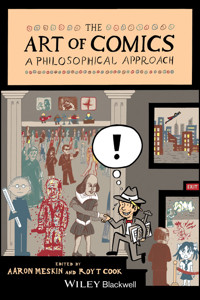
THE ART OF COMICS The Art of Comics: A Philosophical Introduction is the first-ever collection of essays published in English devoted to the philosophical questions raised by the art of comics. The volume, which includes a preface by the renowned comics author Warren Ellis, contains ten cutting-edge essays on a range of philosophical topics raised by comics and graphic novels. These include the definition of comics, the nature of comics genres, the relationship between comics and other arts such as film and literature, the way words and pictures combine in comics, comics authorship, the "language" of comics, and the metaphysics of comics. The book also contains an in-depth introduction by the co-editors which provides an overview of both the book and its subject, as well as a brief history of comics and an overview of extant work on the philosophy of comics. In an area of growing philosophical interest, this volume constitutes a great leap forward in the development of this fast expanding field, and makes a major contribution to the philosophy of art.
Sie lesen das E-Book in den Legimi-Apps auf:
Seitenzahl: 503
Veröffentlichungsjahr: 2012
Ähnliche




















Contents
Editors’ Acknowledgments
Figures
Contributors
Foreword
The Art and Philosophy of Comics: An Introduction
1 Introduction to the Introduction
2 What We Are Doing, and Why
3 A Short History of Comics
4 Comics Scholarship and the Philosophy of Comics: A Brief History
5 The Contributions
Part One The Nature and Kinds of Comics
1 Redefining Comics
McCloud’s Definition
Pictures and Comics
Panels, Panels Everywhere
Seeing-in and Closure
Pictureless Comics?
Wordless Prints, Unprinted Words
Spaces Between Words
The Air of Non-Pictures
A Continuum of Cases
Comic Books and Ideal Books
2 The Ontology of Comics
Introduction
Multiplicity
How Are Instances of Comics Created?
Autographic and Allographic
Conclusion
3 Comics and Collective Authorship
Introduction
A Cautious Set-Up
Minimal Authorship (of Sorts)
Minimal Authorship (of the Comic Sort)
Some Work for a Theory of Comic Authorship
Illustrating Robust Comic Authorship
Comic Authorship of the McCloudian Sort
Appropriation Cases
Commission Cases
Collaborative Cases
Non-Collaborative Cases
Final Thoughts
4 Comics and Genre
Introduction
Desiderata for an Account of Genre
Existing Accounts of Genre
An Account of Genre
Conclusion
Part Two Comics and Representation
5 Wordy Pictures: Theorizing the Relationship between Image and Text in Comics
Illustrated Books: A First Step
The Image-Text Complex in Comics
The Image
The Text
How Comics Work
An Objection
Conclusion
6 What’s So Funny? Comic Content in Depiction
Where are the Funnies?
Writing Images, Drawing Words
Without Words
Just Looking
Where’s the Fun?
“What’s That For?” Arts and Artifacts
7 The Language of Comics1
Introduction
A Pre-Emptive Strike
How Comics Mean
The Unified Comic
Conclusion
Part Three Comics and the Other Arts
8 Making Comics into Film
9 Why Comics Are Not Films: Metacomics and Medium‐Specific Conventions1
The Problem
The Filmstrip Argument
Metacomics
Bomb Queen’s Editor Girl
The Filth’s Max Thunderstone
Conventions and Aesthetic Analysis
Conclusions
10 Proust’s In Search of Lost Time: The Comics Version
Index
New Directions in Aesthetics
Series editors: Dominic McIver Lopes, University of British Columbia, and Berys Gaut, University of St AndrewsBlackwell’s New Directions in Aesthetics series highlights ambitious single- and multiple-author books that confront the most intriguing and pressing problems in aesthetics and the philosophy of art today. Each book is written in a way that advances understanding of the subject at hand and is accessible to upper-undergraduate and graduate students.
1. Interpretation and Construction: Art, Speech, and the Law by Robert Stecker2. Art as Performance by David Davies3. The Performance of Reading: An Essay in the Philosophy of Literature by Peter Kivy4. The Art of Theater by James R. Hamilton5. Cultural Appropriation and the Arts by James O. Young6. Photography and Philosophy: Essays on the Pencil of Nature ed. Scott Walden7. Art and Ethical Criticism ed. Garry L. Hagberg8. Mirrors to One Another: Emotion and Value in Jane Austen and David Hume by Eva Dadlez9. Comic Relief: A Comprehensive Philosophy of Humor by John Morreall10. The Art of Videogames by Grant Tavinor11. Once-Told Tales: An Essay In Literary Aesthetics by Peter Kivy12. The Art of Comics: A Philosophical Approach by Aaron Meskin and Roy T. Cook
This edition first published 2012© 2012 Blackwell Publishing Ltd.
Blackwell Publishing was acquired by John Wiley & Sons in February 2007. Blackwell’s publishing program has been merged with Wiley’s global Scientific, Technical, and Medical business to form Wiley-Blackwell.
Registered OfficeJohn Wiley & Sons Ltd, The Atrium, Southern Gate, Chichester, West Sussex, PO19 8SQ, UK
Editorial Offices350 Main Street, Malden, MA 02148-5020, USA9600 Garsington Road, Oxford, OX4 2DQ, UKThe Atrium, Southern Gate, Chichester, West Sussex, PO19 8SQ, UK
For details of our global editorial offices, for customer services, and for information about how to apply for permission to reuse the copyright material in this book please see our website at www.wiley.com/wiley-blackwell.
The right of Aaron Meskin and Roy T. Cook to be identified as the authors of the editorial material in this work has been asserted in accordance with the UK Copyright, Designs and Patents Act 1988.
All rights reserved. No part of this publication may be reproduced, stored in a retrieval system, or transmitted, in any form or by any means, electronic, mechanical, photocopying, recording or otherwise, except as permitted by the UK Copyright, Designs and Patents Act 1988, without the prior permission of the publisher.
Wiley also publishes its books in a variety of electronic formats. Some content that appears in print may not be available in electronic books.
Designations used by companies to distinguish their products are often claimed as trademarks. All brand names and product names used in this book are trade names, service marks, trademarks or registered trademarks of their respective owners. The publisher is not associated with any product or vendor mentioned in this book. This publication is designed to provide accurate and authoritative information in regard to the subject matter covered. It is sold on the understanding that the publisher is not engaged in rendering professional services. If professional advice or other expert assistance is required, the services of a competent professional should be sought.
Library of Congress Cataloging-in-Publication Data
The art of comics: a philosophical approach / edited by Aaron Meskin and Roy T. Cook. – 1p. cm. – (New directions in aesthetics; 12)Includes bibliographical references and index.
ISBN 978-1-4443-3464-7 (hardback)1. Comic books, strips, etc.–History and criticism. 2. Philosophy in literature.I. Meskin, Aaron. II. Cook, Roy T., 1972–PN6710.A86 2012741.5′9–dc23
2011036428
A catalogue record for this book is available from the British Library.
This book is published in the following electronic formats: ePDFs 9781444354812; Wiley Online Library 9781444354843; ePub 9781444354829; Mobi 9781444354836
Editors’ Acknowledgments
Our primary debt of gratitude is to the authors of the papers in this volume. Not only did they contribute great philosophical work but, many of them provided useful feedback to other authors. John Holbo deserves special mention for going above and beyond in commenting on others’ articles. We are grateful to Matthew Kieran and Kathleen Stock for useful feedback on our introduction. David Heatley provided us with a fabulous cover, and Warren Ellis wrote a fantastic preface; we owe thanks to both of them. Aaron also owes David thanks for reintroducing him to comics about a decade ago. Thanks also to MontiLee Stormer and Rob Callahan. We would also like to thank Jeff Dean (editor-aesthetician extraordinaire) and the rest of the staff at Wiley-Blackwell for all their support in getting this book out. Finally, we’d like to thank our families – Alice, Sheryl, and Ethan. Without their support and tolerance the book simply wouldn’t have gotten done. Excelsior!
Aaron MeskinRoy T. Cook
Figures
1.1
“Mommy, why ain’t I juxtaposed?”
1.2
“Mommy, why ain’t I juxtaposed?” part II
1.3
Scott McCloud, Understanding Comics: The Invisible Art (1994) a
1.4
Scott McCloud, Understanding Comics: The Invisible Art (1994) b
1.5
Caravaggio, The Sacrifice of Isaac (1603)
1.6
Poussin, Landscape with Saint John on Patmos (1640)
1.7
Quote from Jane Austen a
1.8
Quote from Jane Austen b
1.9
Quote from Jane Austen c
5.1
Huck and Jim “On the Raft,” from The Adventures of Huckleberry Finn
5.2
From The Classics Illustrated ‘Last of the Mohicans’
5.3
A text-balloon
5.4
Text used to represent a sonic event
6.1
Corbie Psalter
6.2
Caricature of Schopenhauer by Wilhelm Busch (1832–1908)
7.1
Xenozoic Tales, Issue 13, Page 18, by Mark Schultz
9.1
‘Circular Panel Comic’ from “Comic Theory 101: Loopy Framing” by Neil Cohn
9.2
Bomb Queen Vol IV, Issue 2, page 13
9.3
The Filth, Issue 10, page 6
10.1
Elstir’s Harbour at Carquathuit
10.2
Elstir’s Harbour at Carquathuit
Contributors
Catharine Abell is a lecturer in philosophy at the University of Manchester. She has published articles on a variety of issues in aesthetics including the nature of depiction, the definition of art and cinematic representation, in journals including Philosophical Review, Philosophy and Phenomenological Research, Australasian Journal of Philosophy, American Philosophical Quarterly, and the British Journal of Aesthetics. Together with Katerina Bantinaki, she co-edited Philosophical Perspectives on Depiction (OUP, 2010). Her current research focuses on the philosophy of the representational arts and, in particular, on issues concerning fiction, such as the nature of the act of fiction making, the ontological status of fictional characters, and the scope and determinants of narrative content.David Carrier is Champney Family Professor, Case Western Reserve University/Cleveland Institute of Art. His books include Artwriting, Principles of Art History Writing, The Aesthetics of Comics, Writing About Visual Art, Museum Skepticism, A World Art History and Proust/Warhol.Roy T. Cook is associate professor of philosophy at the University of Minnesota – Twin Cities, a resident fellow at the Minnesota Center for Philosophy of Science, and an associate fellow of the Northern Institute of Philosophy at the University of Aberdeen. He has published numerous articles and book chapters on philosophical logic, mathematical logic, philosophy of mathematics, and more recently on the aesthetics of comics. He previously edited The Arché Papers on the Mathematics of Abstraction (Springer 2007), and is the author of A Dictionary of Philosophical Logic (Edinburgh University Press 2009).Darren Hudson Hick (PhD, University of Maryland) is an Assistant Professor of Philosophy at Susquehanna University, where he specializes in issues in the ontology of art, philosophical problems in intellectual property, and their overlap. Occasionally, he writes philosophical papers about things like comics, zombies, and Guitar Hero. His work appears in a range of philosophy journals, law journals, and anthologies. He is the author of the forthcoming Introducing Aesthetics and the Philosophy of Art (Continuum), a former managing editor of The Comics Journal, and has received a great deal of press for an essay he wrote on what it would cost to become Batman.John Holbo is associate professor of philosophy at the National University of Singapore. His most recent book is Reason and Persuasion: Three Dialogues By Plato (Pearson, 2009), an illustrated introduction. He is the co-editor of a forthcoming anthology, Reading Graphs, Maps and Trees: Responses To Franco Moretti (Parlor Press, 2011). His personal contribution to comics artistry (self-published) is Squid and Owl (Blurb, 2010). He is well-known as a blogger at www.crookedtimber.org.Christy Mag Uidhir received his PhD in philosophy from Rutgers University in 2007. He is a former postdoctoral associate at the Cornell University Sage School of Philosophy and currently an assistant professor of philosophy at University of Houston. His main areas of research are artistic intentions and the ontology of art, with a special interest in printmaking and print-related areas such as comics and photography. He has published articles in journals such as Philosophical Studies, Australasian Journal of Philosophy, American Philosophical Quarterly, The Journal of Aesthetics and Art Criticism, and the British Journal of Aesthetics, and is currently editing the volume Art and Abstract Objects for Oxford University Press.Patrick Maynard, emeritus full professor of Philosophy, University of Western Ontario, taught most subjects in Philosophy at all levels there, also as visiting professor at the universities of Michigan-Ann Arbor and California-Berkeley, and Simon Fraser University. He is author of The Engine of Visualization: Thinking Through Photography and Drawing Distinctions: The Varieties of Graphic Expression – both the only full philosophy treatises on their subjects – and co-editor of Aesthetics (Oxford Readers). Works in progress include Plato’s Republic and Ours, Fly the Ocean in a Silver Plane, Many Aesthetics (including an essay on paper-folding, based on translation of Unamuno) and a collection of papers, Planes of Focus. An active visual artist and photographer, he is particularly interested in visual (including information) design. He has written or edited many Wikipedia articles, and has drawn cartoons steadily since childhood.Aaron Meskin is senior lecturer in philosophy at the University of Leeds. He is the author of numerous journal articles and book chapters on aesthetics and other philosophical subjects. His work on comics has been published in The Journal of Aesthetics and Art Criticism, the British Journal of Aesthetics and two previous anthologies. He was the first aesthetics editor for the online journal Philosophy Compass, and he co-edited Aesthetics: A Comprehensive Anthology (Wiley-Blackwell, 2007). He is a former Trustee of the American Society for Aesthetics and is Treasurer of the British Society of Aesthetics.Henry John Pratt received his PhD in philosophy from the Ohio State University in 2005 and is currently assistant professor of Philosophy at Marist College. His primary research interests include artistic value, comparing artworks across genres, and narrative. His work on comics began with an article co-written with Greg Hayman, “What Are Comics?” (in Aesthetics: A Reader in Philosophy of the Arts, 2nd. ed.). Since then, he has presented on comics at numerous conferences and has had his articles published in The Journal of Aesthetics and Art Criticism, Storyworlds, and the third edition of Aesthetics: A Reader in Philosophy of the Arts.Thomas E. Wartenberg is professor of philosophy at Mount Holyoke College where he also teaches in the film studies program. His current research focuses on issues in the philosophy of film and philosophy for children. He is the author of two books on film: Unlikely Couples: Movie Romance as Social Criticism (Westview) and Thinking On Screen: Film as Philosophy (Routledge). He has recently edited three books: The Nature of Art (Cengage 3rd edition), The Philosophy of Film: Introductory Text and Readings (Blackwell with Angela Curran), and Thinking Through Cinema: Film as Philosophy (Blackwell with Murray Smith). His most recent publications include Existentialism: A Beginner’s Guide (Oneworld) and Big Ideas for Little Kids: Teaching Philosophy Through Children’s Literature (Rowman and Littlefield Education). He has published widely on topics ranging from the history of philosophy and social theory to the philosophy of art. He maintains a popular website for teaching philosophy through children’s literature: www.teachingchildrenphilosophy.org.
Foreword
Comics are a strange beast. It’s a strange attractor of an artform, and almost everything that sticks to it is a source of continual argument, including the term “comics.” From one perspective, comics take things from all other artforms and sew them together into a weird hybrid animal. Comics comprise illustration and prose and theatre and sloganeering and graphic design and any other damn thing you want to sling into the pot. From another, it’s the first and simplest way we did visual narrative. Cave paintings are sequential art. So is the Bayeux Tapestry. Someone once argued that the Stations Of The Cross constitute a comic strip.
Comics have been around for so long that no-one can find a convincing start point for them anymore. In the West they’re considered a niche art at best, but there’s a comic packed into every airplane seat in the world that explains how to not die if the damn thing catches fire. Comics are often regarded as fringe-y and “alternative,” and yet the US Army used them for operating manuals and the CIA dropped them on unfavoured countries to teach dissent to their populations. As pervasive as air and yet somehow as shameful as crack, comics win literary prizes and reshape the cultural landscape at the same time as we’re told that comics are “just movies on paper,” and therefore unworthy of special or separate consideration as an artform.
That last one … that’s been sticky, that epithet. Like all genuinely ignorant comments, it seems to have a half-life that outlasts more aware and less toxic observations. The shaky development of comics criticism and theory from inside the field has been too scattershot, too stop-start and often too fraught with industry politics to make any real headway against statements like that.
Which is just one reason why I’m so pleased to have this volume in my hands. In many ways, it feels like a fresh start for comics theory. Its strong and reasoned explanation of why comics are not paper movies alone make it a valuable contribution, and represents the sort of accessibly-presented clarity the field’s been crying out for. Even when arguing that comics are the best material for film adaptation due to their similarities, there is a sharp understanding of what separates the two arts.
It’s the book I would have wished for twenty years ago, when I was just entering the field, and the last in a depressing series of false starts for the medium as an intellectual art (or even as provider of half-smart entertainment) was burning away again. A rock-solid collection of thinking about what defines the medium and what it’s capable of, and a fine foundation for building a new critical and theoretical language to explore comics’ corridors. To have been able to place this book in front of people who didn’t even understand why I’d want to involve myself in a thing like comics: that would have been delightful.
This book is a wonderful reader, and a superb set of argument-starters and positions that reveal intent and rigorous thinking about my medium. I hope you enjoy it as much as I did.
Warren EllisEnglandHallowe’en 2010
The Art and Philosophy of Comics: An Introduction
Aaron Meskin and Roy T. Cook
1 Introduction to the Introduction
You hold in your hands (or view on a screen) the first-ever anthology of essays on the philosophy of comics written from the perspective of Anglo-American philosophy. An introduction to any such volume is intended to give the reader an overview of the subject and a feel for what is to be found in the remainder of the volume. Being the first anthology of this sort, however, places additional burdens on an adequate introduction. In addition to sketching what it is that we shall be doing in the remainder of the book, it will also be useful to indicate why the time has finally come for such a volume and how the essays contained in it connect to larger themes within research into both art in general and comics in particular.
With this in mind, this introduction will be structured as follows. First, we shall outline, in Section 2, what we take to be the subject matter of the philosophy of comics and of this volume, and why these issues and questions should be of interest to philosophers of art, philosophers more generally, and comics fans and scholars of all kinds. Once we have a better idea of what our target questions and controversies are, this introduction will take a somewhat historical turn. Although there has been little philosophical work until now on comics within the analytic Anglo-American tradition, both comics and comics scholarship have histories that inform the essays in this volume. Thus, we shall provide a short history of comics in Section 3, one that emphasizes aspects of that history that are relevant to the tasks at hand; and in Section 4 we shall provide a brief overview of recent comics scholarship with a particular emphasis on the small amount of pre-existing philosophical work on comics within the Anglo-American philosophical tradition. The introduction will then conclude with an overview of the contents of the volume, summarizing each essay and forging links, when possible, between these essays and the larger picture sketched here.
Lesen Sie weiter in der vollständigen Ausgabe!
Lesen Sie weiter in der vollständigen Ausgabe!
Lesen Sie weiter in der vollständigen Ausgabe!
Lesen Sie weiter in der vollständigen Ausgabe!
Lesen Sie weiter in der vollständigen Ausgabe!
Lesen Sie weiter in der vollständigen Ausgabe!
Lesen Sie weiter in der vollständigen Ausgabe!
Lesen Sie weiter in der vollständigen Ausgabe!
Lesen Sie weiter in der vollständigen Ausgabe!
Lesen Sie weiter in der vollständigen Ausgabe!
Lesen Sie weiter in der vollständigen Ausgabe!
Lesen Sie weiter in der vollständigen Ausgabe!
Lesen Sie weiter in der vollständigen Ausgabe!
Lesen Sie weiter in der vollständigen Ausgabe!




