


22,49 €
Mehr erfahren.
- Herausgeber: The Crowood Press
- Kategorie: Lebensstil
- Sprache: Englisch
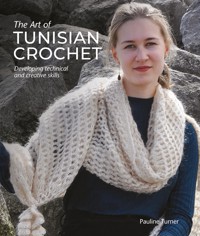
Until the twenty-first century, Tunisian crochet was a little-used style of crochet that was considered relatively simple and unadventurous. Fortunately, nowadays, that has all changed. The Art of Tunisian Crochet offers a comprehensive exploration of what is an often underestimated technique that combines both knitting and crochet principles. The book takes the reader from the technique's relatively young history, dispelling common misassumptions, to the exciting possibilities available to the crafter today. This beautifully illustrated book includes the origin of Tunisian crochet; advantages and disadvantages of materials and equipment; the limitless variations of the basic Tunisian simple stitch; achieving the unexpected ethereal look of Tunisian lace; exploring a creative variety of texture and colour, and finally, incorporating Tunisian crochet with other crafts.
Das E-Book können Sie in Legimi-Apps oder einer beliebigen App lesen, die das folgende Format unterstützen:
Seitenzahl: 332
Veröffentlichungsjahr: 2021
Ähnliche















The Art of
TUNISIANCROCHET
Developing technicaland creative skills
The Art of
TUNISIANCROCHET
Developing technicaland creative skills
Pauline Turner
First published in 2021 byThe Crowood Press LtdRamsbury, MarlboroughWiltshire SN8 2HR
www.crowood.com
This e-book first published in 2021
© Pauline Turner 2021
All rights reserved. This e-book is copyright material and must not be copied, reproduced, transferred, distributed, leased, licensed or publicly performed or used in any way except as specifically permitted in writing by the publishers, as allowed under the terms and conditions under which it was purchased or as strictly permitted by applicable copyright law. Any unauthorised distribution or use of this text may be a direct infringement of the author’s and publisher’s rights, and those responsible may be liable in law accordingly.
British Library Cataloguing-in-Publication Data
A catalogue record for this book is available from the British Library.
ISBN 978 1 78500 925 9
Cover design by Kelly-Anne Levey
CONTENTS
Conversion Chart
Abbreviations
1 Introduction
2 The Fundamentals of Tunisian Crochet
3 Exploring Tunisian Simple Stitch
4 Tunisian Crochet Lace
5 Tantalizing Texture
6 Continuing Tunisian Crochet Creatively
Bibliography and Further Reading
Acknowledgements
Index
CONVERSION CHART
For Frequently Used Hook Sizes and Yarns
ABBREVIATIONS
Abbreviations in Patterns
Note: UK crochet terminology is used throughout this book.
Instructions to work the traditional crochet stitches listed below can be found in Crochet for the Absolute Beginner (see Bibliography and Further Reading for further details).
3trcl
three-treble cluster
C
contrast colour
C1, C2, and so on
contrast colour 1, contrast colour 2, and so on
ch
chain
dc
double crochet
dc2tog
double crochet the next 2sts together
dc3tog
double crochet the next 3sts together
dtr
double treble
htr
half treble
M
main colour
RS
right side
RtrB
raised treble back
RtrF
raised treble front
slst
slip stitch
st(s)
stitch
Tdtr
Tunisian crochet double treble
Tgs
Tunisian crochet garter stitch
tog
together
Tpuff
Tunisian crochet puff stitch
tr
treble
TRtr
Tunisian crochet raised treble
TRtrB
Tunisian crochet raised treble back
TRtrF
Tunisian crochet raised treble front
Tslst
Tunisian crochet slip stitch
Tss
Tunisian crochet simple stitch
Ttr
Tunisian crochet treble
Ttrtr
Tunisian crochet triple treble
Tx
Tunisian crochet cross stitch
Txtr
Tunisian crochet extended treble
WS
wrong side
yoh
yarn over hook
CHAPTER 1
INTRODUCTION
Where Did Tunisian Crochet Begin?
Crochet is the youngest of the needlecrafts. One has only to look in the catalogue of the Great Exhibition, 1851, to realize that entries under crochet, or Tunisian crochet, did not exist. This catalogue lists every craft and trade imaginable at that time. If you search hard enough, you can find a small list of crochet taking up less than one column in this massive three-column catalogue. It is to be found under ‘embroidery’ in a section allocated to tambour; as so little crochet was available around 1851, it can be assumed the organizers recognized that crochet is worked with a hook and placed the tiny list of items together with this technique of embroidery, which also uses a hook. Tunisian crochet, even under the word ‘tricot’, could not be found. The oldest printed reference using the name ‘Tunisian crochet’ is to be found in the Encyclopedia of Needlework by Th. de Dillmont, published in 1884. In this beautiful gem of a book of needlework, there are six pages given to Tunisian crochet (pp. 336–41).
Speculation as to where and when Tunisian crochet emerged as a needlecraft continues, but, despite extensive research, there is no definitive answer. Until someone can bring forward proof of its existence prior to the early nineteenth century, we can confirm its existence only from the latter half of the eighteen hundreds. As to where – the colourful unsubstantiated possibilities are rife with conjecture.
The history of Tunisian crochet as known in the twenty-first century is vague, and, after extensive research to find validating material in order to discover the source of Tunisian crochet, it is still unclear. Just looking at the various names given to Tunisian crochet underlines the difficulty in answering the question ‘where did Tunisian crochet begin?’
What is Tunisian Crochet?
Is that crochet or knitting?
This is one question frequently asked when someone watches Tunisian crochet being worked. It is an understandable question when observing a fabric being made with yarn and a long hook: the viewer at first sees all of the loops on the hook, as for knitting, and then, a little later, they disappear, as for crochet. Observers unfamiliar with a Tunisian crochet hook assume that the hook is a knitting needle and the resulting material is being made with just one knitting needle! Although many are curious, only a few outgoing people will ask what this craft actually is.
A sample of Tunisian simple stitch showing the side with the square look facing, which is generally acknowledged as the right side of the fabric.
A sample of the other side of Tunisian simple stitch, which resembles the look of the back side of a piece of knitted stocking stitch.
There are numerous names given to this style of crochet. These names are part of its history. In order to bring it into the current decade starting in 2020, it is possibly best to clear away the confusion surrounding what to call this type of needlework. If it can be shown at the outset that there is a valid reason for this needlecraft to be called Tunisian crochet and not one of the many other names that it has accumulated over the years, some of the confusion could be alleviated.
This definition is true whether the hook is a classic crochet hook for working with yarn, a fine lace hook for working thread-based lace or a Tunisian crochet hook. A facsimile of a crocheted fabric produced with only the fingers, instead of a hook, is not crochet according to this definition.
Although Tunisian crochet can appear to look like knitting, after the first stage of the process when all of the loops are on the hook, the second stage removes all of the loops until only one loop remains, therefore ‘Tunisian crochet’ is technically a correct name.
It is interesting to note that, in the mountainous regions of South America, knitting is made in the round on five needles that have one sharp end and one hooked end. It is the hooked end that is inserted into the loops. Long tubes of knitting of varying diameters are produced in this way. As the tubes vary in diameter, they can be cut to make a bodice, and sleeve for a garment, or for some other article.
The hook required for working Tunisian crochet is longer than the standard crochet hook. The hook needs to be able to accommodate all of the loops produced for the first stage of working a row.
Without having any knowledge of Tunisian crochet, however, it is understandable that an observer would assume that what they are seeing is a strange form of knitting. Because of this perspective, it is plausible that what we are referring to as ‘Tunisian crochet’ could be called ‘Tunisian knitting’, but it is necessary to remember that having all of the loops on the hook is only half of the process. Unlike knitting, which retains these loops on the needle (or needles) throughout, Tunisian crochet removes the loops during a second stage of the process, leaving only one loop on the hook, before repeating these two steps to produce a fabric.
A true, widely accepted definition of crochet is as follows:
‘Crochet stitches begin with one loop on the hook and end with one loop on the hook.’
Alternative names given to Tunisian crochet
Researching the origin of the names for Tunisian crochet was intriguing. Given the background of each different name and how it came to be used to describe Tunisian crochet, all have valid reasons for being given to Tunisian crochet as a name. Listed here are most of the alternative names that you may encounter relating to Tunisian crochet, in their order of review in the following sections.
• Tunisian knitting
• tricot
• Afghan crochet
• Princess Frederick William stitch
• shepherd’s knitting
• railway knitting
• blanket knitting
Fortunately, the confusion is lessening, as ‘Tunisian crochet’ is now becoming the accepted name globally.
Tunisian knitting
It is doubtful that this needs any explanation. When working in public on a long, straight Tunisian crochet hook, in a fairly short time, comments such as ‘I have never seen anyone knit with one needle’, ‘What kind of knitting is that?’, ‘That is quite a thick needle you are knitting with’, and so on, are sure to be heard. These frequently heard comments quickly confirm why Tunisian crochet is sometimes called Tunisian knitting!
At the stage when all of the loops are placed on to the Tunisian crochet hook, Tunisian crochet can appear to be some kind of knitting to an uninformed observer. The loops are on the hook for 50 per cent of the time, and, during the picking-up stage, the actions can seem to be a process of casting on for knitting; however, this is relevant to only the time before the loops are worked off the hook to go back to there being one loop only. When all of the loops are on the hook, it is necessary to acknowledge that most people will primarily be looking at the back of the work, for the front of the Tunisian crochet to be facing the crocheter whilst they are working the first stage of the process. Thus, the viewer sees only the back, or rough side, of the Tunisian crochet, which looks exactly like the back of a piece of knitting worked in stocking stitch. Inevitably, ‘knitting’ is the word that will pop into their mind. Personally, I am reluctant to call the rough side of Tunisian crochet the ‘wrong side’, as both sides of Tunisian crochet play their part when producing a design.
Tricot
Tricot was the first name given to Tunisian crochet in Britain. It can be loosely translated as ‘French knitting’. My research led me to discover that ‘crochet’ came from the French name ‘croc’, or hook. Therefore, it makes sense that other words from the French language would intrude. Much early information on tricot was written by members of the French aristocracy residing in Britain.
An image of Queen Victoria crocheting was released to the press at the end of the nineteenth century as a call to the British public to support the efforts of the military forces during the Second Boer War. The earliest record in the royal archives of any member of the royal family taking an active interest in crochet is this one of Queen Victoria, dated 1889. Interestingly, in the image, Queen Victoria is using a tricot hook, which in those days was similar in thickness to that of knitting needles. In that period, the thickness of yarn produced was quite fine, and a double-knitting (DK) yarn would have seemed coarse and clumsy, even if the yarn itself was soft and pleasant to work with!
Queen Victoria, crocheting with a tricot hook.
Queen Mary was later known to be a skilled needlewoman whose repertoire included crochet.
Afghan crochet
In the USA, Tunisian crochet was called Afghan crochet for many years, and reference is still made to Tunisian crochet under that name. ‘Afghan’ crochet hooks were initially thicker than crochet hooks, making it a faster method with which to make a throw or Afghan blanket. In the USA, creating Afghans, blankets and knee rugs with the Tunisian crochet simple stitch (seeChapter 2) increased in popularity during the 1970s, and this interest has been maintained since then. To avoid confusion between the Afghan blanket and the Afghan style of crochet, the European name of Tunisian crochet has gradually infiltrated the written word in the USA.
Princess Frederick William stitch
It would be remiss of me to exclude the reference to the name Princess Frederick William stitch. It is found mainly in older patterns produced in the USA. Princess Frederick William stitch was often used in place of the term ‘Afghan’ as a stitch, in the hope of elevating its status, as it has an elite sound, linking it to the British royalty. The date that this term emerged seems to have been after Queen Victoria’s rally call to the women of the British Empire to provide comforters for the brave men fighting for peace.
Shepherd’s knitting
Scotland was, and still is, a country known for the quality of its needlecrafts. The climate and temperature of Scotland is renowned for being damp, windy and, in most regions, colder than the rest of Great Britain. It makes sense, therefore, that spinning, weaving, felting and knitting were predominant activities, in an effort to keep one’s family members warm and dry.
The Black Isle in Scotland seems to be the first place where the title of ‘shepherd’s knitting’ appears. When I once admitted to being puzzled as to why they used the name ‘shepherd’s knitting’, a mature lady from that area of Scotland who was working Tunisian crochet in one of my workshops informed me that all those working Tunisian crochet in that area associated the long hook with the shepherd’s crook. They believed that the crook was a more accurate name for the long Tunisian crochet hook, particularly as the small, thin hooks that they were using for other crochet projects were used in a different way. No one seems to know when Tunisian crochet began being worked in that region, only that ‘Granny did it!’
Railway knitting
This name seems to have been handed down through two generations, and it is claimed to date back to the 1880s in Canada. The date is feasible, as Canada was under British rule from 1763–1867, so it is possible that the technique could have been taken across the Atlantic by British travellers.
There is speculation as to how the technique gained this name. The author of The Railway Knitting Workbook has given the supposition that it could have been the vertical lines of Tunisian crochet simple stitch resembling the symmetry of railway lines, or because Tunisian crochet was used on the long train journeys from the east coast of Canada to the west coast, and vice versa – an eighty-four-hour journey.
Blanket knitting
Because Tunisian crochet was mainly used for the making of blankets in the early years of it being counted as a craft, the source of its name is self-explanatory. Its use for blankets prompted one manufacturer to make a hook that was thick enough and long enough to make warm blankets. The hook is in three sections to allow the crocheter to make the hook longer when necessary, to accommodate more loops for a wider blanket.
The Carnell needle for blanket making has three sections.
Why Did It Take So Long for Tunisian Crochet to Become Popular?
It was only upon entering the twenty-first century that Tunisian crochet became popular, although it had been in existence for approximately 150 years before that. Until the introduction of digital communication with smartphones, tablets, Facebook and YouTube, and so on, it was difficult to find any patterns for this style of crochet. Recently, Tunisian crochet has become more well known, partly due to the advent of short home-made videos being posted electronically, demonstrating the craft and what can be achieved with it.
Unfortunately, many of the earlier patterns used the same size of Tunisian crochet hook as would be selected for knitting needles if using the same yarn to produce an equivalent knitted item. As a result, much of the twentieth-century Tunisian crochet was made on hooks that were much too small, resulting in very dense fabrics that were stiff and unable to drape, as well as requiring a lot of yarn. An observation was made that, for children in the Victorian era, who were meant to be seen but not heard, the density of the resulting crocheted garments would be tantamount to these children wearing straightjackets!
Even when a Tunisian crochet pattern was available, a further complication arose, because of the confusion over what comprises a ‘row’. Some designers referred to picking up the loops on to the hook as one row and taking off the loops from the hook as another row. Yet other designers classed the picking up of the loops and their removal as one row. Patterns produced by myself and my company Crochet Design list both stages as one row, simply because the Tunisian crochet craft fits the definition of crochet, therefore the row should end with one loop on the hook, just as it started with one loop on the hook. Whichever stitch pattern is used, the process of working Tunisian crochet does end up with only one loop on the hook at the end of a row. In some way, it requires both the picking up of loops and their removal, and so it still fulfils the definition of crochet.
The Scope of Tunisian Crochet
A whole world of colour and texture opens up to anyone enjoying the combination of logic and artistic inspiration that Tunisian crochet can provide. The two stages of Tunisian crochet allow numbering, counting and planning to be used, because of the need to have all of the loops on the hook at one time prior to removing them, so satisfying someone with a logical mind. At the same time, the limitless number of stitch and yarn combinations is most gratifying to someone with an artistic temperament.
Suggestions for some of the ways that Tunisian crochet can be used are provided here:
• Quickly made, simple projects for presents or for sale at charity events can be produced.
• Accessories to liven up a favourite outfit can often be achieved in one or two evenings.
• The oddment stash of leftover yarns can be utilized for knee rugs, chair covers, blankets and throws.
• Fashion designs for men or women, babies, children and teens are able to be produced with Tunisian crochet.
• Unique emblems, symbols, logos, and so on, can be incorporated readily into a design featuring Tunisian crochet simple stitch with its even square pattern.
• All manner of household items, from lacy curtains, cushions, bathroom accessories and even upholstery fabrics, for use in such items as chairs with a drop-in seat, can be made.
• Art forms either on a garment or as a picture are both rewarding and fun to produce.
A little bit of Tunisian crochet magic
During my teaching career, I have been privileged to teach many people with both temporary and permanent disabilities. In addition to those with physical disabilities, there are those who attend a class or workshop as a respite from the stress of their everyday life. It is heart-warming to see so many mindfulness groups emerging, where all forms of crochet are being included to reduce stress. We see community groups working on projects either to raise funds for charity or to send donations to disadvantaged areas, both at home and abroad. There is a special place in my heart when it comes to the long, straight Tunisian crochet hook.
Although nowadays short Tunisian crochet hooks with a wire of the desired length attached can be purchased, the classic long, straight hook has some advantages over the shorter version. For instance, I have included a picture of the first ever Tunisian crochet sampler made by a lady who had become paralyzed in one arm. She could not have achieved this with the shorter-length crochet hook to which a wire is attached. The story behind this achievement is worth relating, as it can open the door to many frustrated needlecrafters for whom one of their hands or arms can no longer be used, either temporarily or permanently.
It is the mixture of various types of yarn and working partial rows of Tunisian simple stitch that has created this Tunisian crochet picture.
An example of first attempts of working Tunisian crochet with one hand only.
I was demonstrating Tunisian crochet at the National Exhibition Centre in Birmingham, England, many years ago, using the long hook and attracting a crowd. A lady rushed up to me shouting, ‘Can I do that with one hand?’ I answered ‘Yes’, only to be challenged by her irritated husband. Apparently many other crafts had stated only one hand was needed, and he was angry about the false hope given to his wife. Inevitably, the crowd grew larger at this exchange. I asked him, ‘If I do this type of crochet using only one hand, will you let your wife try for herself?’ He agreed. I placed the long hook in my belt and used only the hand holding the yarn to make the stitches. His wife then tried and succeeded sufficiently to learn enough to be able to continue at home, with the instructions and long Tunisian crochet hook.
A few months later, a parcel arrived in my office, containing the cushion shown in the photograph. She informed me this was her first attempt and to keep the cushion because now she could produce a better standard of Tunisian crochet, although her arm was still paralyzed. I treasure this cushion, which is a symbol of hope to a lot of people.
Working with just one hand, the Tunisian crochet hook can replace the classic crochet hook to produce all styles of traditional crochet. Placing the Tunisian crochet hook in a belt and using the hook head only results in conventional crochet. Select the same size Tunisian crochet hook as that recommended in the pattern. The yarn does the work, and the hook is not moved, so any basic crochet pattern can be reproduced in this manner.
CHAPTER 2
THE FUNDAMENTALS OF TUNISIAN CROCHET
Tunisian Crochet Hooks
Even today, obtaining hooks for working Tunisian crochet can be a challenge, because not all yarn shops have them in stock. As more interest is being taken in needlecrafts generally, producers of tools and equipment have realized the need to satisfy both the professional and the hobbyist needlecrafter. This has resulted in an increase in the number and type of Tunisian crochet hooks being produced, although they are still not readily available everywhere; as a last resort, they can usually be purchased by mail order.
This Tasseled Boa is quick and simple to make.
Tunisian crochet hooks can be grouped into three types:
• classic Tunisian crochet hooks
• double-ended Tunisian crochet hooks
• Tunisian crochet hooks with wire extensions
Classic Tunisian crochet hooks
The classic Tunisian crochet hook is similar in length to a long, straight knitting needle. It has a hook at one end and a stopper at the other.
The first Tunisian crochet hooks manufactured were of metal. Production then progressed specifically to aluminium, being the most common material for the manufacturing of non-steel knitting needles. In the twenty-first century it is possible to purchase mass-produced Tunisian crochet hooks made of plastic, aluminium, bamboo and wood. The largersized Tunisian crochet hooks are frequently available as hand-tooled wood. The hook does not have to be glossy or finished with lacquer for it to be useful for working Tunisian crochet. A beeswax finish will suffice, as long as the wax has been polished to remove any sticky residue. Of course, the quality of lathe-turned and hand-produced wooden hooks depends upon the skill of the machinist or woodworker.
A selection of classic Tunisian crochet hooks.
Wooden hand-turned classic Tunisian crochet hooks.
When purchasing any hand-produced Tunisian crochet hook, look out for the following points:
1. The hook is smooth and sanded to a gloss finish, with no snags or splinters in the wood.
2. The hook head has been formed with a rounded top, to allow the vertical strands and stitches to be easily picked up.
3. The claw end of the hook head is not without shape – if it is thin and flat, it can cut the yarn as it is being worked.
4. The inside of the hook head is an area that may get missed when the wood is being sanded to a smooth finish, but it is to the inside of the hook head that the yarn has to go! Check whether there has been attention to detail and appropriate finishing of this vital area of a wooden Tunisian crochet hook.
Tunisian crochet hook sets can be purchased, with the hooks typically ranging in size from 2.00mm to 8.00mm; however, your local yarn shop may carry only a few sizes, unless they have a strongly crochet-based clientele. A wider range of hooks is more likely to be found at needlecraft or yarn-craft exhibitions and fairs. In such places, the range of Tunisian crochet hook sizes can be as large as 1.50mm to 25.00mm. Prior to visiting such events, check who will be exhibiting, particularly if the reason for your visit is solely to buy a Tunisian crochet hook or set.
The classic Tunisian crochet hook has the additional advantage of being able to be used as though it were a small crochet hook by anyone unable to utilize both hands.
Double-ended Tunisian crochet hooks
Double-ended Tunisian crochet hooks are produced in the same sizes and materials as are the classic Tunisian crochet hooks. Originally, the double-ended Tunisian crochet hook was available only in the same length as the classic Tunisian crochet hook. Now, however, shorter-length double-ended Tunisian crochet hooks have become available, which are ideal for making changes in the stitch direction when designing more adventurous Tunisian crochet fabrics.
A selection of double-ended Tunisian crochet hooks.
The double-ended Tunisian crochet hook is more versatile to use than is the single-ended hook, making it possible for reversible Tunisian crochet fabrics to be produced, and the turning of the work when using such a hook reduces the resulting fabric’s natural curl. It opens up many other techniques that would be difficult to work with a single-ended Tunisian crochet hook. With the aid of a little plasticine or play dough that does not harm the yarn, a stopper can be moulded for temporary use, turning the double-ended Tunisian crochet hook into a classic Tunisian crochet hook, when desired.
The beauty of using a double-ended Tunisian crochet hook is its ability to produce reversible fabrics. For instance, garments produced with two different colour combinations and using two different types of yarn can be designed to be reversible, allowing the wearer a choice of two alternative-colour outfits.
Tunisian crochet hooks with wire extensions
The shorter Tunisian crochet hook with a wire extension is also available in a wide range of hook sizes. Not everyone wants to work with a long hook, but there are certain things to remember when producing an item worked in Tunisian crochet with a shorter hook and its wire extension. Most importantly, when purchasing such a hook, even from a reputable firm, it is necessary to check the screw or attachment part of the hook. I personally recommend the Japanese Tulip range, as from experience I can say that the screw is long and very finely turned, preventing it from coming undone even after a lot of use.
A Tunisian crochet hook with a wire extension and stopper.
A selection of Tunisian crochet hooks with wire extensions.
Some Tunisian crochet hooks with wires work well initially, but, if the screw end of the wire is short, it will eventually work loose from the hook. There are many other manufacturers producing hooks with wire extensions that work well, but do check the length of the screw and how closely the ridges of the screw sit next to each other.
Another part of a hook with a wire extension that needs to be checked is the wire itself. It must not be so springy that it is impossible to keep your work lying flat. Without the work lying flat, there may be tension problems.
The end of the wire will have either a secure or a moveable stopper. Both operate well, depending on what you need the stopper to do as the Tunisian crochet project is being made. The wires themselves can vary in length, and it is often useful to have a range of these wires handy. A set of Tunisian hooks with wires contains a removable stopper, allowing another hook to replace it and turning it into a double-ended hook.
One additional advantage of working with a wire extension is its usefulness when working borders, because of its flexibility.
Yarns
The fibre content of a yarn is only significant if it affects the project at hand, for example, in terms of drape, thickness, caring for the item and the intended recipient or user of the crocheted item. There is no limit to the different fibres contained in a yarn, which can be based on either a single fibre or a mixture; both types of yarn produce excellent results. In other words, you can use string, wire, thread and knitting yarn (smooth or textured) for working a Tunisian crochet article. Fine cottons are suitable for heirloom items when worked with an appropriately small Tunisian crochet hook. Heavily textured fashion yarns can be incorporated into a suitable design to be worked with Tunisian crochet once the correct size of hook has been selected. The size of hook should be large enough to allow the texture of the yarn to show its beauty and not be of a size that flattens and removes the texture incorporated in the yarn.
Yarns gain their different appearances by the way that they are produced. For instance, mercerized cotton has an additional final process to ensure its longevity of life and its ability to retain its colour through the years. On the other end of the smoothness spectrum, textured yarns (ones that include crimps, coils, loops, long hairs and other distortions) gain their texture during a heating or plying stage. The myriad colours available primarily depend upon the processes used during dyeing.
A selection of smooth 4-ply, DK-and aran-weight yarns.
A selection of yarns of different textures, some of which are heavily textured.
A selection of thinner bedspread-weight mercerized cotton threads.
There are a few things to be aware of when working with more than one colour:
• The inclusion of dye in the yarn will change its physical weight. Different dyes have different weights that can impact how far a ball of yarn will go in terms of how many stitches or how much fabric it can produce. Even when the same thickness of yarn is purchased from the same spinner and in the same range, there will be a difference in how much length is included for the same gram weight of the ball depending on its colour. How the yarn is dyed is relevant when designing a project.
• Space-dyed yarns that change colour after only a few stitches can be used for an overall pattern, but, when selecting a complementary colour to accompany such a yarn, choose one that blends with the finished look and not one of the colours used to make the multicoloured yarn because, paradoxically, that colour will clash with the completed fabric overall.
• The use of longer lengths of colour present in a spaced-dyed skein or cake needs to be carefully planned if the design to be worked includes any seams. These yarns provide wide stripes of colour when the yarn is used to work back and forth or around and around over the same number of stitches on each row or round, which can be beautiful. However, when an article has been designed to include clean bands of colour, as for the Accent-on-Autumn design (seeChapter 5), it would be unwise to have one of the selected yarns as a space-dyed one. The very nature of the yarn produces higgledy-piggledy breaks in such stripes, which can be off-putting to the wearer or viewer.
Other materials, tools and accessories
The following is a list of materials that may be needed when working Tunisian crochet. Many are similar to those used for other needlecrafts, and you may already have many of these items amongst your craft supplies.
A variety of materials to substitute as yarn. Starting at the top and looking back and forth: strung wooden beads; a selection of colourful leather thong on reels; elastic bands, which can be linked to form a thread; tape; metal wire, which could include jewellery wire and fuse wire; linen thread; pipe cleaners; elaborate sequin ribbon, and of course other ribbons could be used; and strung shells.
Extra items that can be acquired as necessary for your practice of Tunisian crochet. From left to right: iron; note-taking equipment; row counter; tape measures; scissors; sewing machine; camera or mobile phone; magnifier of some sort, whether glasses or another lens; rulers; sewing needles; stitch markers and holders; straight pins; needle and hook-gauge; thimble; safety pins.
Basics
Scissors
These are a necessity! Ideally have two pairs of scissors at hand: a small pair of very sharp, pointed embroidery scissors, for cutting close to the crocheted fabric without causing harm, and a pair with longer blades, for cutting material and paper into shapes to act as a template.
Not everyone likes to use the same pair of scissors for material and paper, in which case purchase an additional pair to keep solely for paper.
Large-eyed sewing needle
These are needed for securing the ends of the yarn. The ones available for knitting are also suitable for crochet. However, the better-known brands of tapestry needles have a wider range of thicknesses and a large eye to accommodate the yarn.
A selection of different thicknesses of sewing needles is good to have at hand, not only for ease when threading the yarn through the eye of the needle but also to have a sewing/tapestry needle slender enough to avoid distorting the crochet.
Stitch markers
This tool has many different names, but a small, regularly used type of stitch marker that is readily available is a stitch locker.
Typical stitch markers and stitch lockers may be too small for use with some of the thicker yarns, and it may be necessary to revert to using small nappy pins that are smooth at the loop end or safety pins, or to use a length of yarn (being careful to ensure that it will not pull out whilst you are working on your project).
Tape measure
This is necessary to ensure the size appropriateness of a finished project. Even more importantly, a tape measure is essential for measuring tension. A ruler can be an advantage, particularly if a template of paper is being made first. Ideally, choose a tape measure that shows both centimetres and inches.
Notebook and pens or pencils
These materials are a must. Even those of you with excellent memories can forget some of the finer details of a design or pattern, particularly when using an unfamiliar technique. Jotting down legible notes can save time, energy and money, as well as reducing frustration!
Possible extras
Coloured pencils
These are a useful addition when designing with more than one colour but also for highlighting important aspects of a pattern and other information.
Eraser
This is an obvious necessity when using pencil (my preferred tool for note-taking)!
Stitch holder
This is handy to have because, for Tunisian crochet, there are times when the loops already on the hook need to be removed whilst another process is ongoing. A knitter’s stitch holder is something to keep handy and could really be included in the first group of basic materials, tools and accessories.
Bent large-eyed sewing needle
This is used for those occasions when two pieces of Tunisian crochet go round a corner and need to be joined together. A bent large-eyed sewing needle can make tackling this challenge easier.
Camera
With today’s digital technology, it is easier to keep a visual record of your work. You can use a camera designed for the purpose, or take pictures with your smartphone or electronic notepad.
Steam iron
This should be at hand purely for emergencies and needs to be used with care. Acrylic yarns can be distorted by steam, and other fibres may change shape upon exposure to heat.
All crochet, including Tunisian crochet, ideally ought not to be pressed. Mercerized cotton and some other materials can prove to be an exception. However, adding fabric as a lining or as a backing normally requires the fabric to be ironed or pressed first.
Tunisian Crochet Simple Stitch
Tunisian crochet simple stitch, more commonly referred to Tunisian simple stitch (Tss), is the basic stitch of Tunisian crochet, producing a fabric that looks different on both sides. The flatter side has an appearance of canvas, with squares predominating, whilst the opposite side is textured and appears similar in look to that of the reverse side (the purl side) of knitted stocking stitch. In the majority of instances, it is the flatter side that is considered to be the right side. However, for crochet, there is no right and wrong side until the fabric is made to have a right and a wrong side.
A sample of Tunisian simple stitch with the square look facing, which is generally acknowledged as the right side of the fabric.
A sample of the other side of Tunisian simple stitch, which resembles the look of the back of a piece of knitted stocking stitch.
Principles of working Tunisian crochet
As with all styles of crochet, Tunisian crochet starts with a single loop placed on to the hook and finishes with one final loop on the hook that needs to be secured. This is true no matter how complicated the in-between processes become. The initial loop is provided in the form of a slip knot, which is then followed by a length of chain stitches. It is vital that the slip knot is made in such a way that the short end, rather than the end from the ball of yarn, is the one that will tighten. If the slip knot tightens from the ball end, the result will be an ugly little knot protruding at the end of the first row.
Making a slip knot; it is important to ensure that the short end tightens the loop on the hook.
The slip knot here is not flush with the edge of the work.
The slip knot needs to be eased to the edge of the work by manipulating the short end of the yarn.
Begin by making a length of chain stitches with a crochet hook that is smaller in size than the Tunisian crochet hook selected to work the Tunisian simple stitch. Place the last loop on to the Tunisian crochet hook, and keep the smooth side of the chain facing (this is, the front side that looks like a row of embroidered chain stitches, lying horizontally, rather than the back side that looks like a row of raised dashes or bumps, lying end to end). The hook is inserted under the top strand of each chain stitch (that is, picking up only one strand of yarn).
The construction of a knitting stitch.
The construction of a crochet stitch, with the addition of another strand of yarn.
The construction of a Tunisian crochet stitch, requiring two interlocking loops.
The number of chains worked should be exactly the same number as that required for working the Tunisian simple stitches needed. The strand of yarn is caught and pulled through the top of the chain to make a loop that is left on the hook. For one row of Tunisian crochet, all of the chain stitches need to contain one loop (that is, to have one loop extending perpendicularly out of it). At this point, the work resembles knitting rather than crochet. To complete the row, it is necessary to sequentially remove the loops on the hook until just one loop is left on the hook.




