


16,31 €
Mehr erfahren.
- Herausgeber: Fernhurst Books Limited
- Kategorie: Lebensstil
- Sprache: Englisch
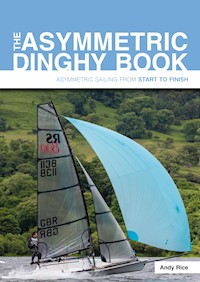
Asymmetric dinghies burst into the sailing scene in the 1990s and have transformed the sport. They led to the introduction of new types of courses and a new sailing style. While the basic principles may be the same as for conventional dinghies, the increased focus on apparent wind sailing and responding to changes in wind pressure and direction downwind are exciting new elements that asymmetric dinghies bring. This book allows you to learn the secrets of getting the most from your asymmetric dinghy – whether you sail an entry level dinghy or a high-performance skiff, single-handed or with a crew. Following its advice will enable you to enjoy being at one with your boat and the wind. It is written by asymmetric champion sailor and journalist Andy Rice who has also gleaned tips, advice and some great shortcuts from expert sailors in a wide range of classes. This will give you the inside knowledge to improve your techniques and get ahead of the fleet. There's step-by-step guidance, accompanied by great photo sequences. Every stage of asymmetric sailing is covered, including rigging and tuning, hoists, gybes and drops, tactics, survival sailing and advanced skills for solo and crewed boats.
Das E-Book können Sie in Legimi-Apps oder einer beliebigen App lesen, die das folgende Format unterstützen:
Veröffentlichungsjahr: 2021
Ähnliche


















ANDY RICE
JOURNALIST, BROADCASTER & CHAMPIONSHIP-WINNING ASYMMETRIC DINGHY SAILOR
Andy Rice has won championships from both ends of a skiff, winning a 49er National Championship as a helm and International 14 Europeans and Prince of Wales Weeks as a crew. He has sailed with a number of top sailors over the years, including Olympic medallists John Merricks, Ian Walker and Simon Hiscocks. Andy continues to race a Musto Skiff competitively in his 50s.
As a sailing journalist, he has reported on every major event from the Olympics to the America’s Cup, the Volvo Ocean Race and the Vendée Globe. He writes for many racing-oriented magazines including Seahorse, Yachts & Yachting, Yachting World, Boat International and Sailing World. As a live commentator he has reported at multiple Olympic class events, America’s Cup regattas, the Sailing Champions League and the Extreme Sailing Series.
Andy’s passion is for asking great sailors what makes them tick and finding out why they’re so fast. That was the basis of writing this book, and is also the basis of SailJuice.com, Andy’s online treasure trove of top sailboat racing tips, and RoadToGold.net, an online course with top Kiwi coach Hamish Willcox on how to put together a world-class sailing campaign.
THE EXPERTS
There are many friends and experts whose advice I sought when writing the book, some of them quoted, some of them not. From almost three decades of racing in asymmetric fleets like the Laser 5000, the 49er, International 14 and Musto Skiff, I’ve had the fortune to race with or against some of the best skiff sailors in the business, and I’ve badgered them for tips and advice along the way. There isn’t room to mention everyone I spoke to, but here’s a brief background of some of the experts whose advice crops up in the book.
Trevor Baylis, a great crew who has won the 505, International 14 and 18ft Skiff World Championships.
Paul Brotherton, a 49er European Champion from Great Britain, former 470 Olympic representative, and one of the best coaches in the business. He coached the Yngling girls to Olympic gold in Qingdao 2008 and the British 49er team for Weymouth 2012.
Andy Budgen, one of the most talented skiff sailors even if he’s not a household name. He’s placed 2nd in the 49er Worlds and 18ft Skiffs and coaches many top teams in the 49er class.
Derek Clark, a 470 Olympian, America’s Cup designer, and the driving force behind a number of skiff projects including the Laser 5000 and the Rebel Skiff, which features in many of the photo sequences in the book.
Chris Draper, 49er World Champion and Olympic medallist, and America’s Cup and SailGP competitor.
Dave Hivey, one of Britain’s talents on the small boat scene, having won National titles in the highly competitive RS200 and RS400 fleets as well as the International Moth European Championship.
Steve Irish, a 420 World Champion who moved into asymmetrics and won the RS800 Nationals several times.
Bruce Keen, since winning his first Musto Skiff National Championship in 2010, Bruce has been the dominant force in the trapezing single-hander for a decade, winning multiple World and National titles.
Emma McEwen, 3 times European and twice National Champion in the front of an RS800.
Stevie Morrison, 49er and Fireball World Champion who has twice represented GBR at the Olympic Games.
Chris Nicholson, dominated the 18ft Skiff circuit back in its professional heyday, then won three 49er World Championships. Veteran skipper in the Volvo Ocean Race.
Richard Parslow, a Fireball World Champion, and my coach when I was in the British 49er squad. A goal-setting expert extraordinaire.
Rick Perkins, a Fireball National Champion, but more importantly for this book, a Musto Skiff National Champion.
Frances Peters, ISAF Youth World Champion in the 29er class. She won the girls’ fleet, but she probably would have beaten the boys too. A rising star in skiff sailing.
Ben Saxton, World Champion in the Nacra 17 foiling catamaran, represented GBR at Rio 2016 Olympics, multiple dinghy and keelboat champion including six-time winner of the Endeavour Trophy, champion of champions event in the UK.
Mari Shepherd, a top 29er crew, and never afraid of a new challenge, such as when we put her out in the Rebel Skiff for our windy photoshoot.
Chris Simon, rules expert and consultant who has worked at every level of the sport, including the Olympics, America’s Cup and Volvo Ocean Race.
CONTENTS
Foreword
Introduction
PART ONE: GETTING STARTED
The Basics
Standard Moves
Advanced Moves
PART TWO: STRONG WINDS
Survival Sailing
Avoiding Disaster
Capsizing
PART THREE: MASTERCLASSES
Boatspeed
Racing: Strategy & Tactics
The Racing Rules
The Final Five Percent
Acknowledgements
FOREWORD
BY NATHAN OUTTERIDGE
I met Andy early on in my asymmetric career at the 2007 49er World Championships in Portugal. This was just after Andy stopped competing in the class, but I have got to know him well since then as one of the leading and most knowledgeable journalist covering high-performance racing.
He has reported on the three Olympics I have competed in and it is obvious when he interviews you that he understands high-performance asymmetric racing. But more than that, he is able to communicate the techniques to the sailing public through his live commentary, written journalism, his sailjuice.com website and, most recently, RoadToGold.net.
I am absolutely delighted that he has written The Asymmetric Dinghy Book which includes not only Andy’s knowledge but also tips from so many superb sailors. This book will be a treasure trove for anyone who sails an asymmetric dinghy, whether they are just starting to learn about apparent wind sailing or are competing at a high level.
If you want to enjoy asymmetric sailing, and improve your skills, I thoroughly recommend this book. Andy knows what he’s talking about. Following his advice will enable you to enjoy being at one with your boat and the wind.
Good luck, and I hope to see you out on the water!
Nathan Outteridge
49er gold (London, 2012) and silver (Rio, 2016) medallist
4 x 49er World Champion
2 x International Moth World Champion
3 x ISAF (now World Sailing) Youth World Champion (1 x 29er, 2 x 420)
America’s Cup helmsman in 2013 and 2017
PART 1
GETTING STARTED
THE BASICS
This chapter is about choosing an asymmetric boat and going for your first sail.
CHOOSING THE RIGHT BOAT
It’s not within the scope of this book to ask you too many questions about what kind of boat you plan to sail. Because asymmetrics come in many different shapes and sizes, it’s difficult to hand out any specific advice, but I just want you to be sure that you’ve thought about the following factors:
1. ABILITY
Do you have the ability to sail the boat competently? Or, let’s put it another way, do you have the potential? Now, I know sailors in their 50s and 60s who handle the 18-foot Skiff and Musto Skiff very competently, and asymmetric boats don’t get much harder than that. But even these highly accomplished sailors did a lot of capsizing and swimming before they reached a certain level of competence. Are you prepared to do the same? If so, great! If not, then maybe you want something a bit more stable and easier to handle.
2. TEAM
Are you going to be sailing in a team boat? If so, how much can you rely on your team mate(s) to show up on a regular basis? Better to agree on the goals and the schedule for the year before you put down your hard cash on a boat.
3. BUDGET
Do you have the money, not just for the boat, but for its upkeep and maintenance? If you’re racing a boat where you expect to be doing a lot of capsizing and putting the equipment through quite a bit of abuse while you drag yourself up the learning curve, then it may be better to do your learning on a well-sorted second-hand boat. Even better if you can get the seller to throw in a day’s coaching to help you get to grips with the basics. It’s also a great way to check that the boat you’re buying is working properly and that you haven’t been sold a pup.
4. LOCAL FLEET
Is there a local fleet at a nearby sailing club, or a good racing circuit that you can get involved in? While any new boat is exciting to sail initially, the novelty will eventually wear off. But it’s the racing and the camaraderie that will keep you interested. So give this factor some serious thought before deciding which boat to sail.
APPARENT WIND SAILING
GOT TO GET UP TO GET DOWN…
One of the difficult things to get your head around when you’re discovering asymmetric sailing for the first time is the idea that if you want to get downwind you need to head up first. In planing conditions, if you want to get the bow pointing as low as possible downwind and make the best VMG (Velocity Made Good) to the next mark at the bottom of the course, then the way to do that initially is actually to luff up as high as possible towards the wind. Unless you do this, you’re not really apparent wind sailing, you are just wafting downwind with the breeze and the gennaker will be caught behind the mainsail and the jib, and will never get a chance to fill properly. So, if you’re new to this, the first thing to do is to head up perhaps more than you think you need to, and get the air flowing across the gennaker from luff to leech and drafting out the back of the sail.
Once you do that, the apparent wind will kick in and start building on itself. As the apparent wind increases, it also moves forward, and you need to sheet on the gennaker and the mainsail to compensate. And, if it’s windy, you’ll need to hike out as hard as possible to counteract the increase in power. In strong winds you’ll find those who hike out hardest actually end up sailing lowest and deepest towards the leeward mark. At first it doesn’t seem to make sense. After all, in most sailing you sit in to sail lower, but not in an asymmetric when you’ve got the power of apparent wind on your side.
HOW LOW CAN YOU GO?
In light-to-medium airs, when there isn’t enough wind to get the boat planing, then it’s about sailing as low as possible before you experience a massive drop off in flow across the sails. Where sailing dead downwind is an option in non-asymmetric boats, it’s never an option with asymmetrics. You always need to sail angles downwind, and in light-to-medium conditions the trick is finding out just how low you can go.
On a keelboat you may have electronic GPS equipment which you can use to help determine your best VMG downwind. On a dinghy, you don’t have that luxury, so you have to develop a feel for when you think the boat is travelling at the optimum VMG downwind. Quite often you can’t really work this out until you start racing other boats, when you can compare yourself to others nearby. In marginal planing conditions you’ll find there are those who like pushing high and sailing extra distance for the extra speed, while there are those who like really running deep and going slower, but sailing a shorter distance to the next mark.
Both those extremes have their place, and sometimes it pays to do a little bit of each. A lot of the time, the decision that you make about whether to sail in high, medium or low mode is based on the tactics of where the boats around you are, and where you’re aiming for next. It is also based on where you think the best breeze is. Sometimes, when you’re in a nice but narrow line of breeze, it pays to sail low to stay in it as long as possible. The temptation can be to head up, get on the plane and sail really fast – only to sail yourself out of the breeze line.
So it’s really important to be able to sail in all these modes. We’ll address this in the Boatspeed chapter. And it’s also important to know how and when to apply these modes on the race course, which we’ll address in the Racing: Strategy & Tactics chapter.
EXPERT ADVICE
Ben Saxton: Learning about VMG in asymmetrics
Although he was a very good Optimist sailor, downwind Feva sailing was initially a mystery to Ben:
“Downwind was one of my super-strengths in the Optimist, but the first time I got into an asymmetric boat – an RS Feva – I just couldn’t get anywhere near this kid who was a couple of years younger than me, James Peters. I was 13 or 14 so it was pretty hard being given a lesson by this kid who wasn’t even a teenager! It took me quite a long time to learn that I need to luff the boat up to push higher and get the breeze flowing across the sail. You’ve got to get that balance right between not sailing higher than you need, but not sailing so low that you lose the power out of the asymmetric. But the mistake that I made, not heading up enough early, I think that’s a common one for newcomers to asymmetric sailing.”
EXPERT ADVICE
Frances Peters: Getting to grips with asymmetrics
Former ISAF Youth World Champion in the 29er, Frances Peters, looks back at her move into asymmetrics from conventional dinghies:
“It was a big transition to make at first, because suddenly you’re sailing big angles downwind. There’s so much more to be gained and lost, so it was a big mental transition and you had to start thinking about it from a new perspective. Upwind we get used to watching pressure [the wind] coming down and sailing to the pressure and sailing on the lifted tack. You’ve got to start thinking in a similar way downwind. But it’s another perspective downwind because you’re actually sailing away from the pressure, so you’ve got to watch where the pressure’s going and you’ve got to try to find ways to stay in the pressure as it moves. Equally it’s easy to ignore shifts downwind and you should try to pay more attention to them as well.
I’ve found that having got some experience in asymmetric sailing, going back into a symmetrical conventional spinnaker or a boat without a spinnaker at all, it really helped my sailing. It really made me think a lot more about what was going on around me, and there’s so much to be gained and lost downwind as well as upwind. Before asymmetric sailing, I used to think that places weren’t really gained or lost downwind and that actually it didn’t really make much of a difference which way you went. But as you start sailing in asymmetrics, you realise that there’s so much else going on around you. It highlights the difference in pressure and shifts across the course, and although it’s not as obvious in other types of sailing, it still applies. Sailing asymmetrics makes you much more aware of the possibilities downwind.”
GETTING THE BASICS RIGHT
HOISTING FROM A CHUTE
If you’re using a boat with a spinnaker chute then it’s the crew who tends to do all the hoisting in a two-handed boat. Because the halyard is usually connected to the bowsprit launch mechanism, the head of the gennaker and the tack all go out at the same time. One rope does the whole job of hoisting, which is why it’s a one-person task. This means the helm is free to steer the boat so that it’s upright and stable and gives the crew plenty of opportunity to hoist the spinnaker without worrying about helping to keep the boat upright.
HOISTING FROM A BAG
With a boat where the gennaker is hoisted from a bag, you might want to share out the job of hoisting the sail, as there are more ropes to pull. It’s a matter of dividing up the workflow in such a way that you get your gennaker up and pulling in the shortest amount of time after the windward mark. For example, maybe it makes sense for the helm to pull up the spinnaker halyard while the crew pulls out the pole and the tack line. Try a few combinations of tasks until you find the one that achieves the hoist in the quickest time.
In a boat with three or more crew, such as an 18-foot Skiff, then you can divide up the workload even more. So the typical work pattern might be:
• Helm continues to steer while taking the mainsheet from the middle man
• Forward hand goes to leeward to prepare the gennaker by opening up the bag; he then pulls out the bowsprit; at the helmsman’s command the forward hand hoists the gennaker and cleats it off
• While the forward hand is hoisting the gennaker, the middle man pulls the tack line until the tack reaches the end of the bowsprit; he then moves straight to the kite sheet (taking it from the helm if the helm has already picked it up) and gets the kite set while the forward hand sets the jib and tidies the cockpit and the kite halyard in particular
RIGGING THE GENNAKER
When you rig the gennaker, make sure you get it right before you go afloat! I can guarantee that at some point in your asymmetric sailing career, you will forget this simple advice. Some lessons you have to learn for yourself, and believe me, there are few more embarrassing or painful than having to re-rig the gennaker out on the water. It’s not easy, and it often results in a capsize. You can remind me of this fact the next time you see me up on the foredeck of my Musto Skiff!
If you launch from bags, as with a B14 or an 18-foot Skiff, then at least all you have to do is tie three corners to the correct rope. But for the sake of simplicity and avoiding silly errors, make sure you write ‘Tack’, ‘Clew’ and ‘Head’ on the correct corners. And I’d tie them on in that order too, although this isn’t too critical. One reason for doing this is for rigging up on a windy day, when you don’t want to have the kite blowing around the dinghy park and potentially capsizing your boat. Having the names written on the corners means you can have the kite stuffed in the bag and still tie on the corners without exposing too much sail to the wind.
Now, if you launch from a chute, which is the norm for most asymmetric dinghies, then you have the added complication of a retrieval line, which is basically the other end of the halyard because it’s one continuous line. The retrieval line makes it much more possible to create tangles and to get it wrong if you’re not careful with your rigging procedure. It also makes it much harder to re-rig it on the water if you get it wrong, so it’s particularly important to make sure that you’ve got your rigging correct with a chute style of boat.
There are different ways of doing it, but my favourite way of rigging a gennaker on an International 14 or a 49er for example, is to:
• Tie the tack first, with the bowsprit retracted into the boat
• Loop the kite sheets through the clew and reeve the port sheet through the port-hand ratchet block on the boat
• Pull the foot of the sail tight so that you know there’s no tangle – I do this on the port side of the boat on the 14 because this is the side where the kite hoists from
• Take the retrieval line (already threaded through the spinnaker sock) and run it underneath the foot of the sail, and then run it through the bottom retrieval patch near the foot
• Depending on whether you’ve got a one-, two- or three-patch retrieval system on your kite, make sure that the halyard is going through all the correct patches, and then tie the end of the retrieval line off to the top retrieval patch
• Take the other gennaker sheet that runs around the starboard side of the boat, take this starting from the clew, and run it along the side of the boat inside the gennaker, making sure it goes over the top of the retrieval line, runs around the forestay and then back down the other side of the boat through the ratchet block
• Tie off your gennaker sheets in the middle of the cockpit
• Finally, tie the halyard on to the head of the kite
The reason for attaching the halyard last is so that if the wind does catch the sail while you’re rigging it, you’re not going to get it filling and flying out from the top of the mast, potentially capsizing the boat and causing damage while you are on the shore. So the gennaker halyard is always the last thing to be tied on and then you’re ready to fully retract the kite into the chute and that should make sure that you don’t have any tangles. If it’s windy you can pull most of the sail into the chute before you attach the halyard.
If the winds are light, and you don’t think it’s going to cause any harm to the boat, then take the opportunity to double check your rigging. Hoist the gennaker to the top of the mast and make sure that all the sheets are running clear. If the winds are strong, the chances are that you won’t get an opportunity to do that, which means that when you get out on the race course, unless it really is extremely windy, you want to check that you rigged the gennaker correctly as early as possible before the start of the race. If by any chance you have made a mistake, you at least give yourself the maximum time to put it right. But good luck!
ADDING A SPACER KNOT TO THE RETRIEVAL LINE
If you’ve got a kite with two or three patches, then the sail can bunch up at the chute mouth as you’re pulling it back into the boat during a kite drop. This can sometimes create extra friction and effort for the crew at a crucial point in the race. One way to avoid this is to thread a plastic ball on to the retrieval line which sits between two of the patches. If you tie a figure-of-eight stopper knot or a long bowline, and create a gap of, say, 10cm (4 inches) between the patches, this will help avoid the bunching effect as you haul the kite back into the chute.
HEALTH & SAFETY
There’s some safety gear and clothing you might want to take with you, particularly if you’re sailing a high-performance boat for the first time. Take a knife, in fact take two. I keep one in my buoyancy aid tied to a lanyard, and I keep a diver’s knife on the back bar of the Musto Skiff. It doesn’t happen often, but every few years there is a story of a sailor who got tangled up with the rigging or caught under the boat, and a knife might just have made the difference to whether they lived or drowned.
Knife. Take a knife, and wash it in fresh water after every time you sail so that it stays sharp and ready for action.
Spares. Take a shackle key, some spare shackles and a spare piece of rope. You’ll be surprised how often you need them, and how much easier life becomes when you have them at the ready.
Wear gloves. If you’re sailing an asymmetric boat properly, you’re moving sheets all the time, and that can wear out your skin really quickly. If you’re steering a 49er or other skiffs where the crew is playing the mainsheet upwind, then you might get away without gloves, but pretty much every other job on an asymmetric boat requires gloves.
Helmets. I’ve never worn one but I’ve certainly thought about it, particularly for those days where I’m out on the open sea in my Musto Skiff by myself. When you’re learning and expecting a bit of crash and burn, a helmet will give you a lot more confidence to take risks. It will help speed up your learning curve.
Foot loops. These are vital bits of kit on high-performance trapeze boats and can be as simple as a piece of hose pipe with some rope running through the centre, to ready-made windsurfer foot straps to specially made sailing foot loops. It’s really down to personal preference. Some are designed to give way if they’re subjected to a lot of force. The idea is that, if you have a big tumble, the foot loop detaches before it causes damage to your foot or ankle. It doesn’t happen very often, but people have occasionally been known to break an ankle when they get their foot stuck after falling off the boat in a capsize. So it’s important to get some foot loops that you have confidence in using.
GOING SAILING FOR THE FIRST TIME
Tempting as it might be to launch your new boat the first time, be sure to pick the right conditions, particularly if you’ve chosen a boat that is more high performance than you’ve been used to. Just bear in mind your level of experience and don’t give yourself too much to do the first time you go out sailing.
If you possibly can, find someone who’s already got experience in the boat to go sailing with you the first time. It will massively shorten your learning curve, and could help you avoid some costly errors.




