


Erhalten Sie Zugang zu diesem und mehr als 300000 Büchern ab EUR 5,99 monatlich.
- Herausgeber: Mercier Press
- Kategorie: Geisteswissenschaft
- Serie: Mercier's History of the Irish Civil War
- Sprache: Englisch
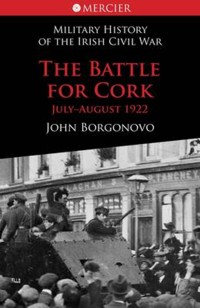
By the sixth week of the Irish Civil War in 1922, all eyes turned to Cork, as the National Army readied its climactic attack on the 'rebel capital'. At 2 a.m. on a Bank Holiday Monday, Emmet Dalton and 450 soldiers of the National Army landed at Passage West, in one of the most famous surprise attacks in Irish military history. Their daring amphibious assault knocked the famed Cork IRA onto the back foot, though three more days of stubborn fighting was required for the National Army to secure the city. The retreating IRA left destruction in their wake, setting the stage for Michael Collins' fatal final visit to his home county. For the first time, 'The Battle for Cork' tells the full story of the battle for Cork, showing all the chaos, bravery and misery of the largest engagement of the Irish Civil War and the final defeat of Republican Cork.
Sie lesen das E-Book in den Legimi-Apps auf:
Seitenzahl: 221
Veröffentlichungsjahr: 2011
Das E-Book (TTS) können Sie hören im Abo „Legimi Premium” in Legimi-Apps auf:
Ähnliche



















THE BATTLE FOR CORK
JULY–AUGUST 1922
JOHN BORGONOVO
SERIES EDITOR: GABRIEL DOHERTY
MERCIER PRESS
3B Oak House, Bessboro Rd
Blackrock, Cork, Ireland.
www.mercierpress.ie
http://twitter.com/IrishPublisher
http://www.facebook.com/mercier.press
© John Borgonovo, 2011
ISBN: 978 1 85635 696 1
Epub ISBN: 978 1 85635 977 1
Mobi ISBN: 978 1 85635 971 9
This eBook is copyright material and must not be copied, reproduced, transferred, distributed, leased, licensed or publicly performed or used in any way except as specifically permitted in writing by the publishers, as allowed under the terms and conditions under which it was purchased or as strictly permitted by applicable copyright law. Any unauthorised distribution or use of this text may be a direct infringement of the author’s and publisher’s rights and those responsible may be liable in law accordingly.
ACKNOWLEDGEMENTS
This book was written with the assistance of a number of people. Thanks to Pat Gunn, who passed on a copy of his fascinating interview with his father George, an IRA veteran. Gerry White and Colman O’Mahony provided personal insights into their published work on these events, for which I am grateful. I would also like to thank Dr Donal Ó Drisceoil of the University College Cork (UCC) School of History for assistance with illustrations; Michael Murphy of the UCC Geography Department for generous map production; Cork Fire Brigade historian Pat Poland; Cork historian Antoin O’Callaghan; series editor Gabriel Doherty of the UCC School of History; and the staff at Mercier Press.
Kieran Burke and the staff at the Local Studies Department, Cork City Library, provided critical help. I would also like to acknowledge Commandant Victor Lange at the Military Archives, Dublin; the staff at the University College Dublin Archives; and Brian McGee and the team at the Cork City and County Archives. Thanks are also due to the Port of Cork for offering prompt access to its strongroom.
The National Archives of Ireland graciously granted permission to use the Hogan/Wilson photographs, which serve as an excellent documentary source for these events. Thanks to Sarah Buckley for offering her father’s photographs for publication. I am also grateful to Tony McCarthy, who provided a photograph of ‘Scottie’ McKenzie Kennedy, and a copy of the Timothy Kennefick Coroner’s Inquest, planting seeds that blossomed in this work.
Many thanks to Ronan Kirby and Denis Kirby, who offered welcome local knowledge of Douglas/Rochestown, as well as a fruitful driving tour. I am also grateful to John Dennehy of Cobh for his expert knowledge of the port, and to Martin Buckley, formerly of the Irish Navy, for further harbour advice.
Historian Tom Mahon of Hawaii earns special kudos for graciously copying Captain Somerville’s reports to the British Admiralty, which can be found in Kew National Archives. I am looking forward to Tom’s upcoming book on the Upnor raid.
LANGUAGE AND SOURCES
This book sets out to examine events in the city of Cork during July and August 1922, in the conventional phase of the Irish Civil War. Its structure and style are intended to appeal to a wide readership; it is not meant to offer the last word on Cork in the Civil War, or on the National Army’s amphibious offensive during August 1922. The Battle for Cork seeks to answer the question: How did a city so closely identified with militant Irish Republicanism from 1917 to 1921 pass so easily into the hands of the Irish Free State? Events are viewed deliberately from a Cork perspective.
My use of language deserves a brief mention. I call members of the anti-Treaty military force IRA Volunteers, and/or Republicans. Anti-Treaty Republicans enjoyed direct continuity with the Irish Volunteer organisation founded in 1913; that organisation became popularly known as the Irish Republican Army (IRA) in 1919, after it pledged allegiance toDáil Éireann and placed itself under the control of the Dáil minister for defence. Between 1919 and 1921, the Volunteer (or IRA) organisation was led by its General Headquarters Staff (which included RichardMulcahy and MichaelCollins), elected originally by a Volunteer convention in 1917. No Volunteer convention met between 1918 and 1921, and overall control of the IRA/Volunteer organisation remained a contested and nebulous issue. After the ratification of theAnglo-Irish Treaty in 1922, a National Army was formed from pro-Treaty IRA units and other recruits who pledged allegiance to the Irish Free State. This set the stage for the IRA convention of March 1922, where Irish Volunteer organisation delegates voted to elect a new governing executive and to withdraw their allegiance toDáil Éireann. Members of this organisation retained the title of Volunteer, and promised to defend the Irish Republic that had been declared in 1916. When describing these people or their IRA organisation, I deliberately avoid terms such as Executive Forces, Irregulars, anti-Treaty IRA or Mutineers.
Correspondingly, I describe their military opponents as the Free State Army, National Army, National troops or National soldiers. These combatants were full-time soldiers, paid by theProvisional Government of the Irish Free State, which was a non-Republican dominion of the British crown. Since the Irish Free State was not a republic, I do not refer to its officials or supporters as Republicans. I understand the implications and limitations of terms such as invade, attack, assault, defend and liberate.
Some confusion may arise as a result of Cork’s status as both a city and a county. For the purposes of this book, Cork is used to mean the city of Cork; when the county is intended, I use County Cork.
The Battle for Corkrelies on three prominent histories of the Irish Civil War. More than twenty years after its publication, Michael Hopkinson’sGreen Against Green: the Irish Civil Warremains the authoritative work on the subject. Hopkinson builds on the work of two earlier Civil War historians, Calton Younger and Eoin Neeson. While preparingIreland’s Civil War, Younger conducted extensive interviews with Free State Army leaders, most notably General EmmetDalton and Commandant FrankO’Friel. ForThe Civil War in Ireland, Cork native Eoin Neeson met surviving Civil War IRA officers in the city, many of whom knew Neeson’s parents from joint service in the Republican movement. From the different conversations of Younger and Neeson, a discernible narrative emerges that encompasses both sides of the firing line.
I also drew on Gerry White and Dan Harvey’s valuable The Barracks: A History of Victoria/Collins Barracks, Cork. Another Cork authority, Colman O’Mahony, provided excellent material from his book, The Maritime Gateway to Cork: A History of the Outports of Passage West and Monkstown, 1754–1942. In the course of his research, O’Mahony interviewed a surviving member of the IRA garrison at Passage West, who provided insights regarding the landing of National troops there. Finally, I would be remiss if I did not acknowledge Anne Dolan and Cormac O’Malley’s ‘No Surrender Here!’: The Civil War Papers of Ernie O’Malley. This exhaustive and well-organised work serves as an essential reference source for IRA communications in 1922.
Readers will note the frequent mentions of Dr JamesLynch’s first-hand account, ‘The Battle of Douglas’. As verified by the 1911 Census, Dr Lynch lived in the area ofDouglas/Rochestown that saw the most severe fighting of the battle. His participation as a National Army medical officer was noted inTheCork Examiner, and many of the details in his narrative match different newspaper accounts. Lynch provides the best eyewitness testimony of the battle. Newspapers also provided information about the engagement, withTheCork Examineroffering first-hand accounts from its reporters on the scene. TheIrish Independentprinted another eyewitness report from a journalist in the city during the three critical days. Correspondents fromTheFreeman’s JournalandThe Irish Timesaccompanied the invading National Army forces. Photographer W. D. Hogan also travelled with the Free State assault troops, and his pictures frequently verify newspaper details.
FOREWORD
‘How did a city so closely identified with militant Irish republicanism from 1917 to 1921 so easily pass into the hands of the Irish Free State?’
This is the central question posed by the author John Borgonovo in his introduction to this, the latest volume in Mercier Press’ Military History of the Irish Civil War series. It is a deceptively simple question, to which, as will become apparent, there is no single, or simple, answer. Social stratification certainly played a part, with religion, social class, gender and age all playing their respective roles, as did a variety of human qualities: bravado, courage, fear and, not least, luck.
There were, however, two over-arching and interrelated factors that together effectively determined the outcome. The first was that elusive quality of generalship – the effective direction of forces in combat. The second was that this engagement was indeed a battle – small in scale admittedly, but recognisably an instance of conventional warfare in an area of the country with greater recent experience of, and topographically suited to, guerrilla tactics. The author makes a very convincing case that in this confrontation the driving force behind the Free State attack on the city, Emmet Dalton, handled the resources at his disposal far more competently than did his opposite number Mick Leahy, who, in theory, had the easier task of organising a defence. That defence was not helped, of course, by the utterly inadequate number of men and amount of material under Leahy’s control – but this is where the second key issue comes into play, for to hold ground and engage in a set-piece firefight under such circumstances was, with the benefit of hindsight, decidedly unwise.
It is important to bear in mind that while the city of Cork itself fell with scarcely a shot being fired in anger, and with most of the city’s buildings, industry and infrastructure intact, the precipitate flight of Republicans to the west of the county followed a battle that, in scale, exceeded the famous victories registered in the county during the Anglo-Irish War, such as Kilmichael and Crossbarry. The fight for Rochestown/Douglas was fought over three days, with dozens of dead and wounded – yet knowledge (or at least discussion) of this is today scarce, even in the locality itself. This is all the more noteworthy given that battle was joined following not just one of the most daring manoeuvres of the entire war, but one of the most difficult of all military actions – the amphibious assault of Free State forces on the IRA-held port facilities in Passage West. Even if the scale was vastly different, the then recent debacle at Gallipoli had shown just how fraught with danger such an opposed landing could be. In skilfully planning and successfully executing this operation, as well as in their conduct during the subsequent engagement on the road into the city, Dalton and his troops more than earned the sycophantic adulation (amongst other forms of attention) showered on them following their ensuing triumphant entry into the city proper.
In conclusion one must remember, of course, that the fall of the city was by no means the end of the fight in County Cork, and the book’s coda – the death of Michael Collins at Béal na mBláth in west Cork on 22 August – in many respects signals the start of the second, longer-lasting and more vicious phase of the Civil War in the country as a whole, which was marked by a return to unconventional warfare by Republicans in their Munster fastnesses. In this respect there is a striking symmetry in the local arcs of hostilities in the months and years following the 1916 Rising and the outbreak of the Civil War in 1922. On both occasions Republicans in the city, led initially by MacCurtain and MacSwiney and subsequently by Leahy, for sound military reasons, either refused or felt themselves unable to give conventional battle. In both cases this apparently defeatist passivity was followed by an intense period of guerrilla warfare, albeit one that lasted for a shorter time and was attended with much less success during the latter period. Perhaps – and this can only be a supposition, for we are dealing here with psychological factors not easily verified by the standards of conventional historical investigation – it might be posited that the shameful memory of the one was one of the many causes of the other?
Gabriel Doherty
Department of History
University College Cork
INTRODUCTION
Following Dáil Éireann’s approval of the Anglo-Irish Treaty on 7 January 1922, the fear of civil war grew throughout Ireland. The Irish Republican Army (IRA) gradually split into pro- and anti-Treaty factions, as its powerful provincial commanders demanded the right to sanction the settlement. After weeks of delays, the Dáil Éireann cabinet (ruling in tandem with the Free State Provisional Government) approved an IRA convention in Dublin, but fearing a coup d’état, the Minister for Defence, Richard Mulcahy, promptly reversed his decision, banned the convention and announced the dismissal of any IRA attendee. Despite Mulcahy’s threats, the convention opened as scheduled on 26 March 1922, and 223 delegates gathered at the Mansion House, representing a strong majority of IRA brigades and battalions, though anti-Treaty officers suspected the government would attempt to arrest delegates en masse. In defying the government ban, they had essentially repudiated their fealty to the civilian authority.
TheCork No. 1 Brigade contingent took no chances, arriving at the Mansion House in their ‘bloody big armoured car’,‘The River Lee’, a massive home-made contraption described as ‘a labourer’s cottage’ on wheels.1Wearing trench coats, leggings, collars and ties, the Corkmen filed into the hall past crowds of onlookers, led by their brigade commander, SeánO’Hegarty. Inside, they greeted their cousins from the other Cork brigades, representing the most powerful fighting formations in the independence movement. They sat with the taciturn1st Southern Division commanders,Florrie O’Donoghue (Cork City), LiamDeasy (West Cork) and LiamLynch (North Cork), who controlled the IRA in Cork, Kerry and Waterford. The1st Southern had enough firepower and experience to launch a civil war by itself, if it so decided.
During the convention proceedings, a series of young speakers denounced Ireland’s new status as a dominion of the British Empire. They urged the army to repudiate the Dáil for voting to disestablish the Irish Republic, which the IRA Volunteers had vowed to defend. A vocal faction proposed the immediate creation of an IRA military government to defeat the Treaty. Despite a hard-line reputation, the 1st Southern officers opposed this proposed dictatorship, and their truculent spokesman Seán O’Hegarty eviscerated its advocates. However, the Munster men supported the convention’s establishment of an independent Army Executive to govern the IRA. Going forward, the IRA would only answer to its own Volunteers and not the Irish parliament. A clash with the new Free State Provisional Government now seemed possible.
Though the anti-Treaty IRA units enjoyed a strong numeric superiority over the budding National (Free State) Army, they were heavily outgunned. Driving back to Cork city, Republican officers discussed their plan to redress the arms imbalance. Three days later, they launched a naval operation that violated spectacularly the nine-month Truce between the IRA and the crown forces. As the British police and military left Ireland, they had deposited assorted small arms at the Haulbowline naval base in Cork Harbour. At the end of the month, tons of rifles, pistols, ammunition, machine guns and explosives would be transported back to Britain aboard the ordnance steamer Upnor. Unfortunately for the Royal Navy, a Republican shipyard worker gained access to the Upnor’s manifest and notified the Cork No. 1 Brigade of her scheduled departure. As with many of the Cork City IRA’s sallies against the British, the plan was audacious, well-organised and coolly executed.2
British coastal forts commanded the mouth ofCork Harbour, while a fleet of Royal Navy warships regularly patrolled the shipping channels. TheUpnor, therefore, could only be intercepted in the open ocean.Cobh IRA Volunteers gathered a crew of Republican sailors (abundant in a port town), while the City IRA provided the boarding party. On the morning of the operation (2 April 1922),Cobh Republicans approached the Royal Navy headquarters and stole the Admiralty ensign from its mast. They also secured a large brown envelope, similar to those used for carrying official naval communiqués. The Republicans had selected a tug for the operation, but to their chagrin they discovered its absence from its mooring because of engine trouble. On the quays, despondent IRA Volunteers watched theUpnorpush out of the harbour, before they noticed the docked deep-water tug,Viking. They lost valuable time in locating and abducting theViking’s skipper (to prevent him from notifying the naval authorities) and replacing him with veteran shipmaster and Republican sympathiser, Captain JeremiahCollins. By the time theVikinggot under way with twenty Republicans on board, they were almost two hours behind their quarry. As theVikingsteamed out of the harbour at maximum speed, it passed unsuspected beneath British coastal artillery.
In the Celtic Sea a few hours later, the Upnor was sighted in the twilight. Closing the distance, the Viking hoisted the stolen Admiralty ensign, while the IRA Volunteers hid below deck. A lone Republican crew member waved the giant envelope, signalling an urgent message from naval headquarters. The Upnor cut its engines and waited for the Viking to pull alongside. The ship sent a launch over to the Viking, which was boarded by four armed Republicans, one of whom carried a Thompson machine gun under his trench coat. They motored back to the Upnor, climbed aboard, produced their weapons and announced that they were seizing the ship. ‘This is piracy on the high seas and it is a hanging matter,’ spluttered the captain, a quotation that became enshrined in Republican folklore.3 The two vessels adjusted course, opened their engines and sped to the small port of Ballycotton, located about twenty miles east of Cork city.
On land, the Cork No. 1 Brigade had not been idle. That morning, Cork Republicans methodically visited garages and commercial premises across the city, seizing almost every available lorry and large car. Armed two-man Volunteer teams drove nearly 100 vehicles to Ballycotton Pier. Other IRA parties blocked roads, cut telephone and telegraph wires, and established outposts around the sleepy coastal town. Volunteers seized the coastguard’s wireless station at Roche’s Point to intercept naval messages relating to the Upnor. All told, nearly 300 Volunteers were involved in the complex amphibious operation. By evening, the reception preparations were complete, though there was still no sign of the Upnor. At 4 a.m. Volunteers dozing on the pier were awoken by the sound of engines, and cheering erupted as the two vessels entered the harbour. Once the boats had docked, brigade leaders looked eagerly at their haul, and could hardly believe the deadly bounty they had gained to fight the British Empire.
All through the morning and afternoon, the Republicans off-loaded the weaponry, expecting at any minute to be interrupted by the British. Yet their luck held, as lorry after packed lorry departed for prepared arms dugouts around the county. At midday, the IRA Volunteers had a shock as a warship searching for the Upnor cruised past the harbour, but the warship’s crew failed to see the off-loading proceeding at the pier. The last vehicles pulled out of the town at sunset, just as the Royal Navy sloop HMS Heather docked.4 The sailors checking the Upnor found only broken packing boxes and the ship’s inebriated captain. The Republicans had invited him ashore for a meal and drinks, and they had parted on the friendliest of terms, with the captain calling them ‘grand fellows’.5
In the House of Commons, the embarrassed colonial secretary, WinstonChurchill, denounced ‘the gang of Republican conspirators’, who ‘piratically seized’ theUpnoron the high seas. He also pointed out to the Free StateProvisional Government, ‘their control over Cork and this district is practically non-existent’.6Back in Cork, the IRA distributed 400 rifles, almost doubling the1st Southern Division’s supply, as well as hundreds of thousands of rounds of precious .303 ammunition, and at least forty machine guns. Brigade engineers eyed greedily numerous crates of high explosives. Having recently mastered the production of landmines, they finally had the means to mass produce them.
Overnight, the Cork No. 1 Brigade had upgraded its firepower dramatically and could meet the British-armed National Army on something like equal terms. For the Free State authorities to secure a lasting settlement between Britain and Ireland, they now needed either to win the Corkmen’s approval or to beat them into submission. Republican Cork prepared for both contingencies.
CHAPTER 1
THE TREATY DEBATE IN CORK
By late 1921, ‘Rebel Cork’ was a city synonymous with militant Republicanism. It had earned an international reputation as a result of the assassination of Lord Mayor TomásMacCurtain and the hunger strike of his successor, TerenceMacSwiney, both of whom had commanded theCork No. 1 Brigade, IRA. Further notoriety followed the burning of the city centre by crown forces in December 1920. IRA street fighters punched back with assassinations, ambushes and executions of suspected informers, keeping residents on edge. The city acted as a fulcrum for Republican resistance across County Cork, serving as an intelligence and communications conduit to theCork No. 2 andCork No. 3 Brigades in north and west Cork. Together, these three Cork brigades faced a disproportionate number of British troops in Ireland, and mustered the IRA’s most sophisticated and lethal guerrilla organisation.
THE ANGLO-IRISH TREATY
The Truce of July 1921 seems to have been arranged with little input from provincial IRA units in Cork or elsewhere. IRA Volunteers throughout the 1st Southern Division welcomed the break, though senior officers believed their organisation was gaining strength when hostilities were suspended. From their perspective, they had defeated the British, which made the Anglo-Irish Treaty signed in December 1921 all the more shocking.
TheAnglo-Irish Treaty disestablished the Irish Republic declared byDáil Éireann in January 1919. Southern Ireland became a self-governing dominion within the British Empire, headed by the king of England. Republicans objected to continued citizenship within the empire, enshrined in an oath of allegiance to the king. The endorsement of a partitioned Northern Ireland state only added to the distaste for the settlement. Pragmatists argued that theTreaty provided most elements of political independence and the potential to achieve the difference in future years. More important, the alternative was renewed war with the British Empire, the world’s reigning superpower at that time. ToTreaty supporters, Ireland was dancing on a razor’s edge between independence and annihilation.
Contemporary perspectives of the Irish Civil War assume a slow build-up to an inevitable clash between pro- and anti-Treaty supporters. However, events often moved with bewildering speed, as new developments reset the situation every month or so. TheTreaty was signed on 5 December and theDáil debates began a week later. On 14 January 1922, theDáil ratified the Treaty and established theProvisional Government; the British evacuation began immediately. During February and March, IRA provincial leaders resisted theTreaty, and by April they had repudiated theDáil and occupied the Four Courts in Dublin. In May Republican peace negotiations pointed towards a resolution and by early Junede Valera andCollins had produced theirElection Pact to rule the country through a coalition government, with the army being commanded by officers from both sides of theTreaty divide. Two weeks after the election,Provisional Government forces bombarded the Four Courts. Initial hope that the war could be confined to Dublin disappeared immediately, as fighting erupted across the country.
THE CORK SITUATION
Events in Cork broadly followed the national trajectory, with some notable exceptions. A Republican front composed of the IRA, Sinn Féin, Cumann na mBan and the Cork Labour Party had effectively ruled the city since early 1920. When the Anglo-Irish Treaty negotiations began in London, Cork Republicans watched from the sidelines, learning new details from the intense newspaper coverage.
Remarkably, though the Irish cabinet anticipated something short of a Republican settlement (including de Valera’s preferred ‘external association’), politicians made little effort to prepare the IRA for a compromise. Visiting Cork in October 1921, just before he left for London, Michael Collins addressed the Munster IRA’s senior leadership, under the auspices of the Irish Republican Brotherhood (IRB). Before his speech, he casually mentioned to Liam Lynch, Florrie O’Donoghue and a couple of others that he thought a non-Republican agreement might be signed, which O’Donoghue recalled was, ‘the first indication that any of these officers heard’ of such a possibility. Collins then informed the larger assembly that they would be consulted before any agreement was concluded. In November and December, the Cork IRB repeatedly asked the IRB Supreme Council (headed by Collins) for clarification about the direction the talks had taken, but heard nothing. The announcement of non-Republican Treaty terms therefore shocked the Cork IRA.1
Cork’s conservative political elements immediately welcomed the settlement. The RedmonditeCork Examinerwrote celebratory editorials for a week, announcing ‘Ireland’s Triumph’, and claiming ‘reason has triumphed over force’.2CardinalLogue and the Irish bishops championed theTreaty terms, with Cork bishop, DanielCohalan, scheduling masses of thanksgiving across the diocese.3(Cohalan had excommunicated IRA fighters in 1920.) TheCork Chamber of Commerce laid out signature books for business leaders to record their support, while Redmondite politicians spoke in its favour.4Constitutionalist bodies such as theSouth of Ireland Cattle-traders and theCork Legion of Ex-Servicemen similarly endorsed the agreement.5The day theTreaty terms were published, the British government released thousands of Irish prisoners, adding to an end-of-war atmosphere. Hundreds of Cork Volunteers returned home to celebratory welcomes, as detention camps atBere Island,Spike Island andBallykinlar were emptied.6Because of the optimistic coverage in the pro-Treaty Cork newspapers, it took the public a few days to realise the depth of Republican hostility to the Treaty.
On 10 December, the powerful 1st Southern Division informed IRA General Headquarters (GHQ) that its officers opposed the Treaty.7 Cork No. 1 Brigade commander Seán O’Hegarty told the city’s two pro-Treaty members of the Irish parliament (TDs) that he considered a ‘yes’ vote to be ‘treason to the Republic’, a fatal offence in Cork.8 During the Dáil debates, the IRA obstructed pro-Treaty lobbying, destroying pamphlets and confiscating Chamber of Commerce signature books.9




