


Erhalten Sie Zugang zu diesem und mehr als 300000 Büchern ab EUR 5,99 monatlich.
- Herausgeber: Mercier Press
- Kategorie: Fachliteratur
- Serie: Mercier's History of the Irish Civil War
- Sprache: Englisch
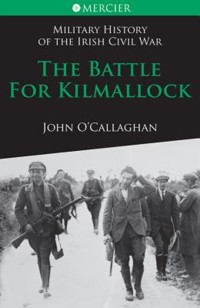
When the Free State army captured Limerick city in mid-July 1922, Republican forces retreated south towards Cork and made their next determined stand around Kilmallock. This area barred the way to the heartland of the 'Munster Republic'. In one of the largest and most intense battles of the Irish Civil War, Free State and Republican troops fought for possession of Kilmallock, Bruree and Bruff, with the latter two towns repeatedly changing hands. The eventual Free State occupation of Kilmallock was a vital turning point in the war. In The Battle for Kilmallock John O'Callaghan outlines the goals of the opposing forces, assesses their respective strengths, charts the course of the combat over two weeks in late July and early August, examines key strategies, and evaluates the role of leading personalities. The book challenges inherited wisdom about the engagement and offers sobering insights into the conduct of the belligerents.
Sie lesen das E-Book in den Legimi-Apps auf:
Seitenzahl: 186
Veröffentlichungsjahr: 2011
Das E-Book (TTS) können Sie hören im Abo „Legimi Premium” in Legimi-Apps auf:
Ähnliche


















MILITARY HISTORY OF THE IRISH CIVIL WAR
OTHER BOOKS IN THIS SERIES:
The Fall of Dublin
The Battle for Cork July–August 1922
The Battle for Limerick city
The Summer Campaign in Kerry
MERCIER PRESS
3B Oak House, Bessboro Rd
Blackrock, Cork, Ireland.
www.mercierpress.ie
http://twitter.com/IrishPublisher
http://www.facebook.com/mercier.press
© John O’Callaghan, 2011
ISBN: 978 1 85635 6923
Epub ISBN: 978 1 85635 9764
Mobi ISBN: 978 1 85635 9702
This eBook is copyright material and must not be copied, reproduced, transferred, distributed, leased, licensed or publicly performed or used in any way except as specifically permitted in writing by the publishers, as allowed under the terms and conditions under which it was purchased or as strictly permitted by applicable copyright law. Any unauthorised distribution or use of this text may be a direct infringement of the author’s and publisher’s rights and those responsible may be liable in law accordingly.
ACKNOWLEDGEMENTS
Undertaking to write a history book is an ambitious project, and one that only reaches a successful conclusion if support is forthcoming from a variety of sources. I wish to thank Pádraig Óg Ó Ruairc for originally suggesting that I might wish to attempt to put order on the chaos that was the battle for Kilmallock. Pádraig was brave enough to read the first draft and the manuscript was a better one for his suggestions. Shane Walsh provided not only historical advice but tremendous technical skill in the production of the maps. Des Long generously shared his insights about the activities of both his father and father-in-law as IRA Volunteers in Limerick during the period of this study. Paul V. Walsh, Tom Toomey and David Costelloe shared their knowledge on the military history of the Civil War. Francis E. Maguire granted permission for the inclusion of excerpts from the diaries of John Pinkman, a participant in the battle for Kilmallock. Mike Maguire of Limerick City Library, Keith Murphy of the National Photographic Archive and Brian Hodkinson of Limerick City Museum offered invaluable assistance. Credit is also due to the staffs of the following archival institutions and libraries: the National Archives of Ireland and England; the National Library of Ireland; the Military Archives of Ireland; University College Dublin Archives; and the Imperial War Museum, London. At Mercier Press, it was a pleasure to work with Wendy Logue, who is a paragon of patience, and Mary Feehan, who is a challenging editor. Any errors which remain are mine alone.
FOREWORD
At first glanceKilmallock, a small market town in the south of CountyLimerick, was an unlikely, almost unprepossessing, location for one of the largest and most protracted military engagements on the island of Ireland, not just of the Irish Civil War, but of Irish history generally in the modern era. Neither the town proper, nor its extended hinterland, offered any obvious or decisive prize to the contending parties. There were no significant strategic or economic targets in the vicinity (beyond the fact that the region generally was located in that particularly fertile zone known as the ‘Golden Vale’); few significant communication channels such as canals or major rivers were in evidence, with the exception of the admittedly important railway line betweenCork andDublin, and a number of under-developed roads; and no sites of major symbolic importance were to be found nearby. Topographically, too, it was unremarkable, with the ranges of small hills (which were to play a significant role in the battle) that bordered the town the exception to the generally flat terrain of the environs. In short it was a rather mundane locale for events that were anything but mundane.
The causes, course and consequences of the battle are adroitly outlined in the following pages, and they make for a multifaceted amalgam of intent, luck, judgement (good and bad), planning, accident, parochialism, nationalism, honour and, in those thankfully few instances where prima facie evidence exists of the premeditated murder of prisoners of war, disgrace. In short, as in all such encounters, the full range of human virtues and vices was on display throughout.
One of the most praiseworthy aspects of John O’Callaghan’s approach is his refusal to accept the ‘inherited wisdom’ regarding the engagement, and his determination to anchor the discussion as firmly as possible in the extant primary sources. This sound methodology enables him to rectify errors in the conventional account (some of which can be traced to the earliest professional studies of the Civil War), such as the very date of the battle itself. This historiographical fog of war is a formidable obstacle to a balanced understanding of the event, especially as it encompasses not just the differing perceptions and recollections of the two sides, but also their respective numerous subtle, and not-so-subtle, internal differences (which, inevitably, were more telling for the losing, Republican side).
What is clear, however, is that the battle marked a juncture in the war, between the open, mobile, conventional warfare of its decisive early weeks (albeit warfare waged by opposing forces ill-at-ease with the demands of same), and the drawn-out, excruciating, guerrilla phase. The estimate of around 1,600 participants in the fight seems reasonable, with the Free State army (as happened with surprising frequency during its advance to the south and west) finding itself at a serious numerical disadvantage during the final assault onKilmallock itself. That they prevailed nonetheless can be attributed to several factors, not the least of which was the precipitate departure of manyCork andKerry natives from the town’s Republican garrison upon hearing word of the successful landings of pro-Treaty forces at several points along the south-west coastline. This co-ordination of a well-executed plan (Operation Order No. 6) at the local, tactical level with more ambitious strategic flanking movements, was but one illustration of the superior generalship on display on the Free State side during this first phase of the war – although the author quite correctly points out that some key decisions taken by the pro-Treaty commanders were by no means beyond reproach.
The concluding pages of the study are sobering indeed, for the author firmly rebuts the ‘comforting myth’ that the generally low casualty figures reflected a reluctance to kill fellow countrymen and former comrades. On the contrary, all the evidence points to a growing mutual antipathy which could only widen and deepen the longer the conflict went on, and which inevitably manifested itself in ever-more vicious blows and counter-blows. It is a cautionary thought that the denizens ofKilmallock, for all that they were witness to significant bloodshed during the final days of July and the early days of August 1922, may have been the lucky ones, when their experiences are compared with the misery that was to be visited upon civilians in the zone of guerrilla operations a few miles to the south, which started just a few weeks later.
Gabriel Doherty
Department of History
University College Cork
INTRODUCTION
The battle for Kilmallock was one of the largest engagements of the Irish Civil War and one of the most prolonged in duration. The objective of this book is to contextualise the military state of affairs and the political situation before the battle, and to outline the goals of the opposing forces and the stakes of victory and defeat at Kilmallock. It also seeks to assess the respective strengths of the forces involved in terms of their numbers, armaments, discipline and communications; to chart the course of the combat over more than two weeks; to consider the outcome of the fighting; and to evaluate its wider significance.
The War of Independence fought by the Irish Republican movement against British rule in Ireland resulted in a truce on 11 July 1921. The Anglo-Irish Treaty was signed in London on the morning of 6 December 1921, but proved divisive. Internal tensions, which had been buried or lain dormant during the previous ‘four glorious years’, soon resulted in a split in the Republican movement. The resulting Civil War has proven largely resistant to productive general overviews by historians, with only a few notable exceptions. Local studies concentrating on the causes, courses and consequences of the military aspects of the Civil War have, in some respects, been the most successful in revealing its intricate and often contradictory nature.
The body of historical scholarship on the Irish revolution, including the Easter Rising of 1916, theWar of Independence and the Civil War, has matured appreciably in recent years. We now know and understand a great deal about the key dynamics in the revolutionary process but, conversely, there is still much that we do not know or understand. As the centenaries of the seminal transitions which constituted the revolutionary period ofc. 1916–23 draw near, interest among academics and the public gathers unrelenting pace. What form and character potential new controversies may take – over the Civil War in particular – remains unclear, but debates and arguments can only be settled based on historical evidence. This book provides some of that evidence.
The language and phraseology employed by historians, particularly when dealing with a politically charged and emotionally resonant subject such as the Civil War, can carry significant symbolic meaning and involve important ideological implications. Contentious or problematic terminology should not be avoided simply to circumvent debate but, similarly, value-laden or pejorative terms should not be courted simply to provoke controversy. Contemporaneous terms can be rich, revealing and compelling, but they can carry with them underlying partisan implications, betraying a pro-Treaty or anti-Treaty agenda. They should be used sparingly and with caution. Treatyite propagandists, for instance, coined the term ‘Irregular’ to emphasise the legitimacy of the ‘regular’ pro-Treaty forces and the illegitimacy of the anti-Treaty forces. In this book, the pro-Treaty side will be variously referred to as the Free State,Provisional Government or National Army. The anti-Treaty side will be described as the Irish Republican Army (IRA) or Republicans, without necessarily endorsing the assumption that pro-Treatyites were not Republican.
KILMALLOCK
The battle for Kilmallock began after the fall of Limerick city to pro-Treaty forces on 21 July 1922 and culminated in the occupation of the town by the same forces on 5 August 1922 after anti-Treaty forces had evacuated. Developments in the interim were highly complex, erratic and often confusing. They do not lend themselves easily to a simple chronological approach. The fighting took place not in the town of Kilmallock itself, but was concentrated primarily in its immediate south Limerick hinterland of Bruff and Bruree.
Republicans chose this zone to make their next determined stand after Limerick city because it had considerable strategic importance. Kilmallock and the villages of Bruff and Bruree formed a rough triangle, with Bruff at the apex, about fifteen miles south of Limerick. Bruff is about six miles north-east of Kilmallock and Bruree is about four miles north-west. Kilmallock, in particular, as the first large town between Limerick city and the Cork border, was worth defending. The location of Charleville, a major town in north Cork, only a few miles south of both Bruree and Kilmallock, raised the stakes even further. Possession of Bruff and Bruree would be crucial in the battle for Kilmallock, since the IRA planned to use them as protective buffers. Patrickswell, about thirteen miles north of Bruree on the main road to the city, was also a factor because it straddled the primary route west from Limerick to Adare, Rathkeale, Newcastlewest, Abbeyfeale, and on to north Kerry.
TheBruff-Bruree-Kilmallock triangle presented a strong barrier to aProvisional Government advance fromLimerick city on the heartland of the so-calledMunster Republic, which was an almost exclusive bastion of anti-Treatyism. It lay south of a notional defensive line fromLimerick city in the west, bordered on the north by theRiver Shannon, toWaterford city in the east, flanked by the RiverSuir. Republican commanderLiamDeasy, Officer Commanding (O/C)1stSouthern Division IRA, explained that ‘A defence line extending fromKilmallock toBruree was established in the hope of holding the south.’1The Republican plan was to hold this area to stop the Free State army from advancing onCork from their base in Limerick. Their position here would also act as a threat to the flank of any Free State advance westwards to theKerry border.
Furthermore, Kilmallock controlled the intersection of a number of major roads, as well as being in close proximity to the main Dublin–Cork railway line and only fifteen miles from Limerick Junction. It was an ideal base from which to protect, or indeed sabotage, infrastructure.
The geography ofKilmallock also lent itself to a stubborn defence.Kilmallock Hill,Quarry Hill andAsh Hill each overlookKilmallock, from the north, the north-east and the south-west respectively. They are little more than half a mile from the town itself, which sits in a depression on the banks of the RiverLoobagh.Knocksouna Hill, two miles to the west ofKilmallock, was also significant. The surrounding hills dominated the approaches to the town and, as such, were key to the control ofKilmallock. If theanti-Treaty forces inKilmallock could maintain their hold on these heights, then wresting control of the town from them would be extremely problematic for the Free State army. Republicans who had retreated fromLimerick city, together with local IRA units and anti-Treaty veterans fromCork andKerry, maintained a significant presence in theBruff-Bruree-Kilmallock triangle in southLimerick until early August. Anti-Treaty forces also briefly heldPatrickswell at the start of the month. They were driven from all of these positions by 5 August, however, and were dislodged fromAdare,Newcastlewest andRathkeale in west Limerick by mid-August.
THE POLITICAL BACKGROUND
There is no universally acceptable basis of identifiable fact and objective truth which can accommodate fundamentally competing interpretations, but any attempt to sum up the causes of the Civil War should consider the role of the Free State, the IRA and the British government. Joe Lee has made the essential point that the ‘intimidatory gunman lurking in the shadows’ of Irish politics under the Union was British.2The critical factor in the structure of Irish politics was the overwhelming superiority of British firepower: the threat made by the Prime Minister,David Lloyd George, of ‘immediate and terrible war’ hastened the conclusion of Anglo-Irish negotiations in London in December 1921.
The Treaty was in large part a British diktat, and the Irish plenipotentiaries were, arguably, cowed into submission (although some of them, including Michael Collins, might simply have felt they were getting the best deal available). Dáil Éireann began to debate the Treaty on 14 December 1921 and endorsed it by a small majority (by 64 to 57) on 7 January 1922. The arguments raised for and against recognition of the Treaty were, for the most part, reasonably uncomplicated. The issue of partition was not prominent because most shades of Republican opinion simply assumed that the measure was temporary – to placate Unionists – and that the situation would right itself in due course.
Éamon deValera was one of the minority in cabinet – three of seven – who opposed theTreaty. His main arguments were that the character of the Treaty was incompatible with the Republican nature of theDáil, that the delegates had exceeded their authority and that, consequently, even if a majority ofDáil deputies voted in favour of theTreaty, he and his supporters would not feel duty-bound to abide by their decision.
The Treaty had the prerequisite that TDs would be obliged to take an oath of allegiance to the British Crown. This proved particularly objectionable to many Republicans and their concern was mirrored by the fixation of British monarchists with attaining symbolic supremacy. The British had seemingly been prepared to return to war on this point and the oath was also one of the main reasons why the anti-Treaty Irish Republicans were later willing to engage in civil war.
Those in favour of the Treaty argued that it granted Ireland a degree of freedom which could be used as a stepping-stone towards complete independence. Collins stressed that it was not the signing of the Treaty which represented the fatal compromise on the status of the Republic, but the initial agreement to negotiate. Likewise, the binding nature of the Treaty was bestowed on it not by its original signing in London, but by its ratification in the Dáil.
The press and the Catholic Church employed their substantial resources and influence in support of the Treaty. For instance, anti-Treatyite Liam Manahan of Ballylanders, an East Limerick IRA Brigade veteran,3 asserted that his local Dáil member for Limerick City–Limerick East, Colonel Liam Hayes from Kilteely, had opposed the Treaty until the parish priest convinced him otherwise.4 The fact that the debate extended over the Dáil Christmas break, however, was perhaps even more important. The encounter that TDs had with local public opinion at this stage certainly influenced some towards ratification of the Treaty when they might otherwise have voted against it. Limerick County Council called on the Dáil to do everything possible to arrive at a unanimous decision on the issue.5
In fact, Dáil unanimity was not essential. Disagreement without disruption would not have led to civil war. It did not matter what the Dáil and the politicians did, so much as what the IRA and the military men did. Thus, it was not the split among the political leaders of the Dáil that caused the Civil War – it was the rift within the IRA. It is reasonable to assume that even had the Dáil been unanimous in ratifying the Treaty there would have been some resistance to civil authority by sections of the IRA. Previous attempts by the Dáil during the War of Independence to bring the army fully under its control had not been completely successful. There was no tradition of political control of militant Republicanism, and ultimately, the IRA was beholden to itself alone.
There has been something of a trend among historians towards extolling the constitutional and democratic virtues of the pro-Treaty position while simultaneously deprecating the anti-Treaty position as anti-democratic, authoritarian and dictatorial. The reality is that most pro- and anti-Treatyites took sides before they knew which way the Dáil vote or any subsequent election would go. Many members of the IRA appear to have decided their stance on the Treaty quite independently of the national leadership.
The split within the IRA was caused by many local, non-political factors, of which local leadership seems to have been the most important. The nature of the guerrilla campaign of 1919–21 had necessitated a parochial structure in which local IRA Volunteers knew and trusted each other. The level of control exercised by IRA General Headquarters (GHQ) in Dublin over units around the country was often very limited and this had ramifications when the movement splintered in the run-up to the Civil War.
The war developed along political as well as military lines, however. De Valera did not cause the war but, in his efforts to claw his way back from the sidelines and reclaim his leadership role, he did not do as much as he might have to prevent it. He also did much that was harmful (though some of his militarist rhetoric may have been misreported at the time). The conduct of the war was outside his influence, although he was certainly able to manipulate the Treaty in the late 1920s and 1930s, shaping it to his own political purposes and deriving benefit from it for the country at large. His pursuit of radical support from the army further destabilised the situation, even though the army paid little enough attention to him in the run-up to the war.
De Valera resigned as president of the Dáil and was replaced by Arthur Griffith. De Valera and the other anti-Treaty TDs withdrew from the Dáil, taking with them any hopes for a smooth and orderly implementation of the terms of the Treaty. On 14 January 1922 the one and only meeting of the parliament of southern Ireland, as established under the 1920 Government of Ireland Act, set up the ‘Provisional Government’ under the chairmanship of Michael Collins. Thus, there was a dual system of power in place, though membership of the Dáil cabinet and the Provisional Government largely overlapped.
Some of the terms of the Treaty were implemented in an effort to illustrate the independence which the country enjoyed after official control over the political administration of the twenty-six counties was transferred to the Provisional Government on 16 January 1922:
The Irish Free State was scheduled to come into being on 6 December 1922.A committee empowered to draft the constitution of the new state came together.British forces began to evacuate the country.Procedures for a general election were set in train.Initial moves were made to create a new police force (an Garda Síochána) to replace the discredited and demoralised Royal Irish Constabulary.Initial moves were also made to establish an Irish army from pro-Treaty units of the IRA.There were several, varied pro-Treaty perspectives. Collins and Griffith, for instance, may well have supported the Treaty for very different reasons. Collins probably regarded it as a tactical delaying manoeuvre. Griffith, although never as comfortable as Collins with the physical force element of the Republican campaign for independence, was fully committed to the Treaty and had little doubt that its terms were the best that Ireland could realistically have hoped to achieve. Griffith was intolerant of opposition to the Treaty and was determined to crush all dissent quickly, even if it meant civil war, but he was initially restrained by Collins. Most elements of the anti-Treaty side were reluctant to commit to a military campaign until the Free State constitution was published.
The electoral pact agreed betweenCollins and deValera on 20 May 1922 aimed to preserve the fragile strands of unity which remained between the pro- and anti-Treaty sides. Approved by theDáil and theSinn Féin party, it seemed to hold out the possibility of a peaceful solution. It was contingent on a constitution with a Republican character and an electoral procedure (albeit a somewhat undemocratic one that prevented voters from directly expressing their opinion on theTreaty), which would guarantee coalition government and shared cabinet participation.
The immovable obstacle to its implementation was the objection of the British government. The pact fell apart in the days before the election and the proposed constitution of the Free State was redrafted to satisfyLloyd George. The chief architect of the amended final document was legal expert HughKennedy, working under




