


19,99 €
Mehr erfahren.
- Herausgeber: John Wiley & Sons
- Kategorie: Fachliteratur
- Sprache: Englisch
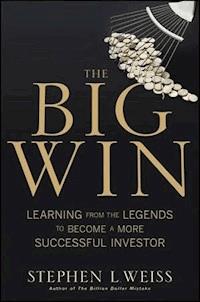
A rousing and practical look at the extremely successful investments of top investors In his first book, The Billion Dollar Mistake, author Stephen L. Weiss showcased the biggest blunders of some of the world's legendary investors--which lost them billions of dollars on a single investment. Incredibly, the mistakes they made were the same mistakes made by everyday investors but for the magnitude of the loss. Weiss's second book, The Big Win: Learning from the Legends to Become a More Successful Investor, highlights financial successes, explaining how the world's most successful investors make a fortune and how you can do the same. As with the missteps Weiss profiled in his first book, the strategies used by these legendary investors are available to all, regardless of size or sophistication. * Profiles legendary investors and highlights their investment strategies--from finding the right investment to researching to making a move * Probes each investor's personality and questions their investment thinking * Identifies and describes each investor's "big win" and why it became their most successful investment The Big Win is a primer on successful investing the way it is really done by the people who do it for a living--passionately and with extraordinary success. The Billion Dollar Mistake told readers what not to do to get rich; The Big Win shows readers how to do it right for the payoff of their lives.
Sie lesen das E-Book in den Legimi-Apps auf:
Seitenzahl: 343
Veröffentlichungsjahr: 2012
Ähnliche

















Table of Contents
Cover
Title page
Copyright page
Dedication
Disclosure
Acknowledgments
Introduction
Chapter 1 The Legends I Have Met
Wanted: The Truly Successful and the Truly Interesting
Tying the Common Threads Together—The Portrait of the Perfect Investor
Chapter 2 Follow the Money
Chapter 3 The Glass Ceiling of Performance
Puts and Calls and Corn
A Feel for Trading
Commodities as Mover and Shaker
Managing Risk
Renée Haugerud’s Big Win: The Three-Instrument Trade
Chapter 4 The Boom Goes Bust
A Fan of the Facts
The Baldwin-United Short
Short Seller Supreme
Doggedly—and Successfully—Cynical
The China Short
Chapter 5 Digging Deep, Coming Up Big
Nurturing a Tiger Cub
Apprentice to Journeyman to Master
Mapping Maverick
The Cognizant Big Win: Challenging Conventional Wisdom with Research
Chapter 6 small caps, BIG GAINS
On the Not-So-Fast Track
Reaping Value
RBA: A Classic Big Win in the Royce Style
Chapter 7 The Prophet of a Profitable Vision
Native Wolverine
Big Wins: The Enclosed Mall and the Irvine Ranch
Core Competency
Defeating Threshold Resistance
The Process
Chapter 8 The Twenty-First Century Belongs to China—and Commodities
Easy Rider Explores the World
A Father’s Gift
Bullish on China
The Commodities Connection
Chapter 9 Opportunity Is Where You Find It
No Limitations
Finding the Deal
On the Beach
The Peebles Way to a Win
Chapter 10 Finding Value in Junk
Educational Value Added: On-the-Job Training
Solo
The More You Know . . .
Bringing the Carcass Back to Life
Conclusion: So There You Have It . . .
About the Author
Index
Copyright © 2012 by Stephen L. Weiss. All rights reserved.
Published by John Wiley & Sons, Inc., Hoboken, New Jersey.
Published simultaneously in Canada.
No part of this publication may be reproduced, stored in a retrieval system, or transmitted in any form or by any means, electronic, mechanical, photocopying, recording, scanning, or otherwise, except as permitted under Section 107 or 108 of the 1976 United States Copyright Act, without either the prior written permission of the Publisher, or authorization through payment of the appropriate per-copy fee to the Copyright Clearance Center, Inc., 222 Rosewood Drive, Danvers, MA 01923, (978) 750-8400, fax (978) 646-8600, or on the Web at www.copyright.com. Requests to the Publisher for permission should be addressed to the Permissions Department, John Wiley & Sons, Inc., 111 River Street, Hoboken, NJ 07030, (201) 748-6011, fax (201) 748-6008, or online at http://www.wiley.com/go/permissions.
Limit of Liability/Disclaimer of Warranty: While the publisher and author have used their best efforts in preparing this book, they make no representations or warranties with respect to the accuracy or completeness of the contents of this book and specifically disclaim any implied warranties of merchantability or fitness for a particular purpose. No warranty may be created or extended by sales representatives or written sales materials. The advice and strategies contained herein may not be suitable for your situation. You should consult with a professional where appropriate. Neither the publisher nor author shall be liable for any loss of profit or any other commercial damages, including but not limited to special, incidental, consequential, or other damages.
For general information on our other products and services or for technical support, please contact our Customer Care Department within the United States at (800) 762-2974, outside the United States at (317) 572-3993 or fax (317) 572-4002.
Wiley also publishes its books in a variety of electronic formats. Some content that appears in print may not be available in electronic books. For more information about Wiley products, visit our web site at www.wiley.com.
Library of Congress Cataloging-in-Publication Data:
Weiss, Stephen L., 1955—
The big win : learning from the legends to become a more successful investor/ Stephen Weiss.
p. cm.
Includes bibliographical references and index.
ISBN 978-0-470-91610-0 (cloth); ISBN 978-1-118-22127-3 (ebk);
ISBN 978-1-118-23358-0 (ebk); ISBN 978-1-118-25971-9 (ebk)
1. Investments—United States. 2. Portfolio management—United States. I. Title.
HG4910.W3678 2012
332.60973—dc23
2012004093
To Lauren, Shelby, and Lindsay
My BIGGEST WINS
Disclosure
Data from various sources was used in the preparation of this book. The information is believed to be reliable, accurate, and appropriate, but it is not guaranteed in any way. The forecasts and strategies contained herein are statements of opinion, and therefore may prove to be inaccurate. They are in fact the author’s own opinions, and payment was not received in any form that influenced his opinions. Stephen L. Weiss implements many of the strategies described. This book contains the names of some companies used as examples of the strategies described, but none can be deemed recommendations to the book’s readers. These strategies will be inappropriate for some investors, and we urge you to speak with a financial professional and carefully review any pertinent disclosures before implementing any investment strategy. This book has been prepared solely for informational purposes, and it is not an offer to buy or sell, or a solicitation to buy or sell, any security or instrument, or to participate in any particular trading strategy. Investment strategies described in this book may ultimately lose value even if the opinions and forecasts presented prove to be accurate. All investments involve varying amounts of risk, and their values will fluctuate. Investments may increase or decrease in value, and investors may lose money.
Acknowledgments
It seems that no matter what I set out to do, my wife, Lauren, is the critical component in my getting there. Always a great sounding board, she is also a wonderful editor, excellent illustrator, and all-around good sport. As with most all else that I have accomplished, I could not have written this book without her partnership and love. As we came down to the finish line, Lauren was also finally willing to own up to the fact that our beautiful, incredibly intelligent daughters take after me more than her, but I think that had everything to do with how they approach their schoolwork, and my missing the submission date for this book, and nothing to do with their better qualities. My aforementioned daughters, Lindsay and Shelby, were very understanding about the time commitment required to write this book and their enthusiasm about the project kept me enthused as well. They promised me that they would read this one, but I’m not going to hold out too much hope. Susanna Margolis once more proved herself to be the best of the best as far as editors and confidants go. My in-laws, Harriet and Irwin Karassik, and sister-in-law, Beth, who, in addition to being responsible for making Lauren the person she is, were incredibly helpful in providing feedback on each chapter. Debby Englander at John Wiley & Sons was again extremely supportive, patient, and encouraging. I appreciate her continuing to have faith in me and my ability to write another well-received investment book. I hope she’s right. Thank you, Debby. The entire staff at Wiley makes my job as an author very easy; Kimberly Bernard, Donna Martone, and Tula Batanchiev were very helpful. My appreciation also extends to Andrew Stuart, my agent, for continuing to represent my nonfiction efforts and getting my work in print. And of course a special thank you to all those who so graciously allowed me into their lives: Lee Ainslie, Jim Chanos, Alfred Taubman, Chuck Royce, Marty Whitman, Don Peebles, Renée Haugerud, and Jim Rogers. These very successful individuals gave me as much time as needed and could not have been more open during the process.
S.W.
Introduction
If you have flipped open the cover of this book, or tapped the screen on your iPad or Kindle to arrive at this introduction, I hope you won’t be disappointed by not having found another dry, dull how-to book on investing. The Big Win: Learning from the Legends to Become a More Successful Investor has been written to read like a collection of entertaining short stories while providing invaluable insights, culled from the experiences of some of the best investors in the business, that you can integrate into your investment strategy in order to drive greater profitability.
My first book, The Billion Dollar Mistake: Learning the Art of Investing Through the Missteps of Legendary Investors (John Wiley & Sons, January 2010), profiled 11 top investors, their life stories, their paths to success, and their biggest mistakes. While virtually all investment books lay out a step-by-step strategy that, if adhered to, will allow for the achievement of “financial independence” or “success beyond your wildest dreams”—sarcasm intentional—The Billion Dollar Mistake is unique in its approach—focusing on what not to do. It is a “don’t do what I did and get rich” kind of book. The mistakes in each chapter are the garden-variety missteps that we all make, investors big and small, the only difference being the number of zeros to the left of the decimal point. In fact, most professional investors assiduously relive their mistakes, dissecting them over and over both as involuntary penance and, more productively, in an effort to understand what went wrong so that it doesn’t happen again. George Santayana put it best1 when he said: “Those who cannot remember the past are condemned to repeat it.”
This follow-up, The Big Win: Learning from the Legends to Become a More Successful Investor, possesses many of the same characteristics of my first book. In fact, I used the same criteria for selecting those profiled on the following pages: compelling life stories, awe inspiring financial achievements, and most important, investment philosophies that could be successfully and relatively easily assimilated by the average investor in order to achieve greater profitability. But I also wanted to add a touch of diversity to the investments I examined while ensuring that the underlying tenets of each strategy were transferrable to and from all asset classes including stocks, bonds, real estate, and commodities. And to really spice it up, I added one of the best short sellers into the mix, offering you, the reader, the opportunity to make money in any type of market—bull, bear, or sideways. Importantly, each chapter concludes with takeaways that make it easy to grasp how you can—in fact, should—take advantage of each lesson. As noted, the core principles of any investment discipline should be transferrable to different asset classes; there are many ways to generate return on your capital, and stocks may not always be the best vehicle for wealth creation. In fact, one of the professional investors featured herein remains skeptical of the ability to consistently generate return by owning any stocks.
Virtually all those included herein blazed new trails in finance: Renée Haugerud, a woman, is an extremely successful hedge fund manager, a minority class if there ever was one; R. Donahue Peebles is perhaps this country’s wealthiest African American real estate developer; Martin Whitman was at the forefront of distressed debt investing; Chuck Royce, a pioneer as a value investor in small capitalization companies; Jim Rogers, a former partner of George Soros, was an early hedge fund innovator in commodities; Jim Chanos is perhaps the best short seller of all time; Lee Ainslie started out working for Julian Robertson at Tiger Management and now runs one of the world’s largest equity hedge funds; and Alfred Taubman is a multibillionaire real estate investor and inventor of the modern shopping mall.
The Big Win examines the other side of the trade discussed in The Billion Dollar Mistake. This book illustrates what went right for the eight investors featured, explaining how they parlayed their personal strengths into fortunes. Each chapter provides an analysis of an investor’s biggest win, not necessarily in terms of monetary gain, although that is also present, but rather in terms of an investment that epitomizes their style. The chapters conclude with a takeaway laying out the most important aspect of each legend’s strategy.
I hope you will find this book informative and entertaining—learning by osmosis, so to speak—as you enjoy the personal stories of these individuals who all came from humble backgrounds to achieve great wealth and success. Most of all, you should come away from this book with an appreciation of how you can use your personal strengths to profit in any market in any asset class.
Note
1. George Santayana (1863–1952) was an American philosopher. Historians, librarians, and trivia experts have engaged in spirited debate over his exact words, but the meaning is very clear.
Chapter 1
The Legends I Have Met
A Behind the Scenes Look at What Makes a Legend
Writing a book is work, hard work at times. So why do it? Well, no one said that work can’t be enjoyable and I enjoy writing. In some respects, writing fiction is easier because you can just make stuff up, which is great for people who drink a lot or use mind-bending drugs. Fortunately, or unfortunately as the case may be, I don’t imbibe to excess with the former and have never partaken of the latter so I am left with an unimpaired yet fertile imagination that occasionally lets me down by being very infertile. Such is the difficulty with fiction: The occasional inability to create something from nothing and then having to toil laboriously to make it sound coherent and interesting. But, I write fiction because I enjoy letting my mind wander and putting those thoughts down on paper, fictitious thoughts that no one can say are incorrect. I enjoy the vacation from reality.
Nonfiction, on the other hand, is easier on the creative engine in terms of developing the material. Sure, you still have to make the book interesting and entertaining, no doubt about that, or people may read the phone book instead, a literary tome that arrives free of charge. But with nonfiction, at least the track is already in place, the basic content available if you know where to get it. In fact, what I enjoy most about writing nonfiction is the process of gathering material. It provides me the opportunity to meet some of the best investors who ever put a dollar at risk and some of the best business people who ever sat in a CEO’s chair. Getting to know them in a rather informal setting, exchanging thoughts and ideas, but most of all, listening to them tell their stories and espouse their philosophy on life, investing, and business—often overlapping thoughts—is what interests me. Then, when I sit down to pull it all together, I enjoy reflecting upon these conversations, discerning whether there is a causal relationship between the people they were, the people they have become, and their success; how their life stories have served to create their approach to investing. I enjoy breaking down each piece of their strategy and then putting it all together, crafting it into a story that culminates with a practical application. I am rarely at a loss for what to write about in my business books. If writer’s block rears its ugly head in one chapter, I move on to another individual. With fiction, that’s not possible since the story line has out be fleshed out and followed.
Lesen Sie weiter in der vollständigen Ausgabe!
Lesen Sie weiter in der vollständigen Ausgabe!
Lesen Sie weiter in der vollständigen Ausgabe!
Lesen Sie weiter in der vollständigen Ausgabe!
Lesen Sie weiter in der vollständigen Ausgabe!
Lesen Sie weiter in der vollständigen Ausgabe!
Lesen Sie weiter in der vollständigen Ausgabe!
Lesen Sie weiter in der vollständigen Ausgabe!
Lesen Sie weiter in der vollständigen Ausgabe!
Lesen Sie weiter in der vollständigen Ausgabe!
Lesen Sie weiter in der vollständigen Ausgabe!
Lesen Sie weiter in der vollständigen Ausgabe!




