


8,49 €
Mehr erfahren.
- Herausgeber: The History Press
- Kategorie: Lebensstil
- Sprache: Englisch
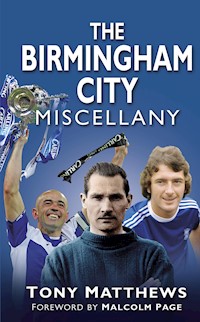
The Birmingham City Miscellany – a book on the Blues like no other, packed with facts, stats, trivia, stories and legend. Delve deep to find out all about the events and people who have shaped the club into what it is today. Featured here are a plethora of stories on this charismatic football club ranging from how the club was formed, to little-known facts about players and managers. Here you will find player feats, individual records and plenty of weird and wonderful trivia. Rivalry with Villa, favourite managers, quotes ranging from the profound to the downright bizarre and cult heroes from yesteryear – a book no true Birmingham City fan should be without.
Das E-Book können Sie in Legimi-Apps oder einer beliebigen App lesen, die das folgende Format unterstützen:
Veröffentlichungsjahr: 2012
Ähnliche


















ACKNOWLEDGEMENTS
I’d like to say a special thank you to two ardent Blues supporters, Ivan Barnsley and Dave Drage, whose joint archive record of Blues facts, figures, stats and general knowledge has once again proved invaluable. I would also like to acknowledge the contribution made by several other ‘Brummie’ fans who, in their own time, have filtered through bits of information which have been included in this book … thanks a lot gents, you know who you are from just talking football!
A huge thank you goes out as well to former player Malcolm Page for penning the foreword, to Michelle Tilling and Richard Leatherdale at The History Press, and to my darling wife, Margaret, who, although enjoying a wonderful lifestyle in sunny Spain, has never really complained about me tip-tapping away on the computer keyboard for hours (and sometimes days) on end. It’s all been worthwhile though … I think!
Tony Matthews
CONTENTS
Title
Acknowledgements
Foreword
Introduction
Potted History of the Club
Badge of Honour
Formation of a Club
Neutral Grounds
‘B’ Team Brummies
Colour Change
Wartime Despatches
Fry (Big Not Small)
Longest Game
Police officers in blue!
Getting Shirty
Posh Spiked
Posh Blues!
Super Savers
Keeper Facts
Shirty!
Gypsy’s Curse & Major Error!
Fight Backs
Crowds Flock in … and Keep Out!
Football Alliance
Age Concern
Cut Short
If the Cap Fits …
England’s Last Twelve Blues!
Internationals
Anglo-Italian Cup
Ancona Controversy
Barcelona Browned Off
Spanish Blues
Transfer Trivia
Escapees (the Ones who Got Away!)
Yet to Meet
Midland Adventurers
Family Connections
Welsh Connection
Brotherly Love
Blue Workers
Fa Cup Record
Change of Name
First Day Blues!
Goals Galore
Long Season
Major Frank Buckley – A Great Manager (But mot with the Blues)
Young Skipper
Managerial Duties
Nicknames
The Blues–Villa Story
No Mean Rivals
Sunday Best (Almost)
Rapid Scoring
Bearded Wonders
Test Matches
Champs – But Not Promoted!
Burns Slays Rams, Foxes & Canaries (Among Others)
Unusual Middle Names
Anglo-Scottish Cup
Europa League
Home Sweet Home
Fairs Cup Adventure
Cricketing Footballers
Smith, Smith & More Smiths
Keeping Up With the Joneses
First Hero in Blue
League Cup Record
Scottish Connection
San Siro Success
Auld Enemy
Jim Herriot – Goalkeeper & Vet
Believe or not!
Kop that!
Orritt From Wales
Short & Sweet
Winged Wonders
Penalty Ref!
Winter Of ’63
Barkas of four!
Young Ones
Away the Blues
Name Change
Blue Belles
Olympic Lasses
Medal Winners
Fifties Front-Line
First & Foremost
Early Bath
Football League/Premiership Record
Grass Roots
Guest Players
Gayle Force
Home from Home
Sequences (Good & Bad)
Gr-Eight (Nil)
Versatile Welshmen
Tedious Journeys
Dancing TV Stars
Right Real Victories
Try, Try & Try Again
Unlucky Breaks!
Celebrity ‘Bluenoses’
Blues News
Cheers – Beer the Boss & Musician
‘Diamond’ Fred
Hat-Trick Heroes
Magnificent Seven
Long-Throw Expert
Soccer Nomads
‘V’ Sign Spells Danger for Blues!
Tanned … in Preston & Australia!
Blanket Finish – the Closest Ever
Animal Magic
Aggregate Victory (Record)
Cup-Winning Captains
Blue Baggies
Not the Blues’ Finest Hour
Play-Off Disappointment (& Joy)
Longest Name
Second Time Round
Vehicles on the Pitch
Blues Abroad
Consistency
Down But not Out
Own Goals
Nine-Goal Thumpings (For & Against!)
Ten-Goal Thrillers
Void Matches
Double-Figure Scores
Hammered!
500 Club
Blue Destination
First-Half Shocker!
Goal Shy
Keep Right on
Late, Late Blues!
Man Mountain
Playing Record
Christmas Stuffing
Four-Goal Deveys
Rejected by Liverpool
Minor Triumphs
Quick off the Mark
Yankee Doodle Blues
Bold (& Sometimes Brilliant) Blues
Auto Windscreens Shield
Autoglass Trophy
Dreaded Drop
Grassed off!
Fratton Park Thriller
Home Internationals
Instant Impression
Premiership Record
Super Sub of Substitutes
Valentine’s Day Massacre
Eight Men
Busby Babes Beaten
Ever-Presents
Cup Capers
Better Late than Never
Forest Felled – Twice
Arsenal Outgunned
Turned Down Arsenal
Water Sport
Switched Venue
Useless Pair!
Travelling Blues
Unchanged
M-M-M-M
One Out – all Out, Nearly!
Midland (United) Counties League
Spurring on the Blues!
Well-Travelled Boss
Loyal Service as a Player
Boxing Footballer
Arctic Blues
Giant-Killers
All Square on the Blue Front
Defensive ‘Blue’ Wall
Frozen Out
Full Members’ Cup
Howler!
Leyland Daf Trophy
Five-Star Show
Lighting up
Goal Machine
Making a Point
Promising Start
Mi££ion Pound Man
Double Winners
We are the Champions!
Licenced to Pull
Recalled
Most Goals in a Game
The Short & the Tall
Bribery
Defeated, Again, Again & Again
Buoyed by Boyd
Irish Connection
No Contest
Great Start
Burslem Blitzed
Consecutive Goalscoring
Jack the Lad
Olympians
Stan the Man Cullis
Roll of Honour
Champion Goalscorers
Sir Doug Ellis
Blue Shrimps!
Centurions
Long-Range Goals!
So Near, Yet so Far
Chocolate Meltdown
Clean Sheets
Millennium Win
Page Boy
Super Trev
Close Encounter
No Place Like Home
Record Holders
Sir Alf Ramsey
Piano Man
Loan Players
Dynamic Duos
Spongemen
No Goals
Cup Joy
Gate Receipts
Long Wait
Baggies Blitz
On fire!
Three Points Make a Difference!
Centenary Win
Draw Specialists
Record Win
Games Aplenty
Professionalism
High Fliers
Nightmare Debut
In the Book
Freehold Bought
Sign Here, Please
Devon Link
Live on TV
Call me ‘Yellow’ Yellow
Ex-Brummies
One-Liners from Blues Managers
Copyright
FOREWORD
by Malcolm Page
When I was growing up I was, like all of my mates, football crazy. I would kick a ball around anywhere – in the lane, in the playground, down the orchard, up in the village green, in fact all over mid-Wales – and this would be every single day, no matter what the weather was like. I supported Birmingham City and my idol was the great goalkeeper Gil Merrick; although I had only seen him play once in the FA Cup final, I said to myself, ‘I’m going to be a professional footballer when I leave school.’ And to my sheer delight, that’s what happened.
While playing for Radnorshire and District Boys in 1962, I was spotted by Birmingham City chief scout Don Dorman who invited me down to St Andrew’s for a trial. I obviously did well and in July 1962 I was signed as an apprentice, turning fully professional two years later. I made my first-team debut against Everton at Goodison Park in February 1965, helped the Blues regain their top-flight status in 1972 and appeared in three FA Cup semi-finals, unfortunately losing them all, one in the very last minute of extra time!
During my career with Blues, I served under seven different managers, occupied virtually every outfield position and played with and against some great footballers. I visited places I never dreamed of seeing, the sort of places I’d only ever read about, and I certainly got involved in many incidents, some good, some bad, but I would have never swapped my life in football for anything else.
This book, compiled by one of the most prolific football writers I have ever known, Tony Matthews, is packed full of interesting facts, records, statistics and events, snippets about players and managers and much, much more. I was absolutely chuffed to read about several events, incidents, games and competitions involving myself as a Blues player – there are some things I never thought were made public! This is a great book to read and enjoy – I have.
Malcolm Page, 2012
Malcolm Page scored 10 goals in 391 senior appearances over 19 years for Birmingham City, during which time he also won 28 caps for Wales.
INTRODUCTION
This book is nothing like the others I have written/compiled on Birmingham City – this is an-easy-to-read mini encyclopaedia about the club, its players, managers and opponents covering the period from 1875 to 2012. And, although out of the Premiership right now, the Blues are still marching on, still going strong, and will do so for many years to come.
From the day the club was first formed (as Small Heath) headlines have been made, some for good reasons, some for bad. At the outset players turned out for nothing, simply because they loved football. As time progressed, however, a League team was assembled with a manager and star players, some of whom became internationals.
A fine ground – St Andrew’s – was built early in the twentieth century and is now a smart, 30,000 all-seater stadium. Some great games have taken place there and thousands of avid Blues supporters have cheered their heroes to victory in some very important games down the years. I have tried to cram everything into this pocket-size almanac and I’m sure you will find it exceptionally interesting. Read about the forty-seven players used in one season by manager Barry Fry, the Blues’ 1961 trip to America, City’s defensive wall, Jack ‘The Lad’ Jones, ‘Diamond’ Fred Wheldon, the Blues’ Man Mountain and much, much more besides.
There is a common purpose surrounding this book – it’s one for all Blues supporters to enjoy. You will read about those superb wins and all the heavy defeats, remember great players, relive three Wembley triumphs, recall promotion and cringe at relegation.
Tony Matthews, 2012
POTTED HISTORY OF THE CLUB
The club began life as Small Heath Alliance in 1875, formed by a group of young cricketers who attended the Holy Trinity Church in Bordesley Green.
After three seasons in the Football Alliance, the club became the first ever champions of Division Two in 1893 (but not promoted). However, this was achieved as runners up 12 months later, but it was up and down after that until the team settled in the First Division in the early 1920s. The Blues then spent all 18 inter-war years in Division One. They reached the FA Cup final in 1931, losing 2–1 to neighbours West Bromwich Albion and in 1939, saw a record crowd of 67,341 assemble at St Andrew’s for a cup tie with Everton.
Halfway through the hostilities, in the summer of 1943, the name City was added to Birmingham. The club spent only two seasons in the top flight between 1946 and 1955, yet twice almost reached the FA Cup final, losing at the semi-final stage in 1946 and 1951.
In truth, the modern history of the club only really began to be written when City gained promotion in 1955, finished sixth in their first season back in the top flight (1955/56) which was the club’s highest league position at that time, and finished runners up once more in the FA Cup, beaten this time by Manchester City.
Also in 1956, City became the first English club to play a major European competition, entering the inaugural Inter-Cities Fairs Cup in 1956, drawing their opening game 0–0 away at Inter Milan. The Blues went on to reach the semi-final of this competition before losing in a replay to Barcelona. In 1960, the team went one better and made the final where, yet again, they were second best to the Catalan giants, Barcelona lifting the trophy with a 4–1 aggregate victory. The battling Blues then tried again, and in 1961, after ousting Inter Milan in the semis, they once again reached the final, but fell at the last fence, this time to AS Roma.
The wait for a major trophy finally ended in 1963, when City beat their arch-rivals Aston Villa 3–1 over two legs in the League Cup final. However, a cycle of relegation and promotion began in 1965, and over the next 25 years Blues bounced up and down between divisions – although occasionally the scene lit up with the arrival of a star player or two! Arguably the most notable was Trevor Francis who, as a 16-year-old, scored 4 goals in a league game, represented England and then became the first £1m+ footballer when he joined Brian Clough’s Nottingham Forest in 1979.
Also, some World Cup-winning glamour came to St Andrew’s in 1979, first when the club was briefly managed by former England chief Sir Alf Ramsey, and then when Blues boss Jim Smith signed the Argentinian defender Alberto Tarantini.
Between the club winning the League Cup in 1963 and being relegated to the Third Division for the first time in its history in 1989, City had ten different managers, including Stan Cullis, Fred Goodwin, Smith and Ron Saunders who had won the League Championship with Aston Villa in 1981.
Unfortunately St Andrew’s was a dismal place to be in the late 1980s. The team was twice knocked out of the FA Cup by non-league opponents and then, after another spell of managerial unrest, for a short period of time the club found itself in administration. Thankfully, things gradually improved. The Leyland DAF Trophy was won in 1991 and the Auto Windscreens Shield followed 4 years later, but this, in truth, was small consolation.
At this juncture, thankfully (for the supporters especially) the club had achieved a degree of stability, having been bought by millionaire businessman David Sullivan for £1.7m in March 1993. However, for a time the Blues became known as ‘the Nearly Men’ – the team lost in 3 consecutive play-off semi-finals (1999–2001), and in the latter year they also suffered an agonising penalty shoot-out defeat by Liverpool in the League Cup final.
Trevor Francis, who had returned to the club as manager in 1996, left after 5 years in office and almost immediately his successor, Steve Bruce, guided City into the Premier League for the very first time after a redemptive victory, also on penalties, over Norwich City in the 2002 play-off final. The inspired signing of French international Christophe Dugarry helped City to briefly establish themselves in the top flight, but demotion in 2006 led to 4 consecutive seasons of relegation and promotion.
New boss Alex McLeish eventually ended that cycle in 2010, with the Blues settling comfortably in ninth position, their highest league finish since 1959. The following year, City won the League Cup, beating the favourites Arsenal at the ‘new’ Wembley Stadium and so qualify to play in the Europa League, but in truth, the 2010/11 season was one of mixed fortunes, especially in the Premiership and to a certain extent in the FA Cup, as the Blues went out in the quarter-finals to Bolton Wanderers and then suffered relegation on the final day of the league programme by losing 2–1 at Tottenham Hotspur.
In May 2012, under the management of Chris Hughton, City were beaten in the play-off semi-finals by Blackpool having finished fourth in the Championship. A good home record, with only 1 defeat, was unfortunately not matched away from St Andrew’s, the Blues gaining only 7 wins and 7 draws against 9 defeats. In June 2012 Lee Clark was appointed manager after Chris Hughton left to take over the reins at Norwich City.
BADGE OF HONOUR
Birmingham City has had three different official club crests/badges. From 1945 (the year City was added to the club’s name) until 1972, the Birmingham coat of arms was the badge featured on the players’ shirts. The second crest (1971–76) was formed by intertwining the letters ‘BCFC’ and appeared on the front of the players’ penguin-style shirts. The third and current badge has been in evidence for almost 35 years and the ‘Globe Crest’ and is recognised throughout the world of football.
FORMATION OF A CLUB
Small Heath Alliance (Birmingham City) was founded in late September/early October 1875 by a bunch of cricketing enthusiasts most of whom attended Trinity Church in Bordesley Green. Determined to continue their sporting relations during the winter months, they decided to form a football team which they called Small Heath Alliance. It was as simple as that!
After a few pre-arranged kickabouts on a stretch of waste land in Arthur Street, just off the main Coventry Road and not too far away from the club’s present ground at St Andrew’s, the newly formed team played its first game (a 12-a-side contest) in November 1875 against Holte Wanderers, holding out for a 1–1 draw: The team was W. Edden (goalkeeper), A. Wright, F. James, T. James, G. Edden, W. Edmunds (captain), T. Edden, D. Keys, C. Barmore, C. Barr, J. Sparrow and R. Morris. Keys scored the goal.
NEUTRAL GROUNDS
The club have so far played competitive football matches on 15 different neutral grounds – and this includes one League Cup final at Cardiff’s Millennium Stadium (2001), two FA Cup finals at the ‘old’ Wembley Stadium (plus the finals of the Leyland DAF Trophy in 1991 and Auto Windscreens Shield in 1995) and the 2011 Carling Cup final at the ‘new’ Wembley.
A Blues team has played five FA Cup semi-finals at Hillsborough, Sheffield (1946, 1956, 1957, 1972 and 1975) and three at Maine Road (two replays, in 1946 and 1975, and in 1951), and also an Inter-Cities Fairs Cup semi-final replay against Barcelona in Basle, Switzerland, in 1957. Other neutral grounds used have been Bramall Lane (Sheffield United), Hyde Road (Manchester), Aston Lower Grounds Road and Villa Park (homes of Aston Villa), Molineux (Wolves), Filbert Street (Leicester), Elland Road (Leeds), Goodison Park (Everton) and the County Ground (Northampton). During the Second World War, the club utilised the grounds of Leamington Town, Solihull and Aston Villa after bombs had severely damaged St Andrew’s.
‘B’ TEAM BRUMMIES
‘Buzzing’ Blues’ ‘B’ teams from 1900–39, 1946–2000 and the twenty-first century:
1900–39
H. Bailey, W. Ball, E. Barkas (capt), J. Bumphrey, F. Buckley, P. Barton, G. Briggs, B. Bond, W. Beer, J. Bradford, J. Beattie. Reserves: H. Booton, R. Bonthron, J. Bumphrey, L. Burkinshaw.
1946–2000
I. Bennett, J. Badham, G. Breen, S. Bruce, M. Beard, L. Boyd (capt), K. Broadhurst, J. Bloomfield, D. Bremner, K. Burns, E. Brown. Reserves: B. Bridges, J.E. Brown, J. Bowen, J. Berry.
Twenty-first century
J. Butland, J. Bass, A. Bruce, B. Bragstad, D. Burrows, N. Butt (capt), L. Bowyer, D. Bentley, J. Beausejour, N. Bendtner, M. Bent. Reserves: C. Benítez, R. Blake, H. Bouazza, C. Burke.
COLOUR CHANGE
When the Blues first started to play football in earnest, the club’s colours were dark blue (almost navy) shirts with a white sash and white shorts. In 1883/84, they changed to wearing plain royal blue shirts and five years later turned out in black tops with gold collars and cuffs. In 1890/91, these were changed to a much lighter blue with a dark trim, and this design remained in vogue until 1914/15 when the shirts switched to being royal blue with a prominent central ‘V’ running from the shoulder downwards. This smart design stood until 1927/28 when the plain royal blue shirt was reintroduced. This stayed with the club for several years, although at times the neckline changed and in 1957/58, the button-up design was replaced by a small V-neck which remained as part of the kit until 1961 when a round neck was brought in. This was subsequently replaced by a much thinner single round design and there were also a few minor changes made over the next decade with a double ring neckline appearing occasionally.
In 1971, the club’s blue and white penguin strip was seen for the first time. This lasted for four years before the club reverted back to having a plain blue shirt. There followed another style of neck design, a different V-neck shape and also a square-type neck.
In the 1980s, a thin white stripe was added into the blue top and also a red flash was seen on the shoulders as well as a white broad band across the front of the players’ shirts. The team donned a patterned blue shirt with red and yellow flecks in 1992/93, but the blue was always prominent. When Trevor Francis returned as manager in 1996 he immediately reintroduced the penguin strip (albeit briefly) and the fans also saw a white and blue striped shirt in 1999.
Since the early 2000s – and since City reached the Premiership – players, in general, have worn the traditional Birmingham City blue, with a flurry of accessories thrown in for good measure. Regarding the club’s change strip, I can tell you that the team has played in chocolate, red, white, black, green, a shade of purple and even bright yellow shirts … virtually every colour imaginable!
WARTIME DESPATCHES
During the First World War, the Blues played a total of 106 matches and in the Second World War they competed in 215. The match details:
First World War
Venue
P
W
D
L
F
A
Home
53
38
8
7
134
55
Away
53
20
12
21
89
85
Totals
106
58
20
28
223
140
The Blues did not play any games in season 1916/17
Second World War
Venue
P
W
D
L
F
A
Home
99
67
14
18
238
104
Away
113
39
24
50
183
223
Neutral
3
1
1
1
7
8
Totals
215
107
39
69
428
335
The club did not play competitively in 1941/42 and the 1945/46 FA Cup games are not included in this category.
Birmingham’s biggest wins in the First World War were 7–0 v Barnsley and 7–2 v Notts County, both in 1918. The club’s heaviest defeats were 8–2 v Rotherham (a) in 1916 and 7–0 v Notts County (h) in 1919.
In the Second World War, the club’s top victory was 8–0 v Tottenham Hotspur (h) in 1945 and they also beat Walsall (h) 8–1 in 1940. Their heaviest defeats were 6–1 against West Bromwich Albion (a) in 1940, 6–2 v Wolves (a) in 1939 and 6–3 v Walsall (a) in 1940.
The Blues fielded two teams on 14 October 1939 although both lost, to Wolves 1–0 and Stoke City 3–2.
City recorded 18 successive home wins in 1945/46 on their way to winning the Football League (South) championship (on goal average from rivals Aston Villa).
City’s biggest home attendance in wartime football was that of 56,615 v Charlton Athletic in February 1946. A crowd of 63,820 had attended the away game at Villa Park a month earlier.




