


8,49 €
Mehr erfahren.
- Herausgeber: The History Press
- Kategorie: Lebensstil
- Sprache: Englisch
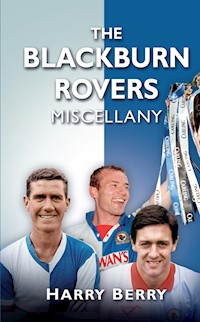
The Blackburn Rovers Miscellany is a gem of a book, packed with facts, stats, trivia, stories and legend. This is the ultimate book of trivia on the club and a treasure trove of information that you can dip in and out of at your leisure. It's book that will make you smile, laugh out loud, sigh and reflect on the good times and the bad. Written by lifelong fan Harry Berry, this is a book no self-respecting Rovers fan should be without.
Das E-Book können Sie in Legimi-Apps oder einer beliebigen App lesen, die das folgende Format unterstützen:
Veröffentlichungsjahr: 2012
Ähnliche


















To Archie & Izaak
INTRODUCTION
It is over sixty years since I started following the Rovers, which was the club of my grandfather. My son, Karl, has been attending matches with me for 37 years, my nephew, Andrew Smith, for almost as long. My grandson, Archie, attended his first game when aged three, my youngest grandson, Izaak, is keen to start. We bleed blue and white in our family. The recent events at the club have made it harder to be a Blackburn Rovers supporter than at any time I can remember. I have had a season ticket since 1960, when I left school, but this year was the first time that I seriously contemplated not renewing it. I am not unique in my feelings. Many Rovers supporters of long standing have taken the decision to withhold their support from the club that they love. Supporters as old as me have lived through similar circumstances. In 1960, the year that they reached the final of the FA Cup, the club had an average gate of 27,299. There was a widespread dissatisfaction over the distribution of the cup final tickets, compounded by the fact that it was well known that the players were dealing openly in them. The following year the average attendance was 19,343, the season after 15,906. Those who stayed away never came back. It took the arrival of Jack Walker and the winning of the Premiership to build the gates back to the levels of the 1950s. Yet in 1960 the depth of feeling was not as great as it currently is. Those like myself for whom the club has been a huge part of our lives, fear the future. Each wrong step the club takes reduces the core support and ensures that more and more Blackburn people start catalogue shopping for a favourite club on Sky, and never return to the fortnightly pilgrimage to Ewood Park.
This has been a great club that has achieved more than any small town has a right to expect. A galaxy of truly great players has pulled on the blue and white. In my childhood the club had Ronnie Clayton and Bryan Douglas, players who still rank in the top five all-time great players of the Rovers. It was a privilege as well as an education to watch the way they influenced games in their different ways. In 1959 the club won the FA Youth Cup with three players, Keith Newton, Mike England and Fred Pickering, who would have graced any team in the world. Later came Alan Shearer, about whom any comment would be superfluous and Henning Berg, the most technically gifted defender who has ever worn the blue and white. Even when the club could not sustain the impetus of the Jack Walker years there were still Brad Friedel and Tugay, players of ability way beyond the ordinary. It has been gratifying to have these great players but the Blackburn crowd has never been one to only welcome the stars. Hard work and commitment are the qualities demanded above all and few players who display these facets are ever ill-received at Ewood. Demonstrative of this is that by far the most popular player of the modern age is Simon Garner, a character, a loyal club man, a good goalscorer and a man whose heart is divided into blue and white halves even if his training methods would not find their way into any text book. Yet what makes Blackburn Rovers truly unique is that the crowd never fail to acknowledge their debt to Jack Walker, who brought success to the club beyond the realms of anything the most optimistic fan could have dreamed of.
CONTENTS
Title
Dedication
Introduction
Primordial Rovers
Thoughts on Blackburn
A Man of Few Public Words
Corner Shops
Practical Jokers
Some Came Running
Nicknames
For Some it’s Easy
Youngest Scorers
The Youngest Debutants
Oldest Players
Did You Know?
Pillars of Society
The Cradle of Lancashire
Yes Mr Wenger, They did Play Rugby
Strangers in Green
Spot on
Cordon Bleu
When You Need a Man used to Saving, it does no Harm to have Two
The Twenty-five
By the Numbers
Foreign Legion
Goalkeeping Statistics
If on a Winter’s Day a Traveller
Male Model
Did You Know?
The First Eleven
For King and Country
If the Cap Fits
The Lancashire House
The Pantomime Season
Déjà Vu
Déjà Vu (Two)
Family
Maskelyne Unmasked
The Greatest Athlete
It’s a Marathon
A Neighbourly Affair, the Town up the Road
The One-armed Man
Did You Know?
Wartime Football
Mr Fix it or Mr Loose Tongue?
Seven up
Four in Five
Garner, Goal Hero
It’s Still About a Ball
A Game Unique to Blackburn
Some You Win: the Ones who Got Away
Scoring Goalkeepers
Who’s for Tea?
Long Throws
Formations
Hard Men
Goal-line Clearances
The Raffle
The Worst Decision Ever
Goalkeepers are Different
Did You Know?
Short Apprenticeships
Travel
Red Cards
Who’s Laurie Calloway?
Winning but no Medal
Top Transfers
Big Spenders
Other Rivalries
Scoring Debuts
Did You Know?
Some Waited Longer
Long Service
What’s in a Name?
The Kamikaze Hooligan
The Changing Face of Advertisements
Now You See Him
On Strike
Freeman of the City of London
Managerial Records in the Premiership
Club Colours
Did You Know?
And then There was One
Champions
How the Premiership-winning Side of 1995 was Built
Blackburn Rovers, Almost Champions of the World
Obfuscation
Unusual Christian Names
Nonda’s Tale
Charitable Mokoena
Other Charitable Rovers
Did You Know?
Hanging up the Boots
Goalscorers
The Lure of the Merseyside Dollar
Most Appearances
Facial and other Adornments
Directors
Trainers
Managers
Did I Really Say that?
There’s only One Blackburn Rovers
All-time Team
Copyright
PRIMORDIAL ROVERS
The history books are quite clear that Blackburn Rovers FC was formed on 5 November 1875, at a meeting at the St Leger Hotel. Yet a team called Blackburn Rovers had preceded them. Ten years before this climactic date, sport in the town was limited to cricket and athletics in the summer and the occasional game of rugby in the winter. However, Albert Hornby had started working at his father’s mill, Brookhouse, and decided to organise football games for his workers. He found them adept and formed his own team to provide the opposition – they came from the well-heeled in town and called themselves the Rovers. In addition to Hornby, who later played cricket and rugby for England, there were his brothers Harry and Cecil, Joseph Law, Arthur Appleby, Hugh Pickering and William Baynes. The rest have been obscured by time and those named are only remembered because of the subsequent memories of Joseph Law, a local bookseller. Harry Hornby was later to become Sir Harry, after public service that included 24 years in Parliament (without making a maiden speech) and two spells as Mayor of Blackburn. His brother Cecil played the odd cricket game for Lancashire, but became a professional soldier, serving with distinction in the Zulu and Boer Wars. Appleby, the son of an Enfield mill owner, played for a long time for Lancashire and was described by Albert Hornby as ‘a good left-arm trundler.’ Pickering was a successful brush maker in the town and Baynes, the first pupil to enrol at Blackburn Grammar School when it was reopened, became a man of the cloth, ending his days in Herefordshire. Strangely as proof of some egalitarianism, the names of the Brookhouse team have survived.
THOUGHTS ON BLACKBURN
‘Blackburn is a proud, working-class area, Blackburn Rovers is their outlet. They live in rows of houses with no gardens and they don’t like it when we play badly.’
Ryan Nelsen
‘It always seems to be pitch dark by 3.30 in Blackburn and if you want to go shopping there is nothing to buy and there’s no decent language school.’
Stéphane Henchoz
‘It’s a shithole.’
Lucas Neill
‘When you are driving through Blackburn, shut your eyes. This is no disrespect to Blackburn but see beyond it. This place is changing.’
Kenny Dalglish’s advice to Kevin Gallacher
‘I wouldn’t want to live in Blackburn. The place is lovely and I’m not saying the fans would be trouble but I know if I walked into a fish and chip shop in Blackburn I’d get noticed.’
Ryan Nelsen
‘The town is unhealthy. Even to natives the climate is very trying. I always regard health as the greatest wealth. I refuse to sacrifice my family on the altar of mammon.’
Archie Kyle explaining his decision to flee Blackburn in the summer of 1909
A MAN OF FEW PUBLIC WORDS
In his 8 glorious seasons with the club, the much-loved Tugay only spoke to the press once, in his first season. After that he refused all interviews, even with the club’s own radio station. When he finally retired in May 2009, the final game of the season was set aside to celebrate his huge contribution to the club and his unique bond with the fans. Tugay masks were distributed and the fans special chant, ‘You’re my Turkish Delight’, was sung throughout. At the end Tugay finally spoke, ‘I love you and I’ll miss you,’ and then handed the microphone back to the interviewer.
CORNER SHOPS
When the Rovers reached the final of the FA Cup in 1960 there was some conjecture over whether the club would bring back their much loved English international, Bill Eckersley, for a swansong to his illustrious career. The management was obviously unaffected by sentiment and the regular occupant of the number three shirt, Dave Whelan, played although he might have been better to have opted out since he broke his leg during the game, an injury that blighted his career. Both men are also connected by corner shops.
Whelan started a business career with a corner shop in Mill Hill, moved on to a stall in Wigan market, built up a supermarket chain that he sold to the Morrisons organisation and used the proceeds to build up the JJB sports chain. Eventually he turned it into a public company, making him one of the richest men in the United Kingdom. With his wealth he indulged his passion for sport and at one time owned Wigan Athletic, Wigan Rugby League Club and Orrell Rugby Union Club. Ultimately he concentrated on the football club and guided them into the Premier League.
Bill Eckersley had for a time, a small grocery and confectionery shop not a hundred yards from Ewood Park. It was a small terraced building with a shop window either side of a central doorway. On one particular day Eckersley had two tins of peas in the left showcase and his collection of English caps in the right one. Derek Dougan, who was injured at the time, strolled past with a friend on his way to watch the reserves. He stopped at Eckersley’s shop, shook his head and observed, ‘Bill’s not really got the hang of retailing, has he?’ Eckersley’s collection of caps were almost consumed by fire at the house in 1958 when an overturned paraffin stove caused a fire that was put out by Bill Marlow, a passing policeman.
In that FA Cup final of 1960, the Rovers team contained three men who were shopkeepers, John Bray (sweet shop), Ronnie Clayton (newsagent) and Dave Whelan (grocer).
PRACTICAL JOKERS
Every club has its practical jokers but there have seldom been two such outrageous exponents at one club at the same time as the Rovers possessed in the 1950s, with Bill Eckersley and Jack Campbell. They appeared to be driven to fresh excesses in an endeavour to surpass each other but it was Eckersley who finally won the contest conclusively. When the team were staying overnight in a hotel, he shinned down the drainpipe into Campbell’s room and, disguised by a balaclava, relieved Campbell of his watch and wallet.
Campbell came back to Ewood Park for an old boys’ reunion, not long before his death at his home in Spain. A sprightly pensioner, his last act on the Ewood turf was to attempt to stick the point of his umbrella up the rear of the Wolverhampton mascot.
SOME CAME RUNNING
The introduction of substitutes took football into places where there was no etiquette as to how these men behaved. Forced to await a call to action, it did not escape their team-mates’ notice that certain individuals were forever trying to catch the manager’s eye. Even worse were the ones who stripped off the minute the trainer was allowed on the field. No such charge could be levelled at Eamonn Rogers, a somewhat laid-back young man with an amiable disposition who was badly misrepresented by the press as a consequence of a series of confrontations with the management. Eddie Quigley, the Rovers manager, had experience of how cold it can get in Blackburn and as a player had been a master at conserving his energy. He therefore ordered a massive sleeping bag to keep the substitute warm, rather than have him expending his strength running up the touchline. In one particular game he suddenly caught the referee’s eye so that he could introduce Rogers as a substitute. Unfortunately he had not communicated his intention to the player, who remained swathed in the cocoon that was his sleeping bag, with only the point of his nose on display. Quigley had to bend down to his eye level to inform him of the action required, and this appeared to flummox the player, giving rise to the rumour that he had in fact been asleep. Certainly his efforts to remove the bag were laborious – Harry Houdini used to escape from chains and a straitjacket in considerably less time than it took Rogers to discard his sleeping bag! When he was finally revealed he was wearing a track suit. Even when this was discarded no blue and white shirt could be seen and not until two sweaters had been removed did he appear ready to take the field. Except that he was not wearing his boots, which he appeared to have somehow misplaced and were only located after a frantic search of the dugout.
NICKNAMES
Comparatively few players acquire original nicknames. The majority involve a mangling of their name but occasionally there are a few that transcend the normal. Here are a few.
Cheyenne
Derek Dougan
The Tank
John Bray
Braveheart
Colin Hendry
The Bull of the Bosphorus
Hakan Sükür
Woody
Alf Woolfall
Dino
Don Martin
Chip
Tom Briercliffe
Basil
Mick Rathbone
Pepper
Ernest Bracegirdle
Tiny
John Joyce/Martin Taylor
Pinkie
Eddie Latheron
Nudger
Jack Campbell
Skimmy
Jack Southworth
Iron Man
Willie Kelly
Killer
Glenn Keeley
Tex
Terry Eccles
Noddy
Ally MacLeod
Spider
Dave Helliwell
Ciccio
Corrado Grabbi
Mbazo (The Axe)
Aaron Mokoena
Tinker
William Davies




