


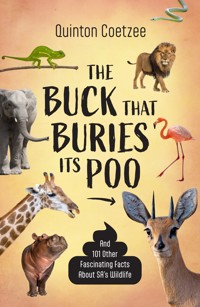
Erhalten Sie Zugang zu diesem und mehr als 300000 Büchern ab EUR 5,99 monatlich.
- Herausgeber: Jonathan Ball
- Kategorie: Lebensstil
- Sprache: Englisch
Is a zebra black with white stripes or white with black stripes? And why do flamingos stand on one leg while bats hang upside down? Did you know that a chameleon's tongue can shoot out at five times the acceleration of a fighter jet? In The Buck That Buries its Poo, naturalist Quinton Coetzee answers these and many other intriguing wildlife questions. He also dispels countless myths and elucidates some of the legends that surround creatures in the South African bush we thought we knew all about. For example, bats do not get tangled in people's hair (because they are far too adept at flying) and elephants are not afraid of mice (but they do fear bees!). Other tall tales you might hear around the campfire are that lions roll in animal dung, entrails or carcasses to disguise their scent, and that rhinos have a predilection for stamping out fires. What is true, though, is that hyenas are more closely related to cats than to dogs. This handy guide is based on Coetzee's own research and that of others, and his experience gleaned over decades living close to nature and wildlife. It seeks to unravel the mysteries of nature in Africa – from mammals and birds to arthropods and plants – with fascinating information and fun trivia. It is a book that will enlighten and entertain. PS: Zebras are black with white stripes!
Sie lesen das E-Book in den Legimi-Apps auf:
Seitenzahl: 345
Veröffentlichungsjahr: 2023
Das E-Book (TTS) können Sie hören im Abo „Legimi Premium” in Legimi-Apps auf:
Ähnliche



















Jonathan Ball Publishers
JOHANNESBURG • CAPE TOWN
Ex Africa semper aliquid novi
(Out of Africa, there is always something new)
– Pliny the Elder
For Benn and Ladoo, Clay and Keegs. May knowledge, truth and integrity be your compass – always! And to Cassie, my constant companion and ‘sounding board’ throughout the writing of this book.
Contents
Introduction
Southern Africa is home to an astonishing diversity of life forms, which occur in widely contrasting habitats: from dry deserts and humid forests to warm beaches and icy peaks. Without exception, every one of these animals and plants has developed an amazing strategy of adaptation to climatic conditions and habitat over time.
Since childhood I’ve happily nestled in the embrace of Mother Nature’s wonders. I’ve always been entranced by the marvels and mysteries of the natural world, surrendering helplessly to their spells, which effortlessly captivated, seduced and encircled me, as a moth is drawn to light.
After completing a BSc degree in zoology and microbiology at Rhodes University, where the principles of biology were hammered into an empty head, I spent many years (surviving!) in the bush as a bushcraft instructor. I have also been a cat hunter on Marion Island, a director at the Johannesburg Zoological Gardens, a safari guide (unqualified), a professional platform speaker and a television presenter on wildlife programmes such as Aardwolf and 50/50.
The hugely popular TV stint especially attuned me to the strange and unrecorded in nature (thanks to my incomparably erudite producer, Ronnie Watt). Without respite, I’ve been enthralled by, and indulged in, the bizarre, unlikely, remarkable or astounding biological phenomena on our planet. Every time, I was intrigued by whether these accounts were anecdotal or factual, myth or truth.
I have been driven by a search for answers. Even if you don’t always find answers in nature, there’s invariably a most plausible explanation. My quest has taken me to places strange and far: the unpredictably treacherous weather of the subantarctic zone, scorching deserts of the Middle East, the highest ice peaks in Russia, frozen wastelands of outer Mongolia, shimmering plains in Africa and the sweltering jungles of the Amazon basin.
Spending time in the wild, with so many different and wonderful people, I was struck by the realisation that their interests, conversations and questions about nature were often about the same things. Whether professional naturalists or safari guides, nature-loving adults or wide-eyed children, our curiosity about the fascinating world of nature has no bounds. How often I have been asked questions like these:
●Is a zebra black with white stripes, or white with black stripes?
●Are dassies and elephants really related?
●Do frogs and toads cause warts?
●How do geckos stick to walls?
●Why do giraffes have such long necks?
●How old do baobabs grow?
●Why do flamingos stand on one leg?
And then there are the myriad of myths, legends and old wives’ tales about animals that are typically seen as mysterious creatures, such as bats, snakes and owls.
I embarked on this project to answer some of these questions, and organised them into six groups – in line with the systematics of classification that have underpinned biological discovery for almost 300 years (more about that on page xii).
•Part 1 – Mammals makes up almost a third of the book, despite this group of organisms representing not even 0.5% of all the described species of living things on Earth. South Africa is home to around 350 mammal species, ranging from the tiny pygmy mouse to the tall giraffe, and the splendour of the Big Five in between. Our mammals are diverse, dramatic and renowned worldwide, attracting people from around the globe to see them in their spectacular natural habitats.
•In Part 2 – Birds,I touch on some of the extraordinary, weird and wonderful birdlife of South Africa. People have a natural affinity for birds (unlike for reptiles!), because they’re delicate and harmless and often boast magnificent colours, song, intellect, powers of instant flight, and so much more. And because they’ve adapted to so many diverse habitats, they’ve developed remarkable survival strategies. Owing to their secretive (read: flighty) nature, not many people know about these behavioural traits. It’s these little-known ‘oddities’ that I’ve chosen to discuss in this book in the hope that the reverence that we hold for the avian world becomes even more meaningful.
•As I explain in Part 3 – Reptiles and Amphibians, these animals don’t hold nearly the same appeal as mammals and birds do for many people. Whereas mammals are (mostly) soft and furry, reptiles are dry and scaly, and amphibians are moist and often slimy. Indeed, the fear of reptiles (herpetophobia) is the most common animal phobia. Snakes, in particular, are feared not only because they are able to kill people but also because of the negative connotations, myths and legends attributed to them over centuries – despite the fact that the vast majority of snakes are entirely harmless to humans.
Since this fear is based entirely on paucity of knowledge, I have approached this section with an intent not only to expose some of the little-known wonders of these animals, but also to allay some fears, bust the myths and create a better understanding of this misunderstood group.
•Part 4 deals with a large group of invertebrate animals (meaning ‘animals without a backbone’) called Arthropods. It’s estimated that these spineless animals make up around 80% of all known animal species, making them the most successful creatures on Earth. Arthropods all have a segmented body, pairs of jointed limbs and a tough outer covering made of chitin, which is shed periodically. The group spans insects, myriapods (centipedes and millipedes), arachnids (spiders and scorpions) and crustaceans (crabs, prawns and lobsters).
Unlike most of the creatures featured in the other groups in this book, arthropods may often be encountered in our daily lives, within our homes and in our gardens. Because they don’t hold much of an interest for most people (except for the prophets of Doom!), I have chosen to discuss many of the arthropods with which we’re most familiar, to shed light on the little known, and once again, to assuage the misplaced fears associated with so many of these critters.
•Part 5 – Fish looks at the last of the animal groups in this book. Southern Africa’s coastline extends over 2 850 km from the coastal borders of Namibia to Mozambique. Our oceans have an astonishing diversity of marine life, but the fish that attract the most attention in our oceans, by far, are the sharks. (Yes, sharks are fish!) People fear them universally because they are large creatures against which we have little defence in water. It is for this reason that I’ve chosen to discuss only sharks here, in an effort to dispel many of the terrors that surround these ill-judged yet fascinating creatures.
•Part 6 – Plants touches on a small section of South Africa’s extensive botanical diversity. I have chosen to write mainly about trees, no doubt because of the strong allure that all things arboreal have for me. Trees have a vital role in every environment and are an essential part of our landscapes, whether in the bush or in our cities. I’ve realised that a landscape is only described as barren when it has no trees on it!
Trees are extraordinary for so many reasons, not the least of which is their longevity and ability to withstand untold adversity while providing refuge, shelter and food for a myriad of other life forms – including humans. Sadly, the feelings of respect and admiration we should have for these remarkable organisms are frequently absent. My hope is that this small section will encourage a greater appreciation for and awareness of trees in South Africa.
This book does not attempt to provide all the answers or give a definitive confirmation of behaviour or form in the natural world. Many answers continue to elude us, but at the very least it offers a handy guide based on my own research and that of others, and of course experience gleaned over decades living close to nature and wildlife. I’ve also touched on explanations towards a better understanding of the naming of our national parks, the joy of collective nouns for all creatures great and small, and provided personal insights into so many of the natural mysteries that have intrigued me and others about the stuff that’s amazing, astonishing, remarkable and unexplained in South Africa’s unique and varied natural splendour.
Understanding classification:The relationships between all living things
Scientists are not only keen observers but also inquisitive by nature. It’s this combination of noticing how things around us look and behave and asking why it is so that forms the foundation of biologists’ (admittedly limited) understanding of life on Earth.
But where do you start to make sense of it all if there are, based on scientists’ current estimates, about 8.75 million different types of living things on Earth (give or take a million or two either way)? Well, you tackle it systematically (some would say it’s much like eating an elephant …)
About 290 years ago, this is exactly what a Swedish botanist called Carl Linnaeus did – and to this day he is regarded as the father of taxonomy, the discipline of identifying and classifying living things. In 1735, Linnaeus published the first edition of his Systema Naturae, a volume in which he put similar organisms together into distinct groups. This thinking formed the basis of the biological classification system we still use today, in which all life on Earth is classified according to five kingdoms: the bacteria, the protists (single-celled organisms), fungi (for things like moulds and mushrooms), plants and animals.
Linnaeus realised that although a group of organisms can be described according to specific, characteristic features that are the same across all individuals in that group, they also tend to fit into a bigger group of organisms, which are similar but not exactly the same. This means that they are of a more general description than those in the specific group. And so he planted the seed for the idea that we should be able to group organisms according to different levels of specificity.
Today we have a biological classification system that consists of seven hierarchically organised levels, going from broad to specific as you move down the steps – almost like an upside-down triangle where the wide base is at the top and the narrow tip is at the bottom. The levels go like this: kingdom à phylum à class à order à family à genus à species. So, at the top end of the range we find a kingdom – a large group of organisms that all share only a few very general features. At the bottom end, we find a species – a small group of organisms that share a large number of very specific features (and are able to interbreed).
While it was great to be able to group organisms systematically, Linnaeus realised biologists (merely called naturalists in those years) needed to be able to name organisms. But there had to be a system for that, too, otherwise different people in different parts of the world speaking different languages would call the same thing by different names and no one would know what the other was talking about.
So, in 1753 he published the Species Plantarum, a volume on the species of plants known at the time, in which he gave each plant a two-part Latin name: the first word describing the genus and the second the species. This ‘shorthand’ became the gold standard and is used to this day, although the scientific community has adapted the naming convention somewhat in that the words aren’t actual Latin anymore, but merely sound like Latin.
Linnaeus’s system for classifying and naming organisms forms the foundation for understanding evolutionary relationships, as already used by 19th-century biologists such as Jean-Baptiste Lamarck and Charles Darwin. This developed our understanding of life on Earth even further – as you will see when you read about why giraffes have such long necks, why people say dassies are related to elephants and why hyenas are thought to be more like cats than dogs.
In this book you’ll see both common names of plants and animals and their scientific names, and understanding something about how names come about in biology, you’ll be able to appreciate the (sometimes heated) debates that scientists find themselves embroiled in when hashing out what the name of a newly discovered species, or the new name of a long-known one, must be, as happened to the acacia trees of Africa.
But don’t get too bogged down in the technicalities of biological classification, naming conventions and evolutionary ancestry. Instead, just keep these concepts in the back of your mind as you discover the wonders of the living world around us.
AARDVARK
Is an aardvark a pig?
Aardvark is an Afrikaans word that means ‘earth pig’ when translated literally, but in English this animal is also called an antbear. But an aardvark is neither a pig nor a bear, and it is not an anteater either.
The aardvark looks somewhat like a chimera. It has a snout like a pig, ears like a rabbit and what looks like the tail of a kangaroo. But it’s not related to any of these creatures. So where exactly does the aardvark fit among the mammals of the animal kingdom?
Scientists have thought they may be related to the South American anteaters or to pangolins or armadillos, but none of these turned out to be a good fit.
In the end, aardvarks got a special place in the taxonomic puzzle: an own order and an own genus. They’re unique in this regard, as they’re the sole order of mammals that has only a single living representative.
The name of their order, Tubulidentata, means ‘tube-like teeth’, which deserves some explanation. Aardvarks’ teeth are unique in structure. Instead of the normal pulp cavity, they have a number of thin dentine tubes, each containing pulp. They have no enamel coating and so the teeth continue to regrow as they wear down.
Aardvarks (Orycteropus afer) occur throughout sub-Saharan Africa (hence the species name afer). They’re solitary, nocturnal wanderers, shuffling over large distances at night, seemingly with no plan in mind, snout to the ground as they search for a meal. They eat ants and other insects, but their main diet consists of termites, which they excavate and slurp up by the tens of thousands with their long (up to 30 cm), sticky tongues.
They’re well adapted for this type of diet – their tough skin protects them from insect bites and they’re able to seal off their nostrils to keep out dust or crawlies. There’s not much chewing of the food, though; it’s swallowed whole and ground up in the muscular lower stomach. They get most of their moisture from the insects that they eat, so they seldom drink water.
Their genus name, Orycteropus, means ‘digging footed’ and is especially apt. With their powerful limbs and feet, armed with spade-like claws, they are astonishingly efficient at digging for their food. They have four toes on each front foot and five on the back feet, and they also use their claws for defence.
A female aardvark carries her unborn offspring – only one per pregnancy – for seven months.
Aardvarks have a vital role in the ecosystem. So much so that they’re considered a keystone species, which means they’re crucial to the proper functioning of the ecosystem. This is linked to their digging behaviour, as the burrows they dig become home to approximately 17 mammal species and a number of reptile and bird species. These include warthog, porcupine, jackal, bats, owls, pythons, hyena and wild dogs.
Seldom, if ever, will you find an aardvark burrow that is not, or has not been, used to good effect by another creature. The veld would be all the poorer if it wasn’t for the aardvark sanctuaries, dug by so few but serving so many.
ANTELOPE
What is the difference between a ram and a bull, and between a ewe and a cow?
In the smaller antelope species such as duiker or impala, the male animals are known as rams, whereas the females are called ewes. Their babies are called lambs. Larger antelope species such as kudu or eland have bulls and cows. Their youngsters are called calves.
So, where in this group of animals does the changeover from rams to bulls and ewes to cows happen?
The buck stops with nyala: males are bulls and females are ewes. All male antelopes smaller than a nyala bull are therefore called rams. All female antelopes larger than nyala ewes are called cows.
Seeing that a nyala baby’s mother is a ewe, maybe it should be called a lamb? Yet the accepted convention says it’s a calf. If ever there were a non-conventional family in the animal kingdom, the nyalas are it.
Do antelope horns regrow after breaking?
Not usually. A broken horn in a young animal may show some form of regrowth, but it will usually be deformed. Horns broken off in adult animals will not regrow.
Do antelope mothers abandon their young?
This commonly held misconception probably comes from the observation that many female antelope either hide their young for a period after birth (to conceal them from predators) or, in some cases, such as with impalas, the youngsters become part of nursery herds, where the young are cared for by several adults.
As the female may be known to have given birth or was previously seen with an infant that is no longer ‘around’, it is often incorrectly assumed that the mother abandoned her young.
BABOONS
Are baboons monkeys?
Yes. They’re the largest monkeys in the world.
All monkeys, including baboons, are primates. They are generally grouped into Old World monkeys (those found in Africa and Asia) and New World monkeys (those from South and Central America). Monkey species can be either from the Old World or the New World, but baboons are only from the Old World.
There are five species of baboon: chacma, olive, yellow, Guinea and hamadryas. The latter, originally found in the Horn of Africa, is the only species that has dispersed beyond Africa (into south-western Arabia).
Do the swollen red butts of female baboons make them irresistible to randy males?
A popular myth about baboons is that the bright red colour of female baboon butts and the dramatic changes in their size are part of a seductive display that male baboons find irresistible. After all, the bootylicious butt only occurs when the female is ovulating. Surely, then, it must be a sign of her sexual readiness and the fact that she is fertile?
A female baboon in estrus. The swollen, red baboon butt is an indication of her readiness to mate.
Putting two and two together, it’s not unreasonable to think that the swollen, red butts are a ‘come-hither’ display to any available males. In fact, it’s been suggested by evolutionary biologists that human males share the same attraction for the colour red, which is, supposedly, why women use red lipstick, red clothing and even red hearts to lure men.
But(t) it’s a logical fallacy.
Research has shown that females with big red butts aren’t mated more by the males nor that they are better mothers. Instead, studies indicate that male baboons are more interested in how long ago the female had her last baby than in how red her rump is.
Females with older babies that they are no longer nursing are, in fact, more likely to be mated. A researcher from Duke University, Courtney Fitzpatrick, wrote in an article in the journal Animal Behaviour in 2015 that it’s almost as if the males are counting. Female baboons, just like women, are not as fertile when they’re nursing infants because they don’t ovulate during that time. Male baboons seem to be aware of this, and tend to choose females that have gone through more ovulation cycles since their last pregnancy before mating with them.
The red, swollen backside of a female baboon signals to a male that she is ovulating, fertile and ready to mate. For about 15 days every month, the bobo butt grows larger, ballooning to its maximum size when the female is at peak fertility in her cycle (around day 15). The swelling then shrinks again and the butt returns to its normal size. So, a big red butt is not an indication of how fertile a female baboon is, but rather of when she is most fertile.
BATS
A few myths dispelled
Steeped in myth and legend, bats have, for centuries, been associated with the underworld, the occult and spooky stuff. Just the mention of a bat, or worse still its unexpected presence at a gathering, is bound to elicit squeals of alarm and terror. On cue a brave hero will speed off in search of a tennis racket (the silver bullet!) to unceremoniously deal with the intruder.
For many people, bats are, well, just bats. They are under the impression that there’s just one kind of bat, or that they’re all basically the same. Nothing could be further from the truth.
There are 75 bat species in southern Africa alone, and over 1 400 in the world, including three species of vampire bat (more on this later). Bats account for approximately 20% of all mammals, more than any other mammal group except rodents. Speaking of rodents, bats are not ‘flying mice’, as many people mistakenly describe them. Bats are not even closely related to rodents. In fact, bats are believed to be more closely related to primates, even to humans, than they are to rodents.
Bats are the only mammals that are capable of true, winged flight. The smallest mammal on the planet is a bat from Thailand called Kitti’s hog-nosed bat (or the bumblebee bat), because it’s about the size of a large bumblebee and weighs only 2 g. At the other end of the scale is the giant golden-crowned flying fox from the Philippines, weighing over 1 kg and with a wingspan that can exceed 1.5 m.
Let’s examine a few common myths attributed to these remarkable creatures.
●Bats are blind. While their eyes may be small or poorly developed and the expression goes that someone is as ‘blind as a bat’, these animals are, in fact, not blind. Many species of bat have excellent vision, and rely mainly on their eyesight and sense of smell to find fruit. The fact that some bats hunt by echolocation (emitting sound waves and analysing them as they bounce back from insects or other objects) perhaps supports the notion that they have no need for eyes, hence the belief that they must blind.
●Bats get tangled in people’s hair. The reason why we know this is myth rather than fact is because bats are far too adept at flight to accidentally become tangled in someone’s hair. And besides, why would they be batty enough to do so on purpose?
●Bats bring bad luck. Some people believe that bats are omens of bad luck. To them, a bat in the house means something dreadful is going to happen. But it’s all part of bat mythology. In fact, many people consider bats to be beneficial, as they reduce the numbers of pesky insects. Some bats can eat half their body weight in insects in a single night. Nosy, superstitious neighbours you want to get rid of? Install a bat house today!
●Bats are unimportant to the ecosystem. Owing to a general fear and loathing of bats, their very existence on the planet is sometimes questioned. But bats have a vital role in the environment and the economy through pest control, plant pollination and seed dispersal. Bats, together with bush babies and some insects, also pollinate baobab trees. All the more reason to conserve bats and create bat-friendly environments – and encourage others to do the same.
Do bats suck the blood of humans?
Hold on to your hats: there are neither vampire bats nor vampires in South Africa. Of the 1 400 bat species in the world, only three are blood-feeding – and they’re all found in Central and South America.
Nowadays, they feed mainly on domestic livestock (as opposed to on wild animals, as they did in the past before there was an abundance of livestock); it’s extremely rare that they will target humans.
Vampire bats are so light and surreptitiously unobtrusive that they can land on sleeping prey without waking them up. Using their sharp teeth, they nick the skin just enough to cause blood to flow, and then lap it up with their tongues. A protein in their saliva – called draculin! – keeps the host’s blood from clogging while they feed. They’re so delicate and subtle when feeding that they can drink their fill for more than 30 minutes without waking up their sleeping prey.
Are bats carriers of rabies in South Africa?
The majority of human rabies cases in South Africa are associated with domestic dog bites, according to researchers from the University of Pretoria’s Department of Veterinary Tropical Diseases. But, they say, there are ‘rabies-like’ viruses that are reported – rarely – in some species of bat and that have been associated with two fatal rabies cases in humans in South Africa. This certainly dispels the common misconception that bats are major carriers of rabies in South Africa.
I was intrigued by astonishing parallels between rabies and vampires outlined in an article in the journal Neurology in 1998. The article proposed that rabies and its symptoms fit hand in glove with the fearful characteristics attributed to vampires in the 1730s in medieval Europe, when people still believed implicitly in their existence. Vampires were a source of true terror in those times.
A terrible rabies epidemic occurred in Hungary in the 1720s – coincidentally at the very same time and place that the vampire legend seems to have started. Consider the following:
●Bites: According to vampire legend, someone will become a vampire when they are bitten by another vampire, and they will then bite others in turn. People with rabies are known to become aggressive and try to bite other people. Rabies is also most commonly spread by biting.
●Aversions: Legend has it that vampires can be repelled with garlic. And that they hate sunlight; in fact, it kills them. That’s why they sleep in coffins during the day. Similarly, people with rabies are inclined to avoid certain stimuli, including strong odours such as garlic, and they tend to become extremely sensitive to light. When people with rabies are confronted by these stimuli, they can react in an irrational way. For example, their face can contort, their upper lip can curl back in a snarl, exposing their teeth, and they can start bleeding or frothing from the mouth while uttering strange, hoarse sounds.
●Insomnia: Vampires go wandering at night, apparently in search of victims. People with rabies are inclined to wander around at night, since rabies causes insomnia.
●Becoming lustful: Vampires are known to be amorous and lustful. In fact, rabies-infected men are prone to priapism – an erection that can last for days. Vampires are most popularly depicted as men. People with rabies are easily aroused. Statistically, seven times more men are infected by rabies than women.
●Turning into other animals: Vampires are said to have the ability to morph into other animals. This probably stems from the observation that the symptoms and behaviour of animals with rabies are almost the same as those of humans with rabies – they also bite, growl and snarl with frothy, bloody mouths.
●Blood from the dead: In light of all the anxiety around vamp-ires at the time, it was not uncommon for bodies to be exhumed to see if they were truly dead or had turned into vampires. Exhumed bodies were often relatively well preserved, as they were sealed in coffins in the cold winter soil, but exhibited bloating owing to the decomposition of internal organs, which can force bloody fluids into the mouth. This apparently made gravediggers of the 18th century believe that the deceased had recently sucked someone’s blood. Returning to reality, the blood in the body of someone who had a rabies-related death can remain liquid for some time.
It is therefore understandable that supposedly ‘classic vampire behaviour’ in humans may have a logical explanation. In the 15th and 16th centuries, explorers returned to Europe from South and Central America with exaggerated accounts of blood-sucking bats. But it was Bram Stoker’s book Dracula, published in 1897, that actually cemented the association between vampires and bats.
Why do bats hang upside down?
Because if they didn’t, they would have great difficulty getting airborne. Unlike birds or insects, which are capable of powered flight, most bats struggle to take off into the air from the ground. They’re not well adapted for ground takeoff owing to low wing loading – meaning they have large wings but small bodies – and they also can’t jump to kick-start their takeoff. Furthermore, bats don’t have hollow bones like birds, lightweight bodies like insects or powerful wings – all adaptations that assist a rapid launch into the air.
Although bats are excellent fliers once airborne, it’s getting into the air from the ground against gravity that’s the problem. That’s why they always perch on a high point from where they can simply let go for an instant, gravity-assisted drop into full flight. Problem solved! In fact, this way they can be in full flight quicker than birds, which have to work against gravity to get themselves up and away.
Tendons in bats’ feet naturally pull the toes tightly around the anchor point while they’re hanging upside down, enabling bats to hang about effortlessly and not fall off their perch while sleeping.
How do bats poo while hanging upside down?
Although the thought of pooing while upside down causes most humans some angst, pooing is not a big deal for bats. Their excrement is normally quite dry and resembles small, dark grains of rice that simply drop to the ground, forming dumps called guano. This means it doesn’t mess all over them. Some bats can flip themselves upright for a moment to poo.
Peeing is usually done while in flight. But when peeing from a perch, some bats can arch their bodies backwards, away from a forward-directed stream, or shake vigorously (left to right) to spray the pee forward, away from the body. How’s that for batshit crazy?
How do bats mate?
Mating takes place while hanging upside down, or on cave ledges or crevices. The male takes hold of the female from behind for copulation.
Mothers even give birth hanging upside down. Newborns are ‘caught’ with the wings and cradled against the body for suckling and protection. Some species fly with their pups attached to them. Others leave the babies at the roost during flight.
‘BIG FIVE’
A marketing con?
Left to right: Elephant– Ikiwaner, lion [Yathin S Krishnappa], buffalo– [Gouldingken], rhinocerous– [Richard Ruggiero[ and leopard– [Steve Jurvetson/ Creative Commons Attribution[.
The 1800s epitomised the glory days of colonial hunters in Africa. They sailed from England to Africa with fine hunting rifles and sallied forth to test their courage, daring and bravery against the ‘savage creatures’ that roamed the continent’s plains and forests. Seeking fortune in the ivory and skin trades, their adventures and exploits were lauded back home – they were heroes of their time.
It was these first big-game hunters who determined that the most dangerous animals to hunt were elephant, buffalo, leopard, lion and rhino. Herein lies the origin of the concept of the ‘Big Five’. (By the way, very few of these hunters made the distinction that we have two kinds of rhino – black and white. Should we assume they were referring to the more aggressive and temperamental black rhino?)
I find it interesting that even today, the Big Five – a hunting concept – remains the biggest marketing line in African wildlife tourism; in fact, spotting these five species is used to measure the success on a safari (a Swahili word meaning ‘journey’) today. I know of foreign tourists who, if they didn’t manage to tick off the magic number five on their two- or three-day safari, would slink back home to Europe or the United States, blaming the lodge where they stayed, their tour operator or field guides for this ‘catastrophe’. Even South Africans use this measure when they ask, ‘What did you see in the Park?’ and visitors boast about which of the Big Five they saw.
I find it so sad that people are disappointed when they complain that they didn’t see the Big Five, and then go on to add that they spotted cheetah, wild dog, hippo, giraffe and so much more of our magnificent wildlife, perhaps even a kill – and often for the first time in their lives.
Fortunately, it does seem as if more people are becoming as enthralled and excited at the sighting of civets, serval, aardvark or aardwolf as when they encounter the Big Five. A high five to anyone who ceases to measure their safari score against the Big Five. As wonderful and iconic as they are, there’s so much more to be seen and experienced in the African bush.
Have you heard of the ‘Little Five’?
Elephant shrew – Chris and Mathilde Stuart
red-billed buffalo weaver – Greg Tee
leopard tortoise – Bernard Dupont
antlion (winged) – Yakovlev Alexey
rhino beetle– Bernard Dupont
In response to the hype around the Big Five and how they invariably steal the limelight, the concept of the ‘Little Five’ was born. It probably arose from the frustration and pressure on safari guides who become desperate to appease the primary (if not only) interest of many of their guests.
This tongue-in-cheek concept refers to smaller, lesser-known creatures who share the same environment as the Big Five and all bear a part of the name of their more famous double: elephant shrew, buffalo weaver, leopard tortoise, antlion and rhino beetle.
BUFFALO
Who are the ‘dugga boys’?
No game drive during which one encounters a few lone buffalo bulls is complete without someone saying that these so-called ‘dugga boys’ were kicked out of the herd and now spend their time lying in mud. But I don’t believe one can truthfully make this claim. Who would have kicked them out? Why would they have been kicked out? What happened at the time – was it a brutal battle or did they leave amicably by choice? I have yet to meet someone who has conclusive answers to these questions.
When it comes to spelling, I’ve seen ‘dugga’, ‘dagga’ or ‘dagha’ all being used in South Africa. Dagga is a South African term for marijuana (cannabis). In Afrikaans, the word dagha is an adaptation from udaka, used in both isiZulu and isiXhosa, to mean ‘mud’. During the apartheid years, black workers who were employed to mix cement on building sites were derogatively referred to as ‘dagha boys’. Buffaloes are partial to wallowing in mud or dagha (also see the entry on mud wallowing later). I suspect ‘dugga’ is simply an English transliteration of dagha.
Do buffalo attack their adversaries from behind?
Buffalo are included in the Big Five (see an earlier entry) because of their reputation for being belligerent, and having tremendous strength and determination. They don’t hesitate to attack when threatened or wounded. Indeed, the anguished bellow of a distressed buffalo will rally the herd into a cooperative onslaught to viciously defend their distraught comrade.
It is widely chronicled that buffalo are notorious for circling back around a hunter, a position from where they revengefully ‘turn the table’ on their unsuspecting pursuer to stalk, gore, trample and kill him.
There may have been occasions on which a hunter was attacked from behind by his buffalo quarry. Fight or flight are the only options available to a pursued buffalo. Wounded or not, they’re opponents not to be messed with. However, I doubt very much that such encerclement to surprise the hunter from behind is a natural or deliberate strategy.
It’s more likely that the hunter had overtaken his well-hidden quarry, who might have been incapable of full flight due to its injuries. Or, in its wounded and confused state, the buffalo may have been disorientated and have inadvertently blundered in a direction that brought him up behind the hunter.
It is also said that buffalo never forget a wrong done to them. They’re reputed to take brutal revenge on hunters that have wounded them, even if the incident happened years before. Presumably with a cunning ambush from behind? What goes around, comes around!
Although such calculated behaviour is not purely legend, it’s also not the norm. One should also keep in mind that astute battle tactics are often attributed by survivors to ferocious adversaries, especially after life-threatening encounters.
CAMOUFLAGE CLOTHING
Can camo clothing fool animals?
The question about whether wearing camouflage clothing will make you harder to spot in the bush has raged for decades, and I suspect it’s probably fuelled by the hunting industry, a sector worth billions of rands annually. It could also be because humans marvel at the fantastic examples of camouflage in the insect world, which we are often completely fooled by.
But the joke is probably on us. Camouflage clothing may be effective to humans in a military context and specifically during covert operations when we must try to conceal ourselves from the opposition in the outdoors (although I notice that for some, camouflage clothing is all the rage when going to a shopping mall).
However, the same cannot be said about making ourselves less conspicuous to animals. Even though animals do rely on their eyesight to detect potential threats, equally important – if not more so – is their acute sense of smell, movement and silhouette, all of the latter having nothing at all to do with camouflage patterns.
For some reason it’s considered cool to wear camo in the bush, to blend in by looking all ‘leafy’, as if that is the natural way to be ‘in tune’ with nature. But animals do not perceive the world around them in the same way humans do. Our indigenous hunters have known this for centuries and that is why they use stealth, not camouflage, to outwit their prey. Besides, if camouflage colours and patterns according to human design really work, why don’t we see any animals using this clever trick? After all, there aren’t any buck with ‘leafy’ foliage patterns on their hides … Instead, they have spots, stripes or blotches on black, brown or tan hides. If anything, surely this must be the natural way?
Incidentally, I wonder if bullfighters would not be better off dressed in camo, rather than the magnificently ornate traje de luces (suit of lights), richly embroidered in gold, silver and shiny beads. It is said that the muleta that a matador so deftly manipulates to provoke the bull is red to infuriate the animal, which some say gave rise to the expression that someone ‘saw red’. (I’ve heard people – city types – become fearful when they are wearing red clothing even in the presence of cattle, or when in a game drive vehicle and they come across buffalo.)
This is yet another myth. Bulls don’t charge at the colour red, because, like all cattle, they’re colour blind. In fact, the bull is irritated by and charges at the movement of the cloth as it’s whipped around. Further evidence of this is that the bull also charges at the matador’s larger cape, the capote, which is coloured blue or gold on one side and magenta on the other. No red there!
CARACAL
Why do these wild cats have tufts on their ears?
Nobody knows what the purpose is of their distinguishing ear tufts – or even if there is a purpose at all. But what is sure is that a caracal is not a lynx, the latter being known for their characteristic ear tufts. This common characteristic is probably the reason for the terms ‘caracal’ and ‘lynx’ often being used interchangeably. (To set the record straight: although caracals and lynx belong to the same subgroup in the family Felidae, a caracal is classified as a small wild cat, whereas a lynx is grouped with the medium-sized cats.)
There are many theories about why caracal have ear tufts, but none of them are particularly credible. For instance, it’s been proposed that the tufts act as ‘whiskers’ at the top of the head to help the cat feel its way around in the dark, or that the tufts are flicked around to mimic insects while the animal lies in long grass, and that this, in turn, would attract birds, which the cat can prey on. Other hypotheses include that the tufts keep debris out of the ears, that they filter sound into the ears, that they are used to communicate with other caracal, or that they’re an ‘attractive’ feature for a potential mate (think: size counts).
The truth is that nobody has a definitive answer; there may be no physiological function for the tufts at all. This is yet another example of humans’ innate need to find some sort of scientific or evolutionary explanation for any and every feature exhibited by an animal.
DASSIES
Are the dassie and the African elephant related?
They are indeed. Dassies (Afrikaans for rock hyraxes, from the Dutch word das




