


1,19 €
Mehr erfahren.
- Herausgeber: Hesperus Press Ltd.
- Kategorie: Lebensstil
- Sprache: Englisch
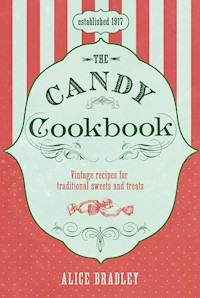
Discover a delicious array of recipes in this classic cookbook - the first ever to feature a chapter on chocolate! From fudge to marshmallows, cakes to macaroons, mouth-watering sweet treats await the enthusiastic home baker. For a book first published in 1917, The Candy Cookbook is a ground-breaking work, featuring as it does mouth-watering recipes for fudge, meringues, fondants and all kinds of other sweets - perhaps more importantly though, it was the first ever recipe book to contain recipes for cooking with chocolate. With Alice Bradley presiding over her kitchen like a prototype Mary Berry from The Great British Bake Off, The Candy Cookbook is a must-have for any keen baker of confectionary. Reprinted in a beautiful edition, with brand new striking line-drawn illustrations, this is a book both to treasure and to use practically, helped along the way with the handy lists of instructions and desirable utensils. Still as tasty today as when they were first published, these recipes display the perennial fascination with confectionary mankind's sweet tooth creates. Browse through and familiarise yourself with recipes that will soon become family favourites. Choose between the beautiful 'Wild Rose Ornamental Frosting', the delicious sounding 'Cream Butterscotch with Nuts' and perhaps even the intriguing 'Mushroom Meringues'. 'Candy bought in the stores is likely to be expensive, poorly made, or impure. Candy made at home need be none of these things. And how enjoyable the process of candy making!' Alice Bradley Chapters: Uncooked Candies, Assorted Chocolates, Fudges, Fondant Candies, Caramels and Nougatines, Pulled Candies, Hard Candies, Glacis and Pulled Flowers, Crystallized Fruits, Fruit, Gelatine Candies, Dried Fruits and Nuts, Meringues and Macaroons, Popcorn Candies, Decorated Candies and Cakes, Favors
Das E-Book können Sie in Legimi-Apps oder einer beliebigen App lesen, die das folgende Format unterstützen:
Veröffentlichungsjahr: 2014
Ähnliche



















Preface
Candy bought in the stores is likely to be expensive, poorly made, or impure. Candy made at home need be none of these things. And how enjoyable the process of candymaking!
What a pleasure it is some afternoon or evening when there is time to spare, to gratify the appetite with some confection, easily made! Even the little folks may take part, may help in the exciting business of manufacture, learn something of the mysteries of the kitchen, gain a little in power to use their head and hands. All of us enjoy the process and relish the product. Why, candymaking is one of those all important household pleasures that make family life mean what it does. The hours thus spent are an intimate part of that life. The writer believes, therefore, that she serves all homelovers in compiling this book. Its recipes have been thoroughly tried and tested in our school kitchens. They are simple and well adapted for ordinary use.
It is in the hope that they will be the source of many a pleasant time at home that this work is committed to its readers.
– Alice Bradley, March 1917
Contents
Candies are composed of sugar of various kinds, chocolate, nuts, fruits, colorings, and flavorings. Each of these has its own particular value as appealing to the sense of sight, the sense of taste, or the need of the body for nourishment.
Sugar
Sugar (C12H22O11) is a crystalline substance known by its sweet taste and its solubility in water. Sugar undergoes little change during digestion; as glucose it is carried by the blood through the body, and unites with oxygen breathed in from the air, forming carbon dioxide (CO2), gas, and water, in which forms it leaves the body. During this change, energy is produced, and used for muscular work. Sugar is more rapidly oxidized than any other kind of foodstuff, and makes a very desirable quick fuel food.
The principal kinds of sugar are cane sugar or sucrose, grape sugar or glucose, milk sugar or lactose, and fruit sugar or levulose.
Cane sugar is obtained from sugar cane, sugar beets, and maple trees. It is sold in many forms. Granulated sugar is the kind most commonly used in candymaking. It is made by dissolving, filtering, and crystallizing the raw sugar that has been extracted from the sugar cane or sugar beet.
Brown sugar is not so completely refined as white sugar and has more flavor. Keeping it in a covered jar in a cool place prevents it from becoming lumpy.
Confectioners’ sugar (icing sugar) is cane sugar so very finely ground that it is like a powder, and dissolves instantly. In recipes where it is called for other sugar cannot be substituted, although confectioners’ sugar can be used in place of powdered or granulated sugar. It is a pure form of sugar with nothing added to it.
Molasses is a by-product in the manufacture of sugar, and cannot be crystallized with ordinary methods.
Maple sugar is obtained by boiling down the sap obtained by tapping maple trees. Its delicious flavor is due to ‘impurities’ that are present. Maple syrup can be made by dissolving maple sugar in boiling water, or by using the maple sap before it has been sufficiently reduced to become crystalline. The amount produced in this country each year is by no means sufficient to supply the demand, and consequently there are many imitations.
Grape sugar or glucose, found in honey and all sweet fruits, is less sweet than cane sugar. It may sometimes be seen on the outside of dried fruits such as dates and raisins. It is manufactured on a large scale from cornstarch, and is for sale as glucose in kegs and barrels of 110, 300 and 650 pounds each. As corn syrup or Karo, where it is combined with sugar syrup, it can be obtained in red label and blue label tins of one and one half and two and one half pounds capacity. When used in candies it prevents crystallization and gives a smoother product.
Milk sugar or lactose is present in milk, and when separated from it is sold as milk sugar. It is not sweet, and is only found in candy when milk is used.
Fruit sugar or levulose is found in sweet fruits.
It is sweeter than cane sugar and too expensive for ordinary use
Chocolate
Chocolate is obtained from cocoa beans cleaned, roasted, and finely ground. It contains much nourishment, in a concentrated form, fat, protein, and carbohydrate being present, with very little water.
Chocolate used on the outside of candies is called coating chocolate. Large candy manufacturers grind and blend cocoa beans to get the particular grade of chocolate coating for which they are famous. Sugar and vanilla are added, and any chocolate sold by name can be relied upon. It is for sale in ten-pound cakes, and should cost not less than twenty-five cents a pound for a good quality. There is upon the market a sweet coating chocolate in one sixth and half-pound cakes, in red wrappers. This can be obtained from grocers, and is very satisfactory.
Bitter or unsweetened chocolate has had nothing added to it, and should be used in fudges and other candies in which chocolate is cooked with sugar. It is for sale in quarter and half-pound cakes, divided into small squares, each weighing one ounce. Bitter chocolate is combined with sweet chocolate, and used for coating ‘bitter sweets’.
Cocoa is prepared from cocoa beans by the removal of a portion of the fat. Sugar, flavorings, and sometimes starch are added.
Cocoa butter is the fat obtained from the cocoa bean in the manufacture of cocoa. A small amount is sometimes added to melted chocolate to keep it thin enough for dipping, at a moderate temperature.
Nuts
Almost all kinds of edible nuts are used in candymaking. They contain protein, fat, and carbohydrate in varying proportions, and are excellent sources of energy. Some, like peanuts and black walnuts, almonds and pine nuts, are so rich in protein that they may be used as meat substitutes. Their digestibility is increased by being finely ground. Most nuts may now be obtained shelled at about the same cost for the edible portion as in the shells. For some purposes, broken nut meats are quite satisfactory; they cost less than the whole kernels. Nuts, when used in candies, increase the bulk and food value, detract from the sweetness, and improve both appearance and flavor.
Almonds and English walnuts are the nuts chiefly grown in this country. There are both sweet and bitter almonds; the latter are used sparingly to give flavor to almond confections. Jordan almonds are the finest almonds grown, and are for sale out of the shell, as are also other smaller and shorter varieties.
Almond paste may be made at home of finely ground almonds, but it is more satisfactory to purchase it ready for use in one and five-pound packages.
Brazil nuts are large three-cornered nuts, with a hard shell and a brown skin. The latter should usually be removed before the nuts are used in candy. Beechnuts and butternuts (white walnuts) are not often found in the market, but if obtainable may be used in recipes that call for walnuts or pecans.
Cashew nuts are small crescent-shaped nuts, and are usually sold with the shells removed.
Chestnuts should be of the large Spanish variety. They are rich in starch, and when boiled in syrup are a delicious confection. They may be purchased in bottles as ‘marrons’ in vanilla or brandy-flavored syrup, and used for centers of fancy bonbons, chocolates, or glacés.
Coconut may be purchased desiccated in packages, or as ‘desiccated’, ‘long’, ‘short’, or ‘macaroon’, in bulk from wholesale confectioners. The very long shreds of coconut are desirable in some candies. Fresh-grated coconut should be used for coconut cakes if obtainable.
Coconut oil is a very hard fat, for sale as nucoa and used in chewing-candy.
Hazelnuts are round, about the size of a marble, and rich in fat. They are usually purchased in the shell.
Hickory nuts are like small walnuts, but the meat is difficult to remove whole from the shell, although delicious when obtained.
Peanuts are grown in larger and larger quantities in the United States, and furnish a nutritious and inexpensive food product, rich in protein and fat. They may be obtained raw or roasted, in or out of the shell. Raw peanuts are desirable in some recipes for peanut brittle.
Peanut butter is made by putting roasted peanuts through the finest cutter of the meat grinder, and may be prepared at home, or purchased in jars or in bulk by the pound.
Pecans are a particularly crisp, well-flavored nut. If they are first soaked for 5 hours in cold water, and then allowed to stand until dried off on the outside, the nut meats can be obtained whole. They may be purchased shelled, whole, or broken.
Pine nuts grow on pine cones of large pine trees. They have an agreeable flavor, are rich in fat and of considerable food value. They require no other preparation than picking over.
Pistachio nuts are small, of a bright green color, with a purplish skin and a hard shell. The unshelled nuts have been boiled in salt water. They usually are not of such brilliant color as the nuts that may be purchased already shelled. They are expensive but not heavy, and a few of them add much to the attractiveness of candies without adding materially to the expense. They will keep a long time in a covered glass jar.
Walnuts of the English variety are obtainable almost everywhere. Being rich in fats they are an exceedingly nutritious food, and when used in candies help to overcome the cloying sweetness while increasing the food value. They may be obtained in or out of the shell.
Black walnuts are not as common as the English varieties but most satisfactory in all candies that call for walnuts.
Dairy Products
Milk, cream, and butter enter into the composition of many candies. Heavy cream makes a rich candy that will keep soft for a long time, and may be used either sweet or sour. When cream is not available milk and butter may be substituted, or evaporated milk may be used.
Butter should be of the best quality. Butterine or peanut oil is less expensive, and may sometimes be substituted for butter.
Eggs
Eggs for candy should be fresh. If whites only are required, care should be taken in separating that no particle of yolk gets into the white, as it will prevent its being beaten light and stiff. Bowl and egg beater must be absolutely clean, dry, and cool, or whites will not beat up well. Dried eggs or egg albumen are largely used in manufactured candies.
Fruits
Fresh, canned, and dried fruits are used in candy-making, and add bulk and flavor, while reducing the sweetness. Fresh fruits may be dipped in fondant, chocolate, or glacé, or cooked down to a thick jelly.
Canned fruits, as apricots or pineapple, are useful when fresh fruits are not obtainable, and jams, like raspberry, may be mixed with fondant for bonbon centers. Maraschino cherries are sometimes used, with their syrup, to give flavor and variety to fudge and bonbons.
Dried fruits, like raisins, dates, figs, and prunes, are cheap and nutritious. Combined with nuts or fondant they may be classed with candies and used as a dessert.
Candied fruits – such as apricots, cherries, pears, pineapple, and plums – may be prepared at home, or purchased in city grocery stores, or from dealers in confectioners’ supplies. They are valuable for decoration, for centers of chocolates and bonbons, and as an ingredient of fudges and glacéd fruits.
Angelica is the green stem of a plant, used chiefly for its color.
Flavorings
Extract of vanilla properly made is the pure essence of the vanilla bean dissolved in alcohol.
Many vanilla extracts are made from Tonka beans, or from vanillin prepared synthetically in a laboratory. These are labeled vanilla compounds.
Extracts of lemon and orange are made by dissolving in alcohol, oil obtained from the yellow skin of the fruit.
Raspberry, strawberry, cherry, apple, pineapple, banana, and other familiar fruit flavors constitute a class of flavoring extracts similar in character and similarly made.
Attar or otto of rose, one of the first perfumes and perhaps the most exquisite of all, is the base of true rose extract.
Ginger extract is made by steeping and filtering ground ginger roots in alcohol.
Almond oil is procured by pressing, powdering, and drying bitter almonds, allowing the mixture to ferment, and then distilling it by steam. Almond extract is the oil dissolved in alcohol.
Pistachio flavor can better be simulated in candy by using one part almond extract and two parts vanilla extract than by using pistachio extract.
Peppermint oil is distilled from dried peppermint plants.
Maple flavor is a preparation of roots and herbs used to give a maple taste to white or brown sugar candy.
All spice extracts are made either by dissolving an essential oil in alcohol or percolating a ground bark with alcohol.
Colorings
The varied color of candies may be due to the food materials of which they are made, or to small amounts of coloring matter added to them. Satisfactory pastes may be obtained in eight colors, in small glass jars selling for fifteen or twenty-five cents each. They are inspected and registered by the United States Government. Small amounts only are required for the delicate shades that are desirable in first-class candies. The color may be taken on the end of a toothpick and mixed directly with the candy, or be diluted with a few drops of water before being added.
Gelatine
Gelatine is obtained by the treatment of skin, ligaments, and bones of young calves with boiling water. It is for sale in sheets, in shreds, or granulated. The latter is most convenient to use, but sheet gelatine is considered best for Turkish paste.
Vegetable Gelatine
Agar-agar, or Japanese gelatine, is used by many candy manufacturers, and is for sale at confectioners’ supply houses.
Marshmallow Paste
Marshmallows which are made by strong beating machinery are cheaper and more satisfactory than those made at home. For use in layer caramels, marshmallow comes in sheets weighing one pound each. There are five sheets in a box. The soft marshmallow cream that is sold in tin boxes may be added to fudge to make it soft and creamy.
Food Value of Candy
Food is required to furnish energy and heat to the body, and material for growth, repair, and for the regulation of body processes.
Heat and energy are estimated in calories, the average person requiring enough food in the form of fat, starch, sugar, and protein, to furnish about 2,500 calories a day.
Material for growth and repair is furnished by protein foods, of which from sixty to one hundred grams per day are needed, and by water and various ash constituents which are also needed to maintain the body in health.
Candy, especially when it contains fruit and nuts, can supply both calories and protein, and is therefore to be reckoned as food. Large amounts of candy taken in addition to regular meals may lead to increase in body weight, and to serious digestive disturbance. Reasonable amounts may well take the place of other desserts, or may be used to furnish energy in an emergency, as on a long tramp.
Recipes
For satisfactory results in candymaking, as in other kinds of cooking with tested recipes, accurate measurements are necessary. With half-pint measuring cups divided into quarters and thirds, with teaspoons, tablespoons, and a case knife, the ingredients in the following recipes can be put together without the use of scales.
The table at the end of this book can be used to determine how much of any material needs to be purchased, or to change cup measurements to pounds or ounces.
Most of the recipes in this book are proportioned to make one pound of candy.
How To Measure
To measure a cup of dry material like sugar, fill the cup by putting in the sugar with a scoop or large spoon, until cup overflows, and level off with a knife. Tablespoons and teaspoons are filled and leveled in the same way. Divide with knife lengthwise of spoon for a half-spoonful; divide halves crosswise for quarters, and quarters crosswise for eighths. A cupful or spoonful of liquid is all the cup or spoon will hold. Less than a cupful of material should be measured to the proper mark upon the cup. Less than one eighth of a teaspoon is called a few grains.
Equipment for Home Candymaking
Many varieties of candy can be made without any other utensils than are found in the average kitchen. The following list will be sufficient for the preparation of any candies found in this book. When candy is to be made commercially on a large scale, many other pieces of equipment will be found desirable.
List of Utensils Desirable in Candymaking
Saucepan, 1 pint, agate or aluminum
Saucepan, 1 quart, agate or aluminum
Saucepan, 3 pint, agate or aluminum
Double boiler, 1 quart
Cup, half-pint, agate
Scotch kettle, iron or copper
Frying pan, iron
Case knife, 6 inches long
Spatula, 8 inches long
Wide spatula, 2½ inches wide, 6 inches long
Two-tined fork
Butter brush, rubber set
Wire bonbon dippers
Small round cutters
Small fancy cutters
Tin grater
Bowls, agate or crockery
Purée sieve
Wire strainer
Rolling pin
Marble slab or white agate tray
Cake pans
Scales
Wire whisks
Egg beaters
Half-pint measuring cups divided in quarters
Half-pint measuring cups divided in thirds
Teaspoons
Tablespoons
Wooden spoon, long handle
Mixing spoon, long handle
Sharp knife, 8 inches long
Sharp knife, 4 inches long
Candy thermometer
Small pair tweezers
Candy hook, to be attached to the wall
Plaster of Paris molds
Tin confectioners’ funnel for dropping candies
Steel bars
Sugar spinner
Nut cracker
Food chopper
White table oilcloth
Wax paper
Rice paper
Chocolate dipping paper
Paper cases
Cheesecloth
Timbale irons
Covered jars
Pastry bag and tubes
Saucepans and double boilers may be of agateware or aluminum. Tin is not desirable. An agate cup is useful for melting butter with which to grease pans.
An iron frying pan, or copper or iron Scotch kettle, is best for candies that are cooked to a very high temperature.
A marble slab is most convenient for receiving hot candies that are later worked with a spatula until creamy. A white agate tray, like those used by butchers for displaying meat, or a large platter, may be substituted. For turning over and scraping up the candy nothing is better than a wide, flexible steel spatula. A wooden butter paddle may be used, but it is not as convenient.
Bonbon dippers may be purchased or fashioned at home from a piece of Number 14 wire. They should be six inches long and the open bowl of dipper three quarters of an inch across.
Steel or iron bars, sixteen inches long and three quarters of an inch square, are convenient to keep the candy from running off a marble slab. The opening between may be made of any size, and candy may thus be cooled on the marble without the use of a pan.
Sugar spinners are made of a bundle of twenty coarse wires, ten inches long, fastened together at one end with wire coiled round and round to make a handle. A large wire egg whip, with the wires cut at the end, answers the purpose perfectly.
Paraffin or wax paper comes in different weights. The thinnest paper is generally used for wrapping caramels, or for receiving dipped candies. Chocolate dipping paper is stiff, with a high gloss on one side, and is desirable for receiving dipped chocolates, although white table oilcloth is equally good, and may be used over and over again. Rice paper is used for the top and bottom of nougatines, and may be eaten with the candy.
Candy Thermometer
For accurate and uniform results in candymaking, a thermometer that registers up to 400°F (204.4°C) is almost indispensable.
Much experience is necessary to determine correctly the required condition by testing candy in cold water. With careful usage, a thermometer should last for years. It may be obtained at hardware and kitchen furnishing stores for one dollar and upwards.
Care of Thermometer
The thermometer should be placed in syrup before the boiling point is reached, in order to avoid heating it too suddenly. If it is necessary to put it into candy heated beyond the boiling point, it should be held for a few moments just above the liquid that it may become warm, and then lowered gradually into syrup. When removing thermometer from candy, place it immediately in boiling water or very hot water, and allow it to cool slowly.
The following table gives tests for sugar syrup and corresponding degree on the thermometer.
For inexperienced candymakers, and the children who want to make their own sweets, there are several varieties of uncooked candy that can hardly fail to come out successfully.
Confectioners’ sugar (icing sugar) must be used where called for, or the candies will not harden properly. This sugar should be kept in a closely covered jar or pail and be sifted before using, to free it from lumps. If the lumps are very hard, a large sheet of clean paper should be spread on the table and the sugar rolled on it with a rolling pin until smooth, then sifted through a fine sieve.
Uncooked Cream Fondant
2 tbsp heavy cream
1 cup confectioners’ sugar (icing sugar)
1 teaspoon corn syrup
Flavors
Colors
Put cream and light-colored corn syrup in a bowl, add sifted sugar gradually, stirring until smooth, and add as much sugar as is necessary to make a stiff paste. Add flavoring or coloring as desired and use as a filling for dates, fruits, nuts, or as centers for bonbons or chocolates.
It may be warmed (but not made hot) over hot water, and nuts, cherries, grapes, sections of orange, and fondant centers be dipped in it. It will have to be kept over the hot water, stirred constantly, and frequently put for a few moments over the fire. See directions for dipping on page 33.
Uncooked Egg Fondant
1 egg white
½ tsp vanilla
1 tbsp cold water
2 cups confectioners’ sugar (icing sugar)
Put egg white, water, and flavoring in a bowl, and beat until well blended. Sift sugar and add one spoonful at a time, stirring until well mixed, before each addition.
Continue adding a spoonful at a time until mixture is very stiff, then take out on a board, and knead with the hands until perfectly smooth. Use as stuffing for dates, for nut creams, or for centers for chocolates and bonbons.
Fondant may be colored by the addition of pink, green, yellow, lavender, or orange color paste, and other flavors may be used instead of vanilla.
Almond Creams
Almonds
Fondant
Plain or colored granulated sugar
Blanch almonds (see page 148), and place one on each side of a small ball of fondant, or cover almonds with fondant, shape like a very small egg, and roll in granulated sugar.
Cherry Creams I
Fondant
Candied cherries
Take fondant, cooked or uncooked, of any color or flavour, roll out one eighth inch thick, shape with round cutter one and one half inches in diameter, and roll around cherry, leaving a small portion exposed. Place in paper cases. Vanilla, coffee, and pistachio fondant look particularly well with the cherries.
Cherry Creams II
Select as many firm, smooth, candied cherries as are desired. Cut each cherry, starting at the open end, into four sections, and separate into petals. Make a tiny hole at the other end, and insert a strip of angelica one and one half inches long for a stem. Place a small ball of fondant between the petals, and arrange on a doily, or use on top of a box of bonbons.
Cherry Creams III
Cut candied cherries almost in two; between the halves of each cherry place a flat ball of fondant, press together gently, and roll in coarse granulated sugar.
Uncooked Coconut Creams
3 tbsp heavy cream
½ tsp violet essence or vanilla
Lavender color paste
1 cup confectioners’ sugar (icing sugar)
1 cup shredded coconut
Color the heavy cream a deep shade of lavender, add flavoring and coconut, and let stand 10 minutes. Then add sifted sugar, heat over hot water until softened, and drop from the tip of a fork on wax paper, in rough balls the size of a chocolate cream. Leave until firm. Color paste may be omitted, or other colors may be used instead of lavender.




