


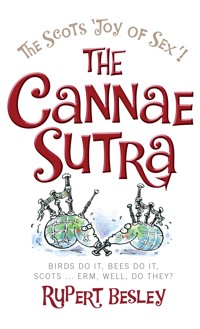
5,99 €
Mehr erfahren.
- Herausgeber: Birlinn
- Kategorie: Lebensstil
- Sprache: Englisch
'A stimulating read' – The Auchernach Free Post & Advertiser 'Deeply disturbing' – Auchintoul Gazette 'An accursed, dorty, reeky, drochlin, houremongerin, shaan abomination of a book' – Cluanie Thunderer 'Ban this book' – Inchgrundle Times 'Ceased trading' – Ardteatle News 'Manky, mawkit and downright clarty. My wife loved it! ' – Editor, The Dunfankle Free Press Birds do it. Bees do it. Scots – um . . . Well do they? All is revealed (well, not quite all – this is Scotland) in The Cannae Sutra, a ground-breaking exposé of the nation's best-kept secrets. Sex, it seems, is not what coal is delivered in in Morningside. The nation's best-kept bedroom secrets are laid bare in this full frontal, no-holds barred (but by no means serious) peek at what is under the kilt, on every Scotsman's mind and can be induced by too much Irn Bru and porridge. Just make sure you know your houtie-croutie from you elbuck before embarking upon a bout of houghmagandy. The book contains previously unpublished historical material along with helpful advice on ticklish subjects. Topics covered include: techniques, positions, rubberwear, bondage, group sex, sheep love, Scottish porn, secrets of the sporran, FAQs of Life, shortbread fingers, Gaelic symbols, cybersex, curling and socks.
Das E-Book können Sie in Legimi-Apps oder einer beliebigen App lesen, die das folgende Format unterstützen:
Veröffentlichungsjahr: 2017
Ähnliche

















The Cannae Sutra
ACKNOWLEDGEMENTS
With many thanks for their considerable contributions and support to Hugh Andrew, Lindsey and Marcus Besley, Laura Esselmont, Aline Hill, Jim Hutcheson, Andrew Simmons and others.
Material (carefully selected!) from the Get by in Gaelic section is reproduced by kind permission of Morag MacNeill from her book Everyday Gaelic.
First published in 2006 by
Birlinn Limited
West Newington House
10 Newington Road
Edinburgh EH9 1QS
www.birlinn.co.uk
Reprinted 2007, 2009, 2011
Text and illustrations copyright © Rupert Besley 2006
The moral right of Rupert Besley to be identified as the author of this work has been asserted by him in accordance with the Copyright, Designs and Patents Act 1988
All rights reserved. No part of this publication may be reproduced, stored or transmitted in any form without the express written permission of the publisher.
ISBN 13: 978 1 84158 484 3
British Library Cataloguing-in-Publication Data
A catalogue record for this book is available from the British Library
Designed and typeset by Robbie PorteousPrinted and bound in Poland
ERRATUM
Chapter 5: for porn read prawn
Contents
1. Preface
2. From the Beginning
3. Outlying Parts
4. For the Visitor
5. Scotland’s Porn Industry
6. The Joy of Sets
7. Literature & Art
8. Get by in Gaelic
9. The Music of Love
10. Sport for All
11. Beastly Companions
12. A to Z
13. FAQs
14. Words of Wisdom
15. Fun Page
16. Glossary
17. Index
1. Preface
SEX IN EDINBURGH, as everyone knows, is what the coal comes in. It’s tea-time in Morningside. It’s the instrument played by Charlie Parker. It’s something they do down south; it’s not what’s done in Scotland. Having sex is what happens four times a year, when the coalman delivers.
But there is more to Scotland than meets the aye. Scots have always been fond of their oats. Sex and Scotland may seem unlikely bed -fellows, but beneath the covers there is much to explore. Settle down somewhere comfortable. Loosen that straitjacket. And now read on.
2. From the Beginning
A SHORT HISTORY OF SEX IN SCOTLAND
SEX IN SCOTLAND was first discovered by Edinburgh-born Marie Stopes in the early part of the twentieth century. It was a discovery that upset a lot of people, including her husband Reginald. (Their marriage was annulled in 1916 after five years, on grounds of non-consummation.) Another to be rattled was Walter Blackie, the Glasgow publisher. As he put it to Marie Stopes when rejecting her manuscript for Married Love, ‘I think there’s far too much talking and writing about these things already.’
Twenty-five years on, Mr J.F. Coates, member for New South Wales, told the Australian Parliament, ‘The Empire today has three enemies – all from Munich. One is Hitler, the other Goebbels and the third that doctor of German philosophy and science - Dr Marie Stopes. The greatest of these is Marie Stopes.’
Stopes did not invent sex. She was just among the first to stop pretending it didn’t exist. With her PhD from Munich in palaeobotany, Dr Stopes would have known that sex has been knocking around an awful long time. Even in Scotland.
Early life-forms multiplied by simple fission. But breaking up is hard to do. Ever since the first speck of protozoa got the hots for its neighbour, sex has been the driving force of all that followed. That at least was how, through steamed-up glasses, Freud saw it.
At first all went swimmingly. Then along came the dinosaurs, rarely able to get their act together – so they died out.
The animal kingdom had another 60-odd million years in which to develop and refine the arts of sexual encounter to the level enjoyed by Stone-Age Man and little changed since.
PICTS, ROMANS AND NORSEMEN
CRUITHNE, SON OF CINGI, the father of the Picts, reigned for a hundred years. He had seven sons: Cat, Ce, Circinn, Fortran, Fotlaig, Fidach – and Fib.
The Picts were a hardy race, who wore no clothes, but painted themselves blue instead. They spent their time huddled over hot drinks in the Highlands, leaving cup and ring marks on every flat surface in Alba. Recent researches have cast doubt on these facts: Pictish carvings do show figures wearing clothes, as may also have been the case with some of the elephants, mermaids and serpents that lived alongside. Pictish inscriptions are in ogham, a system of lines and bars intelligible only at supermarket checkouts.
Don’t be fooled by the colosseum at Oban: the Romans were not a great success in the north. A few brave souls made it past Hadrian’s Wall to Falkirk. Here they put up another wall, 37 miles long but mainly of grass. A 12-foot high mound of turf was never going to halt marauding Picts in their tracks. Homesick and lovesick, with their fashionable outfits fast losing shape in the rain, the Romans retreated to Glasgow and Edinburgh, where they cleaned up in the ice-cream business instead.
Little is known about what went on in the Dark Ages. All we have is a few names and dates of early kings and sub-kings, from Fergus MacErc to Lulach the Fool. The House of Alpin and its immediate successors stuck mostly with Kenneths and Malcolms and Constantines, with the odd throat-clearing Aedh, Eochaid, Giric and Duff thrown in for good measure. The Vikings did a better line in names. They had earls of Orkney called Thorfinn Raven-Feeder and Sigurd the Stout.
William the Lyon (1143–1214, married to Ermengarde) was the man who brought the rearing lion into Scotland’s royal coat of arms, along with the motto, ‘Nemo me impune lacessit’ (‘No one gets away with calling me puny’ or ‘Wha daur meddle wi’ me?’). Replacing the earlier emblem (a boar) meant a trawl through the royal menagerie, and ended in a toss-up between rampant lion and rampant gerbil; the lion won.
The first signs of sexual awakening in Scotland date back to the medieval era, when days were cold and knights were bold. The religious houses (Ardchattan, Sweetheart, Nunraw) were among the first to get a name for such things.




