“The
discovery and decipherment of this Code is the greatest event in
Biblical Archæology for many a day. A translation of the Code,
done by Mr. Johns of Queens’ College, Cambridge, the highest living
authority on this department of study, has just been published by
Messrs. T. & T. Clark in a cheap and attractive booklet.
Winckler says it is the most important Babylonian record which has
thus far been brought to light.”—The
Expository Times.
INTRODUCTION
The
Code of Hammurabi is one of the most important monuments in the
history of the human race. Containing as it does the laws which
were enacted by a king of Babylonia in the third millennium B.C.,
whose rule extended over the whole of Mesopotamia from the mouths
of
the rivers Tigris and Euphrates to the Mediterranean coast, we must
regard it with interest. But when we reflect that the ancient
Hebrew tradition ascribed the migration of Abraham from Ur of the
Chaldees to this very period, and clearly means to represent their
tribe father as triumphing over this very same Hammurabi (Amraphel,
Gen. xiv. 1), we can hardly doubt that these very laws were part of
that tradition. At any rate, they must have served to mould and
fix the ideas of right throughout that great empire, and so form
the
state of society in Canaan when, five hundred years later, the
Hebrews began to dominate that region.Such
was the effect produced on the minds of succeeding generations by
this superb codification of the judicial decisions of past ages,
which had come to be regarded as ‘the right,’ that two thousand
years and more later it was made a text-book for study in the
schools
of Babylonia, being divided for that purpose into some twelve
chapters, and entitled, after the Semitic custom,
Nînu ilu sirum,
from its opening words. In Assyria also, in the seventh century
b.c., it was studied in a different edition, apparently under the
name of ‘The Judgments of Righteousness which Hammurabi, the great
king, set up.’ These facts point to it as certain to affect
Jewish views before and after the Exile, in a way that we may
expect
to find as fundamental as the Babylonian influence in cosmology or
religion.For
many years fragments have been known, have been studied, and from
internal evidence ascribed to the period of the first dynasty of
Babylon, even called by the name Code Hammurabi. It is just
cause for pride that Assyriology, so young a science as only this
year to have celebrated the centenary of its birth, is able to
emulate astronomy and predict the discovery of such bright stars as
this. But while we certainly should have directed our
telescopes to Babylonia for the rising of this light from the East,
it was really in Elam, at Susa, the old Persepolis, that the find
was
made. The Elamites were the great rivals of Babylonia for
centuries, and it seems likely that some Elamite conqueror carried
off the stone from a temple at Sippara, in Babylonia.However
that may be, we owe it to the French Government, who have been
carrying on explorations at Susa for years under the
superintendence
of M. J. de Morgan, that a monument, only disinterred in January,
has
been copied, transcribed, translated, and published, in a superb
quarto volume, by October. The ancient text is reproduced by
photogravure in a way that enables a student to verify word by word
what the able editor, Father V. Scheil,
Professeur à l’École des Hautes-Études,
has given as his reading of the archaic signs. The volume,
which appears as
Tome IV., Textes Élamites-Sémitiques,
of the
Mémoires de la Délégation en Perse
(Paris, Leroux, 1902), is naturally rather expensive for the
ordinary
reader. Besides, the rendering of the eminent French savant,
while distinguished by that clear, neat phrasing which is so
charming
a feature of all his work, is often rather a paraphrase than a
translation. The ordinary reader who desires to estimate for
himself the importance of the new monument will be forced to wonder
how and why the same word in the original gets such different
renderings. Prolonged study will be needed to bring out fully
the whole meaning of many passages, and it may conduce to such a
result to present the public with an alternative rendering in an
English dress. Needless to say, scholars will continue to use
Scheil’s edition as the ultimate source, but for comparative
purposes a literal translation may be welcome as an
introduction.The
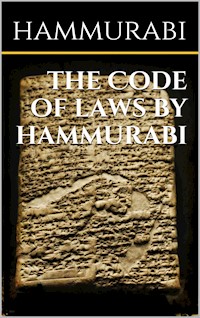
monument itself consists of a block of black diorite, nearly eight
feet high, found in pieces, but readily rejoined. It contains
on the obverse a very interesting representation of the King
Hammurabi, receiving his laws from the seated sun-god Šamaš, ‘the
judge of heaven and earth.’ Then follow, on the obverse,
sixteen columns of writing with 1114 lines. There were five
more columns on this side, but they have been erased and the stone
repolished, doubtless by the Elamite conqueror, who meant to
inscribe
his name and titles there. As we have lost those five columns
we may regret that he did not actually do this, but there is now no
trace of any hint as to who carried off the stone. On the
reverse side are twenty-eight columns with more than 2500 lines of
inscription.A
great space, some 700 lines, is devoted by the king to setting out
his titles, his glory, his care for his subjects, his veneration of
his gods, and incidentally revealing the cities and districts under
his rule, with many interesting hints as to local cults. He
also invokes blessing on those who should preserve and respect his
monument, and curses those who should injure or remove it. A
translation of this portion is not given, as it is unintelligible
without copious comment and is quite foreign to the purpose of this
book, which aims solely at making the Code intelligible.I
desire to express my obligations to Dr. F. Carr for his many kind
suggestions as to the meaning of the Code.The
Index will, it is hoped, serve more or less as a digest of the
Code.
One great difficulty of any translation of a law document must
always
be that the technical expressions of one language cannot be
rendered
in terms that are co-extensive. The rendering will have
implications foreign to the original. An attempt to minimise
misconceptions is made by suggesting alternative renderings in the
Index. Further, by labelling a certain section, as the law of
incest, for example, one definitely fixes the sense in which the
translation is to be read. Hence it is hoped that the Index
will be no less helpful than the translation in giving readers an
idea of what the Code really meant.No
doubt this remarkable monument will be made the subject of many
valuable monographs in the future, which will greatly elucidate
passages now obscure. But it was thought that the interest of
the subject warranted an immediate issue of an English translation,
which would place the chief features of the Code before a wider
public than those who could read the original. The present
translation is necessarily tentative in many places, but it is
hoped
marks an advance over those already published.Dr.
H. Winckler’s rendering of the Code came into my hands after this
work was sent to the publishers, and I have not thought it
necessary
to withdraw any of my renderings. In some points he has
improved upon Professor Scheil’s work, in other points he is
scarcely so good. But any discussion is not in place here.
I gratefully acknowledge my obligations to both, but have used an
independent judgment all through. I hope shortly to set out my
reasons for the differences between us in a larger work. A few
of Dr. Winckler’s renderings are quoted in the Index, and
marked—Winckler’s tr.C.
H. W. JOHNS.
THE TEXT OF THE CODE
§
1. If a man weave a spell and put a ban upon a man, and has not
justified himself, he that wove the spell upon him shall be put to
death.§
2. If a man has put a spell upon a man, and has not justified
himself, he upon whom the spell is laid shall go to the holy river,
he shall plunge into the holy river, and if the holy river overcome
him, he who wove the spell upon him shall take to himself his
house.
If the holy river makes that man to be innocent, and has saved him,
he who laid the spell upon him shall be put to death. He who
plunged into the holy river shall take to himself the house of him
who wove the spell upon him.§
3. If a man, in a case pending judgement, has uttered threats
against the witnesses, or has not justified the word that he has
spoken, if that case be a capital suit, that man shall be put to
death.§
4. If he has offered corn or money to the witnesses, he shall
himself bear the sentence of that case.§
5. If a judge has judged a judgement, decided a decision,
granted a sealed sentence, and afterwards has altered his
judgement,
that judge, for the alteration of the judgement that he judged, one
shall put him to account, and he shall pay twelvefold the penalty
which was in the said judgement, and in the assembly one shall
expel
him from his judgement seat, and he shall not return, and with the
judges at a judgement he shall not take his seat.§
6. If a man has stolen the goods of temple or palace, that man
shall be killed, and he who has received the stolen thing from his
hand shall be put to death.§
7. If a man has bought silver, gold, manservant or maidservant,
ox or sheep or ass, or anything whatever its name, from the hand of
a
man’s son, or of a man’s slave, without witness and bonds, or has
received the same on deposit, that man has acted the thief, he
shall
be put to death.§
8. If a man has stolen ox or sheep or ass, or pig, or ship,
whether from the temple or the palace, he shall pay thirtyfold.
If he be a poor man, he shall render tenfold. If the thief has
nought to pay, he shall be put to death.