


50,99 €
Mehr erfahren.
- Herausgeber: John Wiley & Sons
- Kategorie: Fachliteratur
- Sprache: Englisch
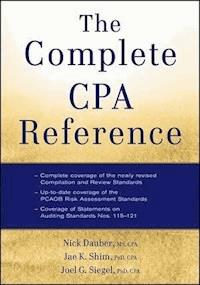
The newly updated fast-reference problem solver The Complete CPA Desk Reference--the convenient, comprehensive reference professionals have relied on for nearly fifteen years--is now updated in a new Fifth Edition to give today's busy executives and accountants the helpful information they need in a quick-reference format. Packed with practical techniques and rules of thumb for solving day-to-day accounting issues, the new edition helps you quickly pinpoint what to look for, what to watch out for, what to do, and how to do it. In an easy-to-use Q & A format, it covers such useful topics as IFRS standards, internal control over financial reporting financial measures, ratios, and procedures. * Includes complete coverage of the Risk Assessment Auditing Standards and Standards of the PCAOB * Incorporates Accounting Standards Codification (ASC) throughout the book * Adds new chapters on professional ethics and quality controls for CPA firms * Features a new section on International Financial Reporting Standards (IFRS) Packed with checklists, samples, and worked-out solutions to a variety of accounting problems, this reliable reference tool is a powerful companion for the complex, ever-changing world of accounting.
Sie lesen das E-Book in den Legimi-Apps auf:
Seitenzahl: 1002
Veröffentlichungsjahr: 2013
Ähnliche


















Contents
Cover
Title Page
Copyright
Dedication
About the Authors
Acknowledgments
Introduction
Part I: Commonly Used Generally Accepted Accounting Principles
CHAPTER 1: Financial Statement Reporting: The Income Statement
Income Statement Format
Comprehensive Income
Extraordinary Items
Nonrecurring Items
Discontinued Operations
Revenue Recognition
Other Revenue Considerations
Multiple Deliverables
Software Revenue Recognition
Research and Development Costs
Advertising Costs
Restructuring Charges
Other Expense Considerations
Earnings per Share
CHAPTER 2: Financial Statement Reporting: The Balance Sheet
Assets
Liabilities
Fair Value Measurements
Fair Value Option for Financial Assets and Financial Liabilities
Stockholders’ Equity
CHAPTER 3: Financial Statement Reporting: Statement of Cash Flows and Other Disclosures
Statement of Cash Flows
Personal Financial Statements
Incorporation of a Business
Partnerships
CHAPTER 4: Accounting and Disclosures
Hierarchy of GAAP
FASB Accounting Standards Codification
Accounting Changes
Prior-Period Adjustments
Disclosure of Accounting Policies
Development-Stage Companies
Troubled Debt Restructuring
Segmental Reporting
Imputing Interest on Notes
Accounting for Futures Contracts
Oil- and Gas-Producing Companies
CHAPTER 5: Key Financial Accounting Areas
Consolidations
Business Combinations
Investments in Securities
Equity Method
Leases
Pension Plans
Other Postretirement Benefits
Income Tax Accounting
Foreign Currency Translation and Transactions
Insurance Contracts
U.S. GAAP versus IFRS
Part II: Analyzing Financial Statements
Chapter 6: Financial Statement Analysis
Introduction
Horizontal and Vertical Analysis
Balance Sheet Analysis
Income Statement Analysis
Bankruptcy Prediction
Liquidation Value
Part III: Managerial Accounting Applications
Chapter 7: Appraising Segmental Performance
The What and Why of Responsibility Accounting
Cost Center Performance and Standard Costs
Flexible Budgets and Performance Reports
Profit Centers and Segmented Reporting
Profit Variance Analysis
How to Measure the Performance of Investment Centers
More on Economic Value Added
Corporate Balanced Scorecard
How to Price Goods and Services Transferred
Alternative Transfer Pricing Schemes
Budgeting and Financial Planning
Chapter 8: Analysis of Projects, Proposals, and Special Situations
Cost–Volume–Profit and Breakeven Analysis
Short-Term, Nonroutine Decisions
Theory of Constraints
Life-Cycle Costs and Target Costing
Activity-Based Costing
Just-in-Time and Total Quality Management
Taguchi Method of Quality Control
Backflush Costing
Environmental Costs and Ecoefficiency
Time Value Fundamentals
Capital Budgeting
MACRS Rule
Chapter 9: Quantitative Applications and Modeling in Accounting
Statistical Analysis and Evaluation
Regression Analysis
Trend Analysis
Regression Statistics
Quantitative Methods for Accounting
Decision Making
Linear Programming and Shadow Prices
Goal Programming and Multiple Goals
Learning Curve
Inventory Planning and Control
Program Evaluation and Review Technique
Project Budgeting and Control Using Earned Value Analysis
Part IV: Auditing, Compiling, and Reviewing Financial Statements
Chapter 10: Auditing Procedures
Risk Assessment Procedures
The Entity and Its Environment
Internal Control
Substantive Procedures
Audit Reports
CHAPTER 11: Compilation, Review, and Other Reporting Services
Compilation of Financial Statements
Review of Financial Statements
Accountant's Consideration of Obtaining an Updating Representation Letter from Management
Documentation in a Review Engagement
Restricting the Use of an Accountant's Compilation or Review Report
Consideration of an Entity's Ability to Continue as a Going Concern
Subsequent Events
Subsequent Discovery of Facts Existing at the Date of the Report
Change in Engagement from Audit or Review to Compilation
Reporting on Prescribed Forms
Communication between Successor and Predecessor Accountants
Compilation of Specified Elements, Accounts, or Items of a Financial Statement
Compilation of Pro Forma Financial Information
Communicating to Management and Others in a Compilation or Review Engagement
Reports on Prospective Financial Statements
Attest Engagements
Examination of an Entity's Internal Control over Financial Reporting That Is Integrated with an Audit of Its Financial Statements (SSAE 15)
Integration with the Financial Statement Audit
Reporting on Controls at a Service Organization
Compliance Attestation
Management's Discussion and Analysis
Personal Financial Statements Included in Written Personal Financial Plans
Reporting on Comparative Statements
Special Reports
CHAPTER 12: Auditing Standards
SAS 1—Codification of Auditing Standards and Procedures
SAS 2—Reports on Audited Financial Statements
SAS 3—The Effects of EDP on the Auditor's Study and Evaluation of Internal Control
SAS 4—Quality Control Considerations for a Firm of Independent Auditors
SAS 5—The Meaning of “Present Fairly in Conformity with Generally Accepted Accounting Principles” in the Independent Auditor's Report
SAS 6—Related Party Transactions
SAS 7—Communication between Predecessor and Successor Auditor
SAS 8—Other Information in Documents Containing Audited Financial Statements
SAS 9—The Effect of an Internal Audit Function on the Scope of the Independent Auditor's Examination
SAS 10—Limited Review of Interim Financial Information
SAS 11—Using the Work of a Specialist
SAS 12—Inquiry of a Client's Lawyer Concerning Litigation, Claims, and Assessments
SAS 13—Reports on a Limited Review of Interim Financial Information
SAS 14—Special Reports
SAS 15—Reports on Comparative Financial Statements
SAS 16—The Independent Auditor's Responsibility for the Detection of Errors or Irregularities
SAS 17—Illegal Acts by Clients
SAS 18—Unaudited Replacement Cost Information
SAS 19—Client Representations
SAS 20—Required Communication of Material Weaknesses in Internal Accounting Control
SAS 21—Segment Information
SAS 22—Planning and Supervision
SAS 23—Analytical Review Procedures
SAS 24—Review of Interim Financial Information
SAS 25—The Relationship of Generally Accepted Auditing Standards to Quality Control Standards
SAS 26—Association with Financial Statements
SAS 27—Supplementary Information Required by the Financial Accounting Standards Board
SAS 28—Supplementary Information on the Effects of Changing Prices
SAS 29—Reporting on Information Accompanying the Basic Financial Statements in Auditor-Submitted Documents
SAS 30—Reporting on Internal Accounting Control
SAS 31—Evidential Matter
SAS 32—Adequacy of Disclosure in Financial Statements
SAS 33—Supplementary Oil and Gas Reserve Information
SAS 34—The Auditor's Considerations When a Question Arises about an Entity's Continued Existence
SAS 35—Special Reports: Applying Agreed-Upon Procedures to Specified Elements, Accounts, or Items of a Financial Statement
SAS 36—Review of Interim Financial Information
SAS 37—Filings under Federal Securities Statutes
SAS 38—Letters for Underwriters
SAS 39—Audit Sampling
SAS 40—Supplementary Mineral Reserve Information
SAS 41—Working Papers
SAS 42—Reporting on Condensed Financial Statements and Selected Financial Data
SAS 43—Omnibus Statement on Auditing Standards
SAS 44—Special-Purpose Reports on Internal Accounting Control at Service Organizations
SAS 45—Omnibus Statement on Auditing Standards—1983
SAS 46—Consideration of Omitted Procedures after the Report Date
SAS 47—Audit Risk and Materiality in Conducting an Audit
SAS 48—The Effects of Computer Processing on the Audit of Financial Statements
SAS 49—Letters for Underwriters
SAS 50—Reports on the Application of Accounting Principles
SAS 51—Reporting on Financial Statements Prepared for Use in Other Countries
SAS 52—Omnibus Statement on Auditing Standards—1987
SAS 53—The Auditor's Responsibility to Detect and Report Errors and Irregularities
SAS 54—Illegal Acts by Clients
SAS 55—Consideration of Internal Control in a Financial Statement Audit
SAS 56—Analytical Procedures
SAS 57—Auditing Accounting Estimates
SAS 58—Reports on Audited Financial Statements
SAS 59—The Auditor's Consideration of an Entity's Ability to Continue as a Going Concern
SAS 60—Communication of Internal Control Related Matters Noted in an Audit
SAS 61—Communication with Audit Committees
SAS 62—Special Reports
SAS 63—Compliance Auditing Applicable to Governmental Entities and Other Recipients of Governmental Financial Assistance
SAS 64—Omnibus Statement on Auditing Standards
SAS 65—The Auditor's Consideration of the Internal Audit Function in an Audit of Financial Statements
SAS 66—Communication of Matters about Interim Financial Information Filed or to Be Filed with Specified Regulatory Agencies
SAS 67—The Confirmation Process
SAS 68—Compliance Auditing Applicable to Governmental Entities and Other Recipients of Governmental Financial Assistance
SAS 69—The Meaning of Present Fairly in Conformity with Generally Accepted Accounting Principles in the Independent Auditor's Report
SAS 70—Service Organizations
SAS 71—Interim Financial Information
SAS 72—Letters for Underwriters and Certain Other Requesting Parties
SAS 73—Using the Work of a Specialist
SAS 74—Compliance Auditing Considerations in Audits of Governmental Entities and Recipients of Governmental Financial Assistance
SAS 75—Engagements to Apply Agreed-Upon Procedures to Specified Elements, Accounts, or Items of a Financial Statement
SAS 76—Amendments to Statement on Auditing Standards No. 72, Letters for Underwriters and Certain Other Requesting Parties
SAS 77—Amendments to Statements on Auditing Standards No. 22, Planning and Supervision; No. 59, The Auditor's Consideration of an Entity's Ability to Continue as a Going Concern; and No. 62, Special Reports
SAS 78—Consideration of Internal Control in a Financial Statement Audit: An Amendment to SAS 55
SAS 79—Amendment to Statement on Auditing Standards No. 58, Reports on Audited Financial Statements
SAS 80—Amendment to Statement on Auditing Standards No. 31, Evidential Matter
SAS 81—Auditing Investments
SAS 82—Consideration of Fraud in a Financial Statement Audit
SAS 83—Establishing an Understanding with the Client
SAS 84—Communications between Predecessor and Successor Accountants
SAS 85—Management Representations
SAS 86—Amendment to Statement on Auditing Standards No. 72, Letters for Underwriters and Certain Other Requesting Parties
SAS 87—Restricting the Use of an Auditor's Report
SAS 88—Service Organizations and Reporting on Consistency
SAS 89—Audit Adjustments
SAS 90—Audit Committee Communications
SAS 91—Federal GAAP Hierarchy
SAS 92—Auditing Derivative Instruments, Hedging Activities, and Investments in Securities
SAS 93—Omnibus Statement on Auditing Standards—2000
SAS 94—The Effect of Information Technology on the Auditor's Consideration of Internal Control in a Financial Statement Audit
SAS 95—Generally Accepted Auditing Standards
SAS 96—Audit Documentation
SAS 97—Amendment to Statement on Auditing Standards No. 50, Reports on the Application of Accounting Principles
SAS 98—Omnibus Statement on Auditing Standards—2002
SAS 99—Consideration of Fraud in a Financial Statement Audit
SAS 100—Interim Financial Information
SAS 101—Auditing Fair Value Measurements and Disclosures
SAS 102—Defining Professional Requirements in Statements on Auditing Standards
SAS 103—Audit Documentation
SAS 104—Amendment to SAS 1, Codification of Auditing Standards and Procedures (“Due Professional Care in the Performance of Work”)
SAS 105—Amendment to SAS 95—Generally Accepted Auditing Standards
SAS 106—Audit Evidence
SAS 107—Audit Risk and Materiality in Conducting an Audit
SAS 108—Planning and Supervision
SAS 109—Understanding the Entity and Its Environment and Assessing the Risks of Material Misstatement
SAS 110—Performing Audit Procedures in Response to Assessed Risks and Evaluating the Audit Evidence Obtained
SAS 111—Amendment to Statement on Auditing Standards No. 39, Audit Sampling
SAS 112—Communication of Internal Control–Related Matters Identified in an Audit
SAS 113—Omnibus 2006
SAS 114—The Auditor's Communication with Those Charged with Governance
SAS 115—Communicating Internal Control Related Matters Identified in an Audit
SAS 116—Interim Financial Information
SAS 117—Compliance Audits
SAS 118—Other Information in Documents Containing Audited Financial Statements
SAS 119—Supplementary Information in Relation to the Financial Statements as a Whole
SAS 120—Required Supplementary Information
SAS 121—Revised Applicability of Statement on Auditing Standards No. 100, Interim Financial Information
AS 1—References in Auditor's Reports to the Standards of the Public Company Accounting Oversight Board
AS 2—An Audit of Internal Control over Financial Reporting Performed in Conjunction with an Audit of Financial Statements
AS 3—Audit Documentation
AS 4—Reporting on Whether a Previously Reported Material Weakness Continues to Exist
AS 5—An Audit of Internal Control over Financial Reporting That Is Integrated with an Audit of Financial Statements
AS 6—Evaluating Consistency of Financial Statements
AS 7—Engagement Quality Review
AS 8—Audit Risk
AS 9—Audit Planning
AS 10—Supervision of the Audit Engagement
AS 11—Consideration of Materiality in Planning and Performing an Audit
AS 12—Identifying and Assessing Risks of Material Misstatements
AS 13—The Auditor's Responses to the Risks of Material Misstatement
AS 14—Evaluating Audit Results
AS 15—Audit Evidence
Chapter 13: Sarbanes-Oxley Act of 2002
Auditor Independence
Partner Rotation
Public Company Accounting Oversight Board
Part V: Taxation
Chapter 14: Tax Research
Sources of Tax Law
The Court System
Part VI: Other Professional Standards
Chapter 15: Consulting Services
Chapter 16: Quality Control
Chapter 17: Code of Professional Conduct
Rule 101—Independence
Rule 102—Integrity and Objectivity
Rule 201—General Standards
Rule 202—Compliance with Standards
Rule 203—Accounting Principles
Rule 301—Confidential Client Information
Rule 302—Contingent Fees
Rule 501—Acts Discreditable
Rule 502—Advertising and Other Forms of Solicitations
Rule 503—Commissions and Referral Fees
Rule 505—Form of Organization and Name
Index
Copyright © 2012 by John Wiley & Sons, Inc. All rights reserved.
Published by John Wiley & Sons, Inc., Hoboken, New Jersey. Fourth edition (The Vest Pocket CPA) published in 2008 by John Wiley & Sons, Inc. Published simultaneously in Canada.
No part of this publication may be reproduced, stored in a retrieval system, or transmitted in any form or by any means, electronic, mechanical, photocopying, recording, scanning, or otherwise, except as permitted under Section 107 or 108 of the 1976 United States Copyright Act, without either the prior written permission of the Publisher, or authorization through payment of the appropriate per-copy fee to the Copyright Clearance Center, Inc., 222 Rosewood Drive, Danvers, MA 01923, (978) 750-8400, fax (978) 646-8600, or on the web at www.copyright.com. Requests to the Publisher for permission should be addressed to the Permissions Department, John Wiley & Sons, Inc., 111 River Street, Hoboken, NJ 07030, (201) 748-6011, fax (201) 748-6008, or online at http://www.wiley.com/go/permissions.
Limit of Liability/Disclaimer of Warranty: While the publisher and author have used their best efforts in preparing this book, they make no representations or warranties with respect to the accuracy or completeness of the contents of this book and specifically disclaim any implied warranties of merchantability or fitness for a particular purpose. No warranty may be created or extended by sales representatives or written sales materials. The advice and strategies contained herein may not be suitable for your situation. You should consult with a professional where appropriate. Neither the publisher nor author shall be liable for any loss of profit or any other commercial damages, including but not limited to special, incidental, consequential, or other damages.
For general information on our other products and services or for technical support, please contact our Customer Care Department within the United States at (800) 762-2974, outside the United States at (317) 572-3993 or fax (317) 572-4002.
Wiley also publishes its books in a variety of electronic formats. Some content that appears in print may not be available in electronic books. For more information about Wiley products, visit our web site at www.wiley.com.
Library of Congress Cataloging-in-Publication Data:
Dauber, Nick A.
The complete CPA reference / Nick A. Dauber, Jae K. Shim, Joel G. Siegel.
p. cm.
Includes bibliographical references and index.
ISBN 978-1-118-11588-6 (cloth); ISBN 978-1-118-22440-3 (ebk);
ISBN 978-1-118-23761-8 (ebk); ISBN 978-1-118-26252-8 (ebk)
1. Accounting--Handbooks, manuals, etc.I. Shim, Jae K.II. Siegel, Joel G.III. Title.
HF5636.D377 2012
657--dc23
2011041537
To Karen J. Dauber Loving wife and dear friend Katie and Michael Dauber Precious children Margie, Marc, and Susan Dauber Loving and wonderful mother, father, and sister and Roberta Siegel Loving wife and colleague Philip E. Levine Dear and precious friend and Chung Shim Dedicated wife
About the Authors
NICK A. DAUBER, MS, CPA, is an accounting practitioner specializing in auditing and taxation. Prior to starting his practice more than 25 years ago, he was an audit and tax manager at a CPA firm.
Mr. Dauber is also an instructor of auditing and taxation at Queens College of the City University of New York. He was the president of Person-Wolinsky CPA Review Courses and has instructed over 100,000 CPA Exam candidates during the past 31 years. Mr. Dauber was the writer of the review course's auditing and taxation material and served as the editor of the law and financial accounting material.
In 1992, Mr. Dauber was named Professor of the Year at Queens College of the City University of New York and was recipient of the Golden Apple Award bestowed by the Golden Key National Honor Society. He has also served as an award-winning lecturer in auditing and taxation for the Foundation for Accounting Education at the New York State Society of CPAs as well as for the American Institute of Certified Public Accountants.
Mr. Dauber has served as a book reviewer for major book publishers and has published articles in many professional accounting journals, including the CPA Journal (New York), Massachusetts CPA, Virginia Accountant Quarterly, and National Public Accountant.
Books by Mr. Dauber include The Complete Guide to Auditing Standards and Other Professional Standards for Accountants, Corporate Controller's Handbook of Financial Management, and Barron's How to Prepare for the CPA Exam. He has also been a contributor to professional books in accounting and auditing.
JAE K. SHIM, PhD, is one of the most prolific accounting and finance experts in the world. He is a professor of accounting and finance at California State University, Long Beach, and CEO of Delta Consulting Company, a financial consulting and training firm. Dr. Shim received his MBA and PhD degrees from the University of California at Berkeley (Haas School of Business). He has been a consultant to commercial and nonprofit organizations for over 30 years.
Dr. Shim has over 50 college and professional books to his credit, including Barron's Accounting Handbook, Barron's Dictionary of Accounting Terms, 2012 GAAP: Handbook of Policies and Procedures, Budgeting Basics and Beyond, 2011–2012 Corporate Controller's Handbook of Financial Management, US Master Finance Guide, Uses and Analysis of Financial Statements, Investment Sourcebook, Dictionary of Real Estate, Dictionary of International Investment Terms, Dictionary of Business Terms, The Vest-Pocket CPA, The Vest-Pocket CFO, and the best-selling Vest-Pocket MBA.
Thirty of his publications have been translated into foreign languages such as Chinese, Spanish, Russian, Polish, Croatian, Italian, Japanese, and Korean. Professor Shim's books have been published by Commerce Clearing House, Barron’s, John Wiley & Sons, McGraw-Hill, Prentice Hall, Penguin Portfolio, Thomson Reuters, Global Publishing, American Management Association (Amacom), and the American Institute of Certified Public Accountants (AICPA).
Dr. Shim has also published numerous articles in professional and academic journals. He was the recipient of the Financial Management Association International's 1982 Credit Research Foundation Award for his article on cash flow forecasting and financial modeling.
Dr. Shim has been frequently quoted by such media as the Los Angeles Times, the Orange County Register, Business Start-Ups, Personal Finance, and Money Radio.
JOEL G. SIEGEL, PhD, CPA, is professor of accounting and finance at Queens College of the City University of New York. He is also an accounting practitioner to various clients.
Dr. Siegel was previously a member of the audit staff of Coopers & Lybrand, CPAs, and a faculty resident with Arthur Andersen, CPAs. He has acted as a consultant in accounting issues to many organizations, including International Telephone & Telegraph, United Technologies, Person-Wolinsky CPA Review Courses, and Citicorp.
Dr. Siegel is the author of 67 books and approximately 300 articles on accounting topics. His books have been published by Prentice Hall, McGraw-Hill, John Wiley & Sons, Barron’s, Richard Irwin, Probus, Macmillan, HarperCollins, International Publishing, Southwestern, Commerce Clearing House, the American Management Association, and the American Institute of Certified Public Accountants.
His work has been published in numerous accounting and financial journals, including Massachusetts CPA, Ohio CPA, Michigan CPA, Virginia Accountant Quarterly, Delaware CPA, the CPA Journal, National Public Accountant, Financial Executive, and the Financial Analysts Journal.
In 1972, he was the recipient of the Outstanding Educator of America Award. He is listed in Who's Who Among Writers and Who's Who in the World. He is the former chairperson of the National Oversight Board.
Acknowledgments
Permission to quote from the Audit and Accounting Manual, Professional Standards, Statements on Auditing Standards, Statements on Standards for Accounting and Review Services, Statements on Standards for Attestation Engagements, and the May 1983 Auditing CPA Exam (Question 5) was received from the American Institute of Certified Public Accountants (AICPA). Copyright by the American Institute of Certified Public Accountants, 1211 Avenue of the Americas, New York, New York 10036.
Permission to reprint Example 1 of Appendix C (pages 44–51) of FASB Statement 95, Statement of Cash Flows, and the example on page 32 of FASB Statement 96, Accounting for Income Taxes, was received from the Financial Accounting Standards Board. Copyright by the Financial Accounting Standards Board, High Ridge Park, Stamford, CT 06905. Reprinted with permission. Copies of the complete document are available from the Financial Accounting Standards Board.
Introduction
The Complete CPA Reference is a useful reference and problem solver for today's busy certified public accountant (CPA). Organized in a handy question-and-answer format, it will help you quickly pinpoint:
What to look forWhat to watch out forWhat to doHow to do itThis valuable book will guide you through the complex, ever-changing world of accounting. You'll find financial measures, ratios, procedures, techniques, and rules of thumb to help you analyze, evaluate, and solve most accounting-related problems as they come up. Throughout, you'll find this book practical, quick, comprehensive, and useful. Carry it with you for constant reference wherever you go—on a business trip, visiting a client's office, meeting corporate executives, and at your office. The content of the book applies to public and private accountants whether employed by large, medium-size, or small firms. The uses for this book are as varied as the topics presented.
This practical reference contains the latest information on proven approaches and techniques for understanding and solving problems of:
Financial accountingFinancial statement analysisFinancial planningManagerial accountingQuantitative analysis and modelingAuditingTaxationPart I takes you through accounting principles, financial reporting requirements, disclosures, and specialized accounting topics, to keep you up to date with generally accepted accounting principles (GAAP). It points out differences between U.S. GAAP and International Financial Reporting Standards (IFRS) where applicable. FASB Accounting Standards Codification is referenced throughout this part.
Part II examines the financial health and operating performance of a business entity. You'll learn about:
Analytical tools used in appraising a company as a basis for determining the extent of audit testing, financial reliance on testing, and going-concern problemsThe viability of a targeted company for a mergerAchievement of optimal investment return while controlling riskInvestment analysis techniquesPart III presents internal accounting applications to help you:
Evaluate your own company's performance, profitability, effectiveness, efficiency, marketing, and budgeting processes.Highlight problem areas with variance analysis.Move your company toward greater profits through breakeven analysis.Apply quantitative decision modeling.Guidelines are presented for evaluating proposals, whether they are short-term or long-term, for profit potential and risk-return comparison. Operations research, quantitative, and modeling techniques are clearly presented so that the accountant can use up-to-date approaches in solving business problems.
Part IV relates to audit planning, procedures, and reporting. The chapters address means of gathering audit evidence, evaluating internal control, appraising financial statement items, and preparing audit work papers, and discuss review and compilation services. The practitioner is provided with a handy guide for designing audit plans. There are checklists to assist the auditor in developing work programs for any client environment. Chapter guides the practitioner through the many Statements on Auditing Standards (SASs) and Auditing Standards (ASs) of the Public Company Accounting Oversight Board and exposes him or her to the many types of reports pertinent to various engagements. Given a standard report, the practitioner can prepare modifications with a minimum of effort. The pronouncements relevant to the various reporting situations have been streamlined for easier application. Chapter discusses the major provisions of the Sarbanes-Oxley Act from the practitioner's point of view.
Part V applies to conducting income tax research.
Part VI addresses other professional standards. Specifically, the practitioner is provided guidance in connection with consulting services, quality control, and the AICPA Code of Professional Conduct.
The Complete CPA Reference provides instant answers to any accounting or finance question you may have.
The content of the book is clear, concise, and current. It is a valuable reference tool with guidelines, checklists, illustrations, step-by-step instructions, practical applications, and how-to's for you, the up-to-date, knowledgeable accountant. Keep this book handy for easy reference and daily use.
PART I
Commonly Used Generally Accepted Accounting Principles
CHAPTER 1
Financial Statement Reporting: The Income Statement
The reporting requirements of the income statement, balance sheet, statement of changes in cash flows, and interim reporting guidelines must be carefully examined. Individuals preparing personal financial statements have to follow certain unique reporting requirements, as do those who are accounting for a partnership. Points to note are:
Income statement preparation involves proper revenue and expense recognition. The income statement format is highlighted in this chapter along with the earnings per share computation.Balance sheet reporting covers accounting requirements for the various types of assets, liabilities, and stockholders’ equity.The statement of cash flows presents cash receipts and cash payments classified according to investing, financing, and operating activities. Disclosure is also provided for certain noncash investment and financial transactions. A reconciliation is provided between reported earnings and cash flow from operations.Interim financial reporting allows for some departures from annual reporting, such as the gross profit method to estimate inventory. The tax provision is based on the effective tax rate expected for the year.Personal financial statements show the worth of the individual. Assets and liabilities are reflected at current value in the order of maturity.This chapter deals with the reporting requirements on the income statement. Chapter 2 deals with the balance sheet, and Chapter 3 covers the remaining statements.
Income Statement Format
With respect to the income statement, the certified public accountant (CPA)'s attention is addressed to:
Income statement formatComprehensive incomeExtraordinary itemsNonrecurring itemsDiscontinued operationsRevenue recognition methodsAccounting for research and development costsPresentation of earnings per shareHow are items on the income statement arranged?
In the preparation of the income statement, continuing operations are presented before discontinued operations.
Starting with income from continuing operations, the format of the income statement is:
Lesen Sie weiter in der vollständigen Ausgabe!
Lesen Sie weiter in der vollständigen Ausgabe!
Lesen Sie weiter in der vollständigen Ausgabe!
Lesen Sie weiter in der vollständigen Ausgabe!
Lesen Sie weiter in der vollständigen Ausgabe!
Lesen Sie weiter in der vollständigen Ausgabe!
Lesen Sie weiter in der vollständigen Ausgabe!
Lesen Sie weiter in der vollständigen Ausgabe!
Lesen Sie weiter in der vollständigen Ausgabe!
Lesen Sie weiter in der vollständigen Ausgabe!
Lesen Sie weiter in der vollständigen Ausgabe!
Lesen Sie weiter in der vollständigen Ausgabe!
Lesen Sie weiter in der vollständigen Ausgabe!
Lesen Sie weiter in der vollständigen Ausgabe!
Lesen Sie weiter in der vollständigen Ausgabe!
Lesen Sie weiter in der vollständigen Ausgabe!
Lesen Sie weiter in der vollständigen Ausgabe!
Lesen Sie weiter in der vollständigen Ausgabe!
Lesen Sie weiter in der vollständigen Ausgabe!
Lesen Sie weiter in der vollständigen Ausgabe!
Lesen Sie weiter in der vollständigen Ausgabe!
Lesen Sie weiter in der vollständigen Ausgabe!
Lesen Sie weiter in der vollständigen Ausgabe!




