


6,99 €
Mehr erfahren.
- Herausgeber: Atlantic Books
- Kategorie: Geisteswissenschaft
- Sprache: Englisch
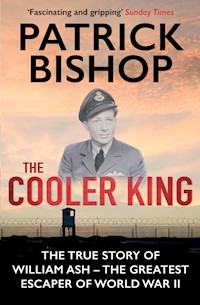
A thrilling tale of incredible courage and resilience, a true wartime story of William Ash. The Cooler King is at once uplifting and inspirational, and stands as a testament to the durability of decent values and the invincible spirit of liberty. The Cooler King tells the astonishing story of William Ash, an American flyer brought up in Depression-hit Texas, who after being shot down in his Spitfire over France in early 1942 spent the rest of the war defying the Nazis by striving to escape from every prisoner of war camp in which he was incarcerated. Alongside William Ash is a cast of fascinating characters, including Douglas Bader, Roger Bushell, who would go on to lead the Great Escape, and Paddy Barthropp, a dashing Battle of Britain pilot who despite his very different background became Ash's best friend and shared many of his adventures. Using contemporary documents and interviews with Ash's comrades, Patrick Bishop vividly recreates the multiple escape attempts, while also examining the P.O.W. experience and analysing the passion that drove some prisoners to risk death in repeated bids for freedom.
Das E-Book können Sie in Legimi-Apps oder einer beliebigen App lesen, die das folgende Format unterstützen:
Veröffentlichungsjahr: 2015
Ähnliche



















THE COOLER KING
Also by Patrick Bishop
NON-FICTION
The Reckoning
Wings
Target Tirpitz
Ground Truth
Battle of Britain
3 Para
Bomber Boys
Fighter Boys
The Irish Empire
The Provisional IRA
The Winter War
FICTION
Follow Me Home
A Good War
First published in hardback in Great Britain in 2015 by
Atlantic Books, an imprint of Atlantic Books Ltd.
Copyright © Patrick Bishop 2015
The moral right of Patrick Bishop to be identified as the author of this work has been asserted by him in accordance with the Copyright, Designs and Patents Act of 1988.
All rights reserved. No part of this publication may be reproduced, stored in a retrieval system, or transmitted in any form or by any means, electronic, mechanical, photocopying, recording, or otherwise, without the prior permission of both the copyright owner and the above publisher of this book.
1 2 3 4 5 6 7 8 9
A CIP catalogue record for this book is available from the British Library.
Hardback ISBN: 978-1-78239-022-0
E-book ISBN: 978-1-78239-024-4
Paperback ISBN: 978-1-78239-025-1
The publisher and author wish to thank the following for permission to reproduce copyright material: Under the Wire by William Ash with Brendan Foley, published by Bantam Press, reprinted by permission of The Random House Group Limited; A Red Square by William Ash, published by Howard Baker, reprinted by permission of the Estate of William Ash and Brendan Foley; Reach for the Sky by Paul Brickhill, published by Weidenfeld and Nicolson, reprinted by permission of the author’s estate; Moving Tent by Richard Passmore, extract reprinted with thanks to Thomas Harmsworth Publishing; A Gallant Company by Jonathan F. Vance, published by Pacifica Military History, reprinted by permission of the author. Every effort has been made to trace or contact all copyright holders. The publishers will be pleased to make good any omissions or rectify any mistakes brought to their attention at the earliest opportunity.
Text design by Richard Marston
Printed in Great Britain
Atlantic Books
An Imprint of Atlantic Books Ltd
Ormond House
26–27 Boswell Street
London WCIN 3Jz
www.atlantic-books.co.uk
To Nina
CONTENTS
Acknowledgements
Illustrations
Prologue
One
Two
Three
Four
Five
Six
Seven
Eight
Nine
Ten
Eleven
Twelve
Thirteen
Fourteen
Fifteen
Epilogue
Notes
Index
A Note About the Author
ACKNOWLEDGEMENTS
I would like to thank Bill Ash’s widow Ranjana Sidhanta and his friend and collaborator Brendan Foley for generously allowing me to quote from his publications and reproduce photographs from his early years. I am also grateful to Juliet Ash for sharing memories of her father and to Betty Barthropp for talking to me about her late husband Paddy’s friendship with Bill. The staffs of the National Archives, the Imperial War Museum, the London Library and the Bishopsgate Institute were helpful and efficient.
The work has been made easier and more pleasurable by the professionalism of the Atlantic team, in particular my editor James Nightingale and copyeditor Will Atkins who saved me from many errors.
I would also indebted to my friend Annabel Merullo for shepherding the project through, from inception to realization.
ILLUSTRATIONS
SECTION ONE
The formal portrait Bill sent home in 1941. (Courtesy of Brendan Foley)
Bill with his sister Adele at home in Dallas in 1925. (Courtesy of Brendan Foley)
Bill during training. (Courtesy of Brendan Foley)
At the controls of his Spitfire in late 1941. (Courtesy of Brendan Foley)
Canadian Prime Minister Mackenzie King greets Bill during a visit to 411 Squadron. (Courtesy of Brendan Foley)
The squadron at Digby.
At dispersal, waiting for action, Digby, late summer 1941. (Courtesy of Brendan Foley)
411 pilots just before or after an operation.
Squadron Leader Stan Turner.
Bill is entertained by Buck McNair. (Courtesy of Brendan Foley)
The church at Vieille Église today. (Patrick Bishop)
The house where the Boulanger family once had their estaminet. (Patrick Bishop)
The cover of Bill’s prisoner-of-war file at Stalag Luft III. (Courtesy of Brendan Foley)
Paddy Barthropp.
Sketch map of Stalag Luft III. (The National Archives)
SECTION TWO
Stalag Luft III, c. 1944. (Keystone/Hulton Archive/Getty Images)
Watchtower at Stalag Luft III, c. 1942. (Hulton Archive/Getty Images)
Robert Kee, 1951. (John Chillingworth/Picture Post/Getty Images)
Wing Commander Harry Day briefs Kenneth Moore for his role as Douglas Bader in Reach for the Sky (1955). (Kurt Hutton/Picture Post/Getty Images)
Prisoners laying the foundations for a hut in Stalag Luft III. (Hulton Archive/Getty Images)
Prisoners in a hut in Stalag Luft III, 1943. (Keystone/Getty Images)
Prisoners and camp staff in the Red Cross parcel store, Stalag Luft III. (© IWM, HU 20926)
Prisoners prepare a news sheet, Stalag Luft III. (© IWM, HU 20928)
Prisoners tend their garden at Stalag Luft III. (© IWM, HU 20930)
A church service for POWs at Stalag Luft III, c. 1944. (Hulton Archive/Getty Images)
An American military funeral at Stalag Luft III, February 1945. (Topfoto/The Granger Collection, New York)
The avenue leading away from Stalag Luft III. (© James Finlay, www.jamesfinlay.com)
Halbau today. (© James Finlay, www.jamesfinlay.com)
Liberated POWs at Marlag und Milag Nord at Westertimke, 29 April 1945. (© IWM, BU 4835)
Release of prisoners in Westertimke Camp, 5 May 1945. (Keystone-France/Gamma-Keystone via Getty Images)
Steve McQueen in The Great Escape (1963). (© John Springer Collection/Corbis)
‘The real escaper is more than a man equipped with compass, maps, papers, disguise and a plan. He has an inner confidence, a serenity of spirit which make him a Pilgrim.’
Airey Neave, Colditz escaper
PROLOGUE
The Spitfire slithered to a halt. For a few seconds he savoured the wonderful silence. He opened his eyes. Framed in the windshield in front of his face was the outline of a church tower. The church seemed to be upside down. He realized that he was hanging, inverted by the straps of his safety harness. He felt for the triangular release catch, pressed, and slumped onto the soft earth. He had jettisoned the perspex canopy just before the landing. It made getting out a lot easier. He could smell petrol and hear the tick of hot aluminium. He knew what was likely to come next: a sickening whoompf and an explosion of flame. He wriggled through the gap between the humped fuselage and the ground, rolled clear and staggered upright. He raised his arms and cautiously clenched and unclenched his hands. Amazingly, he felt OK.
He looked back at the wreckage of the Spitfire, which lay there like a spent comet, trailing a long tail of churned dirt. A thought floated through his head, something they drummed into him during training: In the case of a crash landing in hostile territory it is vital to ensure that your aircraft does not fall intact into enemy hands. There was no danger of that. The airframe was bent, the wings were torn from their roots and the propeller blades twisted like wrought iron.
The sound of an aeroplane engine made him look up. One of the German fighters was circling, checking whether he had survived the crash. He felt the pilot’s eyes locking onto him and looked around frantically for somewhere to hide. Across the field lay the church and a line of houses. The pilot would be radioing back to his base at Saint-Omer, reporting the Spitfire’s last resting place. He set off, jogging across the furrows towards the cover of the village. The heavy clay stuck to his boots, turning his limbs to lead, as if he was running in a nightmare.
The village had just a single street. The houses either side were low and built of dull red brick with thick wooden shutters framing the windows. It was two o’clock in the afternoon yet nobody was about. The place was as deserted as a ghost town in his native Texas. The German plane had cleared off, its engine note fading to a distant pulse. The silence that followed felt sinister. It was broken by a rusty creaking. The front door of one of the cottages opened. In the doorway stood a little girl, about nine or ten years old, he guessed. She stepped forward, beckoning to him.
He took a few paces back. It seemed wrong to involve her in his drama. Yet she kept walking towards him, holding out her hand. Instinctively he reached out and took it. She turned round and led him towards the house.
The door shut behind him. He was in a small, dim room. In the gloom he made out the shape of a woman, youngish and attractive, with a sad, kind face. She smiled and beckoned him to follow her as she climbed the stairs.
He tried to remember some of the little French he had learned at school and could only come up with ‘bonjour’. He felt a need to talk, to explain who he was, although it must have been obvious, speaking urgently in English, even though it was clear she didn’t understand a word. She pressed a finger to her lips and he got the message and shut up. Then she tugged at his tunic, opened a wardrobe and pulled out a man’s jacket and some trousers – her husband’s? Her brother’s? He stifled the impulse to ask.
He took off his flying jacket and boots. As he went to pull down his trousers, he saw mother and daughter watching him, and a foolish spurt of modesty made him hesitate. The woman jabbed a finger at the window, motioning for him to hurry before the Germans arrived. He dropped his trousers and pulled on the new pair. They were a bit short but otherwise OK. The little girl clapped. The black jacket was a tight fit but it would have to do. The woman reached again into the wardrobe and bought out a pair of boots and some wooden clogs. He chose the clogs, thinking they would look more authentic. A few seconds later he was regretting it as he clopped unsteadily back down the stairs.
After the horrors of the last half-hour he felt tears pricking his eyes at such unconditional kindness. He had neither the words nor the time to pour out his thanks. Impulsively he gave the woman a quick, heartfelt hug, and kissed the little girl. They led him to the back door. Behind a small garden lay flat fields. He hurried away with no idea where he was heading. He looked back. The door was already closed, as if his saviours had never existed.
It was the end of March. The land looked drab and dead. It was flat and watery, criss-crossed by drainage ditches. Between the ridged planes of the fields stood lines of bare poplars, stabbing like rows of spears into the vaulting grey sky.
To the left of the house was a hedge and behind it a lane ran south of the village. He walked purposefully, not too fast, not too slow, a man with things to do and a home to go to. Over the fields drifted the sound of clashing gears. He looked back. A lorry was driving into the village and behind it a motorcycle with a grey-helmeted rider. The black peasant jacket and the clogs no longer felt like any protection. He had to get out of sight. There was a channel running along the side of the road, a drainage ditch or a narrow canal. He remembered from trips to the movies in Dallas how escapees from chain gangs waded down rivers to throw the bloodhounds off the scent.
He slithered down the bank. The water was cold and slimy. It stank dreadfully. He was standing waist-deep in the village sewer. He waded southwards, crouching down below the bank until he was out of sight of the houses. When he could stand the stench no more he climbed out and trudged across fields and ditches, avoiding anywhere where he might encounter humans.
At six o’clock it was getting dark. He was exhausted, hungry, cold and soaking wet. An isolated copse, etched black against the sinking sun, offered a possible sanctuary for the night. He ducked under the bare branches, stretched out on the mulch of dead leaves and closed his eyes. It was Tuesday, 24 March 1942. In the space of a few hours Flying Officer William Ash’s war had changed utterly.
ONE
The men’s boots crunched softly on the sandy track. It was a midsummer day in June, 1942 but here, deep in the forest, the air was cool and the sun barely penetrated the pine woods that stretched out into infinity on either side of the path. They rounded a bend and there, rising out of a vast clearing, stood the camp. It was a forlorn sight. Rows of grey-green wooden huts lay in neat lines surrounded by tall barbed-wire fences. Watchtowers had been erected at regular intervals around the perimeter from which guards leaned over their machine guns and looked down impassively at the new arrivals.
The men halted at the entrance while their escort consulted with the sentries. Then the gates swung open. The men marched through, shoulders back, arms swinging, in an effort to show they were not beaten yet. A depressing rattle of chains and padlocks confirmed the new reality. They had reached the end of their journey into captivity. From now on the boundaries of their lives would extend no further than the wire walls of Stalag Luft III.
It had taken William Ash more than two months to get there. After crash-landing his Spitfire in a field close to the church in the village of Vieille-Église in the flat lands of the Pas-de-Calais he spent several days wandering the countryside avoiding German patrols before being rescued by a French family who passed him on to a resistance network. He had been taken to Paris where he spent a dreamlike few weeks hiding in the apartment of a young couple. Then one morning he was woken by the sound of the door being kicked in. He was dragged off for interrogation by the Gestapo who, after getting nothing from him, announced their intention to shoot him as a spy. He had resigned himself to death when good luck – a frequent visitor in his short life – intervened. The Luftwaffe somehow learned he was in the hands of the Gestapo. Air force pride demanded the prisoner be handed over to them. The Gestapo reluctantly disgorged him. He spent a brief spell at the Dulag Luft reception centre outside Frankfurt, where all Allied airmen who survived being shot down over German territory were interrogated and processed. And now he was at the end of the line, with every prospect of remaining here until the war was over.
Inside the gates of Stalag Luft III the new prisoners were counted off before being taken into the administration area for processing. They were watched by a gaggle of prisoners who had come over to the compound fence to look over the latest arrivals. They themselves had only been there a few months at most but already they seemed like old lags. Bill stood chatting with the others while he waited his turn, smelling the clean scent of pine resin mixed with the tobacco smoke. First came registration, which meant being fingerprinted, photographed and issued with an identity disc inscribed with the name of the camp and an identifying number. Then they were all marched into the compound and the Germans melted away. Inside the compound, it looked as if organizational matters were in the hands of the prisoners themselves. An efficient man in RAF uniform told Ash he would be billeted in Block 64 on the northern side of the compound. He was pleased to hear that a friend he had made in Dulag Luft would be sharing the same barrack. He and Patrick Barthropp had first met a few weeks before. Ash’s first impression had not been favourable. Barthropp seemed to be a ‘fighter boy’ from central casting, a ‘young, hard-nosed Spitfire pilot with a devil-may-care attitude to life and death and a passion for anything fast, including aeroplanes, horses and women’, he wrote years later in a memoir. There was some truth in the caricature, but he had already come to see that the studied carelessness hid something more complicated and more interesting, and in time would judge him to be ‘one of the kindest, most generous men I have ever met’.1
On the face of it they were chalk and cheese. Their backgrounds could scarcely have been more different. Bill Ash was twenty-two and had already had enough adventures for several lifetimes. He had grown up in Texas during the Depression, the son of a travelling salesman who, through no fault of his own, never seemed to hang on to a job. Money was always tight, sometimes non-existent. He been forced to work almost as soon as he could walk. He had paid his own way through university only to find it impossible to get a foot on the ladder to a proper career. In the end Hitler had chosen his future for him. Unlike most of his fellow Texans he had followed closely events in Europe and was determined to fight against Fascism as soon as he could. Long before the United States entered the war he headed north to join the Royal Canadian Air Force, renouncing his American citizenship in the process. He was posted to Britain and had been flying Spitfires with 411 Squadron when his career had come to an end, bounced by a swarm of Focke-Wulf 190 fighters when returning from a raid on the town of Comines, on the Franco-Belgian border.
Paddy Barthropp was twenty-one but his blond hair, slight build and pink cheeks made him look younger. He sprang from the Anglo-Irish gentry, and moved in a world of country houses, shooting parties and horses. He had nonetheless suffered some of life’s knocks. His father had gambled away the family fortune, forcing Paddy to leave his Catholic private school early. The setback had been the making of him. After a brief period as an engineering apprentice he joined the RAF as an officer cadet in 1938 and fought in the Battle of Britain. He had been shot down six weeks after Bill, in the same area of the Pas-de-Calais.
They approached life from opposite directions. Bill liked classical music and serious literature. Paddy hardly read anything but the racing pages of the papers, and was happy to listen to whatever was playing on the anteroom gramophone. Bill was a committed left-winger. Paddy had no interest in politics. These differences, though, were insignificant compared with the attitudes that bound them together. Among them were a broad streak of irresponsibility, an addiction to romance and a feeling of personal affront at the injustices with which the world abounded. Above all they shared an appreciation of the absurd and a great capacity for fun and laughter. As they stowed away their few possessions in the lockers next to their bunk beds and went out to explore their new domain, it was clear they were going to need their sense of humour to deal with what lay ahead.
Stalag Luft III was only a few months old. Its name was an abbreviation of Stammlager Luft – aircrew camp – and it had been built to accommodate the increasing number of fliers being shot down as the Royal Air Force stepped up its campaigns. The air war had moved on. While fighter squadrons still mounted aggressive operations across the Channel to harass the Germans wherever they could reach them, much of the effort was now in the hands of Bomber Command, which launched raids almost nightly on targets inside Germany. From now on American bomber fleets would become increasingly involved in the campaign.
The first airmen prisoners had been housed in Stalag Luft I at Barth, on a lagoon on the Baltic Sea in north-eastern Germany. When that became too small the inmates were dispersed around other sites. Now all aircrew were to be concentrated in a single camp again – one that was designed to be as difficult to escape from as possible.
The Germans knew from their experience of captured British aviators in the First World War that air force prisoners were troublesome. A number had refused to opt for a quiet life and set about planning escapes, some ingenious, some foolhardy. The prisoners at Barth had continued the tradition. Stalag Luft III was therefore sited as far from a friendly frontier as geography allowed. It lay near the town of Sagan, on the old frontier with Poland, about ninety miles south-east of Berlin. The Baltic Sea, from where an escaper stood a chance of finding a ship to take him to neutral Sweden, was two hundred miles to the north and Switzerland was more than five hundred miles to the south-west. In between stretched vast areas of territory, controlled and surveilled with all the efficiency that the Nazi state could muster.
From the outset, the Germans emphasized the futility of trying to break out. ‘The camp staff… hammered into us that Sagan was so remotely sited that even if we did escape there was nowhere to go,’ remembered Wing Commander Henry Lamond, who arrived there from Barth in March 1942.2 ‘Therefore there was no point in escaping and we might as well think of something else to do with our time.’ Lamond was inclined to agree. ‘After we were moved into it and had studied the general layout the general opinion was that they had got it right and this place would be very hard to escape from.’
Nonetheless the very look of the place was enough to make you want to try. ‘If any spur had been needed to induce prisoners to escape from the compounds at Sagan, the bleakness of the surroundings would have provided it,’ wrote Aidan Crawley, another early arrival. ‘The areas inside the barbed wire were covered with tree stumps and were without a blade of grass. And the soil, which was mainly pine needles on top and sand underneath, crumbled into dust in summer and in winter became mud. Outside the wire a monotonous and unbroken vista of fir trees was all that the prisoners could see.’3
In June 1942, the camp had two compounds, though more would be added in the coming years as the influx of prisoners forced repeated expansions. Central Compound was reserved for non-commissioned ranks – the sergeants who flew as pilots, navigators, bomb-aimers, wireless-operators and aerial gunners, but who, according to the class-conscious criteria of the RAF, did not qualify as officer material. In the mid summer of 1942, only a handful of NCOs had arrived and Central Compound was practically empty.
East Compound, though, was filling up rapidly and by the end of the year would house seven hundred prisoners.4 At this early stage it comprised eight single-storey barrack huts, a cookhouse, a bathhouse and two latrine blocks, laid out in rows. The huts were built out of pine boards planed from trees felled in the surrounding forest, stained grey-green or pale brown by wood preservative, with pitched, tar-paper-covered roofs. They were mounted on blocks about a foot off the ground. In the middle of the compound was a concrete-lined pool from which water could be pumped in the not unlikely event of a fire. An open space in the south-east corner was set aside for sports.
Each hut had twelve large rooms holding eight to ten prisoners, who slept in bunk beds. Three small rooms served as kitchen, bathroom and night urinal. A large window in each room let in some light. For heating there was a single pot-bellied stove which, though adequate for much of the year, made little impression on the cold of a Central German winter, and there were never enough of the coal briquettes which served as fuel.
Prisoners bathed, shaved, and did their laundry in the compound washroom, fitted with cold-water taps, wooden benches and tin basins. The two latrine blocks consisted of twenty holes cut in planks suspended over a cesspit that was emptied according to a haphazard schedule. In high summer the stench was almost unbearable. To make matters worse the cesspit was home to millions of flies which would take off from time to time to patrol the camp in search of other sustenance. An American officer arriving in August 1942 reported that when the prisoners sat down to eat they first had to conduct a ‘fly purge’ by opening the window, closing the doors, then standing shoulder to shoulder and flailing bath towels to drive the flies out of the window before slamming it shut again.5 Unsurprisingly, the camp was plagued with dysentery.
East Compound was bounded on its northern side by a long oblong enclosure, the Vorlager or camp annexe. In the top left-hand corner stood a cement blockhouse housing both the shower area and the punishment cells. Next to it was the sick quarters and next to that the coal store. Standing at right angles were four more buildings. The first was a barrack for the Russian prisoners, who were used as slave labour. To the right was the Red Cross parcel store, adjoined by the office where books and mail were censored. Last in line was a dental surgery and more accommodation for the Russians. Running down the west side of both enclosures was the Kommandantur, containing the German administrative headquarters and the staff living quarters.
The camp was surrounded by two concentric perimeter fences, seven feet apart. Each fence was nine feet high, constructed from strands of barbed wire stretched across concrete stanchions which curved in at the top. The ground in between was littered with drifts of coiled barbed wire. Every hundred yards or so the barbed wire was surmounted by wooden towers, mounted on stilts and equipped with machine guns. They were manned by guards – ‘goons’, in camp slang – who worked brief two-hour shifts to ensure maximum alertness. The towers were known to the prisoners as ‘goon boxes’.
The most daunting barrier was the least impressive. A warning fence, consisting of a wooden rail two feet high, was situated fifteen yards inside the perimeter fence, in full view of the goon boxes. Almost the first thing newcomers learned were the rules concerning the warning fence. ‘The area between this and the perimeter fence was “no man’s land”,’ according to the official camp history, based on the inmates’ testimony recorded after the war.6 ‘Prisoners of war were forbidden to cross the fence or even to touch it and were shot at if they did so.’ If a ball from the games field landed behind the fence, a prisoner had to get permission from a goon to fetch it, or prevail on one of the camp security staff to do so. From September 1942, sentries patrolled inside the perimeter fence during the day and outside at night. When darkness fell, Hundeführers, with Alsatian sniffer dogs, roamed the compound, which was bathed in light from powerful lamps mounted along the fence. Even the ground below the prisoners’ feet was under surveillance. A ring of microphones was sunk nine feet into the soil around the perimeter at ten-yard intervals, connected to a listening post in the Kommandantur where monitors listened for sounds of tunnelling.
At first it took 500 to 600 Germans to run and guard the camp. They were all drawn from the Luftwaffe, as the authorities had decided that each service should be responsible for its prisoner-of-war counterparts. Many of the guards were flak-gunners who had been allowed a break from their duties on the Eastern Front and were grateful for a temporary respite from the carnage. Above them were the camp security staff, the Abwehr, who operated separately from both the camp administration and the companies of guards. They were under the control of the camp security officer, a Major Peschel. He had a small staff of three or four junior officers who controlled specialist teams of five or six men which were under the command of a sergeant. They wore dark blue overalls and Luftwaffe field caps but carried no weapons. The prisoners called them ‘ferrets’. Their job was to counter escape activity. To begin with they were as amateur in detecting escapes as the prisoners were in planning them. But like their charges they were quick learners. Soon a battle of wits began that would never reach a conclusion. The ferrets seemed to relish the contest. They were conscientious and cunning. ‘They crouched under huts looking for tunnels, dug spikes into the ground… peered through windows, eavesdropped and entered rooms,’ the camp history reported.7
The ferrets and the prisoners had a complicated relationship. They soon recognized each other as worthy adversaries. Experience of each others’ wiles brought a wary mutual respect that sometimes shaded into affection. The chief ferret was Oberfeldwebel (Warrant Officer) Hermann Glemnitz. The prisoners called him ‘Dimwits’, but he was far from stupid and his sharp ears and keen eyes would detect many a tunnel in the early stages of construction. He and his charges got on surprisingly well. As a young man he had worked abroad – in Britain or America, according to different accounts – and he could speak good English. Aidan Crawley, a pre-war journalist and man about town, and a prominent figure on successive escape committees, remembered his ‘friendly and bluff manner. Prisoners liked him because as far as was known he was one of the few incorruptible Germans and yet he had a sense of humour.’ Glemnitz never seemed depressed and enjoyed cracking jokes. ‘Well, why are you not digging today?’ he would ask. ‘It’s bad weather to be above ground.’ There was method, though, in his bonhomie. ‘Glemnitz was talkative and observant, going frequently into prisoners’ rooms and haranguing them about politics or any other subject: yet all the time he was on the lookout for signs of escape activity.’8
Corporal Karl Pilz, known as ‘Charlie’, was another cunning adversary, ‘a curious mixture of humanity and subversiveness. He had a genuine understanding of what a prisoner’s life was like and frequently overlooked small irregularities which it was his duty to report.’ He treated his struggle with the prisoners in a sporting manner, as a game with recognized rules. ‘Tunnels in particular he regarded with the eye of an expert. If they were the efforts of new recruits he would pour scorn on them and ask why they were wasting their time. On the other hand a good tunnel aroused his admiration and he would take endless photographs for his escape museum.’ Not that he ever neglected his duties. He ‘could smell a tunnel from a hundred yards away and had a nasty criminal mind which worked on exactly the same wavelength as any escaper’s,’ wrote Tommy Calnan, a serial escaper. ‘Charlie was a menace.’9
The Luftwaffe were always keen to establish common ground with their captives. Those who had flying experience encouraged the idea that, whatever differences might divide their governments, aviators shared a common code. On the train taking Bill Ash from Paris to Dulag Luft were some Luftwaffe fighter pilots from Saint-Omer, returning home on leave. It was the home base of the aircraft that had shot him down. ‘When they learned that an RAF pilot was on board, they came to our compartment to meet me and, since several of them spoke reasonable English, to have a professional chat,’ he wrote.10 He was not in the mood. ‘Ideas of the camaraderie of the air and the whole conflict being something the higher-ups arranged among themselves and nothing to do with us little fellows who simply laid our lives on the line… belonged as far as I was concerned to another war and another film.’ He had nothing to say to them and if they left thinking his reticence was due to the fact that he had been bested by them in an air battle, ‘that was all right with me’.
The captors’ desire to show a human face to their prisoners was not insincere. As the prisoners soon learned, the Germans were able to operate with equal ease at either extreme of the spectrum of human behaviour. To those such as the British who they regarded as blood kin, they showed consideration and respect. For those languishing at what the Nazis believed to be the foot of the racial totem pole there was only unbounded cruelty. At the same time as Stalag Luft III was being built, other camps were under construction all over the German empire, to imprison the Reich’s enemies. Those inside them, the Jews, Gipsies and homosexuals, the political and religious undesirables, could expect only starvation, brutalization and, sooner or later, death. Occasionally, the British and Allied prisoners of war would catch a glimpse of this parallel world from which pity had been banished. The temptation was to shudder and count your blessings. But the knowledge of the depravity that lay beneath the authorities’ civilized veneer hovered at the back of every prisoner’s mind.
The camp’s commandant seemed the antithesis of Nazi inhumanity. Colonel Friedrich-Wilhelm von Lindeiner-Wildau was an efficient and civilized man who spoke English well. In the summer of 1942 he was sixty-one years old, a First World War veteran who had been wounded three times and won the Iron Cross twice. He came out of retirement in 1937 to join the staff of the Luftwaffe chief, Hermann Göring. Acting as chief jailer to Allied aviators was not much to his taste. The prisoners, even those who caused him the most trouble, nonetheless found him ‘an erect, elderly soldier of the old school, very fair and correct’.11 Bill Ash, who would cause him endless trouble, shared this opinion. ‘He generally had our respect,’ he wrote, ‘if rarely our obedience.’12
Lindeiner-Wildau followed, as closely as circumstances allowed, the policy for the treatment of prisoners of war laid down in the Geneva Convention of 27 July 1929, to which the Germany of the Weimar Republic had been a signatory. Given the Nazis’ innate contempt for international law and their record of tearing up inherited agreements which placed any restraints on their actions, it seems at first sight strange that they continued to stick to this one. The explanation for this uncharacteristic behaviour is probably that by honouring it they ensured good treatment for their own prisoners in British hands. In any event, this document would, to an important degree, shape the lives of Allied prisoners for much of the war.
The ninety-seven articles, drawn up by the International Committee of the Red Cross, prescribed a regime based on the highest civilized principles. It decreed that prisoners of war ‘shall at all times be humanely treated and protected, particularly against acts of violence’.13 Under its provisions, captives were to be held well away from battle zones, enjoying the same shelter, food and medical care as German troops in barracks. In addition to official rations they were entitled to receive comforts from outside – most significantly the famous food parcels supplied by the Red Cross itself. Officers were not required to work. Other ranks might be, but under the same conditions as German workers. The authorities were expected to ‘encourage as much as possible the organization of intellectual and sporting pursuits’. They took this seriously. The camp was awash with books and the inmates put on regular theatrical productions, sometimes with costumes brought in from Berlin. The safeguards and provisions went on and on. If implemented they provided an environment in which prisoners would be kept reasonably healthy and well-nourished in mind and body. Lindeiner-Wildau and those above him made an effort to follow the convention, though the quality and quantity of food supplied to the prisoners would often fall short of the standard. By appearing to at least try and play by the rules they hoped the prisoners would do likewise, and develop a cooperative attitude. It seemed a logical strategy. As the Germans would soon discover, it did not take account of the special character of the men they were dealing with.
TWO
Bill and Paddy spent the first days learning the ways of the camp and adjusting to their new circumstances. On arrival the newcomers had been treated to a welcoming address from Lindeiner-Wildau in which he let them know that ‘for you the war is over’. It was a phrase they had all heard on many occasions since being captured. Previously it had sounded somewhat melodramatic and slightly absurd. Now it carried the ring of truth. The journey was at an end and they had reached their final destination. The realization produced mixed reactions. ‘The prisoner’s first sensation on reaching the seclusion of the barbed wire was one of relief,’ wrote Aidan Crawley, who arrived at Stalag Luft III about this time. At last he ceased to be “on show.” Having been stared at, pointed at, segregated from those around him by special guards, perhaps interrogated for long hours, he was among his own people.’1
A man had time for proper reflection, a chance to think back over the events that had landed him where he was. The first thing everyone recognized was that they had a great deal to be thankful for. ‘It is hard to over-emphasize just how much the average pilot had been through,’ wrote Bill Ash. ‘Every single one of us had been through some catastrophic shooting down, parachute experience or crash landing in enemy territory.’2 The feat of escaping from a stricken aircraft was a huge triumph over the odds. Nine out of ten aircrew in such circumstances never managed to struggle free and died ghastly deaths. Once on the ground there were more dangers to contend with: trigger-happy troops or angry civilians catching a first sight of the men who were dropping bombs on them. It seemed to Richard Passmore, who had been shot down in a Blenheim bomber early in the war, that ‘each of us was a walking miracle – a man who should not have been alive but was. We listened to the endless succession of stories… in amazement at the huge and unimaginable – if not downright impossible – variety of ways in which death had allowed itself to be cheated.’3
The tales were astounding. There was the rear gunner of a Whitley bomber that had crash-landed one night in Germany. When the aeroplane finally slewed to a halt the gunner climbed out of his turret and went in search of his crewmates only to find that he was alone. The intercom had been knocked out when they were hit and he had not heard the order to bail out. He had survived a landing in a pilotless aircraft.
There were pilots who had been knocked senseless and blown out of their cockpits at 25,000 feet, who woke up a few hundred feet from earth, pulled the ripcord and landed safely. Some reached the ground unharmed without benefit of a parachute at all. One man fell two miles through the air then collided with another whose canopy was just opening. He grabbed his saviour’s legs and touched down with him.




