


6,99 €
Mehr erfahren.
- Herausgeber: Atlantic Books
- Kategorie: Geisteswissenschaft
- Sprache: Englisch
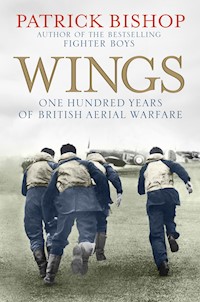
The Royal Air Force is synonymous with its heroic achievements in the summer of 1940, when Winston Churchill's 'famous few' - the Hurricane and Spitfire pilots of RAF Fighter Command - held Goering's Luftwaffe at bay in the Battle of Britain, thereby changing the course of the war. For much of the twentieth century, warplanes were fixed in the world's imagination, a symbol of the perils and excitements of the modern era. But within the space of a hundred years, military aviation has morphed from the exotic to the mundane. An activity which was charged with danger - the domain of the daring - is now carried out by computers and pilotless drones. Aviators have always seemed different to soldiers and sailors - more adventurous, questing and imaginative. Their stories gripped the public and in both wars and air aces dominated each side's propaganda, capturing hearts and dreams. Writing with the verve, passion and the sheer narrative aplomb familiar to many thousands of readers from his bestselling Second World War aerial histories, Fighter Boys and Bomber Boys, Patrick Bishop's Wings is a rich and compelling account of military flying from its heroic early days to the present.
Das E-Book können Sie in Legimi-Apps oder einer beliebigen App lesen, die das folgende Format unterstützen:
Veröffentlichungsjahr: 2012
Ähnliche



















WINGS
First published in hardback in Great Britain in 2012 by Atlantic Books, an imprint of Atlantic Books Ltd.
Copyright © Patrick Bishop, 2012
The moral right of Patrick Bishop to be identified as the author of this work has been asserted by him in accordance with the Copyright, Designs and Patents Act of 1988.
All rights reserved. No part of this publication may be reproduced, stored in a retrieval system, or transmitted in any form or by any means, electronic, mechanical, photocopying, recording, or otherwise, without the prior permission of both the copyright owner and the above publisher of this book.
1 2 3 4 5 6 7 8 9
A CIP catalogue record for this book is available from the British Library.
Hardback ISBN: 978-1-84887-892-1 E-book ISBN: 978-0-85789-981-1
Printed in Great Britain Atlantic Books An imprint of Atlantic Books Ltd Ormond House 26–27 Boswell Street LondonWC1N 3JZ
www.atlantic-books.co.uk
To Tim Harris
My old man, Ernest Bishop, somewhere in wartime Egypt.
Contents
List of Illustrations
Preface: The Last Dogfight
1 Pilots of the Purple Twilight
2 A Wing and a Prayer
3 Archie
4 The New Front Line
5 Death, Drink, Luck
6 The Third Service
7 Jonah’s Gourd
8 Arming for Armageddon
9 Into Battle
10 Apotheosis
11 Flying Blind
12 Seabirds
13 Wind, Sand and Stars
14 No Moon Tonight
15 Air Supremacy
16 Jet
17 ‘Fox Two Away!’
18 Per Ardua ad Astra
Notes
Acknowledgements
Index
A Note on the Author
Illustrations
Frontispiece: Ernest Bishop, courtesy of the author.
1. Lanoe Hawker, VC. Courtesy Philip Jarrett.
2. Oswald Boelcke. Courtesy Philip Jarrett.
3. Albert Ball, VC. Courtesy Philip Jarrett.
4. Short ‘Folder’ seaplane. Courtesy Philip Jarrett.
5. Royal Aircraft Factory BE2Cs. Courtesy Philip Jarrett.
6. De Havilland DH2. Courtesy Philip Jarrett.
7. James McCudden VC. Courtesy Philip Jarrett.
8. Members of 85 Squadron. Courtesy Philip Jarrett.
9. Sopwith Camel. Courtesy Philip Jarrett.
10. Edwin Dunning’s Sopwith Pup. Courtesy Philip Jarrett.
11. Aerial policing over Iraq. Courtesy Philip Jarrett.
12. Hendon Air Pageant. Courtesy Philip Jarrett.
13. Mick Mannock. Courtesy Philip Jarrett.
14. Brian Kingcome. Courtesy Imperial War Museum.
15. Roland Beaumont. Courtesy Imperial War Museum.
16. Keith Park. Courtesy Philip Jarrett.
17. Guy Gibson, VC. Courtesy Imperial War Museum.
18. Peter Hill. Courtesy Imperial War Museum.
19. WAAF mechanics. Courtesy Philip Jarrett.
20. Handley Page Halifax. Courtesy Philip Jarrett.
21. Hugh Dowding. Courtesy Philip Jarrett.
22. ‘Boom’ Trenchard. Courtesy Philip Jarrett.
23. Pilots of 66 Squadron. Courtesy Philip Jarrett.
24. RAF college, Cranwell. Courtesy Philip Jarrett.
25. Sergeant pilots put their feet up. Courtesy Philip Jarrett.
26. Pilots of the Free French 340 Squadron. Courtesy Philip Jarrett.
27. Battle over Britain. Courtesy Philip Jarrett.
28. George Beurling. Courtesy Philip Jarrett.
29. Spitfires of 241 Squadron. Courtesy Philip Jarrett.
30. Hawker Typhoon. Courtesy Philip Jarrett.
31. DH Mosquito B1V. Courtesy Philip Jarrett.
32. Lancaster Bomber. Courtesy Philip Jarrett.
33. Lockheed of Central Command’s 224 Squadron. Courtesy Philip Jarrett.
34. A Glosser Meteor. Courtesy Philip Jarrett.
35. A Sea Harrier. Courtesy Philip Jarrett.
36. An Avro Vulcan. Courtesy Philip Jarrett.
37. A Tornado fighter jet. Courtesy Philip Jarrett.
Preface
The Last Dogfight
The encounter lasted little more than three minutes. It took place in the violet-blue skies of a midwinter dusk, over the Falkland Islands, 8,000 miles from Britain. It happened more than thirty years ago and it is very unlikely that anything like it will happen again.
On 8 June 1982, at 3.50 p.m. local time, a Sea Harrier fighter jet piloted by Flight Lieutenant David Morgan took off from the flight deck of the aircraft carrier HMS Hermes, on station about ninety miles north-east of Port Stanley, the capital of East Falkland. Another Sea Harrier, with Lieutenant Dave Smith at the controls, followed two minutes later. The pair set course for Choiseul Sound, the sea channel separating a stretch of wilderness called Lafonia from the rest of East Falkland, where they were to mount a CAP – a combat air patrol.
Earlier in the day two ships moving soldiers forward for the final assault on Port Stanley had been attacked by Argentine air force jets while the troops waited to disembark. There were no aeroplanes to protect them and no missile batteries in place. The bombs killed more than fifty men. CAPs had been flown over the areas since the catastrophe. While there was still light there was still time for another Argentinian attack.
As Morgan approached the scree-covered hillsides of the island, which were turning purple in the setting sun, he saw ‘a huge vertical column of oily black smoke’ rising from the bay at Fitzroy settlement, where the stricken ships lay. The rescue operation was still under way and landing craft crawled back and forth, loaded with wounded. Morgan wrote later that he was ‘gripped by an awful sense of foreboding’.1
The two jets settled into a pattern, ploughing a parallel furrow a couple of miles above the scene, cruising at 240 knots (276 mph), flying for ten minutes into the sunset, then turning back again. Sea Harriers were equipped with Blue Fox radar for looking downwards. It was designed for use over the Arctic Ocean against the Soviet air force but over land it was ‘useless’. Instead the pair relied on their eyes. The dusk was in layers, shading from light to dark as it neared the earth’s surface. Staring into it was tiring. After a few minutes both pilots began to experience ‘empty field myopia’, losing their middle and long-range vision. Morgan and Smith fought it by focussing on each other, then on their forward radar screens, before resuming their visual search.
As they headed west along Choiseul Sound Morgan noticed a small landing craft making its way eastwards. He radioed the air controller aboard one of the ships in the area, who told him it was a ‘friendly’, transporting troops to the inlet at Bluff Cove, further up the coast. As he passed it on each leg of the patrol he looked down and ‘imagined the crew, cold and tired in their tiny boat and . . . wondered if they had any idea we were watching over them.’
For forty minutes they flew back and forth, nursing their fuel, not talking, ‘both feeling a burgeoning impotence’ at their detachment from the scene below. At about 4.40 p.m. Morgan made another turn to the west and checked his fuel gauge. He had four minutes flying time left before he would have to head back to the mother ship, Hermes. The landing craft was still butting eastwards, with white water breaking over its bow.
Then Morgan noticed a shape emerging out of the dying light of the western sky.
‘A mere mile to the east of the tiny vessel was the camouflaged outline of a . . . fighter, hugging the sea and heading directly for the landing craft, which had become a very personal part of my experience for the last forty minutes,’ he remembered later.
He jammed open the throttle lever, shouted to Smith to follow him down and pushed his Harrier into a sixty-degree dive as the air-speed indicator shot up from 240 to more than 600 knots. As they hurtled downwards the jet closed on the landing craft. It was a delta-winged A-4 Skyhawk, and he watched it open fire, ‘bracketing the tiny matchbox of a craft’ with 20 mm cannon fire. Then a dark shape detached from the wing. Morgan was relieved to see the bomb explode at least a hundred feet beyond the vessel. But then he saw another A-4 running in behind the first attacker. The second pilot did not miss and he watched ‘the violent, fire-bright petals of the explosion, which obliterated the stern’.
Morgan felt rage grip him. ‘All-consuming anger welled in my throat,’ he recalled, ‘and I determined, in that instant, that this pilot was going to die.’
It seemed to him that ‘the world suddenly became very quiet. I was completely focused and was acutely aware that this was the moment for which all my training had prepared me.’
He had flown many hours of mock-combat, but never encountered a real enemy. He hauled his Harrier down and behind the second Argentinian. Edging into his peripheral vision on the left, he suddenly picked up another Skyhawk skimming low over the wave-tops. He decided to go for this one first. He ‘rolled out less than half a mile behind the third fighter, closing like a runaway train’.
The radar that detected targets and relayed them to the ‘head-up display’ (HUD) beamed onto the cockpit windscreen. As it picked up the aircraft an electronic pulse sounded in Morgan’s earphones that became an ‘urgent, high-pitched chirp’ when it located the heat of the Skyhawk’s engine. This was the signal for the pilot to lock on the Sidewinder.
‘My right thumb pressed the lock button on the stick and instantly the small green missile cross in the HUD transformed itself into a diamond sitting squarely over the back end of the Skyhawk,’ Morgan remembered. The weapon was ready to fire.
‘I raised the safety catch and mashed the red, recessed firing button with all the strength I could muster.’ There was a fractional delay as the missile’s thermal battery ignited. Then ‘the Sidewinder was transformed from an inert, eleven-feet-long drainpipe into a living, fire-breathing monster as it accelerated to nearly three times the speed of sound and streaked towards the enemy aircraft.’
The shock of the departing missile flung Morgan’s aircraft onto his starboard wing-tip. As he righted the Harrier, he saw the missile racing for the Skyhawk’s flaming jet pipe, ‘leaving a white corkscrew of smoke against the slate grey sea’. After two seconds ‘what had been a living, vibrant flying machine was completely obliterated as the missile tore into its vitals and ripped it apart.’ The pilot, Ensign Alfredo Vazquez, ‘had no chance of survival and within a further two seconds the ocean had swallowed all trace of him and his aeroplane as if they had never been’.
There was no time for reflection. Another target was directly in front of him, only a mile away. It was the Skyhawk which had bombed the landing craft and it was turning to the left. Morgan locked on and fired. The jet was flown by Lieutenant Juan Arrarás. He seemed to realize the mortal danger behind him and swung hard to the right, forcing the missile to reverse its course. It made no difference. The Sidewinder closed on the Skyhawk, impacting behind the cockpit in a flash of white light.
‘The air was filled with the aluminium confetti of destruction, fluttering seawards,’ Morgan wrote. ‘I watched, fascinated, as the disembodied cockpit yawed rapidly starboard through ninety degrees and splashed violently into the freezing water.’ At that moment ‘a parachute snapped open, right in front of my face’.
Arrarás had managed to eject from the disembodied cockpit. He ‘flashed over my left wing, so close that I saw every detail of the rag-doll figure, its arms and legs thrown into a grotesque star shape by the deceleration of the silk canopy’. Morgan felt a flash of ‘relief and empathy’ for his enemy, then concentrated on his next target.
Both his missiles were gone. That left the Harrier’s two 30 mm guns. What he took to be the last remaining Skyhawk was ahead of him. He lifted the safety slide on the trigger. The head-up display had disappeared from the windscreen and he had only his own skill and eyesight to rely on when taking aim. As he closed on the Skyhawk it ‘broke rapidly towards me. I pulled the blurred outline to the bottom of the blank windscreen and opened fire.’ The cannon shells pumped out at a rate of forty per second. In the darkness he could not see whether or not they were hitting. Then, ‘suddenly over the radio came an urgent shout from Dave Smith: “Pull up! Pull up! You’re being fired at!”’
Morgan had seen only three Skyhawks. He had failed to spot a fourth, piloted by Lieutenant Hector Sanchez, which was now bearing down on him. He ‘pulled up into the vertical, through the setting sun, and in a big, lazy, looping manoeuvre, rolled out at 12,000 feet, heading north-east for Hermes with my heart racing.’
Smith, meanwhile, dived low and chased the third Skyhawk over the water. At a mile range he fired a Sidewinder. Seven seconds later it struck the aircraft of First Lieutenant Danilo Bolzan. There was a brilliant white flash as the missile exploded. Looking behind, Morgan saw it disappear ‘in a huge yellow-orange fireball as it spread its burning remains over the sand dunes on the north coast of Lafonia.’
Two Argentinian pilots, Bolzan and Vazquez, were now dead. Arrarás, whose rag-doll figure had flashed past Morgan’s cockpit, had also perished, killed by the impact of the low-level ejection. Though they had won the battle, the British pilots’ survival was uncertain. They were dangerously low on fuel and Hermes was ninety miles away. If they ran out of petrol they would have to eject into the freezing sea and pray that a helicopter would find them. They climbed high, gaining the maximum height to glide down into a landing.
‘At forty thousand feet the sun was still a blaze of orange,’ wrote Morgan, ‘but as I descended the light became progressively worse. By the time I had descended to ten thousand feet the world had become an extremely dark and lonely place.’
To add to the hazards a storm was brewing and Hermes was lying in heavy rain and gusting wind. There was no fuel to spare for a careful approach using his on-board radar to guide him. He called the carrier and asked the Controller to talk him down, onto the centre line of the flight deck. He was descending through thick turbulent cloud with three miles left to run when his fuel warning lights flashed. A few seconds later he ‘saw a glimmer of light emerging through the rain and at eight hundred feet the lights fused into the recognizable outline of the carrier’. He ‘slammed the nozzle lever into the hover stop, selected full flap and punched the undercarriage button to lower the wheels’. The Sea Harrier was a jump jet, capable of stopping dead in mid-air and hovering. Morgan’s aircraft came to an airborne halt on the port side of the deck. He manoeuvred it sideways onto the centre line, then ‘closed the throttle and banged the machine down on the rain-streaked deck’. As he taxied forward to park he heard Dave Smith landing behind him.
So ended the last air-to-air action engaged in by British pilots. It hardly merits the description ‘dogfight’, as the Argentinian pilots, despite their manifest courage, then as in previous encounters, never properly ‘came out to play’, to use the characteristic euphemism of the British jet jockeys. It came at the end of a brief air war that still carried a whiff of classic aerial combat of the First and Second World Wars.
As a young war correspondent who had sailed to the South Atlantic with the Task Force I had a grandstand view of some of the fighting. I witnessed the heroism of the Argentinian pilots as they took their Mirages and Skyhawks in low over San Carlos Water through a curtain of corkscrewing missiles and fizzing tracer. On the long trek to Stanley my blood stirred when a pair of Harriers screamed protectively overhead. They seemed to us, shivering in the sleet and mud, the direct descendants of the Fighter Boys of 1940. And that is how they self-consciously saw themselves. Ground controllers still vectored pilots onto targets by informing them that there was ‘trade’ in the offing – just as they did in the Battle of Britain. Pilots still called out ‘Tally Ho!’ before launching their attacks.
Having downed a few pints of beer after his victory, David Morgan retreated through the eerie red glow of the night-lighting in the Hermes passageways to the deserted briefing room, where he sat for a while. His ‘feelings of satisfaction and pride were tempered by a melancholy that I could not identify’. He remembered a poem, ‘Combat Report’ by John Pudney, who had served as an RAF intelligence officer in the Second World War. Something compelled him to write it out in felt-tip pen on the briefing board. The last lines seemed right for what he had just seen and done.
‘I let him have a sharp four-second squirt,
Closing to fifty yards. He went on fire.’
Your deadly petals painted, you exert
A simple stature. Man-high, without pride,
You pick your way through heaven and the dirt.
‘He burned out in the air: that’s how the poor sod died.’
That done, he sat down on the bench at the front of the room. He became aware that ‘there was moisture running down both my cheeks’.
The air war ended two days later. British pilots would never again fight another like it. High technology was already in the process of edging human agency from the aerial battlefield. When Britain went to war with Iraq nine years later, British pilots rarely saw an enemy plane, and the seven fixed-wing aircraft brought down were the victims of missiles. In the Balkans conflict of 1992–1995, the Serbian air force posed little threat, nor did the Iraq air force during the 2003 invasion, or the Libyan air force during NATO operations in 2011. In the Afghan conflict there is no risk at all from enemy aircraft as the Taliban do not have an air force.
British and American pilots sit in the skies, launching incredibly expensive weapons, utilizing the most sophisticated technology against men with rifles who wear sandals to go to war. In this conflict, I also had a ringside seat.
In the summer of 2008, in Helmand Province, I was with the Parachute Regiment on an operation to clear a route south of the Kajaki Dam in preparation for the delivery of a new turbine for the powerhouse generator. As we moved down the track we came under sporadic fire from insurgents hidden in mud-walled compounds. A pattern was soon established. The RAF Joint Tactical Air Controller on the ground with the Paras radioed the map co-ordinates of the troublesome enemy to a distant air base. There was a pause while permission was obtained for a strike. Then a few minutes later the location would erupt in flames from a laser-guided bomb launched from an aircraft flying at a height that made it invisible. Military aviation has come a very long way in a very short time. This is the story its journey.
Chapter 1
Pilots of the Purple Twilight
In the space of three generations flight has flooded and ebbed from the worlds imagination. Aeroplanes are part of the backdrop of life and travelling in them has become mundane and usually tedious. Yet a hundred years ago the sight of a rickety contraption of wire and canvas, fluttering and swooping above the fields with a strangely clad figure perched precariously inside, was guaranteed to create great even wild excitement.
In June 1910, only twenty months after the first aeroplane made a paltry, 450 yard hop over British soil, Flight magazine reported that it is becoming the fashion to consider any openair function quite incomplete unless there is an exhibition of flying to give tone to it. The editorial was commenting on an incident that had taken place a few days before. At an agricultural show in the city of Worcester a Blriot monoplane ran amok. At the controls was Mr Ernest Dartigan. He was assistant to a Captain Clayton, who had been due to give a series of spectacular flights but had injured himself in a crash the previous day. Rather than disappoint the 14,000 people gathered at the showground, Dartigan had rolled the Blriot out to taxi up and down on the grass. The results were disastrous. Dartigan quickly lost control and the aeroplane charged into the crowd, killing a woman and injuring several others.
At the subsequent inquest, Clayton admitted that he was not a captain at all, but had adopted the title for business purposes. Neither he nor Dartigan possessed a certificate of competence from the Royal Aero Club. The pseudo-aviator did not shoulder the blame alone, however. A Worcestershire County Council official who witnessed the accident told the court that the conduct of the crowd was foolhardy in the extreme. [They] insisted upon crowding around the aeroplane and badly hampered the movements of the man who was in control, in spite the efforts of police and officials to keep them back.1
This little tragedy tells us quite a lot about those early days. It reveals the ad hoc nature of primitive aviation, glorious or foolhardy according to your point of view. Everything was necessarily innovatory and improvised. Captain Clayton might have crocked himself in a prang, but the show went on nonetheless. The pressure that Dartigan felt to perform is also revealing. He seems to have considered himself duty bound to give the crowds what they came for. One suspects he also saw an opportunity to indulge his own fantasies. With Clayton indisposed, a splendid opportunity arose for his assistant to shine. From the outset, aviation was in the hands of those with a tendency to show off frequently with the same sad results as on this occasion.
Lesen Sie weiter in der vollständigen Ausgabe!
Lesen Sie weiter in der vollständigen Ausgabe!
Lesen Sie weiter in der vollständigen Ausgabe!
Lesen Sie weiter in der vollständigen Ausgabe!
Lesen Sie weiter in der vollständigen Ausgabe!
Lesen Sie weiter in der vollständigen Ausgabe!
Lesen Sie weiter in der vollständigen Ausgabe!
Lesen Sie weiter in der vollständigen Ausgabe!
Lesen Sie weiter in der vollständigen Ausgabe!
Lesen Sie weiter in der vollständigen Ausgabe!
Lesen Sie weiter in der vollständigen Ausgabe!
Lesen Sie weiter in der vollständigen Ausgabe!
Lesen Sie weiter in der vollständigen Ausgabe!
Lesen Sie weiter in der vollständigen Ausgabe!
Lesen Sie weiter in der vollständigen Ausgabe!
Lesen Sie weiter in der vollständigen Ausgabe!
Lesen Sie weiter in der vollständigen Ausgabe!
Lesen Sie weiter in der vollständigen Ausgabe!
Lesen Sie weiter in der vollständigen Ausgabe!
Lesen Sie weiter in der vollständigen Ausgabe!
Lesen Sie weiter in der vollständigen Ausgabe!
Lesen Sie weiter in der vollständigen Ausgabe!
Lesen Sie weiter in der vollständigen Ausgabe!




