


10,99 €
Mehr erfahren.
- Herausgeber: John Wiley & Sons
- Kategorie: Fachliteratur
- Serie: Bloomberg
- Sprache: Englisch
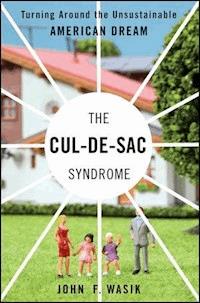
An incisive look at the consequences of today's costly and damaging suburban lifestyle In The Cul-de-Sac Syndrome, Bloomberg News' John Wasik exposes the economic, cultural, environmental, and health problems underlying life in suburbia. Wasik provides powerful insights into how the U.S. suburban lifestyle has become unsustainable and what can be done to salvage it. His observations are firmly grounded in exclusive on-the-ground research, interviews with thought leaders, and the latest studies and statistics. The book * Exposes the untold truths about suburban home ownership: green isn't always so green, life isn't cheaper after accounting for gas, water, and taxes, and modern suburban living isn't so idyllic considering the toll it takes on our health * Includes exclusive research and analysis by experts in the field that debunks the many myths associated with suburban living * Explores innovative solutions being developed in cities across the country The American Dream of moving further from a city to buy a bigger house and find better schools has become a costly nightmare. The Cul-de-Sac Syndrome examines why and what can be done.
Sie lesen das E-Book in den Legimi-Apps auf:
Seitenzahl: 352
Veröffentlichungsjahr: 2010
Ähnliche


















Contents
Preface
Introduction
Part 1: A Dream Gone Bad
Chapter 1: False Economics
The Home as an Investment
Spurb Corridors
Chapter 2: Origins of a Dream
Jefferson’s Broader Vision
Sacred Places: Homes as Moral Bastions
Revolutionary Home Financing and the New Deal
Chapter 3: How Debt Addiction Fed a Housing Crisis
Sloppy Economic Thinking
The Risk Shift: A Decayed Social Contract
Debt Addiction and the Tax Burden
Chapter 4: Cul-de-Sac Nation
Energy Use and the Unsustainable Home
Water, Water Everywhere? Not Anymore
Unpaid Infrastructure Bills
Chapter 5: The Spurbing of National Health
Driving Ourselves Sick
Changing Direction
Part 2: Reinventing Home and Community
Chapter 6: Toward Sustainable Dreams
Scrapping Traditional Homebuilding
Green Building for Healthier Homes
The Faux-Green Phenomenon
Chapter 7: Building Smarter
Inside the Smart Home
The Energy-Intensive Home and How It Started
The American Dream Updated
Solar, Sexy, and Expensive
The Green-Marketing Muddle
Subsidies Needed
Chapter 8: The Near Death of a Suburb
Creating a Model Community
The Decline of the Model Suburb
The Revival
Hometown USA
The Abandonment of Suburbia
Chapter 9: Reclaiming the Inner City
Jobs, a Community’s Anchor
The Rebuilding
Barriers to Revival
The Affordability Crunch
The Steep Cost of the Exodus
Rampant Exploitation
Moving Forward
Chapter 10: Sustainability and Development
Measuring Environmental Impact
The Re-Imagined Home
The Spurb Shakeout: A New Urbanism Agenda
There Will Be Blood
Chapter 11: The Bill Comes Due
Machine-Driven Living
The Ecodynamic Community
Poised for Recovery—or Not
Revitalizing the American Dream
Good Ecology Makes Economic Sense
Epilogue
Notes
Index
About the Author
Praise for The Cul-de-Sac Syndrome
Turning Around the Unsustainable American Dream
by John F. Wasik
“John Wasik’s The Cul-de-Sac Syndrome offers enough to chew on for three sets of teeth, enough to digest for three stomachs and then alerts the mind faster than an approaching siren.”
— RALPH NADER
Consumer advocate
“Wow! Get ready for a totally original look at the American dream. Yes, we slipped off track. Now we need real solutions. And fast. Here they are. Wasik delivers the first truly multidisciplinary examination—using psychology, planning, law, architecture, and history to focus on working solutions that get us back on track and keep the American dream alive for future generations. This is a must-read winner!”
— PAUL B. FARRELL, JD, PhD
Columnist, MarketWatch.com
Author, The Millionaire Code
“As John Wasik eloquently writes in his new book, The Cul-De-Sac Syndrome, quoting national statistics to describe the most local of all markets—the residential real estate market—almost misses the point. This excellent book takes a ground-level look at the causes of our housing crisis and offers a myriad of ideas on reinventing the concepts of home and community.”
— ILYCE R. GLINK
Syndicated real estate columnist
Author, 100 Questions Every First-Time Home Buyer Should Ask
Publisher, ThinkGlink.com
“The Cul-De-Sac Syndrome is a genuine kick to the head, showing how our individual quests for the biggest house on the hill is destroying our environment, the economy, and our physical and mental health. But The Cul-de-Sac Syndrome is no dead end. It offers a new, green, urbanized promised land with real community, more free time, and a higher living standard. It’s a masterful blueprint to unpave paradise and restore the world we cherish.”
— LAURENCE KOTLIKOFF
Professor of Economics, Boston University
Coauthor of Spend ’Til the End: The Revolutionary Guide to Raising Your Living Standard—Today and When You Retire
Also by
John F. Wasik
The Audacity of Help:
Obama’s Stimulus Plan and the Remaking of America
Also available from
Bloomberg Press
Aqua Shock:
The Water Crisis in America
by Susan J. Marks
Collateral Damaged:
The Marketing of Consumer Debt to America
by Charles R. Geisst
Pension Dumping:
The Reasons, the Wreckage, the Stakes for Wall Street
by Fran Hawthorne
Copyright © 2011 by John Wasik. All rights reserved.
Published by John Wiley & Sons, Inc., Hoboken, New Jersey.
Published simultaneously in Canada.
No part of this publication may be reproduced, stored in a retrieval system, or transmitted in any form or by any means, electronic, mechanical, photocopying, recording, scanning, or otherwise, except as permitted under Section 107 or 108 of the 1976 United States Copyright Act, without either the prior written permission of the Publisher, or authorization through payment of the appropriate per-copy fee to the Copyright Clearance Center, Inc., 222 Rosewood Drive, Danvers, MA 01923, (978) 750-8400, fax (978) 646-8600, or on the Web at www.copyright.com. Requests to the Publisher for permission should be addressed to the Permissions Department, John Wiley & Sons, Inc., 111 River Street, Hoboken, NJ 07030, (201) 748-6011, fax (201) 748-6008, or online at http://www.wiley.com/go/permissions.
Limit of Liability/Disclaimer of Warranty: While the publisher and author have used their best efforts in preparing this book, they make no representations or warranties with respect to the accuracy or completeness of the contents of this book and specifically disclaim any implied warranties of merchantability or fitness for a particular purpose. No warranty may be created or extended by sales representatives or written sales materials. The advice and strategies contained herein may not be suitable for your situation. You should consult with a professional where appropriate. Neither the publisher nor author shall be liable for any loss of profit or any other commercial damages, including but not limited to special, incidental, consequential, or other damages.
For general information on our other products and services or for technical support, please contact our Customer Care Department within the United States at (800) 762-2974, outside the United States at (317) 572-3993 or fax (317) 572-4002.
Wiley also publishes its books in a variety of electronic formats. Some content that appears in print may not be available in electronic books. For more information about Wiley products, visit our web site at www.wiley.com.
ISBN 978-1-57660-320-8 (cloth); ISBN 978-0-470-91808-1 (paper);
ISBN 978-0-470-88336-5 (ebk); ISBN 978-0-470-88412-6 (ebk);
ISBN 978-0-470-88537-6 (ebk)
To my father, Arthur Stanley Wasik
Preface
One of the worst housing busts in history began in 2007 and was still ravaging the U.S. home market and several European countries by early 2011. Except for a few areas, foreclosures continued and home sales (through 2010) were the slowest since the Kennedy administration. Not even an $8,000 first-time homebuyer’s credit in early 2010 was enough to revive the market. Many of the worst-hit areas (see Chapter 11) were still hobbled by foreclosures and huge inventories of bank-owned homes while others in Texas, the Northwest and Northeast were hobbling along.
For millions of Americans who overbought homes and were unprepared for the consequences of the bust, it represented a great reckoning. For others who prudently lived within their means and paid their mortgages, it represented an unfair loss in equity. Their stake in the American Dream, a stable middle class lifestyle and upward mobility was diminishing.
How did the United States succumb to one of the most devastating housing recessions since the 1930s? Weren’t homes supposed to be the safest investments on the planet? Ultimately, the housing bust may turn out to be one of the biggest financial blowups in history, rivaling the Great Depression with more than $4 trillion in wealth evaporating. Millions entered a financial dead end during this period of irrational exuberance. It may take years for them to escape from it.
What drove this flood of exuberant optimism? Did everyone from mortgage brokers to Wall Street simply get greedy? Or do the true causes lie much deeper, in the American dream itself and in the goal that eventually became an obsession with ever-bigger homes? A bubble in which demand exceeded realistic economic fundamentals was triggered by a number of uniquely American cultural values, desires, and economic shortcomings. These underlying reasons for the debacle have been ingrained in Western culture for almost half a millennium. They’re myths that have flourished precisely at a time when Americans’ view of themselves, their post-9/11 security, and their shaky financial future were being tested as never before.
The stereotypical villains in the subprime story have been Wall Street bankers, the government, and greedy participants, from speculating “flippers” to the Federal Reserve. There’s plenty of blame to spread around when it comes to who was motivated by pure avarice or criminal exploitation, and much of that picture has been illuminated. Those who thought they would profit handsomely have already been exposed, have taken their losses, and are known to anyone following this calamity. It’s far too easy, though, to point fingers at the purveyors of human excesses. That’s only part of the story.
The American dream—and what it has cost us—is what underlies the crisis and what this book explores. How did we come to believe that a home should be an investment worth enough to propel millions to leverage beyond their ability to pay? In an age of burgeoning info-technology, why are we still building homes with the latest nineteenth-century techniques? What was the market behavior that drove homeowners into subprime loans and moving ever farther away from jobs and cities? How did we come up with the idea that we should buy as much house as we can afford, with no regard for the cost of heating and cooling it and the time and expense of getting to it?
We’ve gotten stuck in a vicious cycle, a cul-de-sac of unsustainable costs and serious long-term consequences for our health and our environment. After following the bubble and its aftermath since 2001 as a personal finance columnist for Bloomberg News, I’ve gained some insights into urban planning, resource depletion, and homebuilding techniques and economics that cast a critical—and disturbing—light on the American dream of homeownership. That dream led to the creation of what I call “spurbs,” the car-dependent sprawling urban areas, unconnected to core cities by public transportation and beset by unsustainable costs for infrastructure, services, and resources. As highly leveraged locations ravaged by foreclosures and falling property values, these enclaves will hurt the most in coming years.
We’ve suffered from a cul-de-sac syndrome on not only how to finance the American dream, but how to build it in the future so that it’s economically and ecologically sustainable. How do we cure this malady, one that’s responsible for global financial calamity? Even if the home market fully recovers with higher prices, home starts, and sales, the deep-seated problems this shortsighted cultural mythology brought about will haunt future generations if we don’t correct them.
I’ve traveled from coast to coast several times to highlight the myriad stories of innovators, dreamers, activists, and visionaries who are still creatively searching for a way to make the American dream attainable and affordable. I’ve consulted with the leading minds in architecture, economics, engineering, homebuilding, and urban planning to uncover insights on the past, present, and future of the home market.
Readdressing, reimagining, and redesigning the foundation of the American dream has no downside because we will be creating and preserving jobs and wealth and even addressing global warming. In the words of John Ruskin, “That country is the richest which nourishes the greatest number of noble and happy human beings; that man is richest, who, having perfected the functions of his own life to the utmost, has also the widest helpful influence, both personal, and by means of his possessions, over the lives of others.” It all starts in our homes and communities—my home, your home.
Introduction
The Foundation Cracks
The last Spanish sultan, Boabdil, sobbed as he left the Alhambra. His heart was broken as he looked back upon the heavenly complex of crenulated arches, fountains, and pools within the splendid palaces of the Moorish rulers of Granada in southern Spain, on his way to exile in Africa in 1492. He was not only mourning the loss of his bastion to the Catholic monarchs Ferdinand and Isabella but also grieving for what might have been—a culturally vivacious state where no group had to supplant the other due to lack of land or resources. Although there was certainly barbarism during and after the Alhambra’s golden age, the combined will of the houses of Castile and Aragon set in motion a land lust that would ravage two continents.
Christopher Columbus had met with Queen Isabella in the newly conquered Alhambra, and he had his marching orders. Gold and land were the primary objectives of the Spanish crown. They had coffers to fill, armadas to build, and conquistadors to finance. Keeping everything in check was their form of the Gestapo—the Inquisition. Jews or Moors who would not convert to Christianity were tortured or killed. Even if they were baptized, they were subject to abuse and discrimination. Jews, who had contributed immeasurably during the halcyon days of the Alhambra, were eventually exiled.
As strangers in a strange land, the Moors were the most successful diplomats on the Iberian peninsula, building their dominion over a seven-hundred-year period. During their tenure, they practiced tolerance, translated the great works of antiquity from Greek into Arabic and Latin, and then entreated Europe to feast on the knowledge and imagination of the classical authors. Pythagoras, Ptolemy, Aristotle, and the great theoreticians of ethics, physics, and philosophy were reborn in the learning enclaves of Toledo and Córdoba. Andalusia became the Harvard, Princeton, and Yale of Western civilization from the eighth century through the fifteenth. Establishing a multicultural ministate on a peninsula that had been invaded by Celts, Romans, Franks, and Visigoths, the Moors had few peers in the realm of cultural sustainability in their heyday.
Lesen Sie weiter in der vollständigen Ausgabe!
Lesen Sie weiter in der vollständigen Ausgabe!
Lesen Sie weiter in der vollständigen Ausgabe!
Lesen Sie weiter in der vollständigen Ausgabe!
Lesen Sie weiter in der vollständigen Ausgabe!
Lesen Sie weiter in der vollständigen Ausgabe!
Lesen Sie weiter in der vollständigen Ausgabe!
Lesen Sie weiter in der vollständigen Ausgabe!
Lesen Sie weiter in der vollständigen Ausgabe!
Lesen Sie weiter in der vollständigen Ausgabe!
Lesen Sie weiter in der vollständigen Ausgabe!
Lesen Sie weiter in der vollständigen Ausgabe!
Lesen Sie weiter in der vollständigen Ausgabe!
Lesen Sie weiter in der vollständigen Ausgabe!
Lesen Sie weiter in der vollständigen Ausgabe!
Lesen Sie weiter in der vollständigen Ausgabe!
Lesen Sie weiter in der vollständigen Ausgabe!




