


Erhalten Sie Zugang zu diesem und mehr als 300000 Büchern ab EUR 5,99 monatlich.
- Herausgeber: The History Press
- Kategorie: Geisteswissenschaft
- Sprache: Englisch
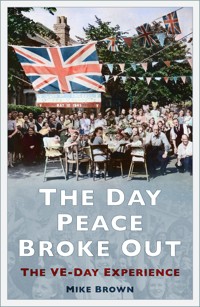
At 3 p.m. on 8 May 1945, Prime Minister Winston Churchill made a long-awaited speech in which he officially declared the war in Europe to be over. After six bitter years of conflict, however, perceptions of how victory over Nazism was to be celebrated and what post-war Britain should look like were very different from the visions of the people and the politicians in 1939. Illustrated with photographs, adverts, posters and cartoons, The Day Peace Broke Out describes the VE-Day celebrations in Britain and across the world through the memories of those who were there, combined with contemporary newspaper and magazine articles. Mike Brown, an authority on the British Home Front of the Second World War, charts the nation's progressive change of heart from defeatism to growing confidence of certain victory. He looks at the immediate post-VE-Day period and the celebration of victory over Japan in August 1945. What should have been a story with a happy ending concludes with the harsh realisation of post-war austerity and the increasing disillusionment that led many Britons to conclude that they had won the war but lost the peace.
Sie lesen das E-Book in den Legimi-Apps auf:
Seitenzahl: 249
Veröffentlichungsjahr: 2005
Das E-Book (TTS) können Sie hören im Abo „Legimi Premium” in Legimi-Apps auf:
Ähnliche















THE DAY
PEACE
BROKE OUT
THE VE-DAY EXPERIENCE
MIKE BROWN
First published in 2005 by Sutton Publishing Limited
The History Press
The Mill, Brimscombe Port
Stroud, Gloucestershire, GL5 2QG
www.thehistorypress.co.uk
This ebook edition first published in 2013
All rights reserved
© Mike Brown, 2005 2013
The right of Mike Brown to be identified as the Author of this work has been asserted in accordance with the Copyright, Designs and Patents Act 1988.
This ebook is copyright material and must not be copied, reproduced, transferred, distributed, leased, licensed or publicly performed or used in any way except as specifically permitted in writing by the publishers, as allowed under the terms and conditions under which it was purchased or as strictly permitted by applicable copyright law. Any unauthorised distribution or use of this text may be a direct infringement of the author’s and publisher’s rights, and those responsible may be liable in law accordingly.
EPUB ISBN 978 0 7509 5317 7
Original typesetting by The History Press
Contents
1.Whose Victory?
2.The Tide Turns
3.The End Is Nigh
1–7 May
4.VE-Day
Celebrations Begin
5.VE-Day
A Night of Rejoicing
6.Later Victory Celebrations
7.Aftermath
Acknowledgements
Bibliography
CHAPTER 1
Whose Victory?
At the time of the Munich Crisis in September 1938, popular sentiment in Britain had been heavily anti-war; cries of ‘Stand by the Czechs’ had been drowned out by calls for peace. When Neville Chamberlain returned from Munich promising ‘Peace for our time’, he received a hero’s welcome, cheered by crowds at the airport, cheered by crowds at Buckingham Palace and cheered at Downing Street – where the crowd was so big that the police had trouble controlling it.
Yet public opinion, often fickle, was changing rapidly. People had been scared out of their wits, and that would not happen again. The French historian André Maurois wrote:
In January 1939 I went to Great Britain for a lecture tour that took me into all corners of the country. There I found out that public opinion was now ahead of the government. The latter was hesitating to adopt conscription; the country was energetically demanding it. Everywhere English men and women of all classes said to me, ‘We must not allow this man Hitler to dominate Europe; we must have a large army and a strong air force.’
When war was declared in September 1939 Britain entered it confident of victory and, what is more, a swift victory. The BEF embarked for France to the sound of bands playing ‘We’re gonna hang out the washing on the Siegfried Line’, a popular hit of the period. Propaganda began immediately. The press was full of pieces describing German losses and Allied advances. On 14 September, for example, the Daily Mirror reported:
Saarbrücken, the key German city across the River Saar, is now surrounded by French troops . . . The French advance continues. On a front of more than twenty-five miles many German villages have been captured . . . important positions, and notably some good observation posts, have been occupied . . . Heavy French tanks crashed through the German pillboxes and barbed wire entanglements. German losses, it is stated, are so great that the number of doctors and nurses available is insufficient to deal with them.
The same newspaper reported a Polish communiqué stating that, ‘Polish troops had taken 1,000 German prisoners after routing a German division in the region of Kutno, west of Warsaw.’
Two days later the Daily Mirror announced that:
The British Navy is already driving the U-Boats off the sea . . . Hitler’s troops were reported last night to be retreating from their advance positions all along the northern flank of the western front . . . Saarbrücken itself was reported . . . to have been reduced to ruins by bombardment from the Maginot forts . . . German hopes of an early peace are dwindling; rationing is tighter – even cat and dog food is rationed; the French offensive on the Western Front is causing mass evacuation of German towns.
Despite such grand claims, the result of the war in Poland was a foregone conclusion. France and Britain, having entered the war in support of Poland, were in reality able to offer little but encouragement. The Polish Army fought with great tenacity, but its German opponents were vastly superior in terms of numbers, training and equipment and, perhaps most telling of all, the Luftwaffe had established complete mastery of the air in the first few days; this it ruthlessly exploited.
On 17 September, Russia took a hand; the Red Army invaded eastern Poland. As ever, Poland was the meat sandwiched between its two great neighbours. The inevitable end came when Warsaw surrendered on the 27th; the first test of the tactics of Blitzkrieg (‘Lightning War’) was a resounding success. Hitler now laid his plans for the rest of Europe. On 9 October preparations were set in motion for ‘an offensive action on the northern flank of the Western front crossing the area of Luxembourg, Belgium and Holland’.
The fall of Poland seemed to leave the war in a kind of limbo. After all, the Allies had gone to war because of the German invasion; what was now the point of continuing? On 6 October Hitler put out peace feelers through neutral countries, but public opinion both in Britain and France had swung completely since the wave of pacifism that had engulfed them in September 1938. Hitler’s attack on Poland had underlined his untrustworthiness. Propaganda had proved so successful that the British and French publics had no doubt who would win. It was said, just like in 1914, that it might be ‘all over by Christmas’, and that this time Hitler had ‘bitten off more than he could chew’. It was high time he was taught a lesson, and the Allies, safe from attack behind the massive fortifications of the Maginot Line, were just the ones to do it. On the 12th, Hitler’s peace offer was rejected.
The Daily Express of 2 November carried an article giving the views of a Dr Rosinski:
Very few of the leading [German] professional soldiers believe in a lightning victory. That is the pet idea of the Nazi politicians. The German generals have few hopes of being able to follow the classic German strategy of moving very rapidly so as to turn their enemies’ flanks. They may not even be anxious to invade Holland or Belgium, or Switzerland to give them the chance of doing this. They are thinking . . . of frontal attacks. These are not to be decided by a sudden stroke, but by a long struggle. One side will eat away the enemy’s position until he collapses . . . the Germans have lost their old pre-eminence in what is called ‘the higher study of war’.
The theme of much Allied propaganda, repeatedly expressed by experts, was that the Germans did not have the stomach, and more importantly the raw materials, for a long war.
On 5 April Chamberlain made a speech that, in retrospect, seems to have been sorely tempting fate, ‘After seven months of war, I feel ten times as confident of victory as I did at the beginning. Hitler has missed the bus.’ He little knew that a month before, on 3 March, Hitler had ordered the invasion of Norway and Denmark. Just four days after Chamberlain’s speech the Phoney War came to an abrupt end as German forces carried out their invasion plans; Denmark was a walkover, surrendering the same day, but Norway was a harder nut. It was at this time that the rest of Europe learnt a new name and a new fear. Vidkun Quisling, an extreme right-wing Norwegian politician, had been having secret meetings with German agents for some time. The original German plan had been for his supporters to seize power with some German support. A back-up plan was prepared based around surprise German troop landings; this plan soon superseded the original one, to the extent that Quisling and his supporters were kept ignorant of any details. Apart from serious losses suffered by the German Navy, the landings themselves were successful, with very little, if any, help from Quisling’s supporters, but it suited all sides to claim that their part had been a vital one.
On 15 April, British troops landed in Norway. At first they had some success, but overwhelming German air superiority meant that each gain was soon followed by retreat, while Namsos, the main British base, was flattened by repeated air raids. On 2 May, Namsos was evacuated under air attack, with the loss of three destroyers and a sloop. (The last Allied forces would leave Norway in early June.) The campaign had little to commend it; both land and sea forces had proved woefully ineffective, lacking adequate air support. British confidence in the government dropped to an all-time low.
On 8 May, Chamberlain appealed to the opposition parties to join a coalition government, but it was all too late. Labour refused to join any government which he led. There followed a two-day debate in the House of Commons, where frustration with the government exploded. Leo Amery repeated Cromwell’s words, this time against Chamberlain, ‘You have sat too long here for any good you have been doing. Depart, I say, and let us have done with you. In the name of God, go.’ And on 10 May, Chamberlain did just that. Nearly a hundred Tories defied a three-line whip, voting with the opposition, and Chamberlain resigned. His favoured successor was the Foreign Secretary, Lord Halifax, yet Halifax seemed to realise that he would not make a good war leader and refused the post. Eventually Winston Churchill was the man summoned to Buckingham Palace, to be asked to form a government.
At dawn that day, 10 May, the German Army rolled into neutral Holland, Belgium and Luxembourg in a massive attack which made the Norwegian affair seem like a side-show. Hitler had gathered eighty-nine divisions for the task, with another forty-seven in reserve. The British Expeditionary Force (BEF) entered Belgium to set up a defensive line.
Blitzkrieg, perfected in Poland, hit western Europe. Airborne units, dropping ahead of the main army, seized key points in the elaborate system of defensive fortifications, rendering the defences useless; Holland fell in five days. The vaunted Maginot Line, into which France had poured billions of francs, and all its hopes, was outflanked by German armour through what was thought to be the impenetrable Ardennes forest. This thrust pierced the French front line and drove on to the Channel coast west of Abbeville, cutting off most of the BEF from the main French forces to the south.
The fact that the Germans, so recently written off, were not only advancing, but at an unbelievable speed, seemed like a form of magic. And if not magic, why then, the answer must be treason. As in Norway, rumours were rife of ‘fifth columnists’, German sympathisers waiting for their chance to strike, with sabotage and other despicable acts, to hinder the defenders and aid the invaders. In Britain, news, first from Norway, then from the Low Countries, generated fears, almost to the level of panic, of the fifth column. In his book Invasion 1940 Peter Fleming summed up the general paranoia, ‘Flashing lights, poisoned sweets, bridges blown too soon or not at all, punctured tyres, cut telephone lines, misdirected convoys – in whatever went amiss the hand of the Fifth Column was detected, never the normal workings of muddle or mischance, confusion or plain cowardice.’
In Britain many eyes turned suspiciously to ‘foreigners’, and especially the waves of refugees who had entered the country since the rise and spread of Nazism. At the beginning of the war 2,000 aliens, suspected German sympathisers, had immediately been rounded up and interned. Now, with Europe in turmoil, the net began to be spread wider; on 10 May, all adult male aliens living in those coastal areas liable to be invasion sites were interned. Six days later, another 7,000 aliens, both men and women, with their children, were interned in the Isle of Man. This did little to calm the press and public outcry so, on the 21st, the government ordered the internment of all other aliens.
The new prime minister was not actually the leader of the Conservative Party; Chamberlain still held that post, and Churchill asked him to continue. Churchill was thus freed to create a coalition government, bringing in such people as Anthony Eden, Kingsley Wood, and Duff Cooper from the Conservatives, Archibald Sinclair, the Liberal Leader, and Clement Attlee, Herbert Morrison and Ernest Bevin from the Labour Party.
On 13 May, Churchill made a speech to the House, setting out the war aims of his new government:
. . . I would say this to the House as I said to those who have joined this government: I have nothing to offer but blood, toil, tears and sweat. We have before us an ordeal of the most grievous kind. We have before us many, many long months of struggling and suffering. You ask what is our policy; I will say: It is to wage war, by sea, land, and air, with all our might and with all the strength that God can give us, and to wage war against a monstrous tyranny, never surpassed in the dark, lamentable catalogue of human crime. That is our policy.
You ask what is our aim; I can answer in one word: It is victory – victory at all costs – victory in spite of all terrors – victory, however long and hard the road may be; for without victory there is no survival – let that be realised – no survival for the British Empire, no survival for all that the British Empire has stood for, no survival for the urge and impulse of the ages, that mankind should move forward towards its goal.
On the evening of the 14th, the mustering of a citizens’ militia, the ‘Local Defence Volunteers’ or LDV (renamed the Home Guard in July), was announced in a War Office statement, and in a broadcast speech by Anthony Eden. Within a day a quarter of a million men had reported to their local police stations to enrol. Landings by German airborne forces in the Low Countries had produced widespread fears among the British public that hordes of German parachutists, dressed in various disguises (nuns’ habits being the favourite) would descend on Britain at any time. Indeed, on the 14th, the BBC broadcast a warning to Germany that captured parachutists dressed in anything other than official German uniform would be shot.
On the following day the Dutch Army capitulated. On the 16th a general warning about parachutists was included in the BBC’s news bulletin, and next day guards appeared outside the BBC and the various ministries in Whitehall. That day the US Embassy advised all its citizens in Britain to leave as soon as possible via Eire.
Yet the spirits of the British public were still buoyant. On 16 May, a Mass Observation survey summary included, ‘People haven’t begun to consider that we might actually be beaten. It just hasn’t occurred to most people that we can be beaten. The old complacency has been shaken, but it persists. If suddenly shattered, there will be a morale explosion.’ There was a distinct split; morale among the upper and middle classes was very low, probably because they were better informed. On the 18th, for example, Sir Samuel Hoare wrote in his diary, ‘Everything finished. The USA no good. We could never get our army out, if we did it would be without any equipment.’ On the following day, the civil servant Oliver Harvey noted in his diary, ‘Defeatism in London among the richer classes.’ The latest Ministry of Information report stated that, among the public at large, morale was still quite good, but the mood was becoming more realistic, ‘The morale of women is considerably lower than that of the men.’ On the 19th, the Mass Observation summary stated, ‘. . . today still shows plenty of implicit or unconscious defeatism, and a few open references to German victory.’
Press reporting of the war was still mostly positive; by the 26th, the Allies were reported to be holding the German assault. In fact the French ‘War Committee’ was discussing peace talks with Germany. A few days earlier, Churchill had asked the Chiefs of Staff to prepare a report on the worst possibilities. The report, ‘British Strategy in a Certain Eventuality’, concluded that, should France fall and Italy enter the war, Britain could still hold out if the Navy and RAF continued to control the Channel and the skies above Britain. However, in the longer term, increasing US aid would be necessary for Britain’s survival. It should be noted that these conditions related to survival, not victory. That still relied on Germany being unable to keep a war going. Although he knew nothing of the report, King Leopold III of Belgium seems to have independently agreed with its conclusions. That day he told his ministers:
The cause of the Allies is lost . . . No doubt England will continue the war, not on the Continent, but on the seas and in the colonies, but Belgium can play no part in it. Her role is terminated . . . There is no reason for us to continue the war on the side of the Allies.
That day, the BEF was also preparing to give up the struggle in Europe; Lord Gort, the Commander-in-Chief, abandoned the French plan for a counter-attack, and from that moment all British units headed towards the Channel ports.
What is often called simply ‘Dunkirk’, that is the withdrawal of the BEF, French and other Allied troops from that town, began on Monday 27 May. That morning, the Germans, having moved up their guns, began to shell the town and ships trying to enter or leave the port. In Cabinet, Churchill spoke of the possibility of a French collapse, and Britain’s response to it, ‘If the worst came to the worst, it would not be a bad thing for this country to go down fighting for the other countries which had been overcome by the Nazi tyranny.’
On the 28th, according to Mass Observation, public morale was still high, in spite of the announcement of Belgium’s surrender, ‘There is an unusual lack of real worry as yet today. A strong section still express complete confidence, though in the past few days talk about the inevitability of our victory as a walkover has steadily declined.’
There was another struggle taking place, a secret one which would dictate Britain’s response to the fall of France. A struggle of which the vast majority of the British public was unaware, yet its outcome would affect them deeply. It was between those who wished to come to some sort of accommodation with Germany, led by the Foreign Secretary Lord Halifax, and those, led by the Prime Minister, who refused to envisage any such idea.
During May, feelers had been put out by the Italians, still neutral at this point, offering to act as intermediaries in peace talks, just as they had done at Munich. Lord Halifax was keen to follow up their offer, as was the French government, but most of the British War Cabinet believed this was merely a convenient way for the French to pull out of the war in spite of their treaty commitments to Britain.
Matters came to a head at a War Cabinet meeting on Tuesday 28 May. Churchill argued that, if Britain were to start peace negotiations, it would be impossible to pull out. If the government tried to withdraw from negotiations, it would find that the country’s resolve had been mortally weakened by the very fact of peace talks, and their implicit prospect of an end to conflict – the country would be deeply split, almost certainly irrevocably so.
In December 1939, Halifax had argued in the cabinet that should the French ever drop out of the war, ‘we should not be able to carry on the war by ourselves.’ He now argued that Britain would be offered better terms before France fell than after, and that that fall was now certain. Churchill took the opposite view; he believed that, whatever the circumstances, German demands would have to include the neutralisation of the British fleet, and other measures which would emasculate Britain, to prevent Britain from posing any sort of threat to Germany. Even Chamberlain stated that the alternative to continuing the conflict involved a considerable gamble.
Arthur Greenwood, the Minister without Portfolio, acknowledged that either path involved considerable dangers but spoke for many when he said that it did not seem to be the time for capitulation. Churchill went further. With typical pugnacity he said that those countries which went down fighting rose again, whilst those which surrendered tamely were finished.
The meeting adjourned; Churchill then met the entire Cabinet, a meeting at which no-one demurred from his position. Halifax at this point backed down – Churchill, the ‘warmonger’ of German propaganda, had won – the die was cast, Britain would fight on. Hugh Dalton, who was present, quoted Churchill as saying, ‘We shall go on and we shall fight it out, here or elsewhere, and if at last the long story [of the British Empire] is to end, it were better it should end, not through surrender, but only when we are rolling senseless on the ground.’
Thus the ‘new’ coalition Cabinet represented by Churchill, vanquished the ‘old’, represented by Halifax, who, in the eyes of many also represented a discredited ideology which had culminated in the shame of Munich, and the disasters of the Blitzkrieg. The new cabinet’s multi-party make-up had brought in not only new people, but new ideas and ideologies. Socialist concepts of state control and centralisation seemed to be exactly what were needed to put British industry on to a real war footing, and to make other wartime schemes, such as rationing, work effectively.
On 24 August 1939, with war rapidly approaching, the government had rushed through an Emergency Powers Act, which empowered it to make regulations by Orders in Council for the defence of Britain. The Emergency Powers Act had not only brought in a raft of new offences, such as contravening the black-out regulations, it had also been used to give the government sweeping powers. All trade in foodstuffs from abroad was taken over by the Ministry of Food and retail prices of the most important goods were controlled. The state also now had the right to seize just about anything it believed was needed for the war effort: cars, houses, hotels, livestock, farms, and so on. These were a few, a very few, of the dozens of new powers which the government had granted itself. E.S. Turner wrote ‘One day sufficed to turn Britain into a totalitarian state.’ Many on the right complained of ‘creeping socialism’, yet many accepted the situation, and the idea of ‘war socialism’ was born. The New Statesman of 1 June pronounced, ‘We cannot actually achieve socialism during the war, but we can institute a whole series of Government controls which after the war may be used for socialist ends.’
On 31 May, orders were given for signposts throughout the country to be taken down, milestones to be removed and road names, railway station name boards and so on painted out or removed. There were further measures against foreigners; the BBC announced that, from 3 June, no alien could own any motor vehicle, sea-going craft, aircraft, or even a bicycle without police permission, and that all aliens would be subject to a curfew. Further, should any alien stay the night away from his or her registered place of residence, it was the duty of the householder where they were staying to report their presence to the local police.
On 4 June, the Dunkirk evacuation came to an end; one third of a million Allied troops, mostly British, had been lifted off. Some saw it as a victory, but many, especially in the military, were only too aware of the pitiful state of the country’s defences. The army had left behind in France most of its heavy equipment, guns and tanks, and a great deal of personal equipment and small arms. There was a dire shortage of everything, including men.
George Pringle remembered:
In September 1939 I was ordered to report to a Government medical centre in Renshaw Street, Liverpool. After a brief but thorough examination I was classed as A3. Dunkirk was the first time I began to doubt if Britain would win the war, or even survive. My doubts were further increased when I was reclassified A1 and conscripted into the Army. These were not eased when, wearing khaki battledress, I was given a broom handle to assist in my training to become a killer.
On 5 June, J.B. Priestley began broadcasting a series of talks, called ‘Postscripts’ on the BBC. These proved immensely popular, though not with the Conservative right, who accused him of being ‘leftish’. The reason for this anger was that his talks began to voice a growing sentiment that, post-war, there should be no return to the social conditions of the 1930s. On the 7th the BBC news bulletins reported that the US Embassy ‘stressed that this might be the last opportunity for Americans to get home until after the war’.
John Wheatley remembered:
Just after Dunkirk was the lowest time. I remember the father of our evacuee lads came down from Kent about this time for a few days, and how worried he was about the situation; you could feel the anxiety in the air, our backs really did seem to be against the wall. It seemed as if the Germans could have walked in after the fall of France and there was not a lot we could do to stop them. Some people thought that soon the air would be full of human paratroops and Jerry tanks would be rolling through our towns. There was definitely an air of foreboding. We had some other terrible lows, but none as bleak as summer 1940.
On the 10th, Mussolini, not wishing to miss out on the glory or the spoils, brought Italy into the war. His troops engaged the French in the Alps and were soon in trouble; luckily for them, and him, the battle was almost over. This ‘act of treachery’, as it was seen by many, brought retribution to Italians living in Britain, as the Cleveland Evening Gazette of 11 June noted:
In Middlesborough police acted quickly to round up about 20 Italian aliens in the town. But there were repercussions when a crowd toured the town’s streets and virtually wrecked six well-known ice cream establishments in Linthorpe Road, Grange Road, Suffield Street, Newport Road and Corporation Road. Large stones were hurled at plate glass windows and furnished interiors and in some cases interior equipment was used to finish wrecking shop fronts.
When the German forces renewed their advances, the French front on the Somme crumbled before the attack. On 10 June the French government left for Tours and Paris was declared an ‘open’ city. Four days later German forces entered the capital, while others were advancing far to the south. Winston Churchill flew to Tours to urge the French government to fight on. André Maurois wrote that the Prime Minister was:
. . . horrified by the complete disorganisation of the country. The airport at which he landed was deserted. No member of the government, no representative, came to meet him. The city was overcrowded with refugees and he had great difficulty in finding the government. There, in a château on the Loire, the French premier told him that he, Reynaud, stood for continuing the struggle but that he might be forced to make way for another government which would ask for an armistice.
Reynaud’s plan was to continue the war from French North Africa, but it was defeated in the Council of Ministers by a vote of thirteen to ten. There was now no hope left for France, on the 17th, the 84-year-old Marshal Pétain replaced Reynaud as Prime Minister. Next day the French asked Germany for an armistice.
With France out of the war, few gave Britain much chance, as Winston Churchill recalled in a speech in December 1941, ‘When I warned them that Britain would fight on alone whatever they did, the [French] generals told their Prime Minister: “In three weeks England will have her neck wrung like a chicken.” Some chicken; some neck.’
Preparations to resist an invasion began in earnest. The ringing of church bells had been banned on the 13th; henceforth they would only be used by the military or the LDV to signal that airborne forces were landing. It was also announced that the August Bank Holiday was to be cancelled. On the 15th the US liner Washington sailed from Galway, carrying 2,000 US nationals out of Britain. On the 19th, the British War Cabinet decided that it was not possible to defend the Channel Islands. It was thus decided that the islands be demilitarised, effectively leaving them to the advancing Germans. About one third of the islands’ 90,000 inhabitants chose to be evacuated to the mainland.
On the 21st, in the forest of Compiègne, the armistice between France and Germany was signed, to come into effect on the 25th. German newsreels showed Hitler walking jauntily away from the scene, while the soundtrack played the latest German hit, ‘Wir fahren gegen England’ (‘We are marching against England’). Indeed, on the 30th, German occupation of the Channel Islands began and part of the United Kingdom fell under German control.
On 16 July, Hitler issued Directive Number 16 to his armed forces. This began:
As England, in spite of the hopelessness of its military position, has so far found herself unwilling to come to any compromise, I have decided to begin to prepare, and if necessary to carry out, an invasion of England. This operation is dictated by the necessity of eliminating Great Britain as a base from which the war against Germany can be fought, and if necessary the islands will be occupied.
Initial plans envisaged an invasion force of forty divisions – the actual strength of the British Home Forces in August and September was twenty-nine divisions and eight independent brigades, all below, and mostly well below, their official establishment of men and equipment.




