


Erhalten Sie Zugang zu diesem und mehr als 300000 Büchern ab EUR 5,99 monatlich.
- Herausgeber: The History Press
- Kategorie: Geisteswissenschaft
- Sprache: Englisch
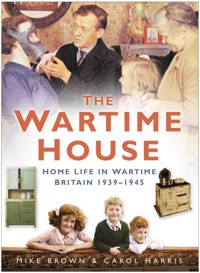
What was it like to live in Britain during the Second World War? What kind of house did the average family live in? How did people cope with the ever-present threat of air-raids, not to mention the hardship of food and clothes rationing? How was a typical suburban home built? What were the choices open to householders when it came to interior decoration and furnishing? How did the war affect the domestic routines of an average household? The demands of a nation at war had many other far-reaching effects on the average home. How did women cope with bringing up a family single-handedly after their husbands were conscripted for military service? How did they use the rations and keep up their families spirits? What was it like to 'Make do and Mend' or 'Dig for Victory', or to sleep in an Anderson shelter? By looking at the lives of ordinary people who inhabited the semi-detached world of suburbia, Mike Brown and Carol Harris have painted a vivid picture of daily life on the Home Front in wartime Britain.
Sie lesen das E-Book in den Legimi-Apps auf:
Seitenzahl: 331
Veröffentlichungsjahr: 2005
Das E-Book (TTS) können Sie hören im Abo „Legimi Premium” in Legimi-Apps auf:
Ähnliche

















THE
WARTIME HOUSE
HOME LIFE IN WARTIME BRITAIN 1939–1945
MIKE BROWN & CAROL HARRIS
THE HISTORY PRESS
First published in 2001 by Sutton Publishing
This paperback edition first published in 2005
Reprinted in 2007
The History Press
The Mill, Brimscombe Port
Stroud, Gloucestershire, GL5 2QG
www.thehistorypress.co.uk
This ebook edition first published in 2013
All rights reserved
© Mike Brown and Carol Harris, 2005, 2013
The right of Mike Brown and Carol Harris, to be identified as the Author of this work has been asserted in accordance with the Copyrights, Designs and Patents Act 1988.
This ebook is copyright material and must not be copied, reproduced, transferred, distributed, leased, licensed or publicly performed or used in any way except as specifically permitted in writing by the publishers, as allowed under the terms and conditions under which it was purchased or as strictly permitted by applicable copyright law. Any unauthorised distribution or use of this text may be a direct infringement of the author’s and publisher’s rights, and those responsible may be liable in law accordingly.
EPUB ISBN 978 0 7524 9472 2
Original typesetting by The History Press
CONTENTS
Acknowledgements
Conversion Tables
Introduction
ONE
The Suburban Dream
TWO
House Beautiful
THREE
Furniture and Furnishings
FOUR
Housework and DIY
FIVE
Rationing
SIX
The Wartime Kitchen
SEVEN
'If the Invader Comes'
EIGHT
Fashion
NINE
Entertainment
TEN
Reconstruction
Conclusion
Bibliography
ACKNOWLEDGEMENTS
We would like to take this opportunity to thank the following people whose help has proved invaluable in the production of this book:
John Davis of Manchester Metropolitan University; Ramesh Rajadurai; Clare Bishop, Catherine Watson, Kirsty Steadman and Jonathan Falconer from Sutton Publishing; William and Ralph.
Photographs are from the following sources:
Bromley Local Studies Unit; Daily Express; Daily Mail; Design Council; Hallmark Cards (Holdings) Ltd; Geo Harrap; Imperial War Museum; Lewisham Local History Centre; Osbert Lancaster, Homes Sweet Homes (1938); John Murray (Publishers) Ltd; Odhams Press; Vinmag Archives Ltd.
CONVERSION TABLES
MONEY
The currency used during the war was, like today, based on the pound. But under the old system, known as pounds, shillings and pence, the pound was divided into 20 shillings, each of which was worth 12 pennies. An amount would be written in the form of £3 17s 10d, or three pounds, seventeen shillings and tenpence. Smaller amounts might be written in the form of 12/6d or twelve shillings and sixpence. The guinea, worth £1 1s, was rather old fashioned by the late thirties, but continued to be used for more expensive items. Items priced in guineas were therefore implicitly of better quality.
RELATIVE VALUE OF THE POUND
It is difficult to understand how much something was actually worth in the past. A house might cost £800 pounds in 1932, but people earned a lot less too; so, is it relatively more or less expensive than a house today? The following conversion table shows the relative value of £1 using today’s values; so £1 in 1900 would be worth £55.36 today.
1900
£55.39
1905
£53.66
1910
£50.50
1914
£47.69
1918
£22.01
1920
£19.08
1925
£26.83
1930
£30.12
1935
£33.02
1939
£30.12
1940
£26.02
1941
£23.85
1942
£23.85
1943
£23.85
1944
£23.85
1945
£23.52
1950
£20.44
Source: National Statistical Office
COOKING
Weight
Measures
Liquid
The Cup
Another measure commonly used was the cup – ‘take one cupful of breadcrumbs’. This referred to a standard tea-cup (not a mug). It was an approximate measure, different from the precise US measure, also called a cup.
Oven Temperatures
Most wartime recipes have oven settings that are described rather than given as a figure; for example: ‘Bake in a moderately hot oven for fifteen minutes.’ The following table gives modern equivalents for these.
Description
Degrees C
Gas number
very slow
110–120
¼–½
slow
140–150
1–2
moderate
160–180
3–4
moderately hot
190–200
5–6
hot
220–230
7–8
very hot
240
9
INTRODUCTION
One of the greatest social revolutions of the last two centuries has been the massive and rapid expansion of what we would today call the middle classes. This group had its beginnings in the freemen of feudal England, the merchants and artisans, people whose skills and intelligence enabled them to rise above the ‘common’ people, without threatening the position of the ruling elite. The members of this group became the grease that allowed the wheels of society to turn smoothly. Those with ability and intelligence were plucked from the lowest rungs and put to good use in the evolving civil service, in the Church, and in commerce, running the country for those who ruled. This symbiotic relationship was nothing if not mercenary; the wealth created by the middle classes during the Industrial Revolution bought them marriages into the aristocracy, which by this time needed both money and fresh blood.
The middle classes excelled especially in the growing field of commerce, putting to good use the education that they valued so highly. So it was no coincidence that, as England became part of Great Britain, the middle classes spread throughout the towns and cities where most of that trade was conducted. This expansion was particularly obvious in the south-east of England, where much of the increasing Continental trade was based. Yet until the Industrial Revolution, the middle classes remained but a small sector of British society.
In 1867, the same year in which Karl Marx’s Das Kapital was published, Dudley Baxter’s book National Income of the United Kingdom quantified the size and distribution of the national income. As part of this process, Baxter attempted to sort the population into a number of groups or classes, creating a system that is still recognised today. He grouped the upper class with the upper middle class to make about half a per cent of the population. Next came the middle and lower middle classes, who together made up 20 per cent. Finally, skilled, ‘less skilled’ and unskilled labour, plus agricultural workers, made up the rest. So, by the second half of the nineteenth century, the middle classes had become a significant group and their numbers continued to rise.
But income was not the only identifying characteristic. Education was important, as was religion. Middle class morality, so despised by Alfred Doolittle in George Bernard Shaw’s play Pygmalion, was a definable set of values unique to the class. Retrospectively, it became synonymous with the values of the Victorians, and, as Dickens demonstrated time and again, the hypocrisy of a society which often paid little more than lip service to them. Its morality was rooted in a genteel lifestyle fuelled by salaries earned by predominantly clerical and professional workers.
With this new morality came a new way of life, unique to those living in the suburbs, totally alien to manual labourers living in the inner cities, or on farms for whom domestic life, with its earth closets, standpipes, slums, poverty and disease, had changed little since their grandparents’ time. In the twentieth century, the success of Suburbia was such that the enduring image of the inter-war period is of their cosy, semi-detached world.
This is the story of a typical British suburban house and the lives of those who might have inhabited it during the Second World War: it is representative of millions who, from their beginnings in the middle of the nineteenth century, grew rapidly to become the dominant feature of twentieth-century British society.
ONE
THE SUBURBAN DREAM
THE BEGINNINGS OF SUBURBIA
The nineteenth century witnessed a huge expansion of Britain’s towns and cities. The Industrial Revolution had followed a distinct pattern: workers were packed into tenements that had been quickly thrown up around the factories. The lack of public transport and the long hours they worked meant that the people had to live near to their workplaces, and this gave rise to overcrowded slums, close to the smoke, grime and dirt created by these industries.
The towns grew quickly as the move from countryside to town gathered pace. In 1851 about half the population of England and Wales lived in urban areas; by 1901 this had risen to three-quarters, and by 1939 to four-fifths. At this time, Greater London alone encompassed one-fifth of the entire population of the two countries. The rate of expansion continued into the twentieth century. In 1900 London’s Charing Cross was about 8 miles from the countryside, north or south; by 1939 this had almost doubled to about 15 miles in a new outward surge.
As the population of workers in the slum areas of the industrial towns grew, those with higher paid positions who could afford transport lived on the outskirts of the town, or the suburban areas – the suburbs. Here they were on the edge of the countryside, and could enjoy fresh air and peaceful surroundings.
In 1898 Ebenezer Howard’s book Garden Cities of Tomorrow compared urban and rural living. His ‘Garden City’ concept combined the pleasant aspects of living in the country with the ability to work in the town, while keeping commuting time to an acceptable minimum. He proposed that a series of new towns be established around London, each surrounded by its own ‘Green Belt’ of land. With private funding, Howard began building at Letchworth in 1903, and Welwyn Garden City in 1920. His ideas were very popular, and were copied in such schemes as the Hampstead Garden Suburb, begun in 1907. His ideas and influence also contributed to the fashion for nostalgia in designs, with Elizabethan and other historic styles predominating.
AN ENGLISHMAN’S HOME IS . . .
The typical seven-room semi contained (average sizes are given): three bedrooms: 14 ft 6 in × 11 ft (4.35 m × 3.3 m); 13 ft × 11 ft 6 in (3.9 m × 3.5 m); and 8 ft × 7 ft 6 in (2.4 m × 2.25 m); a drawing-room: 14 ft 6 in × 12 ft 6 in (4.35 m × 3.75 m); a dining-room: 14 ft × 11 ft (4.2 m x 3.3 m); a kitchen or kitchenette: 10 ft × 7 ft 6 in (3 m x 2.25 m); and a bathroom, of a similar size to the kitchen.
The late Victorian and Edwardian suburbs had typically comprised rows of neat, brick-built terraced houses, but the ease of movement (and consequent expansion of the suburbs) provided by improved transport systems meant that houses could be built far less densely, with front and back gardens. This led to the shift away from terraced to detached, or at least semi-detached construction, and the inter-war suburb – the period during which growth was most marked – was typified by the three-bedroomed semi-detached house, or ‘semi’. The single family semi was a determined move from the typical Victorian tenement lifestyle, where many generations of the same family lived squashed together, everyone knowing everyone else’s business; the suburban semi, with its garden (front and back) and its (partial) insularity, was the embodiment of a desire for genteel privacy.
Initially, however, few could afford to move out to the suburbs; while the houses were not particularly expensive, they were still beyond the reach of the lowest paid. The cost of commuting also had to be considered. Transport in the form of the horse, with or without carriage, was pricey. Even the earliest horse-drawn omnibuses were relatively expensive, although the arrival of passenger trains, with their cheap, early morning, workman’s tickets eased the situation. These factors tended to make the suburbs the domain of the rapidly growing lower middle classes.
TRANSPORT
By the beginning of the twentieth century, public transport services were being rapidly improved, with the result that more people could live further away from their places of work. Allied to this was the move to shorter working hours, which gave people more time to be able to travel to and from work. These changes, in turn, created a new outward spurt of suburban house building.
Electric trams had been introduced at the turn of the century, and soon replaced the horse-drawn versions. Motor buses were also introduced; although at first they were noisy, smelly, and inclined to break down, by 1910 new models such as the London General Omnibus Company’s B type – sometimes called the ‘Old Bill’ – had solved most of the problems. The omnibus, which could cover new routes without needing new tracks or cables, became the preferred mode of transport for town dwellers, putting most of the tram companies out of business.
In the larger cities, where longer distances between the centre and the outskirts made travel by bus less viable, railways met the demand for public transport. The sheer size of London meant that the scale of the problem was far greater and needed a different solution. The first underground electric line had opened in London in 1890, then the Metropolitan and District Underground Railway Companies began replacing their steam trains with electric versions. In 1900 a new company, the Central London Railway, opened its first line, running from the Bank to Shepherd’s Bush. It proved a great success, carrying 100,000 passengers a day, and was followed by several others: the Bakerloo line in 1906 (Baker Street to Waterloo); the Piccadilly line, also in 1906 (Finsbury Park to Hammersmith); and the Hampstead line in 1907 (later integrated into the Northern line).
The Hampstead line is an excellent example of the symbiotic relationship between transport and housing development at the time. The line terminated at the cross-roads in Golders Green and for a short while the station was the only building in the area. But within months, builders were putting up houses all around it. Such was the demand for housing in these locations that house-builders themselves put money towards the cost of constructing stations.
After the First World War, the underground lines continued to expand, and in 1933 the various companies were brought together into the London Passenger Transport Board (LPTB). Buses linked the stations to the new estates, allowing easy access to the centre from the suburbs, facilitating the movement outwards. Between 1921 and 1937 the population of outer London rose by 1,400,000, while that of central London fell by 400,000.
Underground posters encouraged this outward move, with many extolling the peace and beauty of suburban life. The first of these, ‘Golders Green’, produced in 1908, shows a neat timber-gabled house with an equally neat garden; a middle-class man in his shirtsleeves is watering his flowers, while his wife sits winding wool in a deck-chair on the lawn, with their young daughter at her feet.
The Metropolitan Railway produced an annual guidebook, Metro-land, from 1915, which described the country districts served by the line. One of the main sections, and the purpose of the booklet, was the ‘House Seekers’ section, with pages of advertisements for houses, usually newly built, in the area. The term ‘Metro-land’ became synonymous with districts north-west of London in Middlesex, Hertfordshire and Buckinghamshire, which were served by the line. The booklet continued to be issued until 1932, after which the Metropolitan line disappeared into the LPTB.
The road network too had seen expansion. By-passes, such as that at Kingston in Surrey and the North Circular Road, as well as new fast routes, such as the Western and Eastern Avenues, were signs that cities were becoming more accessible to the rapidly expanding car-owning public who could commute greater distances. Houses, factories and shops sprang up along these and other main roads because services (gas, water, electricity and sewage) were immediately accessible so there was no need for new and expensive pipework. This meant that houses could be built far more cheaply. However, ribbon development, as this became known, marred the whole point of these new roads, as what were supposed to be fast access roads became clogged with local traffic; ribbon development was prohibited by an Act of Parliament in 1935 but by then the damage had been done.
SOCIAL TRENDS
In 1909 C.F.G. Masterman, in The Condition of England, delineated the class structure in Britain as: the Conquerors; the Suburbans; and the Multitude. He described the Suburbans as ‘practically the product of the last half century’. Masterman’s description of suburban life was just as valid in 1939 (and, apart from its sexual stereotyping, is still recognisable today):
its male population is engaged in all its working hours in small, crowded offices, under artificial light, doing immense sums, adding up other men’s accounts, writing other men’s letters. It is sucked into the City at daybreak and scattered again as darkness falls. It finds itself towards evening in its own territory in the miles and miles of little red houses in little, silent streets, in number defying imagination. Each boasts its pleasant drawing room, its bow window, its little front garden, its high-sounding title – ‘Acacia Villa’ or ‘Camperdown Lodge’ – attesting unconquerable human aspiration.
The aspiration again stems from the Industrial Revolution. Previously, knowing one’s place and its immutability, set at birth, had been the cornerstone of society. During the Industrial Revolution, men like Richard Arkwright had literally gone from rags to immense riches and, in doing so, had taken on the trappings of traditional ‘Lord of the Manor’. Upward mobility became the aim of many, even on a modest scale. And upward mobility most easily defined itself in the manner exemplified by Arkwright and other successful magnates, who themselves took a traditional approach to displaying their success. Therefore, it is no coincidence that much suburban housing of the twenties and thirties had the feel of minor baronial halls, with their half-timbered finishes, their bow windows with stained glass and latticed panes, and their Gothic front doors. This feeling of rural selectivity was aided by the naming of roads as Drives, Lanes and Avenues. Indeed, many houses were marketed as ‘Baronial Halls’, or ‘Cosy Palaces’, and a big selling point was that ‘Every one different’, even though the differences were usually minuscule.
The numbers of those in ‘blackcoat’ jobs – in government offices, banks, trade and commerce – raced up, reaching 3 million in 1939. Besides these, there were the professionals, or salaried workers – lawyers, teachers, doctors, clergymen and so on – whose numbers doubled to 1½ million between 1911 and 1921. By the late thirties, most of these men were earning good salaries and could afford to pay for good houses. These new salary-workers swelled the ranks of the lower middle classes, who demonstrated this newly improved status by moving out of the city centres and into more genteel surroundings. To move from a terrace to a detached or semi-detached villa, and better still, from renting a property to buying one, was the ultimate way to show one’s transition from worker to professional. By 1939 over a quarter of all houses were owner occupied; a remarkable change in just four decades.
Yet this affluence did not remain exclusively the reserve of the middle class; the living standards of the working classes, especially the skilled craftsmen, foremen and supervisors, also gradually improved during the last quarter of the nineteenth century. The average purchasing power of the working classes increased by almost 50 per cent. In 1900 the average wage for a skilled craftsman was about 37s. a week. By the end of 1919, wages had increased by about 120 per cent over pre-war levels, but the cost of living had increased by a similar amount, wiping out any advantages. Over the next ten years, both wages and the cost of living fell, with wages slightly ahead. By the early thirties, unemployment was high, reaching 22 per cent. Yet paradoxically, those still in full-time employment in 1933 had a purchasing power that had increased by over 10 per cent since 1930 – their wages had fallen but prices had fallen even more.
After 1933, the world began to ease its way out of the slump and the cost of living began to rise again and by the outbreak of the Second World War wages were 15 per cent higher in real terms than they had been in 1924. One result of this was that many of the better paid manual workers were able to make the move to suburbia; by 1939 over 30 per cent of all those taking out mortgages were wage earning as opposed to salaried workers.
This move towards house-ownership was completely new. Few Victorians owned the houses they lived in, mainly because renting made far more sense in a society which was far more economically mobile than today. Also, the size of a Victorian household could fluctuate wildly; a young family would expand rapidly. The average family had five or six children, and almost 20 per cent of families had ten or more. On the other hand, a family could, even more rapidly, shrink at a time when child mortality rates were high and epidemics of measles, chicken pox, diphtheria and other viruses could rage unchecked. Additionally, the typical Victorian family could be expected to care for aged, infirm, or less fortunate relatives, as even a cursory glance at Dickens’ works can tell us. Most of the advice to those looking for a home in the late nineteenth century recommended taking out a lease of no more than three years.
Before the First World War, the most prolific year for house building was 1906, when about 150,000 houses were constructed. The ever-increasing demands for manpower during the war meant house building effectively stopped; afterwards, in the election of December 1918, Lloyd George’s coalition promised soldiers that they would return to ‘Homes Fit for Heroes’, but the costs were huge. The war had created runaway inflation – in 1919 it cost four times as much to build a house than it had in 1914.
During the war, rent strikes by militant workers had led to the Government imposing a rent freeze on poorer dwellings. This was extended to all housing after the war in response to the acute shortage of houses for rent, and the consequent profiteering by landlords who realised they could charge ever higher rents. In responding to the necessity to keep available housing affordable, the Government found itself facing a worsening shortage that it could do little to remedy.
Before the war, it had been common for people to buy houses as a form of investment, either outright or as part of a syndicate. The owners would receive a regular income in the form of rent, and the capital (the house) could be realised (sold) fairly easily at any point. The best investments could be said to be ‘as safe as houses’, but rent freezes meant that they ceased to be such an attractive proposition, and few people were prepared to invest their money in them.
Not only were no new houses built for the four years of the war, but there appeared to be little hope of any more being built at all, especially at a time of rapidly spiralling costs for raw materials. The promises of Lloyd George started to ring hollow.
This was also a time when the rulers and governments of Europe had been shaken to their foundations by the Russian Revolution of 1917, which had resulted in the overthrow of one of the most powerful dynasties in Europe. The ruling classes of this country were not a little concerned at the prospect of men, trained and experienced in the use of arms, returning to find that their promised ‘Homes fit for Heroes’ were, in reality, the same stinking tenements and slums they had left behind.
Partly to pre-empt this, the British Government passed what was to become known as the Addison Act, after Dr Christopher Addison, the then Minister of Health. Under this act, for the first time government money was put into public housing. This was done in the form of large grants to local councils towards the cost of building houses. Not surprisingly, this led to a massive increase in the building of local authority housing between 1919 and 1921. Sixty per cent of all the houses erected in this period were council houses – a ten-fold increase of pre-war figures. But in 1921 a severe economic slump brought all this to an end; inevitable cuts in public spending included the cessation of grants created by the Addison Act. In 1919, in an effort to stimulate the building trade, the Government had also introduced grants to private builders to put up cheap semis either for rent or sale. This practice continued, and was extended in 1923 when the grants were raised.
THE RISE OF THE BUILDING SOCIETY
As the market for investing in houses collapsed in the 1920s, so the end of the war, the Communist uprisings in central Europe and the re-drawing of the political map by the Treaty of Versailles, which ended the First World War, and other treaties brought such uncertainty in the world that overseas investments also became risky. One domestic solution was the building society. Instead of directly investing in a house, people put their money into these societies. This was further encouraged by a deal worked out between the societies and the Inland Revenue which allowed investors to pay tax at source. Soon the societies had far more money to lend.
Further, the uncertainties of the 1920s, which began with the slump and ended with the Depression, made the middle classes worried about their investments. So, once again the idea of investing in property in the form of buying your own house (if only on a mortgage) seemed very attractive. These factors both stimulated the building of new houses, and dictated that most of them would be sold rather than rented, creating a different kind of social revolution from that which was happening in Russia. More and more, people bought their own houses and owner-occupation began to filter down the social scale. Soon the proportion of houses built by the local authorities began to shrink back towards pre-war figures.
Building societies had been around on a small scale since the act of 1836. Now they began to grow. For example, in 1913 the building societies advanced £9 million to those wanting to buy their own homes; by 1938 this had risen to £137 million. Mortgage repayments became very favourable compared with rents and there were few disincentives to buying; repayments were made over (usually) twenty to twenty-five years, the average repayment being around £1 a week. However, for many prospective home-buyers the down-payment demanded by the building society was often difficult to find. Frequently set at 20 per cent of the purchase price of the house, it was well beyond most first-time buyers’ pockets – and most people, at this time, were first-time buyers. So the building societies worked with the building trade to set up ‘Builders’ Pools’. Under this scheme, the developer of an estate would pay some of the down-payment demanded by the building society, so that the down-payment for the buyer was able to fall to a far more reasonable average of 5 per cent of the purchase price.
An added impetus for house-buying was the steep drop in prices; in the immediate post-war period, a typical three-bedroomed semi might cost around £1,000 to £1,200. In the early thirties, this had tumbled to £600 to £800 for a similar house in Greater London. By the outbreak of war, this had dropped to £400 to £600 (£100 less in provincial towns). There were many reasons for this fall. In the building trade, wages remained low because of high unemployment in other areas of industry. Costs were further held down by the standardisation of house design. A simple plan, which could be adjusted in size, meant that costly architects were not needed.
THE BUILDING BOOM
As mortgages were growing in popularity during the later 1920s, renting was becoming more and more difficult. Most of the middle-classes, and even the better paid manual workers, were therefore more or less forced to buy their own properties, spending a greater proportion of their earnings on property than ever before. House advertising began to emphasise the comparative advantages of ownership; slogans such as ‘Why pay rent?’ became common.
Agriculture was depressed so, increasingly, land-owners sold off parcels of land cheaply to the builders. Many of these land-owners tried to control the type of housing, or more accurately, the type of tenants who would occupy the land. They would often do this by stipulating, as part of the deal, that the land could only be used for a certain type of high quality housing, thus ensuring that the value of the rest of their land did not plummet. These caveats usually took the form of an agreement to limit the size and number of buildings per acre. These demands were often supported by the local councils, who had no wish to see city slums, or slum-dwellers for that matter, appearing in their area.
PROSPEROUS PROPERTY
The 1921 census recorded a total of just over 9 million houses in Britain, and the next two decades were to see an incredible boom, with 4 million new houses being built altogether. Each year, more and more houses were constructed, the number rising from 93,000 in 1923/4 to 261,000 in 1927/8. Almost three-quarters of these were private, rather than council, houses and by far the majority of these were for sale rather than to rent. Thousands of seven-room semis were built; by the mid-thirties, over 360,000 homes were being built each year, although this figure tailed off after 1937.
So there was an upturn in house building. Builders were quick to respond to this new demand. ‘Spec-building’ – building houses to be sold when finished, rather than building them to order – became the normal practice. Most building was carried out by small businesses; in 1930, over 80 per cent of all building firms employed fewer than ten workers.
Various methods were employed to make what were essentially the same, formula houses appear slightly more unique. Some were given a fascia of white plaster and black-painted timber to create the Tudor cottage look, referred to derisively as ‘Stockbroker Tudor’ – a term coined by the cartoonist and satirist Osbert Lancaster; in others, the exterior walls often had cement render over the bricks; small gravel was thrown on to the wet cement to create a new effect called ‘pebble-dash’. Purchasers had a choice of stained glass designs for front windows and doors ranging from the traditional to the pictorial, and the ultra-modern, Art Deco geometric. Individuality was further ensured by choices of styles for front doors and porches.
ROGUE TRADERS?
Standards of building varied enormously. It is an indication of how poorly some houses were built that some were actually advertised as having ‘concrete foundations, double slate damp courses and lead flashings’ – things that would be taken for granted today. One case that made the news was that of Mrs Elsie Borders, who became known as the ‘Tenants’ K.C.’
Mrs Borders bought a house in West Wickham in Kent, with a mortgage from a building society. The house cost £633 and Mrs Borders moved in with her family in 1934. The shoddy workmanship soon became evident as damp and infestation by beetles took hold, wallpaper peeled away from the walls, cracks appeared and the floorboards shrank. Mrs Borders stopped her mortgage payments, arguing that the building society’s assurances that the house was sound were clearly a misrepresentation. The builder, not untypically, had gone into liquidation so Mrs Borders also claimed that the building society had therefore lent money on inadequate security. The building society sued for repossession. Mrs Borders, by now fast becoming a nationally known figure, counterclaimed for the return of her money as well as for an additional £1,000 to represent the cost of repairs to the property.
The press was not slow to realise this homeowner’s fight against poor building standards struck a chord with many others on similar estates and developments throughout the country. National newspapers ran pictures showing the family in the front porch of their crumbling house, with its name, ‘Insanity’, picked out neatly in white letters beside the front door. Mrs Borders became a cause célèbre and fought her case until 1941, when the House of Lords, the highest court in the land, finally ruled in favour of the building society. But if her seven-year battle had eventually been lost in the courts, the war against poor standards was, by 1941, largely won.
Tenants’ Defence Leagues, guarantees of workmanship from builders and other initiatives to allay the fears of the aspiring suburbanites became prominent selling features as those building houses tried to distance themselves from the perils of jerry-building – a nineteenth-century term, incidentally, and nothing to do with the First World War. One consequence of the continuing furore was that many builders began offering one- or two-year guarantees on materials and workmanship. In 1937 the National Housebuilders’ Registration Council was set up, offering registration of companies prepared to work to a certain standard, and offer a two-year warranty. Over a thousand companies registered in the first year, and many used this membership as part of their advertising.
Inevitably, all this building created a buyers’ market, and builders had to work hard to sell their properties. Advertising boomed and the practice of producing a furnished show house on an estate became common. Houses were offered with lawns and gardens planted free, one-year’s free season ticket on the railway, free furniture or kitchen fittings. Radio or film stars were hired to promote the launch of an estate, as were firework displays and concerts. As the Second World War approached, even the threat of aerial bombardments in the inner-cities was used to sell suburban houses in safer surroundings.
BUILDING A NEW LIFE
For those who did not have the means to buy a new house yet longed to own a house out of the city, one solution was to buy a plot of land (average cost £5) and build your own home, travelling to the plot at weekends and during holidays to do some work on the project. Farmers were only too keen to sell of areas of poor quality agricultural land. Councils in seaside locations were more willing to allow developments on unused land than their suburban and metropolitan equivalents. On the whole, they were also less concerned about preserving the existing character of the locality, if such existed and, while they might not have liked the more radical designs, they welcomed the income that such developments inevitably brought.
Ideal Home magazine produced a series of books throughout the twenties and thirties, The Ideal Home Book of Plans, each of which contained sets of (very basic) plans for houses and bungalows. They tempted readers with: ‘Dreams of that “Home of your own”. . . of that haven of comfort which you hope will soon come true? Not the ready-made “creation” of someone else – but a distinctive dwelling place which will express your own personality.’
The second Book of Plans contained a doom-laden warning to those foolish enough to buy unserviced land:
In the course of the last few years many estates have been cleverly exploited by people having capital whose sole object is to sell land and houses and make money. Again and again people have bought land with the promise that roads, sewers, water, light would be forthcoming very soon. Having bought and paid for the land they find that they own a small freehold in the middle of a field, without access, and with no facilities for building. It is clearly impossible to build unless water is laid on and for that one may have to wait for years.
Various building acts brought in over the period set down minimum standards for self-built or commercial premises. These concerned safety and covered fire-proofing, sanitation (including plumbing and drainage), and the fabric of the building, including a law to make a damp-proof course compulsory on every building. These regulations, to some extent, added to the uniformity of buildings produced but this was far outweighed by the general improvements in standards.
It is often said that ‘They don’t build them like they used to!’ A brief inspection of a late Victorian terraced house can reveal inadequate or non-existent footings, cheap materials and poor workmanship which would lead most to agree with the words of the statement – if not the usual implication.
HOME SWEET HOME
Away from the patronage of leading architects, so-called shanty towns sprang up. A popular song, recorded by Les Allen in 1932, celebrated the joys or otherwise of this type of living:
A Shanty in Old Shanty Town
It’s only a shanty in an old shanty town,
Where the roof is so slanty it touches the ground.
Just a tumbledown shack
By an old railroad track,
Like a millionaire’s mansion,
It’s calling me back.
I’d give up my palace,
If I were a king,
It’s more than a palace, it’s my everything.
There’s a queen waiting there with a silvery crown
In a shanty in old shanty town.
In the period after the Second World War, many of these developments were cleared away by the local authorities who had welcomed them just as enthusiastically a couple of decades earlier.
An advertisement for Peacehaven, one of the most famous ‘plotlands’ where plots could be bought for self-build or with houses ready-built. These areas were often unregulated and became shambolic shanty towns.
‘A PLACE OF ONE’S OWN’
The suburban semi, epitomising the lower middle classes, has long been the butt of jokes. Even while they were being built, they were scorned by architects and writers. Osbert Lancaster famously differentiated semis under the headings: ‘Stockbrokers’ Tudor’; ‘Wimbledon Transitional’; and ‘By-pass Variegated’. Heath Robinson, whose illustrations lampooned all aspects of modern life, certainly included suburban dwellers and their mores among his targets. But the suburban developments had tapped into a deep current; they allowed many who could not otherwise have afforded to do so to purchase ‘a place of their own’, to have their own bit of garden, and to live in quiet respectability. Today, this seems a fairly modest ambition, but just a century ago it would have been an impossible pipe-dream for many people.
In 1939, however, the building of new houses slowed once more, coming to a complete halt in 1940, as another war shook the world.
TWO
HOUSE BEAUTIFUL
STYLES AND DESIGN
The Arts and Crafts Influence
There was no single identifiable ‘wartime’ house. No houses were built during the Second World War, so suburban houses were mainly those built before or during the inter-war years. Furnishings and fittings were in short supply, if they could be obtained at all, and furniture was rationed. So throughout the war, the average wartime house in the suburbs was built, decorated and furnished in thirties’ style.




