


Erhalten Sie Zugang zu diesem und mehr als 300000 Büchern ab EUR 5,99 monatlich.
- Herausgeber: Luath Press
- Kategorie: Lebensstil
- Sprache: Englisch
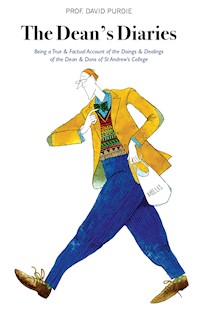
A collection of diary entries from the dean of the fictional St. Andrews College, Edinburgh. Longsuffering and cantankerous, he documents the comings and goings of eccentric professors, academic triumphs and failures and the disastrous outcome of a physics department's experiment resulting in the magnetisation of the number 42 bus.
Sie lesen das E-Book in den Legimi-Apps auf:
Seitenzahl: 163
Veröffentlichungsjahr: 2015
Das E-Book (TTS) können Sie hören im Abo „Legimi Premium” in Legimi-Apps auf:
Ähnliche


















PROF. DAVID PURDIE was born privately and spent most of his early years as a child, before being educated publicly at Ayr Academy and the University of Glasgow. His career took him abroad for over 20 years to England where he was Clinical sub-Dean of Leeds University medical school. He concluded his medical academic life as a Professor Emeritus of the Universities of Hull and York.
He is presently an Hon. Fellow of Edinburgh University’s Institute for Advanced Studies in the Humanities (IASH) located on The Meadows, the capital’s great public park, upon which he gazes thoughtfully when seeking Enlightenment. Fellows of IASH work in the fields of, inter alia: Philosophy; Classics; European Literature and other disciplines too complex to spell.
David is an Editor of the 4th Edition of theBurns Encyclopaediajointly with Profs Gerry Carruthers and Kirsteen McCue of Glasgow University – and of editions of Sir Walter Scott’sIvanhoeandHeart of Midlothian. Following his work with Prof. Peter Fosl of the US on Scotland’s greatest philosopher,le bon David, he regards himself simply as a Humean being.
A Patron of the National Library and National Galleries of Scotland, he occupies a 400 year-old pile with plumbing to match and resident ghost, on Edinburgh’s North-West Frontier, i.e. between the New Town and Stockbridge.
The Dean of St Andrew’s College is suspected to be a close relative. Any resemblance to persons dead, living, or yet unborn, is accidental.
The Dean’s Diaries
Being a True & Factual Account of the Doings & Dealings of The Dean & the Dons of St Andrew’s College
PROF. DAVID PURDIE
with illustrations by
BOB DEWAR
Luath Press Limited
EDINBURGH
www.luath.co.uk
First Published 2015
ISBN: (EBK) 978-1-910324-65-3
(BK) 978-1-910745-20-5
The author’s right to be identified as author of this work under the Copyright, Designs and Patents Act 1988 has been asserted.
© David Purdie 2015
Contents
Foreword
Introduction
College Animals
The 15 Tesla Problem
The Guest in the Laundry Chute
High Table Dining
Misprisions
The Decalogue
Richard PorsonMA
The Dean at Oxford
New College
Scott and the Aussies
Saints & Sinners
Public Transport
The Big Bang – and Chimps
Armistice day
The Lord’s Taverners Lunch
Student Japes
A Summer Roundup
TheAGM
Gravity
Founder’s Day Lecture
Appraisals
Trains
The Dean from Krakow
Machrihanish
The Dean on the Phone
The Dean in America
The Dean inDC
Golf in America
College Burns Nicht
The Dean’s Ivanhoe
The Lady Mondegreen
The Dean in Musselburgh
The Dean’s Correspondence
Foreword
by the Rt Hon. the Lord Fanshawefrs
IT IS WITH REAL and unfeigned pleasure that I contribute this Foreword to the long-awaited publication of theDean’s Diariesin book form. By far the most formative period of my own academic career were the years spent at St Andrew’s College, first as Research Fellow and then as a Don.
Like allalumni, I retain an intense interest in the old place and in the extraordinary press reports involving the Dean and his faculty. These include the misadventure of my colleague Prof. Trevelyan in the College laundry chute and the seismic matter/antimatter explosion which blew out almost every window in Edinburgh’s Old Town. Of current interest is the Dean’s repeated denials of the persistent rumour that the Astrophysics Unit had made contact with an ‘entity’ within the constellation Andromeda.
Thanks to the advocacy of my learned friend Alec MacEchron QC of the College’s Dept. of Scots Law, the Court of Session has finally agreed that the secretive old Constitution be set aside so that the completeDiaries of the Deansdating back 450 years may be published, starting with the diaries of the current Dean. We will thus gain insight into the College’s role in the development of the aerophone, the self-starting oven and the omnilingual translator. Out of the shadows will come, finally, an account of the creation of the first artificial Black Hole which swallowed the entire Physics Department before vanishing in the direction of the City Chambers.
I hope to be present,dv, next September when the College will participate in Open Doors Day. The highlight of this is to be a lecture by Prof. Sir Iain Roberts DD, holder of the David Hume Chair of Advanced Scepticism entitled:
The Virgin Birth; Some Conceptual Difficulties
In summary, the general population of Scotland remains rightly proud of St Andrew’s College, seeing in its fierce political incorrectness and general eccentricity a shield against the creeping gloom of the Endarkenment.
Lang may its lum reek in Reekie.
Fanshawe,
President, Emmanuel College, Oxford.
Introduction
FOUNDED IN January 1561 by a Decree of the Regent Earl of Moray and the Rev. John Knox, St Andrew’s College occupies a unique position both in Edinburgh and at the apex of British academia. Superintended by its Dean andEstaitis, or Council, the College was described recently in a review byThe Times Academic Supplementas, ‘A Titanic of the Intellect’. As a University College it is independent of the City’s four other universities (Edinburgh; Heriot Watt; Napier and Queen Margaret).
The College occupies a full city block in King George IV Bridge between the National Library of Scotland and the National Museum at the corner of the Bridge and Chambers St. Intriguingly, it cannot be approached using any GPS device due to a massive augmentation of the Earth’s magnetic field by the Supertesla Array used in its anti-gravity work for the Ministry of Defence. This may also explain the recent ‘tractoring’ into the College atrium of a passing No. 42 Lothian bus, followed by the ATM machine from the Bank across the street. St Andrew’s maintains a marine biology ‘outstation’ at Machrihanish at the Mull of Kintyre. There is also an ‘enclave’ in the Carrifran Valley in the Moffat hills, the purpose of which is known only to the MoD.
Traditionally highly secretive, St Andrew’s is believed to have about 40 permanent academic staff, known as Dons. There are a similar number of postdoctoral Research Fellows, the Dean recently stating to the BBC that he was ‘never quite sure of theprecisenumber, as they pop in and out of existence in a quantumly relativistic way.’ Many of these come from overseas, including England, their Fellowships lasting as long as their project, or the Dean’s patience, lasts. St Andrew’s, however, remains resolutely international. It presently houses three Fullybright Scholars from the US, two from the Sorbonnet in Paris and one from the Max Plonck Institute in Stuttgart. College Fellowships rank with those of All Souls College, Oxford and of Harvard as the ultimate ‘Glittering Prize’, in any academic career.
Regarding subject matter, both Dons and Fellows range across the Humanities with particular emphasis on: Classics; Philosophy; History and Literature, while the Sciences are restricted by space to those disciplines not requiring heavyweight equipment; such as theoretical geology and astrobotany.
Former Fellows include several Nobel laureates including Sir Hector Mackendrick who discovered ‘The One’ by uniting quantum dynamics with Einsteinian general relativity, and Prof. Aeneas Blair-Drummond who deciphered the Pictish Papers. Current Dons include Prof. Abe Rabinowitz, head of Semitic Studies who finally proved that the Scots are the lost 13th tribe of Judah, and Dr Henry Burns, recipient of the McGonagle Prize for 2013 for his invention of the Bathing Wig™.
St Andrew’s has no undergraduate students. Thanks to the Endowment, neither Dons nor Fellows undertake any teaching or administrative duties. They are thus freed to prosecute ‘blue sky’ research in the manner of such sister institutions as IASH at the nearby University of Edinburgh, and the Institute for Advanced Study at Princeton University in the US.
The College is financially independent, receiving no funding either from HMG at Westminster or from Holyrood. This is due to its massive Endowment, believed to derive from its Constitution written in 1698 in the aftermath of the Darien Scheme. Itdeliberatelyrepresented the Scheme as a failure, thus concealing from public view the enormous quantity of gold bullion and silver artefacts brought back to Scotland from the Isthmus of Panama and secreted in the College vaults.
Intense public and press interest in the secretive College and its Dons prompted the Dean to begin releasing his weeklyAcademic Diaryin the Martinmas Term of 2012. Revelation of the extraordinary activities at St Andrew’s, together with the oddities of the Dean and his senior officers: the Bursar; Warden; the Bedellus and the ‘Visitor’, constitutes one of the most remarkable documents to emerge from Academia in recent centuries.
‘I do this for Posterity, don’t you know,’ said the Dean in the recent STV documentaryRisen by Gravity, ‘despite Posterity having done absolutely nothing for us… yet.’
College Animals
Office of the Dean
St Andrew’s College
King George IV Bridge
EdinburghEH1 1EE
THE MARTINMAS TERM is now well underway – and the College hums with scholarly endeavour. That is, when it is not humming with the atrocious pong coming from our Palaeontology Research Unit where a complete adult woolly Mammoth is being warmed up for dissection. Dug out of some Russian ice-bog, it was presented to us as a ‘fraternal greeting’ by the Sverdlovsk Academy of Sciences.
I really wish we could be spared these very kind but hugely inconvenient ‘gifts’ from colleagues elsewhere. Last year it was a Giant Squid (Architeuthis physenteris) with suckers the size of soup plates from somewhere off the Azores. Its arrival in the Marine Biology Lab coincided with an unusually warm April and had all of us in gasmasks for a fortnight. The thing was so recently dead that when an electric cable touched one of its huge arms it uncoiled, whiplashed across the lab, smashed a window and grabbed Mrs Tunnock the tea-lady, whose shrieks I can still hear.
The animal life of this College is truly remarkable. The sheer range of creatures calling the place home matches the provenance of the Fellows – and their oddities. Yala, the Bursar’s dog, is here under false pretences, canines being banned by Statute. However, on hearing how our Oxford colleagues surmounted the problem of the Master’s poodle at Balliol, a Council meeting formally declared it,nem con., to be a cat.
This hound is aShar-pei, or rather a沙皮in Cantonese, and is the traditional gate-keeper of their ancient religious sites. How a Chinese temple guardian came to be in Edinburgh’s dog pound where the Bursar found it, is a mystery to me. Anyway, the creature now guardshimwith assiduous care, fixing all visitors, including me, with an inscrutable oriental stare.
Much more entertaining isMnemosyneour Philosophy Department’s Hill Mynah (Gracula religiosa) named after the Greek goddess of memory and mother of the nine Muses. Memo, as she’s known throughout College, is actually in the Guinness Book of Records for possessing an astonishing 800 word memory. Less believable is the assertion by our metaphysician Prof. Archie MacKendrick that Memo actuallyunderstandsthe theory of syllogistic logic and is a disciple of David Hume’s approach to the problem of induction.
The bird regularly attends seminars in the Philosophy Department, listening intently to all the positing, conjecturing and refuting they get up to. She enlivens proceedings with an occasional bowel movement and fixes a beady eye on any participant suspected of a logical inexactitude or a dodgy premise. Its suspicion of any such is greeted with a whistle and a piercing cry of ‘Bull!’ or ‘UpWittgenstein!’ thereby reducing the company to hysterics.
However, the absolute star of bird eloquence was the Captain’s cockatoo on the frigate HMS Gangesback in the age of sail. Orders were then were issued to the jolly Jack Tars by complex whistles on the Bosun’s pipe. The bird had learned a dozen or so of these and when the actual Bosun whistled, it would issue accurate but contradictory instructions – to the white fury of the Bosun and delight of the crew. The whistle for ‘Admiral’s barge approaching’, would be followed by ‘Abandon ship!’
The creature also had superb timing. When the pipe was ‘Anchor,hoist’ after a pause to let the sweating Tars get it half-way up with the windlass, the bird would signal ‘Let go!’
Animal intelligence is not confined to cockatoos, killer whales or bottle-snouted dolphins. The chimpanzee, our nearest cousin, is also seriously smart, not surprising, given that it shares no less than 98.5 per cent of its DNA withHomo sapiens.
The announcement of this in 2006 coincided with a theological conference here at the College. I mentioned it to our principal guest, the then Archbishop of York who seemed rather taken aback. At lunch, his Chaplain confided to me that His Grace had been seriously unamused to be told that he shared 98.5 per cent of his genetic endowment with a chimp. I said, ‘Not amused is he? Just wait till he hears that he shares 48 per cent of it with a banana!’ However, by the time of his own Keynote Lecture that afternoon, the Archbishop had come to terms with science. He told a startled audience that since Man’s immortal soul is part of the body politic and is thus encoded by our DNA, this means that the Chimpanzee also probably has a soul. Consequently, the care and welfare of the souls of apes residing south of the Border might well become a charge upon the Church of England… My Lord Archbishop did not produce any consensus for this extraordinary conjecture, but he reckoned without the presence of the Press. The result next day was a splendid headline over theDaily Telegraph’s report on our conference. It ran,
‘Chimpanzees have souls – says Primate’
The 15 Tesla Problem
Office of the Dean
St Andrew’s College
King George IV Bridge
EdinburghEH1 1EE
ST ANDREW’S COLLEGE is an independent University College, geographically close to but not part of, the University of Edinburgh. We are often described as the ‘Northern All Souls’ (we’re ‘McCall Soles’ inPrivate Eye) because like that splendid Oxford College, we have no undergraduates. We have only the academic staff, known as Dons, plus Postgraduates and Research Fellows from home and abroad, to the number of about 60. I’m actually never sure of the exact number since they pop in and out of existence in a relativistic and indeed quantum mechanical way. The College is superintended by myself as Dean, assisted by the Bursar, the Prebendary, the Warden and the Bedellus, all of whom sit on the ‘Estaitis’, an ancient Scots word for Council, dating back to our Foundation in 1561.
College is mercifully quiet at present, thanks to the summer break when most of the eccentrics who teach or research here are away on leave or disrupting conferences. That is, except those weirdest of our physicists, they of the AGL (the Anti-Gravity Lab). They have refused to leave, telling me yet again that they’re on the verge of a breakthrough. If they’d break through into one of the parallel Universes they go on about, I’d be frankly delighted, given the mayhem here last week.
What happened it seems, is that one of them tripped over Schrödinger, the cat they keep in the AGL for quantum experiments. In falling, this clot desperately stuck his hand out and caught the ‘Disarm!’ lever of the lead shielding round the powerful 15 Tesla Magnetic field they use. Suddenly released, the field now blanketed King George IV Bridge which runs past the College. Confusingly, the Bridge is actually a major Edinburgh street. Anyway, before they tumbled to what was happening, the gigantic and invisible field, 15 times the strength of the Earth’s own magnetic Field, had ensnared a passing Number 42 Stockbridge bus. I happened to be looking out from my study windows when to my astonishment I saw the now highly magnetised bus suddenly execute a swerving left turn and crash through the front door of the College. It charged into the atrium, demolishing the Mammoth skeleton before heading determinedly in the direction of the AGL. Thank God it was a single-decker… the bus passed through the staff canteen where it was joined by hundreds of flying knives, forks, blenders etc, all equally magnetic. Now looking like a giant porcupine, the thing finally came to rest in the women’s restroom, scattering the occupants while powerfully attracting those wearing metallic underwear or surgical appliances. Before the Field could be switched off, it had also attracted or rathertractoredinto our entrance hall, a garbage truck, several automobiles and the ATM machine (with its contents) from the Bank of Edinburgh across the street.
I had to explain all this later to anextremelygrumpy President who was staring at a bill from Lothian Buses for a new vehicle, while the Bank considers whether the abduction of its ATM, plus £25,500 in notes, constitutes armed robbery. The President has always regarded the AGL with the deepest suspicion since the antimatter explosion last year, despite the fact that they’re one of our greatest revenue-earners. He’ll get over it.
Right, that’s all for today. I have now to attend a meeting with the Chinese Legation here – who are apparently incensed at an article in theBritish Journal of Sport Archaeologyby our historian Dr David Wilkie. According to the Chinese, their game ofChui Wan, (‘hit ball – with stick’ in Mandarin) is the progenitor of Golf and dates from the Ming Dynasty, long before the game appeared at St Andrews or anywhere else in this country… according to Wilkie, however, it’s the other way round. The game, says he, was actually brought to the Middle Kingdom from Scotland in 1421 by the Ming Emperor’s squadron of ocean-going war-junks commanded by Admiral Zheng He. Apparently he, or rather He, came ashore at North Berwick with a squad of marines, interrupted a golf competition and grabbed clubs and balls before making off to the ship, pursued into the surf by the furious locals.
The fact that the 10th hole at the ancient North Berwick Golf Club is called ‘Eastward Ho’ (clearly a misprint forHe) seems pretty conclusive – but we’ll see.
The Guest in the Laundry Chute
Office of the Dean
St Andrew’s College
King George IV Bridge
EdinburghEH1 1EE
A MOST EMBARRASSING incident this morning. At about 7 a.m. the laundry staff in the basement heard muffled cries coming from a large heap of linen at the bottom of the College’s laundry chute. Investigation revealed Emeritus Professor Sir Lionel Trelawney of Cambridge among the used bedding etc, still in evening dress and having apparently spent the nightin situ.
A world authority on the pre-Socratic philosophers of Greece, Lionel gave the Bertrand Russell memorial Lecture here yesterday. His subject was that fiery pre-Socratic philosopher Empedocles of Agrigentum, the sage of Sicily who committed suicide in spectacular fashion by leaping into thecalderaof Mt Etna. Lionel had finished with a memorable sally from theHistory of Western Philosophyby Bertrand Russell, who quotes an unnamed poet on the subject: ‘Great Empedocles, thatardentsoul, Leapt into Etna – and was roasted, whole!’
Anyway, as a guest of College, old Lionel dined last night at High Table with myself, the Rector, the Bursar and the usual crowd of Dons and guests. He was in good form, discoursing as usual upon the EmpedocleanFragments. These I should point out are all that survive of the sage’s writings – not what remained ofhimpost-Etna. Having made a fair dent in our stocks of claret, he went on to relish the College vintage port. His impish sense of humour was well to the fore;
‘Meiklejohn,’ said he to his old friend, our Chair of Epistemology, ‘I think you should drinklessport!’
‘But why, Lionel?’
‘Because, old boy, I’ve been watching you – and your face is becoming dishtinctly fuzzy!’
And with that, amid the laughter, he departed to bed.
Next morning I was told of the remarkable discovery in the laundry chute. Our guest bedrooms being on the 4th floor, I sent the Bedellus to fetch him, keen to discover how on earth he had landed, literally, among the bedding in the basement. Thankfully none the worse for his adventures, he was shown into the Deanery; whereupon it emerged that it was allmyfault! As he’s nearly 90, I had indeed told him to use our new Smythson Stairlift to reach his guest bedroom on the top floor landing. However, I had apparently omitted to tell him to read the stairlift’s printedInstructionswith due diligence.
Now, the College’s normally sedate stairlift also has aTurbosetting which does the job at far higher speeds. A standing joke in College is that it allows our aged Bursar to reach the top floor before forgetting what he was there for. Anyway, theTurbosetting requires application of a powerful brake to slow the thing down on its approach to its upper terminus. It’s only used by our engineers and the younger Dons, all of whom are strictly charged that on leaving the stairlift, the Control handlemustbe returned fromTurbotoStandard. This had not been done…
Dear old Lionel had apparently eased himself snugly on to the seat, pressedActivate– and found himself hurtling upstairs at alarming speed. His cries were unheard as he soared past the Labs on the 2nd floor, ascended beyond the Seminar Rooms on the 3rd and found himself rapidly approaching the 4th floor Terminus, unaware that the brakes were now urgently required. We even have a sign on the banister sayingBRAKE!for just such an emergency but he was going far too fast to see it.
With hindsight, it was a mistake to position the 4th floor laundry-chute flap opposite the stairlift terminus. There was an almightyBANGas the seat crashed to a halt – unlike Lionel. Now obeying Newton’s 1st Law of Motion, he continued straight across the landing until partially arrested by the chute’s entrance flap. This opened to receive him and then closed again as he began an equally rapid descent, bouncing off the sides until coming mercifully to a soft landing four floors below on the linen pile. There, literally blanketed amid the bedding and sedated by the Port, he drifted into the arms of Morpheus until awakened by Mrs O’Malley our Irish laundry-lady.
The following conversation then ensued.
‘Good morning, madam,’ said the voice from the sheets, ‘May I enquire if this is Sir Lionel Trelawney’s room?
‘Ah, go on with ye, sir. Sure, ye’re Sir Trelawney himself!’
‘Madam, I know who Iam– I am enquiring if this is myroom!’
‘Dis is the sump of the linen chute sir. Jaysus, if it was yer shirt or yer knickers ye wanted washin’, sure ye just leave them outside yerdoor…!’
Coffee was served as I tendered our unreserved apologies for his lightning tour of our facilities.
‘Don’t mention it, old boy,’ was the response, ‘reminded me of being on the Cresta Run more than a few years back – and I had a softer landing than old Empedocles, what?’
The conversation turned inevitably to the Pre-Socratics, before veering off, predictably in the circumstances, to the adventures of Dons in strange academic surroundings. We exchanged stories of our colleagues’ adventures abroad and concluded that the best of all concerned The Chancellor, no less, of a certain Oxbridge university. Having attended an academic meeting years ago in Russia, he was pursued home by a furious set of telegrams alleging that the fire which had consumed a wing of the accommodation block at the Soviet Academy of Sciences, had been traced to his bedroom. It had been caused, fumed the telegrams, by his lighted cigar, dropped during a vodka-fuelled slumber. Repairs would run into hundreds of thousands of Roubles – and the bill was coming his way.
‘Absolutely outrageous’, wrote back the Chancellor, ‘A disgraceful calumny and unfounded allegation; and for tworeasons:
One; I was stone cold sober.
Two; the bed was already on fire when I got into it…’
High Table Dining
Office of The Dean
St Andrew’s College
King George IV Bridge
EdinburghEH1 1EE
WITH MOST OF the staff on summer vacation till the start of the Martinmas Term in early October, the College should be mercifully quiet. It is not. These days, like all academic centres with lecture halls and accommodation, we make serious money during Summer Vacation by hosting conferences and seminars. We also supply three venues for Edinburgh’s astonishing – and now gigantic – Festival Fringe.
This latter activity has brought ‘comedians’ into College this year. The dress, language and general behaviour of these individuals is regarded by my colleagues as eccentric; a fact remarkable in an institution where the competition is already pretty fierce. However, more of the Fringe comedians’ antics anon.
We were also privileged to have a visit from the distinguished Anglo-Greek philosopher Prof. Rocco Hector Simonides. He has kindly allowed me to reprint his subsequent article in theHellenic Philosophy Quarterlydescribing Dinner at our High Table.
‘Through the subdued roar of conversation, an insistent clink and ping of Sheffield knife on Edinburgh crystal permeated down to the lower reaches of the Great Hall. The pings sharpened in clarity as a tottering silence emerged. The Dons and Fellows of St Andrew’s College leaned forwards or back and gazed up to High Table.
The Dean rose, unaware of his academic gown silently sweeping a large glass of Oloroso sherry into the capacious lap of the Rector.
‘The Prebendary,’ he announced, ‘will ask Grace in the name of…’
‘Christ!’ shouted the Rector, recoiling as the first seepage of sherry reached his groin.
‘Thank you, Rector,’ said the Dean evenly, nodding to the tall dog-collared Prebendary now standing at the lectern.
The Prebendary closed his eyes and nodded to the Rector who banged his tuning–fork on the table, producing the pure B-flat in which the Prebendary habitually intoned his Graces. This, together with his use of Latin and his drop-down from B-flat to G for the last syllable of each line, led to an aura of monkish plainsong – and to mutterings of ‘nascent Popery’ from the Calvinists among the theologians present.
‘Gratias tibi agimus, Domine, pro Christo bo-no,
Aquam qui in vinum mutaa-vit’, intoned the Prebendary, givingmutavita long ‘aa’ and a powerful dying fall on the -vit.
‘Et pro his omnibus a quibus mox revertiee-tur.’
Bowing to the Dean and High Table, the Prebendary swept back to his place down the hall. As he went, he bestowed a huge wink on his fellow classicists, followed by a pious deadpan to the quietly seething Calvinists.
‘Did hesaythat?’ said Yancey, a newly-arrived American Platonist to his neighbour, a table napkin held to his face, ‘I do notbelievehe said that!’
‘And what, precisely,’ said Anstruther the philosopher drily, ‘did he saythistime? You have the Latin.’
‘He actually said we should thank J.C. for turning the water into wine; and thank God for all ofuswho’re about to turn itback again!’
Yancey stared at his neighbour; nothing at Princeton had prepared him for this.
‘Excellent,’ said Anstruther reaching for the wine with a grin at the others, ‘We thus have an impossibility linked causally to an absolute certainty. Remind me to speak to him,again.’




