


Erhalten Sie Zugang zu diesem und mehr als 300000 Büchern ab EUR 5,99 monatlich.
- Herausgeber: Birlinn
- Kategorie: Geisteswissenschaft
- Sprache: Englisch
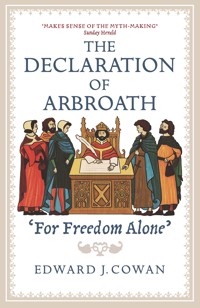
The Declaration of Arbroath, 6 April, 1320, is one of the most remarkable documents to have been produced anywhere in medieval Europe. Signed by 51 Scottish nobles, it confirms Scotland's status as an independent sovereign state with the right to use military action if unjustly attacked. Quoted by many, understood by few, its historical significance has now almost been overtaken by its mythic status. Since 1998, the US Senate has claimed that the American Declaration of Independence is modelled upon 'the inspirational document' of Arbroath. This is the first book-length study to examine the origins of the Declaration and the ideas upon which it drew, while tracing the rise of its mythic status in Scotland and exploring its impact upon revolutionary America.
Sie lesen das E-Book in den Legimi-Apps auf:
Seitenzahl: 337
Veröffentlichungsjahr: 2020
Das E-Book (TTS) können Sie hören im Abo „Legimi Premium” in Legimi-Apps auf:
Ähnliche




















‘FOR FREEDOM ALONE’
This eBook edition published in 2013 by Birlinn Limited West Newington House Newington Road Edinburgh EH9 1QSwww.birlinn.co.uk
First published in 2003 by Tuckwell Press, East Linton This edition first published in 2008 by Birlinn Ltd Copyright © 2003, 2008 Edward J. Cowan
The moral right of Edward J. Cowan to be identified as the author of this work has been asserted by him in accordance with the Copyright, Designs and Patents Act 1988
All rights reserved. No part of this publication may be reproduced, stored in an information retrieval system now known or yet to be invented, or transmitted in any form or by any means, mechanical or electrical, photocopied or recorded without the express written permission of the publishers except by a reviewer wishing to quote brief passages in a review either written or broadcast.
eBook ISBN: 978-0-85790-670-0 ISBN: 978-1-84158-632-8
British Library Cataloguing-in-Publication Data
CONTENTS
LIST OF PLATES
ACKNOWLEDGEMENTS
MAP
A Note on the Text
CHAPTER 1. A Letter from Arbroath
CHAPTER 2. Death in Dumfries. The Enigma of Robert Bruce and the Wars of Independence
CHAPTER 3. The Nobility of Freedom
CHAPTER 4. Contract, Kingship and Prophecy
CHAPTER 5. The Scottish Legacy
CHAPTER 6. A Tale of Two Declarations
L’Envoi
APPENDIX 1. The Declaration of Arbroath
APPENDIX 2. Printed Versions of the Declaration of Arbroath
SELECT BIBLIOGRAPHY
Notes
INDEX
LIST OF PLATES
1 Arbroath Abbey, western doorway
2 Arbroath Abbey, the chapter house and south transept
3 New Abbey, north-west view
4 Pluscarden, the chapter house
5 The Declaration of Arbroath
6 Arbroath Abbey, grave marker of William the Lion
7 The ‘wrong’ Bernard commemorated in an Arbroath hostelry
8 John Witherspoon
9 James Wilson
10 Arbroath Abbey, the Declaration Statue by David Annand
11
ACKNOWLEDGEMENTS
The Declaration of Arbroath, as it has come to be known, is one of the most remarkable documents to have been produced in late medieval Scotland. Quoted by many, understood by few, its historical significance has now almost been overtaken by its mythic status. The beginning of a new century, in the wake of the re-establishent of the Scottish Parliament, seems an appropriate moment to re-examine one of Scotland’s long-cherished historical icons.
My indebtedness to various historians will be obvious in the following pages. Of those who have illuminated the study of ‘Arbroath’ (as I refer to it when I intend to signify the document rather than the burgh) I am greatly beholden to Professor Archie Duncan, particularly for permission to include his translation of ‘Arbroath’, and to Professor Geoffrey Barrow. The late Professor Ranald Nicholson first introduced me to the subject many years ago. North American interest in the Arbroath Declaration served to rekindle my own. In this respect I must thank Bill Somerville of Toronto, sometime president of the Scottish Studies Foundation, Dave Pritchard of Visualize Productions, Alison Duncan of Washington DC, Alan Bain of the American Scottish Foundation and Duncan Bruce of New York. Colin Kidd kindly commented on the typescript, saving me from several errors, though those that remain are my responsibility alone. John and Val Tuckwell proved, as ever, patient and sympathetic publishers. My greatest debt is to Lizanne, who made many helpful comments on the first draft and who frequently rescued me when my computer decided to embark upon a freedom quest of its own, refusing to submit to external domination.
E. J. C.
Glasgow, 1 October 2002
A Note on the Text
The reviewers were generally kind to the first edition of this book though I remain uncertain that all of them, together with certain other media pundits, actually read it. This edition corrects a number of errors and typos while incorporating some recent research, notably that which appeared in Geoffrey Barrow (ed.) The Declaration ofArbroath: History, Significance, Setting, Edinburgh 2003, the proceedings of a conference held in Arbroath on 20 October 2000 and organised by the Society of Antiquaries, Historic Scotland and Angus Council. I have particularly profited from the contributions of Dauvit Broun, ‘The Declaration of Arbroath: Pedigree of a Nation?’, and Archie Duncan, ‘The Declarations of the Clergy, 1309–10’. New or additional material in the present edition includes some discussion of Duns Scotus’ possible contribution to evolving Scottish political ideas, based upon the work of Professor Alexander Broadie and Fr Bill Russell, both of whom have kindly shared their findings with me. Also included is an explanation as to why the Arbroath Declaration was dated 6 April. The commemorations of the seven-hundredth anniversaries of the execution of William Wallace and Robert Bruce’s inauguration as King of Scots, in 2005 and 2006, respectively, prompted some fresh ideas on both of these remarkable individuals. There is further discussion of the role of the Arbroath folk in the popularisation and mythologisation of their Declaration, as well as a little more information on the origins and development of Tartan Day, more fully discussed in my ‘Tartan Day in America’ in Transatlantic Scots, Celeste Ray, ed. (2005). Appendix 2 reproduces ‘Printed Versions of the Declaration of Arbroath’, which first appeared in my ‘Declaring Arbroath’ in Arbroath, Barrow, ed. (2003).
I am grateful to John and Val Tuckwell, Hugh Andrew and Andrew Simmons for their patience and support. As ever, Lizanne’s efforts to modify some of my dafter notions are appreciated even more than her superior computer skills.
Global interest in the Arbroath Declaration continues to grow. The document must, of course, be viewed in its own context and of its own time, but there is no doubt that it remains inspirational in its invocation of the universal ideas of constitutionalism and freedom. How it came to be is the theme of this modest book.
E.J.C.
University of Glasgow at Dumfries
Crichton Campus
Dumfries
25 March 2008
1
A Letter from Arbroath
There is still much to be learned from that remarkable manifesto. Read it again, and judge for yourselves whether it does not deserve on its merits to be ranked as one of the masterpieces of political rhetoric of all time.
LORD COOPER (1951)1
Arbroath is a burgh that feels as if it has always been there, nowadays retreating up the hill from its harbour, split by the coast road from Dundee to Aberdeen, but still dominated by the ruins of the abbey founded by William the Lion, king of Scots, in 1178. Down in the old town, by the harbour, the air reeks of the pungent, delectable mouthwatering odour of smokies: haddocks cured over oak chips. Since 1947 the Arbroath Pageant has celebrated the most famous event in the burgh’s history, which, in the best traditions of historical commemoration, never actually happened. From there a letter to the pope was dated on April 6, 1320, which originated, not in a crowded parliament or convention, but rather in the comparative obscurity of the royal chancery located somewhere in the abbey. Written in the high-flown style which papal correspondence demanded, the Declaration of Arbroath, as it is known, has, over a period of almost 700 years, acquired a near-mythic status as it has come to be regarded as inextricably linked to Scottish identity and nationalism. The letter is real enough. It survives and it can be read and has now been translated several times from its original Latin into English, and into metrical Gaelic and Scots; it belongs to Arbroath as well as the world. But there was no gathering at Arbroath in 1320, no great ceremony at which the glitterati of Scotland stepped forward with trembling hands to sign a document which they somehow were aware would be known in future years as a type of early Scottish constitution, as a ringing endorsement of Scottish nationalism, past and present, and as the supreme articulation of Scottish identity and the immortal values for which all Scots were allegedly willing to lay down their lives. The National Trust for Scotland, for example, self-appointed keeper of the nation’s soul, in depicting the Scottish nobility armed to the teeth and attacking the document with a quill pen, in its Bannockburn exhibit, is guilty of historical amnesia, bogus distortion and heritage creationism.
Identity, like history, is subject to change according to the preoccupations of the moment and the perspectives created by posterity. As Walter Bower noted in his masterly fifteenth-century Scotichronicon in response to the unprecedented calamities which befell Scotland in the last decade of the thirteenth century, ‘the state of affairs both in the past and now is not permanent’.2 If it is true that ‘nothing endures but change’, almost all historians of the Scottish Wars of Independence, from the earliest in the fourteenth century to those currently writing, are in general agreement that in the three decades between 1290 and 1320 a new sense of Scottish identity and nationhood was refined and given expression.
This little book will suggest that Scottish activists and thinkers of the period not only attempted to resolve their own political philosophies in response to the unprecedented contingencies which potentially threatened the very existence of their nation and kingdom, but that they also contributed towards ideas of constitutionalism which would ultimately feed into the mainstream of British, European, and eventually American, political thought. Since political ideas are to be considered as practical, realistic mechanisms rather than as dusty scholastic or academic abstractions, such ideas can tell us much about how the people of the time saw themselves and the nature of the societies to which they belonged. As such, some of what are argued to be near-revolutionary developments, not only in a Scottish but also in a European context, were to confer aspects of identity upon the Scottish people which survive to the present day.
Novel responses during the Wars of Independence coalesced around the concept of freedom or libertas, but the question of to whom the defence of liberty should be entrusted would stimulate a profound and far-reaching debate arising out of the peculiar, indeed unique, historical circumstances of the time. What, then, is so significant about this momentous parchment and what is it about?
It should be stressed that the Arbroath document, which became known as ‘The Declaration of Arbroath’ only in the mid-twentieth century, was a letter addressed to pope John XXII by thirty-eight (or forty-four if additional names written on some of the seal tags are included), individually named nobles, barons, freeholders, and the ‘community of the realm of Scotland’. It relates that as mentioned in ‘the deeds and books of the ancients’, the nation of Scots had a distinguished history, originating in the vicinity of the Black Sea, whence they wandered through the Mediterranean to the Straits of Gibraltar for a lengthy sojourn in Spain. Through the clever device of parallelism – mention of twelve hundred years after the Israelites crossed the Red Sea– the Scots are identified as a chosen people who arrived in Scotland to defeat Britons and Picts while fighting off Scandinavian and English attacks.
‘As the historians of old times bear witness’, the Scottish nation had held its possessions ‘free of all servitude ever since’, under the custodianship of one hundred and thirteen kings, ‘the line unbroken by a single foreigner’. Even though the Scots existed ‘at the uttermost ends of the earth’, they were singled out among the first for salvation through the good offices of Saint Andrew, the first-called of all the disciples. This favoured people was protected by successive popes as a ‘special charge’ of Andrew, living in freedom and peace, until the king of the English arrived in the guise of a friend to despoil them as an enemy. The atrocities and outrages perpetrated by Edward I upon clerics and laity alike could not be fully described or comprehended except by those who had experienced them.
God intervened to release his people through the medium of Robert Bruce, ‘another Maccabeus or Joshua’. The next section which has fascinated posterity and which is often regarded (wrongly) as the climax of the document, deserves to be quoted in full:
Divine providence, the succession to his right according to our laws and customs which we shall maintain to the death, and the due consent and assent of us all, have made him our prince and king. We are bound to him for the maintaining of our freedom both by his right and merits, as to him by whom salvation has been wrought unto our people, and by him, come what may, we mean to stand. Yet if he should give up what he has begun, seeking to make us or our kingdom subject to the king of England or the English, we would strive at once to drive him out as our enemy and a subverter of his own right and ours, and we would make some other man who was able to defend us our king. For as long as a hundred of us remain alive, we will never on any conditions be subjected to the lordship of the English. For we fight not for glory nor riches nor honours, but for freedom alone, which no good person gives up but with life itself.
Yet the main business of the letter is still to come. After a reminder that in the sight of God there is no distinction between Jew and Greek, Scotsman or Englishman, the pope is urged to ‘admonish and exhort’ the English king (Edward II), who should be content with what he has since England used to be big enough for seven kings or more, back in Anglo-Saxon times, ‘to leave in peace us Scots, who live in this poor little Scotland, beyond which there is no dwelling place at all, and who desire nothing but our own’. The senders are willing to concede whatever is required for peace – ‘due regard having been paid to our standing’. They boldly tell John XXII that his memory will be tarnished if ‘the church suffers any eclipse or scandal’ during his time. They are deeply concerned that local wars distract from the larger concern of the crusades in which the Scots would gladly participate if peace were theirs. If the pope pays too much heed to the tales of the English, and will not credit Scottish sincerity, future slaughters and calamities will be laid at his door. They undertake to obey the pope and they entrust their cause to God, ‘firmly trusting that he will inspire courage in us and bring our enemies to nothing’. The pope, in conclusion, is wished holiness, health and long life, and the missive is dated at the monastery of Arbroath, 6 April 1320.
‘Can anything conceivably be said about a document apparently so well known in Scotland as the Declaration of Arbroath?’ asked Grant Simpson in 1977 to answer resoundingly in the affirmative by expertly disentangling the relationship between surviving copies of the document in a critique of Sir James Fergusson’s version of 1970. Sir Walter Scott described it in 1830 as ‘a spirited manifesto or memorial, in which a strong sense and a manly spirit of freedom are mixed with arguments suited to the ignorance of the age’. Hill Burton, whose eight-volume history of Scotland first appeared in the mid-nineteenth century, detected ‘a solemn address . . . a great remonstrance’. Writing of the Wars of Independence in 1874, William Burns was the first to devote a fairly lengthy discussion to the ‘Aberbrothoc manifesto’, which he described as a combined pleading and remonstrance. John Mac kintosh’s four-volume History of Civilisation in Scotland (1892) celebrated ‘a spirited and constitutional address’. In his Constitutional History (1924) James Mac kinnon wrote of ‘a declaration to the pope in 1320’, while R. L. Mackie in his Short History (1930) asserted, ‘this letter is sometimes called the Scottish Declaration of Independence’. R. K. Hannay in 1934 pronounced, ‘this writ is at once letter, covenant and memorial’. Emerging awareness of the document and its possible significance was, of course, not unconnected with the founding of the Scottish National Party. In post-war Scotland the missive’s sentiments were beginning to seep into public consciousness, and even The Source Book of Scottish History (1952) labelled the letter ‘The declaration of Arbroath’. All, however, had been anticipated by a local historian, J. Brodie, in his About Arbroath: The Birthplaceof the Declaration of Scottish Independence, published in 1904, thus indicating that, as so often where the declaration is concerned, populist opinion and sentiment were well ahead of academic interest and enquiry.
The process of mythologisation was thus well under way, for ‘declaration’ is a technical term denoting a statement issued subsequent to an act or action by way of explanation. But a declaration could also have the force of law, as an act declaratory, when, for example, the monarch declared war. Declarations of this technical variety became common during the period of the British civil wars of the seventeenth century and figured prominently in such events as the so-called Glorious Revolution of 1688–9 which had a direct impact upon those who drew up the American Declaration of Independence of 1776. To describe the letter of 1320 as a declaration was a politically motivated anachronism, an attempt to confer upon the document a status and prestige which historically it had never been intended to enjoy; it was obviously dubbed a declaration with the American example in mind. It is therefore ironic that a number of Americans are now claiming that their declaration was modelled upon that of Arbroath, in commemoration of which the Senate now recognises 6 April as Tartan Day. So far such claims have not been the subject of scholarly investigation, an hiatus which this present inquiry hopes in part to redress. Yet perhaps the Arbroath letter has not received the full attention that it deserves either. It is true that we know much more about it than we did, say, forty years ago, but despite some of the excellent research that has been accomplished there is still some way to go. In what follows I am mainly interested in the ideas conveyed by the document, where they came from and what they meant, mostly in a fourteenth-century context. However, in an attempt to confront the mythic status which it now enjoys, I will attempt to explore something of what the document represented, if anything, to subsequent generations of Scots both at home and abroad. A beginning might be made by briefly surveying what is known about the Declaration of Arbroath as it is now invincibly and irrevocably styled.
In 1947 J. R. Philip noted that the freedom passage derived from Sallust’s Bellum Catilinae, The Conspiracy of Catiline.3 Two years later Lord Cooper pointed out that ‘Arbroath’ contained at least nine quotations from the Vulgate (St Jerome’s Latin version of the Bible completed in ad 405 and regarded as the standard throughout the medieval era). He also waxed eloquent over the document’s use of the papal cursus, indicating certain stylistic and contextual similarities in other documents emanating from the chancery of Robert Bruce. The cursus was a high-flown rhetorical style which was used when writing to the pope, partly out of respect for his unique office but also, we may suspect, to hold the attention of the individual pontiff who was in danger of dozing off as he half-listened to petition after petition.
Geoffrey Barrow’s absorbing study of Bruce (published in 1965 and revised in 1976, 1988 and 2005) attempted to demonstrate – contentiously in the view of some of his critics – that ‘the Community of the Realm of Scotland’, communitas regni Scotie, denoted
the totality of the king’s free subjects, but also something more than this; it meant the political entity in which they and the king were comprehended. It was in fact the nearest approach to the later concept of a nation or national state that was possible in an age when . . . a kingdom was, first and foremost, a feudal entity, the fief . . . of its king.
He suggested, though he did not elaborate upon the notion, that ‘Arbroath’ was to be seen as a practical counterpart to Marsiglio of Padua’s Defensor Pacis, Defender of the Peace, of 1324, a classic and influential attack upon papal authority which contained much of relevance to secular rulers as well. Meanwhile Ranald Nicholson had discovered the Irish Remonstrance of 1317 which was uncannily reminiscent in tone, content and composition of the Arbroath letter and which ‘may have been the work of King Robert’s propaganda department’ since his brother Edward had, by that date, contrived to have himself recognised as ‘High King of Ireland’.
The approach of the 650th anniversary generated further scholarly interest. In his Historical Association pamphlet Archie Duncan soberly reminded his readers that ‘Arbroath’ is a ‘petition to the Pope that he should write to Edward II to leave the Scots in peace’. He agreed with Barrow that it probably owed something to Edward I’s letter to the pope in 1301 which had ‘maintained a similar fiction of baronial intransigence if the king should give way’. He found another antecedent in the letter of 1317 sent by Scottish magnates to papal legates, purporting ‘to make the king appear the servant of his people’s will and so to justify stiff necked behaviour unbecoming or unnatural in so true a servant of the church’.4 As might be expected, monarchs and magnates had long had reasons for writing to the papacy but none of the surviving letters, with the possible exception of the Irish Remonstrance of 1317, can remotely stand comparison with ‘Arbroath’.
Ranald Nicholson, in his massive treatment of later medieval Scotland, believed that Barrow had mistaken
an emotive appeal abounding in hyperbole for a workaday constitutional treatise. The Declaration presents instead a few important ideas in cogent and sonorous phrases; and the field from which these ideas are drawn is not legalitas but humanitas.
However, markedly more nationalist in 1975 than he was in his 1965 article, Nicholson opined: ‘Simply because it is based on an assumption of universal human qualities the Declaration . . . is the most impressive manifesto of nationalism that medieval Europe produced’. Professor Barrow returned to the fray in 1978 to demonstrate that the document’s author or authors drew inspiration from several different passages in the The Conspiracy of Catiline and not just from the freedom passage. The actual quotation which Philip (and the Rev. James Bulloch in the Times Literary Supplement, June 1945) distinguished as the source of the document’s inspiration reads, ‘We, however, are not seeking dominion or riches – the invariable causes of war and quarrelling among human beings – but only freedom, libertas, which no true man ever surrenders while he lives’. Barrow persuasively suggests that the author of ‘Arbroath’ must also have had in mind the speech of Catiline: ‘Here before your very eyes is the liberty that you have often yearned for, and withal riches, honour and glory’.5
In another investigation of ‘the palladium of Scottish nationality’ Archie Duncan minutely scrutinised the surviving Scottish copy, known as Tyn after Tyninghame. The latter estate in East Lothian belonged to Sir Thomas Hamilton of Byres, later 1st earl of Haddington. He was clerk register, essentially keeper of the records of Scotland, at that time housed in Edinburgh Castle. In 1612, while repairs were being carried out on the building, Hamilton removed the declaration, together with other documents, ‘to study them at leisure’. Such at least is the charitable interpretation advanced by Sir James Fergusson, a former keeper of the records. There was ample time for study since they remained at Tyninghame until 1829,6 suggesting that the Scottish aristocracy had lost none of its plundering instincts.
Professor Duncan showed that the creation of ‘Arbroath’ required much effort, being conceived at a large council held at Newbattle in March 1320, drafted around 6 April at Arbroath Abbey, and sent off in May; the April date may have been retained to pacify the pope who had summoned Bruce and four bishops to appear at the curia on 1 May to explain Scottish infringement of the papal truce. Duncan also expertly scrutinised the document itself to demonstrate that the intention was to have three rows of seals appended; a slit was provided for each, above which was written the name of each seal owner. The original design was apparently to use red wax for the first twenty, the rest using green, probably indicative of hierarchy, but at least one was out of order. In the third row the seals were somewhat awkwardly attached. It is fascinating to note the attachment of eleven seals which belonged to barons not actually named in the document. Some used slits originally intended for others and some were provided with new slits. All of this might imply that the seals were attached over a period of time and that they were brought to the chancery by the owners or their stewards, but, as Duncan points out, the surviving seals are all in a wax ‘so uniform that the letter cannot have been peripatetic’.7 It might be added that there is quite a contrast between the clutter of the seals at the end of the document and the clear, well-spaced manner in which the names of their senders are entered at the beginning. The presence of the phantom eleven surely implies that there was no expectation that anyone at the Avignon end would bother to match up names and seals, at least not completely if at all, and yet Bruce’s advisers were concerned to make the letter as impressive in appearance as it was in content.
‘A full-scale governmental effort with all the stops pulled out’ was Barrow’s response to Duncan’s findings, adding that in tone and language the letter ‘is very different from that of any normal royal letter or administrative document; its content is strongly academic, even didactic’. More recently another commentator has gone even further, sensibly observing that ‘this important monument in the national mythology is clearly far more than a work of medieval propaganda’.8
In 1998 I published an article on ‘Arbroath’ which this short book seeks to expand and correct. Two years later Terry Brotherstone and David Ditchburn produced a stimulating discussion on the subject which somehow managed to incorporate such luminaries as Billy Connolly, Sean Connery and Michael Forsyth. Oor Willie for some reason did not make it, though many others and much else did. This investigation is partly conceived as a response to Brotherstone and Ditchburn’s suggestion that the debate about the document ‘might stretch from the seminar room to the public arena to mutual benefit’, although I am convinced that such debate is, and for some considerable time has been, much less restricted than these two pretend, not only in Scotland but in Canada and the United States as well. It is now over thirty years since I first gave a public lecture on this topic, appropriately enough on the 650th anniversary, to the Saltire Society at Gladstone’s Land in the Lawnmarket, Edinburgh. On arriving at the door, I was informed that admission was 7/6d. ‘But I’m the speaker’, I protested. ‘Aye, but you get coffee and shortbread at half-time’. While Scottish historians continue to subsidise their own lectures, interest in the missive of 1320 has not flagged during the last half-century.
While teaching Scottish History at the University of Guelph in Canada, I had the good fortune to become involved, around 1989, in the Canadian campaign to make 6 April, the anniversary of ‘Arbroath’, into an annual fixture known as Tartan Day. Most Scots cringe at the name but this is not a Scottish festival, and whether various Scottish pundits or agencies like it or not, tartan and Scotland are forever linked in the mind of the world. The Canadian plan was to persuade, in the first instance, individual provinces to adopt Tartan Day. Nova Scotia was first and then many of us became involved in pushing the idea in Ontario. I have happy memories of impassioned speeches in the Toronto Press Club courtesy of Honest Ed Mirvisch, entrepreneur and impresario, a great admirer of all things Scottish who donned a kilt annually on Burns Day. The Scottish Studies Foundation organised elaborate Tartan Day events in Toronto which attracted hundreds of people, including some who actually wanted to attend them and had not been coerced by the Scottish mafia. The speaker circuit was extensive, Burns clubs particularly receptive. British Columbia was the next target where the novelist Jack Whyte and I devised a sort of Scottish historical cabaret in the Hotel Vancouver. The campaign was eventually successful nationally but when I left Canada to return to Scotland the good fight was still being vigorously fought.
Meanwhile the Americans had become interested and in 1998 the Senate adopted Tartan Day. Through the good offices of Dave Pritchard of Visualize Productions I presented the keynote address at a conference on Scotland and America at the Smithsonian in Washington DC in 2000; similar American and Canadian invitations followed in subsequent years. It was a privilege to participate in Scotland’s first Tartan Day celebrations at Arbroath and Carnoustie in 2004. I was thus fortunate in being given so many opportunities in so many places, both within and furth of universities, particularly in North America, to attempt to communicate the significance of the Arbroath Declaration to many, many people who frequently had never heard of it, and who had not the vaguest idea what it signified. Often the explanation had to be brutally succinct. This book, a revised edition of the 2003 publication, represents a rather more fulsome elaboration of what I think ‘Arbroath’ was about when it was composed, and of what it has become, not only in Scotland but worldwide. I aim, in other words, to explore both its historical and its mythic significance. The name of the burgh of Arbroath is now becoming known globally, as it should.
There are those who will be unable to accept some of the claims made in the following pages because they believe in their hearts of hearts that Scotland was too barbaric and backward a country ever to have nurtured the peerless pontifications about popular sovereignty or the beautiful testimonies to freedom. The predicament of the Scottish historian who operates in a country where history is still a vital and contentious public property was well expressed by Lord Hailes in 1776:
I propose these conjectures with all diffidence, and indeed with little expectation of satisfying my readers. For there are some facts which may be termed the land-marks of history, by which men have been wont to conduct themselves. He who removes them or endeavours to place them in a different point of view, is considered by all parties as a pragmatical and dangerous innovator.9
A pragmatical and dangerous innovator I certainly am not, but it should be recalled that Robert Bruce walked in the same world as Dante, Giotto, Duns Scotus, Francesco Petrarch and Giovanni Boccaccio. Bruce and Petrarch each climbed their mountains for different reasons but each was attempting to come to terms with present contingencies for which there appeared to be absolutely no precedent. Each was involved in a lifelong quest. Bruce, by far the senior of the two, founded a nation, Petrarch the Renaissance. There were no direct links between the two men but in Bruce’s reign Scottish canon lawyers found their way to Italy and to Paris to debate issues of power and authority which were to change the world, and the way people thought about their place within it, forever.
I will argue that Scotland was on the cutting edge of political thinking because of the peculiar hand that history dealt her and because of the remarkable women and men who appeared on her tiny stage to preserve, in the nick of time, the fragile flame which seemed about to be extinguished. This book is concerned with providing some answers but it will also raise a larger number of questions. It is not written according to any agenda or at the behest of any vested interest, political or otherwise. The assumption is that the Declaration of Arbroath was one of the most remarkable documents to be produced in medieval Europe, and the goal is to explore its significance and influence, or otherwise. We might adapt an observation from John Knox and say that the reek of ‘Arbroath’ infected as many as it blew upon. Distilled in these vapours are essences and essentials which still have a relevance today.
2
Death in Dumfries. The Enigma of Robert Bruce and the Wars of Independence
This would be more than a letter, Sire. A statement of a people. A declaration. The signed declaration of a nation. His Holiness could scarce ignore such. Not if it was signed and sealed by hundreds, great and small. You said that he had acted in ignorance. That the Pope was ignorant of the true facts of our independence as an ancient realm. Let us inform him, then. Let us dispel his ignorance, declare the truth of our history and our polity. That we have never been subject to the English, or any other in Christendom. That we love freedom above all things, and will submit to none. Though we would be friends with all.
NIGEL TRANTER, Robert the Bruce, The Price of the King’s Peace
On 10 February 1306 Robert Bruce and John Comyn, known as the Red Comyn, lord of Badenoch, met in the sanctuary of the Franciscans, the Grey Friars, at Dumfries. What was said on that occasion we know not. But in due course, according to Sir Walter Scott, whose version of events in Tales of a Grandfather is probably the best known, Bruce, ‘forgetting the sacred character of the place in which they stood, struck Comyn a blow with his dagger’, whereupon he rushed from the building calling for his horse. Two of his attendants, Lindsay and Kirkpatrick, asked the agitated and bloodstained earl of Carrick and lord of Annandale what had happened. ‘I doubt’, said Bruce, ‘that I have slain the Red Comyn’. ‘Do you leave such a matter in doubt?’ said Kirkpatrick. ‘I will mak siccar’. He and Lindsay went back inside the precinct and despatched the wounded victim. Scott’s version, as usual, enjoyed the inestimable boon of having been embellished by the great wizard’s adventurous imagination but it represents no more, or less, of a distortion than most other accounts from the fourteenth century onwards.
Although the killing had national and international repercussions, there were strong elements of a local feud in this episode. The Comyns, or Cummings, held Dalswinton Castle some seven miles up the River Nith from Dumfries; there was still a ‘Comyn’s Pool’ nearby in the eighteenth century. Bruce’s castle at Lochmaben was about nine miles to the east. The event, however, which plunged Scotland into considerable confusion, represented the worst possible initiation of a campaign for the kingship in any nation’s history. Bruce was automatically excommunicated for defiling the sanctuary. He promulgated civil war in Scotland, for the Comyns were, quite simply, the most powerful family in the land. They enjoyed huge estates and alliances in the north, and they had substantial interests in the south. They were also staunch allies of the Balliols; Comyn’s late father was the brother-in-law of John Balliol, also known as king John of Scotland. Furthermore, Bruce challenged the greatest of English medieval kings. Edward I was believed to be dying but one could never be sure of such things. What had brought Bruce to this calamitous conjuncture?
For twenty years the Scots had been no strangers to calamity. On March 18 1286 Alexander III hastened homewards on a night of wild weather to his young bride of less than six months; he was killed in a fall from his horse, on the coast road near his intended destination, the royal manor of Kinghorn. All of his children by his first wife had predeceased him, his sole heir an infant granddaughter, Margaret of Norway, Scotland’s least regarded queen. Less than three weeks later Robert Bruce, grandfather of the future king, signified his own bid when he claimed that a female could not succeed, despite Alexander having obtained an oath from his subjects in 1284 recognising Margaret as his heir. That Alexander secured such agreement probably testifies to his popularity, as does the absence of any scandalous rumour about his death, which seems to have been considered by all as resulting from accident rather than conspiracy, somewhat surprisingly in an age much given to suspecting the worst.
At the Scone parliament later in April John Balliol turned up to claim that if a female was excluded then he, rather than Bruce, had the best claim to the kingship. In a case such as that which afflicted Scotland, when a king like Alexander died without heirs of his own body, it was necessary to trace back through his genealogy for possible successors among collaterals. Both Bruce and Balliol traced descent from daughters of earl David, a brother of William the Lion. Balliol claimed through primogeniture, succession through the eldest child, his grandmother; Bruce based his case on nearness of degree, meaning that because of his advanced age he was physically closer in time to the source of his claim, his mother, who was earl David’s middle daughter. Bruce also asserted that Alexander II, about to depart on an expedition to the Hebrides in 1238, had designated him as his heir. The problem was that Bruce was so ancient that nobody could provide corroboration or denial. It is probable, though, that his negative views on female succession enjoyed a fair degree of support, for the oath of fealty to Margaret elicited at Scone referred vaguely to ‘the nearest by blood who by right must inherit’.
Portentously, parliament sent a delegation to ask Edward I for his advice and protection. It also appointed six guardians, custodes pacis, keepers of the peace, according to one English chronicle, to govern in the absence of a monarch. There were two representatives each of the nobles, bishops and barons. It is of the greatest significance that two of these positions were held by Comyns – Alexander earl of Buchan and John lord of Badenoch, the father of Bruce’s victim in 1306. William Fraser of St Andrews and Robert Wishart of Glasgow provided episcopal representation. The other two were the earl of Fife and James Stewart. It fell to all six to decide by discussion who was to be appointed to rule.1 There was a possibility that Alexander’s widow might produce a posthumous male heir who would have precedence over little Margaret, but in the Turnberry Band Bruce had some of his supporters swear fealty to that person ‘who will obtain the kingdom of Scotland according to the ancient customs hitherto approved and used in the kingdom of Scotland’. When it was clear that Alexander’s queen was no longer, or never had been, pregnant, Bruce attacked Balliol holdings and adherents in the south-west. The kingdom had its first taste of civil war; many other samplings were to follow. The legendary Thomas Rhymer had supposedly prophesied in March 1286 that a strong wind would engulf Scotland, a fierce blast which would ‘dumbfound the nations and render senseless’ those who heard it. It blew across an uneasy Scotland in which the Balliol, Bruce and Comyn factions all manoeuvred for position. So far as these families were concerned, their own interests and those of the kingdom were identical. If this was without question a time for all good men to come to the aid of their country, they emphatically did so on strictly partisan terms for they could conceive of reacting in absolutely no other way.




