


0,99 €
Mehr erfahren.
- Herausgeber: Identity Publications
- Kategorie: Ratgeber
- Sprache: Englisch
Have you ever considered the true meaning of Destiny and its role in your life?
The Destiny Book by Helena Lind deciphers the grand cosmic law of life, offering liberating insights for your spiritual growth, self-discovery, and finding essential purpose based on her decades of personal experience, deep reflection, and study.
Her well-researched yet accessible work explores Destiny’s historical and mythological origins and its metaphysical significance across various civilizations, religions, and thought systems. Join Helena on a transformative time-traveling adventure, spanning the ages from antiquity to modernity, as she unravels Destiny's eternal thread from the mystical roots of ancient pantheons to contemporary doctrines.
Through her multi-pronged holistic approach, Lind shows how this intercultural phenomenon influences individual lives and broader societal aspects, such as philosophy, faith, politics, art, literature, music, science, psychology, death, and the popular notion of destined love. This eye-opening book presents a compelling perspective on how major cultures and creeds have been shaped by Destiny and how they realize this formative principle's roadmap. Lind’s intrepid inquiry invites readers to redefine their personal narratives to prepare for our complex world's increasingly dangerous balancing act between unseen forces and individual agency. Challenging common wisdom and complacency, The Destiny Book offers a wealth of knowledge, empowering readers with a vibrant viewpoint on Destiny's unifying might.
Contemplate humanity's storied relationship with Destiny—and your own.
Find out about Destiny's connection with fate, luck, serendipity, karma, and philosophical ideas like stoicism, free will, and determinism.
Investigate Destiny's impact on the development of ethics, justice, and the focus on human character.
The Destiny Book: Rediscovering the Mother of Spirituality is a comprehensive mind-body-spirit primer on everything you need to know about humanity's favorite superpower.
Das E-Book können Sie in Legimi-Apps oder einer beliebigen App lesen, die das folgende Format unterstützen:
Seitenzahl: 444
Veröffentlichungsjahr: 2024
Ähnliche




















Copyright © 2024 Helena Lind
All rights reserved. No part of this publication may be reproduced, distributed, or transmitted in any form or by any means, including photocopying, recording, or other electronic or mechanical methods, without the prior written permission of the publisher, except in the case of brief quotations embodied in critical reviews and certain other noncommercial uses permitted by copyright law. Any perceived slight against any individual is purely unintentional. Although the author and publisher have made every effort to ensure that the information in this book was correct at press time, the author and publisher do not assume and hereby disclaim any liability to any party for any loss, damage, or disruption caused by errors or omissions, whether such errors or omissions result from negligence, accident, or any other cause. The content of this book is for entertainment purposes only. Neither author nor publisher accepts any responsibility for the results of any actions taken on the basis of the information in this book. Author and publisher expressly disclaim all and any liability and responsibility to any person in respect of the consequences of anything done or omitted to be done by such person in reliance, whether wholly or partially, upon this book. For permission requests, write to the publisher at [email protected]. Connect with the author at www.helenalind.com
Library of Congress Control Number: 2023914798United States Copyright Office Certificate of Registration Number: TX 9-363-500
ISBN-13: 978-1-945884-80-1 (paperback)
ISBN-13: 978-1-945884-81-8 (hardcover)
ISBN-13: 978-1-945884-82-5 (ebook)
First edition, published by Identity Publications.
Editor: Gregory V. Diehl
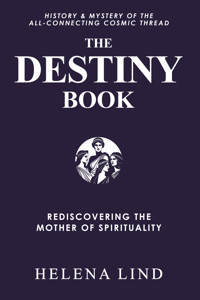
Cover Ornament: Ladies Who Destine, 2023, inspired by classic Greco-Roman Goddesses, Helena Lind with LensGo beta.Autodesk Sketchbook pencil drawing, a 2023 interpretation of Ananke and the Moirai by Edmond Lechevallier-Chevignard, 1857, La Magasin Pittoresque. The original is in the Public Domain. https://commons.wikimedia.org/wiki/File:Ananka_i_Mojre.JPG
Book Cover by MiblArt, Ternopil, Ukraine
Contents
Author’s Note
Dedication
Foreword
Preface
Introduction
Prologue
Chapter 1: Origins of a Perennial Principle
What Exactly Is Destiny?
Destiny or Fate?
Snapshot of a Superforce
Who Invented Destiny, and Why?
An Interspiritual Backstory
Chapter 2: Destiny and Mythology
Gods of Destiny
Between Antiquity and Modernity
Destiny’s Diviners
Chapter 3: Faithful Destiny
Destiny’s Realization in Active World Views
Divine Providence
Theodicy
To Believe or Not to Believe
Our Relationship with Gods and Destiny
Chapter 4: Affiliated Destinal Agencies
Fortunes, Lucks, and Co.—what are the Odds?
Determinisms, and Co.—Doctrinal Simulation Games
Philosophers’ Darling
The Cult of Free Will and Ego
When Science Meets Destiny
Destinal Psychology
Political Destiny
Red Thread of Civilizations
Golden Laws of Cause and Effect
A Question for Destiny, God(s), and Karma
Designated Exceptionalism
Deathstiny
Chapter 5: Prisms of Arts and Love
Literature—Destiny is Written
Western Art’s Changing Notion of Destiny
The Soundtrack to Human Destiny
Wrapping the Mega Maxim
Games of Destinies
A Love That’s Meant to Be?
The Idea of Preordained Love
World-Changing Power Couples
Conclusion: Ubiquity of a Pervasive Compass
Miscellany
The Destinal Theme in Arts and Media
Bibliography & Links
About the Author
Endnotes
Acknowledgments
Errata
Author’s Note
Due to the dynamic nature of the Internet, any URLs or web addresses, or links stated in this book are subject to change and/or may have been changed since this book was published; hence, they may not always be valid.
Some of the Gutenberg Project and other links listed in the back matter may not work in all countries due to local copyright laws.
Most specific names and terms were anglicized.
I am trying to avoid the use of excess timeline details, dates, numbers, etc., wherever possible since this is not a scholarly or pontificating work but a rather easy reintroduction of the history and lasting significance of the metaphysical order of cosmic and human Destiny to entertain and spark curiosity.
Furthermore, I predominantly write in the collective form to ward off pronoun pile-ups. I dislike indoctrination, so I include my readers in the only way synonymous with how we, as humanity, would work best—together, in concert.
Dedication
To my loved ones, near or far, human and feline, across all levels of existence. To my amazing daughter and, particularly, to Paul for his unwavering understanding.
Foreword
Many people say they have a book in them. Someday, they’ll get around to writing it. But more often than not, that book never materializes and makes its way into the public light.
Independent thinker and creator Helena Lind, though, had indeed been working on a viable book concept for many years. It would culminate her lifetime of experience, inquiry, and contemplation into a dynamic subject of grand scale: destiny. At last, she invites us to reflect on the interplay between choice and fate, agency and determinism, and the human quest for meaning in an unpredictable universe—without prescribing any particular dogmatic and limiting view. Instead, she sparks contemplation, curiosity, and a deeper appreciation for how we have come to view the forces that have potentially always been influencing human lives.
The desire to understand how people see their place in the world has been one of the primary driving factors in my life, too. It has motivated my lifestyle choices and informed everything I’ve written or had a hand in publishing. The release of this book brings clarity to this supremely important topic, and I am tremendously glad to have had the opportunity to play a part in it.
As history shows, there has never been a time that freethinkers, and even whole societies, have not grappled with the implications of fate, free will, and why things happen the way they do. In one form or another, people have always felt something greater than themselves that influences the progression of the cosmos and their place within it. The book you are reading explores these multifaceted conceptions of destiny from throughout history—the cultural, religious, and philosophical underpinnings that have shaped our collective understanding of the “big picture.” It illuminates ancient beliefs about predetermined cosmic order, myths of gods and goddesses, and modern, scientifically informed interpretations of life, the universe, and everything.
The Destiny Book shows how this universal idea has always been with us. Though conceptions of overarching cosmic order evolve, adapt, and transform along with human consciousness, certain themes and principles seem to recur wherever and whenever we look for them—and so, we stand to learn from them. The lingering awareness of where things are going, where they ought to go, or perhaps even where they must go still makes the world go ‘round.
We all sometimes look at the world around us dissatisfied. We feel called to do something to improve it and move it closer to how we think it should be. We are always moving toward a personal conception of what is right and necessary, even if most of us avoid too much scrutinizing about it. One way or another, we adhere to a narrative that grants order and a sense of purpose to everything.
Left unexamined, our underlying metaphysical beliefs can become dangerous things. We can’t really know who we are and what we are capable of unless we are willing to assess the lens through which we look at life. We might start to believe that going against the narrative that we have accepted is to go against existence itself: what Helena calls a dogmatic, thus faux, destiny—and so, others must be made to act against their will according to what we believe.
I know many readers will understand when I say that I have always felt pulled toward certain fundamental ideals. With experience, I embraced them as an inescapable part of who I was and increasingly necessary to uphold in the world. They represented what I would always seek to do and become: my personal destiny. I could never say with certainty what would happen in my future—only what I would always choose to pursue as long as I could, as a seed sprouts into a tree given conditions that allow it.
The Destiny Book shows us how to question the standards through which we evaluate the meaning of our actions and everything seemingly good or bad that happens to us. Helena’s heroic effort gives us a generous helping of how human thought has evolved in this domain over the centuries. By understanding why we believe what we do about the universe, we will come to understand ourselves considerably better, too.
This first volume constitutes the introduction, the companion to the documented backstory of a larger and integrated modern take on human destiny. Readers will surely look forward to Helena expanding on it in her upcoming work in the Destinosophy series. I am grateful to have helped bring it out to the world.
By Gregory V. DiehlAuthor of The Heroic and Exceptional Minority
Preface
Inspired by lifelong awareness and the disruptive events of 1992, I first envisaged and even working-titled The Destiny Book after having been told that I’d reached the dead-end street in most, or as some professionals claimed, in all possible ways. Challenging years of phoenixing followed, reliably accompanied by a steady comparison of roadmaps, fitting in the labor of love on this ancient showrunner’s story whenever possible. Result: an informal perspective of a worldview-shaping paradigm through my affectionate lens, my prism of interpretation, and the first of several nonfiction and fiction concepts on our sublime topic.
Ideally, the reader finds this publication a ticket to rediscover one of life’s greatest enigmas, an introduction to some of the many facets of a de facto pièce de résistance, and, not too boring 411 to my upcoming publications and world events, especially the catharsis that awaits humanity. I created it as an accessible, relatable essence of some of the most relevant mythologies and tenets of this arcane entity spanning several millennia. Take it as a curiosity-provoker, an invitation to think anew, a collection of keywords to tickle interest, and a gentle nudge to hop on a swift quest to discover the many aspects of the lode star we call Destiny. Due to my talking point’s unlimited vastness, this little book can only be a teaser to an infinite movie. Yet, this first stepping stone may already help to dust off some often overly simplistic, if not reductionist, ideas encircling this primus inter pares—the first among all otherwise equal metaphysical phenomena.
And I am here to make that clear.
Introduction
The most beautiful experience we can have is the mysterious. It is the fundamental emotion which stands at the cradle of true art and true science. Whoever does not know it and can no longer wonder, no longer marvel, is as good as dead.
– ALBERT EINSTEIN
Before anyone asks: I don’t believe in Destiny in the typical way, as in believing in a theology or ideology conceived and accepted upon cultural or social agreement or via “persuasion.” Because Destiny is neither. My unbridled consciousness and intuitive cognition of a trailblazing, religion-independent yet spiritual cosmic paradigm, which inspires uncounted millions worldwide to acknowledge its relevance from the moment go, gives testament to my first-hand experience with this grand enigma. I created this book as a shareable quintessence of Destiny’s amazing backstory. I call it long-term personal awareness; others may consider it to be an act of faith or confirmation bias. We’re all right. Whatever works best works best.
Destiny is a complex and polarizing topic preloaded with ancient, seminal meaning and unending popularity. And like all worthwhile movers and shakers, it triggers a healthy amount of prejudice, derision, and even antagonism. Not for nothing, since this arcane fountainhead of abstract phenomena transcends cosmogonies, mythologies, deities, and faith systems. Naturally, it entices strong opinions about deterministic influences on well-cultured ideas of human moral responsibility versus a more or less decreed existence and world. The thought goes that if external Destiny is predominantly in charge of it all, we cannot be held accountable for ethical and material trespassing of rules and laws. And that, in tandem with the resulting scarcity of freedom, isn’t all too compatible with the governing agenda. Therefore, skeptics feel deeply objecting to absurd transcendental ideations, including the slightest inkling of being guided, let alone determined, for that must be impossible. In contrast, others may criticize that divine Destiny is solely enacted by almighty God instead of an impersonal seminal principle that, bar a few ancient exceptions, hardly ever required systemic dogma, organized worship, or submissive prayers because of the absence of a point. Because petitioning for a change of plan or fortunes to a faceless paradigm doesn’t feel right enough, nor does it make much sense to us anthropomorphizing1 mortals. And that’s why a synergetic dialogue is ruled out unless humanoid form, emotion, mentality, and hierarchy are applied. Which we did. Aplenty. Even to Destiny.
Nonetheless, this conundrum flows forever forward without God(s) and codified beliefs. Our cookie crumbles just as it does, or rather, it is kept from negatively disintegrating more often than not, sadly rarely recognized yet. Do we ever even pause, think and let alone acknowledge that of all the many facts not in our favor (and in view of the multitude of possibilities that can go wrong for our fragile setup), so far not as much as easily could happen is actually occurring? Even though it may appear very different to those afflicted by what occurs?
Whether we revere our own liberty or God(s), benevolent worldviews are rightly highly respected since they provide helpful notions to foster all-important equilibrium. Reality is what we experience and how. There is no one way to feel, opine, and do things anyway. Thankfully, Destiny isn’t an ideological or religious premise where critics or contenders may be at risk of becoming targets for zealous scorn and limitations to their physical existence. In contrast, everything is quite easy here.
Our formative concept of Destiny has stood the test of time and remains incredibly and increasingly popular because it just is the natural umbrella concept staying religiously neutral and independent for the ages. As the antithesis of entropy, its invisible sway on humanity inspired leading codes and creeds that adopted Destiny’s characteristics to better equip their celestial personalities.
The direction, balance, and order-inducing notions of our chaos-taming éminence grise, prevalent throughout most, if not all, great civilizations, are arguably the mother, foundation, precursors, surefire blueprint, and ignitor of the faiths2 we cherish, question, or reject today and, especially, tomorrow.
We behold the vertex, i.e., pinnacle, the original mover resulting in the creation of human outlook and religion, our Mothership in the universe. A fun testament to this is that our splendid, established religions rushed to “adopt” Destiny to supercharge their divine powers with its significant essence. It stands just as the Irish poet Oscar Wilde (1854–1900) confirmed: Imitation is the sincerest compliment available on Earth.
The showrunner of life, just like the belief in God(s) or doctrines, such as karma and dharma, is often judged as a mere faith-based marvel or statement that can never be proved or disproved. No science, philosophy, or religion can claim to be able to “objectively” establish the non-existence of supernaturalism and God(s). Arguably, no mortal is able to make it known as a cold, hard fact that God(s) or any other invisible, abstract, unfathomable agencies ever3 existed to influence the genesis of humanity. And so the cosmic premise remains imperceptible.
Destiny once was the preternatural4 kickstarter of our major religions. They all wanted for themselves the meaning Destiny offered us humans.
Even the all-governing laws of cause and effect carry a connective notion of this mainstay of human sensemaking, right down to the claim of self-ordained fate among free-willing humanity. And ever since Destiny set the great stage, it circulates in the world’s water supply. Everywhere. Little wonder that we find its ancient principles represented and incorporated in the divine personifications of our most enduring religions.
Prologue
Our independent melody of the universe has been with us since the dawn of civilizations, transcending any past or active tradition, faith, or creed. It is invoked worldwide, while its echoes sound more or less softly in almost every principal school of thought.
The very idea of the invisible order always made us ponder its promise of a beckoning future. What would be more critical in our transformative times than to pause, look back, take stock, think, and discuss the Destiny of humankind? That is even more vital now since we are walking the brink between a luminous tomorrow and an increasingly manifesting abyss.
Naturally, a good many past and modern thinkers, as well as some materialist and revolutionary-minded communism proponents, dismissed the idea of an elusive, invisible background “power,” be it called God(s) or Destiny. Several of our best brains are still highly skeptical today. The world remains colorful; some of us even question the personal impact of specific determining laws of the universe and Nature. All too often, we tend to believe, or rather “will,” what we perceive to represent our cherished self-image. Those of us that even postulate not to believe in anything at all, or rather claim to believe in nothing, are rendering themselves technically belief-less. This is a big fallacy because of one fact and trait we all have in common: We do believe in something subjectively, which is often driven by what we fear or desire. Human beings feel more than they think; many of us interpret our emotions as rational thoughts, taking each of these thoughts as “reality.” Hence, no wonder so much cognitive dissonance5 and so little tolerance abound, especially when contested with differing ideas.
Maybe we are just disappointed in our elders, their God(s), traditions, and omissions, or failures in our upbringing. So we drag our proverbial heels while telling ourselves and anyone who cares to listen that there’s nothing to believe in or that we must not consider anything apart from our subjectively rational selves. Granted, some established religions caused terrible, inhumane acts, but we should not judge them just on their, albeit many, low moments and instead also try to see the good they do. Anyone should believe whatever they prefer since we are not who and what we believe to be, anyway. We are mostly highly subjective beings. That delivers even more reasons not to scoff at the thought-feelings, or rather feeling-thoughts, of others. We’re all rowing the same boat, carrying forth our individual destinies. Whether we are aware of it or not or believe in anything, we all share in our collective human Destiny.
Anyway, most of our thoughts aren’t as relevant as we think, so we better try to respect those of others. Let’s not forget and forgive that producing sentiments about “not believing in anything” carries the added perk of garnering attention, just like those nihilistic notions often thrown about as gauntlets and challenges to a more traditional or religious status quo—and to raise the claimant’s dopamine level.
It is often stated there is strength in numbers. The fact so many of us subscribe to specific concepts and faiths comes with legitimacy, proven or not. For there are beneficial elements in our ongoing, extensive acceptance of God(s), religions, and philosophies that deserve respect, tolerance, and understanding, even if we don’t always agree on single entities, narratives, or details, and even if we are unable to share or reject the religious metaphors others hold dear.
The thing is, there is strength and safety in numbers.
Christianity, to date the world’s largest and most successful organized religion, is swiftly losing followers in the so-called First World, even among white American evangelicals. Christianity’s staggering ca. 2.38 billion upholders worldwide give evidence to the point that their faith carries incredible weight. The same goes for flourishing Islam, the next most extensive and rapidly expanding religion with ca. 1.9 billion global devotees and counting, followed by millions of Hindus, Buddhists, and then some.
Numbers do matter.
Worldwide, many, many millions believe in Destiny, also referring to it as fate. I’m terrible with numbers; nevertheless, let’s look at some exemplary figures.
Nearly 50 percent of the British believe in Destiny6 and state that important life events are foreordained. Even 46 percent of the United Kingdom’s Christians say so.7 As of early 2023, these sceptered isles counted 68,801,032 inhabitants. You do the math, please.
As many as 52 percent of Americans adhere to the notions of Destiny or fate.8 The majority state to perceive a deeper pattern to life, with 52 percent saying they believe in fate, according to a 2015 report in The Washington Times.9 Yes, you read that right: That would be the majority of the now estimated population of 334,233,854 inhabitants.10 That’s a lot, right?
In 2014, US researchers Konika Banerjee and Paul Bloom from the Yale Mind and Development Lab found that crediting a supernatural force like Destiny for determining what happens in life would not require religious beliefs. They are so correct. And it gets better. Even followers of organized faith confirmed there was no need to believe in God to accept the actions of an independent, preordainment agency.11
Participants were presented with questions to find out if they believed “life events happen for a reason.” Partakers included the religious and non-religious. The study found the majority of both groups expressed belief in Destiny and fate.
Among subscribers to the existence of God, 84.8 percent expressed trust in fate, while just 2.2 percent said they did not believe in it. The rest were neutral. A total of 54.3 percent of atheists, agnostics, and freethinkers reported varying degrees of belief in fate. Those who did not believe in it accounted for 40 percent, and those who were neutral, 5.7 percent.
Participants were also asked to describe or characterize fate (a noun often used to express Destiny). Among the religious participants, 72.9 percent said fate was instructive. Others saw it as either fair (62.1 percent) or kind (54 percent). The group of non-believers described fate as “just a fact” in the cosmos.
Researchers also asked about the most significant event in the partakers’ lives in the past five years. Twenty-four percent of non-believers and 53.1 percent of believers said fate had played a vital role in those events.
We haven’t even looked at the large demographics in Latin America, India, China, or Russia, majorly invested in Destiny’s guiding idea through local interpretations.
To me, all that data means the international interest and belief in the existence of Destiny results in such great numbers that this ancient principle should rank on par with all the other illustrious metaphysical and spiritual principles and faiths, in its own unique category and league, of course. Just saying. Not for no reason, Destiny hasn’t joined the “Ozymandian12 league” of slumbering giants of bygone beliefs.
Later in the book, we shall look beyond the anglophone world, discovering deeper connections with Destiny, fate, and karma in other cultures, religions, and philosophies. Ancient reasons await.
Humanity’s relationships with Destiny’s seminal concept and law are manifold and robust. Today, to some, it is a figure of speech or a meaningful metaphor. To others, Destiny is a notion from old books, an astrological almanac, or a romantic comedy: a force and state of being and experience far beyond our reach. And then some equate Destiny and especially fate—her darker epitome—with a kind of modern karma, interpreting the latter as a means of comeuppance out there to mop up baddies on auto settings. And, as seen above, to many of our fellow humans, Destiny is a valid concept, at least considered to have a hand in the flow of this world. We are looking at an undeniable cross-cultural and interspiritual omnipresence.
Our cosmic compass rose comes with many interpretations. It is often seen as a proverbial entity, a trope, a statement of character and standing, the red threat and clarion call of hero stories and movies, and the raison d’être of famous leaders and politicians like the “man of Destiny” Napoleon. Winston Churchill declared himself to have been “walking with Destiny” (also the title of a memoir on him) throughout his remarkable yet controversial life. Since time immemorial, this software of life has delivered massive momentum and magical mainstay to the spheres and many forms of special relationships, philosophy, religion, history, politics, literature, movies, and the music industry.
To this day, plenty of concern still exists that if the concepts of Destiny, and determinism for that matter, are indeed a proven fact or became “that popular thing” again, they could invalidate human moral responsibility exercised through our self- or God-granted self-determination, possibly leading to a plethora of excuses for bad choices, nether actions, and deeds. Why? Because anything could be interpreted as predetermined, i.e., outside our domain or control to decide against or not.
Such perilous limitations of human accountability and culpability are relevant topics and understandable moral worries. But what if we humans aren’t the masters of the universe, no matter how much we’d like to run around with that label? And what if the whole strategic human self-ordination kit granted by God or ourselves is just a decoy or handy mirage? Imagine if the news outlets were plastered with flashes stating:
SHOCKING EVIDENCE: DESTINY IS IN CONTROL, NOT HUMANITY.
Then what? Would we insist on clinging to the opposite? Probably. Would hell break loose? Likely not. Would our world religions crumble? Not so much since the majority adopted and developed their versions of holy divine providence from the original concept of Destiny anyway.
Isn’t there perhaps far too much angst and too little trust in intuitive human awareness and innate moral thinking floating between our experts’ learned brains and lips? Many of us are born with an inbuilt moral scope and are thus, for ourselves, not necessarily in dire need of controlling sets of arbitrary rules. The intrinsic human tendency to try to live with goodness, based on cooperation and as much responsibility as possible, is a fact. Do we have a tendency to cheat, hoodwink, and even trick each other if the opportunity arises? Sure, but in most instances, that does not make us evil beings. We need to develop a lot more understanding of and for one another, our individual stories, circumstances, and the effects of the ravages of life that play on many of us.
Where would we be if a predetermining agency became the immutable fact of life (again)? Would we start to run amok? Declare war willy-nilly? Act selfishly and inhumanely for mere personal or corporate gain? Disregard and exploit the misbegotten and disenfranchised? Manipulate voters? Run corrupt rulerships?
Hold on a moment. All of the above points were and still are international issues.
Many political individuals or factions also abuse(d) the notion of faux Destiny to beautify unethical directions with eternity’s invincible echo. Most of which, in time, led to ashes rather than laurels because their endeavors were never destined but wrongly claimed by misguided ideologies or toxic egos on steroids.
We know many kinds of Destiny: cosmic, natural, human, personal, divine, philosophical, national, political, religious, artistic, and lots more.
Our multifaceted topic is an impactful buzzword in movies or TV shows. It is a favorite moniker of shiver-inducing love-speak or an ennobling prerequisite of aggrandizing political egomaniacs or self-styled private or national exceptionalists.
Today, many, many millions, arguably a majority of people worldwide, accept various concepts of Destiny as a viable, underlying spiritual option far beyond its mythology. For millennia, this original gangster of time-honored phenomena has connected us with the unseen as the first fair and necessary guiding principle. And whatever happens, Destiny prevails as the primordial organizing force in the universe.
And it merrily stays as our great continuum, delivering thoughtfully spun threads running through the fabric of life, woven from the shimmering strands of universal laws, mysticism, imagination, and adventure.
Yet, Destiny is not a figment from a game. It may seem utterly philosophical and convincing, or shockingly limiting and even outmoded, utter tosh, for instance, to general skeptics and, especially, to devotees of scientism. Still, it is not just a holdover of ancient polytheism, nor a Fata Morgana or fictional chimera. It just is what it is. Always was. Always will be. And it may just be that unifying component we humans need to make it to the future.
Time to start pushing the big envelope.
Whether we accept it or not, the eternal thread is a part of our lives. It is even embedded in our material human build and our living force. The awareness of Destiny and fate are all around us. As said, we are talking about omnipresence here. We are saying, whispering, thinking, evoking, and dreaming of it every day.
We use idiomatic expressions like date or a deal with Destiny, all the things meant to be, the hand of fate, Destiny’s wheel(s), a pull or twist of fate, and the call or irony of Destiny, whichever way the cookie crumbles, the dice may roll and whether the chips are going to be up or down.
My favorite Destiny metaphors are the mothership, the originator, the supreme sense maker, Ananke’s spindle, the software of life, the D Word, the cosmic choreography, the script of life, the grand design, the celestial blueprint, the cosmic compass, the universal symphony, the dance of Destiny, the tapestry of existence, the cosmic navigator, the celestial algorithm, the universe’s plan, the game of serendipity, the river of everything, life’s operating system, the mainstay, the foremost force, the melody of being, the compass rose, the real secret service, the Mona Lisa of principles, humanity’s fairy Godmother, the cosmic law, the thread of everything, the lap of the Gods, and The All.
Our mothership performed the lead role in our quest for meaning, our imaginations, our hopes, and even our expectations in the agency of poetic justice. Neither the entertainment industry nor the worlds of music, literature, and art could do without it, thriving on the magic of a supra power.
It is important to note that Destiny does not translate to hard determinism, especially not to the bleak, responsibility-questioning variant of fatalism. Not all fatalism is created equal.
The Greco-Roman philosophical movement of Stoicism flourished on a liberating, ego-reduced acceptance and optimization of whatever life may bring. Modern scientific insights show that a moderate dose of accepting Destiny/fate improves our coping mechanisms, enabling us to overcome obstacles and move on less burdened and often faster. That’s not limp fatalism. That’s wisdom. Lemons, anyone?
A stoic attitude is a way to live well, to focus and deal with what is within our reach and make the best of what’s there.
Life serves us a plethora of circumstances and situations we cannot change. Yet there is no ruse for inertia or bad excuses suggested for a life lived in harmony with a great principle. Destiny is multi-dimensional, dynamic, and symbiotic, the antithesis of defeatist notions or nihilistic doctrines. It empowers. It does not challenge or question a healthy dose of free will and self-fulfillment. Proactivity, drive, aspiration, and the readiness to seek self-transcending strength for a greater benefit are key ideals here.
So, whichever way we are persuaded and however we may judge or appreciate our topic, the fact is: We are here now; that’s how the proverbial cookie indeed crumbled. Thus, it must be necessary.
The arch-principle of Destiny was and always will be a restorative theriac to an often iniquitous, unjust, and selfish world. Spindle and sphere, wheel and scales are still in full force. These concepts once introduced purpose, verity, identity, and the first shoots of meaning to an archaic world born from creative chaos. This supra entity preceded the religious systems that later borrowed many strands from the original fabric. Our contemporary world could do with a little, if not a lot, of that orderly principle of a good way to live in unity.
From the beginning, I had a sense of destiny, as though my life was assigned to me by fate and had to be fulfilled. This gave me an inner security, and, though I could never prove to myself, it proved itself to me. I did not have the certainty; it had me.
– CARL GUSTAV JUNG
CHAPTER 1
Origins of a Perennial Principle
Humanity loves to worship presumed supernatural and extraordinary beings: God(s), prophets, gurus, even celebrities, etc. Several religions and faith systems rule many of the invisible worlds of our spiritual needs throughout all cultures, geographies, and ethnicities. Inception myths and narratives generated impressive content and track records for those venerable beliefs and institutions that go back millennia. And the seminal concepts of Destiny—as legitimate as any of them—are no exception.
No one can escape Destiny.
– PLATO
But the grand blueprint should not be conflated with religion. Destiny hails from above and beyond any faith system. This is likely one reason my favorite force is more than alive and kicking today, despite no dedicated promotion, PR, or marketing efforts. No places of worship, no landmarks, priests, services, adorations, events, no rule books, no conditions, and no competition in the picture. Why? It is unnecessary. Its notion resides in so many of us—our reflections, hopes, and even trust in higher, if not poetic, justice. Confirmed by popular vote. Destiny is with us in many forms, not just in our everyday communications, books, art, movies, TV shows, and political and other ambitions. It shines internationally on the coveted, preordained, eternal bonds of our hearts and spirits, on time-and-space-spanning “meant-to-be’’ relationships. In many fields, Destiny and fate command unsurpassable quality through evocation and invocation, unbeatably unifying and democratic, due to the sheer absence of dogma, ulterior motives, control games, or financial interests. We don’t have to call on the invisible unless we electto do so.
Are human self-determination and Destiny mutually exclusive?
It is not for no reason that the creators and story smiths of our organized faiths longingly adapted the metaphysical might of the great plan from polytheistic cultures. They went so far as to adopt the maxim of time and life itself to feature as a fundamental trait of their leading patriarchal overlords. The Abrahamic religions took off and grew swiftly and successfully because of their flexible attitude toward incorporating much older pagan components, symbols, pre-existing eternal personifications, and other narratives of myth and faith, pragmatically focused on filling voids in human sensitivity. So, no wonder Destiny was cleverly imported into religions to increase their importance with long-proven magnetic star quality and leadership. And why not? Faith knows neither plagiarism nor intellectual property infringement. It worked. Still does. Nothing is more successful than success.
But while we wonder whether knowing or believing in one or another element of Destiny is comparable with being religious, the answer is no. Our topic is an ancient, independent energy that emanates from the cosmic, human, metaphysical, and spiritual realms. It is a faith-independent force embedded in humanity’s requirement for a higher source of attention, acceptance, balance, justice, and order. It is a legitimate spiritual alternative, and it can delight with a liberating perspective that continues to touch the lives of millions of people throughout the world.
This eternal and deeply human phenomenon always was and always will be a standalone, non-religious, meaningful power beyond comparison. Does being conscious of Destiny mean we are mere puppets remote-controlled by an unexplainable, incalculable force? Again, no. We are not expected to relinquish our wishes and actions. We’re not told what to do unless called upon for a viable reason.
Our storied paradigm was and is a mentor, fairy Godmother, and inner voice, with us to help us seek self-development and venture into new frontiers on all levels. The actual “magic” always happened when humans and devised directions rose beyond all limitations as one. Yet sometimes it’s just as well to close our eyes, listen and trust because we don’t always know what’s what, let alone what is right. Mostly we know little, anyway—very little. Still, we yearn for control while walking with one or the other big chip of illusion on our shoulder, but always in the company of natural necessity and inevitability.
Just like the flow of time, a concept of Destiny is innately present in most of us. It’s all over the world as a virtue-inducing influence, deeply ingrained in our humanity, likely even genetic. No arbitrary, preconditioned guilt here. No masculine dominance. No ceremonies. No pomp. No cap-doffing deference. No elitist thinking. Non-doctrinal, clean slates for all. A principle that signifies Nature and open horizons. Our future. The eternal way forward.
N.B. This book does not aim to dissuade or evangelize readers revering established faiths. I won’t argue against or diminish anyone’s belief in any deity or thought school of choice, even if such a faith isn’t freely chosen but the result of a particular and set cultural environment firmly internalized by family, peer group, and country. If a divine emanation is held in high esteem over a long time, it does exist through the histories, narratives, and unique places in its followers’ hearts and hopes. That goes for all spiritual principles and entities; all of them are stewards of human Destiny.
First and foremost, we are all fellow humans. We are not our persuasions, which can enrich but also divide and burden us. Wherever the river flows, we are united in a shared, collective Destiny, even if we oppose each other or stand in competition. This ancient concept is free-flowing, all-encompassing, non-divisive, and unconditional. It costs nothing for the absence of hierarchical structures needing financing. There are no rituals to perform or laws of lifestyle to obey. We don’t even have to believe in it. That quiet-yet-universal presence is underlined by enduring prevalence within our human dynamics and DNA.
Long away and far ago, our ancestors asked the very same questions we still raise today. What are we doing here? Do we matter? What is the meaning of all this? Where are we going? Who are we? How freely can we decide the purpose, shape, and direction of our life journey? What are our options, and what are the limits? How much are we guided without even wanting or realizing it? What is out there? And why?
In the past, humanity held strong beliefs in the laws of Destiny. It wasn’t an alien concept to them to have their paths laid out and even be led by this mystical, ancient force of supreme balance that ruled serenely by their supreme might in the universe.
Our beautiful world is Planet Destiny, nurturing life and incredible evolution for millions of years. In the UK, the University of Southampton’s Earth System Science professor Toby Tyrell stated recently in a study that our unique fertile habitat is an amazing exception in space. Other heavenly bodies did not fare so well. Professor Tyrell puts it down to fortuity. Fair enough. Or was our home planet singled out and protected by a cosmic force, even gifted with the favors of remarkable fortune?
For most of human history, cosmologies (world creation theorem) arose from the idea that everything that happened had to be incepted and sanctioned by non-human uber-beings. Many empires, kingdoms, and legendary narratives rose on the belief their leaders or prophets were destined for greatness and, sometimes, even ordained by God(s). Ancient civilizations believed that the foundations of their existence were based on the fact that Gods and demigods created and supported them and that these deities decided if earthly realms and leaderships would flourish or go under. Sometimes, the Gods bestowed particular, even luminous destinies on their often awe-inspiring favorites. However, even those perhaps less-entertaining yet deserving souls of conscience and character, those rare ones who stand tall for high principles and virtues, were promoted to elevation.
Over many years, increasingly, impressions emerged that not just the divine bunch but we mortal folk, too, could be capable of forging our futures. Philosophy and science enabled humankind to reflect on ourselves as rational creatures in charge, existing independently, reaching out toward our personal goals, and even influencing the course of Nature, if not the world. As ideologies, persuasions, and societies changed, the perceptions of Destiny and free will became more fluid and evolved.
In time, more concepts arose within and beyond official religions, while the ancient factuality of Destiny was, and is never, religious. Creeds and understanding of it inspired and vested world beliefs such as Judaism, Christianity, and Islam. The sacred books of all three Abrahamic religions feature Destiny in the form of God-driven foreknowledge and decree over anything and anyone, including respective ideas of an afterlife and the high and low fate of souls.
A splendid example from the Bible: Nifty-shifty Jacob is a perfect, although at first not evident, agent of Destiny chosen to fulfill a great mission for his God and his people. He even learns how and why to dodge conflict, strikes a covenant to hold peace, and walks away from vengeful battle and the typically unavoidable biblical fisticuffs to deliver on his Lord’s design. Jacob wisened up, courtesy of a game-changing Mizpah moment. Genesis 31:13 Why not look it up?
We now have differing ideas about both Destiny and religion, and quite a few of our modern notions challenge traditional worldviews that do not comply with our latest perceptions. Many of us like to think we have total control over our lives. At the same time, more and more of us believe the universe and its invisible forces play an important, if not prominent, role in caring about us and our wishes while conspiring to determine our often self-manifested path and future.
We all share an essential common aspect: humanity’s penchant for a cosmic force. There exists an uncrushable need to believe in the presence of a higher rhyme and reason. That said, are we and our ways of living indeed the products of our actions entirely? Or is everything that’s going on in our world a mere consequence of chance coincidence and random occurrences? Are we indeed willing and creating everything for ourselves while waiting for the goodies to come flying?
Is it all about us and what we desire? And, is there also a grand plan to support us, be it ancient, dormant, or quietly working in clandestine ways? Is there anyone, something out there, veiled within the wings of the stage of life and the realms of the unimaginable, waiting to return to the center of humankind’s ever-changing arena to help us get back to who and what we are meant to be? Humanity has always looked for inspiration and a path of virtuous significance. We want to embody something special—deliberately chosen for a meaningful purpose.
It is far from surprising that Destiny and higher-calling-driven scripts and books such as Star Trek, the Star Wars franchise, The Matrix, and The Lord of the Rings trilogy have reached quasi-faith status with large followings that channel the universal significance supplied by these narratives into their own truths.
My take:
Just because something, anything, is ancient and mystical doesn’t make it automatically right.
Just because something cannot (yet) be scientifically proven does not make it automatically wrong.
If something, anything, was and is anchored in our souls and traditions, even without hard evidence, it becomes our actuality. And even if we insist on bivalence—the idea that only two states of truth can be accepted as reality—any heartfelt entity or belief cannot be easily declared false if it subjectively works. Because if anything works, it is as valid as we wish, even true. Ask Neuroscience & Co.
How about a bit of time traveling? Let’s get up close and personal with the backstory of Destiny.
What Exactly Is Destiny?
Varied concepts of Destiny anchored most, if not all, ancient civilizations. We already talked about how they were later adapted and adopted by the great world religions. To this day, a great many people worldwide believe in it, regardless of their persuasion or absence thereof.
Destiny is an ancient, international, universal, multicultural, seminal force, concept, and phenomenon represented by arcane cosmic forces, natural laws, multifaceted non-religious principles, and philosophical and theological personifications. And it is history’s and spirituality’s most constant, imperishable force, the original invisible hand.
Destiny is a teleological14 notion of cosmological order shared with humanity and non-human beings. Its traditional cultural and philosophical axiom15 consists of forever forward-looking, predetermined realities for single persons as well as groups, nations, systems, and even our planet. Another facet is the idea of certain no-matter-what style inevitabilities because of some great out-worldly purpose or rather mighty God’s decree. Its legendary plan continues its impact on humanity from arguably before the bronze and iron ages straight through to our modern world as the debatable yet likely formative factor of the creation of religion. Time shall confirm.
We can define this phenomenon as a pre-envisaged or already decided course of opportunities and events during someone’s or something’s lifetime(s). Furthermore, Destiny is an ancient fact said to influence this world in a larger context and uniquely affect or even empower an individual. While it isn’t static or absolutely unalterable but creative and flowing harmoniously with the agent’s purpose and design, it also offers a reassuring notion of welcome permanence, certainty, and self-enforcement.
Let us examine the D-word’s linguistic roots as per its usage in today’s anglophone world. We have all heard, said, and read the term “Destiny” countless times. Since memory began, we have used this impactful noun (sadly, also often wrongly) in religion, philosophy, history, literature, politics, songs, movies, and more to address a pre-defined, specifically designed person, path, future, goal, or conclusion.
We may have thought, spoken, or written it ourselves when trying to describe an almost unexplainable, seemingly impossible, or even absurd scenario we’ve encountered. I bet it has been less than a few days since the expression popped up in a conversation or context near you that something happened due to fate, that Destiny had her hand in an outcome, that a couple’s love was written in the stars, or that someone followed their destined path.
The concepts of Destiny are everywhere, fortifying our imagination and awareness with an invisible column–the pivot of being.
The Destiny of man is in his own soul.
– HERODOTUS
But what does this mystical word even mean? Let us look at the terminology.
Our noun, Destiny, developed from the Latin “destinare,” meaning “to establish, determine, or to affirm,” and from the Latin “destino.”16
The Latin term destino stems from way back to the pre-Latin Proto-Italic de stanō, which has its roots in the ancient Proto-Indo-European language, the latter having been spoken but not written from around 4500 BCE.17
Another definition of the Latin “destino” is “that which is woven or fixed with cords and threads.”18
In Old French, “destiner” means “to determine,” and “destinée” translates to the great D. Contrasting, we find it spelled “destino” in Italian, Spanish, and Portuguese.
Looking at its etymology, Destiny is commonly used to describe what is ordained or decided, designed to occur.
Take a look at another relative term: “destination.” It refers to a specific, planned location where we wish to arrive.
As a dictionary term, we get a clear idea of Destiny as a concept dealing with getting from one determined life point to another. When we interpret this impression metaphysically and try to rationalize it, we understand how this specific “arrival” is supposed to take place. Like the facts of transportation and location in an exact time and space, we experience events on the way to arriving at that particular place.
A hint of the higher reason may also lead some of us to think our decisions were influenced by forces we do not completely understand, let alone control.
As a metaphysical concept, Destiny is an experience created by a series of forces we may or may not always have a say in. For example, if we made a conscious decision to write a particular book, events in our lives influenced us to do exactly that, or someone strongly suggested to us to get going on that tome rather sooner than later—whichever way, we may simply have been “destined” to write this book all along. At the same time, if we seemingly accidentally started jotting down ideas without any prior intention or reason to ever write a proper book, but we did so anyway, it could still be predetermined. That book had to be written.
Simply relying on etymology and lexical meanings may be a bit too boring and barren. Synonyms for Destiny come to mind. When we look at different contexts and terms with the same or similar connotations and pay attention to cultural and historic overtones that come with such powerful words, we understand that it carries tremendous meaning for being synonymous with the big picture of Nature and the future. And that’s also why Destiny is such a highly polarizing notion.
Not only individuals but all of humanity, peoples, states, societies, civilizations, and movements are still assigned their own destinies. For example, throughout history, the turn of phrase of a nation’s Destiny is used abundantly to explain, elevate or even glorify all kinds of circumstances, not always for the best. Over time, sadly, too many characterless criminals borrowed its significance by wrongly claiming their appalling agenda decreed (or at least sanctioned) by Destiny. One example is Hitler, who brazenly construed the false vision of “Lebensraum” expansion he called “German Destiny” and instigated the catastrophic Operation Barbarossa (invasion of the Soviet Union) to lure his toxic mix of cadaverous-obedient and corrupt followers on the most horrid path of perverse national psychopathy.
Destiny or Fate?
In English, the other word we typically apply with or instead of Destiny is her slightly darker-clad sister, fate. Both terms often mean the same to many users but carry different connotations. Some prefer fateto describe a sense of resignation or inevitability, while others prefer Destiny since it evokes a feeling of hope or optimism.
At first glance, fate seems to be just a straight replacement for Destiny and vice versa. But fate is an entity that decides and manages the outcome of events in a person’s life in an irrevocable fashion. Fate is both force and source of finality.
Destiny means something that’s meant to be, while fate symbolizes a preconceived deal. Fate, in the more classical sense, is a pre-packaged affair, while pure Destiny navigates our journey in tandem with us. Both terms influence our human path, but fate has already carved each station in stone, while Destiny is the eternal voyage yet to be taken, forward-looking like a good travel companion.
An old translation of the Latin word “fatum” means “one’s lot in life” and, more endearingly, “one’s guiding spirit.” Like Destiny, it commands an impressive etymology. Fate is derived from the Latin word “fas, fari,” which means “to speak,” “to predict,” or “to reveal a hidden fact through an oracle,” an ambiguity of the Latin term “fatum” or “fatum est,” which means “that which has been spoken, that which is ordained.” The three Roman Goddesses of Destiny were accordingly called Fatae—the Fates. A foregone conclusion. A fatality. A done deal. Finito.
Destiny is what you are supposed to do in life. Fate is what kicks you in the ass to make you do it.
– HENRY MILLER
And yes, our modern word fate also stems from the Latin term “fata,” which means prediction. Our popular expressions “Fata Morgana” and “fairy” come to mind for all of the right reasons—etymological and meaningful connections include roots from the Latin “fata,” later translated to “fae, fay, and fairy.” Remember the prescient Lady of Avalon and Morgan le Fay from the Arthurian legends? There you go.
Fate, both as expression and meaning, received rising attention and usage when the clever Romans, always keen to quickly adopt everything proven to work from Greece, (re)named the original Destiny trio of Goddesses the Moirai—Clotho, Lachesis, and especially Atropos—as their famous Fatae, the Fates—Nona, Decuma, and Morta—as per the etymology above. More on these amazing ladies a little later.
Since fate often expresses Destiny and vice versa, both are closely associated, yet somehow distinctly different, notions. Let’s inspect.
Destiny applies when we are invited and given options to understand, adjust, and agree on our co-destined direction.
Fate applies when we are no longer asked what we think but, instead, get a kick up the behind.
You can control your Destiny, but not your fate.
– PAULO COELHO
Destiny gives the advantage of choosing which route to take, while fate is more a predetermined, unalterable course, sometimes seen as a one-way street. Fate is predominantly irrevocably woven to happen, no matter what.
Fate leads the willing and drags along the reluctant.
– SENECA
What the Stoic philosopher and statesman Seneca pointed out so succinctly is that Destiny guides those on board with the program, while fate pummels the stubborn and uninsightful.
Let us examine the two concepts of final fate and dazzling Destiny.
The Greeks began their relationship and mystic journey with the divine spinner Moira. Homer’s Iliad and Odyssey initiallyhailedMoira (also called Aisa) as the Destiny, sometimes appearing as a cosmic, deterministic principle, another time via incarnation in a thread-bearing Goddess. The poet episodically mentions an intercepting Godfather, Zeus, grabbing the strands of Destiny or balancing a set of golden scales to determine the future of the Greek hero Achilles and the demise of the equally outstanding Trojan prince Hector. Yet, Destiny is usually represented by female personifications like the proto-Hellenic universe ruling principle Ananke and the three Moirai. Even the Gods had to answer to their personal Moira—Destiny—and accept a lower position in the hierarchy of destination designers.




