


8,49 €
Mehr erfahren.
- Herausgeber: The History Press
- Kategorie: Geisteswissenschaft
- Sprache: Englisch
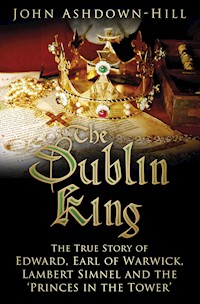
A year after Richard III's death, a boy claiming to be a Yorkist prince appeared as if from nowhere, claiming to be Richard III's heir and the rightful King of England. In 1487, in a unique ceremony, this boy was crowned in Dublin Cathedral, despite the Tudor government insisting that his real name was Lambert Simnel and that he was a mere pretender to the throne. Now, in The Dublin King, author and historian John Ashdown-Hill questions that official view. Using new discoveries, little-known evidence and insight, he seeks the truth behind the 500-year-old story of the boy-king crowned in Dublin. He also presents a link between Lambert Simnel's story and that of George, Duke of Clarence, the brother of Richard III. On the way, the book sheds new light on the fate of the 'Princes in the Tower', before raising the possibility of using DNA to clarify the identity of key characters in the story and their relationships.
Das E-Book können Sie in Legimi-Apps oder einer beliebigen App lesen, die das folgende Format unterstützen:
Veröffentlichungsjahr: 2015
Ähnliche















‘The Punishment of Lamnel (or Wermkin)’, by John Reynolds (W.C. Sellar & R.J. Yeatman, 1066 and All That, London 1930, 1963, reproduced by courtesy of Methuen & Co. Ltd).
δολερòν μέν ἀεἱ κατὰ πάντα δὴ τρóπον πέφνκεν ἄνθρωπος.
Full of deceit, always, and in every way, is the nature of man.
Aristophanes, (The Birds), lines 451–2.
In memory of my dear cousin, Valerie Ashdown (Enkelaar) 1931–2014 – whose life also linked England and the Low Countries.
First published in 2015
The History Press
The Mill, Brimscombe Port
Stroud, Gloucestershire, GL5 2QG
www.thehistorypress.co.uk
This ebook edition published in 2017
All rights reserved
© John Ashdown-Hill, 2015, 2017
The right of John Ashdown-Hill to be identified as the Author of this work has been asserted in accordance with the Copyright, Designs and Patents Act 1988.
This ebook is copyright material and must not be copied, reproduced, transferred, distributed, leased, licensed or publicly performed or used in any way except as specifically permitted in writing by the publishers, as allowed under the terms and conditions under which it was purchased or as strictly permitted by applicable copyright law. Any unauthorised distribution or use of this text may be a direct infringement of the author’s and publisher’s rights, and those responsible may be liable in law accordingly.
EPUB 978 0 7509 6316 9
Original typesetting by The History Press
eBook converted by Geethik Technologies
Contents
Acknowledgements
Introduction
The Historical Background
Part 1 – Possible Childhoods of the Dublin King
1. Richard, Duke of York
2. Edward V – and the Wider Problems of the Fate of the ‘Princes’
3. Edward, Earl of Warwick – Authorised Version
4. Edward, Earl of Warwick – Alternative Version
5. Lambert Simnel
Part 2 – Supporters and Enemies
6. Lincoln, Lovell and Yorkists in England
7. The ‘Diabolicall Duches’
8. The Earl of Kildare and the Irish Contingent
9. Henry VII and John Morton
Part 3 – 1486–1487
10. Evidence from England
11. Burgundian Preparations
12. The Reign of the Dublin King
13. The Battle of Stoke Field
Part 4 – The Aftermath
14. Lambert Simnel, Scullion and Falconer
15. ‘Richard of England’
16. ‘A Newe Maumet’
17. Catherine of Aragon and the Spanish Interest
18. The Third ‘Prince in the Tower’
Conclusions
Appendix 1: Timeline
Appendix 2: Contemporary and Near-Contemporary Records of the Dublin King’s Identity
Appendix 3: Frequency of Occurrence of the Surname Simnel in the UK Circa 1500–2000
Notes
Bibliography
Acknowledgements
I should like to give my profuse thanks to those people in Ireland who, in various ways have helped me with my research. These include James Harte, Samm Coade and the other very kind staff of the enormously helpful Irish National Library, together with Professor McGing and Eileen Kelly of Trinity College, Dublin, and Kate Manning, of the Archives of University College, Dublin. I should also like to record a heartfelt posthumous thank you to Professor F.X. Martin, whose publication on Lambert Simnel first brought to my attention the existence of the surviving (albeit damaged) seal of the Dublin King.
I also have debts of gratitude in the U.K. I am enormously grateful to Dr Emily Kearns, who has very kindly checked my Latin (and Greek) translations in an attempt to ensure that no mistakes have crept in. My thanks are also due to the Essex Library service; to the staff of the Albert Sloman Library of the University of Essex; to Marie Barnfield, of the Richard III Society Non-fiction Papers Library; to the Staff of the Guildhall Library in London; and to Dave Perry, who helped me check through the Great Chronicle of London. Dave Perry and Annette Carson also checked the proofs of my text to remove typographical and other errors and ensure that my meaning was clear. Finally, my thanks also go to the living Essex ‘Lambert Simnel’ who figures on Facebook, and who responded to my enquiry – even though, sadly, his Facebook identity proved to be a pseudonym!
Introduction
Anyone seeking information about Lambert Simnel will easily discover that this rather unusual name refers to a late fifteenth-century pretender to the English throne. His career is seen as marking one of the final chapters of the so-called Wars of the Roses. The word pretender was originally a neutral term, merely meaning claimant. Thus, for example, the eighteenth-century Old Pretender and Young Pretender, though they made the unspeakable error of professing the wrong religion in terms of the England (and Britain) of their day, were certainly not in any sense false claimants to the throne. However, since the word pretender tends to be applied mainly to failures, it is now often seen as implying ‘fake claimant’, and this is definitely its generally perceived meaning in the case of Lambert Simnel. To most historians – and to most of the general public – Simnel was nothing more than an impostor.
The name relates to a boy put forward by Yorkist leaders as the figurehead for their first campaign against Henry VII, a year or two after the latter’s usurpation of the English throne in 1485. Incidentally, the word ‘usurpation’ is another term which might benefit from some analysis. Properly, it means taking something over without a legal right. Yet although it has frequently been applied to the accession of Richard III (who, in reality, was offered the throne of England by the Three Estates of the Realm), curiously it is not generally applied to the violent seizures of power by Edward IV and Henry VII. Apparently in the case of a violent but successful seizure of power, the use of the term usurpation is not now seen as appropriate!
If the general perception of ‘Lambert Simnel, the impostor’ is correct, the story of his 1487 adventure would be the first (and perhaps the only) incident in English history which involved a serious attempt at putting a totally fake claimant on the throne.1 If that is the case, then it certainly needs some explanation. It has therefore been suggested that, thanks to Richard III’s alleged murder of his nephews, the ‘princes in the Tower’, followed by the natural death of Richard’s son, there was no clear and genuine Yorkist claimant to the throne to head the new campaign against Henry VII. Thus the only solution for the defeated and ousted Yorkists was to train a young impostor for the role of their figurehead leader. This impostor was then crowned as king in a unique ceremony held in the building generally known today as Christ Church Cathedral Dublin. However, the boy’s real name was then revealed to be Lambert Simnel by Henry VII’s spokesmen – or by some of them – for in actual fact even the official Tudor sources offer conflicting information regarding the pretender’s true identity.2
Since his alleged name of Lambert Simnel sounds somewhat improbable – and has, in fact, sometimes been described as having a pantomime-like quality – it has also been suggested by some historians that the boy might perhaps have had a non-English (possibly Flemish) ancestry. However, no proof has ever been produced to show that the surname Simnel originated in the Low Countries. In fact, the true evidence relating to the history of this surname will be revealed in Chapter 6.
In addition to positing a misleading modern invention in respect of the origins of the name ‘Lambert Simnel’, the widespread current standard interpretation of his story also often includes misleading statements relating to the lives and deaths of the so-called princes in the Tower. Actually, there is no real evidence that those two sons of Edward IV were murdered. Although it has been widely credited, the very detailed but unsubstantiated account of their slaughter written by Sir Thomas More dates from thirty years after the alleged event. In fact Thomas More himself was an insignificant boy of five in 1483, when the drama which he later reported in such detail was alleged to have occurred.
As for the contemporary fifteenth-century sources on the fate of the ‘princes’, they are conflicting, and very much lacking in detail. However, as we shall see, according to one near-contemporary source, the 1487 pretender was himself supposed to have claimed to be the younger of the two.3 It is true that, when we examine it carefully, the evidence on this point in relation to Lambert Simnel will prove to be somewhat questionable. Nevertheless, there is no doubt whatever that a subsequent Yorkist pretender, known to history as Perkin Warbeck, advanced a similar claim on his own account, and was quite widely believed. Thus the Warbeck case proves incontrovertibly that the death of the sons of Edward IV was by no means universally accepted as a fact in the late 1480s and the 1490s. Indeed, Sir Thomas More himself later acknowledged that belief in the survival of at least one of them still persisted in his day.
The legal situation in respect of the so-called ‘princes’ was somewhat complex. An unofficial Parliament (meeting of the Three Estates of the Realm) in 1483, followed subsequently by the official Parliament of 1484, formally declared these two boys and their sisters illegitimate and unable to claim anything by inheritance. Thus from the summer of 1483 until the summer of 1485 (i.e. during the reign of Richard III) neither of Edward IV’s sons was a genuine, legal prince – in consequence of which, neither of them possessed any claim to the English crown. This legal decision was significant in several ways, as we shall see later. However, one important side effect was that Richard III – who had been recognised as the legitimate sovereign by the same piece of legislation – would have had absolutely no logical reason for killing these two sons of his elder brother in order to obtain the throne, since they had already officially been declared bastards and excluded from the line of succession.
Subsequently, however, that legislation was revoked by the first Parliament of Henry VII. The new king’s purpose in having the Act of Parliament of 1484 rescinded was to enable himself to present Elizabeth of York – the elder sister of the ‘princes’ – as the Yorkist heiress to the throne – and then marry her himself. However, one unfortunate but inevitable side effect of Henry’s repeal was that it also restored the rights to the throne of his bride’s brothers. Thus, if either of them was alive in 1486–87, as the now-reinstated legitimate son of a former king, that boy’s claim to sovereignty would once again have been a strong one – far superior to the virtually non-existent blood claim of Henry VII himself. A surviving son of Edward IV (if there was one) would therefore arguably have been in a strong legal position to reassert a claim to represent the house of York.
One consequence of this is that after 1485 Henry VII’s motivation for ending the lives of his brothers-in-law (the elder of whom would by then have been aged at least 15 and able to reign in his own right) would have been very strong. Indeed, it would have been far more compelling than Richard III’s earlier motivation to do away with a pair of minor children who were legally excluded from the succession. The most significant proof of this statement lies in the fact that Henry VII did indeed put to death Perkin Warbeck, who had advanced a powerful (and, to some people, convincing) claim to be the younger of the two ‘princes’.
However, the second point regarding the Yorkist claim in 1486–87 is that, even if both of Edward IV’s sons by Elizabeth Woodville were dead, there were numerous other Yorkist claimants to the throne in existence. These comprised various nephews of Richard III and Edward IV. At least one of these Yorkist royal nephews – John de la Pole, Earl of Lincoln – was both adult and at liberty. Moreover, he had been promoted to high rank and groomed for government service during the reign of Richard III. Indeed, in terms of the norms of inheritance, he was probably the strongest Yorkist contender for the throne, because, unlike his cousins – the sons of Edward IV, and of the attainted Duke of Clarence – Lincoln’s claim had never been impugned by any parliamentary legislation. If the Yorkists were in search of a leader and a claimant to the throne, Lincoln, the eldest surviving Yorkist prince, would have been an obvious candidate.
But, strangely, instead of putting forward his own claim, the 25-year-old Lincoln chose instead to back the supposed impostor. Why on earth would a genuine – and adult – Yorkist prince such as Lincoln have chosen to back a false claimant who (according to the surviving contemporary accounts) was a minor, instead of advancing his own valid claim? This unanswered question is by no means new, for it reportedly preoccupied Henry VII himself, in 1487.4 Henry is said to have expressed regret at the death of Lincoln at the Battle of Stoke, since that precluded any possibility of interrogating the earl on this very subject. For about five hundred years, then, the issues surrounding the motivation underlying Lincoln’s recorded conduct have been carefully glossed over by those who view Lambert Simnel as a spurious claimant to the throne. Indeed, those historians who accepted the Tudor accounts of Lambert Simnel had little other option, because if Simnel was an impostor, Lincoln’s actions were a complete mystery, utterly lacking any credible explanation.
Despite this problem, most historians have nevertheless maintained that Lambert Simnel claimed – falsely – to be Edward, Earl of Warwick, another (and younger) nephew of Richard III and Edward IV, and the son of George, Duke of Clarence. It is intriguing, therefore, to discover that several surviving contemporary sources actually report that Simnel really was the Earl of Warwick. The geographical location of the writers appears to be highly significant in determining their attitude on this point. While official English (Tudor) sources maintained that Simnel was an impostor, Burgundian sources took the opposite view. Irish sources also held the opposite view until the Tudor victory at Stoke began the slow process of bringing Ireland back under English rule. Thus, consciously or unconsciously, by maintaining that Simnel was a fake, modern historians are following the official Tudor line.
Another intriguing point is the fact that the boy known as Lambert Simnel began advancing his claim in Ireland, with support from Flanders. These locations are significant, because the Earl of Warwick’s father, the Duke of Clarence, had been accused in 1477–78 of attempting to smuggle his son and heir to either Ireland or Flanders. Why was this accusation levelled against Clarence at some length and in considerable detail, despite the fact that an official conclusion was then reached that his attempt had failed? Could it possibly be that – despite the fact that the government of his brother, Edward IV, proclaimed publicly that the 3-year-old Earl of Warwick was still at home – the Duke of Clarence actually succeeded in having his son sent out of England? As for the reason for the official government statement, it may have been that Edward IV and his advisors genuinely believed what they said.
As we have seen, the name ‘Lambert Simnel’ is supplied to us by official mouthpieces of Henry VII – who, of course, had every incentive for attempting to discredit the 1487 claimant. It is those same mouthpieces who also provide us with the alternative story of the pretender’s childhood – as the son, not of a king or a royal duke, but of a tradesman of some kind (there are various conflicting accounts of the father’s employment), who may have lived in Oxford. This story – as told, for example, by Polydore Vergil – superficially sounds clear and authoritative. In reality, however, when examined carefully, just like the other possible accounts of the boy’s childhood, the ‘Simnel of Oxford’ version appears to contain some puzzling elements and a number of contradictions.
Thus, in every respect, the story of Lambert Simnel is far from straightforward. In this re-examination of the pretender and his claims, I shall try to offer a thorough exploration of every piece of evidence – including some new or little-known material – and I shall attempt to avoid proposing any facile conclusions. To avoid prejudging any of the issues, henceforward I shall generally refer to the individual at the centre of the investigation, neither as ‘Lambert Simnel’, nor as the Earl of Warwick or the Duke of York, but as ‘the Dublin King’.
My re-examination begins with the conflicting versions of the Dublin King’s five possible childhoods. The first of these versions is the childhood of the younger son of Edward IV, Richard of Shrewsbury, Duke of York and Norfolk. Many people may feel that they know the basic outline of Richard’s story well. As we shall see, however, the widespread use of the collective term ‘princes in the Tower’ in itself proves very clearly that the life history of Richard of Shrewsbury is quite widely misunderstood. As for the later stages of Richard’s real story, they are full of question marks.
Exploring Richard’s life necessarily involves a re-examination of whether or not the sons of Edward IV really were murdered. This leads inevitably to the theory advanced by some modern writers that perhaps the Dublin King was in reality none other than King Edward V. Although no fifteenth-century accounts explicitly proposed such a theory, this second possible childhood also has to be explored.
The third and fourth stories are two alternative versions of the life history of Edward of Clarence, Earl of Warwick, the son of the Duke of Clarence. The Earl of Warwick’s story has been very little studied and is generally not well understood. Even the entry under his name in the Oxford Dictionary of National Biography (ODNB) contains at least one glaring inaccuracy.
A quick glance at the timeline at the end of this book reveals how young Warwick was when some of the key events took place in which he was allegedly involved. This suggests one very important point which seems generally to have been overlooked. How many people would easily have been able to recognise and identify him? In 1487 Warwick would have been 12 years old. In 1476–77, when his father had tried to smuggle him out of England (and had perhaps succeeded), the little boy had been only 2. How easy is it, even today, to recognise a boy of 12 whom one last saw when he was 2? When considered in this light, Henry VII’s parading through the streets of London of the young person whom he held in custody under the name of the Earl of Warwick, in an attempt to undermine the claims of the Dublin King, appears ridiculous and meaningless.
In fact, what will emerge, as we shall see, is that the life history of the Earl of Warwick actually has two potential – and quite different – versions. The first of these is the authorised version, as publicised by successive English governments. The second is an alternative, unauthorised and unfamiliar version; nevertheless, evidence for its possible authenticity does exist.
The fifth childhood story to be considered is that of the mysterious boy who seems to have borne the name Lambert Simnel – though one contemporary account by a rather important witness tells us that the boy’s real Christian name was actually John. This boy may have been brought up in Oxford, by his father, who may have been an organ maker – or a baker – or some other kind of tradesman. Possibly the boy was not brought up in Oxford, but was taken there by a clergyman who had evil intentions in respect of King Henry VII. Reportedly taken from his menial background (wherever that was) around the end of 1485, at the age of about 8, because he looked so much like the 10-year-old Earl of Warwick (whom most people had probably never seen) – or possibly because he resembled the even older Duke of York – Simnel was then allegedly trained to impersonate a royal prince by an insignificant – but obviously very enterprising – young Oxford priest. One account tells us that this priest was called William Symonds. However, another version of the story reports his name as Richard Simons. According to one source, Symonds/Simons was a prisoner of the Tudor government by the beginning of 1486. Confusingly, other sources report that he was only captured by Henry VII’s forces about fourteen months later, after the Battle of Stoke. It will probably already be apparent that, despite its widespread acceptance, in actuality this official Tudor account of events contains at least as many confusions and potential contradictions as the other versions of the pretender’s story.
Identifying for certain which of these four – or possibly five – boys was where, when and with whom, is by no means easy. The trail becomes increasingly complex as the story progresses. Nevertheless, a serious attempt to track down the true life histories and fates of all the boys in question is the only possible way of embarking upon the quest to shed new light on the story of Lambert Simnel and the Dublin King.
Note
In the Middle Ages the English calendar operated differently from the one we know today, in that the New Year began not on 1 January but on 25 March (Lady Day). Thus events which occurred in the months of January, February or March would have been counted by medieval English writers as occurring in the last months of the previous year. Some foreign writers, however, would have dated them in the modern manner. To avoid any possibility of confusion over year dates, all events which occurred in January, February or March are dated here in the following way:
February 1486/87
This means that in terms of the English medieval reckoning, the event in question took place in February, the penultimate month of 1486 – though in terms of the modern calendar we would date this as February, the second month of 1487.
The Historical Background
The background to the story of the Dublin King is the episode of English history popularly known as the Wars of the Roses. It is essential to understand the basic outline of this complex struggle for power within the royal family in order to be able to comprehend what took place in 1486–87.
The story of the Wars of the Roses started almost a century before the coronation of the Dublin King. It began in about 1390, with controversy over who was the true heir to the throne of the childless reigning monarch of the day, King Richard II. The rival contestants were, first, the descendants of Richard II’s senior uncle, Lionel of Antwerp, Duke of Clarence and, second, the family of a younger uncle, John of Gaunt, Duke of Lancaster. As a result of the marriage of Anne Mortimer, great-granddaughter of Lionel, to her cousin, Richard, Earl of Cambridge, the Clarence descendants eventually evolved into what is known as the royal house of York, while John of Gaunt’s descendants were the house of Lancaster.
Who was the true heir of Richard II?
Historical attempts at analysing the rights and wrongs of the rival Mortimer/Yorkist and Lancastrian/Tudor claims to the throne are often based on the rather naïve assumption that the basic modern rules governing succession to the English throne also applied in the medieval period. The fact that the modern rules have only recently been altered should warn us against making any such assumption.
An examination of practice in relation to succession issues during the five centuries from 1000 to 1500 shows that the seizure of power by force, followed by subsequent Parliamentary ratification, was not infrequently the basis of a sovereign’s authority during this period. It accounts for the accessions of William I (the Conqueror), King Stephen, King John, Henry IV, Edward IV and Henry VII. The accessions both of Stephen and of Henry II also prove beyond any shadow of doubt that a royal daughter could transmit rights to the throne if there was a lack of royal sons. At the same time, however, the civil war between King Stephen and Henry II’s mother, Stephen’s cousin Matilda, demonstrates that prior to 1500 the right of daughters to succeed to the throne in person remained unclear.
In 1399 John of Gaunt’s son forcibly resolved the succession issue of his day by deposing, imprisoning and probably ultimately murdering King Richard II, and by seizing the crown for himself, under the royal title of King Henry IV. Thus began the reign of the house of Lancaster, which lasted for sixty-two years.
Of course, such behaviour invites retaliation. Its effect in this instance was that, from the very beginning of the Lancanstrian era, there were attempts to change the situation in favour of Richard II’s alternative heirs, the descendants of Lionel, Duke of Clarence. The early attempts were unsuccessful, of course, and the house of Lancaster remained on the throne throughout the reigns of Henry IV and Henry V. However, the position of the dynasty was weakened by the death of Henry V, followed by the succession of the third Lancastrian king, his baby son, King Henry VI.
Henry VI was a weak king even when he grew up. His position was further undermined by a tendency to mental instability, which he may have inherited from his grandfather, King Charles VI of France. Doubts about the legitimacy of his supposed son and heir also helped to undermine the Lancastrian cause. Thus, after various vicissitudes, which later came to be called the Wars of the Roses, the Yorkist attempts to displace the house of Lancaster were finally successful. First, Parliament decided that the Yorkist line must succeed to the throne after Henry VI. Then in 1461, after this decision had been contested unsuccessfully by a Lancastrian army, Henry VI was deposed by one of his Yorkist cousins, who founded the Yorkist dynasty and became King Edward IV. Edward IV’s claim to the throne was a strong one, based on three very solid arguments: first, his superior blood right (via his female-line descent from Edward III’s second surviving son); second, his very effective seizure of power; third, the subsequent ratification of his succession by Parliament.
Ultimately, the death of Henry VI in the Tower of London left the Lancastrian dynasty with no clear heir, and the Yorkist takeover would almost certainly have proved to be a long-term success if Edward IV had had a sensible marriage policy. Unfortunately, by involving himself in two secret weddings, the king laid himself open to the accusation of bigamy. In 1461 he married Eleanor Talbot, daughter of the late first Earl of Shrewsbury,1 but in 1464, while Eleanor was still alive, he also secretly married Elizabeth Woodville. Unfortunately for Edward, since only the second of these two secret marriages produced offspring, those children then became liable to accusations of illegitimacy. Matters came to a head when Edward IV died unexpectedly in April 1483.
Notionally Edward IV’s heir was his eldest son, Edward, Prince of Wales, the elder of the so-called ‘princes in the Tower’. Following his father’s death, in April 1483, this Prince of Wales was initially proclaimed king as Edward V. However, the subsequent revelation of Edward IV’s bigamy provoked a new controversy between those members of the nobility, such as Lord Hastings, who were prepared to hush up the young king’s technical illegitimacy, and those like the Duke of Buckingham, who believed that it should not be hushed up, and who insisted that the order of succession should be altered, either to maintain the principle of absolute legitimacy upon which the Yorkist claim to the throne had always been based, or perhaps to ensure the exclusion from any position of power of the parvenu and upstart Woodville family.
The immediate outcome of Hastings’ opposition was his execution. Then, on the basis of the evidence of Edward IV’s bigamy (and the consequential illegitimacy of his children by Elizabeth Woodville), coupled with the fact that George, Duke of Clarence had been attainted and executed in 1478, thereby excluding his children from the succession, the throne was offered to Edward IV’s only surviving brother, the Duke of Gloucester, who thus became King Richard III. Since a Parliament had not, at that stage, formally been opened, the offer of the crown to Richard III was made initially by the Three Estates of the Realm – those noblemen, bishops and abbots, and representatives of the commons, who were in London waiting for the opening of Parliament. However, the following year, when a full Parliament was sitting, the offer was formally encapsulated in legislation, citing both the evidence of bigamy, and also the offer made to Richard III the previous summer.
As at every stage since the usurpation of Henry IV in 1399, the new change in the order of succession to the throne was not universally accepted. In France there was a remote descendant of John of Gaunt living in exile. The French, always happy to undermine the existing government in England, supported this obscure claimant, and to their – and probably his own – surprise, in August 1485 at the Battle of Bosworth, he suddenly found himself King of England, with the royal title of Henry VII.
Henry rapidly repealed the parliamentary decision which had declared Edward IV’s children bastards. This was done in order that he himself could marry Edward IV’s eldest daughter, Elizabeth of York, whom he wished to present to the nation as the Yorkist heiress. In this way he hoped that his marriage would be seen as having brought to an end the rivalry between the houses of Lancaster and York.
As a result of Henry VII’s action, the legal position regarding the Yorkist succession reverted to what it had been during the reign of Edward IV. By rescinding the decision which had declared Edward’s Woodville marriage bigamous and its children illegitimate, Henry restored his bride, Elizabeth of York, to the position of a legitimate princess, which she had enjoyed during the lifetime of her late father. It was also now possible for Henry to claim that Richard III had been a usurper.
The heirs of Edward IV in 1483.
But unfortunately, if Elizabeth’s legitimacy had been restored, so had that of her two brothers. Arguably, therefore, from the Tudor viewpoint, the rightful Yorkist claimant was now either Edward V or Richard, Duke of York – if either of them was still alive. Whether those Yorkists who had supported the late King Richard III would also have seen things in that way is perhaps more questionable. They may still have perceived the sons of Edward IV as bastards, in which case they would presumably have been seeking a new Yorkist leader from among the other surviving nephews of Richard III.
Fortuitously from Henry VII’s point of view, Edward IV’s two sons appeared to have been lost sight of in the meantime. Thus, they were not on hand as immediate contenders for the throne. Now that the legal situation in the autumn of 1485 has been explained, some readers may feel that the boys’ absence was so much to Henry VII’s advantage that it is very tempting to believe that either Henry himself or one of his leading supporters was behind their disappearance. However, Henry VII’s apparent uncertainty as to what had become of his young brothers-in-law constitutes quite a strong argument against this. The possible fate of the so-called princes will be considered in more detail later.
Meanwhile, from the Yorkist viewpoint, Henry’s repeal of the Act of Titulus Regius of 1484 had done absolutely nothing to restore the claim to the throne of the children of the Duke of Clarence, since their father’s attainder had not been reversed. Thus it might appear that the official legal position in Tudor eyes should logically have been that the 8-year-old Earl of Warwick and his elder sister represented no real threat.
However, there was also an alternative Lancastrian viewpoint. Ironically, according to this the Earl of Warwick was the rightful Lancastrian heir to the throne. This complex argument will also be explored in greater detail later. For the moment, suffice it to say that the new king was obviously taking no risks with potential rivals. He rounded up all the young Yorkist heirs that he could find, and made sure that they were placed under very careful supervision. Later, many of them were to be more permanently removed from the political arena by means of execution, either by Henry VII himself, or by his son Henry VIII.
In spite of his careful precautions, about a year after winning the crown Henry VII found himself confronting one possible Yorkist contender for the throne. The claimant was a boy who was recognised by those members of the house of York who were free to express their opinions, as a young but very high-ranking prince of that dynasty. Whoever he really was, all the surviving accounts speak quite well of him. They tell us that ‘the child … was handsome, intelligent and of courtly manners. … Lambertus erat vultu membrisque decorus [Lambert was handsome of face and limbs],’ says John Herd. ‘Puer aspectu decoro et docile [a boy of dignified appearance, and teachable],’ writes Ware. ‘Of a gentle nature and pregnant wit,’ says the Book of Howth.2
Precisely who this boy really was, and what was his true life history, comprises the central subject matter of this book. One fact, however, is beyond dispute: the boy was crowned as King of England at Christ Church Cathedral in Dublin. As for which royal name and number this Dublin King used, various answers have been offered by previous writers. In reality, though, the true position (like so many aspects of the Dublin King’s story) has not been clear. The relevant surviving evidence on this point will therefore be very carefully reviewed in due course. Before that, however, the fascinating quest for the true identity of the Dublin King has to begin by exploring all the possible – and conflicting – accounts of the boy’s childhood.
PART 1
Possible Childhoods of The Dublin King
1
Richard, Duke of York
About fifteen years after the death of King Richard III at the Battle of Bosworth, Bernard André (1450–1522), a French Augustinian friar and poet from Toulouse, who is also sometimes referred to under the Latin form of his surname as Andreas, and who was employed by Henry VII, wrote a history of the new king’s reign. This is often called by its abbreviated Latin title, Historia Henrici Septimi. André’s history of Henry VII offered the following account of the rebellion of 1487:
While the dire death of King Edward’s sons was still a fresh wound, behold, some seditious fellows devised another new crime, and so that they might cloak their fiction with some misrepresentation, in their evilmindedness they gave out that some base-born boy, the son of a baker or tailor, was the son of Edward IV. Their boldness had them in its grip to the point that out of the hatred they had conceived for their king they had no fear of God or Man. Thus, in accordance with the scheme they had hatched, rumor had it that Edward’s second son had been crowned king in Ireland. And when this rumor was brought to the king, in his wisdom he elicited all the facts from the men who had informed him: namely, he sagely discerned how and by whom the boy had been brought there, where he had been raised, where he had lingered for such a long time, what friends he had, and many other things of the same kind. In accordance with the variety of developments, various messengers were sent out, and finally [ — ],1 who said that he could easily divine whether the boy was what he claimed to be, crossed over to Ireland. But the lad, schooled with evil art by men who were familiar with Edward’s days, very readily replied to all the herald’s questions. In the end (not to make a long story of it), thanks to the false instructions of his sponsors, he was believed to be Edward’s son by a number of Henry’s emissaries, who were prudent men, and he was so strongly supported that a large number had no hesitation to die for his sake. Now see the sequel. In those days such was the ignorance of even prominent men, such was their blindness (not to mention pride and malice), that the Earl of Lincoln [ — ] had no hesitation in believing. And, inasmuch as he was thought to be a scion of Edward’s stock, the Lady Margaret, formerly the consort of Charles, the most recent Duke of Burgundy, wrote him a letter of summons. By stealth he quickly made his way to her, with only a few men party to such a great act of treason. To explain the thing briefly with a few words, the Irish and the northern Englishmen were provoked to this uprising by the aid and advice of the aforementioned woman. Therefore, having assembled an expedition of both Germans and Irishmen, always aided by the said Lady, they soon crossed over to England, and landed on its northern shore.2
There are several interesting points to note in André’s account, and we shall return to his narrative to consider some of the issues that arise later. However, the first key point to notice is that André believed the Dublin King to be an impostor. Of course, this was a natural viewpoint for an employee of Henry VII. It would be astonishing if André – or anyone else writing from the official point of view of the Tudor king and his regime – were to tell us that the Dublin King was a genuine royal personage. We need to keep that fact in mind later, when reviewing the accounts of other historians of the reigns of Henry VII and Henry VIII.
The second point is that André states that one of Henry VII’s heralds journeyed to Ireland on the king’s behalf and interviewed the pretender. Although this herald clearly expected to be able to expose without any difficulty the boy’s imposture, it is also evident, from André’s report of what took place, that in actual fact, on meeting the pretender, the herald did not find himself in quite the straightforward situation which he had anticipated. His questions were apparently answered without hesitation, and it seems that, in the end, the herald may have concluded that the boy might indeed be the person he claimed to be. Indeed, André states quite clearly the interesting fact that the Dublin King ‘was believed to be Edward’s son by a number of Henry’s emissaries’ even though they were ‘prudent men’.
The name of the herald who made this trip to Ireland on Henry VII’s behalf is left blank in André’s account, which suggests that André’s report is probably at second hand, and that he had not spoken to the herald directly. However, Henry VII’s Garter King of Arms (who had also previously served both Edward IV and Richard III), was John Wrythe (Writhe), who held this post from 1478 until 1504. It seems likely that Wrythe, who had been close to the Yorkist court, and who would have been in a good position to identify a surviving Yorkist prince – or disprove the pretentions of an impostor – may well have been the herald who visited the Irish court of the Dublin King. He is known to have made at least one visit to Ireland.3 If John Wrythe was the herald in question, that might help to explain why André did not interview him in person. At the time when André was writing his account, Wrythe may already have been dead (for he died in 1504). If he was still alive, he was certainly an old man, and probably in a poor state of health. However, it is clear from André’s account that the herald apparently found his mission a less simple matter than he had anticipated. Further evidence on the identity of the Dublin King, taken directly from the contemporary Heralds’ Memoir 1486–1490, will be examined later (see Chapter 5).
As for the nature of the claims made by the Dublin King, André states quite specifically and unequivocally that he was a young impostor, who was attempting to pass himself off as one of the sons of Edward IV and Elizabeth Woodville. Two sons of this couple outlived their father. They are often known, both to historians and to the general public, as ‘the princes in the Tower’. However, since by June 1483 they were officially no longer princes; since it is not certain how long they spent in the Tower of London, and since for the purposes of this study it is very important to stress that the two individual brothers experienced two quite separate and very different life histories, use of that popular collective term will, as far as possible, be avoided here.
The two boys in question were Edward (who was Prince of Wales until 1483, and then briefly ‘King Edward V’), and his younger brother, Richard of Shrewsbury, Duke of York and Norfolk. André claims that both sons had suffered what he characterises as a ‘dire death’ at some time prior to (but not long before) 1486–87. However it is also his contention that the Dublin King put forward a false claim that he was the younger of these two sons of Edward IV, namely Richard, Duke of York. If André was correct in his assertion, we should hopefully be able to find further near-contemporary accounts which tell us the same story. Moreover, we should also be able to find evidence that the boy-king in Dublin used the royal name of Richard.
For the moment it will suffice to say that Polydore Vergil does confirm André to the extent of stating that, initially at any rate, the Dublin King claimed to be Richard of Shrewsbury. Moreover, there are certainly Irish coins in existence bearing the royal name of Richard which could possibly date from about this period. Unfortunately, however, fifteenth-century coins do not bear any date of issue. In the present case, this makes their significance somewhat difficult to interpret correctly. The Irish Richard coins could simply date from the reign of Richard III. We shall return to both these points to examine the relevant evidence in greater detail in due course.
The first Yorkist king, Edward IV, with his two wives: Eleanor Talbot and Elizabeth Woodville. Edward and Elizabeth are the first possible parents of the Dublin King.
First, however, if this hostile historian of Henry VII is correct when he tells us that the Dublin King claimed to be Richard, Duke of York, it follows that in the eyes of historians from a non-Tudor background, the boy might conceivably have been seen as telling the truth. We therefore need to begin by examining the life history of the young Richard of Shrewsbury in so far as that is known. The clear evidence of his life story comes to an end in 1483. However, we shall also have to confront the very complex evidence of what became of him after 1483, and the question of when, where and how he died.
As his toponym indicates, Richard was born in Shrewsbury on 14 August 1473, the second son of Edward IV and Elizabeth Woodville. The reign of the Yorkist dynasty, which had first formally claimed the throne in the person of Richard of Cambridge, Duke of York, had finally been made a reality by that duke’s eldest son, Edward IV, in 1461. The Yorkist claim was founded upon the principle of legitimacy, which arguably gave the princes of York a better right to the English crown than their Lancastrian cousins. As we have seen, however, it then becomes difficult to establish whom Edward IV married.4
It appears to be the case that Edward IV contracted two secret marriages. The first of these, which probably took place in June 1461, was with Eleanor Talbot (Lady Butler), daughter of the first Earl of Shrewsbury. The second, reportedly in May 1464, was with Elizabeth Woodville (Lady Grey). The first union was childless, but its enduring consequence was that it made the second union bigamous, because the two marriages overlapped. As a result, the children born to Edward IV and Elizabeth Woodville were all technically illegitimate – and hence were ultimately excluded from succession to the throne. These, at any rate, were the conclusions reached by the Three Estates of the Realm in 1483, and formally enacted by Parliament in 1484. Thus, ironically, the marital conduct of the first Yorkist king did much to undermine the principle of legitimacy upon which his family’s claim to the throne had been based.
At the time of his birth, however, Edward IV’s son Richard of Shrewsbury was generally assumed to be legitimate, and was seen as the new second in line to the throne – thereby pushing his senior royal uncle, the Duke of Clarence, one step further from the prospect of ever wearing the crown of England. Richard was created Duke of York on 28 May 1474, when he was less than 1 year old, and he was knighted just under a year later, at which time land formerly held by the Welles and Willoughby families was settled upon him. In May 1475 both Richard and his brother, Edward, were made knights of the Garter.
The death of John Mowbray, Duke of Norfolk, in January 1475/76,5 offered Richard’s parents an unexpected further opportunity to improve their second son’s future. Plans were made to marry him to Norfolk’s only living child, his daughter, Anne Mowbray (1472–81), who, incidentally, was also the niece of Eleanor Talbot. A papal dispensation was required for the marriage of Richard and Anne, because they were close relatives through their mutual Neville ancestry.
Richard’s marriage to Anne was celebrated with great splendour in January 1477/78, at the Palace of Westminster. On Wednesday, 14 January 1477/78, the 5-year-old bride, accompanied by the king’s brother-in-law, Earl Rivers, was escorted into the king’s great chamber in the Palace of Westminster, where she dined in state in the presence of a large assembly of the nobility and gentry of the realm.6 The following morning Anne was prepared for her royal wedding ceremony in the queen’s chamber, from which she was escorted by the queen’s brother, Earl Rivers, on her left. At her right hand side was the king’s nephew, the Earl of Lincoln. Her procession passed through the king’s chamber and the White Hall to St Stephen’s Chapel, the site of which is occupied today by the House of Commons. This Chapel Royal, brightly painted and gilded more than a century earlier by King Edward III, was also adorned for the occasion with rich hangings of royal blue, powdered with golden fleurs de lis.
In St Stephen’s Chapel, under a canopy of cloth of gold, the royal family was assembled to await Anne. The king and queen were there, with both their sons – possibly one of the rare occasions on which the two princes found themselves in the same place at the same time. Their sisters, Elizabeth, Mary and Cecily of York, were also present. So was their grandmother – Anne Mowbray’s great-great-aunt – Cecily, Duchess of York, mother of the king, and the ‘queen of right’, as she was called.
Anne’s local Ordinary, Bishop Goldwell of Norwich, richly vested in a cope, waited at the chapel door to receive the bride. However, her procession was halted by Dr Coke, who ceremonially objected to the marriage on the grounds that the couple were too closely related, and said that the ceremony should not proceed without a dispensation from the pope. Dr Gunthorpe, the Dean of the Chapel Royal, then triumphantly produced and read the papal dispensation.
Once it had thus been formally established that the Church permitted the marriage contract, the Bishop of Norwich led the little bride into the chapel and asked who was giving her away. The king himself stepped forward to perform this office. High Mass was then celebrated, and the king’s brother, the Duke of Gloucester, distributed largesse to those present, after which the bride was escorted to the wedding banquet by the same Duke of Gloucester and by the king’s cousin, the Duke of Buckingham – a relative of Anne’s paternal grandmother, Eleanor Bourchier.
The wedding banquet was held in St Edmund’s Chapel. At the high table, with the bride and groom, were the Duke and Duchess of Buckingham, together with the bride’s mother, Elizabeth Talbot, the young widow of the last Mowbray Duke of Norfolk. The young dowager Duchess of Norfolk was escorted on this occasion by Richard, Duke of Gloucester, who was the husband of her first cousin, Anne Neville. Two side tables were presided over respectively by the king’s stepson, the Marquess of Dorset, and by the king’s second cousin, the Countess of Richmond (mother of the future Henry VII).
The celebrations did not end with the wedding banquet. Three days later, in honour of his son’s marriage, the king created twenty-four new knights of the Bath, and a week after the wedding a great tournament was organised at Westminster by Earl Rivers, with jousting of three kinds, and much splendid display. Anne Mowbray, Duchess of York and Norfolk, was queen of the festivities, and awarded prizes to the victors in the form of golden letters set with diamonds. The letters were ‘A’, ‘E’ and ‘M’.
‘A’ and ‘M’ were for Anne Mowbray, of course. The ‘E’ was pleasantly ambiguous, standing for the names of the king, the queen, the Prince of Wales, the king’s eldest daughter and the bride’s mother. It even stood for the name of the bride’s long-dead aunt, Eleanor Talbot, though her name was probably not one that the king wanted to recall just at this moment. It seems likely that the recent activity of his brother, the Duke of Clarence, had confronted the king with an unpleasant reminder of his relationship with Eleanor. Indeed, even as his son’s wedding was being celebrated, Clarence was in prison, and Edward IV was grappling with the consequences of that reminder.
Young Richard of Shrewsbury was invested with all the main Mowbray titles: Duke of Norfolk, Earl of Nottingham, Earl Warenne and Earl Marshal, not to mention Lord Seagrave, Mowbray and Gower. Edward IV also enacted legislation of dubious legality to ensure that even if Anne Mowbray died her young husband would retain both the Mowbray property and the Mowbray titles.7
In May 1479, when he was still not yet 6 years old, Richard was appointed Lord Lieutenant of Ireland. Although officially he now had his own household, the members of it were his father’s retainers. Thus it seems probable that, on the whole, both Richard and his young bride were brought up by and with his parents and sisters – unlike his elder brother, Edward. Sadly, however, Anne Mowbray died shortly before her ninth birthday, in 1481, leaving Richard a very young widower – and in somewhat dubious legal possession of the Mowbray inheritance.
Edward IV’s notional direct heir, Richard’s elder brother, Edward, Prince of Wales (born in November 1470), was almost three years older than his younger brother, Richard. In 1473 – the year of Richard’s birth – Edward had been established in a household of his own at Ludlow Castle. There the little boy presided – in name, at least – over the newly established Council of Wales and the Marches. In reality, he was living and acting under the guardianship of his maternal uncle, Anthony, second Earl Rivers. Rivers was a well-educated man, and, under careful instructions laid down by the king, he seems to have brought up the Prince of Wales as a cultivated child. As a result of young Edward’s separate household establishment at Ludlow, however, it is doubtful how much Richard, Duke of York saw of his elder brother during their childhood. This makes the traditional picture of the princes in the Tower – which groups the brothers together as though they were a single item – very misleading.
In April 1483, when Edward IV died unexpectedly, the Prince of Wales was still resident at Ludlow with his uncle, Lord Rivers. On the instructions of his sister (now the Queen Mother), Rivers made arrangements to bring the new young king – proclaimed as Edward V – to London, in preparation for his early coronation at Westminster. In effect, this amounted to an attempted coup, plotted by the Queen Mother and her family in order that the Woodvilles might seize power through their control of the young king.
There was no legal precedent in England for what Elizabeth Woodville was hoping to achieve. It is true that, about one and a half centuries earlier, Isabelle of France had overthrown her husband, King Edward II, and had briefly wielded power in the name of her young son, Edward III. However, no one would have regarded that as a model to be followed.




