


9,99 €
Mehr erfahren.
- Herausgeber: The History Press
- Kategorie: Sachliteratur, Reportagen, Biografien
- Sprache: Englisch
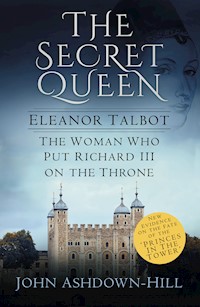
When Edward IV died in 1483, the Yorkist succession was called into question by doubts about the legitimacy of his sons (the 'Princes in the Tower'). The crown therefore passed to Edward IV's undoubtedly legitimate younger brother, Richard, Duke of Gloucester. But Richard, too, found himself entangled in the web of uncertainly, since those who believed in the legitimacy of Edward IV's children viewed Richard III's own accession with suspicion. From the day that Edward IV married Eleanor, or pretended to do so, the House of York, previously so secure in its bloodline, confronted a contentious and uncertain future. John Ashdown-Hill argues that Eleanor Talbot was married to Edward IV, and that therefore Edward's subsequent union with Elizabeth Widville was bigamous, making her children illegitimate. In his quest to reveal the truth about Eleanor, he also uncovers fascinating new evidence that sheds fresh light on one of the greatest historical mysteries of all time – the identity of the 'bones in the urn' in Westminster Abbey, believed for centuries to be the remains of the 'Princes in the Tower'.
Das E-Book können Sie in Legimi-Apps oder einer beliebigen App lesen, die das folgende Format unterstützen:
Veröffentlichungsjahr: 2011
Ähnliche














‘The queen [Elizabeth Widville] then remembered … the calumnies with which she was reproached, namely that according to established usage she was not the legitimate wife of the king.’
Domenico Mancini, 1483.
‘King Edward was and stoode marryed and trouth plight to oone Dame Elianor Butteler, doughter of the old Earl of Shrewesbury.’
Act of Parliament, 1484.
‘The bishop [of Bath and Wells] said that he had married them when only he and they were present.’
Philippe de Commynes, c. 1490.
‘Edward [IV] had espoused another wife before the mother of Elizabeth of York.’
Eustace Chapuys to Emperor Charles V, 1533.
‘There are no sufficient grounds for regarding [the marriage between Edward IV and Eleanor Talbot] as a mere political invention … Perhaps rather an evidence of the truth of the story is the care afterwards taken to suppress and to pervert it.’
James Gairdner, 1898.
In memory of my cousin, Sheila Llewellyn.
Cover illustrations: Tower of London (iStockphoto/Songquan Deng); Eleanor as she may have looked in about 1462. An image based on the 1996 facial reconstruction of CFII (© Mark Satchwill, 2008)
First published in 2009
The History Press
The Mill, Brimscombe Port
Stroud, Gloucestershire, GL5 2QG
www.thehistorypress.co.uk
This ebook edition first published in 2016
All rights reserved
© John Ashdown-Hill, 2009, 2010, 2016
The right of John Ashdown-Hill to be identified as the Author of this work has been asserted in accordance with the Copyright, Designs and Patents Act 1988.
This ebook is copyright material and must not be copied, reproduced, transferred, distributed, leased, licensed or publicly performed or used in any way except as specifically permitted in writing by the publishers, as allowed under the terms and conditions under which it was purchased or as strictly permitted by applicable copyright law. Any unauthorised distribution or use of this text may be a direct infringement of the author’s and publisher’s rights, and those responsible may be liable in law accordingly.
EPUB ISBN 978 0 7524 6895 2
Original typesetting by The History Press
eBook converted by Geethik Technologies
CONTENTS
Introduction
1 John Talbot
2 Margaret Beauchamp
3 Lord Shrewsbury
4 Brothers, Sisters, Cousins
5 Eleanor’s Childhood
6 Lord Sudeley
7 Elizabeth Norbury
8 Thomas Boteler
9 The Botelers’ Wider Family
10 Married Life
11 Widowhood
12 Edward IV
13 Disillusion
14 Corpus Christi
15 Mount Carmel
16 The Widville ‘Marriage’
17 Death
18 Aftermath
19 Eleanor and the Historians
20 Eleanor’s Body
Timeline
Appendix 1: Documentary Evidence – Summary
Appendix 2: Eleanor in Fiction
Appendix 3: What Makes a Lady?
Notes
Bibliography
Acknowledgements
INTRODUCTION
Eleanor Talbot was the rock upon which the royal house of York foundered. Unwittingly and surely, for her part, unintentionally, she brought about the downfall of the dynasty. Her relationship with Edward IV ultimately shook the crown of England so severely that it dropped into the lap of the improbable Henry ‘Tudor’ (Henry VII), remotely and illegitimately descended from Edward III. What the lovely Eleanor would have thought of that outcome is anybody’s guess (though her younger sister Elizabeth, who lived into Henry VII’s reign, seems not to have been one of his fans).
Eleanor brought about this dramatic outcome unintentionally. The problem arose because the Yorkist claim to the throne was founded on the concept of legitimacy. In 1399 Richard II had been deposed by his cousin Henry IV. The Lancastrian branch of the royal family thus usurped the throne, breaking the direct line of the royal succession. The Yorkist princes subsequently argued that, as the senior living descendants of Edward III, their right to the crown was superior to that of their Lancastrian cousins. Legitimacy constituted the foundation of their claim. However, that legitimacy was inevitably compromised when questions arose as to whom Edward IV had married, and whether his son and supposed heir was a bastard. It was Edward IV’s relationship with Eleanor that gave rise to such questions.
In an attempt to save the Yorkist day, the crown was ultimately passed to Edward’s undoubtedly legitimate surviving younger brother, Richard III. But Richard, too, found himself entangled in the web of uncertainty, since those who chose to accept the legitimacy of Edward IV’s children viewed Richard’s accession as a usurpation. From the moment Edward IV’s marriage had been seen as questionable, the house of York (hitherto so secure in the purity of its bloodline) found itself confronting a contentious and uncertain future. Indeed, the dynasty became rent by internal divisions, and Edward IV found himself obliged to execute his own brother, the Duke of Clarence.
Until the first edition of this book was published, very little was generally known about Eleanor Talbot. Even her parentage was a matter of dispute. Yet Eleanor’s Talbot surname and her paternity are absolutely key issues. In a fifteenth-century context, the fact that she was the daughter of the first Earl of Shrewsbury was highly significant. Lord Shrewsbury was regarded as a towering figure and a national hero. Thus, when the Act of Parliament of 1484 explicitly characterised Eleanor as his daughter, the effect of this was akin to that of a late twentieth-century writer describing someone as a daughter of Sir Winston Churchill. Eleanor’s rank – and her plausibility as a potential royal consort – were immediately established beyond any question.
The only possible way to tell Eleanor’s story is to seek to do what has never previously been done – to bring all the facts into the light of day. As a distinguished archaeologist has written, ‘to start to understand what happened in a particular place long ago ... we must first list exactly what we find … if I misinterpret the evidence, at some point I shall discover something that will prove my lines of research are wrong – the “facts” will not fit.’1 A great deal of evidence is there to be found, if one looks for it.
It seems strange that Eleanor’s story was so long neglected and that her name is still unknown to many people. She is, in her own way, a key figure of English history, a veritable ‘Cleopatra’s nose’.2 If her marriage to Edward IV had been acknowledged in her lifetime, if she had actually been enthroned and crowned as England’s queen consort, all subsequent history must have been different. The house of York might still have been reigning today, in a separate kingdom, never united to Scotland. The despotic, paranoid, so-called Tudors3 would have remained unheard of. Enormous consequences would flow from all this. The English Reformation, which sprang from Henry VIII’s dynastic and financial crises, and which was arguably initially unsupported by the English populace, might never have taken place.4 England’s monasteries, still undissolved, could have preserved to the present day their unrivalled cultural heritage. No Tudors would mean no Stuarts; no Civil War; no Oliver Cromwell. The story goes on and on. It all turns on Eleanor.
Some readers may be surprised that the title of this book assigns Eleanor a royal title. It is true that during her lifetime she was never acknowledged as queen. However, by explicitly recognising the legitimacy of Eleanor’s marriage to Edward IV, while at the same time specifically denying the rank of queen to Elizabeth Widville,5 the Act of Parliament of 1484, known as titulus regius, implicitly accorded posthumous queenship to Eleanor. Henry VII’s subsequent repeal of this Act and his reinstatement of Elizabeth Widville’s royal rank may seem to leave Eleanor in a kind of royal limbo. Nevertheless, the subsequent marital shenanigans of Henry VIII – he only recognised two of his alleged marriages on his deathbed – apparently does not preclude all six of his putative spouses from still rejoicing in the title of queen.
This is an updated version of my first attempt to tell the full story of fifteenth-century England’s secret queen. Fifteen years ago, much of the information presented here was either undiscovered or unacknowledged. Unfortunately, despite the discoveries which have been made, a complete picture of Eleanor as a person will probably still fail to emerge. However, this is a feature which is by no means unique to Eleanor. Many other important characters of fifteenth-century English history – including King Edward IV himself – remain somewhat mysterious figures.
In the main body of the text, quotations from fifteenth-century documents in English have generally been modernised in respect of spelling and punctuation. In the presentation of documentary evidence in Appendix 1, original spellings are retained, though contractions are expanded without comment and there is some modernisation of punctuation. In keeping with good genealogical practice, the women who figure in this study are all consistently identified principally by their maiden surnames rather than their married surnames – thus avoiding the widespread traditional conflict between references to ‘Elizabeth Woodville’ (using her maiden name) but ‘Eleanor Butler’ (using the surname of her first husband). Use of the modern spellings of both surnames has also been avoided. Although fifteenth-century spellings of these names are variable, one authentic fifteenth-century spelling of each of them has been adopted here as the standard version.
1
JOHN TALBOT
When the 55-year-old John, Lord Talbot, returned to England in February 1441/2, he had not set foot in his native land since 1435 – the year in which his daughter, Eleanor, had probably been conceived. It is therefore possible that he may never yet have set eyes on this latest addition to his family – the first daughter born to his current wife.1
Incidentally, for an explanation of the use, in this book, of year dates of the form 1441/2, it is important to understand that at this period the New Year in England did not start on 1 January. For this reason dates in January, February and March are here referred to under two year numbers, connected by a forward slash – such as 1441/2. The earlier year date (in this case 1441) is the one which would have been employed in the medieval period. The later year date (1442) is the modern version.
For the past seven years Talbot had been continuously in France, serving the cause of Henry VI. In 1431, this half-French king of England had also been crowned king of France at the cathedral of Notre Dame in Paris. It was Henry VI’s own cousin and representative in France, Richard, Duke of York, who had now dispatched Lord Talbot on a mission back to England. Talbot’s task in England was to plead with the king for more troops and more money to aid the faltering war effort. However, he may also have been glad to have occasion to visit his homeland on his own account, since he had private business in England; business which concerned his children.
It was the first Sunday of Lent, 18 February 1441/2, when John Talbot set sail from the Norman port of Harfleur, a town recaptured from King Charles VII eighteen months previously. He was accompanied by a deputation comprising Norman councillors, the faithful Richard Bannes, and five other men-at-arms from the Harfleur garrison, all of whom wore the Talbot livery.2 Lord Talbot had his own merchant fleet,3 and the vessel that now bore him across the Channel from Normandy may well have been one of his own ships. There was, as yet, no standing royal navy, and it was normal for private ships to be used in the king’s service.
Much of John Talbot’s life had been spent out of England, often in France, sometimes in Ireland.4 His family had served the house of Lancaster long before it attained the English throne. This allegiance even predated the creation of the Talbot baronial title, going back to at least the 1320s. John Talbot’s grandfather had fought in Spain for John of Gaunt, Duke of Lancaster, and it was in the service of the house of Lancaster that John Talbot himself had first gone to France.
He had been born in the reign of Richard II, before the Lancastrian accession to the throne.5 In the same year that he was born, his grandfather, the third Lord Talbot, had died in Spain.6 Then in 1396, when John was still only about 9 years old, his own father, the fourth Lord Talbot, had also died. As a result, a significant influence in John’s early life had been his stepfather Thomas Neville, Lord Furnival – the second husband of his mother Ankaret Lestrange.
John Talbot was one of Ankaret’s nine children by her first husband, Richard, fourth Baron Talbot. As the couple’s second son, he was not the direct heir to the Talbot title, which had passed, when their father died, to John’s elder brother, Gilbert. However, Ankaret’s decision to take a second husband after Richard’s death gave her an opportunity to promote the interests of her second son. Her new husband, Lord Furnival, had no son of his own, and Ankaret suggested that his daughter and heiress, Maud Neville, should be betrothed to John, who was thus placed in line to acquire the Furnival title when his stepfather should die.7
John Talbot is first known to have held a military command in the reign of Henry IV. That was in 1404, when he represented his stepfather patrolling the Welsh border after the battle of Shrewsbury. It was at about this time that John’s marriage to Maud Neville took place. This convenient arrangement paid dividends three years later, when his stepfather died and John Talbot inherited the Furnival title. In 1414 the new Lord Furnival was sent by the new king, Henry V, to Ireland as royal lieutenant. There Talbot quickly established a rather unattractive reputation for rapid response and for the calculated use of terror as a weapon.
It was also in Ireland, at Finglas, near Dublin, that on 19 June 1416 Maud Neville gave birth to John’s first known child, a son, baptised Thomas (presumably after Maud’s father). Thomas seems to have been a sickly child, and died some six weeks later.8 However, by 1419, when the family left Ireland, John Talbot’s second son, and eventual heir, John Talbot II, had probably been born, and perhaps also his third son, Christopher.9 It was also in 1419 that John’s elder brother, Gilbert, head of the Talbot family, died at Rouen, leaving only a daughter, Ankaret, to succeed him.
In 1420 Lord Furnival served briefly in France. However, he returned to England at the end of the year, having been appointed to organise the English festivities celebrating the coronation of Henry V’s bride, Catherine of France. John was one of the lords who served the new queen at the banquet in Westminster Hall following her coronation, while his sister-in-law, Beatrice, Lady Talbot – the Portuguese widow of his brother, Gilbert – was among the ladies honoured by being invited to sit at the table to the left of the queen. As organiser of the festivities, Lord Furnival may have been responsible for the menu served on that occasion, which comprised:
First Course
Brawn with mustard, eels in burneus,10 furmenty with bacon, pike, lamprey powdered11 with eels, powdered trout, coddeling, plaice with merling12 fried, great crabs, lesche lumbarde,13 a baked meat14 in pastry, tarts, and a subtlety15 called pellican, &c.
Second Course
Jelly, blandesoure,16 bream, conger, soles with myllott, chevyn, barbylle, roach, salmon fresh, halibut, gurnarde roasted, roget17 boiled, smelte fried, lobster, cranys,18 lesche damaske,19 lamprey in pastry, flampayne.20 A subtlety, a panther and a maid before him, &c.
Third Course
Dates in compost,21 cream motley, and powdered whelks, porpoise roasted, minnows fried, crevys of douce,22 dates, prawns, red shrimps, great eels and lampreys roasted, a lesche called white leysche,23 a baked meat in pastry with four angels. A subtlety, a tiger and Saint George leading it.24
When he returned to France, in May 1421, Lord Furnival probably left his wife pregnant (a pattern which often seems to have been repeated later, in the course of his second marriage). The birth of a daughter, Joan, probably in 1422, may have been indirectly responsible for Maud Neville’s death, in May of that year, at the young age of about 30.25 Maud’s was one of two deaths in the Talbot family at about that time. The other was that of little Ankaret, the Talbot heiress. As a result of Ankaret’s death, John finally succeeded to his family title of Lord Talbot.
To deal with the family business attendant upon the death of his wife and his own inheritance of the Talbot title, John returned to England in the summer of 1422. There, news reached him that Henry V had also died. This probably came as something of a shock, for the 35-year-old king had been about the same age as John Talbot himself. Henry had died at the Castle of Vincennes, just outside Paris, on 31 August 1422:
[The king had been] fighting a losing battle against a disease which his doctors could not identify – probably either a form of dysentery or a gangrenous fistula … The king’s sufferings were atrocious; his blood was poisoned and he had assumed a most terrible appearance, with lice crawling from his eyes and ear. … Instead of embalming the body after the king’s death, it was taken down to the ground-floor kitchens where it was cut up and the various parts put into an enormous cauldron over a fire … It was so well boiled that the flesh fell off the bones and these were then placed in a lead-lined casket with spices [to be shipped home to England].26
The sojourn in England of Lord Talbot and Furnival may not have been greatly welcomed by the royal council, governing on behalf of the new king, the infant Henry VI. John Talbot had already proved a somewhat turbulent subject, engaging in prolonged and violent disputes over precedence and over the inheritance of the honour of Wexford, with his cousins, the Earl of Ormond and Lord Grey of Ruthin. At all events, he was soon sent back to France, where, fighting at Verneuil in 1424, he earned himself the Order of the Garter.
It was probably towards the end of that year, perhaps on 6 September, that, in the chapel of Warwick Castle, he married his second wife, the woman who was to be the mother of his daughter, Eleanor. She was Lady Margaret Beauchamp, eldest daughter of the Earl of Warwick, and a lady some years his junior. Their first child, confusingly yet another John, was born in 1426.
Lord Talbot now returned briefly to Ireland, where, for the second time, he became the royal lieutenant. The following year, however, he was again back in France with the regent, the Duke of Bedford, fighting at the side of his new father-in-law Richard Beauchamp. There, he encountered Joan of Arc. With the exception of the regent himself, the dynamic and forceful Lord Talbot was apparently the only English leader in France whom Joan of Arc knew by name. At all events, she addressed a letter to him and to Bedford, telling them that they must withdraw and return to their own land. Lord Talbot was subsequently captured by Joan’s army at Patay in 1429, remaining a prisoner in France for several years. Prior to his capture, news may have reached him from England that, in his absence, Margaret had given birth to their second son, Louis – who was presumably named after Charles VII’s son, the Dauphin Louis (later Louis XI), who had been born six years earlier.
Eleanor Talbot’s parents, the Earl and Countess of Shrewsbury, at prayer. Redrawn from the Countess of Shrewsbury’s Book of Hours.
The custody of Lord Talbot was claimed by King Charles VII, who perhaps hoped to exchange him for Joan of Arc (captured by the Burgundians in May 1430, and sold by them to the English). If this was Charles’ plan, however, it was never realised. Eventually John Talbot was released as part of a mutual exchange of prisoners. He returned to England in May 1433, and was in the country long enough to leave Margaret pregnant once again. In July, Henry VI’s government sent him back to France, to serve with the king’s cousin, the Earl of Somerset.
Eventually, Talbot was appointed governor and lieutenant general in France and Normandy. In 1434 – at about the time that Humphrey (his third son by Margaret) was born – the king’s uncle, the Duke of Bedford, raised Talbot to the rank of Count of Clermont. Incidentally, little Humphrey was presumably named after the Duke of Bedford’s brother (Henry VI’s other surviving uncle), Humphrey of Lancaster, Duke of Gloucester. Subsequently John Talbot had made only one brief visit to his native island, in the summer of 1435. It was probably this visit that resulted in Eleanor’s conception and subsequent birth.
Although he had been born in England, Normandy was John Talbot’s ancestral home. Several centuries previously his ancestor, Richard Talbot, had first crossed the Channel from Normandy to England in the invading army of Duke William the Bastard. When the latter became ‘William the Conqueror’, Talbot – who was not in the highest rank of the new king’s supporters – had been rewarded with the grant of a single manor in Essex. By the accession of Henry II, Sir Richard Talbot, then head of the family, held the manor of Eccleswall in Herefordshire. Thereafter the family seems to have based itself on the Welsh border. In 1331, Gilbert Talbot was created first Baron Talbot by the young King Edward III.27
Richard, the son and heir of this first Lord Talbot, married an heiress, Elizabeth Comyn.28 As a result, the Talbot family inherited a fine new home: Goodrich Castle in Herefordshire. The castle’s grey keep dates from soon after the Norman Conquest, but the red sandstone outer walls and buildings were added in the reign of Henry III. By the time the Talbots acquired the castle, the Norman keep was little used, and the main residential quarters were the more modern great hall and its associated buildings.29 John Talbot’s father, Richard, renovated and improved the castle in about 1380, and in the fifteenth century, sturdy, moated Goodrich remained one of the principal dwellings of the Talbot family. In addition, however, the family had also acquired other, more up-to-date houses.
Perhaps as he travelled to England, John Talbot looked forward to revisiting his acknowledged favourite amongst the Talbot homes: Blakemere in Shropshire. He himself had been born at Blakemere, an estate which had come to the Talbots through his mother, the heiress Ankaret Lestrange.30 Blakemere was not, strictly speaking, a castle but a manor house, set in a fine deer park in which were three lakes. The largest of these was the Black Mere, from which the estate derived its name. Licence to crenellate the house had been granted on 14 July 132231 and thereafter it was sometimes referred to as a castle (castellum) although other texts continue to call it a mansum. The house lay to the eastern end of the southern side of the Black Mere, only yards from the lake, which (together with a little stream which still runs down to the lake on the western side of the site of the house) once fed the moat. Blakemere stood about a mile to the east of the town of Whitchurch, whose church tower is still visible today from the site of the house.
Nothing now remains of this favourite Talbot manor house. Still discernible, however, are the ditches that once formed its moat and, within the rough rectangle formed by these ditches, the raised mound where the house itself once stood. Fragments of dressed stone from the building still scatter the site. In the fifteenth century, Blakemere was a rich and productive property. Tenants maintained arable farming as well as both sheep and cattle. A dovecote supplied more than 1,200 pigeons a year for Lady Talbot and her household, and the forty-six beehives contributed more than 8 gallons of honey and 16 gallons of mead annually.32
John Talbot’s own, private business back in England, in the spring of 1442, concerned his children, and the inheritance claims of his second wife. Through her heiress mother, Elizabeth Berkeley, Lady Margaret claimed a share in the Berkeley inheritance. This claim was dear to the hearts of Margaret and John, both of whom were well aware that Margaret’s children – of whom there were now four – were extremely unlikely to inherit any part of the Talbot estates and titles. This was because these latter were entailed. Thus they would go to John’s eldest surviving son, John Talbot II, the child of his first wife Maud Neville.33
Already some seventeen years had elapsed since John Talbot had married Margaret Beauchamp.34 The eldest son of this second marriage, young John Talbot III, was now 16 years of age, and starting to make his own way in the world. The future of this son was probably one of the things in John Talbot’s mind, as he made his Channel crossing. Moreover, the Talbot family was still expanding, as John’s irregular visits to England continued to produce children. Little Eleanor, born probably about the end of February 1435/6,35 was the couple’s fourth child, and their first daughter. Perhaps as John Talbot made his journey back to England across the Channel, he also gave some thought to Eleanor, a child whom he had probably never yet seen. She would soon be 6 years old. He would be home in time for her birthday.
2
MARGARET BEAUCHAMP
At 38 years of age, Eleanor’s mother, Lady Margaret Beauchamp, was a good deal younger than her husband. Although she was unable to travel the world making war as he did, Margaret was also, in her own way, a great fighter. Her character and determination were a match for John’s. Their partnership, which has been described, possibly with justification, as a love-match,1 had proved harmonious and conspicuously successful. This may have been due in no small part to John’s prolonged absences abroad and to the fact that Margaret had, in consequence, enjoyed considerable freedom to order her own household for the greater part of her married life. Her husband evidently trusted her completely.
Margaret was clearly able and highly intelligent. She was also unmistakably a woman of action and capable of remarkable ruthlessness when she felt the occasion demanded. Despite being a woman, Margaret did travel a good deal. It is possible that she visited her husband in Normandy in April of 1441 – when a papal indult, allowing them to have mass celebrated at a portable altar in an area which lay under interdict, was addressed to them jointly there.2 The mention of Margaret’s name in this indult may, however, have been contingency planning or papal politeness. It does not necessarily prove that Margaret had crossed the Channel at that time, although she certainly did so on one later occasion.
Eleanor Talbot’s two lines of descent from King Edward I and Eleanor of Castile.
Ironic fortune, having apparently dealt Margaret an excellent opening hand of cards, had, nevertheless, negated many of her potential advantages by secretly distributing trumps to her rivals. As his eldest child, Margaret had long expected to be the senior coheiress of her father, Richard Beauchamp, Earl of Warwick, but finally his second wife, Isabel Despenser, gave him a son. Then, through her mother, Margaret had a clear claim to the honours of Berkeley and Lisle. However, her mother’s cousin, James, had laid claim to this inheritance and secured the greater part of it. Finally, Margaret had been favoured with a flourishing family of healthy children, whom she would naturally have wished to see as their father’s heirs. Maud Neville, however, had pre-empted her, producing a senior brood who would now keep Margaret’s offspring from the Talbot inheritance. Undeterred by these shabby tricks of fortune’s wheel, Margaret nevertheless fought to make the best of things for her children.
Like most of the English aristocracy, Lord and Lady Talbot were distantly related to one another. For example, they were both descendants of King Edward I. Their relationship, however, was sufficiently remote that in their case no papal dispensation was necessary before they could marry. Their patently successful union had been crowned with a brood of promising and healthy children, who seem to have been born at irregular intervals as a result of John’s periodic home leave. So far the couple had three sons and one daughter. This second Talbot family closely paralleled the one produced for John by his first wife. Maud Neville had given her husband three sons (Thomas, John and Christopher) and probably two daughters (one whose name is unknown to us, and Joan). However, Maud’s brood had dwindled. Thomas, born in Dublin in 1416, had died at the age of 6 weeks, and the nameless daughter had died not long after the death of her mother, in 1424.3 On the other hand all Margaret’s children had so far survived.
Her eldest son, John Talbot III, had been born in 1426. The influence of his father’s campaigning in France could be seen in the naming of their second son, Louis, born two years later. There had then followed a gap of several childless years, because Lord Talbot had been a prisoner of the French. Not until 1433 had he been available to father another child. Humphrey had duly made his appearance in the following year. As we have seen, he was probably named after the king’s uncle, the Duke of Gloucester, who may have been his godfather. At about the time of Humphrey’s birth, Margaret found herself for the first time raised to the rank of countess. On the vigil of the feast of St Louis (24 August) the Duke of Bedford, regent of France, had created her husband Count of Clermont.
A brief visit to England by the new count, in the summer of 1435, seems to have resulted in the birth of Eleanor, Margaret’s only daughter so far. The relationship between female members of aristocratic families in the fifteenth century was often particularly close, so that for Margaret, the birth of this first daughter may have been quite a special event.4 Margaret herself enjoyed a close relationship with her own sisters, and it is evident that she also maintained very close ties with all her children. Later the children – and especially Margaret’s two daughters – were also to keep up close links with one another.
The name selected for the little daughter of John Talbot and Margaret Beauchamp, Earl and Countess of Clermont, in itself marks the closeness of the family ties, for it was almost certainly chosen in honour of her aunt, the elder of Margaret’s two full-blood sisters. She was Lady Eleanor Beauchamp. Formerly she had been Lady Ros (Roos). However, her first husband had died, and she was currently the wife of the Earl of Somerset’s younger brother (and eventual successor), Edmund Beaufort, Count of Mortain. This aunt (who was herself pregnant at the time of Eleanor’s birth) might perhaps have become one of little Eleanor’s two godmothers. About three months later, aunt Eleanor in turn gave birth to a child of her own – her first son by her second husband. This baby boy was little Eleanor’s cousin, Henry Beaufort. He was later to become the heir to the Duchy of Somerset. Curiously, this little boy who had followed Eleanor into the world was also to follow her later in another way, when they were both grown up. Both he and Eleanor are reported to have had relationships with King Edward IV (see Chapter 13).
Herself the first child of her parents’ marriage, Margaret had been born in 1404, when her mother, Elizabeth Berkeley, was 18 years old, and her father, Richard Beauchamp (who had succeeded to the earldom of Warwick three years previously) was 22. Her parents had been married when her mother was not yet 10 years old, and for about six years the marriage had therefore remained unconsummated.5
Despite the fact that King Richard II was her father’s godfather, Margaret’s family, like that of John Talbot, had been drawn into the orbit of the house of Lancaster. Her paternal grandfather, Thomas Beauchamp, Earl of Warwick, fought for John of Gaunt in Spain. Subsequently imprisoned by Richard II in that part of the Tower of London which now bears his name,6 Thomas only narrowly escaped execution. But he survived, to be pardoned and triumphantly set free by Henry IV. However, he had died before Margaret was born, so she had never known him.
Eleanor’s maternal grandfather, Richard Beauchamp, Earl of Warwick, from his tomb effigy in Warwick.
Margaret could possibly just remember her father’s mother, after whom she had been named. Margaret Ferrers, dowager Countess of Warwick, had been some years younger than her husband. Even so, she had not long survived him. Little Margaret had been barely 3 years old when her paternal grandmother had died.
Her maternal grandmother had been yet another Margaret – Margaret de Lisle. This grandmother had died twelve years before her granddaughter was born, and was therefore unknown to her except by name. The fact that she had been the heiress to the de Lisle title was not forgotten, however, and Margaret Beauchamp made use of this information in her ambitions for her own children.
As for her mother’s father, Thomas, Lord Berkeley must have been very well known to Margaret. When he had died, in 1417, Margaret was already 13 years old. Old enough, certainly, to be well aware of the unseemly wrangles over land and titles that immediately followed her grandfather’s death.
The Berkeleys were of an ancient family line. They could trace their English ancestry back to before the Norman Conquest. Elizabeth Berkeley thought she should have been her father’s heiress; an opinion in which her father had concurred. Despite this, the Berkeley title was claimed by a male cousin. From this sprang the acrimonious and long-running Berkeley inheritance dispute, in which Margaret Beauchamp, as her mother’s co-heiress, soon became a chief player.
Eleanor Talbot’s maternal great-grandparents, Thomas, Lord Berkeley and Margaret de Lisle, from their tomb brass at Wotton-under-Edge, Gloucestershire.
Margaret’s grandparents, Lord and Lady Berkeley, had been buried together in a single tomb at Wotton-under-Edge parish church in Gloucestershire. If their tomb inscription is to be believed, they had been a happy couple:
Nos quos certus amor primis conjunxit ab annis
iunxit idem tumulus, junxit idemque polus.
In youth our parents joyn’d our hands, ourselves our harts,This Tombe our bodyes hath; th’heavens our better parts.7
As for Margaret’s father, Richard Beauchamp, he had been knighted at the coronation of Henry IV, and had succeeded to the earldom of Warwick in 1401. He had served Henry IV in Wales, and, after fighting bravely at the battle of Shrewsbury, on 21 July 1403, he had on the day following the battle, been made a knight of the Garter by the grateful king. This had been in the year preceding Margaret’s birth. Not long afterwards, the king had licensed Richard Beauchamp to travel abroad. He had been away for two years, making pilgrimage to both Rome and the Holy Land, as well as travelling elsewhere in Europe. He had returned to England by 1406, and in 1407 Margaret’s younger sister, Eleanor, had made her appearance.
On 9 May 1410, her father was appointed a member of the royal council, and he had emerged as a major figure in the reign of Henry V, at whose coronation he had served as Lord High Steward; he deputised the same role for the Duke of Clarence seven years later when Catherine of France was crowned as Henry’s queen. On this latter occasion he had presumably sampled the banquet served to her by John Talbot (then Lord Furnival).
The year after Henry V’s coronation, Warwick had been appointed deputy of Calais, and shortly thereafter he had been sent to represent England at the Council of Constance. He had probably not returned to England until 1415.8 Her father’s absences abroad as pilgrim, tourist, soldier and diplomat, had caused a hiatus in the birth of his children, but in 1417 another daughter – Margaret’s youngest full sister, Elizabeth – had been born. Elizabeth is the last known child of the Earl of Warwick by his first wife. After her birth he was abroad a great deal, in France, serving Henry V in asserting his claim to the throne of France. Thus the couple had no surviving son when Elizabeth Berkeley, Countess of Warwick, died in 1422, at the age of 36.9
At this time Warwick’s coheiresses were apparently Margaret and her two sisters. However, their father was only 40 when their mother died, so it can have come as no surprise to his daughters when, within a year or two of Elizabeth’s death, he married again. Perhaps it seemed a little bizarre to Margaret that her new stepmother, Isabel Despenser (who was also her third cousin), should be only four years older than she was herself. Naturally, however, her father’s second wife had to be young if his hopes for a son were to be fulfilled.
In fact, Isabel Despenser can never have seemed much like a stepmother to Margaret. Not only were they too close in age but also Margaret left her father’s house within a year or so of his second marriage, to marry John Talbot. She was already Lady Talbot when the news reached her that the new Countess of Warwick had succeeded where her own mother had failed. The birth of her little half-brother, Henry, in March 1424/5, robbed her of the hope of her father’s inheritance.10 Henry remained the Earl of Warwick’s only son, although the Countess Isabel bore the earl another daughter, Anne, in September 1426.11
Margaret’s own mother, Elizabeth, the late Countess of Warwick, had been laid to rest beneath a fair marble tomb in Kingswood Abbey, Gloucestershire, a house of which she had been hereditary foundress and patroness. Nothing now remains of Kingswood Abbey except the gatehouse, and even the site of the former Abbey Church is disputed, so Elizabeth’s tomb is lost. Even by the early seventeenth century no trace of it remained. However, a record of the inscription which it had once borne was preserved at Berkeley Castle:
Here lies the lady Elizabeth, late Countess and first wife of Richard de Beauchamp, late Earl of Warwick, and daughter and heiress of Thomas, late Lord of Berkeley and of Lisle (the which lordship of Lisle was held by this same Thomas according to the law of England after the death of Margaret, his late wife, mother of the aforesaid Elizabeth), the which Richard and Elizabeth had issue Margaret, Eleanor and Elizabeth. Which Countess Elizabeth died in truth on the 28th day of December in the year of the Lord 1422, on whose soul may God have mercy, Amen.12
This was less a memorial inscription than a declaration of war by the countess’s family on her cousin James, the male claimant to the honour of Berkeley. The fight for the rights enshrined in this manifesto would occupy most of Margaret Beauchamp’s life. It was a struggle which would blight her family down to the third generation, and which was destined ultimately to extinguish her male posterity.13
3
LORD SHREWSBURY
John, Lord Talbot, and his retinue landed safely, probably in Portsmouth, soon after 20 February 1441/2. From the port he must have made his way rapidly to London, to impress upon the king the urgent need for reinforcements in Normandy. Evidently his requests fell upon receptive ears. Permission was given to raise a new army to reinforce with all possible speed the existing English forces in France.
Talbot himself seems to have remained in London. In March, commissioners were appointed by the king to requisition ships to convey the reinforcements to Normandy, and some were dispatched to the East Anglian ports, but on Tuesday 27 March, the Tuesday of Holy Week, Lord Talbot himself was commissioned to assemble ships from the Port of London and from Sandwich, which suggests that he was at that time living in or near the capital.1
It is probable that the Talbot family had a house in London at this period. There is an area known as Talbot Court off Gracechurch Street, not far from the site of St Benet’s church, just opposite the east end of Cheap Street, and north of London Bridge. This may mark the site of a former Talbot residence.2 There is still a building there called Talbot House, though the present structure is of much more recent date. Later sources, however, have claimed Talbot Inn in Whitechapel as John Talbot’s London home.3
Evidence certainly exists of Talbot connections with London. In 1467 John’s second wife, Margaret, Countess of Shrewsbury, was probably living in London when she died. She was undoubtedly buried in London, at St Paul’s Cathedral. Their youngest son, Humphrey, also seems to have lived in London for at least part of his adult life. He founded a chantry for himself and his deceased relatives at the church of St Andrew-by-the-Wardrobe.4 He also assumed responsibility for his mother’s funerary monument at St Paul’s Cathedral.
John Talbot’s youngest daughter, Elizabeth, and his daughter-in-law, Jane (Humphrey’s wife), seem to have been familiar with the London suburbs lying beyond the city walls, between Gracechurch Street and Whitechapel. They both retired, in later life, to the Convent of the Poor Clares (‘The Minories’) near Aldgate. There used to be other noble houses in this general area. The Nevilles once had their London home on what is now the site of Leadenhall Market.5 It is entirely plausible, therefore, that John Talbot might have had a house in this part of the city or its suburbs. It is also possible that the Talbot family still from time to time made use of Furnival Inn in Holborn, which had been the former house of John’s first father-in-law. It is said that the latter, as Lord Treasurer, had used Furnival Inn to accommodate the clerks of the Exchequer, who may have remained in occupation of at least part of the building. However, the property certainly belonged to the earls of Shrewsbury until the mid-sixteenth century.6
It was therefore probably either in a house off Gracechurch Street, or in Whitechapel, that John Talbot’s reunion with Margaret and the rest of his family took place. This may well have been the occasion of his first meeting with his daughter Eleanor. It is legitimate to wonder what the little girl (already nearly 6 years old) might have thought of this tall, dark stranger, the formidable man who was her father.7 Had he remembered her birthday? Did he bring her a gift from France? And was it perhaps in this same house, later that night, or on one of the succeeding nights, that the last child of John Talbot’s family was conceived in that spring of 1442?
As usual, Lord Talbot spent little time in his native land. The situation in France meant that the Duke of York required reinforcements urgently. The king therefore commanded that the ships requisitioned to transport them to France should be at the port of Winchelsea by the last day of April.8 For Eleanor, the unaccustomed presence of her long absent father can have been only the briefest of interludes. Moreover, since the earl was much occupied with affairs of state, she may have seen very little of him.
Nevertheless, John Talbot does seem to have found time during this visit to discuss family concerns with his wife. Margaret was increasingly impatient with the pace – so slow as to be virtually indiscernible – of the legal resolution of her claim to part of the Berkeley inheritance. This claim had originally been asserted by her parents, years before, upon the death of her grandfather. Then the Earl and Countess of Warwick had occupied Berkeley Castle, as Margaret knew well, for in due course she was to repeat this action herself. However, Henry V had ruled against them and recognised the Countess of Warwick’s cousin James as the new Lord Berkeley.
As a rather meagre compensation, Margaret’s parents had been granted three of the Berkeley manors: Wotton-under-Edge, Simondshall and Cowley, for the Earl of Warwick’s life only. In exchange, Richard Beauchamp had agreed to abandon his claim to the rest of the Berkeley inheritance – a considerable concession on his part. It is scarcely surprising, therefore, that when their father died, on 30 April 1439, Margaret and her sisters were eager to hold on to these three manors, in spite of the condition of life tenure under which their father had received them.
James, the new Lord Berkeley, repossessed the manors by force, but Lord Talbot used his influence at court to have James imprisoned in the Tower. He was assisted in this by Margaret’s brother-in-law, Edmund Beaufort, whose secret marriage to Margaret’s middle sister, Eleanor, had been recognised in 1438.9 Edmund Beaufort (later created Duke of Somerset) was a cousin of the king, the former lover of Henry V’s widow, and the possible progenitor of the so-called ‘Tudor’ dynasty.10
Subsequently the Earl of Warwick’s inquisition post-mortem ruled (somewhat surprisingly, in view of the terms of the original grant) that Margaret and her sisters were entitled to the disputed manors. Possession, however, has always proved nine points of the law, and James, Lord Berkeley was difficult to dislodge. In 1440 Margaret’s brothers-in-law, Edmund Beaufort and Lord Latimer, made an attempt at arbitration. However, Talbot (then serving in France) threatened to break off the siege of Harfleur and return to England if any decisions were made in his absence.
Margaret’s son, young John Talbot III, next tried a legal approach, sending a subpoena to Lord Berkeley. This move was received with arrogant contempt. Gestures speak louder than words, and the haughty Lord Berkeley signalled unequivocally his uncompromising stance with a pantomime of theatrical provocation. He would make his detested rivals eat their words – literally! The unfortunate Talbot messenger was compelled to consume his master’s subpoena, parchment, wax seal and all.
In 1441 Edmund Beaufort and Margaret’s other brother-in-law, George Neville, Lord Latimer, were again disposed to compromise with Lord Berkeley. Talbot, however, still vigorously opposed any accommodation with the enemy, who, meanwhile, continued in defiant occupation. Legal moves aimed at ousting him dragged on, both in the courts in Gloucester and in Parliament. Meanwhile, Margaret and her husband, with their growing brood of children to provide for, refused to give up what they saw as their rightful claim.
No record has survived of their conversations in the spring of 1442, although discussions of the inheritance disputes must have taken place. This can be inferred from the actions taken by Margaret later that year, following John’s return to France – actions in which she had the support of veteran men-at-arms who had served with her husband in France and who must have been left at her disposal by him for that specific purpose.
But before we get ahead of the story, let us continue with the events of early 1442, when we may conjecture that the Talbots also gave thought to the future domestic arrangements of their eldest son, John III, now 16 years old. Perhaps Lord Talbot deputed his wife to look out, in his absence, for a likely bride for the young man.
On Whit Sunday, 20 May 1442, King Henry VI acknowledged the growing importance of Lord Talbot by honouring him with an English earldom. As we have seen, he had already been created Count of Clermont by the English authorities in France. But English contemporaries seem to have taken little account of this, for chronicles and in fact the Patent Rolls continue to call him Lord Talbot until the end of May 1442.
His new English title was officially Comes Salopie, which was perhaps originally intended to be translated into English as ‘Earl of Shropshire’. However, it was soon popularly rendered as ‘Earl of Shrewsbury’. This form of the title then became the norm, and it has continued to be borne by John Talbot’s descendants, down to the present day, despite the fact that it was unusual in the fifteenth century for an earl’s title to be derived from a town rather than a county. Talbot’s new title meant that his little daughter was now unquestionably Lady Eleanor Talbot.11
On the following Friday, 25 May, commissioners were appointed by the king to take the muster of the new troops,12 ‘and the 25th day of May my Lord Talbot (sic) took his way toward the sea, for to pass into France with his retenue’.13 By Friday 15 June they were all in Normandy and mustered at Harfleur. The new Earl of Shrewsbury had spent less than four months in England, but when he departed he left Margaret an acknowledged English countess. He also almost certainly left her pregnant yet again, carrying the child who was to be the last addition to their family.
Lord Shrewsbury’s hard work on his king’s behalf did not go unnoticed by Henry VI, who subsequently remarked on the Earl’s ‘strenuous probity, even to old age’.14 Nevertheless, the Earl’s return to France in the summer of 1442 may have been timely, in more ways than one. It had the distinct advantage that he was not on the spot to be asked awkward questions when violence subsequently erupted in connection with the Berkeley dispute (see below).
Before that, there was also a little matter of piracy accusations against the crew of a merchant ship belonging to the Earl of Shrewsbury. Apparently ‘certain evildoers’ from one of the earl’s balingers had made off with six bales of cloth which merchants of the Hanse in London had been in the process of exporting, via Faversham and Dover, to Calais. The merchants, Robert Blitterswyk and Bertrand Questenbergh, protested to the king, who instructed his serjeant-at-arms, Robert College, to track down the cloth and apprehend the ‘evildoers’.15
This was not the first time that the king had found himself enquiring into the activities of one of the Earl’s ships. In December 1438 the then Lord Talbot and Furnival had made a formal complaint to the Lord Chancellor, the Bishop of Bath and Wells, that his ship the Margaret of Portladown, valued at 100 marks, was at sea bound for Rouen with a cargo of salt worth 13s 4d when a Cornish balinger, the Jenot of Fowey, had attacked her and made off with the cargo, with the knowledge of her owner, Thomas Jerard of Fowey.16 On that occasion Lord Shrewsbury seems to have been the victim of a piratical attack.
There had also been another occasion (in 1440) when the king had been obliged to command the arrest of Thomas Williamson, master of one of the then Lord Talbot’s balingers, for piracy: specifically, the plundering of a ship called Le Crayer (master, Cornelius Brandson), containing the goods of the Hanseatic merchant John Dasse of Cologne.17 What Lord Shrewsbury himself knew of such piratical activities by his own mariners, cannot, of course, be ascertained, but the fact that his ships were implicated in acts of piracy twice in two years looks a little suspicious.
Much more serious however – because it involved civil disorder – was the escapade upon which the Countess of Shrewsbury embarked later in the year. Finding that legal processes were apparently getting her nowhere, Margaret imitated the examples of her parents, and of her rival and cousin, James, and took the law into her own hands. She seized the manors of Wotton-under-Edge, Cowley and Simondshall. Having seized them, she kept them, and could not be removed. This bold exploit paid off, for not until several years later were the Talbots to enter into any kind of negotiation in respect of these three manors, and then the outcome was that they were allowed to keep them for life.18 On this occasion, as on a similar, later occasion,19 Margaret seems to have employed those men-at-arms provided by her husband, veterans of his French campaigns.
It was probably towards the end of this eventful year of 1442 – in December, perhaps, or in January – that Margaret, Countess of Shrewsbury, gave birth to her last child and second daughter. As her time drew near, Margaret withdrew into her own chambers. The keyholes will have been blocked, and all but one of her chamber windows covered over in preparation for the coming event. For three or four weeks Margaret remained shut off from the rest of the world, surrounded only by her women. This was the first (and only) occasion on which Eleanor Talbot saw the complete withdrawal of her mother’s powerful presence. It may have been a bewildering experience for the little girl.
When she had safely given birth, Lady Shrewsbury stayed for some weeks in seclusion. At first, she would have been expected to remain in bed. Progressively she would then have risen, spending her time sitting, or exercising a little by walking around her rooms. Finally she would have reappeared in the rest of the house. Even then she would not, at first, go out of doors. Meanwhile the newborn baby would have been handed over almost at once to a nurse, as Eleanor and her brothers had been. Noble ladies did not normally breastfeed their own children. It would have slowed down their rate of reproduction: one of their principal raisons d’être. In theory, the fact that the new baby girl was in the hands of a nurse meant that she could be seen by her father, even though the mother was still confined to her chambers. In fact, of course, Lord Shrewsbury, as usual, was not even in the country when his last child was born.
Anxiety in respect of newborn infants meant that they were generally baptised as early as possible. Usually this ceremony was performed within a few days of birth. Since at that time Margaret was still lying in, she would have been unable to attend the new baby’s christening herself. It is, however, possible that little Lady Eleanor attended her new baby sister’s baptism, and it is highly probable that pride of place at the event was taken by one of Margaret’s own sisters. For if Eleanor Beauchamp had stood godmother at little Eleanor Talbot’s baptism six years previously, on this present occasion one can perhaps infer that Margaret’s youngest sister, Elizabeth, Lady Latimer, was the principal godparent. At all events, the new baby was certainly baptised Elizabeth.
For Margaret, the ritual of giving birth terminated in the ceremony of her churching, which marked her return to normal life. This was a short rite of purification and thanksgiving. Accompanied by her midwives and female attendants (possibly including Eleanor) the countess made her way to church bearing a lighted candle. She was received by clergy intoning psalms. An acolyte bore the holy water bucket and aspergillum, which the officiant took, sprinkling Margaret with holy water to cleanse her, while choristers chanted:
Asperges me, Domine, hyssopo, et mundabor;
Lavabis me, et super nivem dealbabor.
(Sprinkle me, O Lord, with hyssop, and I shall be clean;
you will wash me and I shall be whiter than snow.)20
4
BROTHERS, SISTERS, COUSINS
By the beginning of the new year of 1443 (which, as we have seen, in medieval English terms commenced on Lady Day, 25 March), the family of John, Lord Talbot, first Earl of Shrewsbury, was complete, though the earl had yet to meet the latest recruit, the baby Elizabeth.
Next in age to Elizabeth, John and Margaret’s only other daughter, Eleanor, was just turning 7. Eleanor’s birthday probably fell in late February or early March, about two weeks before the end of the medieval English year. Eleanor would probably have been born under the sign of Pisces, and either by fate or by chance, she was to grow up with many of the characteristics traditionally ascribed to that star sign, for she was gentle, sensitive, idealistic and perhaps even somewhat passive. A girl who needed her own space, she would also ultimately develop a bent towards contemplation and mysticism.




