


Erhalten Sie Zugang zu diesem und mehr als 300000 Büchern ab EUR 5,99 monatlich.
- Herausgeber: The History Press
- Kategorie: Sachliteratur, Reportagen, Biografien
- Sprache: Englisch
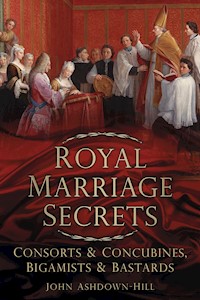
With a new royal baby we witness fundamental changes in the succession laws, but then rules governing the royal weddings and the succession to the throne have always been shifting. So what is marriage and who decides? What special rules govern royal marriage and when did they come into force? How have royal marriages affected history? Were the 'Princes in the Tower' illegitimate? Did Henry VIII really have six wives? Was Queen Victoria 'Mrs Brown'? How were royal consorts chosen in the past? Did some use witchcraft to win the Crown? History has handled debateable royal marriages in various ways, but had the same rules been applied consistently, the order of succession would have been completely different. Here, all controversial English and British royal marriages are reassessed together for the first time to explore how different cases can shed light on one another. Surveying the whole phenomenon of disputed royal marriage, the author offer some intriguing new evidence, while highlighting common features and points of contrast.
Sie lesen das E-Book in den Legimi-Apps auf:
Seitenzahl: 508
Veröffentlichungsjahr: 2013
Das E-Book (TTS) können Sie hören im Abo „Legimi Premium” in Legimi-Apps auf:
Ähnliche














In memory of my friend and colleague,
Dr Karen Tracy Yates-Sabren,
who read bits of it while I was working on it in Turkey,
and who had been looking forward to reading the whole thing.
Oh, ’tis a glorious thing, I ween,
To be a regular Royal Queen!
W.S. Gilbert, The Gondoliers
Such a lot of things are such rot.
History, for instance.
Why, it’s quite different out of different books!
Agatha Christie, The Moving Finger
CONTENTS
Title Page
Dedication
Acknowledgements
Author’s Note
Introduction
One: The Background
1 The Evolution of Marriage
2 Medieval Marriage Practice
3 Royal Marriages 1050–1330
4 Suitable Status
5 Irregular Royal Affairs
6 Summary of the Background Information
Two: Secret And Bigamous Medieval Royal Marriages
7 The Love-Matches of Edward III’s Children
8 Secret Weddings and Witchcraft in the House of Lancaster
9 Talbot’s Daughter and the Grey Mare
10 The Infanta and the Nyght Crowe
11 Review of Secret and Bigamous Medieval Royal Marriages
Three: Reformation, Registration, Cohabitation
12 The Virgin Queen
13 Old Rowley and Mrs Barlow
14 Dr and Mrs Thomson
15 Review of Alleged ‘Tudor’ and Stuart Secret Royal Marriages
Four: The Act Of Settlement, The Marriage Act And The Royal Marriages Act
16 Queen Hannah and Princess Olive
17 Princess Fitz
18 Mrs Brown
19 Murders in Whitechapel and Mysteries in Malta
20 Review of Secret Marriage Allegations in the Modern Monarchy
21 Conclusions: The Queens-That-Might-Have-Been
Appendix 1: Monarchs of England and their Consorts
Appendix 2: List of Royal Extramarital Affairs
Appendix 3: Original Documents
Appendix 4: The Mystery of Laura Culme-Seymour’s Death Certificate
Notes
Bibliography
Plate Section
Copyright
ACKNOWLEDGEMENTS
I should like to thank Annette Carson and Dave Perry for reading and commenting upon draft versions of parts of the text. I am also grateful to Dr Alison Rowland for her advice on medieval love magic, and to Robert Galea-Naudi for his kind assistance with my researches in Malta.
AUTHOR’S NOTE
There are three practical points to draw to the attention of my readers concerning the way in which names have been written. First, in the days before her marriage to the Prince of Wales, it always struck me as a little bizarre when the media referred to HRH the Duchess of Cornwall by the surname of her first husband, rather than calling her by her birth surname – Camilla Shand. The practice of previous historians has often been inconsistent on this point. Some royal consorts, such as Elizabeth Woodville and Catherine Parr, are generally known by their maiden surnames, despite the fact that they had previous husbands. Others, such as Mrs Fitzherbert and Mrs Simpson, are generally called by their married surnames. But in genealogy and family history the normal practice is to refer to women by their maiden names. Therefore throughout this book women’s maiden surnames are used consistently if these are known. Where their married surnames are more familiar, these are sometimes added in brackets in the text and they are cross-referenced in the index.
The second point is that in historical documents some first names occur in many variant spellings. ‘Catherine’, ‘Catharine’ and ‘Katheryn’ are good examples of this. Likewise ‘Eleanor’ in medieval documents is often ‘Alianore’. I have tried to spell first names in one consistent way throughout. One exception is Isabel(le)/Isabella. Where this name refers to ladies of French origin the French spelling, Isabelle is used; for Spanish ladies, the Spanish form, Isabel. Isabella is only used for English ladies who were baptised with that form of the name. Of course, my selections reflect my personal choice and my spellings may not be everyone’s favourites.
Finally, sometimes royal names and/or numbers are given in square brackets – as for example George [IV]. This is simply to show that at the date in question the monarch had not yet succeeded to the throne.
INTRODUCTION
Some historians argue that personal relationships are of little or no real importance in the course of history. I believe that they are wrong. Private emotions certainly affect people and when they are the emotions of people in power they can change the course of events. Moreover, royal sexual activity and royal marriage have always exerted a certain popular fascination, and they continue to do so to the present day. The ménage à trois between the present Prince of Wales, his first wife Diana, and his mistress (later his second wife) Camilla, at times generated huge amounts of publicity. The marriage history of the prince’s siblings – likewise that of his aunt, Princess Margaret – also engaged considerable media attention at key periods.
Modern media interest in royal marriages – particularly questionable royal marriages – is often perceived to date back to the 1930s, and the relationship of the then Prince of Wales (Edward VIII) with his American divorcee, Bessie Wallis Warfield (Mrs Simpson) – a drama which ended in marriage only after the king’s abdication. However, eighteenth- and nineteenth-century press reports about George [IV]’s relationship with the Catholic widow, ‘Princess Fitz’ (Maria Smythe, Mrs Fitzherbert), and about ‘Mrs Brown’ (referring to Queen Victoria’s reputed relationship with her highland ghillie, John Brown) show that there is a much longer history of public interest in such matters.
With only four or five (possible) exceptions1 all English monarchs since the Norman Conquest in 1066 have married at some stage in their careers. Even those whose sexual proclivities may have led them to prefer partners of their own sex did usually marry – constrained to outward conformity by dynastic necessity.2 Some kings married more than once. Many also had sexual partners outside their marriages. However, the number of English monarchs whose marriages have been a matter of dispute can be counted on two hands. Situations in which the identity of a sovereign’s marriage partner was unknown or uncertain were normally ruled out by a natural concern for the succession to the throne.
Nevertheless, secret marriages have been reported or alleged in the case of eight English monarchs and one would-be monarch: Edward IV (reigned 1460–83), Henry VIII (reigned 1509–47), Elizabeth I (reigned 1558–1603), Charles II (reigned 1660–85), ‘Charles III’ (never quite a monarch, but a famous royal figure, and the Stuart pretender to the throne 1766–88), George III (reigned 1760–1820), George IV (reigned 1820–30), Queen Victoria (reigned 1837–1901) and George V (reigned 1910–36). In addition to these nine cases, there have also been allegations of secret royal marriage relating to two heirs to the throne who died before they could succeed. One of these allegations is linked with a celebrated case of serial murder. It relates to George V’s elder brother, Albert Victor, Duke of Clarence. The other alleged secret marriage of an heir apparent relates to Edward III’s son, the ‘Black Prince’.
Although we shall focus chiefly on these eleven cases, alleged secret marriage within the royal family as a whole is a more widespread phenomenon. The secret marriages of princes and princesses will provide a background and context for our exploration.3 Moreover, one case in the wider royal family – the alleged secret second marriage of the queen mother, Catherine of France (widow of Henry V) – is significant so it will be explored in some detail, focusing on possible new evidence.
In some of these allegations, religious issues are important. In particular the stories of the secret marriages of George [IV] and of Albert Victor, Duke of Clarence, to Catholic partners confront us with the discriminatory nature of the 1701 Act of Settlement. The provisions of this act still apply at the moment of writing. Recently it had seemed that things were about to change. In the Queen’s Speech at the opening of Parliament in May 2012 it was announced that the prohibition which prevents British royalty from marrying Catholics would soon be lifted. However, it now seems that the coalition government of Britain has dropped its plans for repealing the Act of Settlement. But for this act, of course, and other legislation affecting the royal succession, one of our cases of disputed royal marriage – that of the Prince of Wales [George IV] with Maria Smythe (Mrs Fitzherbert) would undoubtedly have been legal. But this merely serves to reinforce the point that it is essential for us to be aware of precisely which marriage legislation was in force at the time when each of our disputed royal weddings is alleged to have taken place.
Six of the allegations against sovereigns involve the imputation of bigamy. This is most famously the case in respect of the future George IV. Another instance of bigamy can be detected (albeit heavily disguised by his own propaganda machine) involving Henry VIII. Further cases involving bigamy – largely overlooked by posterity – have been alleged in the cases of Edward IV, ‘Charles III’, George III and George V. These six instances of possible royal bigamy will all be examined and evaluated here.
We shall also consider the quite well-known secret royal marriage allegation involving Charles II. This was certainly not a case of bigamy, for Charles’ two unions (whatever the nature of the first of them) did not overlap chronologically. Nevertheless, there are features which link his case with some of the bigamy allegations.
The remaining two cases of reigning monarchs that we shall explore involved two of England’s queens regnant. These, like the case of Charles II, contain no element of bigamy as far as the monarch is concerned, though in the case of Elizabeth I the complicated story does involve the accusation of bigamy against at least one of the queen’s alleged partners. It also impinges upon the true identity of William Shakespeare!
Of course, whole books have been written about each of these royal personages, and the stories of their alleged marriages have been recounted elsewhere. However, they have never previously been examined together to explore how the different cases can shed light on one another. This present study seeks to take an overview of the phenomenon of disputed English royal marriage as a whole, offering some new evidence, highlighting common features and points of contrast, and suggesting possible explanations.
In the case of Edward IV and Eleanor Talbot, the present writer himself has previously published a detailed exploration of the relevant surviving evidence.4 It was interesting that subsequent discussion of this material and of its interpretation revealed that even some well-known historians apparently had little understanding of how marriage evolved over the past thousand years. Yet the changes in this key social institution have been enormous, and are ongoing. This serves to remind us that when we try to explore historical situations it is absolutely essential to try, as far as possible, to put ourselves back into the context of the period we are studying. Failure to do so is almost bound to lead to anachronisms and errors.
Before we can attempt to understand and interpret the evidence in our cases of disputed royal marriage, we must first try to understand the evolution of marriage practices in England.5 Therefore we shall begin by tracing the overall development of English marriage practice in general over roughly the past one thousand years. We shall also consider the particular evidence relating to the history of royal marriages during this period.
Moreover, since the cases that we shall examine in detail relate to disputed marriages, we should consider what might have been the nature of these nine royal relationships if they were NOT marriages. This means that we shall also review background information relating to England’s many illicit royal love affairs. And since it is important to define all our terms of reference as precisely as we can, as part of our background exploration we shall also consider the interesting question of what was, or is, a ‘mistress’.
Even without reference to wider material on the history of marriage, the disputed royal marriage cases themselves, when considered together, highlight the important point that the form and nature of marriage has not been something fixed and immutable in English history. For example it is easy to see that the marriage legislation which impinged upon George IV made his matrimonial playing field very different from the one upon which Henry VIII had manoeuvred 250 years earlier.
Over the centuries there have been many changes in how marriage is perceived, and how it is carried out. Fifty years ago the majority of English marriages took place in churches. Now this is no longer the case – nor was it the case five hundred years ago. The wording of marriage vows has recently become somewhat flexible – as it was also in the distant past. Nowadays one essential component of any marriage is the marriage certificate. But, in general, prior to the sixteenth century no written records of marriages were kept. Even the history of wedding rings shows that what is now, in popular perception, a key feature of the wedding ceremony has witnessed changes. In the seventeenth century Puritans even attempted to ban wedding rings.
Some of the changes in practice and attitude have been quite huge. Modern rules about marriage are very clear, but in the medieval and early modern period marriage was a kind of minefield. It was only too easy to thoughtlessly utter the wrong words which, when coupled with subsequent sexual intercourse, might leave one tied up in an unintended but almost indissoluble bond. At the same time there is no doubt that this situation could be – and at times was – exploited by infatuated, cynical and powerful men to overcome the moral scruples of reluctant girlfriends. In another way, however, the situation was equally open to manipulation by clever women for their own advantage.
Looking at alleged secret royal marriages over nearly 700 years – from the case of the Black Prince in the mid-fourteenth century to that of George [V] in the late nineteenth century – will help us to understand the evolution of English marriage legislation in general, exposing the differences underlying the individual cases. At the same time, however, common features will be revealed. Hopefully both points will help us to understand each of the individual cases rather better.
Looking at the royal marriage disputes together is interesting in several respects. First, we shall see that in six of the nine cases the disputed marriage of the monarch was set in the wider context of other secret and disputed marriages within the royal family as a whole at the period in question. For example, the late fourteenth and fifteenth centuries had witnessed several unusual Plantagenet and Lancastrian royal marriages prior to the key Yorkist marriage case of Edward IV. The marital manoeuvres of Henry VIII and Elizabeth I occurred in the broader context of several mésalliances in the Tudor dynasty as a whole. For contemporaries, the alleged marriage of Charles [II] and Lucy Walter was set against the background of an acknowledged – but initially secret – non-royal marriage on the part of the king’s younger brother, coupled with the alleged secret marriages of some of his cousins. And the stories of the marriages of George III and his beautiful Quaker, and of George [IV] and his Catholic widow – while each was exceptional in respect of the lady’s religion – were both, in other ways, very similar to the independent and unauthorised matrimonial conduct of the younger brothers of the respective bridegrooms. In several of our cases we must also take account of the fact that it was an outside party who brought the alleged secret wedding into the public domain. An examination of the motivation behind this revelation will therefore form part of our assessment. Another important point, which we shall encounter in several instances, concerns the avowed religious or moral scruples of at least one of the female partners involved.
The purpose of this book is not, of course, to change the present reigning family! However, history has been very inconsistent in its handling of secret or questionable royal marriages. Had they been dealt with more consistently the order of succession might well have been different. Some of the cases have received a great deal of publicity, while others remain almost unknown to the general public. In the case of Henry VIII, the king’s ‘second marriage’ (as popularly perceived) has passed more or less undisputed by historical writers – even though it was much disputed at the time. As a result, Anne Boleyn has usually been described by posterity as a Queen of England, despite the fact that Henry VIII himself officially deprived her of that title. In the case of George IV the existence of a secret marriage is generally accepted, though for legal reasons the status of the bride remains equivocal. In most of the other instances the idea of a secret marriage has been generally discounted by historians, sometimes on good evidence, but sometimes not. Thus, despite the fact that in 1484 Parliament officially enacted that Edward IV’s true wife had been Eleanor Talbot, unlike Anne Boleyn, Eleanor has not generally been accorded royal status.
In several of the disputed cases, the disbelief of historical writers seems to be founded mainly on the lack of any direct proof of a marriage, coupled with the existence of what has been perceived to be an ulterior motive on someone’s part in claiming that a secret marriage had existed. The logic of both of these arguments seems questionable, and in attempting to determine whether or not the disputed secret marriages really took place, we should ideally try to seek firmer ground. As we have already seen, prior to the sixteenth century there was rarely any formal written evidence of a marriage, so that for most, if not all, medieval marriages the available evidence is bound to be circumstantial. Moreover, lack of evidence that an event occurred can never be construed as proof that the event did not take place. If possible, clearer evidence against an alleged union should be sought before dismissing the allegation out of hand. Likewise, the fact that a third party may later have benefited from a secret marriage allegation does not, by itself, prove that allegation to be false.6
I hope that reviewing these nine cases of disputed royal marriage together, and setting them in the wider context of the contemporary marital activities of the royal family as a whole, will allow the individual cases to shed light on one another. Thus we shall perceive some parallels between Henry VIII’s relationships with Catherine of Aragon and Anne Boleyn, and Edward IV’s relationships with Eleanor Talbot and Elizabeth Woodville in the preceding century. Reviewing the official position ultimately taken up by the establishment may, in some cases, also serve to highlight key similarities and differences. For example, in 1911 the case of George V was taken straight to court – presumably because it was considered that there was sufficient evidence for the king to win. Therefore in 1483–84, when Richard III took the disputed marriage of his late brother, Edward IV, to Parliament, perhaps that was for similar reasons. On the other hand, Henry VII’s later suppression and destruction of Richard III’s evidence tends to confirm that the evidence in Richard’s case had been pretty convincing. My review of the case of George V, on the other hand, seems to reveal flaws in that king’s evidence.
Some previous writers have chosen to make very firm judgements about our cases of disputed royal marriage. This will not be done here. Many of the cases are not black and white, and there may be no simple answer. In one sense Henry VIII was certainly married to Anne Boleyn – but in another sense he was not! George [IV] clearly had a wedding with Maria Smythe (Mrs Fitzherbert) – but was it legal? On the whole my preference will be to tell the stories, present the evidence (some of it new), draw some parallels, and then leave the final verdict in each case to my readers.
One
The Background
1
THE EVOLUTIONOF MARRIAGE
That the good purpose of marriage is better promoted by one husband with one wife, than by a husband with several wives, is shown plainly enough by the very first union of a married pair, which was made by the Divine Being Himself.
St Augustine, On Marriage and Concupiscence, Book 1, Chapter 10
One key word which will require careful consideration in this study is marriage. This has been defined in many ways. The Oxford English Dictionary describes it as ‘the formal union of a man and a woman, typically as recognised by law, by which they become husband and wife’.1 An alternative, slightly fuller dictionary definition states that marriage is ‘the social institution under which a man and woman establish their decision to live as husband and wife by legal commitments, religious ceremonies, etc’.2
Each of these definitions makes important basic points. At the same time they both omit essential information.
Implicit in both definitions is the idea that marriage involves one partner of either sex. In other words what is being defined here is monogamous heterosexual marriage. Nowadays, of course, marriage is not universally heterosexual. However, in the past history of English royal marriages heterosexuality always constituted the normal and required pattern.
As for monogamy, as St Augustine’s quote at the head of this chapter shows, in the ancient past, that was not a universal norm, and even today monogamy is not required in some cultures. In Christian contexts, however, monogamy has always been accepted, so that when reviewing English royal marriages, monogamy is a basic rule to which we should always expect those marriages to conform. Thus if an English sovereign already had a spouse, (s)he could not acquire a second married partner without first disposing in some way of the earlier commitment. This point will prove significant in some of the cases which we shall examine.
From a historical perspective the most salient omission in the definitions of marriage quoted above is their failure to state that until five centuries ago the law involved in the recognition of marriage was not the law of the State, but the law of the Church. Prior to the sixteenth century the State generally had no say in matters of marriage, and played no role in the recording of marriages or in the adjudication of their validity.
The key point to remember is that marriage is not a static institution. In the course of history it has evolved a great deal. Until the middle of the sixteenth century Christian marriage throughout Europe was basically a matter of mutual consent between the two contracting parties – and also their families if titles or property were involved. The partners merely had to declare their intention to marry. This had to be followed by their physical union (sexual intercourse).
The couple would promise verbally to each other that they would be married to each other; the presence of a priest or witnesses was not required. This promise was known as the verbum. If freely given and made in the present tense (e.g., ‘I marry you’), it was unquestionably binding; if made in the future tense (‘I will marry you’), it would constitute a betrothal.3
It is important to note that the promise was oral. There was no requirement for anything to be written down. Also the Church might or might not be directly involved, but there was certainly no question of any State involvement. And if subsequently any query arose about the validity of the marriage this would be adjudicated in a Church court, not a civil court.
On one level marriage has always been first and foremost a sexual union. But not all sexual unions are marriages. Implicit in marriage are concepts of commitment and authorisation. In the context of such a commitment a female partner is safe to surrender her virginity and risk pregnancy, because she has the supposed guaranteed support of a male partner, coupled with the approval of society. Sexual unions which were not marriages were much more risky. Even if they outlasted the initial phase of sexual attraction and became enduring long-term relationships, they still lacked official authorisation. The children produced by such unions were traditionally viewed – and treated – by European society as different in quality and inferior in importance to children produced within marriages. It is true that in the twenty-first century the concept of ‘illegitimacy’ has largely faded into insignificance, but historically the discrimination between ‘official’ and ‘unofficial’ offspring was extremely important.
The modern phenomenon of marriage may also be different in other ways from its historical counterpart. In twenty-first century England 55 per cent of marriages are celebrated in non-religious venues. The overwhelming majority of bridegrooms will wear a wedding ring.4 Today, 93 per cent of the couples will have been living together prior to their marriage, and 88 per cent of the brides assume their husband’s surname after marriage, but 3 per cent keep their maiden names. Other couples combine their two surnames.5
One hundred years ago the picture was different in many respects. Most marriages were then celebrated inside churches, and English husbands were rarely given wedding rings as part of the marriage ceremony. The modern move away from a religious venue for a wedding was initially regarded as somewhat revolutionary. However, marriages had not always been held in religious venues. Prior to the sixteenth century a wedding inside a church was by no means the norm. If they were formal, public events, weddings were often held in the open air, outside churches. But many marriages were made in private, by a simple exchange of promises, with no public present. Such simple, private exchanges of vows could take place anywhere – in a house, in a barn, in the open air. It is therefore clear that the history of marriage in England has witnessed many changes over the past 1,000 years, and the form and significance of marriage has by no means been fixed.
Royal marriages may always have been always something rather special, set apart a little from the general run of weddings – and in recent years, perhaps, a little conservative in nature. Thus twentieth-century royal partners did not usually live together before marriage, royal bridegrooms tend not to be given wedding rings in their marriage ceremonies, and royal marriages generally continue to be celebrated in large and significant churches.6
However, even royal marriages have undergone change and evolution. Fiona Macdonald, author of Royal Weddings: A Very Peculiar History, has claimed that recent royal weddings show a break with past tradition in respect of the choice of brides:
Until the 19th Century and early in the 1900s, the pattern had been largely the same for the past 1,000 years. Royal weddings were usually arranged for political, dynastic and empire-building reasons, and the bride and groom were always of mutually royal rank. Marrying a commoner was exceptionally rare. The most famous example was Edward IV marrying Elizabeth Woodville in the 15th Century.7
Many people would probably intuitively agree with Macdonald’s statement that ‘the bride and groom were always of mutually royal rank’, but in fact this is completely untrue. Appendix 1 (below) shows very clearly that, of the forty-nine listed English sovereigns and direct heirs since the Norman Conquest, less than half married consorts who were of royal birth. Royally born spouses have been particularly rare since the Hanoverian accession. Nevertheless, it is true that the most recent generations have certainly witnessed changes in the origin and social status of royal marriage partners by comparison with the immediately preceding centuries.
In other respects, prior to the twentieth century royal weddings varied very considerably. For example, in the past they were by no means automatically public affairs. Sometimes they were celebrated in the privacy of a chapel royal. Queen Victoria and Prince Albert were married on 10 February 1840, in the Chapel Royal of St James’s Palace in London. More than three centuries earlier, on 11 June 1509, Henry VIII married Catherine of Aragon at an even more private ceremony at the Greenwich Greyfriars’ Church – although Catherine had previously married Henry’s elder brother, Arthur, much more publicly, at old St Paul’s Cathedral.8 Some royal weddings were celebrated outside England. The first marriage of Edward I and the marriage of Edward II are examples. A surviving illustration of the occasion implies that the wedding of Edward II may have been a public event, held in the open air, in front of (rather than inside) the shrine church of Our Lady of the Sea at Boulogne. The illustration, however, is not contemporary with the event (see below).
Sometimes royal bridegrooms did not even attend their own weddings. Some royal marriages were celebrated with only one of the two partners present. Thus Charles II married the Infanta of Portugal by proxy – and by Catholic rites, despite the fact that the Reformation had by this time taken place9 – at a partly public, partly private ceremony in Lisbon on 23 April 1662.10 Charles was ‘present’ on this occasion only in the guise of an oil painting. A month later, after the Infanta had reached England, repeat marriage ceremonies, both Catholic and Protestant, were conducted for them, at each of which both of the parties were physically present. The Protestant marriage ceremony was conducted by the Bishop of London. Nevertheless, that was a private, not a public event.
The legal situation in medieval and early modern Europe was similar to that which exists in some Moslem countries today – where religious (sharia) law either plays a significant role alongside civil law, or may even supersede it. In the same way in medieval and early modern Christian society Church law played an important role, and in some matters the religious law was entirely predominant. Thus, in the first part of the period we are considering, the laws relating to marriage were exclusively Church laws and had nothing to do with the State.
However, the medieval Church rules for marriage were in some ways imprecise. They included no provision for any written record, and generated no such document as a marriage certificate – an item which would be considered indispensable in any modern marriage. Curiously, perhaps, the Church marriage laws also required no specific ceremonial, no attendant priest,11 no witnesses and no specific and authorised venue. A formal wedding ceremonial of the Church did certainly exist, and was sometimes used, but it was by no means an essential requirement.12 Hence marriage promises could be, and were, exchanged anywhere. There was no compulsion for vows to be made in a church, or in any other legally established place. And since there was no formal requirement for a priest – or indeed anyone except the contracting couple – to attend, the verbal promises which comprised the first requirement for a wedding could be uttered with only the bride and groom present.
It has always been the Catholic Church’s teaching that marriage is a self-conferring sacrament, which is basically effected by the free consent of the parties, confirmed by consummation. In the Middle Ages (when marriage had not yet become a civil contract) it was the logic of this argument which led to the practical conclusion that no formal, public ceremony was essential. ‘Betrothal followed by intercourse was recognised by the Church as a binding marriage contract’.13 In fact, either a promise exchanged per verba de presenti14 alone (i.e. without subsequent sexual intercourse), or alternatively a promise per verba de futura15 followed by sexual intercourse, constituted a valid marriage.
Vows followed by intercourse had been formally and explicitly acknowledged as constituting valid marriages by decretals of Pope Alexander III.16 Consequently, as we have seen, the official position of the Church was that no special ceremony, no specific venue, no priest and no witness was essential for a valid marriage. One unfortunate result of this prevailing informality was that the promise of marriage could easily be employed by any unprincipled man as a seduction technique.17 As a result, it does seem to have been widely regarded as a wise and useful precaution to have a witness present at any exchange of vows – in case of subsequent disputes.
Actually, although private and informal marriages were recognised, they were not greatly favoured by the Church. The ecclesiastical magisterium had been struggling for some time to impose a more orderly situation, and the medieval Church did already strongly recommend public marriage ceremonies, preferably preceded by the reading of banns,18 precisely in order to avoid the kind of marriage disputes which were wont to arise from clandestine exchanges of promises. As early as 1215 the Fourth Lateran Council had sought to generalise throughout Europe the system of publication of banns before marriage.19 Nevertheless, for several centuries the Church’s attempts to impose a more ordered situation largely fell on deaf ears, and informal and private marriages continued to be practised, as the surviving records of litigation in the English Church courts clearly demonstrate.
In time, however, this situation was set to change.
The failure of the medieval church to impose … its own religious ceremony as the one binding ritual to legitimate a sexual union [makes] the medieval approach to marriage and sex very different from that of seventeenth century England. The introduction of registers of births, marriages and deaths in 1538 was evidence of a tightening of both lay and clerical controls over the private lives of the population.20
Thus, both within the Catholic Church and outside it, from the sixteenth century onwards more formal regulations surrounding marriage were imposed. But such regulations cannot be applied retrospectively when judging the validity of medieval marriages.
In general the marriage rules which applied to medieval English monarchs – including Edward IV (reigned 1460–83) – still applied in the case of the early Tudor monarchs such as Edward IV’s grandson, Henry VIII (reigned 1509–47). These were the rules of the pre-Tridentine Catholic Church. In fact it was Henry VIII’s own conduct which was to considerably alter the situation in England. When England ceased to be part of Catholic Christendom, changes, impelled in the first instance by Henry VIII’s own specific matrimonial needs, began to be introduced into English Church law. Moreover, the fact that the head of State was now also the head of the Church introduced a degree of confusion as to where Church law ended and civil law began. Henry VIII abrogated the teaching of canon law at the English universities and thereafter lawyers who practised in the ecclesiastical courts had to be trained in civil law. As a result, slowly but surely marriage legislation ceased to be a matter for the Church. Of course, Church rules remained in force for the faithful, but in general marriage became increasingly a matter for civil legislation.
However, the historical picture is complex. While Henry VIII introduced notable changes – including a legal requirement for the registration of marriages – he was not acting completely in isolation, or without precedent. The dichotomy between Church legislation and the law of the State had begun to manifest itself much earlier. We shall see shortly that William the Conqueror defied the papacy in the matter of his marriage – and ultimately got his own way. Later the future King John also entered into conflict with the Church over the question of his marriage – in his case unsuccessfully.
The remarriage of widowed English queens was subject to State laws as early as the twelfth century, and these laws were extended by specific and explicit parliamentary legislation in the fifteenth century. Marriages within the royal family generally were subject to the sovereign’s approval from a very early stage, and this particular feature of royal marriages would be progressively reinforced later in history (notably from the sixteenth to the eighteenth centuries).
The fifteenth century shows evidence of increasing State involvement in marriage disputes in several respects. Thus it seems to have been Parliament which took the lead in the moves to dissolve the marriage of Henry VI’s uncle, the Duke of Gloucester, to Eleanor Cobham (see below), although of course the actual annulment decision had to be taken by the Church. Likewise it was Parliament which adjudicated the disputed marriage of Edward IV at the end of the fifteenth century. Thus when Henry VIII used civil law in the matter of his own disputed marriages, and instituted a law requiring marriage registration, he was not being revolutionary. Rather he was following (and developing) existing precedents.
The result of this historical process is that the marriage laws affecting later rulers – for example the Stuart king, Charles II (reigned 1660–85) – were not the same as those that had impinged upon Edward IV and Henry VIII. And, as we shall see, by the lifetime of George IV (born 1762, reigned 1820–30) specific new complications had been introduced, in the form of the Royal Marriages Act and other legislation.
The evolution of marriage law has led to some significant changes, and if attempts were made to apply the modern rules retrospectively to historical cases this might produce bizarre results. For example, the canon law of the Anglican Church – which arose as an independent ecclesial body from the dispute over Henry VIII’s petition for nullity in respect of his marriage to his late brother’s widow, Catherine of Aragon – now permits marriage to a deceased brother’s wife without requiring any dispensation.21 Thus under modern Anglican canon law Henry’s marriage to Catherine would unquestionably be regarded as valid. On the other hand, despite the fact that Catherine of Aragon, in the sixteenth century, considered the question of whether her first marriage had or had not been consummated as a key issue, modern Catholic canon law now specifically decrees that ‘affinity arises from a valid marriage, even if not consummated’.22
In modern Catholic law it is also now the case that if a marriage is declared null and void, any children born of the annulled marriage are regarded as legitimate.23 Had this rule also applied automatically in the fifteenth and sixteenth centuries then Parliament might have thought twice about offering the throne to Richard III, and Henry VIII could not have declared his daughters Mary and Elizabeth to be bastards. However, the key point to remember is that at those periods the rules were different. From this we can see how important it is for historians to understand precisely which marriage laws were in force during the period about which they are writing.
2
MEDIEVALMARRIAGE PRACTICE
GROOM: I … take thee … for fairer or fouler …
BRIDE: I … take thee … to be bonny and buxom at bed and at board …
Extracts from late medieval marriage vows
Throughout the medieval period, then, marriage in England (and indeed in the whole of Western Europe) was a sacrament of the Catholic Church. This sacrament was self-conferring – that is to say all that was required was the free consent of a man and a woman to live together as husband and wife, mutually expressed firstly in the form of a vow or promise and secondly in the form of sexual intercourse. A formal wedding service did exist, which could be conducted by a priest, with witnesses and other guests present. Possibly there would be musical accompaniment to the ceremony, together with the offering of gifts to the marrying couple. However, this ceremony was not obligatory – though the Church certainly preferred it and increasingly encouraged its use.
Of course, the man and woman had to be free to marry. Most importantly this meant that they could not already be married to someone else, although there were also other rules governing the degree of kinship which was permitted (see below). They had to be old enough to be able to express their free consent in words. No actual age of consent for marriage was specified, and in practice children as young as four took the vows on occasions. However, they were not permitted to proceed to the second stage – sexual intercourse – until they reached the age of puberty. ‘Sixteen was the normal age for the consummation of a marriage in which one (or both) of the contracting parties had been a minor’.1
The requirement of being ‘free to marry’ also comprised rules governing the degree of blood (or other) relationship which might exist between the couple, and these rules were very precisely laid down by the ecclesiastical authorities. A couple was not free to marry if the two parties were related within the so-called ‘prohibited degrees’. At the fourth Lateran Council, in 1215, Pope Innocent III limited this prohibition to the fourth degree of kinship. Broadly speaking, this refers to third cousins – individuals who share at least one great-great-grandparent – and closer relatives. Previously – dating back to the time of the Norman Conquest of England – the prohibition had been stricter, extending to the seventh degree of kinship: this earlier and wider prohibition having been formally established by Pope Alexander II (1061–73).2
In practice, of course, the royalty and nobility of medieval Europe – and also the medieval peasants living in a small village – were probably quite often related within the prohibited degrees. Therefore this rule of prohibition was not absolute. The Church could grant a dispensation, allowing a marriage within the prohibited degrees, and this practice was not uncommon. At times, however, the granting of such a dispensation could give rise to problems, as we shall see later. It was also the case that sometimes the bride and groom were either genuinely unaware that they were related within the prohibited degrees, or they chose to pretend not to know. Occasionally it subsequently suited one of the two parties to ‘discover’ a relationship of which they had previously pretended to be unaware, in order to end a marriage which was no longer viable (see below: annulment).
Although there was no formal requirement for marriage vows to be witnessed, in practice a witness was certainly a good idea, because there were many cases of disputed marriage, as the records of the medieval English Church courts testify. If the formal Church wedding service was used, the ceremony would probably be celebrated at the west door of a church, in the open air, with guests present as witnesses. It was probably in the late fifteenth century that marriages began to move inside churches. Ms Royal 14E. IV, f. 284 depicts the wedding of Richard II’s cousin, Philippa (i) of Lancaster (the daughter of Richard’s uncle, John of Gaunt), to King John I of Portugal. The wedding took place in 1387, but the illustration was painted about 100 years later, probably in the Low Countries. It shows the wedding taking place inside a church, before the high altar, so by about 1490 this must have been a normal venue for a wedding. However, Ms Royal 20E. VI, f. 9v depicts the 1420 wedding of Henry V and Catherine of France as taking place in a church porch. This picture was painted in 1487. Ms Royal 15E. IV, f. 295v shows the 1308 wedding of Edward II and Isabella of France taking place outside a church. This picture was painted in about 1475.
The earlier tradition of marriage in the open air may have had an impact on the question of whether or not a bridal veil was worn, and this point is considered in more detail below. Probably every couple would wear nice clothes if possible, but of course in the case of the medieval bridegroom this would have been neither a suit nor a military uniform. Likewise the modern white wedding dress was virtually unknown in the Middle Ages, and a dress of any colour might be worn by the bride.
The first recorded instance of a member of the English royal family wearing a white wedding dress was at the wedding of Philippa (ii) of Lancaster, daughter of Henry IV, at Lund, in 1406. Philippa married Eric, King of Denmark, Sweden and Norway, and for the occasion she wore white silk trimmed with squirrel fur and ermine. Curiously, the late fifteenth-century depiction of the wedding of her aunt, Philippa (i) (see above), while not contemporary with the event, also depicts that bride wearing a white dress trimmed with brown fur over a yellow under-dress trimmed with ermine. Possibly the painting was influenced by descriptions of the wedding dress of Philippa (ii). About sixty years after this picture was painted, in 1559, Mary Queen of Scots wore white for her marriage to the Dauphin of France, because it was her favourite colour. Her choice was remembered because white was the traditional mourning garb for French queens, and Mary’s husband proved short-lived, giving rise to the notion that maybe his bride had made an unlucky choice of colour.
Only in the eighteenth century did white begin to become normal for a wedding dress. In the royal family, Princess Charlotte, daughter and heiress of George IV, wore a white wedding dress in 1816, for her marriage to Leopold of Saxe-Coburg-Gotha (later King Leopold I of Belgium). Queen Victoria wore a white wedding dress in 1840, and during the nineteenth century this custom gradually became more or less universal. Queen Victoria also introduced the custom of having her bridesmaids carry her train.
An old wedding rhyme still survives in England, which recommends for a woman at her wedding:
Something old, something new,
Something borrowed, something blue,
And a silver sixpence in her shoe.
It is not known for certain when this rhyme was composed, and some sources suggest that it is Victorian. However, the traditions which it represents are probably much older. A silver coin worth six pennies was first minted in 1551, so the rhyme as it stands today cannot date back as far as the Middle Ages. But the last silver sixpences were minted in Britain in 1946, so the rhyme must be earlier than that.3 The tradition of the coin in the bride’s shoe may have its origin in an old Scottish custom, whereby the bridegroom put a silver coin in his left shoe for good luck. If so then the verse as it now stands may well date from the nineteenth century, when things Scottish were cultivated and popularised by the royal family.
However, the reference to ‘something blue’ for the bride is almost certainly ancient in origin. Western Christian tradition sees blue as the colour worn by the Virgin Mary and this may explain the preference for a blue garment of some kind to be worn at a wedding. This custom was perpetuated for centuries in England, as a second traditional wedding rhyme clearly shows.
Marry in blue.
Lover be true!
Possibly, blue clothing, through its association with the Blessed Virgin, was thought to symbolise the bride’s virginity in medieval Christian society – just as the white wedding dress came to do later.
Even so, a blue dress was by no means compulsory for weddings in the Middle Ages. In the surviving coloured illustrations of English medieval royal and private weddings we can see an assortment of colours worn by the brides. Edward III’s daughter is shown wearing a pink dress. Eleanor of Provence is portrayed in a green mantle. One surviving version of the wedding of Henry V and Catherine of France shows both bride and groom in gold robes – though this picture was painted many years after the event (see above).
However, blue clothing is shown at the wedding of Edward II. The king and his bride, Isabelle of France, were both depicted wearing very splendid robes of cloth of gold, trimmed with ermine, while the artist gave Edward a fashionable fifteenth-century pair of pointed red shoes. Isabelle’s robe is of blue cloth of gold, and she is also holding up her robe to reveal a beautiful under-dress of royal blue and gold.4
Another point to consider is the question of the bridal veil. A bride who was to become a queen, and who arrived at her wedding a virgin, would not wear a bridal veil, though she did wear an open crown.5 Princesses might also wear crowns to their weddings, as Edward IV’s sister, Margaret of York, did in 1468.6 But there is some evidence that a royal princess who was not marrying a king might have her hair covered.7 In medieval Christian society, as in modern Moslem society, it was considered a sign of modesty for a woman to cover her hair in public. However, young girls and queens were both exempt from this veiling of the head, so that it may have been considered appropriate – and a further sign of the bride’s virginity – for her head to be uncovered at her wedding. Nevertheless, it was traditional for women to cover their heads inside churches. Thus, in the medieval period, when weddings (if the public ceremony was being used) normally took place outside the church door, a prospective queen would have had no need of a bridal veil. Later, however, when weddings moved inside churches, a head covering for the royal bride would have become essential.
During a formal wedding ceremony, vows were exchanged by the bride and groom. Then the groom would place a ring on the bride’s hand – probably in most cases on the ring finger of the right hand. The placing of the ring could be carried out in a little ceremony in which the groom said ‘In the name of the Father’ (touching the ring to the tip of the bride’s thumb), ‘and of the Son’ (touching the ring to the tip of the bride’s index finger), ‘and of the Holy Spirit’ (touching the ring to the tip of the bride’s middle finger), ‘Amen’ (pushing the ring onto the bride’s ring finger). The ring may have been made of metal – possibly a precious metal – but there were no rules about this. There is no evidence that a ring was given by the bride to the groom in England in the medieval period. No formal documents (such as marriage certificates) existed, or were signed, as part of the medieval church wedding. After the exchange of vows and the giving of the ring the couple would repair to their marital home or some other lay venue, accompanied by the guests, for a wedding celebration which culminated in the formal (and public) bedding of bride and groom.
Of course in cases where the formal religious ceremony was not employed, the situation was even more free and easy. A man and woman who were attracted to one another might simply make up their minds to promise to be husband and wife when they were alone together, maybe in a barn, where they could follow up the verbal promise immediately by making love to one another in the hay. Such an informal marriage might have no witness present at the exchange of vows. We know this because the lack of witnesses sometimes caused trouble later, if the marriage became a matter of dispute. Just like the formal church ceremony, an informal marriage had no accompanying paperwork to document it. The informal bride may not have been given a ring, or if she did receive one it might be merely a piece of hay or straw woven into a ring for the occasion: an ephemeral ring which would fall to pieces and be lost after a short time. Even metal wedding rings do not seem to have been worn permanently. Portraits of English queens consort rarely depict anything which can be clearly recognised as a wedding ring on either of the royal hands.
The Catholic Church has never countenanced divorce, so in the Middle Ages marriages which did not work, or which proved in some way inconvenient, could not be terminated in that way. The only means by which a marriage could be ended was either for one of the parties to die, or for the Church courts to rule that for some reason the marriage had never really taken place. The latter process is known as annulment. An annulment could be granted if one or both parties claimed that the marriage had never been consummated (i.e. sexual intercourse had never taken place). Alternatively the Church courts could set aside a medieval marriage on the grounds that the couple had not been free to marry. This might be because it was discovered that the man and woman were related within the prohibited degrees and had not obtained a dispensation for their marriage; because one of the two parties had previously married a person who was still living at the time when the second marriage was contracted, or because there had been constraints of some kind, forcing one of the parties to agree to the marriage. The Church’s laws on these points relating to the validity or otherwise of a marriage will prove to be extremely important in our investigation of the disputed royal marriages of Edward IV and his grandson, Henry VIII.
But before reviewing the evidence about any specific case of disputed English royal marriage, it will be helpful to examine other areas of background information. First, it is essential to understand something of the history of royal marriages in general, and to see what this can teach us. Second, we need to know what were the general expectations relating to the status of the marriage partner, both in terms of birth and social status, and also in terms of marital background. For example, were royal brides always expected to be princesses? Was it essential that they be virgins? We must also review the history of irregular royal sexual partnerships – involving mistresses, lovers and royal bastards – because of course, if any one of the cases of disputed royal marriage we shall explore here is judged not to have been a genuine marriage, it might belong instead in this category of irregular partnerships.
We shall now begin to assemble these key elements of background information by briefly reviewing the history of the marriages of English monarchs from the Norman Conquest up to the fourteenth century. This will help us to form an initial overview of English royal marriage practice. It will also allow us to observe whether marriage practice was consistent over these four centuries, and if not, in what ways the practice might have varied. In subsequent chapters we shall go on to review expectations concerning royal marriage partners, and the history of illicit royal love affairs.
3
ROYAL MARRIAGES1050–1330
Dammit sir, it’s your duty to get married. You can’t be always living for pleasure.
Oscar Wilde
Question marks over English royal marriages since the Norman Conquest are by no means rare. We might easily assume that royal weddings were always grand public occasions, and that the formal church ceremony was always used, but in fact this was not so. For example, in the case of the parents of William I, ‘the Conqueror’, no marriage ever took place. William the Conqueror is also known by the less complimentary name of ‘William the Bastard’, because his father, Robert, Duke of Normandy, had no legitimate children – only a son (and possibly also a daughter) by his mistress, Herleva, daughter of Fulbert of Falaise, a tanner.
Actually Robert was a usurper. He had seized the duchy of Normandy on the death of his elder brother – a death in which rumour suggests that Robert himself may have taken a hand. Robert’s seizure of the power and the title was at the expense of his young nephew, the legitimate heir to the dukedom, whom Robert forced to enter a monastery. But having seized Normandy, Robert proved incapable of providing a new legitimate heir to the ducal title. Thus even before it came to England the house of Normandy was familiar with the problem of a disputed and questionable inheritance.
Robert’s son, William the Conqueror, married his wife, Matilda of Flanders, before he became King of England, but the precise date of their marriage is a matter of interpretation. Negotiations for their union took place in 1049, but in October of that year, at the Council of Rheims, Pope Leo IX forbade the marriage contract. The wedding went ahead, nevertheless, in defiance of papal authority, in the early 1050s – probably in 1053. However, it was not until 1059 that papal approval for the marriage was finally granted. Thus the first five children of William and Matilda – including the future King William II – were all born in a kind of matrimonial limbo.
Their third son, the future King Henry I, was more fortunate than his elder brothers, Robert, Duke of Normandy and King William II. Henry’s birth date of 1068 means that his parents were undoubtedly married by the time he was conceived. Following the childless death of his brother, William II, Henry seized control of the English royal treasury and assumed the Crown. At that time he was still unmarried, and one of his first priorities once he became king was to find a suitable consort. He chose Matilda (also known as Edith) of Scotland – a descendant of the pre-Norman English royal house of Wessex. By this means he strengthened his claim to the English throne. But this marriage also ran into some initial problems, for it was claimed that Matilda (Edith) was a nun, and thus unable to marry. The case was carefully investigated by the ecclesiastical authorities, but they finally concluded (as she herself had already stated categorically) that Matilda (Edith) had never taken vows as a nun, and that therefore the couple was free to marry. The marriage was celebrated at Westminster Abbey on 11 November 1100, by Archbishop Anselm of Canterbury, the wedding being followed by Matilda’s coronation as queen consort. The wedding probably took place outside the west door, after which the couple would have processed into the church for the new queen’s coronation.
The questions raised about the marriages of William I and Henry I are instructive. Both cases clearly show that the authority to judge the validity of the marriage rested entirely in the hands of the Church. And at this period ‘the Church’ in western Europe meant the Catholic Church, for there was then no other Church in existence in Europe apart from the Orthodox Church in the east.1
As we have seen, for the Catholic Church marriage was (and is) a sacrament. It is a union which reflects the oneness between God and his Church. At this early period marriage was not a civil contract, and the secular authorities had no jurisdiction whatever in matters of matrimonial dispute. The only legal element associated with matrimony was not the marriage contract itself but, in the case of families which owned property, peripheral issues relating to such matters as the bride’s dowry and jointure.2
Since no mass media existed at this early period, the only ‘public opinion’ which could express itself about a royal marriage comprised the very limited views of the court or the immediate entourage of the royal couple. Thus the context of a royal marriage was very different a thousand years ago than it is today. Although in the modern age the Church (nowadays, in England, the Anglican Church) may still play some role in deciding contentious issues affecting royal marriage – as it did, for example, in the case of the marriage of HRH the Prince of Wales to Camilla Shand – the Church is no longer the sole authority. Both the law of the State and public opinion have become its powerful rivals.




