


19,99 €
Mehr erfahren.
- Herausgeber: John Wiley & Sons
- Kategorie: Geisteswissenschaft
- Sprache: Englisch
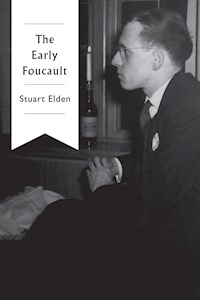
It was not until 1961 that Foucault published his first major book, History of Madness. He had already been working as an academic for a decade, teaching in Lille and Paris, writing, organizing cultural programmes and lecturing in Uppsala, Warsaw and Hamburg. Although he published little in this period, Foucault wrote much more, some of which has been preserved and only recently become available to researchers. Drawing on archives in France, Germany, Switzerland, Sweden and the USA, this is the most detailed study yet of Foucault's early career. It recounts his debt to teachers including Louis Althusser, Jean Hyppolite, Maurice Merleau-Ponty and Jean Wahl; his diploma thesis on Hegel; and his early teaching career. It explores his initial encounters with Georges Canguilhem, Jacques Lacan, and Georges Dumézil, and analyses his sustained reading of Friedrich Nietzsche, Edmund Husserl and Martin Heidegger. Also included are detailed discussions of his translations of Ludwig Binswanger, Victor von Weizsäcker, and Immanuel Kant; his clinical work with Georges and Jacqueline Verdeaux; and his cultural work outside of France. Investigating how Foucault came to write History of Madness, Stuart Elden shows this great thinker's deep engagement with phenomenology, anthropology and psychology. An outstanding, meticulous work of intellectual history, The Early Foucault sheds new light on the formation of a major twentieth-century figure.
Sie lesen das E-Book in den Legimi-Apps auf:
Seitenzahl: 636
Veröffentlichungsjahr: 2021
Ähnliche

















CONTENTS
Cover
Endorsement
Title Page
Copyright
Acknowledgements
Abbreviations and Archival References
Texts by Foucault and others
Archival material
Note
Introduction
Reading and Writing
Structure of this Study
Notes
1 Studying Philosophy and Psychology in Paris
Philosophy and its History
Jean Hyppolite and the Diploma Thesis on Hegel
Psychology
Louis Althusser, Georges Canguilhem and the Agrégation
Notes
2 Teaching at Lille and the École Normale Supérieure
‘Connaissance de l’homme et réflexion transcendantale’
The Binswanger Manuscript
‘Phénoménologie et psychologie’
Other Materials
Hospitals and Prisons
Publications
Notes
3 Psychology and Mental Illness
‘La Psychologie de 1850 à 1950’
‘La Recherche scientifique et la psychologie’
Maladie mentale et personnalité
Notes
4 Translating Binswanger and von Weizsäcker
Introducing Binswanger
Dating and Legacy
Translating von Weizsäcker
Political Controversy
Notes
5 Nietzsche and Heidegger
Encountering Nietzsche in the 1950s
Through Heidegger
Jean Barraqué
Notes
6 Madness – Uppsala to Warsaw
The Maison de France and the Carolina Rediviva
La Table Ronde and Sten Lindroth
Warsaw
History of Madness
Notes
7 Hamburg, Kant
Situating Kant
Translating Kant
Introducing Kant: Anthropology and the Question of Man
Notes
8 Defence, Publication, Reception, Revision
Reception
Rewriting the Past
Maladie mentale et psychologie
The 1964 Abridgement of Folie et déraison
Notes
Coda: Towards Archaeology
Notes
Index
End User License Agreement
Guide
Cover
Table of Contents
Endorsement
Title Page
Copyright
Acknowledgements
Abbreviations and Archival References
Introduction
Begin Reading
Index
End User License Agreement
Pages
ii
iii
iv
vii
viii
ix
x
xi
xii
xiii
xiv
1
2
3
4
5
6
7
8
9
10
11
12
13
14
15
16
17
18
19
20
21
22
23
24
25
26
27
28
29
30
31
32
33
34
35
36
37
38
39
40
41
42
43
44
45
46
47
48
49
50
51
52
53
54
55
56
57
58
59
60
61
62
63
64
65
66
67
68
69
70
71
72
73
74
75
76
77
78
79
80
81
82
83
84
85
86
87
88
89
90
91
92
93
94
95
96
97
98
99
100
101
102
103
104
105
106
107
108
109
110
111
112
113
114
115
116
117
118
119
120
121
122
123
124
125
126
127
128
129
130
131
132
133
134
135
136
137
138
139
140
141
142
143
144
145
146
147
148
149
150
151
152
153
154
155
156
157
158
159
160
161
162
163
164
165
166
167
168
169
170
171
172
173
174
175
176
177
178
179
180
181
182
183
184
185
186
187
188
189
190
191
192
265
266
267
268
269
270
271
272
273
274
275
276
277
278
279
280
281
This book is the third of four major intellectual histories of Michel Foucault, exploring newly released archival material and covering the French thinker’s entire academic career.
Foucault’s Last Decade was published by Polity in 2016.Foucault: The Birth of Power was published in 2017.The Archaeology of Foucault will publish in the early 2020s.
The Early Foucault
Stuart Elden
polity
Copyright © Stuart Elden 2021
The right of Stuart Elden to be identified as Author of this Work has been asserted in accordance with the UK Copyright, Designs and Patents Act 1988.
First published in 2021 by Polity Press
Polity Press65 Bridge StreetCambridge CB2 1UR, UK
Polity Press101 Station LandingSuite 300Medford, MA 02155, USA
Cover illustration: Elsa Norström, Journal de la section des jeunes de l’alliance française d’Upsal 1953–, Uppsala University Special Collections, Carolina Rediviva Library
All rights reserved. Except for the quotation of short passages for the purpose of criticism and review, no part of this publication may be reproduced, stored in a retrieval system or transmitted, in any form or by any means, electronic, mechanical, photocopying, recording or otherwise, without the prior permission of the publisher.
ISBN-13: 978-1-5095-2599-7
A catalogue record for this book is available from the British Library.
Names: Elden, Stuart, 1971- author.Title: The early Foucault / Stuart Elden.Description: Cambridge ; Medford, MA : Polity, 2021. | Includes bibliographical references and index. | Summary: “The first intellectual history of Foucault’s early career”-- Provided by publisher.Identifiers: LCCN 2020047809 (print) | LCCN 2020047810 (ebook) | ISBN 9781509525959 (hardback) | ISBN 9781509525966 (paperback) | ISBN 9781509525973 (pdf) | ISBN 9781509525997 (epub)Subjects: LCSH: Foucault, Michel, 1926-1984.Classification: LCC B2430.F724 E423 2021 (print) | LCC B2430.F724 (ebook) | DDC 194--dc23LC record available at https://lccn.loc.gov/2020047809LC ebook record available at https://lccn.loc.gov/2020047810
The publisher has used its best endeavours to ensure that the URLs for external websites referred to in this book are correct and active at the time of going to press. However, the publisher has no responsibility for the websites and can make no guarantee that a site will remain live or that the content is or will remain appropriate.
Every effort has been made to trace all copyright holders, but if any have been overlooked the publisher will be pleased to include any necessary credits in any subsequent reprint or edition.
For further information on Polity, visit our website: politybooks.com
Acknowledgements
As a part of a series of books on Foucault, a project which has been intermittent since 2000 and intense since 2013, there is a continuing and overlapping debt to those thanked before.
I particularly thank Mark Kelly for sparking the initial idea; Margaret Atack for sharing David Macey’s correspondence and interview transcripts from his research for The Lives of Michel Foucault; Aner Barzilay for conversations on the early Foucault and sharing transcriptions of student notes; Didier Eribon for allowing me to see Foucault’s letters to Georges Dumézil; Stefanos Geroulanos for sharing other material by Dumézil; Laurent Feneyrou for access to the Foucault–Jean Barraqué correspondence; Paul Griffiths for his notes on that correspondence; and Daniele Lorenzini for conversations about Foucault and the posthumous publication programme. I remain grateful to Daniel Defert and Henri-Paul Fruchaud. At a late stage, Daniele and Alison Downham Moore generously read the entire manuscript and made some useful suggestions.
For the first time I have employed research assistants to help with some foreign language material. Oscar Jängnemyr provided summaries or translations of Swedish texts about Foucault’s time in Uppsala; Julia Jasińska summarized a Polish book; Federico Testa summarized Alessandro de Lima Francisco and Marcio Luiz Miotto’s unpublished Portuguese theses, which they kindly sent to me; and Melissa Pawelski located some archival documents, shared notes, and translated a key text about Foucault’s time in Hamburg.
I gratefully acknowledge the British Academy/Leverhulme small grant SRG1819\191434, supported by the Department for Business, Energy and Industrial Strategy, and the Department of Politics and International Studies and the Humanities Research Centre at the University of Warwick for funding archival visits.
For access to archival material I thank the Archives littéraires suisses, Berne; Archives Nationales, Pierrefitte-sur-Seine; Bibliothèque interuniversitaire Sorbonne; Bibliothèque Lettres Ulm, École Normale Supérieure; Bibliothèque-Musée de l’Opéra; Bibliothèque nationale de France-Richelieu, archives et manuscrits, especially Laurence le Bras; Bibliothèque nationale de France-Richelieu-Louvois, département de musique; Nathalie Queyroux and David Denéchaud at the Centre d’Archives en Philosophie, History et Édition des Sciences (CAPHÉS), École Normale Supérieure; Carolina Rediviva Library, special collections room, Uppsala University; Collège de France; Institut Mémoires de l’édition contemporaine (IMEC), Caen; Staats- und Unibibliothek Hamburg; Staatsarchiv Hamburg; Staatsarchiv Thurgau, Frauenfeld; Universitätsarchiv Tübingen; and Beinecke Rare Book and Manuscript Library, Yale University. Peter Harrington Books in Chelsea allowed me to consult a rare copy of the pre-thesis version of Folie et déraison.
I have used several other libraries to find material for this study: Bibliothèque nationale de France–François Mitterand; Bibliothèque Sainte-Geneviève; Bodleian Library, University of Oxford; British Library Rare Books room and Newsroom; Senate House Library; the Tate Library; the Warburg Institute; Wellcome Library; and the libraries of the University of Amsterdam, Columbia University, London School of Economics, University College London and University of Warwick. Warwick staff were very helpful in getting hard-to-find material through the document supply service.
Several other people encouraged, sourced texts or answered questions, and I am grateful to them all: Valentina Antoniol, Christian Abrahamsson, Edward Baring, Elisabetta Basso, Luiza Bialasiewicz, Ryan Bishop, Giuseppe Blanco, Natalie Bouchard, Kurt Borg, Neil Brenner, Chris Brooke, Sebastian Budgen, Graham Burchell, Douglas Burnham, Oliver Davis, Alfred Denker, Elgin Diaz, Klaus Dodds, ‘Ambulo Ergosum’, Mike Featherstone, Colin Gordon, G. M. Goshgarian, Kélina Gotman, Victor Gourevitch, Anna Gumucio Ramberg, Peter Gratton, Inanna Hamati-Ataya, Bernard Harcourt, Marcelo Hoffman, Richard Howard, Luke Ilott, Orazio Irrera, Scott Johnson, Gerry Kearns, Philipp Kender, Anna Krakus, Léopold Lambert, Scott Lash, Stephen Legg, Kai Frederik Lorentzen, Jeff Malpas, Eduardo Mendieta, José Luis Moreno Pestaña, Adam David Morton, Rainer Nicolaysen, Hidefumi Nishiyama, Clare O’Farrell, Gunnar Olsson, Mate Paksy, William Parkhurst, Paul Patton, ‘Petra’, Lucas Pohl, Sverre Raffnsøe, John Duke Raimo, Simon Reid-Henry, John Russell, Parastou Saberi, Philippe Sabot, Christopher Smith, Bal Sokhi-Bulley, Robert A. Tally, Cristina Vatulescu, Nick Vaughan-Williams, Pierre Vesperini, Jean-Baptiste Vuillerod, David Webb, Richard Wilson, and Andreja Zevnik.
I also thank the readers of my Progressive Geographies blog who followed this project through its development. Some resources produced during this work are available at www.progressivegeographies.com/resources/foucault-resources.
Work in this book was presented to audiences at ACCESS Europe, University of Amsterdam; Complutense University of Madrid; Institute of Historical Research, University of London; University of Sussex; Theory, Culture and Society; and University of Warwick. Planned talks at the University of Bologna, New York University and University of Oxford were unfortunately cancelled due to the COVID-19 pandemic. Late stages of the research were conducted around travel restrictions and partial lockdown, and the manuscript completed in challenging academic circumstances. For support in this, and much else, I thank Susan.
At Polity Press I am grateful to Pascal Porcheron, Ellen Macdonald-Kramer, and John Thompson, and the readers of the original proposal for their enthusiasm for my work. In particular I thank Pascal and two anonymous readers for their comments on the manuscript. Susan Beer copy-edited the text and Lisa Scholey compiled the index.
An earlier version of parts of Chapter 4 appeared as ‘Foucault as Translator of Binswanger and von Weizsäcker’ in Theory, Culture and Society. The material is reused with Sage’s permission.
Abbreviations and Archival References
Key texts are referred to by abbreviations. For books translated as a single book the French page number is given first, followed by the English after a slash. With GK and D&E the German is first, followed by the French, and, for D&E, also the English.
English titles are used for work available in translation; French for untranslated works or unpublished manuscripts, though a translation of the title is provided the first time mentioned. I have frequently modified existing translations.
With the different editions of the History of Madness, I have usually made reference to the 1972 French edition and the 2005 translation (HM), unless there is a textual issue at stake.
Texts by Foucault and others
APPV
Immanuel Kant,
Anthropologie in pragmatischer Hinsicht
, Hamburg: Felix Meiner, 2000;
Anthropologie du point de vue pragmatique
and
Introduction à l’Anthropologie
, trans. Michel Foucault, Paris: Vrin, 2009;
Anthropology from a Pragmatic Point of View
, trans. Robert B. Louden, Cambridge: Cambridge University Press, 2006. References are to Akademie Ausgabe pagination, found in the margins of all editions.
C
Daniel Defert, ‘Chronologie’, DE I, 13–64; trans. Timothy O’Leary in Christopher Falzon, Timothy O’Leary and Jana Sawicki (eds)
A Companion to Foucault
, Oxford: Blackwell, 2013, 11–83. Defert’s shorter revised chronology appears in
Œuvres
.
CH
Philippe Artières, Jean-François Bert, Frédéric Gros and Judith Revel (eds),
Michel Foucault: Cahier L’Herne
, Paris: L’Herne, 2011.
DE
Dits et écrits 1954–1988
, eds Daniel Defert and François Ewald, Paris: Gallimard, 4 vols, 1994 – with text number to allow reference to the two editions of this text and bibliographies of English translations.
1
Thus ‘DE#1 I, 65–119’ means text 1, in vol. I, 65–119.
D&E
Ludwig Binswanger,
Traum und Existenz
, Bern-Berlin: Gachnang and Springer, 1992;
Le Rêve et l’existence
, trans. Jacqueline Verdeaux, Introduction and Notes by Michel Foucault, Paris: Desclée de Brouwer, 1954; trans. Jacob Needleman in
Dream and Existence
, ed. Keith Hoeller, Atlantic Highlands, NJ: Humanities Press, 1993, 81–105.
DIE
‘Dream, Imagination and Existence’, trans. Forrest Williams, in
Dream and Existence
, ed. Keith Hoeller, Atlantic Highlands, NJ: Humanities Press, 1993, 29–78.
DL
Raymond Roussel
, Paris: Gallimard, 1963;
Death and the Labyrinth: The World of Raymond Roussel
, trans. Charles Ruas, London: Continuum, 2004 [1986].
E
Roger-Pol Droit,
Michel Foucault, Entretiens
, Odile Jacob, Paris, 2004.
EW
Essential Works
, eds Paul Rabinow and James Faubion, trans. Robert Hurley and others, London: Penguin, 3 vols, 1997–2000.
FD1
Folie et déraison: Histoire de la folie à l’âge classique
, Paris: Plon, 1961. Reprinted in 1964 by Plon; abridged in 1964 as FD2.
FD2
Folie et déraison: Histoire de la folie à l’âge classique
, Paris: UGE, 1964 (abridged edition of FD1);
Madness and Civilization: A History of Insanity in the Age of Reason
, trans. Richard Howard, London: Routledge, 1989 [1965].
FL
Foucault Live: Interviews 1961–1984
, ed. Sylvère Lotringer, New York: Semiotext[e], 1996.
FM
Foucault à Münsterlingen: À l’origine de l’Histoire de la folie
, eds Jean-François Bert and Elisabetta Basso, Paris: EHESS, 2015.
FMT
‘Foucault: Matérialité d’un travail. Entretien avec Daniel Defert par Alain Brossat, avec le concours de Philippe Chevallier’, in Orazio Irrera and Salvo Vaccaro (eds),
La Pensée politique de Foucault
, Paris: Kimé, 2017, 215–36; ‘Foucault: The Materiality of a Working Life – An Interview with Daniel Defert by Alain Brossat, assisted by Philippe Chevallier’, trans. Colin Gordon,
Foucault Studies
21, 2016, 214–30.
GA
Martin Heidegger,
Gesamtausgabe
, Frankfurt am Main: Vittorio Klostermann, 1975ff.
GK
Viktor von Weizsäcker,
Der Gestaltkreis: Theorie der Einheit von Wahrnehmen und Bewegen
, Frankfurt am Main: Suhrkamp, 1973 [1940];
Le cycle de la structure
, trans. Michel Foucault and Daniel Rocher, Paris: Desclée de Brouwer, 1958.
HM
Histoire de la folie à l’âge classique
, Paris: Gallimard, 1972 (revised version of FD1 with new preface and two appendices; reissued in 1976 in Gallimard’s Tel series with same pagination but no appendices);
History of Madness
, trans. Jonathan Murphy and Jean Khalfa, London: Routledge, 2006.
IKA
Immanuel Kant,
Anthropologie du point de vue pragmatique
and Michel Foucault,
Introduction à l’Anthropologie
, Paris: Vrin, 2009;
Introduction to Kant’s Anthropology
, trans. Roberto Nigro and Kate Briggs, Semiotext(e), 2009.
KSA
Friedrich Nietzsche,
Sämtliche Werke: Kritische Studienausgabe
, eds Giorgio Colli and Mazzino Montinari, Berlin: de Gruyter, 15 vols, 1980.
LMD
La Grande Étrangère: À propos de littérature
, eds Philippe Artières, Jean-François Bert, Mathieu Potte-Bonneville and Judith Revel, Paris: EHESS, 2013;
Language, Madness, Desire
, trans. Robert Bonnano, Minneapolis: University of Minnesota Press, 2015.
MMPe
Maladie mentale et personnalité
, Paris: PUF, 1954.
MMPs
Maladie mentale et psychologie
, Paris: PUF, 1962 (extensively revised version of MMPe);
Mental Illness and Psychology
, trans. Alan Sheridan, Berkeley: University of California Press, 1987 [1976].
Œ
Œuvres
, Bibliothèque de la Pléiade, ed. Frédéric Gros, Paris: Gallimard, 2 vols., 2015.
OD
L’Ordre du discours
, Paris: Gallimard, 1970; ‘The Order of Discourse’, trans. Thomas Scott-Railton in Nancy Luxon (ed.)
Archives of Infamy: Foucault on State Power in the Lives of Ordinary Citizens
, Minneapolis: University of Minnesota Press, 2019, 141–73.
PPC
Politics, Philosophy, Culture: Interviews and Other Writings 1977–84
, ed. Lawrence D. Kritzman, London: Routledge, 1990.
SBD
Le Beau Danger: Entretien avec Claude Bonnefoy
, Paris: EHESS, 2011;
Speech Begins after Death: In Conversation with Claude Bonnefoy
, trans. Robert Bonnano, Minneapolis: University of Minnesota Press, 2013.
SKP
Space, Knowledge and Power: Foucault and Geography
, eds Jeremy W. Crampton and Stuart Elden, Aldershot: Ashgate, 2007.
SP
Philippe Artières and Jean-François Bert,
Un Succès philosophique: L’Histoire de la folie à l’âge classique de Michel Foucault
, Caen: Presses universitaires de Caen, 2011.
TS
Luther H. Martin, Huck Gutman and Patrick H. Hutton (eds),
Technologies of the Self: A Seminar with Michel Foucault
, London: Tavistock, 1988.
Archival material
BEIN
Michel Foucault Library of Presentation Copies, Beinecke Rare Book and Manuscript Library, Yale University
BNF
Fonds Michel Foucault, Archives et Manuscrits, Bibliothèque Nationale de France
CAPHÉS
Fonds Georges Canguilhem and Fonds Gérard Simon, Centre d’Archives en Philosophie, Histoire et Édition des Sciences, École Normale Supérieure
DMZ
Fonds Georges Dumézil, Collège de France
HYP
Fonds Jean Hyppolite, Bibliothèque Lettres Ulm, École Normale Supérieure
IMEC
Fonds Centre Michel Foucault, Fonds Louis Althusser, Fonds Jacques Derrida and Fonds La Table Ronde, L’Institut Mémoires de l’édition contemporaine, l’abbaye d’Ardenne, Caen
NC 1874
Alliance Française d’Upsal (Franska Alliansen, Uppsala), Uppsala University special collections, Carolina Rediviva Library StATG Archiv Roland Kuhn, Staatsarchiv des Kantons Thurgau, Frauenfeld
StAHbg
Archiv Institut Français de Hambourg, Staatsarchiv Hamburg
UAT
Archiv Ludwig Binswanger, Universitätsarchiv Tübingen
Note
Unpaginated manuscripts have a page number in brackets, with ‘r’ recto and ‘v’ verso used when needed. Given the nature of the materials, these are correct to the time consulted – material can be moved, reversed or misplaced.
1.
Richard A. Lynch, ‘Michel Foucault’s Shorter Works in English’, in Christopher Falzon, Timothy O’Leary and Jana Sawicki (eds),
A Companion to Foucault
, Oxford: Blackwell, 2013, 562–92.
Introduction
In the late 1970s Foucault said to Jean-Pierre Barou: ‘when I die, I will leave no manuscripts’.1 Writing in 1993, his biographer David Macey judged that ‘he came close to fulfilling that promise’. Foucault’s close friend Hervé Guibert ‘was ordered to destroy the drafts of the final volumes of Histoire de la sexualité and all the preparatory materials’.2 This was due to Foucault’s wish that no one do to him what Max Brod had done to Franz Kafka.3 We now know that neither Foucault nor Macey was correct.
The publication of Foucault’s thirteen Collège de France courses has been supplemented by volumes of lectures given elsewhere. Other lectures, transcriptions of radio programmes, interviews and discussions have all appeared in the past several years. Most notably, the fourth volume of the History of Sexuality, Les Aveux de la chair [Confessions of the Flesh] appeared in early 2018.4 Attention is now turning to materials relating to courses given at universities in France, Brazil and Tunisia from the 1950s and 1960s. In addition, Foucault’s working notes and manuscripts are available at the Bibliothèque Nationale de France.5
This book is chronologically the first of a sequence of four books providing an account of Michel Foucault’s entire career. It is the third to be written, following Foucault’s Last Decade and Foucault: The Birth of Power.6 The missing years of 1962–9, from Birth of the Clinic to The Archaeology of Knowledge, will be the topic of the final volume, The Archaeology of Foucault. The order of the books’ writing has in large part been dictated by the availability of materials either by posthumous publication or in the archive.
The focus here is on the very earliest Foucault, from the traces of his intellectual formation until the publication and defence of his thesis Folie et déraison: Histoire de la folie à l’âge classique in 1961. That work, better known in French simply as Histoire de la folie and in English as the History of Madness, was a book that Foucault regularly described as his first, marginalizing his earlier works as peripheral and insignificant.
Foucault certainly did not publish much before 1961 – the short book Maladie mentale et personnalité, a couple of book chapters, a long introduction to a translation, a book-length translation, and a short book notice. All those publications are discussed in this book, of course, but its sources are deeper. The posthumous publications and the archives are invaluable to this approach. Like the previous books, this book makes use of all available material in tracing a story of intellectual history. Yet while this book is not itself a biography, compared to Foucault’s Last Decade and Foucault: The Birth of Power it does use more biographical sources. This is because there are relatively few other pieces of evidence for this early part of Foucault’s career. There are almost no interviews from this period; Foucault published little compared to later periods; and because he was not yet famous, there are fewer contemporary accounts of his work.
This is also, relatively speaking, a period which has been neglected by his commentators. Back in 1993, biographer James Miller complained that ‘the available evidence for Foucault’s early intellectual itinerary is sketchy, and open to different interpretations’.7 Today the sources are more extensive, though doubtless the possibility of multiple readings remains. There are good reasons for this beyond the limited publications. For one, Foucault did much to try to cover over the traces of this period. He tried, albeit unsuccessfully, to prevent the re-edition of his 1954 book; eventually consenting to revise it in 1962 as Maladie mentale et psychologie so that it removed some of the claims that no longer worked with his later writing. But that version too went out of print in the late 1960s. His two early translations, of the psychologist Ludwig Binswanger and the physician Viktor von Weizsäcker, went out of print, and when the Binswanger translation was republished it was without his long introduction and his role in the translation and its notes was unmentioned. His other publications from the 1950s were in such obscure outlets that even French readers had little access to them: it was only with the publication of Dits et écrits ten years after his death that they were collected and more widely available. One short review was missed by the editors of that volume. Of these early texts only the Binswanger introduction has been translated into English. Maladie mentale et psychologie has been translated, but that only gives a partial insight into the original book.
While much has been preserved in archives, much has also been lost. There are almost no extant materials relating to Foucault’s teaching in Uppsala, Warsaw and Hamburg. The only records of some of Foucault’s early 1950s lectures in France are in the form of student notes. Draft materials were often discarded or reused as scrap paper. There is also a long-standing rumour that Foucault and the sociologist Jean-Claude Passeron ghost-wrote articles for the French Communist Party (PCF) journal La Nouvelle Critique in the early 1950s, stemming from two conversations with the author and diarist Claude Mauriac.8 Neither Foucault’s first biographer Didier Eribon nor Macey was able to substantiate these rumours, and no new evidence seems to have come to light since.9 There is also the tantalizing mention of a text written by Foucault on René Descartes in 1952, which was commissioned by the PCF for the journal Clarté. It was apparently considered too difficult for students and not published.10 No archive seems to have a copy of this text, whose non-publication frustrated Foucault and contributed to his growing distance from the party (C 18/18).
Reading and Writing
While Foucault’s childhood and early schooling will not be discussed here, an anecdote told by his brother, Denys Foucault, is revealing.11 Foucault’s father Paul was a well-known surgeon and medical practitioner, whose Titres et travaux scientifiques was published by a local press the year Foucault was born.12 Foucault’s mother Anne was the daughter of a surgeon and anatomy professor at the University of Poitiers. In their childhood home in Vendeuvre-du-Poitou, there were two libraries – the father’s and the mother’s. His father’s library, in his study, was medical and off-limits; the library of his mother was literary and free to use. If the former would dominate Foucault’s interests through the 1950s and early 1960s, in his work on psychology, madness and medicine, with traces throughout his career; the literary would be a theme to which he often returned. It was in their mother’s library, Denys Foucault suggests, that Michel found Honoré de Balzac, Gustav Flaubert, and classical literature. He wrote on these topics, from an afterword to Flaubert’s Temptation of Saint Anthony to a lecture on that text and Bouvard and Pécuchet, and one on Balzac’s The Search for the Absolute, both given at SUNY Buffalo in 1970.13 His writings in the 1960s for Critique and Tel Quel, on writers including Georges Bataille, Maurice Blanchot, André Breton, Pierre Klossowski, Alain Robbe-Grillet, the Marquis de Sade, and Jules Verne, and of course his book on Raymond Roussel in 1963, all show this enduring literary interest.14
In an interview, Foucault’s partner Daniel Defert says a great deal about his working practices. Foucault apparently worked to a very strict schedule, likening it to a factory job (FMT 215–16/214). He would leave his apartment to reach the library at 9am, often by bicycle, and continue working there until 5.30 or 6pm (FMT 216/215, 232/227). The evenings would be spent on ‘his social and political life’, followed by an hour of reading. This rhythm was not broken at weekends, nor on public holidays, and rarely on vacations. Defert’s recollection is largely of later periods in Foucault’s life – they met in 1960, and much of this relates to the period after Foucault’s return to France from Tunisia. But Foucault had got into these habits early. As a student at the École Normale Supérieure (ENS) he used its library on the rue d’Ulm, as well as the Bibliothèque Sainte-Geneviève situated between the Sorbonne and the Panthéon in the Latin Quarter. From the early 1950s he became an habitué of the Bibliothèque Nationale de France (BNF), then entirely situated on the rue Richelieu near the Louvre and the Palais Royal. This building, with rooms designed by Henri Labrouste, is where the bulk of Foucault’s papers are archived today. Even when based in Uppsala, Warsaw and Hamburg, he would regularly return there on visits to Paris. He resumed working there on a daily basis in the 1960s, apart from while in Tunisia, and this continued until 1979 when he moved to work at the Bibliothèque du Saulchoir.15 As Eribon suggests, the BNF was ‘no doubt the one place in which Foucault spent the most years of his life’.16
While the printed texts and some manuscripts, such as the Clairambault and Joly de Fleury collections, were located in the BNF, Foucault also used other libraries in Paris, including the Bibliothèque historique de la ville de Paris.17 He also worked with materials at the Archives Nationales, and the Bastille archives and the library of the duc de La Vallière at the Bibliothèque de l’Arsenal.18 As Chapter 6 will show, the Carolina Rediviva library at Uppsala University was also important, though not as much as is often said.
While the research was done in the libraries, the writing itself would generally be done at home. Foucault tended to write his books multiple times, in handwritten drafts, which were then developed over time. He would often discard pages and rewrite them anew, rather than cross out material and insert the changes (FMT 225/222, 234–5/229). As the archives show, many of the discarded pages were reused for other purposes, with reading notes or lectures on the reverse, or folded in half to group notes on a theme.19 Defert says that the table on which Foucault wrote History of Madness in Uppsala is still the one in his apartment (FMT 223/220). But while Foucault would write drafts of most of his future books in Paris, he had a habit of finishing them at the family home in Vendeuvre-du-Poitou, where he spent each summer (FMT 223/220).
Structure of this Study
Foucault usually referred to History of Madness as his first book. It is where he begins his candidacy presentation for his chair at the Collège de France, written in 1969, for example (DE#71 I, 842–3; EW I, 5–6). Foucault goes on to situate Birth of the Clinic, The Order of Things and The Archaeology of Knowledge within an overall narrative, and then outlines how his research would develop if he were to be elected to the position. That chronology is well established in the literature, though newly available and forthcoming materials add to it, and the literary is a crucial parallel theme. This period will be discussed in The Archaeology of Foucault. But how Foucault arrived at its putative beginning is a far from straightforward story. While many studies of Foucault begin with the first major book, History of Madness, in 1961, that is where this book ends.
This book therefore offers an account of the long process that led to that major work. Chapter 1 discusses Foucault’s university studies in Paris, in philosophy and psychology, and particularly analyses his diploma thesis on Hegel under the supervision of Jean Hyppolite. Chapter 2 looks at the beginning of Foucault’s own teaching career in Lille and Paris, using various archival sources, and discusses some unpublished manuscripts which may have developed from teaching materials. Chapter 3 discusses the texts he actually published in this period, which are a fraction of what he wrote. Newly available sources help to resolve long-standing issues about the dating of these texts. In Chapter 4, his work as a co-translator of Binswanger and von Weizsäcker is analysed, showing how Foucault and his colleagues rendered German into French.
All these early publications were completed before Foucault moved to Uppsala in 1955. That move is a break in his career, initiating a period of sustained research for the History of Madness alongside the engagement with new inspirations, notably the philosophers Friedrich Nietzsche and Martin Heidegger and the comparative mythologist and philologist Georges Dumézil. His engagement with Nietzsche and Heidegger is the subject of Chapter 5, along with the intellectual side of his relationship with the modernist composer Jean Barraqué. The research and writing he did in Uppsala and Warsaw on madness is the focus of Chapter 6, which also discusses his teaching and cultural activities. Chapter 7 examines the year he spent in Hamburg when he translated Immanuel Kant’s Anthropology. Chapter 8 looks at the defence, publication and abridgement of the History of Madness, and how Foucault was led by this work to revise his first book. The last pages explore how themes from this period point towards his concerns in the 1960s.
While this book, therefore, has its focus on how Foucault’s career led to the History of Madness, it shows a number of other paths explored but not ultimately taken. Among other themes, it shows Foucault’s detailed readings of Hegel, the phenomenologist Edmund Husserl and Kant, all of which led to substantial manuscripts, which he chose not to publish. Foucault’s engagement with the Daseinsanalysis movement, while long known, given the introduction to the Binswanger translation, goes much deeper and archival sources help to substantiate its importance. Foucault’s concern with the question of philosophical anthropology is also significant. The encounter with Nietzsche and Heidegger, while long known to be crucial, is here explored anew in the light of new or neglected sources. This book also analyses his profound yet critical interest in psychology – as a student, researcher and teacher. The importance of teachers, including Louis Althusser, Hyppolite, Maurice Merleau-Ponty and Jean Wahl, in his intellectual formation is explored, as is the influence on his later development by people who never taught him, including Georges Canguilhem and Dumézil. The book utilizes archival sources extensively to fill in details of his teaching, writing and plans for abandoned theses. In the years covered here, Foucault was institutionally located in Paris, Lille, Uppsala, Warsaw, Hamburg and Clermont-Ferrand. All of these settings are significant in the story, which has a geography as much as a history. In tracking and mapping it I have found myself retracing some of Foucault’s own steps.
Notes
1.
Jean-Pierre Barou, ‘Il aurait pu aussi bien m’arriver tout autre chose’,
Libération
, 26 June 1984, 4. Barou only specifies that the conversations were in late 1977 or early 1978.
2.
David Macey,
The Lives of Michel Foucault
, London: Hutchinson, 1993, xix. Foucault appears as ‘Muzil’ in the autobiographical novel, Hervé Guibert,
À l’ami qui ne m’a pas sauvé la vie
, Paris: Gallimard, 1990;
To the Friend who did not Save my Life
, trans. Linda Coverdale, London: Quartet, 1991. On the manuscripts see, especially, chs. 10 and 13. See also Guibert, ‘Les Secrets d’un homme’, in
Mauve le Vierge: Nouvelles
, Paris: Gallimard, 1988, 103–11, 108.
3.
Claude Mauriac,
Les Temps accompli
, Paris: Bernard Grasset, 1991, 43.
4.
Michel Foucault,
Les Aveux de la chair
, ed. Frédéric Gros, Paris: Gallimard, 2018. See Stuart Elden, ‘Foucault’s Confessions of the Flesh’,
Theory, Culture and Society
, 35 (7–8), 2018, 293–311.
5.
On working with this archive, see Samantha Saïdi, Jean-François Bert, Philippe Artières, ‘Archives d’un lecteur philosophe: Le traitement numérique des notes de lecture de Michel Foucault’, in Franz Fischer, Christiane Fritze, Georg Vogeler (eds),
Kodikologie und Paläographie im digitalen Zeitalter 2
, Norderstelt: BoD, 2010, 375–95; Philippe Artières, Jean-François Bert, Pascal Michon, Mathieu Potte-Bonneville and Judith Revel, ‘Dans l’atelier Foucault’, in Christian Jacob (ed.),
Les Lieux de savoir 2: Les Mains de l’intellect
, Paris: Albin Michel, 2011, 944–62; and Marie-Laure Massot, Arianna Sforzini, Vincent Ventresque, ‘Transcribing Foucault’s Handwriting with Transkribus’,
Journal of Data Mining and Digital Humanities
, 2019, https://jdmdh.episciences.org/5218
6.
Stuart Elden,
Foucault’s Last Decade
, Cambridge: Polity, 2016;
Foucault: The Birth of Power
, Cambridge: Polity, 2017.
7.
James Miller,
The Passions of Michel Foucault
, London: HarperCollins, 1993, 404 n. 82. For an earlier study of this period see José Luis Moreno Pestaña,
En devenant Foucault: Sociogénèse d’un grande philosophe
, trans. Philippe Hunt, Broissieux: Croquant, 2006. This was written without access to the posthumous publications or the archival material utilized in this book.
8.
Claude Mauriac,
Le Temps immobile 3: Et comme l’espérance est violente
, Paris: Grasset, 1986 [1976], 341–2;
Le Temps immobile 9: Mauriac et fils
, Paris: Grasset, 1986, 291.
9.
See Didier Eribon,
Michel Foucault
, Paris: Flammarion, 3rd edn, 2011, 95–8;
Michel Foucault
, trans. Betsy Wing, London: Faber, 1991, 54–6 (hereafter French and English are cited separated by /); Macey,
The Lives of Michel Foucault
, 41–2. Eribon’s third edition is updated; the English translation is of the first edition. I will occasionally make reference to the first and second French editions.
10.
C 18/18; Eribon,
Michel Foucault
, 98/55–6.
11.
Philippe Artières, ‘Un Frère: Entretien avec Denys Foucault’, CH 35; Artières et al., LMD 8/vii.
12.
Paul Foucault,
Titres et travaux scientifiques
, Poitiers: Imprimerie du Poitou, 1926.
13.
DE#20 I, 293–325; EW II 103–22;
Folie, Langage, Littérature
, ed. Henri-Paul Fruchaud, Daniele Lorenzini and Judith Revel, Paris: Vrin, 2019, 265–86, 287–304.
14.
These texts mainly appear in DE I, with some translated in EW II. See also DL,
Folie, Langage, Littérature
, and LMD. They will be fully discussed in
The Archaeology of Foucault
.
15.
See Elden,
Foucault’s Last Decade
, 114.
16.
Eribon,
Michel Foucault
, 73/40; see Macey,
The Lives of Michel Foucault
, 49.
17.
Artières et al. ‘Dans l’atelier Foucault’, 954.
18.
The Bastille archives were used for a project envisioned from the late 1950s, but not finally published until 1982. Arlette Farge and Michel Foucault,
Le Désordre des familles: Lettres de cachet des Archives de la Bastille au XVIIIe siècle
, Paris: Julliard/Gallimard, 1982;
Disorderly Families: Infamous Letters from the Bastille Archives
, ed. Nancy Luxon, trans. Thomas Scott-Railton, Minneapolis: University of Minnesota Press, 2017. See Elden,
Foucault’s Last Decade
, 192–4; and Nancy Luxon (ed.),
Archives of Infamy: Foucault on State Power in the Lives of Ordinary Citizens
, Minnesota: University of Minnesota Press, 2019.
19.
See Elden,
Foucault’s Last Decade
, 207–8.
1Studying Philosophy and Psychology in Paris
Foucault moved to the Lycée Henri-IV in Paris in 1945 shortly after the war ended, where he was briefly taught by Hyppolite. Foucault studied philosophy, history and literature in French, German, English, Latin and Greek, reading widely in classical texts. This was the khâgne class to prepare for the concours entrance exam for the ENS. Foucault had failed that exam in 1945 while still studying in Poitiers, but passed in 1946.1 He had also support from Maurice Rat, a family friend who taught at the Lycée Janson-de-Sailly and had passed the agrégation in grammar in 1919.2 Foucault entered the ENS in Autumn 1946 and over the next several years he attended lectures both at its rue d’Ulm site and at the nearby Sorbonne. Foucault was awarded a licence in philosophy in 1948 and one in psychology in 1949. He also received a diplôme in general psychology from the Paris Institut de Psychologie in 1949.3 At the ENS Foucault was taught by Jean Beaufret, Jean-Toussaint Desanti, Merleau-Ponty and, from 1948, Louis Althusser. At the Sorbonne he attended classes by Daniel Lagache and Julian Ajuriaguerra on psychiatric science; Henri Gouhier, Merleau-Ponty, Wahl and Hyppolite on philosophy.4 While he also read his teachers’ work, much of their importance comes from the classes they taught. Years later, Lagache was on Foucault’s thesis jury, Gouhier its chair, Hyppolite the rapporteur for his second thesis (see Chapter 8).
Philosophy and its History
Beaufret taught widely across the history of philosophy. He is best known as the recipient of Heidegger’s Letter on Humanism, sent in response to questions Beaufret posed in 1946.5 He is the author of the four-volume Dialogues avec Heidegger,6 and known for his long introduction and translation of Parmenides’ poem, often known as ‘On Nature’.7 However, Beaufret apparently never taught a course on Heidegger, thinking his thought could not be summarized.8 Instead his teaching covered Plato and Aristotle; Descartes, Gottfried Leibniz, Baruch Spinoza; Kant, Hegel, Nietzsche and Husserl.9 Heidegger’s thought does influence much of Beaufret’s teaching: with the exception of Spinoza, these figures were the focus of most of Heidegger’s own teaching career. Foucault kept notes on what appear to be lectures by Beaufret on Kant and Spinoza.10 Beaufret eventually taught a short course on Heidegger’s Being and Time at a lycée in 1972.11 Beaufret fought for France in the war, escaped from a prisoner-of-war camp, and joined the resistance. He has been criticized for his uncritical attitude to Heidegger’s Nazi past and for his own alleged anti-Semitism and Holocaust denial.12
Desanti was a philosopher of mathematics, a student of Jean Cavaillès, but also a phenomenologist, Spinoza scholar and a member of the PCF until 1956.13 When Jacques Derrida finally submitted his Doctorat d’État in 1980, based on publications, it was directed by Desanti. Derrida’s original supervisor had been Hyppolite, but that thesis was never completed.14 Gouhier mainly worked on French philosophy between Descartes and Bergson, and it seems Foucault attended lectures by him on both.15 Gouhier was also an authority on the theatre, and also helped to edit works by Maine de Biran, Auguste Comte and Henri Bergson’s lectures.16 He was the supervisor of Pierre Bourdieu’s dissertation on Leibniz, a translation and commentary on the Animadversiones in partem generalem Principiorum cartesianorum.17 In 1978 Gouhier would invite Foucault to a lecture to the Société française de philosophie only published after Foucault’s death, known as ‘What is Critique?’18
These figures gave Foucault a broad education in philosophy, but central to his subsequent development was Wahl, a wide-ranging philosopher and historian of philosophy, who worked especially on Plato, Hegel, Nietzsche and Heidegger. He wrote a key work for the French engagement with Hegel in 1929 and a major, 750-page study of Kierkegaard in 1938, one of the first French engagements with existentialism.19 His Human Existence and Transcendence was published in 1944 but, unlike Jean-Paul Sartre’s work from the previous year, has only recently been translated.20 Wahl was also significant in terms of his engagement with Anglophone work, a textbook on French philosophy, and a general introduction on Philosophies of Existence.21 Wahl ran the Collège philosophique at which Derrida presented ‘Cogito and the History of Madness’ in 1963; and would invite Foucault to give the ‘What is an Author?’ lecture to the Société française de philosophie in 1969.22
Crucially for Foucault, Wahl taught on Heidegger from the mid 1940s through the 1950s. Derrida recalls that Heidegger was very much a presence at the ENS due to Beaufret and Hyppolite.23 But Wahl’s Sorbonne courses did much more. They were based on both on his reading of published texts, but also his knowledge of Heidegger’s courses of the 1920s and 1930s.24 Despite some reports, Wahl did not attend lectures himself, noting in a letter to Heidegger of December 1937 that he ‘would love to meet with you one day. But all sorts of obstacles stand in the way at present.’25 Foremost among those obstacles was his Jewish heritage, which meant he left Europe during the war. But Wahl certainly had access to notes from Heidegger’s courses.
Wahl’s introductory course from January to June 1946 discussed Being and Time, but also Heidegger’s work on Kant and his discussion of truth, which as Jean Montenot notes closely parallels Heidegger’s own 1928–9 course at the University of Freiburg Einleitung in die Philosophie [Introduction to Philosophy] (GA27).26 Indeed, it follows Heidegger to such a remarkable degree that as Dominique Janicaud says, it is not so much ‘a course on Heidegger, but a commentary on a course by Heidegger’.27 It was delivered in the academic year before Foucault began University studies, but Defert says that Foucault attended what sounds like a similar course from October 1946.28 A very young Kostas Axelos, newly arrived from Greece, was there for the earlier course, and recalls that Wahl ‘did not read a text written in advance, and only consulted the notes he had with him very occasionally’.29 It seems likely that Foucault attended Wahl’s 1950 course L’Idée d’être chez Heidegger, and possibly the December 1951 to March 1952 course La Pensée de Heidegger et la Poésie de Hölderlin.30
While the dominant French reading of Heidegger in the late 1940s and early 1950s focused on the texts available in translation, and tended to read him through Sartrean and Kierkegaardian lenses,31 Wahl was able to provide a much richer interpretation. These courses make extensive use of Heidegger’s writings after Being and Time, with a special focus on the collection Holzwege. Holzwege was published in 1950 and included texts from 1936–46, notably one on Nietzsche. Wahl also discusses the ‘Letter on Humanism’, and there is a stress on the development of Heidegger’s thought.32 He also draws on secondary literature, including Walter Biemel’s study of the world, and makes extensive use of an article by Henri Birault, then forthcoming in Revue de métaphysique et de morale, a journal Wahl edited.33 Foucault took notes on Biemel’s study, which also includes discussion of unpublished material.34
Two further courses, on the history of metaphysics and philosophy of existence were published in 1951.35 The first of these has a focus on Heidegger’s short book that contained ‘Plato’s Doctrine of Truth’ and the ‘Letter on Humanism’; along with Holzwege. Wahl immediately translates Heidegger’s brief description of what a Holzwege is – a wood path, but also a lost path.36 Wahl also discusses Heidegger’s 1924–5 course on Plato’s Sophist and the first lecture course on Nietzsche from 1936–7 on The Will to Power as Art, unpublished until 1992 and 1961, respectively.37 Foucault either attended this course or had access to its notes.38 Wahl’s subsequent courses included two at the Sorbonne published together as Traité de Métaphysique, though these do not discuss Heidegger as much.39 One notable later course by Wahl was on Introduction to Metaphysics, Heidegger’s 1935–6 lecture course, though not published in German until 1953.40 Wahl’s final course on Heidegger was Mots, mythes et réalité dans la philosophie de Heidegger, published in 1961.41
Wahl’s access to unpublished material is significant. Beaufret recalls that Alexandre Koyré took a copy of a Heidegger course to France in 1929.42 From Beaufret’s recollection of a passage in the manuscript, in which Heidegger compared Dasein to Leibniz’s monad, this is likely the same course Wahl mentions in his 1947 book Petite histoire de l’existentialisme, in which he too discusses such a passage.43 Although Beaufret’s recollection is not precise, it is likely they mean the summer 1928 course, immediately preceding the Einleitung, published in German in 1978 and translated as The Metaphysical Foundations of Logic. This course is a detailed engagement with Leibniz, and it does have a passage that matches their recollection.44
It seems highly likely that Koyré brought more than one course to Paris from his time in Germany in 1928 and 1929.45 While Koyré is best known in English for his works in the history of science, including From the Closed World to the Open Universe and The Astronomical Revolution, he was also a significant thinker of the history of philosophy.46 Koyré had long been an important figure in the introduction of Heidegger’s ideas to France. Koyré and Wahl knew each other well, and Koyré was instrumental in getting Wahl to the United States in 1942, probably saving his life.47 After the war Wahl clearly had access to other unpublished courses by Heidegger, including the one on Nietzsche on which he lectured. Student transcripts circulated and Foucault clearly had access to them too. Foucault’s engagement with Heidegger will be fully discussed in Chapter 5.
Jean Hyppolite and the Diploma Thesis on Hegel
Hyppolite was best known for his work on Hegel. He was the translator of the Phenomenology of Spirit, and wrote important works on that text, the Logic and the Philosophy of History.48 Of a slightly earlier generation, Alexandre Kojève’s lectures had begun this French engagement.49 The audience was extraordinary: Althusser, Raymond Aron, Bataille, Blanchot, André Breton, Koyré, Lacan, Henri Lefebvre, Emmanuel Lévinas, Merleau-Ponty, Sartre and many others.50 Hyppolite himself apparently avoided the lectures ‘for fear of being influenced’.51 As John Heckman puts it, ‘the course served as an indispensable preparation for the renewal of serious interest in Hegel after the Second World War. In large part it is fair to say that Kojève created the reading public for Hyppolite’s translation and commentary.’52 Hyppolite also wrote studies on Marx’s early, Hegelian, work,53 and his essays across the history of western philosophy were collected into a wide-ranging collection two years after his death.54 Foucault later recognizes how Wahl and Hyppolite together had made possible a French engagement with Hegel, albeit one that Foucault would attempt to free himself from with the aid of Nietzsche, Bataille and Blanchot (DE#281 IV, 84; EW III, 246).
In 1965 Hyppolite took part in a televised discussion with, among others, Canguilhem, Foucault, Paul Ricoeur, Dina Dreyfus and Alain Badiou.55 He died in 1968, and it was his chair at the Collège de France to which Foucault was elected. There was a tribute session organized at the ENS on 19 January 1969, at which both Canguilhem and Foucault spoke.56 Foucault suggests that Logique et existence is ‘one of the great books of our time’ (DE#67 I, 785), and pays specific attention to the course on the Phenomenology of Spirit which he attended – in which he says the students heard not only the voice of the professor, but also ‘something of the voice of Hegel, and perhaps even the voice of philosophy itself’ (DE#67 I, 779). Foucault underscores that Hyppolite was not just an historian of philosophy, but spoke of the ‘history of philosophical thought’ (DE#67 I, 780). The next year, Foucault pays fulsome tribute to Hyppolite in his Collège de France inaugural lecture in the History of Systems of Thought (OD 74–82/170–3), which seems to go beyond the standard honours to his predecessor demanded by the occasion. Finally, Foucault led the volume Hommage à Jean Hyppolite in 1971, to which he contributed his ‘Nietzsche, Genealogy, History’ essay, along with pieces by Canguilhem, Laplanche and Michel Serres.57
Foucault’s diplôme d’études supérieures thesis (roughly equivalent to a Master’s degree by research) under the direction of Hyppolite was submitted in 1949. It was entitled ‘La Constitution d’un transcendantal dans la Phénoménologie de l’esprit de Hegel [The Constitution of a Transcendental in Hegel’s Phenomenology of Spirit]’, but was long thought lost.58 Even when Foucault’s papers were sold to the BNF in 2013 this thesis was not to be found: it appears that Foucault did not keep a copy. However, his nephew, Henri-Paul Fruchaud, found it in Foucault’s mother’s house. It is part of a collection of documents relating to the 1940s and 1950s which Fruchaud donated to the BNF, separate from the main Foucault Fonds. There are two typed copies of the thesis, along with fragments of Foucault’s manuscript and some typed summaries and plans, along with Annexes of references and a bibliography. One of the typescripts is missing several pages, but the other is almost complete and missing only pages 74 and 75. Unfortunately these are also missing from the other version.59
Following a note on references and some ‘Preliminary Remarks’, the thesis is divided into three. The first and second parts are in three chapters; the third part in four. The structure is tied to three questions:
What are the limits of the field of phenomenological exploration, and to what criteria must the experience serving as a point of departure for reflection respond?
At what point does this regressive exploration end, and what is the limit of this transcendental domain in which experience is constituted?
What are the relations of this transcendental world with the actuality of the world of experience from which the reflection has unfolded, and for which it must account?
60
Foucault suggests that the first requires an ‘objective examination of the work’; the second a ‘philosophical interpretation’; and the third a ‘critical reflection’.61 The parts are entitled ‘The Transcendental Field’, ‘The Transcendental Subject’ and ‘The Transcendental and History’. In each Foucault outlines the views of Hegel’s predecessors, notably Kant, Johann Gottfried von Herder, Johann Gottlieb Fichte, and Friedrich Wilhelm Joseph von Schelling, before showing how Hegel resolves some of the problems.62 He also recognizes the historical development of Hegel’s writings, seeing the Phenomenology of 1807 as a break from Hegel’s earlier writings, and leading to the work of the Logic.63 The parts are followed by an eleven-page conclusion, itself unpaginated and filed separately from the body of the text, with the Annexes and Bibliography found in other folders.
Foucault’s argument is that we should not see The Phenomenology of Spirit as an introduction to the Hegelian system or its first part, but rather as an assessment of how a ‘system as the totality of knowledge [savoir]’ could be conceived. Here Foucault is breaking with some of the previous commentators, such as Hyppolite who has seen it as an introduction to the Logic, or Wahl, who had conceptualized it as a noumenology,64 as well as Hegel’s own description of it as ‘System of Science First Part’ in its original title. Foucault suggests it has both a negative, critical examination of previous failures to achieve this, and a positive ‘analysis of moments which constitute the possibility of absolute knowledge’. Essentially, this totality of knowledge ‘is a transcendental “milieu” in which the constituent subject is the ego or self [le moi], and the constitutive structure, the concept. The transcendental unity is a “I know [Je sais]”.’65 Foucault sees the transcendental subject in contrast to Kant’s ‘I think’ and Descartes’s ‘I am’, itself of course founded on the cogito.66 Thought in itself does not found knowledge, but the positive role of the Phenomenology is that it ‘reveals not knowledge itself, but the “element”, the milieu of knowledge [savoir]’.67
In Foucault’s presentation, the dialectical basis to Hegel’s method of transcendental investigation consists of two alternating principles. One is a regressive procedure of going from the complex [composé] to the simple; the other is a progressive procedure going from the simple to the complex. The first step is a way of understanding ‘the unity of the transcendental subject in absolute knowledge’; the second moves from the naked perception of the object to the ‘consciousness of the world’. It is the ‘constant correlation of these two steps that makes the complex unity of the phenomenological method’.68 History is both an element in the transcendental world, but also something which ‘must be overcome [dépassé] by a more fundamental element’.69
Foucault argues that we should interrogate Hegel on his own ground, asking him only questions that he asked himself, a process of immanent engagement with his thought.70 He questions how:
Kant’s philosophy of the transcendental became, in history, a category of thought, how, put otherwise, historicity constituted by the Kantian transcendental became a constituent historicity in later philosophy. When we pass from Kant, inventor of the transcendental, to his successors, we do not pass from one moment of history to another, we pass from a world of effective historical experiences to a possible world of historical experiences.71
Essentially we must ask Hegel how the ‘experience of a fact’ relates to a category.72 As Foucault outlines, ‘far from being a tautology, the fundamental definition of knowledge by the “I know” is the only means of giving a reality and a transcendental sense to the “I think”’ of Kant’.73
The definition of the transcendental ego [Moi] comprises three moments: the first consists in the substitution of a ‘I know’ for ‘I think’; the second discovers that knowledge is at the same time knowledge and constitution of a world of experiences; finally, this constitutive principle is not an anonymous substance, it is an ‘I’ [moi] that is only ever a relation to itself.74
Each of these moments is, for Hegel, ‘dialectically defined’ in relation to earlier attempts to ‘discover the constitutive principle of experience’, in relation notably to Kant and Fichte. Foucault underscores that Hegel does not dissociate these three moments, and that the Phenomenology works on them at different levels. This leads Foucault to ‘the question of the status of philosophy in relation to the transcendental’, the theme of the longest part of his thesis.75 Foucault contends that the whole of the Phenomenology demonstrates Hegel’s point of the system of ethical life [Sittlichkeit] that language is the ‘instrument of reason’.76
All this means that Foucault discusses the way in which Hegel conceptualizes history, which he suggests is connected to another sense of time, that of the ‘time of intuition, the immediate presence of a concept’. For Hegel, the transcendental subject is the consciousness that knows [connaît] it, ‘already present in all experiences’.77 Foucault sees Hegel’s work as a fundamental challenge to the ‘empty history of Kant, and the blind history of Herder’.78 In relation to historical matter it makes it temporal; in ‘relation to historical knowledge it is what prevents history from being seen as external to the becoming that it thinks’.79 Therefore, ‘history can be defined as the totality of experience’.80
The problem of the thesis is therefore to examine the relation between the historical and the transcendental, of the conditions necessary for there to be an historical experience. In this sense, the conditions must already be established, even though they are historically constituted: a circular problem.81 Foucault notes that Hegel transforms an historical question into a philosophical problem.82 He suggests that the crucial issue for Hegel is the contrast between a cyclical history, in which the totality is enclosed, and the possibility of escaping from history, ‘because there is no history without a consciousness that thinks it’, and ‘because history, for this consciousness, has a signification which is not historical: it is religion’.83
The resolution for this, Foucault argues, is the ‘new phenomenological dimension’, that of ‘being-for-us [être-pour-nous]’, which is not so much the unity of ‘being-in-itself’ and ‘being-for-itself’ as the consciousness of the philosopher.84 The idea of the truth in itself is problematic, insufficient, because it does not have a relation to a conscience, and because, ‘thought by the philosopher, the in-itself is no longer in-itself’. ‘Being-for-us’ avoids this problem, because it ‘is a mediation and makes the in-itself effective’; and ‘far from disappearing at the level of absolute knowledge, the for-us is what is realized in its totality at the level of absolute knowledge’.85 Finally, Foucault explores how being-for-us and being in history are related. For Descartes, Kant and Fichte, in different ways, the thinker, the object and truth are intertwined. With Hegel, the philosopher is able to transcend this, because there is a transcendental subject, absolute knowledge, which constitutes history, and with which they can identify.86
Foucault devotes some space in his final chapter to the young Marx’s critique of Hegel,87 but it is in the conclusion that the full stakes of his engagement become clear.88 It reiterates some general themes, and contextualizes the writing of the work in 1806 as a response to Kant and Fichte.89 This context is entirely intellectual: Foucault does not mention the famous connection to the Battle of Jena and Napoleon’s entry into the town in October 1806, just as Hegel was completing the work.90 Foucault suggests that the Phenomenology is ‘neither preface nor part of the Hegelian system’; but that it is ‘the search for what makes possible the totality of a system of thought that wants to present itself as a science. It is the process that will allow a thought to be systematic without contradiction.’91 Indeed, he claims that the work as a whole ‘can be interpreted as a phenomenology of philosophical consciousness, as a description of this step towards integral knowledge, if at least we can accept the interpretation of absolute knowledge that we have attempted’.92
A brief discussion of Marx, and a contrast of Hegel with Husserl’s Ideas in the conclusion,93 are the extent of his explicit engagement with the literature after Hegel, though Foucault is clearly indebted to Hyppolite’s interpretation. The debates with which Hegel was involved are outlined, but for the most part this is an internal examination of Hegel’s work, largely but not exclusively through the Phenomenology. Foucault also makes reference to other works by Hegel including the Logic, Elements of the Philosophy of Right and the Encyclopaedia; his lecture courses;94 and the earlier writings which predate the Phenomenology, including theological texts from Hegel’s years in Berne and Frankfurt and writings from the Jena period.95 Except for Hyppolite’s translation of the Phenomenology, Foucault usually makes reference to the Leipzig edition of the Sämtliche Werke, with some other references for early works.96 Secondary literature draws on a wide range in French, German and English, notably including works by Hyppolite and Wahl,97




