


38,99 €
Mehr erfahren.
- Herausgeber: John Wiley & Sons
- Kategorie: Fachliteratur
- Serie: Wiley Finance Editions
- Sprache: Englisch
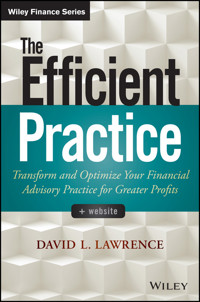
An essential guide to tools and techniques for achieving efficiency, productivity, and profitability in financial advisory firms As a profession, financial advisors have been very well educated on how to be a financial advisor, but the industry does a poor job of preparing financial advisors to be great business owners. This book presents the Profit-Driven Architecture, a visual way of viewing the operational structure of a financial practice. * Provides a concrete way of understanding and improving the interrelationship of different parts of the operations of a financial practice firm * Explains how to increase the efficiency, productivity, and profitability of the firm, recognizing the interrelationships with one another * Reveals how to increase the capacity and value of the practice Given an aging population of financial advisors and increased focus on succession planning, increasing the value of a financial practice is a key deliverable of efficiency and this book showcases the best ways to do so.
Sie lesen das E-Book in den Legimi-Apps auf:
Seitenzahl: 290
Veröffentlichungsjahr: 2014
Ähnliche


















Contents
Cover
Seriespage
Title Page
Copyright
Dedication
Introduction
Part One: Management Efficiency
Chapter 1: The Efficient Management Philosophy
COMMUNICATION IS KEY
THE IRONY OF MICROMANAGING
DELEGATE, DON'T DOMINATE
SUMMARY
Chapter 2: Managing Resources
EFFICIENCY VERSUS EFFICACY
OUTSOURCING
DOWNSIZING
MANAGING CHANGE: A PROCESS OF INCLUSION
SUMMARY
Chapter 3: Managing People and Communications
STEP ONE: PRE-HIRE PREPARATION
STEP TWO: BACKGROUND INFORMATION
STEP THREE: THE INTERVIEW
DEVELOPING A COMPENSATION PLAN
HANDLING CONFIDENTIAL INFORMATION
TWO EXAMPLES
THE HOLISTIC APPROACH
THE RIGHT JOB DONE BY THE RIGHT PEOPLE
SUMMARY
Part Two: Technology Efficiency
Chapter 4: Client Relationship Management
LEVERAGING TECHNOLOGY
SUMMARY
Chapter 5: Other Software Issues
EVERNOTE
DIGITAL NOTE-TAKING TOOLS
TABLETS AND STORAGE SOLUTIONS
REBALANCING SOFTWARE
SUMMARY
Chapter 6: Systems Integration
SOFTWARE INTEGRATION AND COMMUNICATION
PROTECTING CLIENT DATA
SUMMARY
Part Three: Process Efficiency
Chapter 7: Building Procedures
FINANCIAL PLAN PRODUCTION PROCEDURE
FLOWCHARTS
BUSINESS CONTINUITY PLANS
SOCIAL MEDIA POLICIES
USING TECHNOLOGY TO STANDARDIZE CLIENT SERVICE PROCEDURES
SUMMARY
Chapter 8: Workflow Management Systems
PROJECT MANAGEMENT WORKFLOWS
WORKFLOW SYSTEMS: EFFICIENT METHODS FOR TRACKING TASKS IN THE OFFICE
SUMMARY
Part Four: Design Efficiency
Chapter 9: Office Space Utilization
CREATING A PAPERLESS OFFICE
COMMUNICATIONS IN THE OFFICE
AUDITORY AND VISUAL DISTRACTIONS
OUTSOURCING
IMPROVING FIRST IMPRESSIONS
FENG SHUI TIPS FOR YOUR BUSINESS AND OFFICE
SUMMARY
Chapter 10: Efficient Branding
BLUE OCEAN STRATEGY
MARKETING SERVICES
Efficient Websites
SUMMARY
Afterword
IMPACT ON PRODUCTIVITY, PROFITABILITY, TIME MANAGEMENT, AND FIRM CAPACITY
IMPACT ON BUSINESS VALUATION
FIRST CASE STUDY
SECOND CASE STUDY
About the Companion Website
About the Author
Index
Founded in 1807, John Wiley & Sons is the oldest independent publishing company in the United States. With offices in North America, Europe, Australia and Asia, Wiley is globally committed to developing and marketing print and electronic products and services for our customers' professional and personal knowledge and understanding.
The Wiley Finance series contains books written specifically for finance and investment professionals as well as sophisticated individual investors and their financial advisors. Book topics range from portfolio management to e-commerce, risk management, financial engineering, valuation and financial instrument analysis, as well as much more.
For a list of available titles, visit our website at www.WileyFinance.com.
Cover image: Wiley
Cover design: ©oanav / iStockphoto.com
Copyright © 2014 by David L. Lawrence. All rights reserved.
Published by John Wiley & Sons, Inc., Hoboken, New Jersey.
Published simultaneously in Canada.
No part of this publication may be reproduced, stored in a retrieval system, or transmitted in any form or by any means, electronic, mechanical, photocopying, recording, scanning, or otherwise, except as permitted under Section 107 or 108 of the 1976 United States Copyright Act, without either the prior written permission of the Publisher, or authorization through payment of the appropriate per-copy fee to the Copyright Clearance Center, Inc., 222 Rosewood Drive, Danvers, MA 01923, (978) 750-8400, fax (978) 646-8600, or on the Web at www.copyright.com. Requests to the Publisher for permission should be addressed to the Permissions Department, John Wiley & Sons, Inc., 111 River Street, Hoboken, NJ 07030, (201) 748-6011, fax (201) 748-6008, or online at http://www.wiley.com/go/permissions.
Limit of Liability/Disclaimer of Warranty: While the publisher and author have used their best efforts in preparing this book, they make no representations or warranties with respect to the accuracy or completeness of the contents of this book and specifically disclaim any implied warranties of merchantability or fitness for a particular purpose. No warranty may be created or extended by sales representatives or written sales materials. The advice and strategies contained herein may not be suitable for your situation. You should consult with a professional where appropriate. Neither the publisher nor author shall be liable for any loss of profit or any other commercial damages, including but not limited to special, incidental, consequential, or other damages.
For general information on our other products and services or for technical support, please contact our Customer Care Department within the United States at (800) 762-2974, outside the United States at (317) 572-3993 or fax (317) 572-4002.
Wiley publishes in a variety of print and electronic formats and by print-on-demand. Some material included with standard print versions of this book may not be included in e-books or in print-on-demand. If this book refers to media such as a CD or DVD that is not included in the version you purchased, you may download this material at http://booksupport.wiley.com. For more information about Wiley products, visit www.wiley.com.
Library of Congress Cataloging-in-Publication Data:
ISBN 9781118735039 (Hardcover)
ISBN 9781118735145 (ePDF)
ISBN 9781118735152 (ePub)
I would like to dedicate this book to the most inspiring person in my life, my mother, Helen Mattson Lawrence. Helen was an amazing educator for over 60 years, founding her own private school in Florida and pioneering groundbreaking visual teaching techniques for what was referred to then as minimal brain dysfunction children (later called dyslexia). She lived a full life, passing at age 90. But she never lost her love or her enthusiasm for teaching children.
—David L. Lawrence
Introduction
As professionals, financial advisors have been very well educated on how to be a financial advisor, but the profession has done a poor job of preparing financial advisors to be great business owners. This is due in part to the industry's focus on licensing and certification, not to mention compliance-related issues.
Financial practices often grow from a single-person firm to a larger firm with challenges in several key areas of operations. Some firms reach a point that might be termed a revenue ceiling. This is a level of net profit above which the firm cannot seem to grow. Adding more employees, purchasing additional equipment, or even increasing marketing to new prospective clients does not solve the problem as the firm is constrained by its operational construct and management. Firm owners frequently do not recognize the issue because most often they are the problem themselves.
The solution is to take a holistic approach to all areas of financial practice operations and use efficient management techniques to create systems that can greatly extend net profitability, productivity, and efficiency.
I developed a concept many years ago that I call Profit-Driven Architecture, which is a visual way of viewing the operational structure of a financial practice. Regardless of whether it is a small or large firm, the structure provides a concrete way of understanding and improving the interrelationship of different parts of the operations of a financial practice firm. (See Figure I.1.)
FIGURE I.1 Profit-Driven Architecture
Each of the four areas of firm operations should be studied to find ways to increase the efficiency, productivity, and profitability of the firm. However, these areas of operations do not function independently. The greatest impact in efficiency is achieved when these are studied holistically, recognizing the interrelationships with each other. As an example, management efficiency must be studied in the context of how well technology and process relate to the management of the firm, and so on.
The Efficient Practice explores the tools and techniques to bring a firm above the revenue ceiling and achieve the highest possible levels of efficiency, productivity, and profitability. Other impacts to the firm can be increased capacity and a significant rise in practice value. Given an aging population of financial advisors and increased focus on succession planning, increasing the value of a financial practice is a key deliverable of efficiency.
David L. Lawrence
PART One
Management Efficiency
CHAPTER 1
The Efficient Management Philosophy
One of the great challenges of management is adjusting to the growth of a firm. The adjustment is not confined to the owner/manager. Adjustments must be made by all members of the firm. Clearly, though, the first and most fundamental step is for the owner/manager of the firm to recognize that as the firm grows, he or she must change the way in which management of the firm is handled.
For most practitioners who began as a one-person shop, this is a difficult task. When operating a one-person shop, the owner does it all, from clerical to analytical. When the first employee is added, there is still little need for formal management techniques, as there may be time to discuss most everything. But, as more and more employees are added, there is an inefficiency of scale that sets in, interfering with work productivity, increasing time demands on the owner/manager, and potentially limiting profitability. Often referred to as a revenue ceiling, this is the point in growth where the limitations of management so hinder the efficient operations of the practice that continued revenue growth becomes virtually impossible without major changes.
Lesen Sie weiter in der vollständigen Ausgabe!
Lesen Sie weiter in der vollständigen Ausgabe!
Lesen Sie weiter in der vollständigen Ausgabe!
Lesen Sie weiter in der vollständigen Ausgabe!
Lesen Sie weiter in der vollständigen Ausgabe!
Lesen Sie weiter in der vollständigen Ausgabe!
Lesen Sie weiter in der vollständigen Ausgabe!
Lesen Sie weiter in der vollständigen Ausgabe!
Lesen Sie weiter in der vollständigen Ausgabe!
Lesen Sie weiter in der vollständigen Ausgabe!
Lesen Sie weiter in der vollständigen Ausgabe!
Lesen Sie weiter in der vollständigen Ausgabe!
Lesen Sie weiter in der vollständigen Ausgabe!
Lesen Sie weiter in der vollständigen Ausgabe!
Lesen Sie weiter in der vollständigen Ausgabe!
Lesen Sie weiter in der vollständigen Ausgabe!




