


17,99 €
Mehr erfahren.
- Herausgeber: John Wiley & Sons
- Kategorie: Geisteswissenschaft
- Sprache: Englisch
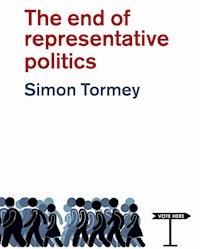
Representative politics is in crisis. Trust in politicians is at an all-time low. Fewer people are voting or joining political parties, and our interest in parliamentary politics is declining fast. Even oppositional and radical parties that should be benefitting from public disenchantment with politics are suffering.
But different forms of political activity are emerging to replace representative politics: instant politics, direct action, insurgent politics. We are leaving behind traditional representation, and moving towards a politics without representatives. In this provocative new book, Simon Tormey explores the changes that are underway, drawing on a rich range of examples from the Arab Spring to the Indignados uprising in Spain, street protests in Brazil and Turkey to the emergence of new initiatives such as Anonymous and Occupy.
Tormey argues that the easy assumptions that informed our thinking about the nature and role of parties, and ‘party based democracy’ have to be rethought. We are entering a period of fast politics, evanescent politics, a politics of the street, of the squares, of micro-parties, pop-up parties, and demonstrations. This may well be the end of representative politics as we know it, but an exciting new era of political engagement is just beginning.
Sie lesen das E-Book in den Legimi-Apps auf:
Seitenzahl: 352
Veröffentlichungsjahr: 2015
Ähnliche




















Contents
Cover
Title Page
Copyright
Acknowledgements
Introduction
1 Contours of a ‘Crisis’
Contours of a crisis I: the view from above
Voter turnout
Membership of political parties
Trust in politicians
Interest in politics
Contours of a crisis II: the view from the margin
The Zapatistas
The World Social Forum (WSF)
Occupy Wall Street (OWS)
Conclusion
Notes
2 Locating ‘Representative Politics’
The origins of ‘representation’
The emergence of the nation state
The waning of religious orthodoxy
Mercantile capitalism and the first great transformation
From absolutist to democratic representation
An ambivalence towards the state
An ambivalence towards the demos
Representation and its critics
The rise of ‘representative politics’
From ‘majoritarian’ politics to the politics of minorities
Conclusion
Notes
3 Are We Becoming Unrepresentable?
Why is representative politics in crisis?
The problem with politicians …
The problem with citizens …
The problem with neoliberalism …
The long revolution: modernity, globalization, individualization
The transition from ‘Fordism’ to ‘Post-Fordism’
Transnational flows and deterritorialization
The proliferation of information, media, communication
Individualization and the erosion of authority
The crumbling pyramid
(Don’t) take me to your leader
The DIY-ification of politics
Conclusion
Notes
4 Is the Party Over?
A farewell party?
Content: what’s the matter with the message?
Form: what’s the matter with the organization?
Politics after and beyond the party
Social media: the quantum leap forward?
Mobilization after social media: from representation to resonance
Conclusion
Notes
5 Citizens against Representation
The Spanish crucible
15M as event
15M and non-affiliated activism
Back to the party
Party politics – but not as we know it …
The new ‘party-based democracy’
Conclusion
Notes
6 Democracy after Representation
The ‘end’ of representative democracy
From representation to resonance
The collision of ‘vertical’ and ‘horizontal’
The transformation of ‘party-based democracy’
The new (political) class warfare
A redrawing of the relationship between governments, politicians, authorities and citizens now better able to act in ‘swarm’ or ‘crowd’ mobilizations
Post-representative democracy?
The end of an aura?
The long wait for the ‘democracy-to-come’
Democracy after ‘post-democracy’?
Conclusion
Notes
References
Index
End User License Agreement
Guide
Cover
Contents
Begin Reading
Pages
iii
iv
vi
vii
1
2
3
4
5
6
7
8
9
10
11
12
13
14
15
16
17
18
19
20
21
22
23
24
25
26
27
28
29
30
31
32
33
34
35
36
37
38
39
40
41
42
43
44
45
46
47
48
49
50
51
52
53
54
55
56
57
58
59
60
61
62
63
64
65
66
67
68
69
70
71
72
73
74
75
76
77
78
79
80
81
82
83
84
85
86
87
88
89
90
91
92
93
94
95
96
97
98
99
100
101
102
103
104
105
106
107
108
109
110
111
112
113
114
115
116
117
118
119
120
121
122
123
124
125
126
127
128
129
130
131
132
133
134
135
136
137
138
139
140
141
142
143
144
145
146
147
148
149
152
153
154
155
156
157
158
159
160
161
162
163
164
165
166
167
168
The End of Representative Politics
Simon Tormey
Copyright © Simon Tormey 2015
The right of Simon Tormey to be identified as Author of this Work has been asserted in accordance with the UK Copyright, Designs and Patents Act 1988.
First published in 2015 by Polity Press
Polity Press65 Bridge StreetCambridge CB2 1UR, UK
Polity Press350 Main StreetMalden, MA 02148, USA
All rights reserved. Except for the quotation of short passages for the purpose of criticism and review, no part of this publication may be reproduced, stored in a retrieval system, or transmitted, in any form or by any means, electronic, mechanical, photocopying, recording or otherwise, without the prior permission of the publisher.
ISBN-13: 978-0-7456-9051-3
A catalogue record for this book is available from the British Library.
Library of Congress Cataloging-in-Publication Data
Tormey, Simon, 1963-The end of representative politics/Simon Tormey.pages cmIncludes bibliographical references and index.ISBN 978-0-7456-8195-5 (hardback: alk. paper) -- ISBN 978-0-7456-8196-2(pbk.: alk. paper) 1. Representative government and representation. I. Title.JF1051.T66 2015321.8--dc23
2014030425
The publisher has used its best endeavours to ensure that the URLs for external websites referred to in this book are correct and active at the time of going to press. However, the publisher has no responsibility for the websites and can make no guarantee that a site will remain live or that the content is or will remain appropriate.
Every effort has been made to trace all copyright holders, but if any have been inadvertently overlooked the publisher will be pleased to include any necessary credits in any subsequent reprint or edition.
For further information on Polity, visit our website:politybooks.com
ACKNOWLEDGEMENTS
This book has its origins in a European Consortium for Political Research Joint Sessions workshop on ‘Representation’ held in Edinburgh in 2003. I gave what was even by my standards a rather leftfield paper, but it nonetheless provided me with an entrée to a world, albeit one I had little intention of inhabiting for very long. The paper was received with good humour and constructive criticism by those who were properly attuned to the intricacies of the topic: Gideon Baker, Henrik Bang, Michele Micheletti, Mike Saward, Graham Smith, amongst numerous others. I thank them for providing the initial stimulus that encouraged me to take up the issue in a more extended form.
As for the present, I feel very fortunate to work with a talented group of colleagues in the School of Social and Political Sciences at the University of Sydney. I would particularly like to thank John Keane, who has done so much to encourage discussion at Sydney of many of the key themes with which this work is concerned. I also acknowledge the important role locally of Pippa Norris, who, like John, has done a huge amount to enliven the environment for the study of representation, how it works and for whom.
I owe a great deal to the university for permitting me to take leave in 2013, when the bulk of the writing for this project was undertaken. During this year I offered a number of papers which became incorporated into the present work. I learned a lot from Wolfgang Merkel and colleagues at the WZB Berlin. I also thank the participants at a workshop on representation held at the Political Studies Association Annual Conference in Cardiff, particularly Mónica Brito Vieira, who provided detailed comments on my paper which gave much food for thought. I’m also grateful to the participants at a workshop on ‘The Crisis of Democracy’ held at Canberra University in 2014.
I’m very pleased to acknowledge the help of Ramón Feenstra of the University Jaume I, in Castellón, Spain. Ramón helped organize two periods of fieldwork which fed directly into Chapter 5 of the present work. He worked tirelessly for weeks setting up meetings, rounding up representatives and ‘post-representatives’ of political parties, taking me to all manner of events in Castellón, Barcelona and Valencia. Whilst in Spain we met with around a hundred activists. Quite simply, this would not have been the same book without their passion, engagement, knowledge and enthusiasm. Meeting individuals like these is the ultimate antidote to a certain weary fatalism that can creep into thinking about the present and future democracy. I salute them all, and thank them for their input into this work. Muchas gracias!
I’m also very pleased to acknowledge the direct help and assistance of Ben Moffitt, Andy Robinson and Ramón in reading and commenting on the full text of this work. All of them made me change my thinking or approach in some important way.
I’d like to acknowledge the help and guidance of the team at Polity Press, particularly Louise Knight and Pascal Porcheron. I am also grateful to the small army of colleagues behind the scenes who commented on my initial proposal and the final manuscript.
Finally (always finally), gros bisous to Véronique, and my children Maximilian, Gabrielle and Louis. Towards the end of the book I describe a form of democracy that is noisy, rumbustious and full of the clamour of unruly dissensus. Any resemblance to the family dinner table is entirely coincidental.
INTRODUCTION
There are not many truisms in the study of politics, but the view that representation is intrinsic to any system of democratic governance is probably one of them. Some people will speak and act on behalf of a group, political cause or identity and thus represent it; others will recognize themselves as being the object of this discourse and be represented by it. Some will hold power as representatives; other people will be represented. ‘Speaking for others’ and ‘being spoken for’ is, according to Hanna Pitkin, author of the classic work on the topic, The Concept of Representation, fundamental to understanding the dynamic of politics. As she puts it: ‘In modern times, almost everyone wants to be governed by representatives…; every political group or cause wants representation; every government claims to represent’ (Pitkin 1972: 2).
Few readers of Pitkin’s text would have had grounds for querying such an analysis when it first appeared in 1967. Now it appears increasingly problematic. The claim that almost everyone ‘wants to be governed by representatives’ is countered by a growing body of evidence that suggests that many of us have become – or are becoming – disillusioned with politics and politicians, with our representatives and with representation (Norris 1999; Dalton 2004; Hay 2007). Compared to the 1960s we vote less – when we vote at all. We are much less likely to join a political party, to be interested in the affairs of the state or the political class (unless it is in the context of a scandal). The citizens of advanced democracies trust politicians less than virtually any other professional grouping, including second-hand car salesmen. In response to such alarming indicators, the Guardian asked in a recent survey whether representative democracy was in ‘terminal decline’ (Burn-Murdoch 2012).
As for the second half of Pitkin’s statement (‘every political group or cause wants representation’), many emergent political groups and initiatives explicitly and implicitly disavow the inheritance of representative politics. Occupy, for example, like other recent movements, rejects the idea that it is seeking to represent, even as it proclaims ‘We are the 99%.’ We can put to one side for a moment the issue of whether and to what extent such responses achieve what they set out to do: avoid, query or move beyond representation. Of interest here is the discourse and repertoire of devices, manoeuvres and gestures groups use to distance themselves from ‘representative politics’. In place of a politics based on a practice of speaking and acting for others, we now find a plethora of forms and styles of what might be called immediate or non-mediated politics: direct action, flash protests, Twitter-led mobilizations, pinging, hacking, squatting, boycotting, buy-cotting, occupying and other interventions of a direct, practical kind. Increasingly, politically engaged citizens don’t vote, they act. They don’t join mass parties contesting power; they create their own initiatives, ‘micro-parties’, networks, affinity groups, deliberative assemblies, participatory experiments. They don’t wait for elections; they seek to make their views, anger, displeasure, known immediately, . They don’t read the media, they (to quote Indymedia) the media.
Lesen Sie weiter in der vollständigen Ausgabe!
Lesen Sie weiter in der vollständigen Ausgabe!
Lesen Sie weiter in der vollständigen Ausgabe!
Lesen Sie weiter in der vollständigen Ausgabe!
Lesen Sie weiter in der vollständigen Ausgabe!
Lesen Sie weiter in der vollständigen Ausgabe!
Lesen Sie weiter in der vollständigen Ausgabe!
Lesen Sie weiter in der vollständigen Ausgabe!
Lesen Sie weiter in der vollständigen Ausgabe!




