


33,99 €
Mehr erfahren.
- Herausgeber: John Wiley & Sons
- Kategorie: Fachliteratur
- Sprache: Englisch
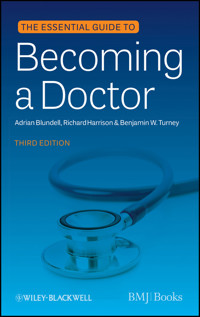
All you need to know about becoming a doctor in the UK
This book contains all the help you need to become a doctor. From applying to medical school through to choosing your specialty, you can find out:
- How to choose a medical school
- How to get into medical school
- How to survive as a medical student
- All about electives
- What life is like as a doctor
As well as easy to follow information on choosing, getting into - and surviving - medical school, junior doctors in different specialties provide unique insight with firsthand accounts of what the job is like in real life, to help you plan and decide your future career path.
Included in this fully updated third edition is the latest information on admission tests, an admission table with practical details about each medical school (as well as greater coverage of graduate medical schools), making this now even more comprehensive for everyone planning a career in medicine.
Sie lesen das E-Book in den Legimi-Apps auf:
Seitenzahl: 458
Veröffentlichungsjahr: 2011
Ähnliche


















Contents
Preface to the first edition
Preface to the third edition
Acknowledgements
Chapter 1: A challenging career
1.1 Medicine or not
1.2 Career planning portfolio
1.3 The decision
1.4 A changing profession
1.5 Planning
1.6 Summary
Chapter 2: The application procedure
2.1 General advice
2.2 Timing your application
2.3 The application process
2.4 Completing the UCAS application step by step
2.5 What happens to your application after it is submitted?
2.6 Clearing
2.7 What are the medical schools looking for?
2.8 How are candidates selected for interview?
2.9 The outcomes and what to do next
Chapter 3: Admission tests
3.1 Entrance exams
3.2 BMAT (www.bmat.org.uk)
3.3 UKCAT (www.ukcat.ac.uk)
3.4 Graduate-entry courses (4-year courses)
3.5 GAMSAT (www.gamsatuk.org)
3.6 Summary
Chapter 4: The year out
4.1 The initial decision
4.2 The options
4.3 Practical information about a year out
4.4 How to apply for a gap year
4.5 Summary
Chapter 5: Choosing a medical school
5.1 So many to choose from
5.2 Does it really matter which one I choose?
5.3 How should I go about choosing a medical school?
5.4 The factors
5.5 Other options: private medical schools
5.6 Summary
Chapter 6: Applying to Oxbridge
6.1 The basic facts
6.2 The differences in the course
6.3 The colleges
6.4 The universities
6.5 The application process
6.6 The selection procedure
6.7 Interviews
6.8 Offers
6.9 Rejection
6.10 Conclusion
6.11 Useful information
Chapter 7: The interview process
7.1 Preparation
7.2 While you are waiting
7.3 On the day of the interview
7.4 The interview itself
7.5 What are you going to be asked?
7.6 Differences at Oxford and Cambridge
7.7 The future
7.8 Finally
Chapter 8: Over 21s
8.1 Applications
8.2 Graduate students
8.3 Mature students
8.4 Summary
Chapter 9: Life at medical school
9.1 The beginning
9.2 Accommodation
9.3 Freshers’ week
9.4 The students’ union
9.5 The medical school facilities
9.6 The first lecture
9.7 The medical society
9.8 Charity events
9.9 The social side
9.10 In times of trouble
9.11 Summary
Chapter 10: The medical course: early years
10.1 Mentor/educational supervisor
10.2 Types of teaching
10.3 Computing
10.4 The curriculum
10.5 The early clinical experience
10.6 Problem-based learning
10.7 Examinations and assessments
10.8 The intercalated degree
10.9 Summary
Chapter 11: The medical course: later years
11.1 Ward etiquette
11.2 The introductory course
11.3 Clinical firms
11.4 An average week
11.5 The clinical attachments
11.6 On-call
11.7 Examinations and assessments
11.8 Student-chosen modules
11.9 The elective (see Chapter 12)
11.10 The shadowing weeks
11.11 Graduation
11.12 Summary
Chapter 12: The intercalated degree
12.1 Popularity
12.2 The choices
12.3 Which subjects are available?
12.4 The objectives
12.5 The benefits
12.6 The downside
12.7 Summary
Chapter 13: The elective
13.1 The official bit
13.2 The unofficial bit
13.3 How do you choose where to go on elective?
13.4 Organization
13.5 Financial limits
13.6 Planning
13.7 Safety on elective
13.8 Summary
Chapter 14: Finances
14.1 The hard facts: tuition fees
14.2 The hard facts: living expenses
14.3 Money management
14.4 Main sources of financial help
14.5 Other financial help available
14.6 Bank loans
14.7 Pay back
14.8 Student employment
14.9 Finance for graduate courses
14.10 Post graduation
14.11 Summary
Chapter 15: House dog to top dog
15.1 The old system
15.2 Modernizing Medical Careers
15.3 The Foundation Programme
15.4 Specialty training
15.5 Fixed-term specialist training and career posts
15.6 Advantages and disadvantages of the specialty training programme
15.7 Senior medical appointments
15.8 Summary
Chapter 16: Working patterns and wages
16.1 Recent changes
16.2 The New Deal
16.3 Junior doctor working patterns
16.4 The European Working Time Directive
16.5 The new pay system
16.6 Is change for the better?
16.7 Flexible training in hospital
16.8 The loot
16.9 Summary
Chapter 17: Life as a doctor
17.1 Foundation Year 1
17.2 Life as a foundation doctor
17.3 Specialist training
17.4 Senior medical appointments
17.5 Regulation of doctors
17.6 Difficult times
17.7 Summary
Chapter 18: Career options
18.1 The career ladder
18.2 The choices
18.3 The options
18.4 Summary
Chapter 19: Training as a general practitioner
19.1 The training requirements
19.2 GP registrar
19.3 Imminent changes to GP training
19.4 The exams
19.5 The image
19.6 Working as a GP
19.7 Summary
Chapter 20: Training in the medical field (becoming a physician)
20.1 The hospital structure
20.2 General medicine
20.3 Foundation years
20.4 Specialist training (Basic Medical Training, i.e. ST1 and ST2)
20.5 Specialist training (Higher Specialty Training)
20.6 Member of the Royal College of Physicians Diploma
20.7 The consultant
20.8 A day in the life
20.9 Summary
Chapter 21: Training in the surgical field
21.1 History of surgery
21.2 The career
21.3 Training
21.4 The surgical exams and courses
21.5 The job
21.6 The options
21.7 Women in surgery
21.8 Training abroad
21.9 Flexible training
21.10 Further information
21.11 The surgical specialties
21.12 Summary
Chapter 22: Working abroad
22.1 Planning
22.2 When to go: the past
22.3 When to go: the future
22.4 Where to go
22.5 Other options
22.6 Summary
Appendix
Index
This edition first published 2011, © 2004 (BMJ Publishing Group), 2007, 2011 by Adrian Blundell, Richard Harrison and Benjamin Turney
BMJ Books is an imprint of BMJ Publishing Group Limited, used under licence by Blackwell Publishing which was acquired by John Wiley & Sons in February 2007. Blackwell’s publishing programme has been merged with Wiley’s global Scientific, Technical and Medical business to form Wiley-Blackwell.
Registered office: John Wiley & Sons Ltd, The Atrium, Southern Gate, Chichester, West Sussex, PO19 8SQ, UK
Editorial offices: 9600 Garsington Road, Oxford, OX4 2DQ, UK
The Atrium, Southern Gate, Chichester, West Sussex, PO19 8SQ, UK
111 River Street, Hoboken, NJ 07030-5774, USA
For details of our global editorial offices, for customer services and for information about how to apply for permission to reuse the copyright material in this book please see our website at www.wiley.com/wiley-blackwell
The right of the author to be identified as the author of this work has been asserted in accordance with the Copyright, Designs and Patents Act 1988.
All rights reserved. No part of this publication may be reproduced, stored in a retrieval system, or transmitted, in any form or by any means, electronic, mechanical, photocopying, recording or otherwise, except as permitted by the UK Copyright, Designs and Patents Act 1988, without the prior permission of the publisher.
Wiley also publishes its books in a variety of electronic formats. Some content that appears in print may not be available in electronic books.
Designations used by companies to distinguish their products are often claimed as trademarks. All brand names and product names used in this book are trade names, service marks, trademarks or registered trademarks of their respective owners. The publisher is not associated with any product or vendor mentioned in this book. This publication is designed to provide accurate and authoritative information in regard to the subject matter covered. It is sold on the understanding that the publisher is not engaged in rendering professional services. If professional advice or other expert assistance is required, the services of a competent professional should be sought.
The contents of this work are intended to further general scientific research, understanding, and discussion only and are not intended and should not be relied upon as recommending or promoting a specific method, diagnosis, or treatment by physicians for any particular patient. The publisher and the author make no representations or warranties with respect to the accuracy or completeness of the contents of this work and specifically disclaim all warranties, including without limitation any implied warranties of fitness for a particular purpose. In view of ongoing research, equipment modifications, changes in governmental regulations, and the constant flow of information relating to the use of medicines, equipment, and devices, the reader is urged to review and evaluate the information provided in the package insert or instructions for each medicine, equipment, or device for, among other things, any changes in the instructions or indication of usage and for added warnings and precautions. Readers should consult with a specialist where appropriate. The fact that an organization or Website is referred to in this work as a citation and/or a potential source of further information does not mean that the author or the publisher endorses the information the organization or Website may provide or recommendations it may make. Further, readers should be aware that Internet Websites listed in this work may have changed or disappeared between when this work was written and when it is read. No warranty may be created or extended by any promotional statements for this work. Neither the publisher nor the author shall be liable for any damages arising herefrom.
Library of Congress Cataloging-in-Publication Data
Blundell, Adrian.
The essential guide to becoming a doctor / Adrian Blundell, Richard Harrison, Benjamin Turney ; cartoons by Rebecca Herbertson. — 3rd ed.
p. ; cm.
Includes index.
ISBN 978-0-470-65455-2
1. Medicine—Great Britain—Vocational guidance. I. Harrison, Richard.
II. Turney, Benjamin. III. Title.
[DNLM: 1. Medicine—Great Britain—Popular Works. 2. Career Choice—Great Britain—Popular Works. 3. Education, Medical—Great Britain—Popular Works. 4. Vocational Guidance—Great Britain—Popular Works. W 21 B658e 2011]
R690.B64 2011
610.69—dc22
2010024517
A catalogue record for this book is available from the British Library.
This book is published in the following electronic formats: ePDF 9781444329759; Wiley Online Library 9781444329742; ePub 9781444329766
Preface to the first edition
So you want to be a doctor? Have you asked yourself why?
Doctors have a highly privileged role. Medics are involved in peoples’ lives from facilitating their conception to dignifying their death. Medicine can be a rewarding career despite constant concerns regarding hours, pay, and working conditions. Consequently, competition for places at medical school is high and on the increase.
Deciding to choose medicine is a decision that has lifelong and lifestyle implications. Do you know that you will have to spend 5 years at university and then up to 15 years before reaching the top of your profession? Do you know what being on call means? Even more importantly do you have any idea what life at university and a career as a doctor will be like?
Look no further because help is at hand. Here is the completely unbiased, honest, and unadulterated guide to telling you everything you ever wanted to know about being a doctor – and a lot more. From the initial application right through to training in your chosen speciality – it’s all here.
We have written this book to help you make a decision about a career in medicine. We hope that you find it helpful. Personally we had little or no idea what we were letting ourselves in for. Lucky for us it was the right decision and we love it. Sadly for some it isn’t. Careful thought early on should prevent this; remember there are other rewarding careers.
Life at university is fantastic, no arguments. Life as a doctor has great moments, but be under no illusion, it is hard work, at times routine, and it can be stressful. Read this book and embark on your career with your eyes and ears open. Work hard but more importantly remember to take time to play hard.
Please remember that courses and application procedures change, as can working patterns and practices. It is advisable to check the latest information before applying.
Good luck!
Adrian Blundell
Richard Harrison
Benjamin Turney
2004
Preface to the third edition
Despite the growing number of places available for medical students, universities are expecting more and more from applicants. Required A-level grades are becoming higher, admission tests have been introduced and a greater emphasis than ever before is being placed on extracurricular activities and work experience. Training as a medical student and life as a doctor has changed considerably since the first edition of this book, nearly ten years ago. The idea of being a doctor can be very different to the reality. Do your research, and plenty of it; if you still want to become a doctor, then go for it – there are few more rewarding careers for those who choose wisely.
Our reasons for writing this book have not changed and our general advice hasn’t either. However many of the specifics are continually changing and will continue to do so with the recent change of government. It is essential to keep up to date, even at an early stage of your career.
We wish you every success in your future career, whatever you choose.
Adrian Blundell
Richard Harrison
Benjamin Turney
2011
Acknowledgements
We are extremely grateful to the following people for their contributions and comments:
Julian BoullinSpecialist Registrar in Cardiology, Southampton University Hospitals NHS TrustTim BrabantsSpecialty Registrar, Acute Medicine, Nottingham University Hospitals NHS TrustEleanor DittnerFoundation Year 1 Doctor, Nottingham University Hospitals NHS TrustTorquil Duncan-BrownGeneral Practitioner, LitchfieldBryony ElliottSpecialty Registrar, Sherwood Hospitals NHS Foundation TrustAlice GallenFinal Year Medical Student, University College LondonAlex GloverFoundation Year 2 Doctor, Nottingham University Hospitals NHS TrustAdam GordonClinical Lecturer in Medicine of Older People, Division of Rehabilitation and Ageing, University of NottinghamRebecca HerbertsonSpecialist Registrar in Medical Oncology, Brighton and Sussex University Hospitals NHS TrustJames HopkinsonGeneral Practitioner, NottinghamEmma LaneFoundation Year 2 Doctor, Palmerston North, New ZealandJohn MacFarlaneConsultant Physician and Professor of Respiratory Medicine, Nottingham University Hospitals NHS TrustSir Peter MorrisFormer President of the Royal College of Surgeons of EnglandPip ParsonFoundation Year 2 Doctor, Royal Derby Hospitals NHS Foundation TrustDavid PowisAssistant Dean and Director of Teaching and LearningUniversity of Newcastle, AustraliaZudin PuthuchearyClinical lecturer in intensive care, Institute of health and human performanceUniversity College, LondonJamie Read5th Year Medical Student, Peninsula Medical SchoolAnna RichSpecialist Registrar, Respiratory Medicine, Nottingham University Hospitals NHS TrustJeremy SnapeConsultant Physician, Sherwood Forest Hospitals NHS Foundation TrustGemma WilkinsonGeneral Practitioner, NottinghamChapter 1 A challenging career
1.1 Medicine or not
The decision to study medicine at university should not be made without a great deal of thought and research into the reality of life as a doctor. At the age of 17 it can be difficult to know whether you want to go to university at all, let alone study for at least 5 years. Your future career ideas should be discussed with family and friends but the final decision needs to be an individual one. Those around you are likely to have differing views; parents and teachers may feel that medicine is a respected profession and possibly encourage you to take this path but some doctors may try to dissuade you. Speak to as many students, doctors and other healthcare professionals as possible in order to gain as many opinions as possible. Ask individuals to justify their reasoning for choosing medicine as a career and to explain why they would or would not recommend it; without experiencing life as a doctor, it is difficult to know what it will really be like. We all know friends who have avoided medicine following their personal experience with one or both parents as doctors. In comparison many students, after experiencing their own family life, do decide to follow in their parents’ footsteps. Although relatively common, try not to be persuaded or coerced into studying medicine by your family – it is YOUR decision and YOUR career for the rest of your life.
For older candidates, the decision is even more difficult. A mature student needs to be certain that the decision to study medicine is the right one as often there is more at stake; each applicant will have their own personal circumstances but returning to student life may involve leaving paid employment and moving a family around the country.
1.2 Career planning portfolio
A useful starting point on the application pathway is to buy a scrapbook or folder for developing into a useful resource full of ideas and information. Early pages should be dedicated to listing your possible career or degree choices. For each decision produce a table with two columns headed ‘Advantages’ and ‘Disadvantages’.
Possible advantages of a career in medicine
Five years at universityInterestingVirtual guarantee of job following graduationReasonable salaryRespected professionDiverse range of specialtiesOption to use both intellectual and technical abilitiesContinual advances in the professionSociable work environmentGood team-working opportunitiesManagerial and leadership opportunitiesStructured careerTransferable skillsOpportunities for working abroadIf you find the disadvantages column dominating at any point, then think carefully whether this decision is correct. Portfolios are used extensively in the medical profession, from medical students to senior doctors, as a record of training that can be used as evidence of competence (i.e. the ability to carry out one’s job). Your portfolio can be divided into different sections: academic; work experience diary; extracurricular activities; employment; managerial, leadership and organizational skills; university choices; commitment to medicine (or other degree); newspaper/journal articles; curriculum vitae. Rather than just listing achievements, it is sensible to reflect on your experiences, for example what were the good and bad bits and how they have helped towards your future career choice. This will develop into an essential resource that will aid your future career choice decision and will be useful to look through prior to interviews.
Possible disadvantages of a career in medicine
Five years at universityLong hoursLots of examsRisk of mistakesStressful periodsDealing with death/sufferingPatient expectationsMedia bashingPaperworkLack of NHS fundingPossible job insecurityLack of flexibility in trainingLitigation (being sued)1.3 The decision
University is only the tip of the medical career iceberg; the remaining 40 years of medicine can be quite different. There is no doubt that a career as a doctor can be challenging, rewarding and exciting, but remember that it is also hard work, stressful, tiring and, at times, mundane. Have you the right personality, not just for the university course but also in the longer term? The majority of sixth form students have no idea what university and a career in medicine will be like, and embark on this journey blinkered by this lack of insight. However, knowledge can be gained by talking to current medical students, career advisors, general practitioners, hospital doctors, and by reading books on the topic of studying medicine and perusing the medical journals. It is also necessary to spend time in and around a hospital or GP surgery, known as work experience or voluntary work. This is an essential prerequisite for obtaining a place at medical school as it shows your commitment, but it is also necessary for gaining more insight into your future career choice.
The decision to study medicine at university should not be made without a great deal of thought
Students have differing motivations for choosing a medical career: family tradition has been discussed, others have experienced medicine as a patient, some have an interest in science, a minority have wanted to become a doctor since the dawn of time, and many just feel that they want to help people. Having experienced medicine from the point of view of being a patient or relative is useful and these experiences can be shared on application forms or at interview. Some of your friends may well know that it is their destiny to become a brain surgeon but the odds are that these people will change their minds over the forthcoming years. The idea of a specialty is different to the reality. It is not necessary for you to decide on your future career prior to applying to medical school, but if you do have some thoughts then these can be mentioned, although remember to have reasons to justify your decision. For many the final decision to study medicine will be made shortly before sending off the UCAS form. Whatever your reason for thinking medicine is your future, it is important to realize that there are other jobs and university courses that would fulfil these reasons and a life following one of these different paths could be just as rewarding. Remember that there are a number of wrong reasons for pursuing medicine as a career.
While deciding on a medical career, it is important not to be disillusioned by the negative media publicity or the drama depicted in television programmes; these are two ends of an extensive spectrum and the majority of the work of a doctor is different. In terms of adverse publicity, remember that doctors have not just started to make mistakes, that doctors probably make fewer mistakes now than ever before, and that the difference is due to the expectation and knowledge of the general public. Mistakes are now less tolerated, and with the advent of the internet patients are more aware of their diseases and also of treatment options.
If you are serious about studying to become a doctor, in addition to researching about life as a doctor (including quality work experience), it is necessary to determine that you have the right attributes and qualities. Although academic excellence does not always equate to good clinical skills as a doctor, there are minimum requirements for entry into medical school. If you have performed badly in your GCSEs or are not likely to get high grades at A level, it is unlikely that you will be offered a place to study medicine, as there is great competition. A useful starting point is to look at the UCAS website for the minimum requirements for entry to each university. Apart from academic pursuits, it is important that applicants demonstrate other interests and abilities and most candidates will have a history of sporting or musical interests and be able to demonstrate leadership and team-working experiences. All these attributes are important for a future healthcare professional, and universities are looking for well-rounded individuals.
There may be other options available if exam results are disappointing at AS level and predicted A-level grades lower than required, and some of these options are discussed in later chapters. Possibilities to consider include resitting A levels and studying a different degree at university and then applying for graduate-entry medicine at a later date. The key is getting excellent A-level grades – if you have the academic requirements for a university place, and the suitable attributes and qualities of a future doctor, then you should be able to get an interview offer, even if this means taking a year off to reapply.
The job of a doctor can be challenging, rewarding, exciting . . .
. . . but also hard work, stressful, boring and routine
The decision to study medicine is just the beginning. Now it is necessary to decide which university and, for some students, which country. It is likely you will have a great time at whichever institution you find yourself. Remember that not all universities are the same and at some the workload could be greater and the social life less. This is why research before applying could save heartache later. Once at medical school, the majority of those students who wish to become doctors do eventually make it through. Some decide that medicine is not the career for them and either leave or convert to another degree. Likewise, some students embark on other science degrees and find that medicine would be more suitable, so make the change then. If you are unsure about your future career, then a possible option might be to study at a medical school offering intercalated degrees as part of the course. For example, at Nottingham the preclinical work includes a research project in the third year that leads to the degree of Bachelor of Medical Science (BMedSci); after this a student could leave the medical school and pursue an alternative career with a degree under his or her belt.
1.4 A changing profession
Medical training and the health service have undergone radical changes in the last 5 years. It is unusual for a day to go by without some mention in the press about changes in doctor training and cuts having to be made due to financial problems. The main push is for a quality health service at an affordable price. Morale has been low due to hospital closures and job uncertainty for many healthcare professionals. It is essential as potential future doctors that even at this early stage you stay up to date with the proposed alterations to career structure, training and NHS reforms. Although it may seem irrelevant at your stage in life, the changes may well alter your decision to study medicine. One interesting aspect is that with the increased number of places at medical school and the reduction in the number of training posts, we may see unemployed doctors for the first time. Employment following graduation is virtually guaranteed but greater competition during later training may mean limited possibilities, especially in smaller specialties and popular locations. Modernizing Medical Careers (MMC) is a government-led initiative that was introduced in 2007 to make training at all levels more formalized. Following medical school, newly qualified doctors now join a 2-year Foundation programme rather than the traditional 1-year Pre-registration House Officer (previously known as the Junior House Officer year). More information about current and future training can be found in later chapters.
1.5 Planning
Planning and research are the key components in deciding and then ultimately applying for medicine. Try to prepare well in advance. Here is a checklist to help formulate a few ideas, although it is by no means exhaustive.
Choosing a medical career: a planning checklist
Keep a scrapbook or folder: develop a plan for a medical career, divided into sections as described earlier. Remember to keep informative newspaper cuttings or journal articles and to write about your experiences rather than just listing achievements.Academia: at an early stage determine which subjects you need at AS and A2 level. Work hard to obtain the required marks! As well as your A-level work, consider some general reading around medical topics. Nature and the British Medical Journal are good starting points; the BMJ is one of the most widely read journals in medicine and the student version has useful articles on career planning and changes in training and also presents interesting medical cases. At a minimum you should be aware of medical advances and developments that have made the lay press and look at these in more detail.Requirements: a good starting point is the UCAS website (www.ucas.org); this has information on the necessary requirements for every course at UK universities. It also has a careers advice questionnaire program that can map your interests and abilities to potential careers and also lots of other general information for potential students. If you are required to pass an extra exam prior to applying (e.g. UKCAT), then make sure you submit applications for these (see Chapter 3).General Medical Council (www.gmc-uk.org): the GMC is the regulatory body for doctors. It produces multiple publications with information for doctors. A useful start would be to look through the booklets Good Medical Practice and Tomorrows Doctors.Department of Health (www.dh.gov.uk): keep abreast of developments in the health service by looking at the Department of Health website. Find summary documents on important governmental papers and legislation.Modernizing Medical Careers (www.mmc.nhs.uk): look through the recent developments in medical training.Research your future career: speak to as many doctors (community and hospital), medical students and other healthcare professionals as you can.Work experience: you need to be organized to sort this in good time. The quality is more important than the quantity and consider a variety of experiences.Medical school research: request the prospectus from the universities you are considering applying to and look at their websites. Make sure you attend the university open days and take the opportunity to speak to as many students as possible and look around the town or surrounding areas (see Chapter 5).Extracurricular activities: as with work experience, it is about the skills and attributes you have gained from your interests outside academia rather than merely the number of hobbies you have.‘Premedics’ groups: rather than isolating yourself from your peers, why not start a small group of students interested in doing medicine to share ideas, knowledge and experiences.Referee: start planning in advance who your referee will be. Ensure that he or she has been aware of your commitment to medicine and also that they are fully supportive of your application.Interview practice: once you have offers, or even earlier if possible, organize mock interviews with several teachers. Practice asking and answering interview questions in your ‘premedic’ group.1.6 Summary
There is no one good or bad reason for studying (or not) to become a doctor. It should be a decision that a student is completely happy with and should not be made lightly. For many, a career as a doctor is usually enjoyable and rewarding, but there are times when it can interfere with personal and family life and this can be seen in the higher rate of divorce, depression, alcohol problems and suicide among medical practitioners. With the changes in working practice and the reduction in hours, the impact on personal life should reduce. To help make your chosen career less stressful, it is important not to bottle up emotions but to talk through any problems with friends and colleagues and to have other interests outside medicine in order to relax.
PERSONAL VIEW
Adrian Blundell
I do not remember when I decided to become a doctor; my first career ambition was to become a pilot, but my early enthusiasm was not shared by my parents. They felt being a pilot would not allow a favourable work/life balance due to the long hours and the frequent trips abroad. My parents are not from a medical background and so possibly didn’t realize the long hours involved in being a doctor. Nevertheless, the idea of being a fast jet pilot was then out of my head. At school, I was fairly good at science and reasonable at the arts. The headache initially was deciding my A levels: science and study medicine, or arts and study law. (This limitation in my choice reflected my naivety about the possible careers available and also a rather disappointing lack of careers advice at school.) Science it was and medicine followed.
My teachers were not particularly generous when predicting my A-level grades (BBC). This was actually fair, as my results in the lower sixth form exams were quite poor. The most common offer in 1990 when I was applying to medical school was BBB, and for this reason I ended up obtaining only one offer from a London college. Other universities I applied to wrote back with offers for other degree courses but I had decided on medicine and turned these down. I actually contacted the medical schools to ask why they had not offered me a place – one response was that I had not done any voluntary work. This might have been true at the time of applying but I spent a large majority of my upper sixth helping at the local hospital.
Results day arrived; I had achieved BBB. A difficult decision ensued as I had obtained the necessary grades to take my medical school place, but I was uncertain as to whether I wanted to spend the next 5 years in London. I really wanted to go to a university rather than a medical school so I declined the London offer, and took a gap year. I then had to commence the application procedure once more.
I was unsure exactly what to do with this year. I had no guarantees of getting an offer and would not find out for several months. An advert appeared in the local paper for a school-leaver with science A levels to work in the field of cancer research at a local pharmaceutical company. I successfully applied for this position and then began the process of reapplication to medical school. Many of my friends spent their year jet-setting around the world. Although a little envious, I still had the problem of finding a place at medical school and this prevented me from leaving the country for long stretches. On this occasion I applied to the University of Nottingham, as I had studied the prospectus and liked the idea of a more modern course. I had never even visited the city before, but on the day of my interview I had a gut feeling that this was the place I really wanted to spend my university days. Fortunately, an offer appeared through my door 2 weeks later. The rest, as they say, is history.
During a gap year, the choices include work, travel, or stay around your home town living off your parents’ generosity. The latter is to be avoided and universities will not look favourably at this. Work or travel is the main question. Most students undertake a bit of both. From personal experience this is probably the best advice, although working for the whole year did mean that I had some beer money when I left for university and also a car in which to carry it. The decision is yours! Good luck.
Chapter 2 The application procedure
2.1 General advice
All applications to university or college courses have to be directed through the University and Colleges Admission Service (UCAS). All applications are now completed online as paper forms no longer exist.
Initially, the task of completing the UCAS application can be quite daunting; after all, this will essentially determine whether you obtain an interview offer and subsequently a university place to study medicine. Do not lose heart: everything in this book is designed to allow you to make an informed decision about your future career, and this chapter guides you stepwise through the application procedure. We will give you hints and tips as to how to complete the form, tell you exactly how the UCAS application system works, and guide you through the application step by step.
Medicine is one of the most popular subjects chosen by undergraduates, and is also one of the most competitive. To be accepted to study medicine, candidates need high grades at A level (or equivalent qualifications), a strong interest in the medical profession and good ‘people skills’. Medicine is a profession that combines an intellectual challenge with a strong sense of vocation and contact with a wide range of people.
2.2 Timing your application
Application dates
Application dates differ according to your chosen course and, in the case of medicine, are earlier. For the majority of subjects, your UCAS application must be submitted before mid-January of the year in which you wish to enter university. For medicine, however, you must apply 3 months before this, by mid-October (usually 15 October). Candidates applying for medicine are not entirely alone in having to apply early; those wishing to apply for any course at Oxford or Cambridge, and those applying for dentistry or veterinary medicine, must also apply early.
Late applications
UCAS state that ‘the universities and colleges guarantee to consider your application if we receive your application by the appropriate deadline’; in other words, if your application is received after the deadline date, they may consider it but there is no obligation for them to do so. Our advice would be to never apply after this deadline without extenuating circumstances. The competition for places is high, so any reason to reject your application will be taken, and a late application is certainly high up on this list. Give yourself the best chance – apply as early as possible.
Deferred entry to university
The subject of deferred entry, also known as a gap year, is considered in more detail in Chapter 4. If you are considering taking deferred entry, you must first check that the university or college will actually accept a deferred entry application. When applying for deferred entry, you must obviously meet the same conditions of offer as those not taking a year out. If you accept a place for deferred entry, you cannot reapply through UCAS in the subsequent year unless you withdraw your original application.
If you do want to defer entry to university for a year, it is not compulsory to apply to UCAS during your A-level year, as you can apply during the gap year. This can be useful if you are unsure of what you really want to study, or if your exam results do not meet expectations. However, if considering a delayed application, we recommend that you talk this over with your teachers and career advisers.
2.3 The application process
There are those who seem to know they were born to enter the medical profession, but many doctors, most of them excellent and dedicated, were not sure which career to follow until the night before the UCAS application deadline! The best advice is to find out as much as you can about medicine and the different medical schools before you complete your application. You can do this by reading university prospectuses, speaking to your careers adviser and visiting the university or college. Talk to your family and friends, particularly those who have been to the universities or colleges that you are considering. It might also be wise to attend one of the available conferences held for 16–18 year olds interested in a career as a doctor. These are held in various locations around the country several times a year and usually involve presentations by medical students and doctors of all levels from junior to professor. Many of them hold practical sessions and small group tutorials. The main aim is to give advice on the application process and to give a feel for what a future career as a doctor may be like. Although attending one of these courses does not guarantee an offer of a place at medical school, it does show a commitment to finding out about your possible career choice. You should be happy with your choice of course and university before you make your final decision. Remember, you will be spending the next 5 or 6 years there!
All applications need to be made using the UCAS secure online application system, APPLY. More detailed information can be found at www.ucas.ac.uk. APPLY can be accessed from any computer with an internet connection. Most students will make their application through a school or college and in these cases it is necessary to obtain the individual school’s log in. It is also possible for individuals to apply. The application can be changed at any time (until submitted) and we would advise printing it out to check before sending. Once complete and you are satisfied with the content, the application is submitted to UCAS through a school staff member who will add your reference. Individual applicants will need to register themselves for APPLY and also sort out their own references and include these before submitting the form. Applicants can pay online or the school can be invoiced.
When you do apply, remember to print out or save copies of the whole application for your own records and check thoroughly before submitting. Always review a copy before any university interviews.
2.4 Completing the UCAS application step by step
Registration
You need to register to use APPLY; you enter personal details, such as your name, address and date of birth. The registration process generates your username and you create your own password, which you use to log in to APPLY.
Personal details
This section is populated from the registration section above. Most of this information is used to uniquely identify you and to help in the carefully maintained UCAS demographics. You are also asked about any disabilities you may have.
Additional information
You are then asked for information about any non-examination-based activities you have undertaken in preparation for higher education (e.g. summer schools), together with other information designed to help the universities and colleges to monitor applications in terms of equal opportunities, such as your national identity and ethnic origin.
Choices
In this section you enter the courses, universities and colleges that you are applying to. You can choose up to five courses, which APPLY will arrange into alphabetical order. The order of your choices does not indicate any preference – your application will be sent to all chosen universities and colleges at the same time. Each university and college will only see details of the particular course or courses for which you have applied. They will not see your other choices until you have received your final decision.
You can apply to a maximum of:
four courses in any one of medicine, dentistry, veterinary medicine or veterinary science;one course at either the University of Oxford or the University of Cambridge.You can use your remaining choice for any other subject. For example, if you have made four choices for medicine, you could still make one choice for dentistry or another subject if you wished. However, you should bear in mind that your personal statement, which often contains course-biased information, will be sent to all the universities and colleges you have chosen.
Another important point when applying for medicine is that when you start your medical training, you will be immunized against hepatitis B. Some universities ask for proof (certificate) that you are not infected with hepatitis B. If you think there is a possibility that you may be infected, you should check directly with the university.
In order to complete this section, it is necessary to know the code names for both the universities and the courses. These are summarized at the end of this chapter.
Education
You then enter where you have studied and which qualifications you are taking or have taken.
Which qualifications should be included?
The simple answer is: all your qualifications. It is likely that you have completed GCSEs and AS levels, and these are the first to enter here, but any of the following should be included.
AS levelsGCSEsIntermediate GNVQs (General National Vocational Qualifications)Key skillsRoyal School of Music (RSM) qualifications.In this section you are trying to convince people that:
you have the aptitude for medicine;you also have other, non-academic interests.What qualifications do I need to be considered for medical school?
The academic standards necessary for medical school are generally quite high, but there is a small degree of interuniversity variability. Three GCEs at advanced (A) level (one usually being Chemistry), or the equivalent level in the Scottish Qualifications Certificate, are the normal minimum entry qualifications for medicine. However, in practice you should have three A levels with good grades (A and B grades in most cases). These should normally be taken in one single sitting. All medical schools accept a combination of A levels and AS levels. Candidates with the Scottish Certificate intending to apply to universities outside Scotland should check the entry qualifications with each university.
What qualifications do I need to be considered for medical school?
All medical schools usually insist that candidates have an A or AS level in Chemistry and normally require a second subject to be in Mathematics, Physics or Biology. The third A level can be in any subject, although most candidates take a science subject. Most universities will not discriminate if a candidate has chosen an art, language or humanity subject as their third A level as this offers a broader perspective. Occasionally, candidates with two art or humanity A levels might be accepted, providing they have the relevant science subjects at GCSE. It is not compulsory to be studying A-level Biology to gain an offer and there is no disadvantage to starting medical school without it. Such candidates will usually be offered extra lectures and within a couple of months students will be up to speed.
It is very important to check with each institution to find out whether your subject combination is acceptable. Some medical schools will not accept General Studies, Art, Music, Design, Media Studies, Home Economics and Physical Education as a third subject. Also some medical schools do not insist on Chemistry. All this information can be found on the UCAS website.
It is important to have good grades (this means A or A*) at GCSE. Subjects should include Mathematics, Physics, Chemistry, Biology and English Language. If one of the key science subjects (Chemistry, Physics, Biology, Mathematics) is not being taken at A level, candidates must have those subjects at GCSE level. Dual award sciences are acceptable at most medical schools as an alternative to the separate science subjects.
Most medical schools will expect applicants to have a minimum of ABB grades at A level, but some (e.g. Cambridge University) normally ask for three A grades. A few medical schools will accept C grade in some subjects, although this is unusual. In Scotland the equivalent qualifications are the Scottish Qualifications Certificate, or Highers, as issued by the Scottish Qualifications Agency. The Scottish medical schools accept a minimum of five Highers at AAABB but the English medical schools will require three Certificate of Sixth-Year Studies (CSYS) subjects.
It is important to check with each university for the required grades or consult the University and College Entrance: Official Guide (published by UCAS). Please note that the requirements may change from year to year and having the required grades does not guarantee a place. You will need to demonstrate other skills and qualities.
As a general rule, the majority of medical schools will not accept BTEC (Business and Technology Education Council) or GNVQ in place of A levels, although some will accept a GNVQ, preferably in science (distinction required), plus an A level in Chemistry. However, the situation may change in the near future. Most medical schools will accept the International Baccalaureate, European Baccalaureate and Irish Leaving Certificate. Some medical schools also accept Access Certificates, HNCs (Higher National Certificates), HNDs (Higher National Diplomas) and qualifications awarded by the Open University, but you will need to check with each school. The full International Baccalaureate at higher levels must include Chemistry.
Employment
In this section, you fill in the details of your work history and employers. If you have not had any jobs, you can leave this section blank, but you will still need to mark it as complete in order to continue with your application.
It is likely that your employment to date is limited to a short time within the retail or leisure industries but, if you are a mature student, you can score points in this section by illustrating that you have been in the employ of a respectable company in a position of responsibility. Enter the names and addresses of your most recent employers, and briefly describe your work, any training you received (e.g. a modern apprenticeship), dates, and whether the work was full time (FT) or part time (PT). You should include weekend and holiday jobs. If you find this section too small, for example if you are a mature student and have had several jobs, contact the universities and colleges to which you have applied if you want to give more information.
Personal statement
Now we reach the part of the UCAS application that strikes fear into the heart of the potential applicant, usually unnecessarily. This is your chance to inform the universities and colleges that you have chosen why you are applying, and why they should want you as a student. Admissions officers will want to know why you are interested in your chosen subject. A good personal statement is important – it could help to persuade an admissions officer to offer you a place.
What to include
This is one of the vital parts of the application. If your academic profile is appropriate, and your referee’s statement indicates that you are not a serial killer, then it is all down to this!
One of the key elements of this statement is justifying why you have chosen medicine. You should try to elucidate your motivation for medicine, and any ideas and concepts that interest you about your chosen subject. Try to include any particular interests that you have in your current studies, especially those related to the field of medicine. You should be trying to convince those on the medical school selection committee that you know what to expect from the medical degree course and the medical career that ensues. Include any job, work experience, placement or voluntary work that you have done, and say how it has broadened your knowledge and experience of medicine and helped your own personal development. While you should not undertake voluntary work purely to include on your personal statement, it is a very useful way of indicating that you have done some homework. Remember that you may be asked questions at the interview that relate to your experience, so keep it truthful.
The skills that make a good doctor can seem rather nebulous at times, but certainly good time management and interpersonal skills never go amiss. These are the type of skills that you might have brought into play while gaining a non-accredited key (core) skill through activities such as Young Enterprise, Duke of Edinburgh’s Award, or the ASDAN Youth Award Scheme.
Knowledge about medical school AND medicine
Training for medicine normally takes 5 or 6 years. The main choice is between (i) a 3-year university medical degree course leading to a BSc or BA (offered by Oxford, Cambridge and St Andrews universities) followed by a 3-year postgraduate clinical course, or (ii) a 2-year preclinical course followed by a 3-year clinical course at the same medical school and leading to the Bachelor of Medicine (BM/MB) and Bachelor of Surgery (BS/BChir/ChB) degrees. Some medical schools include an intercalated degree within the 5-year course (e.g. Nottingham).
The first option takes a mainly theoretical approach and students have minimal contact with patients during the first 3 years. The second option is more vocational and offers contact with patients in the first 2 years.
Not all medical schools follow the structure set out above, and courses will vary in their approach and emphasis. Medical education is undergoing major change at the moment, with less emphasis on factually based lectures and more emphasis on student-centred learning. In each medical school the curriculum will combine varying elements of traditional teaching, for example lectures, seminars, direct experience and student-led (problem-based) learning. It is important to read the prospectus thoroughly to find out what subjects are covered and how they are taught.
Candidates must demonstrate other interests and abilities
Work experience
Include all your work experience to date. Work experience can be difficult to arrange for students under 18 years old so organizing well in advance is essential; do not underestimate the importance of work experience, especially for graduate-entry students. Work experience is important for showing your commitment to discovering more about a career in the health service. Try to arrange a variety of experiences in both the hospital environment and in the community and with a variety of healthcare professionals. A holiday job as a hospital porter or work shadowing a doctor is always useful, as is voluntary work with children, people with disabilities, the elderly or people with long-term illness. Some people assume that laboratory work would be relevant experience, but most medical schools prefer students to have worked in a more people-orientated environment.
When completing the UCAS application it is important to mention the benefits of work experience, for example:
I spent a month in the summer of 1995 working as a porter in an Accident and Emergency unit in a hospital. This gave me the opportunity to experience the kinds of pressures that hospital staff are under, to observe treatments, sit in on consultations, and talk to doctors and nurses.
If you have non-medically related work experience, talk about what this has taught you. For example, if you work in a shop on Saturdays, mention if you have responsibility for money, or for helping customers or managing people, and how you think these skills will be useful. In addition you should mention any courses that you have attended.
Schoolwork
Avoid mentioning that you enjoy working your fingers to the bone and that you read heavy scientific journals late into the night, every night. Firstly, everyone applying has got good academic results; secondly, unless you are really confident about what you have read, you may be asked a particularly tricky question about it in the interview. Of course, if you have a particular interest in an area of your school studies then this could be a useful addition to your form.
Communication skills
Good communication skills are essential for a future doctor so try to include examples of positions of authority that you have held where your communication skills were important.
Future career plans
It can be worth mentioning any future plans you might have. The majority of those people entering medical school do not have a clue about which branch of medicine they wish to go into, but if you have known for the last 18 years that you want to be a forensic pathologist (a surprisingly popular choice judging from recent applications), then put it on the form. It shows that you have future insight and have considered all the options. However, this could be a dangerous path to tread. How much do you know about the subject? If you know lots and have read widely and considered all the other careers, then it is reasonable to mention your career aspiration. If, however, you just spent a day with a psychiatrist, or just think it sounds interesting, then you may get into difficulties in the interview when they ask ‘What particular problems do you think face mentally ill patients in this country at the moment?’ Remember it is not necessary to state at this stage which area of medicine you are interested in.
Year out
If you are planning to take a year out, include your reasons why you wish to do this. If you have already made specific plans, include these. The traditional way of spending a year out is to work and travel, but there are many profitable ways of spending a gap year. The subject of gap years is dealt with in Chapter 3.
Social, sport and leisure interests
Most candidates applying for medicine tend to have interests outside academia. This is important when the university is considering your application, because they are looking for students with well-rounded abilities who have held positions of responsibility. Include all your hobbies and interests but do not lie because it is highly likely that these subjects will be discussed at interview. For example, if you put ‘I’m a keen fell walker in the Lake District’, be ready to know a few of the names of the fells you have climbed and which of the lakes they are near! Musical and sporting abilities should be mentioned and grades obtained in music examinations listed.
Mature students




