


18,99 €
Mehr erfahren.
- Herausgeber: John Wiley & Sons
- Kategorie: Geisteswissenschaft
- Sprache: Englisch
Choice Outstanding Academic Title for 2015
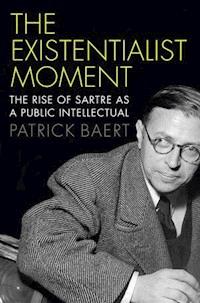
Jean-Paul Sartre is often seen as the quintessential public intellectual, but this was not always the case. Until the mid-1940s he was not so well-known, even in France. Then suddenly, in a very short period of time, Sartre became an intellectual celebrity. How can we explain this remarkable transformation?
The Existentialist Moment retraces Sartre�s career and provides a compelling new explanation of his meteoric rise to fame. Baert takes the reader back to the confusing and traumatic period of the Second World War and its immediate aftermath and shows how the unique political and intellectual landscape in France at this time helped to propel Sartre and existentialist philosophy to the fore. The book also explores why, from the early 1960s onwards, in France and elsewhere, the interest in Sartre and existentialism eventually waned. The Existentialist Moment ends with a bold new theory for the study of intellectuals and a provocative challenge to the widespread belief that the public intellectual is a species now on the brink of extinction.
Sie lesen das E-Book in den Legimi-Apps auf:
Seitenzahl: 479
Veröffentlichungsjahr: 2015
Ähnliche




















To Emma, Sebastian and Audrey
The Existentialist Moment
The Rise of Sartre as a Public Intellectual
Patrick Baert
polity
Copyright © Patrick Baert 2015
The right of Patrick Baert to be identified as Author of this Work has been asserted in accordance with the UK Copyright, Designs and Patents Act 1988.
First published in 2015 by Polity Press
Polity Press65 Bridge StreetCambridge CB2 1UR, UK
Polity Press350 Main StreetMalden, MA 02148, USA
All rights reserved. Except for the quotation of short passages for the purpose of criticism and review, no part of this publication may be reproduced, stored in a retrieval system, or transmitted, in any form or by any means, electronic, mechanical, photocopying, recording or otherwise, without the prior permission of the publisher.
ISBN-13: 978-0-7456-8543-4
A catalogue record for this book is available from the British Library.
Library of Congress Cataloging-in-Publication Data
Baert, Patrick, 1961-The existentialist moment : the rise of Sartre as a public intellectual / Patrick Baert.pages cmIncludes bibliographical references and index.ISBN 978-0-7456-8539-7 (hardcover : alk. paper) -- ISBN 0-7456-8539-0 (hardcover : alk. paper) -- ISBN 978-0-7456-8540-3 (pbk. : alk. paper) -- ISBN 0-7456-8540-4 (pbk. : alk. paper) 1. Sartre, Jean-Paul, 1905-1980. 2. Existentialism. I. Title.B2430.S34B255 2015194--dc23
2014043776
The publisher has used its best endeavours to ensure that the URLs for external websites referred to in this book are correct and active at the time of going to press. However, the publisher has no responsibility for the websites and can make no guarantee that a site will remain live or that the content is or will remain appropriate.
Every effort has been made to trace all copyright holders, but if any have been inadvertently overlooked the publisher will be pleased to include any necessary credits in any subsequent reprint or edition.
For further information on Polity, visit our website: politybooks.com
Contents
Cover
Title Page
Copyright
Acknowledgements
Introduction
The question
Existing accounts
Dreyfus and the notion of the intellectual
Theoretical orientation and hypotheses
Structure of the book
Notes
1 Occupation, intellectual collaboration and the Resistance
German occupation and Vichy
Intellectuals and collaboration
Intellectuals, non-collaboration and Resistance
Concluding comments
Notes
2 The purge of collaborationist intellectuals
Antecedents and developments of the professional purge
The trials: context and complexities
The trials: prosecution and defence
Concluding comments
Notes
3 Intellectual debates around the purge: responsibility, purity, patriotism
The intellectual climate immediately following the liberation
‘La République du silence’
‘Paris sous l’occupation’
‘Qu’est-ce qu’un collaborateur?’
Concluding comments
Notes
4 The autumn of 1945
Les Chemins de la liberté and Le Sang des autres
Les Temps modernes
L’Existentialisme est un humanisme
Concluding comments
Notes
5 Sartre’s committed literature in theory and practice
Theory of literature
Anti-Semitism
Concluding comments
Notes
6 Rise and demise: a synthesis
The rise: a synthesis
The fall
Notes
7 Explaining intellectuals: a proposal
Deficiencies of existing accounts
Performativity
Positioning
Performative tools, narratives and the profane
Relational logic
Cooperation and individualization
Philosophical and methodological issues
Transformation of the public intellectual
Notes
Index
End User License Agreement
Guide
Cover
Contents
Begin Reading
Pages
ii
iii
iv
vi
1
2
3
4
5
6
7
8
9
10
11
12
13
14
15
16
17
18
19
20
21
22
23
24
25
26
27
28
29
30
31
32
33
34
35
36
37
38
39
40
41
42
43
44
45
46
47
48
49
50
51
52
53
54
55
56
57
58
59
60
61
62
63
64
65
66
67
68
69
70
71
72
73
74
75
76
77
78
79
80
81
82
83
84
85
86
87
88
89
90
91
92
93
94
95
96
97
98
99
100
101
102
103
104
105
106
107
108
109
110
111
112
113
114
115
116
117
118
119
120
121
122
123
124
125
126
127
128
129
130
131
132
133
134
135
136
137
138
139
140
141
142
143
144
145
146
147
148
149
150
151
152
153
154
155
156
157
158
159
160
161
162
163
164
165
166
167
168
169
170
171
172
173
174
175
176
177
178
179
180
181
182
183
184
185
186
187
188
189
205
206
207
208
209
210
211
212
213
214
215
216
217
218
219
220
221
222
223
224
225
226
227
228
229
230
231
ACKNOWLEDGEMENTS
I would like to thank Elliott Karstadt, India Darsley and Susan Beer at Polity Press for their help and patience with this project. I am also grateful to John Thompson, who has been encouraging throughout and provided important input at crucial points. I wish to thank Bruno Frère, Marcus Morgan and Flore Cuny for reading the whole manuscript carefully and for suggesting significant improvements. I would like to thank various people who have commented substantially on sections of the book, or on my conference presentations related to the book: in particular, Jeffrey Alexander, Ed Baring, Damian Catani, Randall Collins, Emma Murray, Gisèle Sapiro, Alan Shipman and Darin Weinberg. The comments by anonymous reviewers have been extremely helpful, for which I am most grateful.
Some of the research and writing took place while I visited the Sociology Departments of Brown University and the University of Cape Town, as well as the Centre européen de sociologie et de science politique (CNRS-EHESS-Université de Paris I Panthéon Sorbonne). I am also thankful to staff at the British Library, the University Library in Cambridge and the Bibliothèque nationale de France.
The research leading to these results has received funding from the European Union Seventh Framework Programme (FP7/2007-2013) under Grant Agreement no. 319974 (INTERCO-SSH). This book also benefited from a Leverhulme fellowship (RF-2012-339) and a British Academy small grant (SG102163).
INTRODUCTION
The question
Jean-Paul Sartre achieved an astonishingly high public profile during his heyday. Commentators invariably refer to the huge crowds at his funeral (50,000 according to one estimate), but the evidence for his public standing in France (and indeed abroad) goes well beyond this single event. Sartre’s books and plays have been a remarkable success, and once he had come to public prominence he managed to draw large audiences whenever he gave lectures. The amount of sustained media attention and his political influence in France and abroad has been unrivalled.
This book is an attempt to comprehend this extraordinary case of public celebrity. We will not be discussing at length all of Sartre’s forays into politics which stretched over a period of nearly four decades; there are many books that have documented this aspect of his biography extremely well.1 Instead, we will try to focus on the period, in France, when Sartre rose from relative obscurity to public prominence. We call it the ‘existentialist moment’ because we are talking about a short time span, one in which not just Sartre, but also his philosophy, caught the public’s imagination.
Popular conceptions of Sartre tend to locate his rise and that of existentialism in the context of the political turmoil of the 1960s and the student movement, but closer scrutiny shows that this was a period when Sartre’s philosophical status – and, to some extent, his public impact – was already on the wane. Sartre came to public prominence much earlier, in the mid-1940s. His popularity and that of his philosophy rose dramatically in a remarkably short space of time, between 1944 and 1947 – especially in the autumn of 1945. This is not to say that there was no interest in his writings before 1944,2 but it was primarily limited to a specialist audience.3 By early 1944 Jean-Paul Sartre and existentialist philosophy were still little known beyond a small circle, with his magnum opus, L’Être et le néant, virtually unnoticed when it was published initially.4 Yet, within a mere two to three years, Sartre would turn into a major public figure and existentialism would become vogue. After 1947 Sartre and his fellow existentialists managed to maintain a high profile, though there was no longer a significant rise in their popularity and their philosophy played increasingly less of a role. Indeed, from the late 1940s onwards, the political issues of the day, rather than philosophy, underscored the public appearances and writings of Sartre, de Beauvoir and Camus, as they, like most other intellectuals in France, became embroiled in the cold war over which they eventually fell out.
The central question, therefore, is twofold: one aspect deals with timing, the other with Sartre’s philosophy itself. Firstly, why did Sartre and his philosophical movement gain such rapid intellectual acceptance with an artistic and popular following in France at this particular time – between 1944 and 1947, not before or after? Secondly, why during this period was it Sartre’s existentialist movement that was so successful in gaining popularity? After all, Sartre’s philosophical writings were rather opaque and the philosophical current of existentialism had a remarkably small following in France before 1944. Further, the philosophical origins of Sartre’s existentialism were distinctly German and were indebted to the work of Martin Heidegger, who had been tainted by his closeness to the Nazi regime during the 1930s.
To make sense of the rapid rise of Sartre in the mid-1940s in France, we will analyse various aspects of the socio-political climate at the time, two of which are worth flagging up here. Firstly, between 1940 and 1945, French intellectuals became involved in intense power struggles in which those seen to be associated with the Resistance were ultimately victorious. In this context, we study the activities of the Comité national des écrivains, the Resistance organization of writers, as well as the purge (épuration) of collaborationist intellectuals. We explore how some of the themes that were raised at the trials of collaborationist intellectuals, such as the notion of the author’s responsibility, fed into Sartre’s existentialist concerns. Secondly, we analyse the role of Sartre in the repairing of severed social ties and the remaking of French nationhood. We argue that the notion of cultural trauma5 is particularly apt to describe the state of France at the time. Cultural trauma refers to a widespread sense that certain events – in this case, Vichy and the occupation – caused collective distress and irredeemable damage, potentially threatening the social fabric of society. Sartre expressed a sense of cultural trauma – without using those words – but also, crucially, provided a vocabulary to come to terms with it. We argue that it is this dual role that was a key to their success.
In what follows, we will explore how Sartre wrote about the trauma of the war, rather than focus on which events were intrinsically traumatic or were more likely to be experienced as such. So we want to find out how effective Sartre, in comparison with others, was in making his views heard and through which channels his accounts of the war were disseminated. Which types of arguments did he invoke to support their views? Which past events or actions were portrayed as pernicious, and who was to be blamed? According to him, how can the French people move beyond these events? How, in the process, did Sartre position himself?
Exploring, as we do, how intellectuals such as Sartre wrote about cultural trauma – rather than studying the traumatic events as such – is not to deny that what happened between 1940 and 1944 had been exceptionally disruptive, confusing and a harrowing experience for many French people in a variety of ways. Not only did the rapid military defeat come to many as a surprise, with nearly seven million people fleeing southwards to avoid the war zone; as many as 92,000 French soldiers died between 1939 and 1940 and 1,850,00 soldiers ended up in German prisoner camps.6 Under the conditions of the ‘armistice’, France was divided up. Alsace and Lorraine were annexed, ‘Germanized’ and subjected to conscription, resulting in the mobilization of 130,000 men for the German war effort. A large part of France, including Paris, remained under German occupation throughout the war, and even in the South the so-called ‘free zone’ would eventually – in November 1942 – be occupied as well and divided up in a German and Italian zone of occupation.7 The term ‘free zone’ was highly misleading: Pétain’s État français (as the Vichy regime called itself) involved active collaboration with Nazi Germany that included the rounding up of political opponents and ethnic minorities, resulting in the imprisonment of more than 130,000 people and the deportation of 76,000 Jews.8
Throughout its history, French society had regularly been ‘divided against itself’, as the aftermath of the French Revolution and the Dreyfus affair testify. The events leading up to the war had already increased political tensions within France, with Léon Blum’s Front populaire acting as a focal point,9 and the Vichy regime accentuated even more what came to be referred to as the ‘guerre franco-française’ – the internal war within France.10 Keen to find a scapegoat so as to overlook the strategic errors of the military command, Pétain repeatedly blamed the ‘decadence’ of the Front populaire for the defeat in the war. With its traditionalism and close links to the Church, Pétain’s ‘national revolution’ was hostile to the values of the French Revolution, and indeed Pétain’s dictum ‘Work, family, fatherland’ (‘Travail, famille, patrie’) stood clearly in opposition to the republican values ‘Freedom, equality, solidarity’ (‘Liberté, égalité, fraternité’). Jews, freemasons and communists were portrayed as particularly responsible for the national humiliation, and they were excluded from the civil service and professions.11
As the war continued, economic tensions rose. Germany’s exploitation of the French economy became more apparent, with a considerable proportion of French agricultural and industrial production set to fuel the war economy. Particularly unpopular was the obligatory labour service in France, which was initially set up on a voluntary basis but became compulsory from September 1942. During the war, approximately 700,000 French men were repatriated to work in Germany, of whom a mere 40,000 were volunteers. Under those increasingly problematic circumstances resentment grew and eventually developed into a strong Resistance movement. The activities of the Resistance led to German retaliations, whereby innocent people were taken hostage and executed, something which contributed dramatically to people’s antagonism towards the occupying force, but which also divided opinion in France, at least for some time, as to the wisdom and effectiveness of the Resistance. During the war, tens of thousands of members of the Resistance were either killed immediately or deported to extermination camps where most of them died. By the mid-1940s, the heroics of the Resistance were celebrated, with the French Communist Party, which played a central role in the organization, calling itself ‘the party of the 75,000 executed people’.12
In sum, during the war, France was divided geographically and politically. We will show throughout the book that these political divisions were also played out in the intellectual realm, with collaborationist and Resistance intellectuals pitched against each other and with lives literally at stake. By the mid-1940s, several intellectuals tried to make sense of this confusing episode of French history, a stage in which they themselves had performed many parts. We shall see how the experience of the war and the way in which politicians and intellectuals dealt with it led to a radical reshaping of the intellectual scene, with the curtains finally falling on the dominance by sections of the old literary establishment. It is against this background that we will explain Sartre’s rise.
Existing accounts
There is a wide body of academic literature on existentialism, and on Sartre in particular, approaching the topic from a variety of angles. Most secondary sources attempt to elucidate the philosophy or to analyse the novels and plays associated with it. In contrast, little systematic commentary is available on why existentialism gained such prominence when it did. Within this limited body, two sociological types of explanations can be identified: a Bourdieusian perspective and Randall Collins’ network approach.
Firstly, some commentators present an analysis that is indebted to the work of the French sociologist Pierre Bourdieu. Anna Boschetti’s Sartre et ‘Les Temps modernes’13 is one of the most accomplished examples of this genre. Boschetti draws heavily on Pierre Bourdieu’s sociological theory of cultural production, and central to her Bourdieusian outlook is his notion of field. She defines the field as any system of social relations that has its own logic; it is precisely this logic that accounts for its specific development.14 The cultural field is one such field, which, in the case of France, is exceptionally unified, centralized and hierarchical. The French cultural field, like any cultural field, involves a fierce struggle over symbolic recognition. Within this cultural field, only a limited group that is already consecrated itself – a small circle of cultural producers, editors, publishing houses and journals – can bestow legitimacy onto the producers. In this Bourdieu-inspired perspective, some people are better equipped to compete than others, and different fields require different types of resources or ‘capital’. Educational or cultural capital proves to be essential in the cultural field in general but there is an added complexity in the French case. In the nineteenth century, the cultural arena was divided between the literary and academic world; they constituted separate fields, each with its own logic. It is only in the course of the twentieth century that the two fields started to intersect, and few people managed to combine the requirements to excel in both fields.
Following Bourdieu closely, Boschetti pointed out that Sartre’s profile – his habitus and his personal trajectory – is particularly well suited to the fields in which he would later operate and fitted the requirements of the successful intellectual; she refers in particular to his upbringing at home, his entry to the École normale supérieure and the agrégation. Those experiences provide him with the necessary skills, confidence and authority to excel. Boschetti was keen to show how Sartre at various stages of his career embodied and benefited from his privileged parcours. In addition, Boschetti explained that Sartre’s era was different from that of the nineteenth century, which was characterized by a sharp division between novelists and professors. The former were often self-funded and invariably came from privileged backgrounds, whereas the latter went through the meritocratic channels of the École normale. It is only in the course of the early twentieth century that the worlds of novelists and professors would meet, with an increasing number of intellectuals able to cross from one realm to the other. Sartre’s popularity can be explained mainly by his unprecedented ability to stand out in those two genres, using them as complementary channels for his ideas, as he managed to compete successfully in both the literary and philosophical fields.15 In short, Boschetti explains Sartre’s success primarily by how he managed to be a total intellectual: journalism would allow him to add another string to his bow. She insists, though, that Sartre should not be seen as a maverick: rather than undermining established models, his trajectory ensures that his practices are perfectly in harmony with the logic of the different fields in which he operates.
Besides the primary explanation, she provides a couple of secondary accounts. Firstly, she asserts that the success of Sartre’s existentialist philosophy can be partly explained by the way in which it implicitly propelled the intellectual – depicted as aloof and superior – to the centre stage and was therefore likely to appeal to the rapidly increasing number of teachers and professors.16 Secondly, towards the latter parts of the book Boschetti draws attention to how Sartre was able to rely on a small circle of intimate friends who were powerful intellectuals in their own right, each occupying editorial positions in literary journals and in newspapers and therefore able to help the others with favourable reviews of their work. It is within this context that she explores the role of Les Temps modernes, launched in 1945, which provided the basis for Sartre to establish a hegemonic power base and keep it for a relatively long period of time.17
One of Boschetti’s strengths lies in analysing the inner logic of the French field of intellectual production, with its distinctive elite institutions such as the École normale. Drawing on Bourdieu’s framework, Boschetti also presented a cogent argument as to why, compared to other contemporaries, Sartre was, as an individual, so tremendously successful in advancing his career and public profile. However, although it is true that Sartre managed to excel in various domains and although this might have given him an advantage over others whose activities were limited to one domain, it would be farfetched to argue that this is the main explanation for why so many people were particularly receptive to his ideas, especially given that in French intellectual history Sartre has not been the only one to combine philosophy, literature and journalism and to do so successfully. One of the problems with Boschetti’s analysis is a tendency to treat the intellectual sphere as a relatively autonomous unity, thereby sometimes ignoring how socio-political factors outside the intellectual arena interact with it. In this context, it is interesting to note that Boschetti writes that ‘… Sartre’s later success makes it clear that this widespread, tumultuous recognition of his supremacy cannot be explained simply in terms of a particular conjunction of circumstances at the Liberation’.18 However, Boschetti’s tendency to ignore the wider socio-political context at the time makes it difficult for her to explain why the rise of Sartre and existentialism occurred during this particular period – not before, not after. While methodologically Boschetti is justified in focusing mainly on Sartre, unfortunately her main explanation for his significance occasionally draws on an equally individualistic logic, focusing as it does on his unique and multiple qualities that supposedly gave him a considerable advantage over his competitors in the Parisian intellectual field. For all its Bourdieusian terminology and sociological sensibilities, her account sometimes resembles the catch-all explanation that Sartre’s success is due to his genius or unrivalled charisma albeit socially induced, and this explains why Jean-François Louette describes her perspective as a thinly veiled ‘psychologism’.19 Boschetti is at her strongest when she discusses broader societal developments that impinged on the cultural sphere (such as the rapid increase of highly qualified teachers and professors in the first half of the century) but she fails to pay sufficient attention to the specific conditions at the end of the war and their dramatic repercussions for the intellectual field.
Drawing our attention now to the network approach, Randall Collins’ Sociology of Philosophies20 is an ambitious attempt at a general theory of intellectual change, with a particular focus on transformations within the discipline of philosophy. The theory is applied to no fewer than three centuries of philosophy worldwide, and one of the chapters is devoted partly to French existentialism. Collins’ explicitly sociological stance underscores his criticisms of various engrained perspectives on the history of ideas.21 He is critical of those approaches that conceive of culture – for instance, language – as autonomous of society, and he distances himself from the type of intellectual history that attempts to show, through a detailed investigation of arguments and counterarguments, how one set of ideas brings about another. Collins is critical too of the type of intellectual history that glorifies the individual and his or her creative output, thereby bracketing out the social context in which the production took place. For him, to recognize the situated nature of intellectual activities is not to imply, as ‘postmodernist’ authors tend to do, the impossibility of making generalizations and establishing causal patterns. Collins insists that generalizations can be made and patterns can be found as long as we build on his general theory of interaction rituals and are sensitive to the distinctiveness of interactions between intellectuals.
Drawing on his wider theory of interaction ritual chains,22 Collins’ core idea is that intellectual creativity and production are embedded in personal relations and networks of face-to-face interaction; those relations transmit emotional energy and cultural capital.23 Both emotional energy and cultural capital are crucial for creative process; the former because it is a motivating force, the latter because it helps to direct creative output effectively. From this, it follows that it is a mistake to conceive of ideas as rooted in individuals or individual minds; ideas are anchored in networks and motivated to a considerable extent by rivalries between individuals and between groups of individuals. Young aspiring intellectuals are drawn to high-status intellectual groups and are energized when working under or with an important mentor.24 They compete for the attention of the mentor, with only a few receiving his or her patronage and intellectual direction. Eminent and influential mentors are best placed to provide intellectual guidance to their students, indicating which intellectual avenues are worth pursuing and likely to pay off. These mentors and their students can then form influential schools but there is an upper and lower limit to how many such schools can coexist. Collins calls this the ‘law of small numbers’, which states that only three to six successful creative schools can exist at one time.25 Fewer than three is unlikely due to the competitive nature of intellectual life. If more schools emerge, a competitive struggle will eventually lead to the survival of the three to six ‘fittest’; the others will be wiped out.
In the chapter ‘Writer’s markets: the French connection’, Collins26 shows that existentialism was after 1945 one of those competitive creative schools. For him, the French educational system of the 1920s was particularly conducive to the intellectual synergies that later resulted in the existentialist movement. The highly selective, competitive and hierarchical nature of the intellectual field brought together the most ambitious and talented individuals of their generation. Their intense interactions within institutions like the École normale forged the type of networks that are so important for creative intellectual production. By tracing the connections between Sartre, de Beauvoir, Paul Nizan, Georges Canguilhem, Maurice Merleau-Ponty and Raymond Aron, Collins shows that, here again, personal relations and the concentration of emotional energy and cultural capital account for the creative output that took place.27 This local French network is embedded in a broader German network that includes key phenomenological philosophers like Husserl and Heidegger and importers of German ideas, like Koyré and Kojève. Sartre acts as the ‘energy vortex’ of the network, benefiting from the unusually high cultural capital that he had amassed at home and at the École normale. However, his considerable educational and cultural resources only explain part of his success; the role of the publisher Gallimard is more important for two reasons. Firstly, the publishing house operated like a ‘network centre’, putting innovative thinkers in touch with each other and bringing new German ideas to the attention of French intellectuals. Secondly, from the 1930s onwards, Gallimard revolutionized publishing in France by bringing out cheap paperbacks which suited hybrid forms of literature and philosophy like existentialism.
Collins’ analysis is particularly persuasive in locating French existentialism within a broader set of intellectual networks going back to the nineteenth century and covering several European countries. Collins’ network approach also alerts us to, and helps us to establish, the various personal connections that provided the necessary motivation and sense of direction for Sartre and his fellow existentialists. Collins’ explanation of why existentialism came to the foreground is most convincing when he takes into account exogenous forces, which influence the arena of intellectual production, such as shifts within the publishing industry or within the writers’ market. The question still remains as to why those personal networks, which he identified, produced ideas that appealed beyond the safe contours of the intellectual elite. Collins might be right that the intensive interaction between students at the École normale is conducive to creative production but his notion of emotional energy remains vague and could be attributed to other normaliens as well. Collins’ framework is unable to account for why it was Sartre and existentialism – not some other figure or a different intellectual strand – that rose in the mid-1940s and reached a broader audience. Nor does it explain why it was around 1945 – not earlier or later – that Sartre became a public intellectual and existentialist philosophy caught the public imagination. Collins also points out the importance of the arrival of the paperback and a broader mass market, but again other intellectual currents could have exploited these changes just as effectively. Furthermore, the paperback editions only came off the ground in France during the course of the 1950s – several years after Sartre’s rise and that of existentialism.
Part of the problem lies in Collins’ insistence that the intellectual field is relatively autonomous from other societal developments and, relatedly, in his focus on the inner dynamics of the intellectual world. While in his chapter on French intellectual life he does pay attention to the economic dimensions of intellectual production, his analysis still holds on to the notion that the ‘… distinctive contents of intellectual creativity … derive from the inner struggle for attention in the intellectual space’.28 This makes his approach less suitable for explaining why, at a particular point, some intellectuals, and indeed some intellectual currents, have a broader appeal. More precisely, Collins never properly investigates what he calls the ‘distinctive contents’ of Sartre’s writings, nor does he fully appreciate the extent to which they tied in with the broader cultural climate of the mid-1940s. In our research, we shall analyse Sartre’s work during this period, ranging as it did from journalistic pieces to theoretical tracts. We shall see how Sartre reformulated his earlier existentialist position in ways which resonated with the societal sensitivities at the time. It is this affinity that was crucial in Sartre’s rise and the dissemination of his ideas.
Besides these two sociological works (Boschetti and Collins), it is surprising that there are no major, well-developed attempts to account for Sartre’s rise. Indeed, it is remarkable how few intellectual historians and literary specialists have systematically tried to provide this explanation.29 One possible exception is Ingrid Galster’s edited collection La Naissance du ‘phénomène Sartre’,30 with most of the contributions being by trained historians or specialists in French literature. Based on a conference, Galster’s volume contains some insightful contributions (including from people who witnessed Sartre’s rise first hand or who had worked closely with him), but the chapters are uneven, their article-length limits their scope and significance and there is little that connects then. So the book as a whole does not provide a cohesive argument, and indeed Galster uses the introduction to set out the different perspectives and even to distance herself from some of the contributors.
Nevertheless, there are plenty of secondary sources on Sartre that drop tentative hypotheses as to his success without elaborating or properly defending them. It is worth discussing four of the most recurrent narratives that have become part of the received wisdom about Sartre, if only to show why we regard them as unconvincing or at least incomplete and how our take differs from theirs. The first recurrent explanation that can be found in the literature centres around Sartre’s individual qualities. This can take different forms: we are told that his success was due, for instance, to his intellect, his charisma, charm, adaptability, opportunism or simply his determination, ambition and work ethic.31 While these factors played a role, any such type of explanation in terms of individual attributes, in isolation, is problematic. Take the two characteristics that seem most obviously connected to success: natural aptitude and hard work. There is no doubt that Sartre was very gifted and prolific – later on he would famously resort to amphetamines to enhance his productivity – but many other French writers at the time were talented and industrious. Furthermore, as many writers and artists will testify, work that is later regarded as exceptional can go unseen for decades or even a lifetime. Talent and charisma only come to the fore once recognized by the public, so we need an account for the connection (or lack thereof) between the intellectual and his or her audience. To explain Sartre’s rise by referring to his extraordinary abilities risks drawing on a circular argumentation precisely because his success and people’s recognition of his abilities are so intertwined. What needs to be explained is why at some point people started to recognize him as a man of talent who had something significant to say. It is the intersection between Sartre and the public that should be our focus of attention, not merely Sartre’s idiosyncratic qualities.
A second type of argument focuses mainly, if not exclusively, on the autumn of 1945. Many secondary sources stress the significance of these few months, pointing out that it was at that point that their publications, performances and new ventures accumulated in what became known as the ‘existentialist offensive’. Some narrow it down even more and identify Sartre’s public lecture L’Existentialisme est un humanisme of 29 October 1945 as decisive.32 Now, it is correct that it was around this time that Sartre and de Beauvoir achieved a celebrity status in France, and we will be discussing this important period (including the lecture) at length in chapter 4. The problem, however, with those accounts that centre round the autumn of 1945 is twofold. Firstly, they tend to remain descriptive, outlining a sequence of events that culminated in the existentialist frenzy, without delving further into the mechanisms that made it possible. Secondly, they bracket out the broader historical context which is so important for understanding Sartre’s rise as a public intellectual. To take what is basically a snapshot – the autumn of 1945 – is to ignore the significance of developments in preceding years. It is our contention that by 1945, the experience of the war, with all its trauma and complexity, had already brought about a dramatic and irreversible shift in the political and intellectual scene, and it is this shift which enabled the existentialist offensive to succeed. Sartre’s positioning enabled him to tap into complex collective sentiments of guilt, pride and shame which had engulfed the French nation. In sum, to make sense of how, by late 1945, Sartre had managed to connect with the French public and to become a quasi-mythical figure, we need to understand how the war had reshaped the intellectual landscape and, crucially, people’s sensibilities and concerns.
A third account suggests that around 1945 existentialist thought became popular because it was associated with the relaxing of morals, did not impose any substantial imperatives and formed a much-needed antidote to the repressive years of Vichy.33 At the time the portrayal by the popular press of Sartre and the Left Bank helped to consolidate this picture of a carefree generation. This third account is superior to the two other ones in that it focuses on the connection between Sartre and the public and on the significance of the historical context of the occupation and collaboration. It is also correct that Sartre positioned himself strongly in opposition to Vichy and its conservative values. Closer scrutiny, however, shows this explanation to be problematic in a variety of ways. Besides the fact that it is vague and needs further specification, it also rests on the problematic assumption that existentialism hardly imposed any burden on the individual. While it is true that around this time Sartre reformulated his thought and centred it round the notion of freedom, his existentialism, as we shall see, puts a considerable burden on the individuals, forced as they are to take responsibility for all their actions and the consequences of those actions. Also, although Sartre had not yet embraced Marxism, there was already a strong moral voice to his work, siding with the underdog. To suggest that Sartre’s existentialism was experienced as a licence for unbridled freedom ignores his strong moral vocabulary at the time and the centrality of the notion of responsibility. While this account rightly hints at the significance of the experience of the war and of the relationship between Sartre’s ideas and the existing collective sentiments, we are in need of a more refined and empirically grounded analysis of this process.
A fourth account uses the notion of generation as an explanatory concept. Indeed, a considerable amount of literature in nineteenth- and twentieth-century French intellectual history alludes to the power of generational shifts, especially if the generations concerned experienced very different socio-political developments.34 The underlying assumption is that shared experiences account for similar sensitivities, possibly resulting in related intellectual endeavours, likes and dislikes. In sum, it is assumed that significant experiences, such as a war, have lasting effects on the collective psyche and therefore the intellectual output. The focus here is mostly on accounting for the causes of the intellectual products rather than their reception, but sometimes the distinction gets blurred and generations are invoked to account for changing sensibilities of audiences. We are not unsympathetic towards this argument, and the central thesis of this book has affinities with it in so far as it allocates a pivotal role to the notion of shared experiences. Indeed, the aim of this book is to demonstrate how the French experience of the Second World War played a significant role in the rise of existentialism in the mid-1940s. But resorting to an explanation in terms of generations is by itself insufficient for two reasons. Firstly, the notion of generation is too blunt an instrument to capture the complex relationship between experience and intellectual sensitivities. If anything, it begs for an explanation rather than providing one – what is it about a particular shared experience that accounts for those sensitivities? Secondly, there is the added complexity that different age groups experience the same significant event such as a war. Of course, significant events might mark younger people more than others as they are still in their formative years, but even that very much depends on a variety of factors such as, for instance, their level of exposure and involvement.
Theoretical orientation and hypotheses
Before we set out our tentative hypotheses, it is worth clarifying some concepts that will be used in what follows. We firstly distinguish ‘intellectuals’ from ‘critics’. By intellectuals, we are referring to those who tend to produce relatively innovative intellectual goods, like plays, novels or philosophical treatises. In contrast, critics, including many journalists, tend to paraphrase and comment on those products in journals or newspapers with a relatively wide circulation. Of course, intellectuals occasionally also comment on the work of other intellectuals in magazines or serials, and, likewise, critics occasionally produce intellectual work of their own. So the distinction is one of degree, but nevertheless of importance because the critic can play the role of gatekeeper, helping or halting the dissemination of intellectual works. We shall see that Sartre and his fellow existentialists, while primarily acting as intellectuals, also regularly took on the role of critics, commenting on each other’s work.
Secondly, we distinguish between the ‘intra-intellectual arena’ and the ‘public intellectual arena’. Within the intra-intellectual arena, professional intellectuals address mainly other professional intellectuals. One of the defining features of the intra-intellectual arena is that it is mainly governed by the intellectuals themselves. The public-intellectual arena is quite different, admitting a degree of validation by the ‘consumers’ of knowledge as well as the producers. Public intellectuals, by definition, address a broader audience, and the success of public-intellectual output is determined not solely by intellectuals, but also by the media – professional journalists and commentators – and publishers.
Three additional clarifications need to be made about the distinction between the intra-intellectual and public intellectual arena. The first clarification concerns the precise nature of the intra-intellectual arena and its relationship to the academy. The self-regulatory principle of the intra-intellectual world is epitomised by the Humboldtian notion of the university according to which the academic world is largely managed by the academic producers themselves: they set the agenda, comment and adjudicate on the writings and careers of their colleagues.35 The intellectual status of theories and evidence is established by academic peer review, not public accessibility, acceptance and popularity. Even if increasing government interference, a rising audit culture and budget cuts have meant the gradual erosion of the Humboldtian vision,36 universities still operate with a certain level of autonomy. However, the intra-intellectual domain does not have to be limited to the realm of the academy. It can also refer to writers who operate outside the contours of the university but whose writings are read by a limited group of other specialized producers. Like many other writers of his circle, Sartre never held an academic position; he was a secondary school teacher until the early 1940s. His philosophical essays of the 1930s and his L’Être et le néant – the former are to a certain extent precursors to the latter – made him a respected figure among a small specialized public. While he had published La Nausée and Le Mur before the war and had staged Les Mouches under the occupation, his existentialist philosophy did not reach a wider public until the end of the war.
The second clarification about the typology concerns its resemblance to Bourdieu’s distinction between the field of restricted cultural production and the field of generalized cultural production.37 For Bourdieu, in the field of restricted production producers address other producers and defy an economic logic; in the field of generalized production producers address a broader public and embrace a business model. There is a subtle difference, though, between Bourdieu’s distinction and the one which we use here. His typology reflects his presupposition about how the two fields bring about different cultural products: he believes that the field of restricted production encourages innovative high-brow products and the field of generalized production generates medium-brow replications of a set format. We make no such assumption and focus instead on the dissemination of intellectual ideas from one arena to the other.
The third clarification concerns the relative coverage of the intra- and public intellectual arena in the sociological literature. The intra-intellectual arena has been the subject of extensive sociological analyses.38 Over the last couple of decades, an impressive body of research has emerged, ranging from theoretical reflections on the hegemonic force of elite academic institutions39 and the dispositions of university professors40 to carefully crafted reconstructions of the strategies of academics within their institutional context.41 However, there are limits to the usefulness of this research for understanding the public intellectual arena because the latter operates according to a distinctive logic. Being less sealed off and addressing a broader audience, public intellectuals are more dependent on the media and critics. They can sometimes use a public audience to overcome resistance from a sceptical intellectual elite, appealing to the public ‘over the heads’ of academic peers. Whereas there are plenty of general accounts of the phenomenon of the public intellectual,42 sociological accounts of the public intellectual arena are surprisingly scarce, and they often centre on the debate about the public sphere and its possible decline.43 In this context, both historical sociologists44 and historians with a sociological bent45 tend to invoke a supposedly golden era of the public intellectual, while lamenting its alleged decline.46 Although there can be virtue in this sociological reflection, if only to warn academics of the possible caveats of excessive professionalization,47 it does not always provide empirically substantiated insights into the workings of the public intellectual arena and into the conditions under which it may flourish.48 A recent survey of the little research about public intellectuals that is available shows the situation, at least in the US, to be more diffuse and certainly less apocalyptic than Jacoby and Posner suggest.49 Among the few excellent studies that do contribute to knowledge about the public intellectual sphere is, for instance, Michèle Lamont’s article on Jacques Derrida’s impact both within the academy and beyond, Swartz’s piece on Bourdieu’s foray into the public realm and Misztal’s study of Nobel Peace Prize winners.50 In a similar vein, we shall aim to further our understanding of the public intellectual sphere through a case study, one which in some respects involves a public-intellectual arena in its most archetypal form, as represented by mid-1940s France. While focusing on the case of Sartre, the broader underlying question is under which conditions ideas are likely to spread from the intra- to the public intellectual arena.
In what follows, our approach will differ substantially from those perspectives on intellectual life that are predominantly text-based and that are preoccupied with motives and strategies of individual thinkers. Indeed, sociologists and historians of intellectual life often explore the motives and strategies which individuals developed in a given academic context. On a related note, they tend to treat the intellectual field as in relative isolation from external factors. As the focus here is on the diffusion of a set of ideas from the intra- to the public intellectual domain rather than on the intentions of those who spread the ideas or on the precise meanings of the ideas, it becomes particularly important to broaden our perspective well beyond the safe contours of texts and individual strategies and to be sensitive to the broader institutional and cultural dimensions that have bearing on the intellectual field without being confined to it. Without necessarily siding with all dimensions of actor-network theory as defined by Bruno Latour,51 the approach adopted here has affinities with one aspect of it in so far as it consciously avoids imposing too rigid a theoretical framework from the outset and it makes an effort not to exclude a priori any factors that might have been constitutive of the making of the existentialist movement.
While avoiding a rigid frame of reference, we nevertheless adopt a theoretical orientation. This introduction is not the place to elaborate on the perspective underlying this research, except to say that it centres round the idea that through their work writers position themselves intellectually and that this positioning affects whether their ideas are taken up by others and, if successful, how they are adopted. For those readers interested in the theory, we refer to the final chapter where we expand on this idea and where we revisit some of the empirical material in the light of the new theory proposed. For now, we shall clarify some of the hypotheses which provide a guiding framework for this study.
Our starting assumptions are threefold. Firstly, ideas are more likely to spread from the intra- to the public intellectual domain if they are ‘packaged’ in terms of a coherent intellectual doctrine and ‘labelled’. Writings, public performances and critics help to position the author and present the ideas in a unified fashion and as part of a coherent doctrine. Furthermore, while the spread of the intellectual doctrine or school will undoubtedly depend on the charismatic qualities of those who promote the doctrine and their determination and skills in promoting it, it will also crucially depend on the structural relationship of those intellectuals vis-à-vis the intellectual establishment, the publishing industry and the critics. Finally, whether or not a doctrine manages to enter the public intellectual domain will depend on whether it manages to resonate with recent socio-political experiences and, crucially, whether it does so better than older, established ideas.
On this basis, five concrete hypotheses will guide our research. Firstly, ideas spread more rapidly if their intellectual proponents manage to develop intricate connections within the world of critics. Sympathetic critics will then be able to report favourably and promote the distribution of the writings and the ideas within them. Successful intellectuals tend to have a good rapport with the journalistic world, often taking on the role of commentating themselves. Secondly, the ideas spread more rapidly if the established ideas have lost credibility within society, either because the ideas no longer resonate with a larger public or because the ‘carriers’ of the ideas have lost legitimacy or have diminished authority. Thirdly, the ideas spread more effectively if the publishing industry caters for a ‘high-brow’ mass market, and if the intellectuals are in a relatively strong position vis-à-vis the publishing industry. This strong position enables them to push through their agenda and publicize their ideas. Fourthly, the ideas are more likely to spread if the intellectuals involved use additional communication channels like public lectures and radio or television appearances. The phenomenon of public lectures goes back a long time and became widespread in the course of the nineteenth century, whereas French intellectuals started appearing regularly on the radio as early as the 1940s and on television during the next decade. Fifthly, the ideas will disseminate more effectively if they resonate with the broader cultural climate among the educated classes. The ideas need to strike a chord with their potential audience, allowing them to make sense of their current or recent experiences. The most sophisticated ideas will fail to penetrate the public-intellectual arena if they do not manage to connect with the recent and present experiences of the people involved.
Dreyfus and the notion of the intellectual
As a final introductory point, it is important to dispel a few possible misunderstandings. We are not arguing that Sartre was the first French philosopher to gain public prominence. Henri Bergson, for one, was famous at his time52 and his lectures at the Collège de France attracted huge crowds, especially after the publication of L’Évolution créatrice.53 More importantly, we are not asserting that all aspects of Sartre’s existentialism were exceptionally new or ground-breaking in the French intellectual context at the time, nor are we positing that the broader historical trajectory in the preceding half century proves irrelevant for understanding the rise of existentialism in the mid-1940s. Rather, existentialists revisited historically rooted views about intellectuals and their political engagement – views which acquired a renewed significance at the end of the war. In what follows, we acknowledge the continuity or resemblance between earlier notions of the role of the intellectual and Sartre’s reflections on the same issue, but we focus our attention on those conditions at the end of the war which account for why his particular take on these notions resonated with a wider public and broke through to the public intellectual domain.
It is indeed worth recalling the specific socio-political and intellectual trajectory of France from the late nineteenth century till the end of the war so as to situate the subsequent surge of French existentialism in a broader context. In this period of half a century, one feature stands out as significant for our discussion: the emergence of the modern notion of the intellectual. Intellectual historians tend to agree that the modern concept of the intellectual gained currency especially during the Dreyfus affair in the 1890s, although the term had already been in use slightly earlier.54 While the political divisions between Dreyfusards and anti-Dreyfusards were not as straightforward as previously assumed,55 the term ‘intellectual’ played a pivotal role in the conflict between the two groups. In 1898 a group of academics, students and writers signed two protestations, denouncing the violation of the law in the Dreyfus and Estherházy affair. Contrary to received wisdom,56 the petition was not explicitly a defence of Émile Zola’s ‘J’accuse!’, but it did express similar concerns.57 Shortly afterwards Georges Clémenceau, a defender of Dreyfus, referred to this petition approvingly as the ‘Manifesto of the intellectuals’. One week later the anti-Dreyfusard Maurice Barrès published a little article, entitled ‘La Protestation des intellectuels!’, in which he mocked the use of the term. This acerbic piece popularized the notion, and from then onwards anti-Dreyfusards used it pejoratively and invariably with a sarcastic undertone. For them, ‘intellectuals’ were outsiders, who drew on abstract thinking and who were therefore out of touch with the historical roots of French culture and language. Anti-Dreyfusards also considered intellectuals to be ‘pretenders’: that is, not the genuine article but would-be cultured people, often of foreign extraction and therefore unable to match the cultural and aesthetic attributes of those with a long French ancestry. However, the anti-Dreyfusards were not the only ones using the term. Those Dreyfusards who were targeted swiftly adopted the notion of the intellectual themselves, stripping it of its negative connotations, and using it with pride to refer to themselves as principled defenders of true French values of justice and truth. The intellectual became a self-congratulatory concept. As the Dreyfusards were ultimately victorious, it is no surprise that their notion of the intellectual – and not the pejorative one – became more influential throughout the twentieth century even to the extent that some writers on the right labelled themselves in this fashion.
Important for our concerns are two observations. Firstly, what is particularly striking about the ‘Manifesto of the intellectuals’ is the implied assumption on the part of the signatories that their professional status allowed them to exert authority over the wider public even when they were commenting on a phenomenon well beyond their expertise or specialism.58 Indeed, by the end of the nineteenth century a considerable number of academics and writers appeared convinced that their opinions about socio-political matters were sufficiently important to matter to a broader audience, thereby invoking scorn on the part of anti-Dreyfusards like Ferdinand Brunetière who argued that being an expert in one field does not make you an authority in another. Secondly, the image of the intellectual, invoked by both camps during the Dreyfus affair, is one who is actively engaged in the world, in particular involved in the politics of the day. In that sense, the term ‘intellectual’, as introduced in the late nineteenth century in France, corresponds to the current Anglo-Saxon notion of a ‘public intellectual’. More specifically, this intellectual is tied to the republican cause and defends progressive values based on abstract principles of truth and justice.59L’intellectuel is therefore situated on the left of the political spectrum, although subsequent attempts have been made by right-wing intellectuals to appropriate the term. Finally, intellectuals are anti-conformists who distrust le pouvoir; they present themselves as the voice of reason against government forces.
It is this picture of the intellectual – as authoritative, politically engaged, left-leaning and in opposition to the government – which remained an important feature of the intellectual landscape of the first half of the twentieth century and which eventually fed into the frenzy of the later stages of the Second World War and the liberation. This is not to say that the notion of a committed intellectual had remained uncontested in the first three decades of the twentieth century. For instance, Julien Benda’s La Trahison des clercs famously accused intellectuals of abandoning reason and universal principles in exchange for passion in the pursuit of particular causes (socialism and nationalism), prompting Paul Nizan, a close friend of Sartre, to write Les Chiens de garde, a harsh critique of Benda and a fierce defence of progressive political commitment.60 The 1930s was characterized by a similar ambivalence: while various authors (including Sartre) expressed disillusionment with society and politics and toyed with the idea of art for art’s sake, political events surrounding the Popular Front and the Spanish Civil War sparked off considerable engagement.
We shall see, however, that by the mid-1940s the idea of political engagement had become the new orthodoxy. Key features of the Dreyfusard image of the intellectual reappeared in Sartre’s writings about literature and writing, which explains why some commentators refer to Sartre as a ‘Dreyfusard après la lettre.’61 Just as the petition was associated with the birth of the modern notion of the intellectual, petitions became the hallmark of the era of the intellectuel engagé with Sartre as one of the keenest and most prolific signers. However, we should be careful not to overstate the continuity between the views of the Dreyfusards and Sartre’s thought because the latter presented a coherent philosophical doctrine in which the role of the intellectual was only one, albeit important, ingredient. As we shall see, Sartre incorporated his notion of the engaged intellectual within a much broader existentialist vocabulary that enabled sections of French society to articulate and assimilate the war experience. Therefore, the similarities between Sartre’s views and those of the Dreyfusards are not sufficient to explain why his existentialist framework moved from relative obscurity to prominence between 1944 and 1947, and it is to this question that we aim to provide a multi-layered answer.




