


35,99 €
Mehr erfahren.
- Herausgeber: John Wiley & Sons
- Kategorie: Fachliteratur
- Serie: Wiley Corporate F&A
- Sprache: Englisch
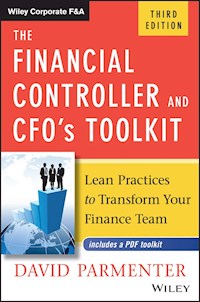
Simplify and streamline your way to a winning legacy The Financial Controller and CFO's Toolkit is a hybrid handbook and toolkit with over 100 lean practice solutions and a wealth of practical tools for senior financial managers of small, midsized and large companies. This book outlines the mindset of paradigm shifters relevant to future-ready finance teams, and contains guidelines on how to become an effective change leader. Guidance from world leading expert David Parmenter provides the insight and tools you need to reach your true leadership potential and achieve more for your organization. Packed with templates and checklists, this book helps you adhere to the best practices in reporting, forecasting, KPIs, planning, strategy, and technology. The companion website--a complete toolbox for positive, entrenched change--gives you access to additional resources that reinforce The Financial Controller and CFO's Toolkit strategy. This new second edition has been updated to reflect the latest practices and technology to streamline your workflow and get more done in less time--without sacrificing quality or accuracy. As an all-in-one resource for the CFO role, this book provides a clear, practical strategy for demonstrating your value to your organization. * Selling and leading change effectively * Get more accurate information from your KPIs * Attracting, recruiting and retaining talented staff * Invest in and implement new essential tools * Investing wisely in 21st century technologies Report the month-end within three days, implement quarterly rolling forecasting, complete the annual plan in two weeks or less, and bring your firm into the 21st century with key tools that get the job done. Be the CFO that your organization needs and the leader that your teams deserve. The Financial Controller and CFO's Toolkit gives you everything you need to achieve more by doing less.
Sie lesen das E-Book in den Legimi-Apps auf:
Seitenzahl: 577
Veröffentlichungsjahr: 2016
Ähnliche
















Table of Contents
Title Page
Copyright
About the Author
Testimonials
Introduction
The Third Version
How to Use the Book
The PDF Toolkit
Reporting History or Making It
Acknowledgments
Part I: Change—Why the Need and How to Lead
Chapter 1: Getting Your Finance Team Future Ready
A Burning Platform?
Reporting History or Making It
Lean Movement
Importance of Abandonment
The Importance of Challenging the Status Quo
PDF Download
Notes
Chapter 2: Leading and Selling the Change
Steve Zaffron and Dave Logan
Harry Mills
John Kotter
Selling to the Senior Management Team
The Power of the Focus Group
PDF Download
Notes
Part II: To Be Completed Before the Next Month-End
Chapter 3: Rapid Month-End Reporting: By Working Day Three or Less
Rating Scale for Month-End Reporting
Benefits of Quick Month-End Reporting
Impact of a Quick Month-End on the Finance Team Workload
Major Steps You Can Do Before Your Next Month-End
Major Quality Assurance Tasks After Day 1
PDF Download
Note
Part III: Technologies to Adopt
Chapter 4: Future-Ready Technologies
Ban Spreadsheets from Core Finance Routines
Seven Technologies to Understand and Evaluate
Planning and Forecasting Tools
Upgrade Accounts Payable Systems
Using a Reporting Tool
Turbo Your G/L with a Friendly Front End
Consolidation and Intercompany Software
Collaborative Disclosure Management
Paperless Board Meeting
Maximize the Use of the Existing G/L
Avoiding the Hard Sell to Upgrade Your G/L
Implementing a New System
PDF Download
Notes
Part IV: Progress You Need to Make within the Next Six Months
Chapter 5: Reduce Accounts Payable Volumes by 60 Percent
Removal of All Charles Dickens Processes
Move to a Paperless Accounts Payable Function
Get Your Electronic Ordering System to Work
Get a Purchasing Card System Implemented as Soon as Possible
How the Purchase Card Works at Month-End
The Better Practices with Purchase Cards
Cut Off Accounts Payable on the Last Working Day
Mount the Last Signed Check on the CEO's Wall
Perform Frequent Direct Credit Payment Runs
Improve Budget Holders' Cooperation
Speed Up Budget Holders' Correction of Omissions
A Welcome Letter to All New Budget Holders
Introduce “Shame and Name” Lists
Reward Good Budget Holder Behavior
Have a Closer Relationship with Your Main Suppliers
Self-Generated Invoices (Buyer-Created Invoices)
PDF Download
Note
Chapter 6: Month-End Reporting Refinements
Avoid Late Timesheets
Minimize Budget Holders' Month-End Reporting
Avoid the Rewriting of Reports
Reporting Based on 4 or 5 Weeks
Delay Changing Your Accounting System
Removing Spreadsheets from the Month-End Routines
Day One Reporting and Virtual Closing
PDF Download
Notes
Chapter 7: Lean Reporting—Informatively and Error Free
The Foundation Stones of Reporting
Concise, One-Page Formats
More Emphasis on Daily and Weekly Reporting
Designing Reports around Current Technology
Error-Free Reporting
Using Best-Practice Graphics
PDF Download
Notes
Chapter 8: Lean Board Reporting
Selling Change to the Board
Scoping of the Information Requests
Avoiding Rewrites of Board Reports
Paperless Board Meeting
Introduce a Change to the Board Meeting Scheduling
Mistakes to Avoid with the Finance Report in the Board Papers
Continually Purging the Board Papers
Moving to Governance Information
A3 (Fanfold) One-Page Board Dashboard
PDF Download
Chapter 9: A Lean Annual Planning Process—Ten Working Days or Less!
Leading and Selling the Change
Foundation Stones of a Lean Annual Planning Process
Efficient Annual Planning Processes
PDF Download
Notes
Chapter 10: Lean and Smarter Work Methods
Techniques to Adopt from the Lean Movement
Post-it Reengineering Workshops
Adopting Scrum Stand-Up Meetings
Adopt Kanban Boards
Toyota's 14 Management Principles
Golden Rules with Emails
Three Books to Read
PDF Download
Notes
Chapter 11: Effective Leadership, Growing and Retaining Talent
Foundation Stones for Leadership That Attracts
Making the Finance Team a Great Place to Work
Putting the Finance Team on the Map
Perform an In-House Customer Satisfaction Survey
PDF Download
Notes
Chapter 12: Quick Annual Reporting: Within 15 Working Days Post Year-End
The Five Stages for a Quick Year-End
Sell the Need for Change
Get Organized
Use Technology to Save Time
Minimize Year-End Stress
Control the Last Mile and Maintaining Quality
Some Case Studies
PDF Download
Note
Chapter 13: Managing Your Accounts Receivable
Operational Improvements to Accounts Receivable
Reporting on Your Accounts Receivable
Avoiding Accounts Receivable Month-End Bottlenecks
Increasing the Use of Direct Debiting Customers' Accounts
Debtors' Collection before Year-End
Chapter 14: Attracting and Recruiting Talent
Ever-Present Danger
The Need to Up-Skill
Law of Attraction
The Recruiting Marathon
Deliver a Good Induction
PDF Download
Notes
Chapter 15: Lean Accounting
Streamlining the Chart of Accounts
Avoid Monthly Cost Apportionment
Value-Stream Accounting
Activity-Based Costing Is Broken
PDF Download
Notes
Part V: How Finance Teams can Help their Organizations get Future Ready
Chapter 16: Implementing Quarterly Rolling Forecasting and Planning
Selling and Leading the Change
Annual Planning Is a Questionable Activity
Myths around Annual Planning
Quarterly Rolling Forecasting and Planning
The Foundation Stones of a Rolling Forecasting and Planning Process
Efficient Forecasting and Planning Processes
Implementing a Quarterly Rolling Forecasting and Planning Process
PDF Download
Notes
Chapter 17: Finding Your Organization's Operational Critical Success Factors
Benefits of Understanding Your Organization's Critical Success Factors
Relationship Among CSFs, Strategy, and KPIs
Operational Critical Success Factors versus External Outcomes
Finding Your Organization's CSFs
PDF Download
Notes
Chapter 18: Getting Your KPIs to Work
KPI Research
The Myths of Performance Measures
The Four Types of Performance Measures
The 10/80/10 Rule
PDF Download
Notes
Chapter 19: Reporting Performance Measures
Reporting the KPIs to Management and Staff
Reporting Other Performance Measures to Management
Reporting Progress to Staff
Reporting Key Result Indicators to the Board
Reporting Team Performance Measures
How the Reporting of Performance Measures Fits Together
PDF Download
Notes
Part VI: Areas where Costly Mistakes can be Made
Chapter 20: Performance Bonus Schemes
The Billion-Dollar Giveaway
Foundation Stones of Performance Bonus Schemes
PDF Download
Notes
Chapter 21: Takeovers and Mergers
Reasons for a Takeover or Merger
Some Big Failures
How Takeovers or Mergers Go Wrong
Alternatives to a Rotten TOM
PDF Download
Notes
Chapter 22: The Hidden Costs of Reorganizations and Downsizing
Ramifications and Associated Costs
An Addiction to Reorganizations
Typical Reasons for a Reorganization
Alternatives to a Major Reorganization
A Checklist to Put You off a Reorganization
Hidden Costs of Downsizing
PDF Download
Notes
Appendix A: Useful Letters and Memos
Appendix B: Rules for a Bulletproof Presentation
Appendix C: Satisfaction Survey for a Finance Team
Finance Team User Satisfaction Questionnaire
Index
End User License Agreement
Pages
iv
ix
x
xi
xii
xiii
xiv
xv
xvi
xvii
xviii
xix
xx
xxi
xxi
xxii
1
3
4
5
6
7
8
9
10
11
12
13
14
15
16
17
18
19
20
21
22
23
24
25
26
27
29
30
31
32
33
34
35
36
37
38
39
40
41
42
43
44
45
46
47
49
50
51
52
53
54
55
56
57
58
59
60
61
62
63
64
65
66
67
68
69
70
71
72
73
74
75
77
78
79
80
81
82
83
84
85
86
87
88
89
90
91
92
93
94
95
96
97
98
99
100
101
102
103
104
105
106
107
108
109
110
111
112
113
114
115
116
117
118
119
120
121
122
123
124
125
126
127
128
129
130
131
132
133
134
135
136
137
138
139
140
141
142
143
144
145
146
147
148
149
150
151
152
153
154
156
157
158
159
160
161
162
163
164
165
166
167
168
169
170
171
172
173
174
175
176
177
178
179
180
181
182
183
184
185
186
187
188
189
190
191
192
193
194
195
196
197
198
199
200
201
202
203
204
205
206
207
208
209
210
211
212
213
214
215
216
217
218
219
220
221
222
223
224
225
226
227
228
229
230
231
232
233
234
235
236
237
238
239
240
241
242
243
244
245
246
247
248
249
250
251
252
253
254
255
256
257
258
259
260
261
262
263
264
265
266
267
268
269
271
272
273
274
276
277
278
279
281
282
283
284
285
286
287
288
289
290
291
292
293
294
295
296
297
298
299
300
301
302
303
304
305
306
307
308
309
310
311
312
313
314
315
316
317
318
319
320
321
322
323
324
325
326
327
328
329
330
331
332
333
334
335
336
337
338
339
340
341
342
343
344
345
346
348
349
350
351
352
354
357
358
359
360
361
362
363
364
365
367
368
369
371
372
373
374
375
376
377
378
379
380
381
382
383
384
385
386
387
388
389
390
391
392
393
394
395
396
397
398
399
400
401
402
403
404
405
407
408
409
410
411
412
413
414
415
416
417
418
419
423
424
425
426
427
428
429
430
431
432
433
434
435
436
437
438
439
440
441
442
Guide
Table of Contents
Begin Reading
List of Exhibits
Introduction
Exhibit I.1 Book Outline
Exhibit I.2 Impact of Working Smarter, Not Harder
Exhibit I.3 The Year's Workload of a Non-Lean Finance Team (Based on a June year-end in the Northern Hemisphere)
Exhibit I.4 The Year's Workload of a Lean Finance Team (Based on a June year-end in the Northern Hemisphere)
Chapter 1: Getting Your Finance Team Future Ready
Exhibit 1.1 The biggest performance gaps in finance teams
Exhibit 1.2 Lean versus a non-lean finance team
Exhibit 1.3 Jeffrey Liker's analysis of Toyota's 14 principles
Chapter 2: Leading and Selling the Change
Exhibit 2.1 The four faces of the
Aha!
moment
Chapter 3: Rapid Month-End Reporting: By Working Day Three or Less
Exhibit 3.1 Speed of Month-End Reporting Ranking
Exhibit 3.2 Table of Benefits of Quick Reporting
Exhibit 3.3 Changing the focus of our work
Exhibit 3.4 Maintaining an “overs and unders” schedule
Exhibit 3.5 Accounts payable invoice processing volumes during month
Exhibit 3.6 Month-End Timings Explanation
Exhibit 3.7 Flash report to CEO at end of day one
Exhibit 3.8 Replacing the number noise of monthly reforecasts with quarterly rolling forecasts
Exhibit 3.9 Key Activities of a Day Three Month-End
Chapter 4: Future-Ready Technologies
Exhibit 4.1 Analysis of Planning Tools
Exhibit 4.2 Technology currently in use or planned to be implemented in next six months.
Exhibit 4.3 Major Components of Payables Automation
Exhibit 4.4 Some Accounts Payable Providers and Their Applications
Exhibit 4.5 Reporting Tools Offered by Application Providers
Exhibit 4.6 Front-End Tools for General Ledgers
Exhibit 4.7 Consolidation Tool Offerings
Exhibit 4.8 Intercompany Software Offerings
Exhibit 4.9 Collaborative Disclosure Management Software Offerings
Exhibit 4.10 “Planner Tool Provider” Evaluation Checklist
Chapter 5: Reduce Accounts Payable Volumes by 60 Percent
Exhibit 5.1 Changes in the balance of work
Exhibit 5.2 AP invoices that a purchasing card is targeting
Exhibit 5.3 Example of a purchase card
Exhibit 5.4 AP invoice processing volumes during month
Chapter 6: Month-End Reporting Refinements
Exhibit 6.1 Closing on the same day each month (4, 4, 5 accounting)
Exhibit 6.2 Johnson & Johnson Time Frames
Chapter 7: Lean Reporting—Informatively and Error Free
Exhibit 7.1 Example of a business unit's report
Exhibit 7.2 Reporting using value streams
Exhibit 7.3 Example of a consolidated profit and loss report
Exhibit 7.4 A3 (fanfold) CEO's finance report
Exhibit 7.5 Example of a summary balance sheet
Exhibit 7.6 Example of a quarterly rolling accrual forecast report
Exhibit 7.7 Example of a short range cash flow report
Exhibit 7.8 Example of a longer range cash flow report
Exhibit 7.9 Example of a sales dashboard utilizing spark lines and bullet graphs
Exhibit 7.10 Example of a simple CAPEX slippage report
Exhibit 7.11 Example of a CAPEX approval report
Exhibit 7.12 Example of a one-page investment proposal
Exhibit 7.13 Example of a daily sales report
Exhibit 7.14 Example of a weekly sales report
Exhibit 7.15 Example of a weekly overdue projects report
Exhibit 7.16 Example of a weekly list of overdue reports
Exhibit 7.17 Example of a sales dashboard for a smart phone
Exhibit 7.18 Checking for consistency
Exhibit 7.19 Common problems with dashboards
Exhibit 7.20 Advice on Graphs
Chapter 8: Lean Board Reporting
Exhibit 8.1 Cost of preparing board papers for a 500 FTE organization
Exhibit 8.2 Efficiency Rating of Board Meeting Scheduling (Number of Working Days Since Reporting Period Ended)
Exhibit 8.3 Example of an A3 page (U.S. Fanfold) board dashboard
Exhibit 8.4 Examples of Key Result Indicators for a Board Dashboard
Chapter 9: A Lean Annual Planning Process—Ten Working Days or Less!
Exhibit 9.1 Cost of the annual planning process
Exhibit 9.2 Reporting what the board wants to hear
Exhibit 9.3 A strategy slide deck based on welch and collins
Exhibit 9.4 Example of an A3 (U.S. fanfold) annual plan
Exhibit 9.5 How a forecasting model consolidates account codes
Exhibit 9.6 Two-Week annual planning outline
Exhibit 9.7 Payroll calculation worksheet
Exhibit 9.8 Draft Agenda for a Planning Focus Group
Exhibit 9.9 Suggested level of detail in a sales forecast model
Exhibit 9.10 Forecasting employment costs (the helicopter way)
Exhibit 9.11 Example of a travel and accommodation calculator
Exhibit 9.12 Expenditure trend graph
Exhibit 9.13 Draft Agenda for the Annual Plan Briefing Workshop
Chapter 10: Lean and Smarter Work Methods
Exhibit 10.1 Post-it Reengineering Instructions
Exhibit 10.2 Allocation of Colored Post-it Stickers
Exhibit 10.3 Workshop Agenda
Exhibit 10.4 Post-It reengineering month-end reporting on a whiteboard
Exhibit 10.5 Abandoning processes by removing the “post-it” stickers
Exhibit 10.6 Moving the bottlenecks to the earliest time they can be completed
Exhibit 10.7 The daily scrum is part of a two-week sprint
Exhibit 10.8 Kanban board used to help staff manage daily workflow
Exhibit 10.9 Jeffrey Liker's analysis of Toyota's 14 management principles
Exhibit 10.10 Toyota's 14 Principles
Chapter 11: Effective Leadership, Growing and Retaining Talent
Exhibit 11.1 Impact of rescheduling meetings in a working day
Exhibit 11.2 What Meeting Outcomes Could Include
Exhibit 11.3 An Agenda for an Offsite Team Meeting
Exhibit 11.4 Example of a finance team balanced scorecard
Exhibit 11.5 Team's intranet site example
Exhibit 11.6 Extract from a Commentary Section Showing Identification of Positive Comments (Bold) and Negative Comments
Chapter 12: Quick Annual Reporting: Within 15 Working Days Post Year-End
Exhibit 12.1 Costing the annual accounts process
Exhibit 12.2 Year-End Reporting Time Frames (from the Year-End to Signed Annual Report)
Exhibit 12.3 Draft Agenda for the Quick Annual Reporting Workshop
Exhibit 12.4 Costing the annual accounts process
Chapter 13: Managing Your Accounts Receivable
Exhibit 13.1 Example of an aged debtors graph
Chapter 14: Attracting and Recruiting Talent
Exhibit 14.1 Candidate Comparison Matrix
Chapter 15: Lean Accounting
Exhibit 15.1 Traditional reporting for a manufacturer
Exhibit 15.2 Reporting using value streams
Exhibit 15.3 Reporting the comparison in the traditional way
Exhibit 15.4 Reporting the comparison using value stream accounting
Exhibit 15.5 Example of a rate of flow calculation
Exhibit 15.6 One-off deals approached from a lean way
Chapter 16: Implementing Quarterly Rolling Forecasting and Planning
Exhibit 16.1 Speed of Annual Planning
Exhibit 16.2 How the rolling forecast works for an organization (June year-end)
Exhibit 16.3 Reducing the number noise by quarterly re-forecasting
Exhibit 16.4 Seven-day reforecast process outline
Exhibit 16.5 Two-week fourth-quarter update that also generates the annual plan
Exhibit 16.6 Closing month-end on the same day each month
Exhibit 16.7 Quarterly updated forecast on an A3 (US fanfold) page
Exhibit 16.8 Suggestions for Overcoming Barriers to QRF
Exhibit 16.9 Draft Agenda for a One-Day Focus Group Workshop
Exhibit 16.10 Timeline for implementing a QRF process example
Exhibit 16.11 Reporting with a rolling forecast target
Chapter 17: Finding Your Organization's Operational Critical Success Factors
Exhibit 17.1 Discord with strategy
Exhibit 17.2 Alignment with strategy
Exhibit 17.3 Hierarchy of success factors
Exhibit 17.4 How CSFs and KPIs fit together and link to strategy
Exhibit 17.5 What impacts the CSFs
Exhibit 17.6 How strategy and the CSFs work together
Exhibit 17.7 Characteristics of Operational Critical Success Factors and External Outcomes
Chapter 18: Getting Your KPIs to Work
Exhibit 18.1 How many KPIs are there in your organization?
Exhibit 18.2 What is the most common time frame KPIs are reported within?
Exhibit 18.3 Suggested six perspectives of a balanced scorecard
Exhibit 18.4 The four measures and their time zones
Exhibit 18.5 Past, current, or future measures to replace lead/lag indicators
Exhibit 18.6 Examples of future measures
Exhibit 18.7 The interrelated levels of performance measures in an organization
Exhibit 18.8 Four Types of Performance Measures
Exhibit 18.9 The importance of knowing your critical success factors
Exhibit 18.10 Characteristics of KPIs
Exhibit 18.11 The 10/80/10 rule
Chapter 19: Reporting Performance Measures
Exhibit 19.1 Example of a daily KPI report
Exhibit 19.2 Example of a daily HR exception report
Exhibit 19.3 Example of a weekly KPI report
Exhibit 19.4 Example of the weekly human resources report
Exhibit 19.5 Example of a monthly report to management
Exhibit 19.6 Example of a monthly report to management
Exhibit 19.7 Combination of sparklines and bullet graphs
Exhibit 19.8 Example of a monthly report to staff
Exhibit 19.9 A3 (fanfold) one page board dashboard
Exhibit 19.10 Example of a weekly team-progress update
Exhibit 19.11 Example of an is monthly team balanced scorecard
Exhibit 19.12 Suggested performance reporting portfolio
Chapter 20: Performance Bonus Schemes
Exhibit 20.1 Retention of super profits
Exhibit 20.2 At-risk component of salary
Exhibit 20.3 Performance-related pay system that will never work
Exhibit 20.4 How the performance-related bonus would differ across teams (airline)
Exhibit 20.5 Testing the performance scheme on past results
Chapter 22: The Hidden Costs of Reorganizations and Downsizing
Exhibit 22.1 Hidden Costs of Dismissing Staff
Appendix B: Rules for a Bulletproof Presentation
Exhibit B.1 Preparing and Delivering a Compelling Presentation Checklist
Exhibit B.2 PowerPoint Presentations Checklist
The Financial Controller and CFO's Toolkit
Lean Practices to Transform Your Finance Team
Third Edition
DAVID PARMENTER
Copyright © 2016 by David Parmenter. All rights reserved.
Published by John Wiley & Sons, Inc., Hoboken, New Jersey.
The second edition of this book was published in 2011 under the title Winning CFOs: Implementing and Applying Better Practices. The first edition was published in 2007 under the title Pareto's 80/20 Rule for Corporate Accountants.
Published simultaneously in Canada.
No part of this publication may be reproduced, stored in a retrieval system, or transmitted in any form or by any means, electronic, mechanical, photocopying, recording, scanning, or otherwise, except as permitted under Section 107 or 108 of the 1976 United States Copyright Act, without either the prior written permission of the Publisher, or authorization through payment of the appropriate per-copy fee to the Copyright Clearance Center, Inc., 222 Rosewood Drive, Danvers, MA 01923, (978) 750-8400, fax (978) 646-8600, or on the Web at www.copyright.com. Requests to the Publisher for permission should be addressed to the Permissions Department, John Wiley & Sons, Inc., 111 River Street, Hoboken, NJ 07030, (201) 748-6011, fax (201) 748-6008, or online at http://www.wiley.com/go/permissions.
Limit of Liability/Disclaimer of Warranty: While the publisher and author have used their best efforts in preparing this book, they make no representations or warranties with respect to the accuracy or completeness of the contents of this book and specifically disclaim any implied warranties of merchantability or fitness for a particular purpose. No warranty may be created or extended by sales representatives or written sales materials. The advice and strategies contained herein may not be suitable for your situation. You should consult with a professional where appropriate. Neither the publisher nor author shall be liable for any loss of profit or any other commercial damages, including but not limited to special, incidental, consequential, or other damages.
For general information on our other products and services or for technical support, please contact our Customer Care Department within the United States at (800) 762-2974, outside the United States at (317) 572-3993 or fax (317) 572-4002.
Wiley publishes in a variety of print and electronic formats and by print-on-demand. Some material included with standard print versions of this book may not be included in e-books or in print-on-demand. If this book refers to media such as a CD or DVD that is not included in the version you purchased, you may download this material at http://booksupport.wiley.com. For more information about Wiley products, visit www.wiley.com.
Library of Congress Cataloging-in-Publication Data is available:
ISBN 978-1-119-28654-7 (Hardcover)
ISBN 978-1-119-29131-2 (ePDF)
ISBN 978-1-119-29132-9 (ePub)
Cover Design: Wiley
Cover Image: © Kamaga/iStockphoto
About the Author
David Parmenter is an international writer and speaker who is known for his engaging presentations and practical and informative books. His workshops have created substantial change in many attendees' organizations. David is a leading expert on lean finance team practices, rolling forecasting and planning, and the development of winning key performance indicators (KPIs). His work on KPIs is recognized internationally as a breakthrough in understanding how to make performance measures work. He has delivered interactive workshops in 31 countries over the last 20 years. David has worked for Ernst & Young, BP Oil Ltd., Arthur Andersen, and PricewaterhouseCoopers, and is a fellow of the Institute of Chartered Accountants in England and Wales. He is a regular writer for professional and business journals.
This book is a follow-on from Pareto's 80/20 Rule for Corporate Accountants and Winning CFOs—Implementing and Applying Better Practices. He is also the author of Key Performance Indicators: Developing, Implementing and Using Winning KPIs, Key Performance Indicators for Government and Non Profit Agencies: Implementing Winning KPIs, and The Leading-Edge Manager's Guide to Success (all from Wiley).
David Parmenter can be contacted via [email protected] or on +64 4 499 0007. His website, www.davidparmenter.com, contains many white papers, articles, and freeware that will be useful to readers to implement change.
Testimonials
What can you expect from this book? Why not read these testimonials on David Parmenter's previous edition of this book and on his workshops and key note addresses.
Praise for the book “Winning CFOs” (the second edition)
Mr. Parmenter has created yet another fine management reference tool with his Winning CFOs book. It reveals how a CFO can be a better manager, and run an accounting and finance function that delivers world-class results. Highly recommended reading for the CFO who is committed to self-improvement. Steven M. Bragg, author of Accounting Best Practices
In this timely book, David Parmenter provides CFOs and their finance colleagues with a number of practical guidelines that will enable them to spend less time on the basic accounting routines and more time adding value and becoming a valued business partner. Jeremy Hope, author of Reinventing the CFO
The CFO can make a major contribution to value creation by the use of information focusing on the critical value drivers in the business. These practical tools and techniques will be invaluable to the busy CFO.
Ken Lever, CFO, Xchanging plc
Praise for the “Lean Finance Team Processes” workshop
We attended David's course on “Winning Finance Teams” and we have had instant success with our Flash report. My Accounting team managed to get the flash report for November completed by 4.00pm on the second day. The workshop gave us the tools and the mindset to achieve this result. Ron Milne, General Manager Finance, Enware Australia Pty Ltd
The three main highlights for me from attending David Parmenter's “Winning CFO” were; David's tight and punchy delivery style, access to soft copy templates to customise and implement in my organisation, and breakout sessions at the end of each section. Amanda McPherson, Director of Finance, Melbourne Convention Exhibition Centre
One of our team members attended your lean finance team processes one-day workshop in Sydney and from that we have: reduced our monthly management report (approximately 30 pages) to the A3 report template from the course, shortened our month end process, run daily stand -up meetings (scrums) for those still involved in the month-end process. Kelly Simpson, Australian Financial Controller, Harcourts
These workshops are now available as recorded webinars, see www.davidparmenter.com for details.
Praise for David Parmenter's key note addresses
David Parmenter held a keynote speech and an in-depth session at our two main events (Copenhagen & Tampa, USA). He is a very inspiring speaker with some interesting topics on his agenda. He delivers his messages in a controversial and humoristic way. His session rated as number one among all speakers. Maj Nedergaard, Research & Campaign Manager, Targit
David Parmenter gave a key note address at our one-day Management Accounting Conference. The audience gave him the highest ratings with comments such as “Best speaker ever, thoroughly enjoyed it.” Jess Vailima, Conference Coordinator, New Zealand Institute of Chartered Accountants
The two presentations delivered at our annual conference were superb with a high degree of satisfaction from the attendees. Not only were the sessions entertaining they contained profound messages. The electronic templates that David provided attendees have been worth the attendee's conference fee! Carolyn Campbell-Wood, Chief Financial Officer, Australian Medicare Local Alliance
Introduction
I am convinced that corporate accountants, as professionals, want to leave a legacy before they move on. To be remembered they need to have made a permanent improvement to the organization.
Many finance teams are merely processing machines, moving from one deadline to the next, having too little time to invest in being a business partner to budget holders and senior management.
I know this from observation and my own personal experience.
THE THIRD VERSION
This book is a third version, as it follows on from Pareto's 80/20 Rule for Corporate Accountants and Winning CFOs: Implementing and Applying Better Practices. The book has been restructured to facilitate easier implementation and is accompanied with a 100-page toolkit. The reader can access, free of charge, a PDF of the suggested templates, checklists and templates from www.davidparmenter.com/The_Financial_Controller_and_CFO's_Toolkit.
The better practices in this book are ignored at your peril, as they are based on the wisdom and better practices of over 5,000 accountants whom I have met through delivering my workshops and webcasts around the world.
I would like to add that few, if any, of these practices were used by me when I was a corporate accountant; thus senior management did not shed a tear when I left the organization. It is my mission to ensure CFOs, financial controllers, and management accountants leave a legacy that remains long after they have left the organization.
David Parmenter
Writer, Speaker, Facilitator
Helping organizations measure, report, and improve performance
Waymark House, 20 John Street, Titahi Bay, New Zealand (+ 64 4) 499 0007
15 September 2016
Dear CFO and Financial Controller,
Invitation to leave a profound legacy in your organization
This book will cover the better practices that will have a profound impact on the way your finance team functions and help you make a difference as a leader and business partner. Do you find yourself and your team locked up in the past as historians, still trapped by the archaic annual planning process, constantly fighting fires, and unappreciated by the organization at large? If so, the panacea for you is here.
This book is written from the standpoint of an accountant and observer. It is a book that you need to read before you pass it down to your direct reports. Far too many CFOs have passed on the responsibility of keeping abreast of 21st century lean finance team methods to their younger accounting staff. While the detail is the domain of the younger corporate accountants, continuing learning is a duty that all of us need to shoulder.
This book is designed to transform your contribution, increase your job satisfaction and profile in the organization, and help you leave a legacy in every organization you work for. Please, would you at least read the following chapters:
Chapter 1
Getting Your Finance Team Future Ready
Chapter 2
Leading and Selling the Change
Chapter 10
Lean and Smarter Work Methods
Chapter 11
Effective Leadership—Growing and Retaining Talent
Chapter 16
Implementing Quarterly Rolling Forecasting and Planning
Chapters 17
Finding Your Organization's Operational Critical Success Factors
Chapters 18
Getting Your KPIs to Work
Chapter 20
Performance Bonus Schemes
Invest 45 minutes of your time to make use of the support materials (webcasts, electronic templates) on www.davidparmenter.com.
I am hopeful that someday in the future we will meet, whether it is at a course or over a coffee. It is my fervent wish that you will be able to say, “I used this book to make a difference.” It will mean that both you and I will have left a legacy.
Kind regards,
David Parmenter
HOW TO USE THE BOOK
This book is divided into six parts and appendices. Exhibit I.1 explains the purpose of each section.
EXHIBIT I.1 Book Outline
Section
Outline
Significance
Part I: Change—why the need and how to lead
Covers why there is a need to change and move away from the existing practices. Includes how to sell change to management and staff and lead the change in the organization.
Far too often, change initiatives fail. By following the leading thinkers in this space, John Kotter and Zaffron & Logan, you will be successful in leading the change.
Part II: To be completed before the next month-end
How you can save days out of the month-end close process.
A fast month-end is the first step on the journey to adopting lean finance team practices.
Part III: Technologies to adopt
Focuses on the technologies you need to implement to achieve efficiency and accuracy.
Removing the reliance on Excel spreadsheets that are unsuitable, in order to move forward with appropriate solutions.
Part IV: progress you need to make within the next six months
Focuses on the areas where the finance team can score the easy goals in the next six months.
The better practices here, if implemented, will free up time so more strategic initiatives can be executed successfully.
Part V: How finance teams can help their organizations get future-ready
Focuses on more wide- ranging changes, such as introducing winning key performance indicators and quarterly rolling planning, which will require a heavy investment of time from the finance team.
These modern initiatives will have a profound impact on your organization, with the finance team as the driver of change.
Part VI: Areas where costly mistakes can be made
Focuses on areas where the CFO can and should save the organization from making costly mistakes, such as performance bonus schemes, takeovers, reorganizations, and downsizing.
The CFO's involvement in these strategic issues will have an extensive positive effect on the organization as a whole.
Appendices and THE PDF toolkit
The templates and diagrams in the book will take some time to absorb. Discuss these with the corporate accountants in the finance team and with your mentor.
Once understood, these templates and diagrams will instruct and allow seamless implementation of these better practices with significant impact.
THE PDF TOOLKIT
With all my books there is a heavy focus on implementation. The purpose is to prepare the route forward. To second guess the problems the finance team will need to address and set out the major tasks they will need to undertake. Naturally, each implementation will reflect the organization's culture, future-ready status, and the level of commitment from the CFO and his or her direct reports.
The PDF toolkit is to be read and used in conjunction with The Financial Controller and CFO's Toolkit—Lean Finance Teams' Best Practices. The location of the templates is indicated in the relevant chapters.
To support your implementing the strategies and best practices in this book, the following electronic media are available:
Webcasts and recorded presentations (see
www.davidparmenter.com/webcasts
). Some of these are free to everyone and some are accessed via a third party for a fee.
A PDF download of the checklists, draft agendas, questionnaires, and worksheets referred to in the chapters are available from
www.davidparmenter.com/The_Financial_Controller_and_CFO's_Toolkit
. The website will refer to a word from a specific page in this book that you need to use as a password to access these free.
The electronic versions of all the templates and most of the report formats, featured in the book, can be purchased from
www.davidparmenter.com
.
EXHIBIT I.2 Impact of Working Smarter, Not Harder
REPORTING HISTORY OR MAKING IT
The impact of the efficient and effective practices listed in the book will, if implemented, make a major change to the nature of work performed by the accounting team. There will be a migration away from low-value processing activities into the more value-added areas such as advisory, being a business partner with budget holders, and implementing new systems.
As Exhibit I.2 shows, the change in focus should mean we are working smarter, not harder. This change in workload will, over time, lead to the formation of a smaller but more experienced accounting team and a better work–life balance.
In many finance teams around the world, far too much time is spent in month-end reporting, the annual accounts, and the annual planning process, as shown in Exhibit I.3. I call these three activities the trifecta of lost opportunities for the accounting team. They leave so little time to add value.
EXHIBIT I.3 The Year's Workload of a Non-Lean Finance Team (Based on a June year-end in the Northern Hemisphere)
Exhibit I.4 shows how the year's workload will change with shift away from processing into more service delivery work (based on a June year-end in the Northern Hemisphere). The key change is to radically reduce the time the accounting team spends in the trifecta of lost opportunities.
EXHIBIT I.4 The Year's Workload of a Lean Finance Team (Based on a June year-end in the Northern Hemisphere)
The better practices in this book will approximately double the amount of “added value time” you and your team have.
Acknowledgments
I would like to acknowledge all those accountants who have shared their better practices with me during workshops I have delivered around the world. This book is about their successes; I am merely the communicator.
This book has been influenced by the great writers who have led my thinking. I would especially like to acknowledge the late Jeremy Hope, who was an invaluable mentor for over 10 years, and the finance teams whom I have worked with.
A big thank you to all those who have collaborated on this book and my colleagues (Jennifer and Francesca). A special thanks goes to my wife, Jennifer, who proofread the original submission.
To all of the abovementioned people and all the other people who have been a direction in my life, I say thank you for providing me with the launching pad for the journey I am now on.
Part IChange—Why the Need and How to Lead
Chapter 1Getting Your Finance Team Future Ready
OVERVIEW
Many finance teams are far from being future ready. They spend long, frustrated hours working with antiquated error-prone systems—and to make it worse, they follow procedures because they were carried out last month. This chapter will take a brief look at areas the finance team can focus on to become future ready. It also explores how the lean movement affects modern accounting, the importance of Peter Drucker's abandonment, and why we should take Steve Jobs' advice and challenge the status quo.
This book outlines how finance teams can help their organizations by getting their team future ready. By future ready, I mean a finance team that is fast and light on its feet and able to react quickly to events as they unfold. A finance team that is nimble through utilizing world best practices, and is an advanced adopter of leading-edge technologies. Finally, a future-ready finance team embraces modern people practices, abandons the ill-conceived management practices of the past, and is thus able to retain its talented staff.
Many finance teams are far from being future ready. How many finance teams today have:
Fully embraced all the lean finance team practices?
An annual planning process that helps their organization prepare for the unexpected?
Successfully adopted the tried and tested leading-edge technologies available in the twenty-first century?
A BURNING PLATFORM?
Many finance teams spend long frustrated hours working with antiquated, error-prone systems—and to make it worse, they follow procedures because they were carried out last month.
Yes, indeed the platform is on fire, and we need to jump off right now. Many performance management processes that I used during my brief time with BP Oil, and helped support as a consultant for Ernst & Whinney, are well and truly broken. I am talking about key performance indicators (KPIs), the annual planning process, forecasting, using outdated technology, and, to round it off, slow month-end and year-end reporting.
These processes have not worked for years—and possibly never worked. The finance teams have presided over an annual planning process where management and the board are told the lies they wanted to hear. The finance teams have issued reports that often end up in an executive's briefcase, which, on their third return journey back to the office, are deemed as read.
There are now significant performance gaps between what CFOs see as important and their current proficiency in that area. In the 2015 IBM Global C-suite study,1 CFOs were saying that the two most important areas for them were “Identify and track new revenue growth opportunities” and “Develop talent in the finance organization”. However, the biggest skill gap was with the integration of information across the enterprise, as shown in Exhibit 1.1.
EXHIBIT 1.1 The biggest performance gaps in finance teams
Source: IBM Global C-Suite Study 2015 based on approximately 600 CFO interviews.
REPORTING HISTORY OR MAKING IT
When Henry Ford said “You can have any color you like as long as it is black,” the world of commerce was a simpler place. The Ford company only had to work out its production capacity in a year and it could then estimate sales, having backed out the expected movement in inventory.
Large production runs, lengthy month-end processes, were the order of the day. Charles Horngren's “Cost Accounting: A Managerial Emphasis” and books like it were locked into detail and a view into costing, budgeting, and allocation of overheads that is directly opposed to the lean movement.
When I was studying commerce at Liverpool University I was taught well to deliver services that Ford might have needed when building the model T Ford. The accounting profession has learned many bad habits:
Area
Bad habit
Direct labor costs are variable
Treating direct labor costs as variable, yet we cannot go back to the Victorian times and hire staff on a daily basis.
Transferring operating costs to the balance sheet
Absorbing as many fixed costs into WIP and closing stock as possible, thereby transferring costs from the current period to subsequent periods.
Wedded to complexity
Installing one complex system after another (e.g., timesheets, work orders, detailed inventory tracking systems, and activity based costing).
Detail is good
Having a large chart of accounts with 200+ account codes for the P/L.
Slow month-ends
Overseeing a slow month-end reporting process as finance teams pursue the perfect number. Yet we are only required to get to a true and fair number, and the “right” month-end number does not exist.
Slow year-ends
Signing up with the auditors for a slow year-end accounts exercise with most of the finance team's time in the first quarter being spent endlessly adjusting the month 12 number. The final audited numbers often being within 5% of those reported at month 12. In other words, we have in reality come full circle.
Spreadsheet epidemic
A spreadsheet for everything, and most certainly, multiple versions of the truth.
Maintaining an annual planning process
Managing the annual planning process, believing that it must be of some use. Each year, thinking that this time the annual planning process will be better, quicker, and easier than last year's disaster.
Generating unread reports
Generating reports that will not be read.
Reporting on a calendar month-end
Blindly following Julius Caesar's calendar, rather than explore the many benefits of reporting with four- or five week months that end on the same day each month.
Maybe It Is Time for Therapy
Two hundred years ago, when the Napoleonic Wars were raging, the English Navy had a device for retribution. It was called the cat o' nine tails. The English Navy stopped using this multi-tailed whip a long, long time ago, so why do so many accountants pick up the cat o' nine tails and whip themselves time and time again?
If it is not the cat o' nine tails, it is shooting ourselves in the foot. This book is about stopping this self-inflicted punishment and changing our ways.
Escaping the Catch-22
Joseph Heller's iconic 1961 book, Catch 22,2 introduced a new term to popular culture. The Oxford English Dictionary defined “Catch 22” as “a situation or predicament characterized by absurdity or senselessness.”
I see many finance teams in this situation. The slow month-end reporting, the never ending annual planning process, and the long, drawn-out annual reporting cycle are both beautifully summed up by the above Catch 22 definition. How do we get out of this Catch 22? The finance team needs to create time for change, to have more time to act. Where do we find this time? We find it by aiming for these lean finance team benchmarks:
Area
Lean finance team benchmarks
Month-end accounts
Fast month-end by day three or less (by next month-end); reporting by the close of the first working day within 12 to 18 months and being able to report net profit intra-month (virtual reporting) inside of three years.
Year-end accounts
Commit the auditors, your finance team, your board and executives to a 15-working-day signed set of annual accounts.
Annual planning
Produce the annual plan in less than two weeks from the rolling planning exercises. Eventually, the annual plan will be dropped in favor of a quarterly rolling planning process.
Key performance indicators (KPIs)
Work with no more than 10 KPIs in the organization. The other operational measures that are not key to operational performance should number less than 80 and be renamed (see the 10/80/10 rule in
Chapter 18
).
Excel ad hoc systems
All spreadsheets over 100 rows are replaced with a robust solution e.g., for forecasting using one of the modern planning and reporting tools.
Streamlining the chart of accounts
Having less than 50 account codes for profit and loss. Any more is unnecessary and leads to miscoding.
LEAN MOVEMENT
The finance team needs to embrace the lean movement to slim down all of its processes so it can be less locked in to the past. This change will have an impact on the workload of the team, as shown in Exhibit 1.2, which compares an antiquated team and a lean finance team.
EXHIBIT 1.2 Lean versus a non-lean finance team
The significant increase in advisory time will lead to:
Adding more value to the business units the finance team supports
Selling and leading change, in particular with regard to new systems
Leading the battle against waste as Jeremy Hope has suggested
3
Having time to adopt the profound lean practices such as Post-it reengineering, Scrum, Kanban, and action meetings
The end result will be participating in more rewarding work and a happy and more fulfilled finance team.
Background to the Lean Movement
The lean movement is largely credited as a Japanese process that was responsible for the meteoric rise of the Japanese multinationals over the period 1960 to 2000. However, when you look at its origins, you see the influence of American writers such as Edwards Deming. Over the years, there have been many institutes and consultancy methodologies that make up the lean movement as we see it today.
The lean movement has been part of workshops for more than 20 years, but lean accounting has been a much more recent phenomenon lead by a series of thinkers and dates back to roughly 2004. The key players include:
Jeremy Hope
4
Brian Maskell
5
Jean Cunningham
6
Frances Kennedy
7
Although most corporate accountants are aware of the revolution of lean and its positive impact on private, government, and nonprofit sectors, few have realized the profound impact it has on the accounting function. The pioneers of lean accounting have now blazed a pathway that all corporate accountants need to walk along.
Indeed, the lean accounting movement has been gaining momentum around the world. Thus, it will not be long before CEOs start asking questions about this hot topic. It is imperative that corporate accountants, sooner rather than later, understand the concepts of lean accounting and its implications for their finance team and organization.
In fact, the movement has progressed to such an extent that there is now an annual lean accounting summit, which can be found easily on the Internet.
Lean Is About Eliminating the Eight Wastes
In lean there are eight types of waste. These wastes are seen within the whole organization and within the accounting function. I have outlined the eight wastes below:
Eight types of waste
Within the accounting function
1.
Over-production
: Having long production runs that produce more product than the current customers'immediate demand. This is done to reduce downtime.
Our reports are too large and go into too much detail.
2.
Waiting
: Production operators waiting because a machine has gone down or a component is not available.
The processing of batches of AP or AR transactions where these batches wait for hours or days before processing. Also the month-end, year-end, annual planning processes have too much waiting time.
3.
Transportation
: Moving materials around the factory. Buying raw materials and components from distant suppliers.
The finance team is always shuffling information around team members.
4.
Extra processing
: Processes that appear productive but are unimportant to the customer. Painting and finishing components that are not seen. Designing additional features into a product that the customers do not use (e.g., the many features in Excel that are heralded each upgrade but in reality hardly used).
The chart of accounts, the month-end, year-end, annual planning processes all have extra processing within them.
5.
Excess inventory
: Having materials, components, work-in-process, and finished goods levels above the immediate need.
The way we have transferred this period's sunk costs into next period production costs has created a blowout in inventory.
6.
Waste of motion
: Having to search for tools, parts, or forms.
The finance function needs a make-over in time and motion. We all need to know where everything is filed and be disciplined in maintaining this.
7.
Defects, scrap, and rework in production
: Complex inspection steps to overcome poor processes or poor design.
Accounting function generates many spread sheets that have a dubious function. They are completed because they were completed last month.
8.
Unused employee creativity
: Employee ideas having to jump over many obstacles before adoption.
Based on Toyota, we would need to have 10 innovations implemented per team member per year within the finance function.
“Most businesses processes are 90% waste and 10% value-added work.”
—Dr. Jeffrey Liker
Liker points out that Boeing reduced over a trillion internal transactions through adopting lean.
Toyota's 14 Lean Management Principles and Their Relevance
I believe Toyota to be possibly the greatest company in the world. It has 14 lean management principles which are the backbone to its culture and Toyota can embed these principles in all countries it operates within. Its Kentucky plant in the USA exceeded all Toyota expectations with its acceptance of the Toyota Way. To understand the Toyota principles one needs to read Jeffrey Liker's book The Toyota Way. He has broken them down into four categories as set out in Exhibit 1.3.
EXHIBIT 1.3 Jeffrey Liker's analysis of Toyota's 14 principles
Source: www.jeffliker.com
I believe that Toyota's 14 principles should be embedded in all private, government, and non-profit agencies as best they can. They would make a profound impact on the organizations, benefiting the staff, management, board, and customers. I have included an overview of Toyota's 14 management principles in the attached electronic media.
IMPORTANCE OF ABANDONMENT
From the time we were at kindergarten we have had a fear of ever admitting we were wrong. In our personal lives we have, in some cases, held onto an abusive relationship for too long because we were scared to admit, to the world at large, we had made a mistake. The longer the relationship goes on we hold onto the hope that it will come right and we can always then say to our family, “I told you so.” In reality this does not happen. If I was to go into a reader's garage, what would I find? Maybe an exercise machine that started off life in great excitement as we envisaged a leaner self. After a couple of weeks in the lounge it started its inexorable journey to the garage, there to rest under the dust cover for a day in the future when we would use it again so we could say “I told you so.”
In the world of commerce this trait is equally damaging. We will hold onto systems, keep going with projects, keep writing that report that nobody reads because to remove it would mean a loss of face. Let's get over it.
Management guru Peter Drucker,8 whom I consider to be the Leonardo da Vinci of management, frequently used the word abandonment. I think it is one of the top 10 gifts Drucker gave us all. He said, “Don't tell me what you're doing, tell me what you've stopped doing.” He frequently said that abandonment is the key to innovation. He left some rather telling statements.
If leaders are unable to abandon yesterday, they simply will not be able to create tomorrow.
Without systematic and purposeful abandonment, an organization will be overtaken by events. It will squander its best resources on things it should never have been doing or should no longer do. As a result, it will lack the resources needed to exploit the opportunities that arise.
In finance, many processes are followed, year-in and year-out, because “it's the way things have always been done.” When staff question, “Why do we do this?” the CFO or financial controller will often answer, “There must be a reason; so please do it.” In order for the better practices in this book to work, there must be an adoption of:
An abandonment of processes and procedures that are broken
A letting go of the past
A commitment to challenge the rules of the past
An organization that embraced Peter Drucker's abandonment earmarked the first Monday of every month for “abandonment meetings at every management level.” Each session targets a different area, so that over the course of a year, everything is given the once-over. This process would work well in the finance team, except we should meet once a week to discuss at least two abandonments.
Every organization I have come across should have an abandonment KPI measuring the number of abandonments that have been made around the organization last week. Teams that were no embracing the concept would soon want to get the CEO's attention and acclaim by embracing the concept.
The act of abandonment gives a tremendous sense of relief to the finance team, for it stops the past from haunting the future. It takes courage and conviction from the CFO. Knowing when to abandon and having the courage to do so are important leadership attributes.
I have included in the electronic media a book review of Elizabeth Haas Edersheim's The Definitive Drucker.9 Read the book for more on abandonment and his other great advice. I consider this book one of the top 10 management books I have read. I hope, like me, you will become a follower of the great Peter Drucker.
THE IMPORTANCE OF CHALLENGING THE STATUS QUO
Far too often, we have accepted antiquated and anti-lean practices within the corporate accounting repertoire as the status quo. If the medical profession used our approach, it would probably still be using leeches. (Well, actually, I understand that leeches are still used in special cases.) The medical profession has breakthrough conferences on a regular basis, and all the practicing surgeons in that field attend and adopt the new procedure. This should be the corporate finance model. The problem with corporate finance is that the “surgeon,” the CFO, is often too busy to attend, caught in the aforementioned Catch-22.
In an interview, called “The Lost Interview,” Steve Jobs was asked, “As a 22-year-old worth $10 million, and a 25-year-old worth $100 million, how did you get your business acumen?” He said that over time, he realized that most business was pretty straightforward. He talked about when Apple had its first computerized manufacturing plant for the Apple II and the accountant sent Steve Jobs his first standard costing report. Jobs asked, “Why do we have a standard cost and not an actual cost?” The response was, “That is the way it's done.” He soon realized that the reason was the accounting system could not record an actual cost quick enough. When that was fixed, standard costing reports vanished.
In business, Jobs believed that few in management thought deeply about why things were done. He came up with this quote I want to share with you. I believe this quote should be on every wall and in front of every work station in the finance team work area.
“Your time is limited, so don't waste it living someone else's life. Don't be trapped into living with the results of other people's thinking. Don't let the noise of others' opinions drown your own inner voice.”
—Steve Jobs
PDF DOWNLOAD
To assist the finance team on the journey, templates, checklists, and book reviews have been provided. The reader can access, free of charge, a PDF of the following material from www.davidparmenter.com/The_Financial_Controller_and_CFO's_Toolkit.
The templates include:
A book review of Elizabeth Haas Edersheim's
The Definitive Drucker
The Toyota 14 management principles
My analysis of Drucker's top 10 gifts
NOTES
1
Joseph Heller's iconic 1961 book,
Catch 22
(New York: Simon & Schuster; 50th Anniversary edition, 2011).
2
Ibid.
3
Jeremy Hope, “Reinventing the CFO: How Financial Managers Can Transform Their Roles and Add Greater Value,”
Harvard Business Press
(2006).
4
Ibid.
5
Frances Kennedy with Brian Maskell, “Why Do We Need Lean Accounting and How Does It Work?”
Journal of Corporate Accounting & Finance
(March/April 2007).
6
Jean Cunningham, “The Lean vs. Standard Costing Accounting Conundrum,”
Finance & Management Faculty Journal, ICAEW
(June 2012).
7
Kennedy and Maskell.
8
To understand Peter Drucker's work, read Elizabeth Haas Edersheim,
The Definitive Drucker: Challenges for Tomorrow's Executives—Final Advice from the Father of Modern Management
(New York: McGraw-Hill, 2006).
9
Ibid.




