


6,99 €
Mehr erfahren.
- Herausgeber: The History Press
- Kategorie: Geisteswissenschaft
- Sprache: Englisch
On 10 May 1941, Rudolf Hess - Deputy Fuhrer of the Third Reich - embarked on his astonishing flight from Augsburg to Scotland. At dusk the same day, he parachuted on to a Scottish moor and was taken into custody. His arrival provoked widespread curiosity and speculation, which has continued to this day. Why did Hess fly to Scotland? Had Hitler authorized him to attempt to negotiate peace? Was British Intelligence involved? What was his state of mind at the time? Drawing on a variety of reliable archive and eyewitness sources in Britain, Germany and the USA, authors Roy Conyers Nesbit and Georges van Acker have written what must be the most objective assessment of the Hess' story yet to be published. Their compelling narrative not only dispels many of the extraordinary conspiracy theories, but also uncovers some intriguing new facts.
Das E-Book können Sie in Legimi-Apps oder einer beliebigen App lesen, die das folgende Format unterstützen:
Veröffentlichungsjahr: 2007
Ähnliche




















THE FLIGHT OF RUDOLF HESS
MYTHS AND REALITY
ROY CONYERS NESBIT AND GEORGES VAN ACKER
For Wilma Van Acker who endured with patience her husband’s preoccupation with Rudolf Hess for more than seven years
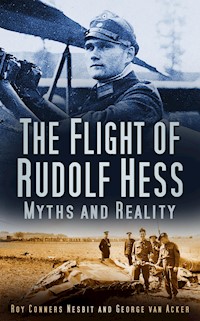
Front cover: (top) Rudolph Hess in the cockpit of a Fokker D.VII (Wolf Rüdiger Hess); Hess’s Messerschmitt Bf110 after it crashed on Bonnyton Moor, south of Glasgow (Aeroplane Monthly).
First published in 1999
This edition first published in 2011
The History Press
The Mill, Brimscombe Port
Stroud, Gloucestershire, GL5 2QG
www.thehistorypress.co.uk
This ebook edition first published in 2011
All rights reserved
© Roy Conyers Nesbit and Georges Van Acker, 1999, 2002, 2007, 2011
The right of Roy Conyers Nesbit and Georges Van Acker, to be identified as the Author of this work has been asserted in accordance with the Copyrights, Designs and Patents Act 1988.
This ebook is copyright material and must not be copied, reproduced, transferred, distributed, leased, licensed or publicly performed or used in any way except as specifically permitted in writing by the publishers, as allowed under the terms and conditions under which it was purchased or as strictly permitted by applicable copyright law. Any unauthorised distribution or use of this text may be a direct infringement of the author’s and publisher’s rights, and those responsible may be liable in law accordingly.
EPUB ISBN 978 0 7524 7276 8
MOBI ISBN 978 0 7524 7275 1
Original typesetting by The History Press
Contents
Acknowledgements
Foreword
Introduction
1. Student, Soldier and Aviator
2. Politician and Aviator
3. Preparations for the Flight
4. The Flight
5. The Next Ten Days
6. Hess’s Messerschmitt
7. Prisoner for Life
8. Some of the Myths
Notes
Appendices
Bibliography
Other books by Roy Conyers Nesbit
Woe to the Unwary
Torpedo Airmen
The Strike Wings
Target: Hitler’s Oil (with Ronald C. Cooke)
Arctic Airmen (with Ernest Schofield)
Failed to Return
An Illustrated History of the RAF
RAF Records in the PRO (with Simon Fowler, Peter Elliott and Christina Goulter)
The Armed Rovers
The RAF in Camera 1903–1939
Eyes of the RAF
The RAF in Camera 1939–1945
The RAF in Camera 1945–1995
Coastal Command in Action 1939–1995
RAF: An Illustrated History from 1918
Britain’s Rebel Air Force (with Dudley Cowderoy and Andrew Thomas)
RAF in Action 1939–1945
The Battle of Britain
The Battle of the Atlantic
Missing, believed Killed
The Battle for Europe
Acknowledgements
The authors would like to acknowledge the assistance of Flight Officer Felicity Ashbee, WAAF; Hank Brown, NASM Smithsonian Institution, Archives Division, Washington D.C.; Oberstleutnant a. D. Bruno Carl; Frederick A. Dieter, NASM Smithsonian Institution, Archives Division, Washington D.C.; Jean Dillen; Dr Rolf Doberitz, Deutscher Wetterdienst, Seewetteramt, Hamburg; The Lord Selkirk of Douglas; Michael Fowler; Simon Fowler, Public Record Office (now The National Archives); Oberstabsfeldwebel J. Fritsch, Bundeswehr IV Korps, Potsdam Wildpark; Dr Fuchs, Archivdirektor Bayerisches Hauptstaatsarchiv München; Martin Garnett, Dept of Exhibits and Firearms, Imperial War Museum, London; His Grace the 15th Duke of Hamilton; Oliver Hoare, Public Record Office (now The National Archives); G.L. Hope, Head of Tidal Branch, Hydrographic Office, MoD, Taunton; Oberst a. D., Werner Horst; the late Flugkapitän Helmut Kaden; Siegfried Knoll; the late Wing Commander C. Hector Maclean; Lieutenant-Colonel John L. McCowen; Eric Mombeek; National Archives Records Service, Washington D.C.; Michael Oakey, Aeroplane Monthly; the late Flight Lieutenant Maurice A. Pocock RAFVR; Dr R. Reinke, Deutscher Wetterdienst Zentralamt, Offenbach; Winston G. Ramsey After the Battle; Karl Ries; Hanfried Schliephake; General Paul Sharp, NATO Brussels; the late Dr ‘F.S.’, former meteorologist; Paul Silberman, NASM Smithsonian Institution, Archives Division, Washington D.C.; Charles J. Thompson; M.J. Wood, Meteorological Office, Bracknell, Berkshire; Mrs Arline Youngman; Gerrit J. Zwanenburg.
To all of them our sincere thanks and gratitude for their highly valued help.
We also wish to thank the following owners of copyright, who gave us permission to quote from published works, or to reproduce photographs and documents from their collection: Mrs Heleen den Beer Poortugael, editor, for article in Schipholland, Amsterdam Airport; Mrs Jeanette Kalman for articles published in Svenska Dagbladet, Stockholm; Luc Van Loon for articles published in Gazet Van Antwerpen; Hans J. Ebert, Daimler-Benz Aerospace, Ottobrunn, for use of photographs; and Christiaan Vanhee, for use of photographs and rare German documents from his extensive collection.
Special thanks to Jean-Louis Roba for hitherto unknown details about Reinhard Heydrich’s flying career, his information about the First World War and use of rare photographs. We were especially grateful to the son of Rudolf Hess, Wolf Rüdiger, who is now deceased. He answered numerous questions from us and lent us many photographs from his private collection. He also gave us permission to quote extensively from Ilse Hess’s book Ein Schicksal in Briefen and gave us other invaluable help.
Foreword
BY THE DUKE OF HAMILTON
At dusk on 10 May 1941 Hess parachuted on to a Scottish moor just south of Glasgow and was taken into custody. He gave a false name and said he had an important message for my father, whom he said he had seen at the Berlin Olympics in 1936, although they had never met. Early next morning, my father, who was on duty at RAF Turnhouse, was told that a German pilot had crashed and was asking for him by name. He went to see the prisoner who identified himself as Hess and said that he wished to meet the king and other British leaders, to make a peace overture on behalf of Hitler. The main proposal was that, in return for allowing Germany freedom of action in Europe and Russia, Britain would get a free hand in most of her Empire. Later that day my father flew south to report to Churchill.
Hess’s arrival aroused widespread speculation. Bizarre hypotheses abounded and within a year my father was obliged to bring a successful libel action against the general secretary of the British Communist Party. His death in 1973 diminished the inhibitions of the more fanciful theorists, since when there has been a marked increase in the number of imaginative theories published.
The authors of this book have drawn heavily on official documents in Germany, the USA and the Public Record Office at Kew. Early papers include a forty-page German report on Hess in the First World War, which gives precise details of his wounds and refers to his mental state. Later papers include those released in the 1990s by the Foreign Office, concerning the involvement of the SOE and MI5 in the affair. There is a detailed account of his preparations for the flight, as well as technical details of the aircraft modified for the purpose. There follows a vivid description of the flight, the efforts of the RAF to shoot him down and, not least, his difficulties in baling out of his aircraft. His life as a prisoner in British hands is covered, as is his trial at Nuremberg and long imprisonment at Spandau. Accounts of his various attempts at suicide are also given, including the final successful one at the age of 93. The book is annotated throughout with references and the narrative is accompanied by a series of remarkable photographs, some published for the first time.
The final chapter, ‘Some of the Myths’, tackles most of the outlandish interpretations of the Hess saga. Examples are those which claim that Hess was not the only person involved, that Hitler knew of or even authorized the flight, or that the man who arrived in Scotland was not Hess at all. There is also a frequently repeated contention that British military intelligence persuaded Hess to make his flight and another that my father was actively involved. Despite the authors’ earnest efforts to deal with at least the wilder theories, it seems inevitable that more will emerge and that the ‘Hess Conspiracy’ industry will remain in business for some time.
It is not easy to be scholarly and entertaining. Nesbit and Van Acker have managed to be both and wear their scholarship lightly. Their research has been exhaustive and their judgement is shrewd. They present technical details simply. Above all, they can tell a story. Theirs is a truth which may be stranger than fiction, but it is clear, concise and entertaining.
Introduction
The western world appears to be more interested in Rudolf Hess than in any other Nazi leader, with the exception of Adolf Hitler. His astonishing flight from Augsburg to Scotland on 10 May 1941, in an attempt to negotiate peace between Britain and Germany, has given rise to much curiosity and speculation. His long and mostly solitary incarceration in Spandau Prison, before his death on 17 August 1987 at the age of 93, has weighed heavily on the consciences of many observers and commentators.
Many books and articles have been written about Hess, describing his life in some detail from early childhood to death. In all these the main subject remains his daring and skilled flight. Some authors even go so far as to describe in detail every move that Hess made and his thoughts during this flight, as though they were looking over his shoulder at the time and were also able to read his mind. However, there are wide variations in these accounts, for they make different assumptions and then advance different theories.
Among the theories put forward by these authors can be found the following: there were two pilots and two aircraft involved; Hess made an intermediate landing at Schiphol airport; he took off from Calais airfield; he was lured to Britain by British military intelligence; the RAF anticipated his flight and allowed the aircraft to pass unhindered across Northumberland and Scotland; one of the drop-tanks from his aircraft was found in the Clyde; the pilot was not Hess but an imposter flying to Scotland for some unexplained reason; he did not commit suicide in Spandau prison but was murdered.
Most of these authors also try to prove their assumptions by using selective evidence, ignoring or dismissing facts which are readily available in British and German public records. The results are known as ‘conspiracy theories’ and we must advise the reader that none will be advanced in this book, although some will be examined and criticized.
The purpose of this book is to provide a straightforward account of Hess’s life and his flight to Scotland, using reliable sources of reference such as the Public Record Office in Kew, the Bayerisches Hauptstaatarchiv in Munich, Daimler-Benz Aerospace in Ottobrun, the National Archives and Records Administration in Washington DC, the Archives Division of the Smithsonian Institution in Washington DC, various other official sources and the accounts of several eye-witnesses to the events. We do not intend to advance further theories about Hess’s motives for his flight, although we have discovered a few additional facts which may prove useful to other researchers; in our opinion by far the most reliable account of his motives is presented in The Truth About Rudolf Hess by James Douglas-Hamilton, published in 1993 after the release of numerous documents relating to Hess by the Public Record Office.
We have concentrated on certain episodes in Hess’s life, such as those which show his ability as a pilot and his preparation for the flight, in order to demonstrate the inaccuracy of some of the conspiracy theories. We hope that our account, suitably annotated with references, will resolve many of the riddles which still bedevil this strange episode of the Second World War.
Roy Conyers Nesbit, Wiltshire, England, 2002
Georges Van Acker, Kontich, Belgium, 2002
CHAPTER ONE
Student, Soldier and Aviator
For several months in early 1941 Hess had been poring over maps of north-west Europe, the boundaries of the North Sea, the northern sector of Northumberland and the south of Scotland. He had been living in a world of aircraft instruments and piston pressures, cooling water temperatures and oxygen supplies, aircraft performance figures and synoptic charts – not to mention all the other details studied by aircrew preparatory to a long-distance flight. Now he was on his way at last, convinced that the most important mission of his life would succeed.
The German weather forecast was favourable, indicating a large anti-cyclone to the west of Britain, with light westerly winds over Germany and the Low Countries veering northerly over the North Sea. Cloud was scattered and visibility was good. Unknown to Hess, the British forecast indicated light variable winds over north-east England and south-west Scotland, where conditions were expected to be mainly cloudy with a few showers. Hess had chosen an excellent day.
Hess was justifiably proud of his skill in making the historic solo flight from Bavaria to Scotland. Some weeks later while in captivity, he wrote a long letter home to his son ‘Buz’, knowing that its contents would be read aloud to the boy by his wife Ilse, who might also pass the information on to those competent enough to understand his methods and admire his achievement. But even if Ilse kept the information to herself for the time being, Hess was recording his daring flight for posterity.
Rudolf Hess was kept incarcerated for another forty-six years, a hapless pawn in the relentless Cold War game of chess between East and West until, in 1987, he took his own life in Berlin’s Spandau prison. His body was eventually laid to rest in the family plot at Wunsiedel where the simple headstone bears the inscription ‘Ich Hab’s Gewagt’, which translated means ‘I dared’.
Rudolf Walter Richard Hess was born on 26 April 1894 in Ibrahimieh, an eastern suburb of Alexandria in Egypt. The villa was not far from Aboukir, the scene of Nelson’s victory over the French fleet on 1 August 1798 which established the Royal Navy’s domination of the Mediterranean. Rudolf’s father was Fritz Hess, a wealthy merchant who owned the trading firm of Hess & Co. This company had been established by Rudolf’s grandfather Christian Hess, who married Margarete Bühler and emigrated to Egypt in 1865 together with their son and two daughters.1 The Hess family originated from Wunsiedel, about 95 km north-west of Nuremberg, in the Fichtelgebirge. Fritz also owned a house in Reicholdsgrün, about 10 km north-west of Wunsiedel. His wife was Klara Münch, the daughter of a textile manufacturer. Rudolf was the eldest of their three children, his brother Alfred being born in 1897 and his sister Margarete in 1908.2
The family lived in a large and beautiful three-storey villa, surrounded by a magnificent garden. The desert stretched eastwards from the garden wall, while to the west was the fairy-tale city of Alexandria with its port, splendid buildings and bazaars. To the north, a golden beach fringed the turquoise waters of the Mediterranean. Life for the family was very comfortable and even idyllic in some respects. The parents gave parties from time to time, their guests usually being members of the German colony in Alexandria, but for the most part their private life was centred on their children.3
The two boys attended the German Protestant School in Alexandria, Rudolf from 1900 to 1906. From 1900 the family travelled to Germany every year during the summer, where they spent several weeks in their house in Reicholdsgrün. After initial schooling, the two brothers received private tuition from an Egyptian tutor, Abdul Aziz Effendi (Master), but they never learnt to speak Arabic. Much to the disappointment of their father, neither boy showed any interest in the family firm or any desire to take over its management. Rudolf was sent to Germany in 1908 and from 15 September of that year attended the Evangelical School in Bad Godesberg. Although his father still expected him to take over the family firm, he showed more interest in mathematics and science. This did not deter his father from sending him in 1911 to the Ecole Supérieur de Commerce at Neuchâtel in Switzerland. Rudolf left that school after a year and began an apprenticeship with a business firm in Hamburg.
By 1914 the population of the German Reich numbered 68 million, about 60 per cent more than when it was founded on 9 December 1870. Unemployment was low, there was little social need, and industries were thriving. Germany was becoming a very wealthy nation and in military terms was the most powerful in the world, with a large and well-equipped army as well as a modern navy which was regarded anxiously by both Britain and France, especially since Germany was casting covetous eyes on their overseas empires. The Triple Alliance of Germany, Austria-Hungary and Italy was confronted by the Triple Entente of Britain, France and Russia. Signs of an impending war were becoming more visible each day.
The event which sparked off the immense conflict was the assassination of the Archduke Franz Ferdinand of Habsburg-Este, heir to the throne of Austria-Hungary, and his consort Sophie Chotek, the duchess of Hohenburg, in Sarajevo in the morning of 28 June 1914.
The man who fired the revolver shots was Gavrilo Princip, a twenty-year-old member of a Serbian secret society known as the Black Hand which opposed the projected incorporation of Serbia into the Austro-Hungarian Empire.4 On 28 July Austria-Hungary declared war on Serbia. Russia, which regarded Serbia as an ally, began to mobilize. Germany declared war on Russia on 1 August, and entered Luxembourg the following day to seize the railways needed for the passage of troops for an invasion of neutral Belgium. On 3 August Germany declared war on France and Britain declared war on Germany the following day. On 6 August Austria-Hungary was at war with Russia. The First World War had begun. Italy remained neutral at first but decided to come in on the side of the Triple Entente on 23 May 1915.
In August 1914 all the members of the Hess family were in their summer residence in Reicholdsgrün except the twenty-year-old Rudolf, who was still serving his apprenticeship in Hamburg. He left this position a few days later and joined his family. Against his father’s wishes, he then travelled to Munich to join the ranks as a volunteer and on 20 August 1914 enlisted in the 7th Bavarian Field Artillery Regiment. After some initial training Infanterist (Private) Rudolf Hess was posted on 18 September to the 3rd Supplementary Company, 1st Supplementary Battalion, 1st Infantry Regiment.5 This was stationed on the Western Front, opposite the British Expeditionary Force on the Somme.
Towards the end of October 1914 the Belgians had succeeded in inundating large areas on both sides of the River Ijzer (Yser), between Nieuwpoort and Bikschote. These defensive measures caused the Germans to withdraw from the region and the fighting came to a temporary halt. The Germans attacked again on 30 October, on a narrower front from the Messines Ridge to Gheluvelt, 5 miles east of Ieper (Ypres). It was here that Rudolf Hess received his baptism of fire against the seasoned soldiers of the British I Corps.
The German forces included numerous recruits who were the flower of the country’s youth, mostly students burning with zeal and patriotism. Waves after waves of these young men were thrown against British regular soldiers, who were trained in rapid fire with their bolt-action rifles. The young volunteers could be heard singing patriotic songs amid the din of fire from rifles, machine-guns and field guns, but they were mown down in their thousands. Nevertheless the Germans broke through at Gheluvelt and were only driven out by a fierce counter-attack from mixed battalions. They broke through again in places and the confused fighting continued for several days, with the outcome remaining in the balance until the attackers withdrew from exhaustion and enormous losses. The British lost about 50,000 men killed, wounded or missing in the battle, including a large part of their regular army. To their south the French lost a similar number. The German losses have never been released but must have been far greater. They described the battle as Der Kindermord von Ypern, which may be translated as ‘The Massacre of the Innocents at Ypres’.
Rudolf Hess survived this slaughter, although the experience must have left a deep and lasting impression on him. Another participant was Adolf Hitler, who had enlisted as a volunteer in the 16th Bavarian Infantry Regiment, although the two men did not meet at this stage. Hitler’s unit also suffered very severe casualties, and the future German Chancellor was recommended for the Iron Cross, Second Class, which was awarded to him on 2 November 1914, in the course of the fighting. The First Battle of Ypres ended the period of open warfare and the two sides dug into entrenched positions until the Germans made their final and unsuccessful push in 1918.
On 9 November 1914 Hess was transferred to the 1st Company of the 1st Infantry Regiment, which was stationed near Arras in the Artois province of France.6 He was promoted to Gefreiter (Corporal) on 21 April 1915 and six days later was awarded the Iron Cross, Second Class, for his bravery in the field. For six weeks from the end of August 1915 Hess underwent courses at the Army Training School at Munsterlager, where he attained the rank of Vizefeldwebel (Lance-Sergeant). On 22 October he received the M.V.K. (Militärisches Verdienst Kreuz, or Military Merit Cross) awarded by the Kingdom of Bavaria. Newly promoted and additionally decorated, he returned to his unit in the front line on 20 November, where he saw more action in the Artois sector. In early 1916 he participated in the battles for Neuville St Vaast, which was completely destroyed. Then a throat infection took him behind the lines on 20 February 1916 for more than two months. On 1 May he returned to his unit once more and took part in the gruesome Battle of Verdun.
The Germans had launched their offensive against the French lines in this sector on 21 February 1916. Their attacks had been successful at first, particularly in the area east of the River Maas, but the French resistance stiffened gradually and the battle became one of attrition, with terrible casualties on both sides. Towards the end of the month, the Germans captured the fort of Douaumont, which resembled a giant ruin when seen from the air. Nevertheless by April General Von Falkenhayn admitted that the German assault on Verdun was becoming a failure. In spite of this admission, he continued a series of pointless attacks.




