


16,31 €
Mehr erfahren.
- Herausgeber: Fernhurst Books Limited
- Kategorie: Lebensstil
- Sprache: Englisch
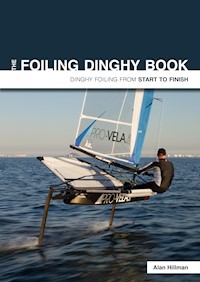
Since the development of the International Moth into a fully foiling dinghy there has been an explosion in the popularity of the class with some of the world's top sailors competing in it and many others enjoying the exhilaration of 'flying'. However there is no doubt that it is a challenge to learn to fly a Moth and other designs are being introduced which are easier to sail and provide foiling opportunities for less dedicated, larger and less agile sailors. This book, the first to be published on dinghy foiling, explains how foils work and how to foil in the International Moth, Waszp and F101. Anyone who can sail a fast planning dinghy like the Laser should be able to foil and this book takes you through the skills and techniques required. Starting with the theory, the book goes through rigging and launching, then low riding sailing, tacking and gybing before moving onto flying and, of course, the foiling gybe and tack. All illustrated by hundreds of colour photographs and many diagrams. Alan Hillman has taught hundreds of sailors to foil, including some of the top names. Through this book his expertise is available to everyone and there is no excuse not to get up on the foils and fly!
Das E-Book können Sie in Legimi-Apps oder einer beliebigen App lesen, die das folgende Format unterstützen:
Veröffentlichungsjahr: 2018
Ähnliche



















First published in 2018 by Fernhurst Books Limited
The Windmill, Mill Lane, Harbury, Leamington Spa, Warwickshire. CV33 9HP. UK
Tel: +44 (0) 1926 337488 | www.fernhurstbooks.com
Copyright © 2018 Alan Hillman
All rights reserved. No part of this publication may be reproduced, stored in a retrieval system or transmitted, in any form or by any means, electronic, mechanical, photocopying, recording, scanning or otherwise, except under the terms of the Copyright, Designs and Patents Act 1988 or under the terms of a licence issued by The Copyright Licensing Agency Ltd, Saffron House, 6-10 Kirby Street, London EC1N 8TS, UK, without the permission in writing of the Publisher.
Designations used by companies to distinguish their products are often claimed as trademarks. All brand names and product names used in this book are trade names, service marks, trademarks or registered trademarks of their respective owners. The Publisher is not associated with any product or vendor mentioned in this book.
This publication is designed to provide accurate and authoritative information in regard to the subject matter covered. It is sold on the understanding that the Publisher is not engaged in rendering professional services. If professional advice or other expert assistance is required, the services of a competent professional should be sought. The Publisher accepts no responsibility for any errors or omissions, or for any accidents or mishaps which may arise from the use of this publication.
A catalogue record for this book is available from the British Library
ISBN 9781912177035
eBook ISBN
9781912177745 (EPub)
9781912177752 (Mobi)
9781912177769 (ePDF)
The author and publisher would like to express their considerable thanks to Richard Langdon for taking most of the Moth photographs.
Front cover and most Moth photographs © Richard Langdon, Ocean Images
All F101 and most Waszp photographs and p9, 13 (top), 17 (right), 22 (top), 25, 32, 33, 35 (right), 36, 37 (top), 73, 74, 83, 96 © Alan Hillman / David Hillman / Geoff Cox / Foiling World / Pro-Vela
p8: Gerald New; back cover (middle), 18 (bottom), 20 (bottom), 26, 29, 79, 93: Martina Orsini © Foiling Week; p12 (left): Tom Gruitt; p12 (right): Tim Hore; p15, 16: James Grogono; p17 (top left): Andy Patterson; p17 (middle left): Brett Burvill; p17 (bottom left): John Illet; p18 (top), 31: Walter Cooper; p19 (top): Onefly; p20 (top left): Wildwind; p20 (top right): Nichola Strehle / Walti Gauer; p34, 35 (bottom left): Jeremy Atkins; p44: Werner Scheidegger; p106: Glide Free Design
Designed & typeset by Rachel Atkins
Illustrated by Maggie Nelson
To my parents David and Margaret who supported my passion for sailing, and to Paloma, Natalia and Naomi for showing me the things that are more important than sailing.
ALAN HILLMAN
FOILING MOTH SAILOR & INSTRUCTOR, F101 CREATOR
Alan Hillman’s lifetime in the sailing world has seen him experience many aspects of the sport, particularly in the area of coaching in which he has over 30 years’ experience. His extensive CV includes:
• RYA Windsurfing Manager, where he developed their training programmes and overseas centres
• Setting up the high performance sailing and windsurfing centre Team Unlimited in Spain with Rob Andrews
• Race Directing for the Extreme 40s and the Barcelona World Race
• Establishing Pro-Vela in Spain, offering personalised coaching, particularly in foiling Moths
• Owning Sportsboat World (distributors of the SB20) and, more recently, Foiling World (creators of the F101) with Jerry Hill and Rob Andrews
One of his greatest strengths is his ability to analyse sailing manoeuvres, break them down into their constituent parts and then teach sailors those elements in a memorable way.
As a competitor, Alan has won National schools titles in both sailing and windsurfing through to senior National titles in the Laser 4000 and SB20 classes.
Alan learnt to sail a foiling International Moth the hard way – by teaching himself: involving many hours on, in and under the water. He has distilled this experience into the programme offered at Pro-Vela where he has introduced many sailors to foiling, including:
• Sir Ben Ainslie
• Ian Walker
• Mike Golding
• Andreas John
This experience is now made more widely available through this book.
Alan Hillman at Pro-Vela in Murcia, Spain
CONTENTS
Foreword
PART ONE: BACKGROUND
Introduction
Foiling Dinghies
How it Works
PART TWO: BASIC SET-UP & SKILLS
(FOR LOW RIDING)
Parts of the Boat
Pre-flight: International Moth / Waszp
Pre-flight: F101
The Secure Position
The Sailing Position
Sailing Off
Turning Around
Coming Ashore
Capsize Recovery
PART THREE: FLYING
First Flight
Points of Sailing
Speeding up the Turns
Advanced Foil Adjustments
Safety
Conversion Kits
Glossary
Acknowledgements
Mike Lennon sailing his Thinnair design
FOREWORD
BY MIKE LENNON
Looking at the entry list for the 2017 International Moth World Championships shows what many of the world’s top sailors do for fun – they sail foiling dinghies! The entry list was like a Who’s Who of America’s Cup and Olympic sailors.
Sailing a foiling Moth is not only fun, it is also quite a challenge to learn how to do it and this book provides a perfect manual. Alan Hillman has been coaching people to sail International Moths for many years and is just the right person to introduce you to this.
But where the International Moth leads, others follow, and so now there are designs which make foiling more accessible to the average sailor. Foiling such craft still has its challenges and you still need to learn how to do it and get the most out of it. Again, this book provides you with that knowledge.
So, whether you are just interested in the idea of foiling dinghies, you want to learn how to foil in one of the modern designs or you want to go the full hog and learn how to sail a foiling Moth, this is the book for you. Packed full of expert advice, top tips and with over 300 photographs, it explains clearly how to foil.
Foiling is here to stay and will only grow and grow. With this book you will be able to understand what foiling is and how you can join in.
I look forward to seeing you flying above the water soon!
Mike Lennon
Past International Moth UK & European Champion
Past International 14, Melges 24 & Scorpion UK National Champion
Moth designer, sailmaker & sailing clothing manufacturer
INTRODUCTION
Overview: This book will set out the basic skills and techniques that are required when learning to sail a foiling sailing dinghy with in-line T-foils. Such a boat should not be viewed as requiring basic sailing skills beyond that needed to sail a fast planing dinghy such as a Laser. Sailors of skiffs / asymmetric dinghies or with experience of apparent wind sailing will find the skill set very similar.
The foiling dinghy really is a versatile machine that can span gender as well as a variety of weights, shapes and sizes.
This book will give you an insight into how such boats work and the basic techniques required to sail one confidently and prove that, if you can sail a performance dinghy competently, you can fly!
Learning to foil is a journey that needs to be guided for the beginner. There is a lot involved in learning to foil. The speeds attainable bring with them an obligation to foil responsibly taking into account the safety of yourself and others.
PRE-REQUISITES TO SAIL A FOILING DINGHY
Sailing a foiling dinghy is a continuous learning process that builds on your pre-existing sailing skills: the better you are at sailing a high performance sailing dinghy, the easier it will be to transfer these skills to foiling. The ability to swim used to be essential: foiling can be an immersion sport when you are learning, particularly in Moths but, with the advent of boats such as the F101, this no longer has to be the case!
FITNESS
Most first time Moth sailors will capsize a fair few times on initial sails but again this is not so true on some of the new foilers. Be prepared for a bit of exercise on your first sails as the boat will give every muscle in your body (and your cardiovascular system) a good workout.
Foiling: A cardiovascular workout
BODY ARMOUR
Wear a wetsuit that covers most of your body: this is for protection from bumps and bruises as climbing in and out of the boat will take its toll on the body. Even the best sailors wear a full wetsuit all the time to ensure that they maximise the pleasure and minimise the pain. Good sailing boots that protect the ankle, whilst being flexible and grippy, are ideal; you will also be doing a lot of sail trimming so gloves are a good idea too!
Recommended sailing kit
We also recommend that beginners wear a helmet. When teaching beginners we often use helmets with built-in radio communication in order to give real-time feedback. This accelerates the learning curve for experienced sailors who often have to unlearn many years of different sailing techniques.
However, the helmet should also be considered by the more experienced. Closing speeds of two foiling boats are potentially above 40 mph and, in this context, wearing a helmet seems a sensible precaution when sailing in the company of other foiling boats. Interestingly, the French Sailing Federation has made the wearing of helmets compulsory when racing foiling craft.
Sailing a foiling boat will change your view of sailing forever: you have been warned!
GETTING STARTED
Learning any new skill can be made much easier by using some basic rules that run true for trying most sports. Foiling requires a sound understanding of well-developed sailing skills. If you have not previously mastered sailing a planing dinghy then your learning process is destined to be longer.
I would strongly recommend having lessons in a foiling school of which more and more are starting to spring up as the popularity and awareness of this branch of the sport develops. This has the advantage of learning in someone else’s boat (you will find a reluctance of most foiling sailors to lend you their carbon fibre pride and joy). The boat is likely to be set up properly and you will save yourself so much time and potential damage that the cost of the course will be a good investment. Many people have learned the hard way thus far but it does require determination, a good skill set and a substantial financial investment. Learning on a well set up boat, with good tuition in a safe environment prior to buying a foiling dinghy will pay dividends.
Learning at a foiling school is much easier than learning by yourself
FOILING DINGHIES
Overview: Sailing boats have been foiling since 1939 but the advent of modern materials and sophisticated computer software have allowed significant developments since 2000.
WHERE FOILING STARTED
Hydrofoils are not a recent invention. As long ago as 1861, Thomas Moy conducted model towing tests of hydrofoils in the Surrey canal in England, but his interest was in flying rather than boats and he was only using water as a safer test bed than going up in the sky. In 1897, the Conte de Lambert built a full-scale steam-driven hydrofoil catamaran which reached good speeds on the River Seine. In 1898, Italian engineer Enrico Forlanini started designing hydrofoils and in 1906 he tested an engine-powered hydrofoil on Lake Magiore.
Sailing hydrofoils first appeared in the United States with Robert Gilruth’s small foiling catamaran in 1939, and in the 1950s J G Baker built a monohull with large V-foils (2 at the front and 1 at the back). This attracted the attention of the US Navy who funded him to build Monitor, a much larger monohull, using two tapered ladder foils and a V-foil at the stern. But the US Navy lost interest and the project stopped.
J G Baker’s first foiling boat, built in 1950
J G Baker’s second foiling boat, Monitor in 1955
Baker was followed by fellow American Don Nigg who developed a series of hydrofoil boats in the 1960s, culminating in Flying Fish which was launched in 1968, for which plans were published and several examples built around the world.
Don Nigg’s Flying Fish, launched in 1968
The mantle for sailing hydrofoil development then transferred to the UK, with James Grogono fitting hydrofoils to his Tornado catamaran Icarus which was developed alongside Philip Hansford’s Mayfly. Both these boats held the World Speed Record for more than 10 years in their respective classes: Icarus in ‘B’ Class and Mayfly in ‘A’ Class.
Also in the 1970s, Frank Raison added V-foils to his wooden scow to create the first foiling Moth which he reported foiled in about 15 knots of wind. However, it didn’t like waves and the bow foil was broken in a chop, putting an end to this development.
The materials and manufacturing processes available in the 1970s limited the development of foiling craft both for cost and practical reasons. The foils were difficult and expensive to manufacture and generally heavy, which negated much of the performance gain created by the foils. In fact, for some time, the foiling Tornado, Icarus, was beaten at speed trials by a conventional, non-foiling, Tornado catamaran.
However, with the advent of modern materials and appropriate computer software, it became easier to design and build hydrofoils and the development sped up.
James Grogono’s foiling Tornado catamaran, Icarus




