


9,99 €
Mehr erfahren.
- Herausgeber: Atlantic Books
- Kategorie: Geisteswissenschaft
- Sprache: Englisch
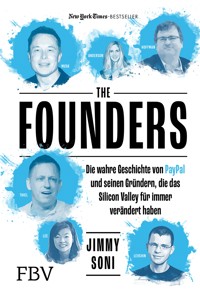
'A fascinating page-turner... An indispensable guide to modern innovation and entrepreneurship.' Walter Isaacson, no. 1 bestselling author of Steve Jobs Perfect for readers of Elon Musk by Ashlee Vance and Zero to One by Peter Theil Out of PayPal's ranks have come household names like Elon Musk, Peter Thiel, Max Levchin and Reid Hoffman. Since leaving Paypal, they have formed, funded, and advised the leading companies of our era, including Tesla, Facebook, YouTube, SpaceX, Yelp, Palantir, and LinkedIn, among many others. Yet for all their influence, the incredible story of where they started has gone largely untold. In The Founders, award-winning author Jimmy Soni narrates how a once-in-a-generation collaboration turned a scrappy start-up into one of the most successful businesses of all time. Facing bruising competition, internal strife, the emergence of widespread online fraud, and the devastating dot-com bust of the 2000s, their success was anything but certain. But they would go on to change our world forever. Informed by hundreds of interviews and unprecedented access to thousands of pages of internal material, The Founders explores how the seeds of so much of what drives the internet today were planted two decades ago.
Das E-Book können Sie in Legimi-Apps oder einer beliebigen App lesen, die das folgende Format unterstützen:
Veröffentlichungsjahr: 2022
Ähnliche



















Jimmy Soni is an award-winning author and biographer. His previous book, A Mind at Play: How Claude Shannon Invented the Information Age, won the 2017 Neumann Prize, awarded by the British Society for the History of Mathematics for the best book on the history of mathematics for a general audience, and the 2019 Middleton Prize by the Institute of Electrical and Electronics. He lives in Brooklyn, New York, with his daughter, Venice.
This edition published by arrangement with Simon & Schuster, Inc., New York.
First published in Great Britain in hardback in 2022 by Atlantic Books, an imprint of Atlantic Books Ltd.
Copyright © Jimmy Soni, 2022
The moral right of Jimmy Soni to be identified as the author of this work has been asserted by him in accordance with the Copyright, Designs and Patents Act of 1988.
All rights reserved. No part of this publication may be reproduced, stored in a retrieval system, or transmitted in any form or by any means, electronic, mechanical, photocopying, recording, or otherwise, without the prior permission of both the copyright owner and the above publisher of this book.
Every effort has been made to trace or contact all copyright holders. The publishers will be pleased to make good any omissions or rectify any mistakes brought to their attention at the earliest opportunity.
10 9 8 7 6 5 4 3 2 1
A CIP catalogue record for this book is available from the British Library.
Hardback ISBN: 978-1-78649-828-1
Trade paperback ISBN: 978-1-78649-829-8
E-book ISBN: 978-1-78649-830-4
Interior design by Ruth Lee-Mui
Printed in Great Britain
Atlantic Books
An imprint of Atlantic Books Ltd
Ormond House
26–27 Boswell Street
London
WC1N 3JZ
www.atlantic-books.co.uk
To my daughter, Venice, who arrived just as this project started, and to my late editor, Alice, who left us just as it finished.
Contents
Introduction
PART 1: SICILIAN DEFENSE
1. Building Blocks
2. The Pitch
3. The Right Questions
4. “What Matters to Me Is Winning”
5. The Beamers
6. Hosed
7. Money Talks
PART 2: BAD BISHOP
8. If You Build It
9. The Widget Wars
10. Crash
11. The Nut House Coup
12. Buttoned-Up
13. The Sword
14. Ambition’s Debt
PART 3: DOUBLED ROOKS
15. Igor
16. Use the Force
17. Crime in Progress
18. Guerrillas
19. World Domination
20. Blindsided
21. Outlaws
22. And All I Got Was a T-shirt
Conclusion: The Floor
Epilogue
Debts
A Note on Sources and Methods
Notes
It ought to be remembered that there is nothing more difficult to take in hand, more perilous to conduct, or more uncertain in its success, than to take the lead in the introduction of a new order of things. Because the innovator has for enemies all those who have done well under the old conditions, and lukewarm defenders in those who may do well under the new. This coolness arises partly from fear of the opponents, who have the laws on their side, and partly from the incredulity of men, who do not readily believe in new things until they have had a long experience of them.
—Niccolò Machiavelli, The Prince
Those who have learned to walk on the threshold of the unknown worlds, by means of what are commonly termed par excellence the exact sciences, may then, with the fair white wings of imagination, hope to soar further into the unexplored amidst which we live.
—Ada Lovelace
Introduction
“Fuck, you’re making me rummage around the attic,” said Elon Musk.
We sat in his living room, but the metaphor still fit. Musk was about to tell me the story of PayPal.
At the moment we met, in January 2019, PayPal—a company he cofounded some two decades earlier—was likely the furthest thing from his mind. The day before, he had announced significant layoffs at Tesla Motors, the electric car company he has led since 2003. And just the week before that, he had cut one-tenth of the workforce at SpaceX, the aerospace manufacturer and transportation firm he started in 2002. With all this present swirl, I didn’t know how much Musk would want to delve into the past, and I was ready for him to trot out a few familiar talking points and send me on my way.
But as he spoke about the internet’s development and PayPal’s origins, the stories spilled out. About his first internship at a Canadian bank. About building his first start-up, then his second. About what it felt like to be overthrown as CEO.
By the end of the afternoon—nearly three hours later—I suggested we pause. We had only scheduled an hour together, and though Musk had been generous with his time, I didn’t want to wear out my welcome. But even as he stood to show me out, he launched into another PayPal story. Forty-seven years old, Musk spoke with the enthusiasm of someone older asked to relive his glory days: “I can’t believe it’s been twenty years!”
It was hard to believe—not just the years that had passed, but how much PayPal’s alumni had accomplished in them. If you have used the internet at all in the last twenty years, you’ve touched a product, service, or website connected to the creators of PayPal. The founders of several of our era’s defining firms—the creators of YouTube, Yelp, Tesla, SpaceX, LinkedIn, and Palantir, among others—were early PayPal employees; others occupy top posts at Google, Facebook, and Silicon Valley’s leading venture capital firms.
Both in the foreground and behind the scenes, PayPal’s alumni have built, funded, or counseled nearly every Silicon Valley company of consequence for the last two decades. As a group, they constitute one of the most powerful and successful networks ever created—power and influence captured in the controversial phrase the “PayPal Mafia.” Several billionaires and many multimillionaires have emerged from PayPal’s ranks; the group’s combined net worth is higher than the GDP of New Zealand.
But to look only at their wealth and impact on technology is to miss the group’s wider imprint: PayPal’s alumni have built world-changing micro-lending nonprofits, produced award-winning films, written bestselling books, and advised politicians at every level—from the state house to the White House. And they’re far from done: Today, PayPal alumni have taken as a mission everything from cataloging the world’s genealogical records to restoring three billion acres of forest ecosystems to “scaling love”—bringing their PayPal experience to bear in each case.
They’ve also been at the center of the biggest social, cultural, and political controversies of our age, including bitter fights over free speech, financial regulation, privacy in technology, income inequality, the efficacy of cryptocurrency, and discrimination in Silicon Valley. For its admirers, PayPal’s founders are a force to be emulated. For its critics, the group represents everything wrong with big tech—putting historically unprecedented power into the hands of a small clutch of techno-utopian libertarians. Indeed, it is hard to find a lukewarm opinion about PayPal’s founders—they are either heroes or heathens, depending on who offers the judgment.
And yet, despite all that, the PayPal days themselves are usually glossed over. If the early years come up at all, they are typically granted a polite paragraph crediting PayPal for making the later, splashier achievements possible. The group’s subsequent successes are so legendary—and their controversies so conspicuous—that they steal the oxygen from the origin story. Space travel, after all, makes for better copy than payment services.
But this seemed odd to me. It was as if these people had grown up in the same tiny town, and no one had bothered to ask what was in the water. It also seemed a shame: To skip PayPal’s creation is to neglect the most interesting stuff about its founders. It is to miss the defining experience of their early professional lives—one that defined so much of what came later.
As I began poking around, asking questions about PayPal’s beginnings, it became clear just how much of the story had been overlooked—and how many of its central figures were absent from the retellings. More than one person I spoke to had never previously been asked about their PayPal tenure at length. And their stories were as rich and revealing as those of the household names.
Indeed, it’s in the recollections of scores of engineers, UX designers, network architects, product specialists, fraud fighters, and support personnel that the story of PayPal comes to life. As one former employee put it, “You have folks like Peter Thiel, Max Levchin, and Reid Hoffman. But when I first got to the company, it was the database administrators who were thought of as gods.”
Whether known or unknown, the hundreds of individuals who worked at PayPal from 1998 to 2002 consider the experience a watershed. It influenced their approach to leadership, strategy, and technology. Several PayPal alumni observed that they’d spent the rest of their careers seeking a team of comparable intensity, intellect, and initiative. “There was something really special, and I think we may not have all realized it at the time,” one member of the product team said. “But now, when I go into teams, I’m just looking for what is that magic that we saw in the early days of PayPal. And it’s rare, but it’s what we keep searching for.”
One employee remarked on PayPal’s butterfly effect—not just in the achievements of people like Musk, Levchin, and Hoffman, whose creations have touched millions, but in the lives of the hundreds present at the creation. “It is . . . something that defines me and my life, and probably will for my entire life,” he said.
Understanding the PayPal years helps shed light on a remarkable period in technological history and the remarkable people who brought it into being. The more I learned, the more convinced I became that “the attic” was worth rummaging through.
PayPal’s founding is one of the great, improbable stories of the internet age. Two decades later, living and shopping in an era in which the “e” in “e-commerce” is redundant, it’s easy to take a service like PayPal for granted. When a couple taps can summon a car to our doorstep, sending money over the internet hardly seems groundbreaking. But it’s a mistake to assume that the technology underlying digital money transfer was easily built, or that PayPal was destined for success.
The PayPal we know today resulted from the fusion of two companies. One—originally called Fieldlink and renamed Confinity—was founded in 1998 by two unknowns, Max Levchin and Peter Thiel. In the course of finding itself, Confinity built a framework linking money to email, a service dubbed “PayPal” that found an enthusiastic audience on the auction website eBay.
But Confinity wasn’t the only company working on digital payments. Fresh off the sale of his first start-up, Elon Musk had founded X.com, a company that also helped users email money. That wasn’t close to the extent of his original ambition, though. Musk was convinced that financial services needed upending, and that X.com would be the platform to do it. He pitched his new start-up as the single-letter finance website to rule them all, offering every financial product or service available. But a series of strategic shifts led X.com to target the same online payments market as Confinity, with digital payments as the gateway for a bigger financial services play.
Confinity and X.com fought fiercely over eBay market share, a contest that raised the competitive ire of both teams and ended in a fractious merger. For the next several years, the company’s survival was an open question. Sued, defrauded, copied, mocked—from the outset, PayPal was a start-up under siege. Its founders took on multibillion-dollar financial firms, a critical press and skeptical public, hostile regulators, and even foreign fraudsters. In the space of just four years, the company survived the bursting of the dot-com bubble, investigations from state attorneys general, and a copycat product built by one of its own investors.
PayPal also faced a spectacularly competitive market. During its formative years, PayPal saw well over a dozen new entrants to the payments space, while simultaneously defending against entries from legacy players—credit card associations like Visa and Mastercard as well as multibillion-dollar banks. And because it emerged as the primary payment platform for eBay, PayPal found itself a hook in the craw of eBay’s executives, who thought of PayPal as an intruder skimming service fees rightly owed to eBay. eBay acquired and launched its own payments platform to unseat PayPal, a rivalry that defined PayPal’s earliest years.
Perhaps unsurprisingly, stormy seas without did not engender peace within the company. “Calling us a mafia is an insult to mafias,” joked John Malloy, an early board member. “A mafia is far better organized than we were.” During its first two years of existence, PayPal cycled through three CEOs, and its senior management team threatened to resign en masse—twice.
Not that PayPal’s senior management had much seniority in the traditional sense. Many of its founders and early employees joined the company in their twenties; most were fresh out of college. Working at PayPal was their first taste of the professional world. A young workforce alone wasn’t uncommon in late 1990s Silicon Valley, awash in young technologists looking to make a fortune. But even by Valley standards, PayPal’s was an iconoclastic culture. Its earliest hires included high school dropouts, ace chess players, and puzzle champions—often chosen because of their eccentricities and peculiarities, not in spite of them.
At one point, the company’s office featured both an indicator called “The World Domination Index,” which tracked the day’s users, and a banner bearing the words “Memento Mori,” Latin for “Remember that you will die.” PayPal’s oddball team was out to dominate the world—or die trying.
Most observers predicted the latter outcome. In the late 1990s, only 10 percent of all online commerce was conducted digitally—the vast majority of transactions still ended with the buyer sending a check by mail. Many people were dubious about entering personal credit card or banking information online, and sites like PayPal were often thought to be portals for illicit activity like money laundering or the sale of drugs and weapons. On the eve of its IPO, a prominent trade publication declared that the country needed PayPal “as much as it does an anthrax epidemic.”
Bad press could be ignored. World-shattering events could not. Just as PayPal’s founders prepared to take the company public—finalizing the terms of what should have been their greatest triumph—two planes screamed through the New York sky, striking the Twin Towers. PayPal was the first company to file for its IPO after September 11, 2001, as the country and the financial markets were only just beginning to recover from the attack.
On the way to its IPO, PayPal faced a raft of lawsuits and an SEC on the prowl following several high-profile accounting scandals at other companies. After nearly endless setbacks—a brutal merger, tens of millions of dollars lost to fraud, and a tough climate for technology stocks—PayPal pulled off the improbable: a stunningly successful IPO, and its acquisition, the same year, by eBay for $1.5 billion.
Musk would later correct an interviewer who offered that PayPal was a hard company to create. The company wasn’t hard to create at all, he said. Rather, “it was a hard company to keep alive.” Twenty years later, PayPal can claim a rare triumph for companies of its era: it still exists. Eventually, eBay spun PayPal out on its own, and today it’s worth roughly $300 billion—making it one of the largest companies in the world.
Just over two years passed between the X.com-Confinity merger and PayPal’s initial public offering on the Nasdaq, but many employees felt as though they’d worked a lifetime. Many remembered the company as a crucible—cutthroat as it was creative, and unforgivingly intense. One employee saw it vividly on the first hour of her first day. Walking over to her PayPal cubicle, she spotted an industrial-sized cache of Tylenol on her right. On her left, in the next cubicle over, she overheard another employee chastising a frustrated spouse. “I remember her talking to her husband, ‘Listen, I’m not going to get home tonight! So stop asking me!’”
Employee after employee described the era as a “blur”—a haze of exhaustion, adrenaline, and anxiety. One engineer slept so little during this period that he totaled not one but two cars driving home late at night from the PayPal office. The company’s CTO described the group as feeling “like veterans of an intense military campaign.”
Still, PayPal’s former employees waxed nostalgic. “It was crazy exciting,” observed Amy Rowe Klement, “I don’t think we even fully realized the rocket ship we were on when we were on it.” Several said they did their life’s finest work during this period. “I felt like I was part of something grand, and I’d never had that before,” said one quality assurance analyst, Oxana Wootton. “To this day,” remarked a fraud analyst, Jeremy Roybal, “I still bleed PayPal blue.”
Many who ended up working at PayPal came to the company circuitously. This project emerged in a similar way. In the course of writing my last book—a biography of the late Dr. Claude Shannon, the founder of the field of information theory and one of the great, forgotten geniuses of the twentieth century—I examined his employer, Bell Laboratories. Bell Labs was the research arm of the Bell Telephone company, and as a group, Bell’s scientists and engineers won six Nobel Prizes and invented, among other things, touch-tone dialing, the laser, cellular networks, communications satellites, solar cells, and the transistor.
I began to wonder about other Bell-like constellations of talent—including tech companies like PayPal, General Magic, and Fairchild Semiconductor, but also non-technological cohorts like the Fugitive Poets, the Bloomsbury Group, and the Soulquarians. The British musician and producer Brian Eno once said that as a visual art student he was taught that artistic revolution came from solitary figures—Picasso, Kandinsky, Rembrandt. But as he looked into these revolutionaries, he discovered them to be products of “very fertile scenes involving lots and lots of people—some of them artists, some of them collectors, some of them curators, thinkers, theorists . . . all sorts of people who created a kind of ecology of talent.”
Eno called it “scenius.” “Scenius,” he said, “is the intelligence of a whole . . . operation or group of people. And I think that’s a more useful way to think about culture, actually.” It’s also a useful way to think about the PayPal story, properly understood as a narrative about the lives, intersections, and interactions of several hundred individuals, set at a moment in time when the consumer internet took shape.
Modern technology tales are usually told as stories of individual achievement—more “genius” than “scenius.” Jobs is inseparable from the Apple narrative, as is Bezos from Amazon, Gates from Microsoft, or Zuckerberg from Facebook. PayPal’s success is a story of a different kind. There is no single hero or heroine. At different moments in the company’s history, various team members produced critical, company-saving breakthroughs; remove any one of them, and it’s possible that the whole thing would have collapsed.
Moreover, many of PayPal’s signature achievements emerged from the productive friction of the group—the tension among the product, engineering, and business teams yielding pearls of innovation. The company’s early history was marked by deep disagreements, and yet, as early engineer James Hogan observed, “There was some way where we just were not stepping on each other’s toes, interpersonally and emotionally, in a way that really spiraled into dysfunction.” At PayPal, disharmony produced discovery.
I wanted to grasp this ecology, the fertile mix of the people involved, the challenges they faced, and the moment in technological history in which they faced them.
For the prospective author, PayPal’s origin tale is thrilling—though daunting—to write. I began with an exhaustive look at what had already been said and written on the subject. Thankfully, many of those who built the company had prolific public profiles; they had written books, launched podcasts, and spoken about PayPal at conferences, on television, on the radio, and in print. I reviewed hundreds of hours of their prior commentary and the hundreds of articles written about PayPal during its formative years, as well as a small number of books and academic papers that included the company as a case study.
I also tried to contact many of PayPal’s pre-IPO employees, and I interviewed hundreds during the course of this project. I was grateful to have spoken to and interviewed all of the company’s original cofounders and most of its board members and earliest investors. I also talked with outsiders who provided invaluable perspectives: the company’s technical advisors, the person whose firm birthed the “PayPal” name, would-be investors who almost pulled the trigger, and the leaders of competing firms, among many others. I am grateful to all who generously allowed me to rummage through their collections of notes, documents, photos, memorabilia, and tens of thousands of pages of email correspondence from PayPal’s earliest days.
paypal—x.com
In many cases, I uncovered previously untold PayPal stories—including harrowing accounts of the near-breakdown of the Confinity-X.com merger, and how close the company came to collapse at several critical points. I also tried to understand how—through the mayhem—PayPal’s internet innovations came to be and came to form today’s internet landscape.
What emerged from those years of research is a tale of ambition, invention, and iteration. From a period of duress came a generation of entrepreneurs, whose later creations bear PayPal’s imprint. But the first triumph—the success of PayPal—was hard-won. Properly understood, PayPal’s story is a four-year odyssey of near-failure followed by near-failure.
It’s fitting, then, that PayPal’s story starts with an historic technological breakdown—a disaster thousands of miles from Silicon Valley that exposed a future PayPal founder to computer technology for the first time.
PART 1
SICILIAN DEFENSE
1
BUILDING BLOCKS
The February 1986 issue of Soviet Life included the ten-page glossy spread: “Peace and Plenty in Pripyat.” Pripyat was, per the article, a cosmopolitan idyll. “Today the town is made up of people belonging to more than 30 different nationalities from all over the Soviet Union,” the authors wrote. “The streets abound in flowers. The blocks of apartments stand in pine groves. Each residential area has a school, a library, shops, sports facilities, and playgrounds close by. In the morning there are fewer people around. Only young women pushing baby carriages stroll along unhurriedly.”
If the town had any problems at all, it was only that it lacked sufficient space for new arrivals. “Pripyat is currently experiencing a baby boom,” the mayor observed. “We’ve built scores of day-care centers and nursery schools, and more are on the way, but they still can’t cope with the demand.”
The demand was understandable, because Pripyat was home to a Soviet technological marvel: the Chernobyl nuclear power plant. The plant was a significant employer, and, per the article, it provided good-paying jobs and energy that was “ecologically much cleaner than thermal plants that burn huge quantities of fossil fuel.”
And what of safety concerns? A Soviet minister was asked directly about this matter, and he replied with all the confidence and assuredness of officialdom. “The odds of a meltdown,” he boasted, “are one in 10,000 years.”
Just months after Soviet Life gushed about Pripyat living, of course, the town was left a smoldering, radioactive ruin. At 1:23 a.m. on April 26, 1986, the number 4 reactor at the Chernobyl nuclear power plant melted down, causing an explosion that ripped the building’s thousand-ton roof clean off. Soon, Pripyat’s skies pulsed with more than four hundred times the radioactive material dropped on Hiroshima.
Maksymilian “Max” Rafailovych Levchin was ten years old, and he was sleeping ninety miles away when Chernobyl exploded. He’d awaken to a life transformed and shaped by the disaster. In those first anxious moments, his parents shipped him and his brother away on a train. During the trip, he was scanned for radiation with a Geiger counter—and set off the machine’s alerts. A rose thorn stuck in his shoe turned out to be the radioactive culprit, but for a moment, he panicked when he considered the possible amputation of his foot.
Levchin’s whole family was affected by the Chernobyl disaster, including his mother, Elvina Zeltsman. She was a physicist and worked in the radiology metrics lab at the Institute for Food Science.
Before Chernobyl, this was a sleepy post. According to her son, she spent her days verifying the safety of Ukraine’s (nonradioactive) bread supply. But after Chernobyl, as radioactive food began emerging from Northern Ukraine, her responsibilities grew—as did the urgency of her efforts.
To aid her work, the Soviet government sent Elvina’s office two computers: a Soviet DVK-2 and an East German Robotron PC 1715. Levchin occasionally accompanied his mother to work, and at first, he found the computers boring and clunky. That is, until a game arrived for the DVK-2: Stakan (one name given to Tetris, which was created in 1984 by engineers at the Academy of Sciences of the Soviet Union). He was hooked.
Levchin’s curiosity soon turned to the Robotron. It came with a Pascal compiler—a program that turned human code into machine commands. Also in the box was a pirated Turbo Pascal version 3.0 manual, which explained the compiler’s use. Such texts were rare in the Soviet Union, and for Levchin, the manual became scripture.
Before long, Levchin could write rudimentary programs—and he was entranced. “This notion of you can tell a machine to do things in the future that you’re only going to know about later on was this profound realization,” he said years later. “From now on, I don’t have to know everything to get stuff done. I can just start writing it down, and it’ll happen on its own later.” Before, Levchin aspired to become a math teacher; now, he boasted that he’d program computers when he grew up.
Levchin relished his early coding and gaming, but the computers weren’t there for his enjoyment. They were supposed to help Elvina report radiation in Soviet food. Seeing that her son’s technical skills surpassed her own, she put him to work and cut him a deal: the computers were all his—once her tasks were complete.
That didn’t leave Levchin much time for leisure-coding. So to preserve precious Robotron time, he devised a system: writing code with a pencil and paper. At the park near his family’s home, he’d draft and edit his programs longhand. Once his mom’s tasks were complete, Levchin transferred the contents of his notebook into the computer. Then came the machine’s verdict: “If I type it out verbatim from my notebook, does it compile and run at start—or do I have to debug it?”
This learning process left exacting standards. “My standard self-definition as a programmer had always been that I started with these decrepit computers,” Levchin said. “It was all . . . very procedural programming in various different assembly languages. . . . [It] probably made me slightly more elitist, but certainly made me very tenacious as a developer. I never really had an option to take the easy way out, I guess.”
Not taking the easy way out was a Levchin family tradition. As Jewish people living in an anti-Semitic state, they worked doubly hard for their achievements—and faced obstacles others did not. One morning, Levchin’s father awoke to find a Star of David graffitied on their front door. They told their son that because of his religion, becoming valedictorian of his high school would be his only shot at getting into a top college.
Despite these barriers, the family had accomplished much, with Levchin’s maternal grandmother leading the way. Dr. Frima Iosifovna Lukatskaya was a four-foot-eight force of nature who had earned graduate degrees in astrophysics and worked at Kiev’s Main Astronomical Observatory of the Academy of Sciences. She advanced the field of astronomical spectroscopy, the science of measuring “eclipsing variables” from stars, and her lengthy papers on the “Autocorrelative Analysis of the Brightness of Irregular and Semi-Regular Variable Stars” and “Properties of Optical Radiation of Variables and Quasars” ran in prestigious journals.
For Levchin, she was fortitude personified—a woman who triumphed in a male-dominated field and a Jewish person who succeeded in a hostile country. Her grit seemed to him almost supernatural. The year Max was born, Lukatskaya was diagnosed with a rare and aggressive form of breast cancer. “She basically said, ‘I can’t die. I have my grandson here.’ So she willed herself to live for another twenty-five years,” Levchin said. “I had this living example of someone who’d never surrender under any circumstances.”
In the early 1980s, as Levchin entered his teenage years, the Soviet economy was in freefall and the Politburo was in panic. Lukatskaya began to feel the disquieting echoes of World War II, the horrors of which she had seen firsthand. As best as the family could tell, the KGB was monitoring Levchin’s father, and the prospect of the government disappearing him loomed large.
Lukatskaya applied for funding from a Jewish refugee agency and made arrangements for the Levchins to immigrate to America. The family’s departure was kept a closely guarded secret. “It was one of these crazy years where I knew for about twelve months we were going to leave the country and I couldn’t tell anybody,” Levchin recalled.
The family left for the airport, pared-down possessions in tow. Despite the balmy July weather, the Levchins arrived at the terminal wrapped in down winter coats to avoid having to declare them. After a final exit interview with a Soviet border agent—who reminded them, in no uncertain terms, that their emigration would be final—they boarded their flight to the United States.
Still cloaked in coats, the Levchins disembarked at Chicago’s O’Hare International Airport on July 18, 1991, one day before a deadly heat wave struck the city. They sold the coats to an underground dealer for just pennies on the dollar. But the limited proceeds made a big difference. Just before leaving Ukraine, the value of the ruble had collapsed, reducing the family’s few-thousand-dollar nest egg to just several hundred dollars.
For his family, immigrating to the United States was risky, but for Levchin, who had just turned sixteen, it was the first step on an epic quest—and the adventure started right away. Levchin had been a strong student, and he wanted to get his Ukrainian high school transcripts verified by the Chicago Board of Education. Rather than ask his parents for help, Levchin hopped on a city bus by himself to complete the mission.
After getting off at the wrong stop, Levchin found himself in the middle of the Cabrini-Green housing projects, then one of the city’s deadliest neighborhoods. “I just kind of strolled through and thought, Oh, there’s no one who looks like me here. Hello, fine American people,” Levchin remembered. “I was completely oblivious . . . I was a skinny Jewish kid with a giant ’fro, and I looked like I wore clothes from the Lenin factory in St. Petersburg—which I did.”
Levchin assimilated in fits and starts. Shortly after arriving in America, he fished a broken television out of the trash, which his physicist family fixed up. He could now watch the sitcom Diff’rent Strokes, and as he told journalist Sarah Lacy years later, he modeled his English on Gary Coleman’s Harlem-raised Arnold Jackson. “Where did you learn English?” one of Levchin’s teachers asked him, curious about Levchin’s New York–meets-Kiev lilt. “Watchu talkin’ ’bout, Mr. Harris?” he replied. The teacher gently suggested Levchin broaden his media diet.
The language and culture were new, but one thing remained: Levchin’s love for all things computers. And in America, he finally got one to use at his leisure. It was a gift from a relative, and it did something his old machines didn’t: connect to the internet. Levchin soon became consumed by the world wide web and found networks and forums full of kindred digital spirits.
He found them at school, too. At Stephen Tyng Mather High School, on the north side of Chicago, Levchin joined the chess club, helped run the computer club, and played clarinet in the school band along with a friend and later PayPal colleague, Erik Klein, who played trombone. At Mather, Levchin showed the early signs of his hallmark intensity. A friend and later PayPal employee, Jim Kellas, recalled that he and Levchin were once left alone in the back of art class. Bored, they decided to hurl X-ACTO knives into the wall like darts. “Max . . . is a perfectionist. He always wants to be the best at everything he does. And so he’s sitting there, and he’s putting his finger on it and like, measuring the weight and saying, ‘Oh, this would be the perfect position to try to throw them,’” Kellas recalled. “And I’m like, ‘No, no, no. Just whip it harder.’”
Levchin excelled in his math and science classes, so when college application season arrived, he approached the Mather guidance counselor brimming with ambition: Levchin wanted to go to “MTI.” “I said, ‘I really want to get into MTI. You have to get me into MTI.’ She’s like, ‘What the hell is MTI?’”
Levchin was referring, of course, to MIT. His college counselor recommended that he apply to the nearby University of Illinois at Urbana-Champaign (UIUC) instead. Here, too, there was an issue: Levchin had missed UIUC’s application deadline. But scanning the requirements, he noticed that the deadline for international students hadn’t passed yet. He saw an opening: “I’m international-ish,” he said. “I’m not a citizen, came to the US less than two years ago, who is to say?” And under that pretense, UIUC said yes to Levchin.
Tired of living at home, Levchin moved to the university two weeks early. The dining halls were still closed, so Levchin ate his first collegiate meal at McDonald’s on Green Street. He also tried to keep a low profile. Before arriving on campus, Levchin had received a letter informing him that a welcoming committee would greet new international students at nearby Willard Airport. It didn’t sound optional.
“I was terrified that they would out me as someone who snuck in,” he recalled. So, on the day the welcoming committee was to greet him, he left campus and went to the airport, carrying two repacked suitcases in hand. He feigned wide-eyed wonder—as if arriving for the first time to his home of two years, America. “The whole scheme—or scam—was fairly elaborate,” Levchin said.
Scam or not, Max Levchin’s UIUC admission was a serendipitous product-market fit: a budding, energetic technologist entered one of the world’s computing epicenters. For decades, UIUC researchers pioneered digital technology and built some of the world’s first social networks. And just as Levchin was playacting the foreign arrival, the UIUC-based National Center for Supercomputing Applications (NCSA) announced a new web browser called Mosaic. Among other improvements, Mosaic added graphics to the web and simplified the browser installation process, changes that mainstreamed the internet and accelerated its growth—with UIUC at the center of it all.
For freshman Max Levchin, the university’s computing triumphs were notable, but at the time, he sought what all new college students want: belonging and diversion. He found both at campus Quad Day, where student organizations pitched new arrivals. Levchin spotted a group of people who had all the trappings of nerds, standing next to a computer with a cardboard box around the monitor. The box shielded the screen from the sun—and signaled to future Association for Computing Machinery (ACM) members that sunshine wouldn’t interfere with screen time. “These are my people,” Levchin concluded.
Indeed, they were. Founded in the mid-1960s, the UIUC ACM chapter quickly became the hub for all things computing on campus and the de facto home for generations of comp sci undergrads. By the time Levchin arrived on campus, the ACM’s various special interest groups—known as “SIGs”—tinkered with everything from advanced networking to immersive virtual reality. “I’ve seen entire [computer science] departments,” one ACM-er from that era boasted, “with less computing power than we have in our ACM office alone.”
Levchin felt at home here and soon occupied the ACM office in the Digital Computer Lab (DCL) more than his dorm room at Blaisdell Hall. “I can tell you that Eric Johnson’s ‘Ah Via Musicom’ guitar instrumental is exactly how long it is to ride from Blaisdell to DCL on a bicycle at seven o’clock in the morning. I did that many, many times,” he confessed to the university’s alumni magazine, years later.
At ACM, Levchin also met two undergraduates who would later play pivotal roles in his life and at PayPal: Luke Nosek and Scott Banister. They first met when Nosek and Banister walked into the ACM office late one night. They found Levchin pounding away at the keyboard, largely oblivious to their presence. By then, Levchin had become such a fixture there that they became curious about him.
“What are you working on?” Nosek asked.
“I’m making an explosion simulator,” Levchin said.
“But what does it do? What purpose does it serve?” Banister asked. “What do you mean? It’s beautiful,” Levchin replied. “It’s in real time, and it recomputes a random explosion every time.”
“Okay, but why?” Nosek asked.
“I don’t know. It’s cool?” Levchin said.
“It’s Friday night. Don’t you have somewhere to be?” Banister said. “No . . . I love this. Don’t you have somewhere to be?” Levchin answered.
“We’re going to go start a company. You should come with us,” Nosek replied.
Like Levchin, Luke Nosek grew up in an immigrant family that had fled communism. Originally from Poland, he arrived in the United States in the 1970s.
Nosek was bright, with a technical bent and a love of learning, but he found school stifling. “I started to shift into thinking that my education was about the things that I do—not the things that they’re making me do,” Nosek said. His mother promised that college would be a freer and more independent learning experience.
Nosek chose UIUC because of the application’s brevity, but he wasn’t there long before formal education disillusioned him again. “By the end of that [first] year, I was trying to figure out how to get out of class,” he said. Nosek dissected the registrar’s handbook and determined a degree’s minimum requirements. And whenever possible, he allowed his test results to compensate for unexcused absences.
He hunted for others of like mind and soon found ACM. “ACM was . . . a little anti-education rebel group,” Nosek said. Even among student organizations, Nosek felt ACM stood apart. “We noticed that the people who were joining other student groups were using them as stepping stones to stay within the system.” ACMers didn’t care for the system, but they united rebellion with creation by making innovative prototypes and trying niche experiments.
One involved taking the ACM office soda machine online. “We thought one of the more interesting uses of the internet was to put our office pop machine—in the Midwest, it’s pop, not soda—on [it],” Nosek said. The machine was nicknamed “Caffeine,” and per the Department of Computer Science newsletter, the ACMers had “installed a microcontroller on a vintage Dr Pepper vending machine and hooked it up to the internet so that students could buy soda by swiping their student ID cards.”
Nosek and other ACMers were proud of the smart soda machine—both its design and the difficulty of designing it. “It was very difficult to hack into a pop machine and put it on the internet,” Nosek said, “We probably could’ve built eBay in the time it took us to do that.”
Before they met Levchin, ACM had also brought Nosek and Scott Banister together. Banister would become the first in their trio to set off to Silicon Valley, the first to sell a start-up, and an investor in the earliest iteration of PayPal, ultimately serving as a founding board member.
Hailing from Missouri, Banister took to technology early. In high school, and then college, he kindled a passion for creating websites and came to UIUC because of its exceptional reputation in computer science.
By the time he and Nosek first met, Banister also chafed against the confines of traditional education, and he began to treat college as a target to hack. He devised workarounds to UIUC rules, including an audacious scheme in which he created a company, hired himself as an intern, then used the internship to earn course credit.
Iconoclastic, intense, soft-spoken, and with “Jesus-like hair,” Banister became a guiding light for both Nosek and Levchin, and the three became fast friends and collaborators. Their first joint venture was a T-shirt for the 1995 Engineering Open House, a student-organized annual conference whose keynote speaker that year was Apple cofounder Steve Wozniak. The trio bonded over producing something small, and it gave them confidence that they might one day make something big.
As they got to know one another, Nosek and Banister gave Levchin a crash course on libertarianism. The two had cofounded a libertarian student group, and Banister coded the group’s website. Together they tried to indoctrinate Levchin, encouraging him to attend various libertarian events and read books like Ayn Rand’s The Fountainhead and Friedrich Hayek’s The Road to Serfdom. “[Nosek and Banister] were the subversives of our group,” Levchin said. “They were burning libertarian love. And I was just like, ‘Guys I just want to write some code.’ I always felt a little bit like the dumb Beatle.”
Levchin’s domain was software engineering. Banister would, on occasion, try to write his own code in Perl, a functional but inelegant programming language, half-jokingly referred to as “the internet’s duct tape.” Levchin was horrified. “Don’t bring that near me,” he said. “That’s gross.” For his part, Banister was happy to pass code-writing on to Levchin. “Max is the person that convinced me not to be a programmer,” Banister admitted, “because he was so good.”
They pooled their respective talents for the group’s first serious project, called SponsorNet New Media, an attempt to build classified advertising for websites. The team ran the business off their meager savings, and then, when that money ran out, credit cards. SponsorNet did bring in revenue, though, enough that the team hired employees and signed a lease on office space at the bottom of Huntington Tower, a minor Champaign landmark. “We were students. And so for us to actually go and get an office,” Banister remembered, “was . . . a fairly big deal.”
To focus on SponsorNet, Banister took the semester off from classes. Levchin and Nosek moonlighted, precariously balancing studies with their SponsorNet duties. The business lasted a little over a year. “We burned through Scott’s reasonable, Luke’s meager, and my nonexistent personal capital in the course of that year,” Levchin later wrote of SponsorNet’s demise, “and were now coming up toward the inevitable wall. Multiple fundraising forays proved futile, and our trivial earnings were not enough to keep the server lights on.”
Despite its failure, SponsorNet was formative, their first go at hiring a team, creating a product, selling it, and making—or in this case losing—money. “I don’t think PayPal would have been possible without it,” Nosek said.
Levchin—the last remaining believer in school among the three—remembered the SponsorNet and UIUC days fondly: “I was a very happy nerd. I went to all my classes and I loved them. . . . If there’s school, programming, girlfriends, and sleep, I traded the last two for the first two.”
Levchin’s class schedule was thick with technical coursework, but one of his nontechnical courses left a lasting imprint. In a film class, Levchin studied some of the twentieth century’s critically acclaimed motion pictures, and he became obsessed with Akira Kurosawa’s Seven Samurai. “I thought that it was the best movie ever,” he remarked. “I’d never seen anything like it.”
During a college summer, Levchin binged the three-hour-twentyseven-minute black-and-white film with abandon. “All you’ve got is you, the TV, and air-conditioning . . . I watched Seven Samurai at least twenty-five times during the course of that summer. I got addicted.” As of this writing, Levchin claims to have watched Kurosawa’s classic over one hundred times—and calls it his sole source of “management training.”
On the social front, Levchin did eventually manage to “acquire a girlfriend,” but his devotion to coding complicated the romantic commitment. “I remember once coming over to her house and, right when I got there, going into the bathroom to write code.” Knocking on the door, his girlfriend asked, “What are you even doing here?”
“What? We’re dating,” he replied, confused at the question.
“No, this is not dating. You are coding in my bathroom.”
For Levchin, writing code—wherever he did it—was a singular source of wonder and insight. For the world, writing code was becoming a path to wealth and influence.
A fellow UIUC alumnus, Marc Andreessen, helped clear that path. As an undergrad, he cut his teeth at the university’s National Center for Supercomputing Applications (NCSA). There, he helped create the Mosaic browser, before taking his talents west and launching the company Netscape. Soon, Netscape landed on the Nasdaq, and Andreessen landed on the cover of Time magazine.
“Perhaps nowhere are our young alumni so prominent right now than in the internet arena,” a mid-1990s Department of Computer Science newsletter reported. “When we started tracking the original Mosaic developers after they left NCSA, it was possible to keep a file of press clippings on them. In a short time, this task became a full-time job, and eventually we gave up.” The clips confirmed the internet’s rising cultural clout: in 1994, Fortune magazine dubbed Mosaic a product of the year—“right alongside the Wonderbra and Mighty Morphin Power Rangers.”
UIUC’s comp sci department was suddenly abuzz. “I came to U of I because of Marc Andreessen,” admitted Jawed Karim, a future PayPal employee and later cofounder of YouTube. In high school, Karim was a Mosaic devotee, and when he learned the browser’s origins, he trained his sights on UIUC for college. He got in, and even before freshman classes started, Karim took a job at the NCSA.
Andreessen’s rise inspired this generation of Illini engineers: here was evidence that the internet was an economic force, not just an eccentric hobby. “One thing that really shaped me—and probably a lot of other people at Illinois—was this constant sense of opportunity in the air because of Mosaic and subsequently Netscape,” Levchin would later tell the UIUC alumni magazine. “It was this notion that students like us built these amazing tools that were not at all contemplated by the industry.”
Scott Banister became convinced that the internet gold rush was too tempting to miss, and he dropped out of UIUC to pursue his ambitions. Luke Nosek wasn’t quite willing to quit college outright, but he redoubled his efforts to earn his diploma and venture west.
With his two close friends California-bound, Levchin had designs on dropping out as well to pursue entrepreneurship full-time. Of course, there was the matter of telling his education-oriented family. The conversation was short: “Your grandma’s already dying,” his parents told him. “Do you want to accelerate the process?” For the Levchins, a bachelor’s degree was simply the first rung on the educational ladder. “Higher education in the Levchin family is . . . a PhD,” Levchin told the San Francisco Chronicle, years after his parents’ admonishment. Shut down, he returned to UIUC to finish his degree.
His West Coast dreams on hold, Levchin had plenty to occupy him. SponsorNet had no sooner failed when Levchin launched his next venture—NetMomentum Software—creating white-label classifieds for newspaper websites. But that venture didn’t last long either. The project brought Levchin his first experience of a bitter founder divorce, as he and his cofounder disagreed over the product and its development.
Short on cash, he launched a consulting company to give a professional mien to his one-off programming gigs. He repurposed NetMomentum’s remains—its “NM” logo—and called the firm NetMeridian Software, cofounding it with a fellow UIUC student Eric Huss.
A NetMeridian project became one of Levchin’s first commercial successes. NetMeridian’s ListBot was a primitive email list manager and spiritual predecessor of Mailchimp and SendGrid. The product launched—then thrived, so much so that Levchin and Huss’s server was pushing its limits. To keep up with demand, they invested in a several-thousand-dollar Solaris server, which weighed 200 pounds and arrived on a big-rig truck.
NetMeridian scored a second success with a project called Position Agent. Even in the pre-Google days of the late 1990s, the top spots on a Lycos, AltaVista, or Yahoo search were coveted. Position Agent helped website administrators track their rankings. It featured a Levchin engineering coup: a ranking counter, which updated without the user having to reload the webpage.
But NetMeridian’s success was both a blessing and a curse. As users grew, infrastructure had to keep pace, but Levchin didn’t have cash for ever-bigger servers. So he revisited a funding model he first used during the lean SponsorNet days: he daisy-chained credit cards to finance the company’s growth, which saddled him with high-interest debt and marred his credit rating for years.
Nominally, Levchin was the founder of NetMeridian, a promising software-as-a-service start-up. In reality, he was an indebted twenty-year-old struggling to stay solvent. Thankfully, coders who could work around the clock were in high demand, and Levchin landed a lucrative gig from John Bedford, the head of a firm called Market Access International (MAI).
Levchin credited Bedford with his “extraction from poverty,” through programming jobs that paid several thousand dollars per week. MAI’s primary product was a CD-based subscription database of competitive intelligence for consumer products and packaged goods. The money was welcome, even though Levchin found the Microsoft-based software “unbearably bad.”
In addition to MAI, Levchin found programming work with the US Army Corps of Engineers, whose research outpost was near campus. “I got an army-issued ID and got to go into a real army installation,” Levchin said. “I’d roll up on a bike and lock it up outside.” The pay was fourteen dollars per hour, and Levchin’s work gave him a rare vantage point—a chance for the young programmer to bounce around military bases and hobnob with helicopter pilots.
His purview was audio software built into the army’s air traffic control system. “By the time I got there, they had this enormous piece of code, built in Pascal, of all things,” he said. The original creator of the software was gone, so it fell to Levchin to maintain it. “I got to learn how real systems were built.”
The software’s users were hardened base commanders—an audience happy with paper-and-pencil flight procedures and skeptical of automation. To address their hesitation, Levchin crafted a user experience that mimicked the paper-and-pencil method. “I once spent a week figuring out how to make a form that would be the exact dimensions of the paper strip,” he said.
Levchin’s form appeared to scroll as the user typed, but he worried that the jittery screen animation looked too “psychedelic” and “insane.” His superiors, though, dubbed it “perfect.” “Our people will use it because they know it,” they told Levchin.
At the Corps, Levchin faced another new experience: aesthetic criticism of his work. “They would tell me that [my program] was perfectly functional—but not cool . . .” Levchin said. That’s when he dusted off an old creation: the explosion simulator. By making it his software’s screensaver, he added a dash of cool to the dull work of displaying flight patterns.
By now, Levchin had earned a dash of cool, too. He would travel to army bases—Fort Drum in New York and Camp Grayling in Michigan, among others—and return with colorful tales to tell. His time as a grunt contractor also exposed him to darker realities of military life. At one point, he learned about two service members, a gay man and a lesbian woman, who were legally married to each other—but lived with other partners. “It’s called an ‘army marriage,’” a friend at the base explained to Levchin. In the days before Don’t Ask, Don’t Tell—when gays, lesbians, and bisexuals were forbidden from serving in the military—such “army marriages” were common. “I grew up a lot by watching all this,” Levchin said.
Soon, one dark reality hit close to home. During Levchin’s tenure, the Army Corps of Engineers grew concerned about foreign employees and information security. Unfortunately for the research outpost at Urbana-Champaign, that meant potentially losing the vast share of its programming talent and leaving a complex computer system in the hands of staff unfamiliar with its upkeep.
Levchin was on the chopping block as well, but his manager intervened: Levchin would continue working on his helicopter software, and he’d receive off-the-books payment in the form of computer parts. This worked in the interim, and the Corps ultimately kept its foreign workers, though with a troubling stipulation: non-US citizen contractors would have to wear yellow identification tags. “If you wear one of these badges, you were monitored closely. You could not leave your desk. And if you did, you would have to be escorted,” Levchin recalled.
For a Jewish refugee, the badges evoked painful parallels. “I didn’t have to do this, but I had relatives who did,” he said. Levchin quit the US Army Corps of Engineers, though he kept the tag, a fraught relic from the strangest of his college side hustles.
By graduation, Levchin was running NetMeridian while simultaneously cramming for final exams and mulling his next step. While his friends prepared for their lives away from Urbana-Champaign, Levchin found himself tethered. NetMeridian was successful, but in a world before cloud computing, the company relied on its massive, immobile server. As long as the server was stuck in Illinois, so was he.
A lifeline came from Scott Banister. By this point, Banister had built and sold a company in Silicon Valley. From his new perch, he brokered the sale of NetMeridian’s ListBot and Position Agent products in August 1998. Levchin had officially achieved “an exit” and could now “escape to California”—the first steps of an entrepreneurial journey that would forever alter the digital world.
It began humbly, with Levchin refusing to pay for movers. Instead, he walked into Penske Truck Rental and rented their second-largest truck. He and his roommate, Eric Huss, loaded up everything from the office, including gently used IKEA desks and chairs. They packed the truck and Huss’s Toyota Tercel to the brim and began the journey west. “We did zero sightseeing anywhere. I just wanted to get to Palo Alto as quickly as possible,” Levchin said.
2
THE PITCH
By his own admission, Peter Andreas Thiel spent his childhood checking off all the right meritocratic boxes: first excelling in high school and then earning admission to Stanford University for his undergraduate and law degrees. “I had been competitively tracked from middle school to high school to college,” Thiel later said in a commencement speech, “and by going straight to law school, I knew I would be competing at the same kinds of tests I’d been taking ever since I was a kid, but I could tell everyone that I was doing it for the sake of becoming a professional adult.”
His success continued after law school as he won a prestigious appellate court clerkship. But then came a consequential failure: Thiel interviewed for a Supreme Court clerkship and was turned down. For Thiel, the court’s rejection was cataclysmic. “It seemed just like the end of the world,” he later said. This prompted Thiel’s “quarter-life crisis trying to find myself,” during which he exited the law, joined Credit Suisse as a derivatives trader, and, in 1996, returned west.
In California, he began anew, raising money from friends and family to launch a hedge fund called Thiel Capital, which focused on global macroeconomic strategy and currency investing. Two years later, as Thiel began the search for the fund’s first employee, he leveraged a familiar talent pool. As a Stanford sophomore, Thiel and fellow undergraduate Norman Book had launched an independent student newspaper called the Stanford Review.
The Review’s first issue established its unrepentant contrarianism: “First of all, we would like to present alternative views on a wide range of current issues in the Stanford community.” Thiel was responsible for fundraising, editing, and soliciting pieces. He also penned editorial essays to open each issue, tracts titled “Open or Empty Mind?,” “Institutionalized Liberalism,” “Western Culture and Its Failures,” and “The Importance of Being Honest,” among others.
For its supporters, the Review offered a breath of fresh air to Stanford’s stifling political correctness. For its detractors, the Review engaged in disingenuous devil’s advocacy, opting for provocation over substance.
The Review became famous on campus for its political heterodoxy. Its inaugural editor-in-chief would later become infamous in Silicon Valley for his.
The Review survived the graduation of its creators, and for Thiel, it proved a lasting link to campus. He attended Review events from time to time after graduating, and that’s where he first connected with a Stanford senior from Texas named Ken Howery. They chatted briefly and kept in touch.
Soon after, Thiel left Howery a voicemail about joining Thiel Capital. The two met for dinner at a steakhouse in Palo Alto to talk things over. Several hours into the dinner, Howery was impressed—not just by Thiel’s depth of knowledge, but also by his range. Howery returned to his dorm and said to his girlfriend, “Peter might be the smartest person I’ve met in my four years at Stanford. I think I might work for him for the rest of my life.”
To Howery’s girlfriend, friends, and family, this was a ridiculous declaration. Howery had received lucrative offers from top East Coast financial firms and he would turn all that down for . . . what? Thiel’s fund had no employees other than Thiel himself. It didn’t even have an office.
But Howery was intrigued nonetheless—if more by the man than his nascent firm. Howery nursed an interest in start-ups and technology, and Thiel seemed plugged in to those worlds. Here was someone worth taking a chance on. So upon graduation, Ken Howery signed up with Thiel Capital.
Soon thereafter, the dot-com boom began—and right in Thiel and Howery’s backyard. Internet firms started listing themselves alongside legacy American companies on stock exchanges, and billions of dollars came pouring westward. While Thiel had found some success as a global macro investor, he saw in the craze for all things internet a lucrative opportunity to invest in promising technology start-ups.
If Thiel were to flourish in this arena, he believed his firm needed the right address, namely on Sand Hill Road in Menlo Park, the home of Silicon Valley’s preeminent venture capital firms. Thiel put Ken Howery on the hunt for office space—Howery’s first Thiel Capital assignment. It wasn’t an easy one. With the internet land grab underway, Sand Hill Road’s low-slung buildings had waiting lists and leased for sums higher than Manhattan offices with sweeping views of Central Park.
Howery traversed Sand Hill Road by foot, hoping in-person solicitations might generate leads. After a frustrating day of rejections, he came to his final stop—3000 Sand Hill Road—where he saw an older gentleman trimming the hedges. Howery approached him, asking who he might speak to about leasing. As it turned out, the hedge trimmer was also the building’s owner—seventy-seven-year-old Tom Ford, a World War II veteran and local real estate baron who could occasionally be found sprucing up his own properties.
Ford led Howery inside 3000 Sand Hill where he pulled out a building schematic. He slid his fingers over the rows of already-filled offices but paused over what looked to Howery like a blip on the page. “Well, I don’t have an office,” he said, “but there is this broom closet that might work.”




